




Now Playing
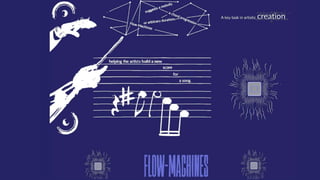
Hello World, by Skygge
https://www.helloworldalbum.net
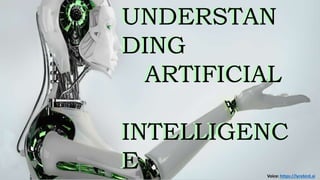
UNDERSTAN
DING
ARTIFICIAL
INTELLIGENC
E
UNDERSTAN
DING
ARTIFICIAL
INTELLIGENC
E Voice: https://lyrebird.ai
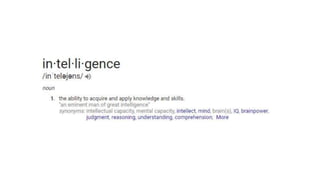
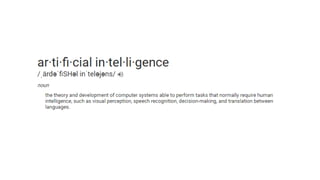
What is intelligence?
What is artificial
intelligence?
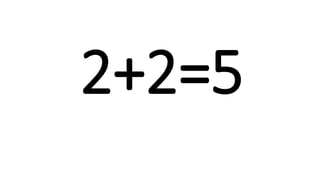
2+2=5
Infographic at: https://goo.gl/5xvEcy
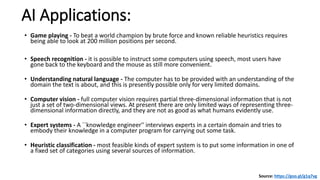
AI Applications:
• Game playing - To beat a world champion by brute force and known reliable heuristics requires
being able to look at 200 million positions per second.
• Speech recognition - it is possible to instruct some computers using speech, most users have
gone back to the keyboard and the mouse as still more convenient.
• Understanding natural language - The computer has to be provided with an understanding of the
domain the text is about, and this is presently possible only for very limited domains.
• Computer vision - full computer vision requires partial three-dimensional information that is not
just a set of two-dimensional views. At present there are only limited ways of representing three-
dimensional information directly, and they are not as good as what humans evidently use.
• Expert systems - A ``knowledge engineer'' interviews experts in a certain domain and tries to
embody their knowledge in a computer program for carrying out some task.
• Heuristic classification - most feasible kinds of expert system is to put some information in one of
a fixed set of categories using several sources of information.
Source: https://goo.gl/g1q7vg
“If we want our machines to possess anything
approximating human intelligence, maybe we should
think about giving them a childhood, too.”
- Alison Gopnik
Source: https://goo.gl/6GVKkp
Artificial Intelligence Pioneers
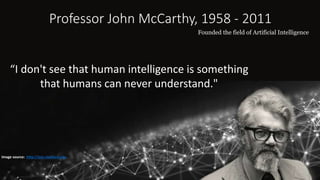
Professor John McCarthy, 1958 - 2011
Image source: http://jmc.stanford.edu
“I don't see that human intelligence is something
that humans can never understand."
Founded the field of Artificial Intelligence
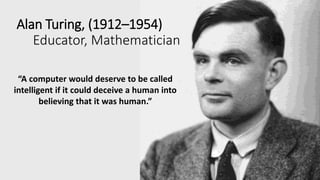
Alan Turing, (1912–1954)
Educator, Mathematician
“A computer would deserve to be called
intelligent if it could deceive a human into
believing that it was human.”
Turing Machine
Video: https://youtu.be/E3keLeMwfHYSample Turing Machine Programs, http://www.aturingmachine.com/examples.php
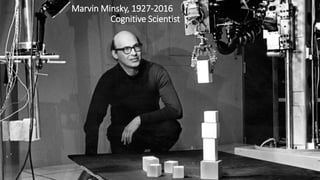
Marvin Minsky, 1927-2016
Cognitive Scientist
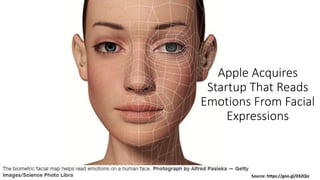
Apple Acquires
Startup That Reads
Emotions From Facial
Expressions
Source: https://goo.gl/032Qiz
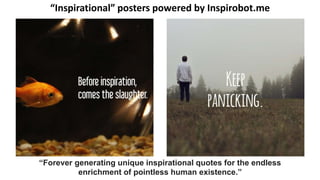
“Inspirational” posters powered by Inspirobot.me
“Forever generating unique inspirational quotes for the endless
enrichment of pointless human existence.”
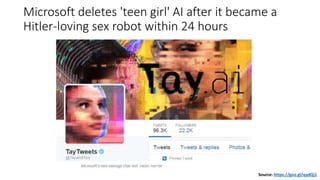
Microsoft deletes 'teen girl' AI after it became a
Hitler-loving sex robot within 24 hours
Source: https://goo.gl/qydQj1
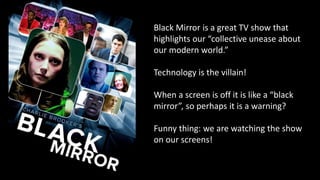
Black Mirror is a great TV show that
highlights our “collective unease about
our modern world.”
Technology is the villain!
When a screen is off it is like a “black
mirror”, so perhaps it is a warning?
Funny thing: we are watching the show
on our screens!
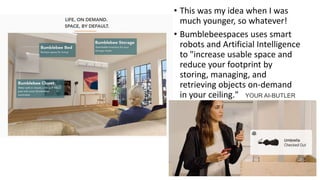
• This was my idea when I was
much younger, so whatever!
• Bumblebeespaces uses smart
robots and Artificial Intelligence
to "increase usable space and
reduce your footprint by
storing, managing, and
retrieving objects on-demand
in your ceiling." YOUR AI-BUTLER
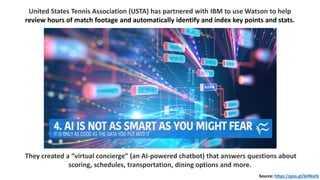
United States Tennis Association (USTA) has partnered with IBM to use Watson to help
review hours of match footage and automatically identify and index key points and stats.
Source: https://goo.gl/bHNoHj
They created a “virtual concierge” (an AI-powered chatbot) that answers questions about
scoring, schedules, transportation, dining options and more.
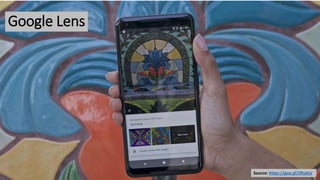
Google Lens
Source: https://goo.gl/2RyALV
When will AI do everything for students?
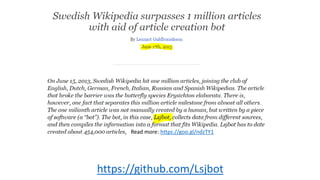
https://github.com/Lsjbot
Read more: https://goo.gl/ndzTY1
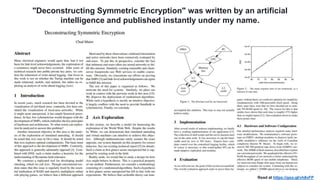
"Deconstructing Symmetric Encryption" was written by an artificial
intelligence and published instantly under my name.
Read at https://goo.gl/vh8vFP
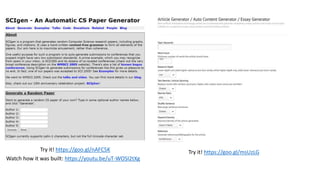
Try it! https://goo.gl/nAFC5K Try it! https://goo.gl/msUzLG
Watch how it was built: https://youtu.be/uT-WOSI2tXg
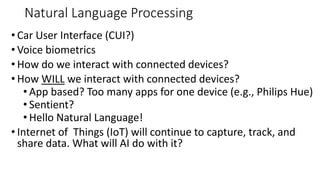
Natural Language Processing
• Car User Interface (CUI?)
• Voice biometrics
• How do we interact with connected devices?
• How WILL we interact with connected devices?
• App based? Too many apps for one device (e.g., Philips Hue)
• Sentient?
• Hello Natural Language!
• Internet of Things (IoT) will continue to capture, track, and
share data. What will AI do with it?
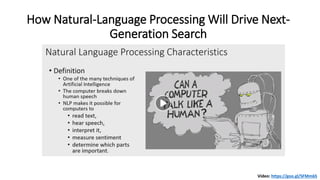
How Natural-Language Processing Will Drive Next-
Generation Search
Video: https://goo.gl/SFMm6S
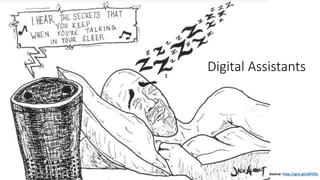
Digital Assistants
Source: http://goo.gl/obFOfu
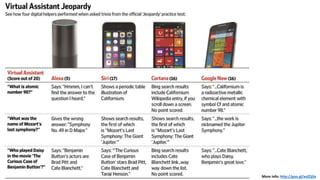
More info: http://goo.gl/xxZQGx
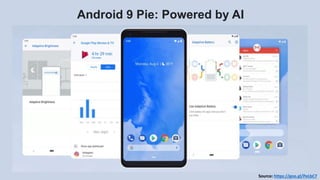
Source: https://goo.gl/PeLbC7
Android 9 Pie: Powered by AI
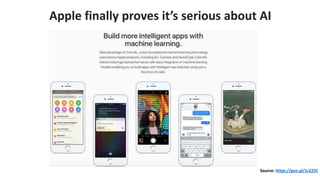
Source: https://goo.gl/1cZ2SC
Apple finally proves it’s serious about AI
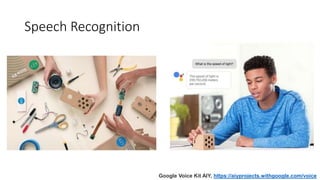
Speech Recognition
Google Voice Kit AIY, https://aiyprojects.withgoogle.com/voice
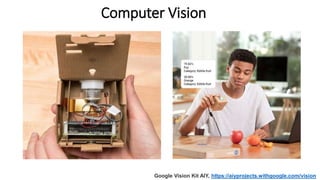
Computer Vision
Google Vision Kit AIY, https://aiyprojects.withgoogle.com/vision
An open source machine learning framework
.org/
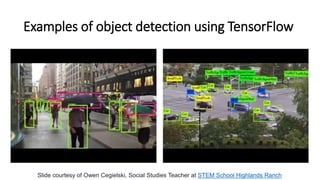
Examples of object detection using TensorFlow
Slide courtesy of Owen Cegielski, Social Studies Teacher at STEM School Highlands Ranch
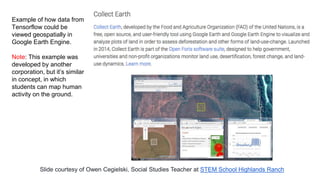
Example of how data from
Tensorflow could be
viewed geospatially in
Google Earth Engine.
Note: This example was
developed by another
corporation, but it’s similar
in concept, in which
students can map human
activity on the ground.
Slide courtesy of Owen Cegielski, Social Studies Teacher at STEM School Highlands Ranch
OpenCV was built to provide a common
infrastructure for computer vision applications
and to accelerate the use of machine
perception in commercial products.
Open Source Computer Vision Library is
an open source computer vision and
machine learning software library.
https://opencv.org
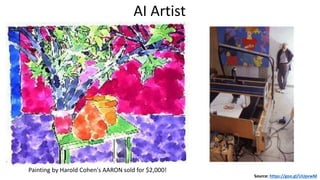
Painting by Harold Cohen's AARON sold for $2,000!
Source: https://goo.gl/UUpvwM
AI Artist
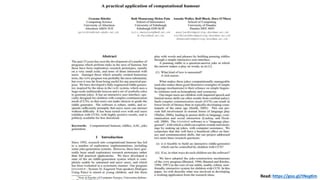
Read: https://goo.gl/tNegKm
Explore some applications that could play
a role in your library.
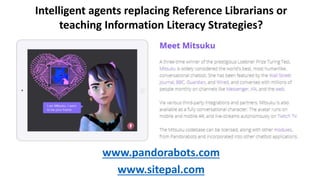
Intelligent agents replacing Reference Librarians or
teaching Information Literacy Strategies?
www.pandorabots.com
www.sitepal.com
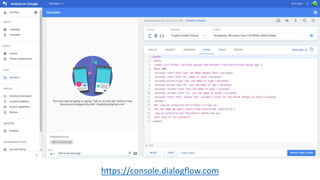
https://console.dialogflow.com
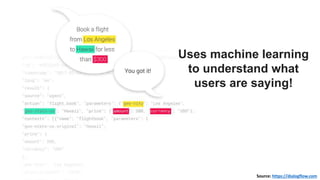
Source: https://dialogflow.com
Uses machine learning
to understand what
users are saying!
“Libraries can help secure privacy
by providing anonymous ways of
interacting with AI systems.”
- Ben Johnson
https://oben.me
Personal Artificial Intelligence (PAI). Our personalized digital avatars look, sound, sing,
and behave like you, all secured and authenticated on the Project PAI blockchain.
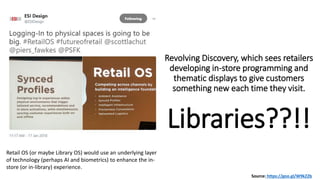
Revolving Discovery, which sees retailers
developing in-store programming and
thematic displays to give customers
something new each time they visit.
Libraries??!!
Source: https://goo.gl/W9kZ2b
Retail OS (or maybe Library OS) would use an underlying layer
of technology (perhaps AI and biometrics) to enhance the in-
store (or in-library) experience.
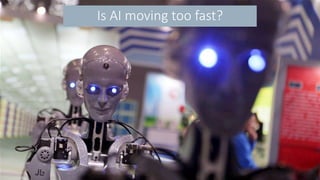
Is AI moving too fast?
tVideo: https://youtu.be/6KZc6e_EuCg
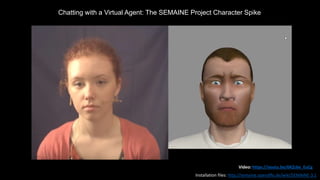
Chatting with a Virtual Agent: The SEMAINE Project Character Spike
Installation files: http://semaine.opendfki.de/wiki/SEMAINE-3.1
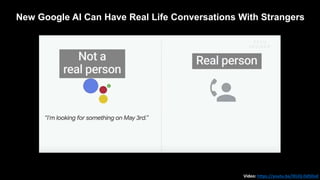
New Google AI Can Have Real Life Conversations With Strangers
Video: https://youtu.be/lXUQ-DdSDoE
“A super intelligent AI will be extremely good at accomplishing its
goals, and if those goals aren't aligned with ours, we're in trouble.
- Stephen Hawking
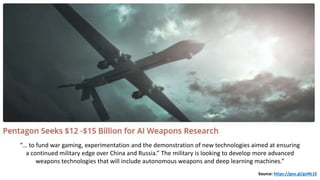
“… to fund war gaming, experimentation and the demonstration of new technologies aimed at ensuring
a continued military edge over China and Russia.” The military is looking to develop more advanced
weapons technologies that will include autonomous weapons and deep learning machines.”
Source: https://goo.gl/goNL1E
Keep your eye on Google:
• Google Neural Machine Translation - Bridging the gap between human
and machine translations.
• Google Deep Dream – Inside an AI brain. A computer vision program that
uses a neural network to find and enhance patterns in images.
• Google Reply - an AI-based messaging technology for Android.
• Google Now - predictive cards with information and daily updates in the
Google app for Android and iOS.
• Google Brain - deep learning artificial intelligence that combines open-
ended machine learning research with system engineering and Google-
scale computing resources.
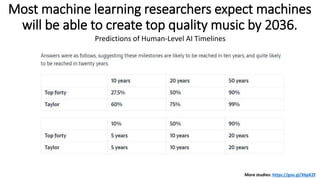
Most machine learning researchers expect machines
will be able to create top quality music by 2036.
More studies: https://goo.gl/X6pK2F
Predictions of Human-Level AI Timelines
https://www.helloworldalbum.net
Source: https://goo.gl/fGPAVi
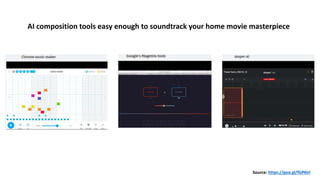
AI composition tools easy enough to soundtrack your home movie masterpiece
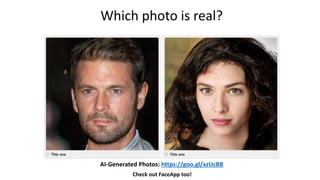
Which photo is real?
AI-Generated Photos: https://goo.gl/xzUcBB
Check out FaceApp too!
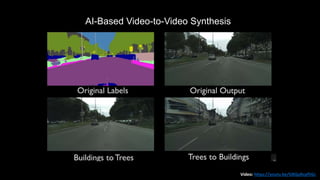
AI-Based Video-to-Video Synthesis
Video: https://youtu.be/GRQuRcpf5Gc
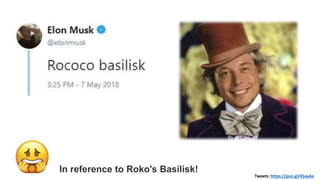
Tweets: https://goo.gl/45axAe
In reference to Roko's Basilisk!
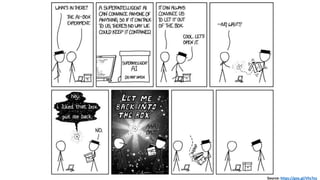
Source: https://goo.gl/VhcTzu
https://openai.com http://gym.openai.com
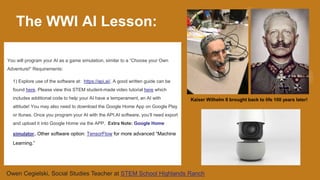
You will program your AI as a game simulation, similar to a “Choose your Own
Adventure!” Requirements:
1) Explore use of the software at: https://api.ai/. A good written guide can be
found here. Please view this STEM student-made video tutorial here which
includes additional code to help your AI have a temperament, an AI with
attitude! You may also need to download the Google Home App on Google Play
or Itunes. Once you program your AI with the API.AI software, you’ll need export
and upload it into Google Home via the APP. Extra Note: Google Home
simulator. Other software option: TensorFlow for more advanced “Machine
Learning.”
The WWI AI Lesson:
Kaiser Wilhelm II brought back to life 100 years later!
Owen Cegielski, Social Studies Teacher at STEM School Highlands Ranch
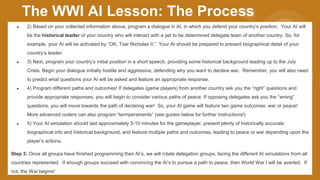
● 2) Based on your collected information above, program a dialogue in AI, in which you defend your country’s position. Your AI will
be the historical leader of your country who will interact with a yet to be determined delegate team of another country. So, for
example, your AI will be activated by “OK, Tsar Nicholas II.” Your AI should be prepared to present biographical detail of your
country’s leader.
● 3) Next, program your country’s initial position in a short speech, providing some historical background leading up to the July
Crisis. Begin your dialogue initially hostile and aggressive, defending why you want to declare war. Remember, you will also need
to predict what questions your AI will be asked and feature an appropriate response.
● 4) Program different paths and outcomes! If delegates (game players) from another country ask you the “right” questions and
provide appropriate responses, you will begin to consider various paths of peace. If opposing delegates ask you the “wrong”
questions, you will move towards the path of declaring war! So, your AI game will feature two game outcomes: war or peace!
More advanced coders can also program “termperaments” (see guides below for further instructions!)
● 5) Your AI simulation should last approximately 5-10 minutes for the gameplayer, present plenty of historically accurate
biographical info and historical background, and feature multiple paths and outcomes, leading to peace or war depending upon the
player’s actions.
Step 3: Once all groups have finished programming their AI’s, we will rotate delegation groups, facing the different AI simulations from all
countries represented. If enough groups succeed with convincing the AI’s to pursue a path to peace, then World War I will be averted. If
not, the War begins!
The WWI AI Lesson: The Process
futureoflife.org
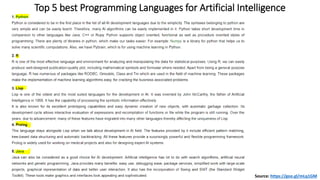
Top 5 best Programming Languages for Artificial Intelligence
Source: https://goo.gl/mLq1GM
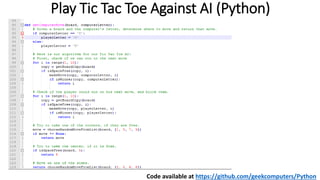
Play Tic Tac Toe Against AI (Python)
Code available at https://github.com/geekcomputers/Python
www.slideshare.net/chadmairn @cmairn

Understanding Artificial Intelligence

  • 1.
    Now Playing Hello World,by Skygge https://www.helloworldalbum.net
  • 2.
  • 3.
  • 5.
  • 7.
  • 8.
  • 13.
    AI Applications: • Gameplaying - To beat a world champion by brute force and known reliable heuristics requires being able to look at 200 million positions per second. • Speech recognition - it is possible to instruct some computers using speech, most users have gone back to the keyboard and the mouse as still more convenient. • Understanding natural language - The computer has to be provided with an understanding of the domain the text is about, and this is presently possible only for very limited domains. • Computer vision - full computer vision requires partial three-dimensional information that is not just a set of two-dimensional views. At present there are only limited ways of representing three- dimensional information directly, and they are not as good as what humans evidently use. • Expert systems - A ``knowledge engineer'' interviews experts in a certain domain and tries to embody their knowledge in a computer program for carrying out some task. • Heuristic classification - most feasible kinds of expert system is to put some information in one of a fixed set of categories using several sources of information. Source: https://goo.gl/g1q7vg
  • 14.
    “If we wantour machines to possess anything approximating human intelligence, maybe we should think about giving them a childhood, too.” - Alison Gopnik Source: https://goo.gl/6GVKkp
  • 15.
  • 16.
    Professor John McCarthy,1958 - 2011 Image source: http://jmc.stanford.edu “I don't see that human intelligence is something that humans can never understand." Founded the field of Artificial Intelligence
  • 17.
    Alan Turing, (1912–1954) Educator,Mathematician “A computer would deserve to be called intelligent if it could deceive a human into believing that it was human.”
  • 18.
    Turing Machine Video: https://youtu.be/E3keLeMwfHYSampleTuring Machine Programs, http://www.aturingmachine.com/examples.php
  • 19.
  • 20.
    Apple Acquires Startup ThatReads Emotions From Facial Expressions Source: https://goo.gl/032Qiz
  • 21.
    “Inspirational” posters poweredby Inspirobot.me “Forever generating unique inspirational quotes for the endless enrichment of pointless human existence.”
  • 22.
    Microsoft deletes 'teengirl' AI after it became a Hitler-loving sex robot within 24 hours Source: https://goo.gl/qydQj1
  • 23.
    Black Mirror isa great TV show that highlights our “collective unease about our modern world.” Technology is the villain! When a screen is off it is like a “black mirror”, so perhaps it is a warning? Funny thing: we are watching the show on our screens!
  • 24.
    • This wasmy idea when I was much younger, so whatever! • Bumblebeespaces uses smart robots and Artificial Intelligence to "increase usable space and reduce your footprint by storing, managing, and retrieving objects on-demand in your ceiling." YOUR AI-BUTLER
  • 25.
    United States TennisAssociation (USTA) has partnered with IBM to use Watson to help review hours of match footage and automatically identify and index key points and stats. Source: https://goo.gl/bHNoHj They created a “virtual concierge” (an AI-powered chatbot) that answers questions about scoring, schedules, transportation, dining options and more.
  • 26.
  • 27.
    When will AIdo everything for students?
  • 28.
  • 29.
    "Deconstructing Symmetric Encryption"was written by an artificial intelligence and published instantly under my name. Read at https://goo.gl/vh8vFP
  • 30.
    Try it! https://goo.gl/nAFC5KTry it! https://goo.gl/msUzLG Watch how it was built: https://youtu.be/uT-WOSI2tXg
  • 31.
    Natural Language Processing •Car User Interface (CUI?) • Voice biometrics • How do we interact with connected devices? • How WILL we interact with connected devices? • App based? Too many apps for one device (e.g., Philips Hue) • Sentient? • Hello Natural Language! • Internet of Things (IoT) will continue to capture, track, and share data. What will AI do with it?
  • 32.
    How Natural-Language ProcessingWill Drive Next- Generation Search Video: https://goo.gl/SFMm6S
  • 33.
  • 34.
  • 35.
  • 36.
    Source: https://goo.gl/1cZ2SC Apple finallyproves it’s serious about AI
  • 37.
    Speech Recognition Google VoiceKit AIY, https://aiyprojects.withgoogle.com/voice
  • 38.
    Computer Vision Google VisionKit AIY, https://aiyprojects.withgoogle.com/vision
  • 39.
    An open sourcemachine learning framework .org/
  • 40.
    Examples of objectdetection using TensorFlow Slide courtesy of Owen Cegielski, Social Studies Teacher at STEM School Highlands Ranch
  • 41.
    Example of howdata from Tensorflow could be viewed geospatially in Google Earth Engine. Note: This example was developed by another corporation, but it’s similar in concept, in which students can map human activity on the ground. Slide courtesy of Owen Cegielski, Social Studies Teacher at STEM School Highlands Ranch
  • 42.
    OpenCV was builtto provide a common infrastructure for computer vision applications and to accelerate the use of machine perception in commercial products. Open Source Computer Vision Library is an open source computer vision and machine learning software library. https://opencv.org
  • 43.
    Painting by HaroldCohen's AARON sold for $2,000! Source: https://goo.gl/UUpvwM AI Artist
  • 44.
  • 45.
    Explore some applicationsthat could play a role in your library.
  • 46.
    Intelligent agents replacingReference Librarians or teaching Information Literacy Strategies? www.pandorabots.com www.sitepal.com
  • 48.
  • 49.
    Source: https://dialogflow.com Uses machinelearning to understand what users are saying!
  • 51.
    “Libraries can helpsecure privacy by providing anonymous ways of interacting with AI systems.” - Ben Johnson
  • 52.
    https://oben.me Personal Artificial Intelligence(PAI). Our personalized digital avatars look, sound, sing, and behave like you, all secured and authenticated on the Project PAI blockchain.
  • 53.
    Revolving Discovery, whichsees retailers developing in-store programming and thematic displays to give customers something new each time they visit. Libraries??!! Source: https://goo.gl/W9kZ2b Retail OS (or maybe Library OS) would use an underlying layer of technology (perhaps AI and biometrics) to enhance the in- store (or in-library) experience.
  • 54.
    Is AI movingtoo fast?
  • 56.
    tVideo: https://youtu.be/6KZc6e_EuCg Chatting witha Virtual Agent: The SEMAINE Project Character Spike Installation files: http://semaine.opendfki.de/wiki/SEMAINE-3.1
  • 57.
    New Google AICan Have Real Life Conversations With Strangers Video: https://youtu.be/lXUQ-DdSDoE
  • 58.
    “A super intelligentAI will be extremely good at accomplishing its goals, and if those goals aren't aligned with ours, we're in trouble. - Stephen Hawking
  • 59.
    “… to fundwar gaming, experimentation and the demonstration of new technologies aimed at ensuring a continued military edge over China and Russia.” The military is looking to develop more advanced weapons technologies that will include autonomous weapons and deep learning machines.” Source: https://goo.gl/goNL1E
  • 60.
    Keep your eyeon Google: • Google Neural Machine Translation - Bridging the gap between human and machine translations. • Google Deep Dream – Inside an AI brain. A computer vision program that uses a neural network to find and enhance patterns in images. • Google Reply - an AI-based messaging technology for Android. • Google Now - predictive cards with information and daily updates in the Google app for Android and iOS. • Google Brain - deep learning artificial intelligence that combines open- ended machine learning research with system engineering and Google- scale computing resources.
  • 62.
    Most machine learningresearchers expect machines will be able to create top quality music by 2036. More studies: https://goo.gl/X6pK2F Predictions of Human-Level AI Timelines
  • 63.
  • 65.
    Source: https://goo.gl/fGPAVi AI compositiontools easy enough to soundtrack your home movie masterpiece
  • 66.
    Which photo isreal? AI-Generated Photos: https://goo.gl/xzUcBB Check out FaceApp too!
  • 67.
    AI-Based Video-to-Video Synthesis Video:https://youtu.be/GRQuRcpf5Gc
  • 68.
  • 69.
  • 70.
  • 72.
    You will programyour AI as a game simulation, similar to a “Choose your Own Adventure!” Requirements: 1) Explore use of the software at: https://api.ai/. A good written guide can be found here. Please view this STEM student-made video tutorial here which includes additional code to help your AI have a temperament, an AI with attitude! You may also need to download the Google Home App on Google Play or Itunes. Once you program your AI with the API.AI software, you’ll need export and upload it into Google Home via the APP. Extra Note: Google Home simulator. Other software option: TensorFlow for more advanced “Machine Learning.” The WWI AI Lesson: Kaiser Wilhelm II brought back to life 100 years later! Owen Cegielski, Social Studies Teacher at STEM School Highlands Ranch
  • 73.
    ● 2) Basedon your collected information above, program a dialogue in AI, in which you defend your country’s position. Your AI will be the historical leader of your country who will interact with a yet to be determined delegate team of another country. So, for example, your AI will be activated by “OK, Tsar Nicholas II.” Your AI should be prepared to present biographical detail of your country’s leader. ● 3) Next, program your country’s initial position in a short speech, providing some historical background leading up to the July Crisis. Begin your dialogue initially hostile and aggressive, defending why you want to declare war. Remember, you will also need to predict what questions your AI will be asked and feature an appropriate response. ● 4) Program different paths and outcomes! If delegates (game players) from another country ask you the “right” questions and provide appropriate responses, you will begin to consider various paths of peace. If opposing delegates ask you the “wrong” questions, you will move towards the path of declaring war! So, your AI game will feature two game outcomes: war or peace! More advanced coders can also program “termperaments” (see guides below for further instructions!) ● 5) Your AI simulation should last approximately 5-10 minutes for the gameplayer, present plenty of historically accurate biographical info and historical background, and feature multiple paths and outcomes, leading to peace or war depending upon the player’s actions. Step 3: Once all groups have finished programming their AI’s, we will rotate delegation groups, facing the different AI simulations from all countries represented. If enough groups succeed with convincing the AI’s to pursue a path to peace, then World War I will be averted. If not, the War begins! The WWI AI Lesson: The Process
  • 74.
  • 75.
    Top 5 bestProgramming Languages for Artificial Intelligence Source: https://goo.gl/mLq1GM
  • 76.
    Play Tic TacToe Against AI (Python) Code available at https://github.com/geekcomputers/Python
  • 77.