An Introduction To
STEM Education
.
by Pretty Emerson
STEM (Science, Technology, Engineering, and Mathematics)
education is a crucial foundation for preparing students to
thrive in the rapidly evolving modern world.
By integrating these core disciplines, STEM education
fosters critical thinking, problem-solving, and innovation -
essential skills for success in the 21st century.
Defining STEM: Science, Technology,
Engineering, and Mathematics
Science
The systematic study
of the physical and
natural world
through
observation,
experimentation,
and the application
of the scientific
method.
Technology
The application of
scientific knowledge
and principles to
develop tools,
devices, and systems
that solve real-world
problems.
Engineering
The use of scientific
principles to design
and build machines,
structures, and
systems that meet
specific needs and
requirements.
Mathematics
The study of
quantities,
structures, space,
and change,
providing the
foundation for
understanding and
manipulating the
physical and
quantitative world.
The Importance of STEM
Education
STEM education - encompassing Science, Technology, Engineering,
and Mathematics - plays a vital role in preparing students for the
rapidly evolving job market and equipping them with essential critical
thinking and problem-solving skills.
By fostering a strong STEM foundation, schools can empower the
next generation of innovators and problem-solvers.
Preparing Students for the Future Job
Market
1
Relevance of STEM
Skills
STEM skills are
increasingly in
demand as technology
continues to transform
the job market.
Equipping students
with a strong
foundation in science,
technology,
engineering, and
mathematics prepares
them for a wide range
of in-demand careers.
2
Cultivating
Adaptability
STEM education
fosters critical
thinking, problem-
solving, and the ability
to adapt to changing
technologies. These
flexible skills are highly
valued by employers
and enable students to
navigate an evolving
job landscape.
3
Entrepreneurial
Mindset
STEM curriculum
encourages an
entrepreneurial
mindset, empowering
students to think
creatively, identify
innovative solutions,
and pursue their own
ventures. This
prepares them to be
leaders and problem-
solvers in the
workforce.
Preparing Students
for Necessary skills
Technical Skills
STEM education equips
students with in-demand
technical skills like coding,
engineering, and data
analysis that are critical for
high-paying, future-proof
careers.
Collaboration
STEM learning fosters
teamwork and
communication skills,
allowing students to work
effectively with others and
adapt to the needs of
dynamic workplaces.
Problem-Solving
The critical thinking and
problem-solving abilities
developed through STEM
prepare students to tackle
complex challenges in
innovative ways, highly
valued by employers.
Integrating STEM into the Curriculum
1
Hands-on Learning
Incorporate project-based activities that allow students to apply STEM
concepts in real-world scenarios.
2
Interdisciplinary Approach
Integrate STEM subjects across the curriculum, connecting
them to other disciplines like art, social studies, and
language arts.
3
Technology Integration
Leverage technology, such as coding,
robotics, and virtual simulations, to enhance
STEM learning experiences.
Fostering an interdisciplinary mindset, and leveraging technology to create engaging and
immersive STEM experiences for students. By taking this holistic approach, educators can help
prepare students for the demands of the 21st-century workforce.
How It Helps?
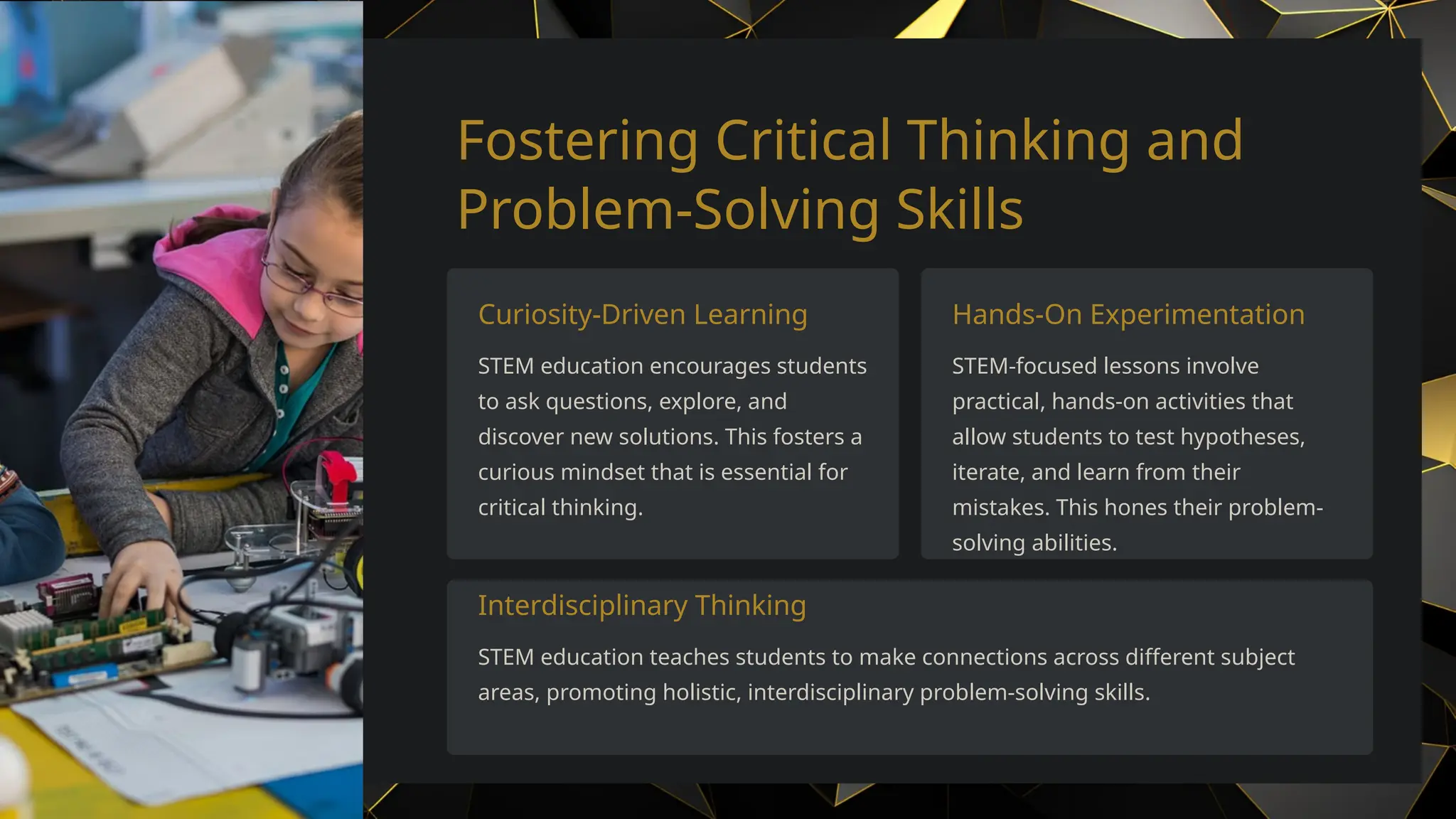
Fostering Critical Thinking and
Problem-Solving Skills
Curiosity-Driven Learning
STEM education encourages students
to ask questions, explore, and
discover new solutions. This fosters a
curious mindset that is essential for
critical thinking.
Hands-On Experimentation
STEM-focused lessons involve
practical, hands-on activities that
allow students to test hypotheses,
iterate, and learn from their
mistakes. This hones their problem-
solving abilities.
Interdisciplinary Thinking
STEM education teaches students to make connections across different subject
areas, promoting holistic, interdisciplinary problem-solving skills.
.
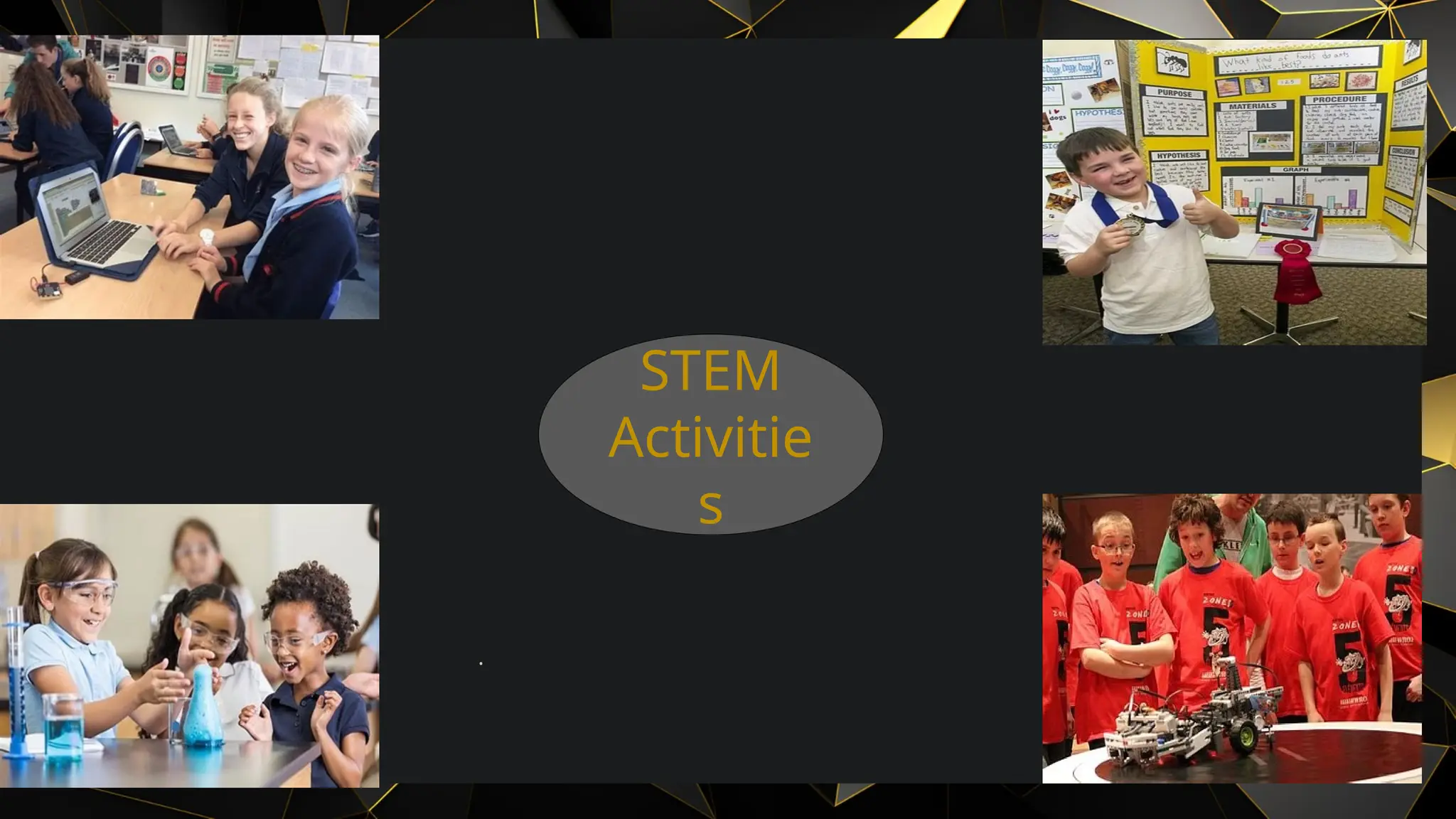
STEM
Activitie
s
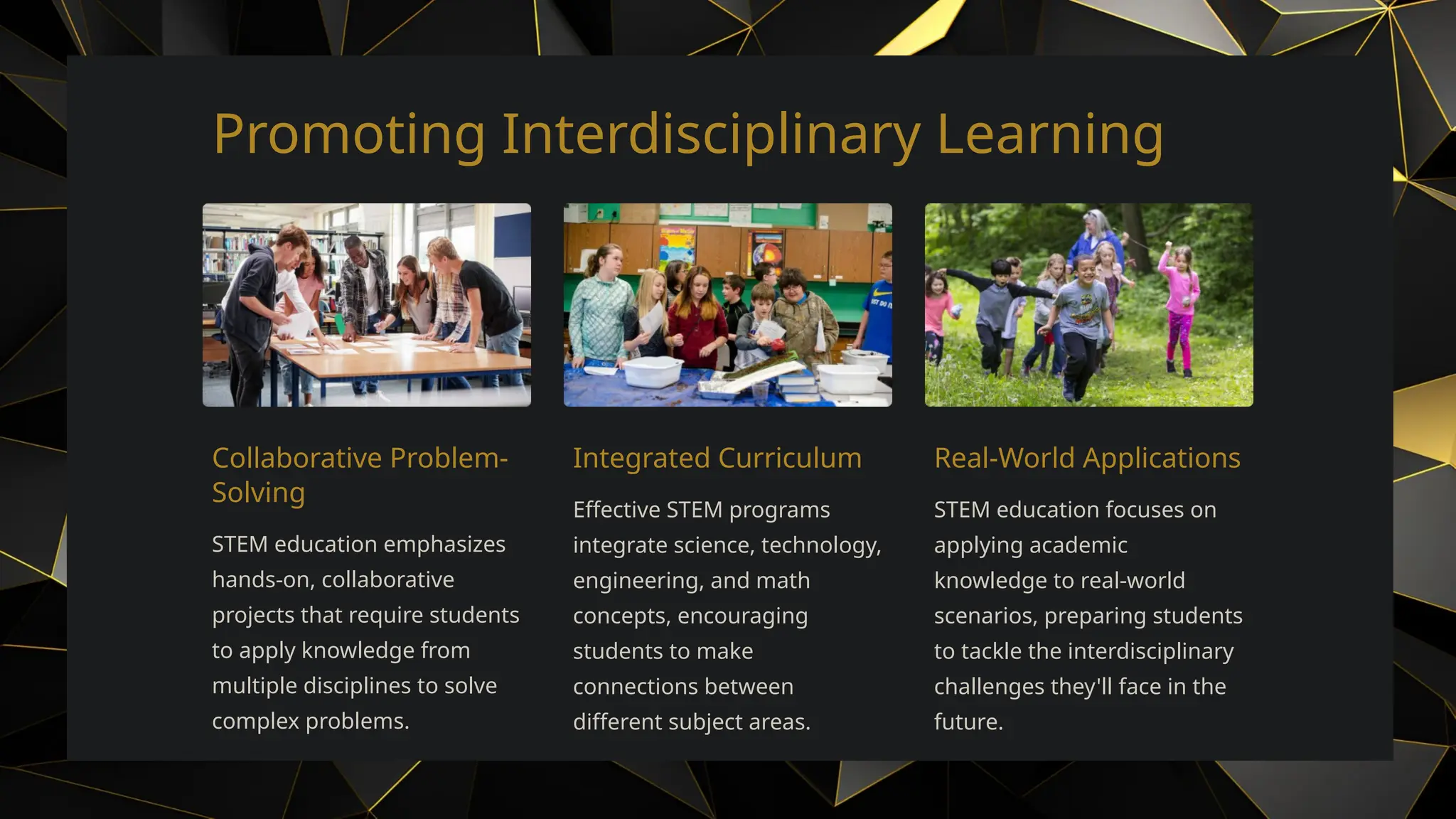
Promoting Interdisciplinary Learning
Collaborative Problem-
Solving
STEM education emphasizes
hands-on, collaborative
projects that require students
to apply knowledge from
multiple disciplines to solve
complex problems.
Integrated Curriculum
Effective STEM programs
integrate science, technology,
engineering, and math
concepts, encouraging
students to make
connections between
different subject areas.
Real-World Applications
STEM education focuses on
applying academic
knowledge to real-world
scenarios, preparing students
to tackle the interdisciplinary
challenges they'll face in the
future.
Integrating STEM Across Different
Subjects
Cross-Curricular
Connections
STEM concepts can
be seamlessly
integrated into
various subjects like
English, History, and
the Arts. This
interdisciplinary
approach helps
students see the
real-world
applications of
STEM knowledge.
Holistic Learning
By weaving STEM
into diverse
curricula, students
develop a more
comprehensive
understanding of
how different fields
interconnect. This
prepares them to
tackle complex,
multifaceted
problems in the
future.
Collaborative
Projects
STEM-infused
projects that span
multiple subjects
encourage
teamwork and
communication
skills. Students learn
to combine their
unique perspectives
and skills to create
innovative
solutions.
Engaging Lessons
Integrating STEM
into other subjects
makes learning
more dynamic and
captivating.
Students are
motivated to
explore scientific
concepts through
the lens of their
other interests and
passions.
.
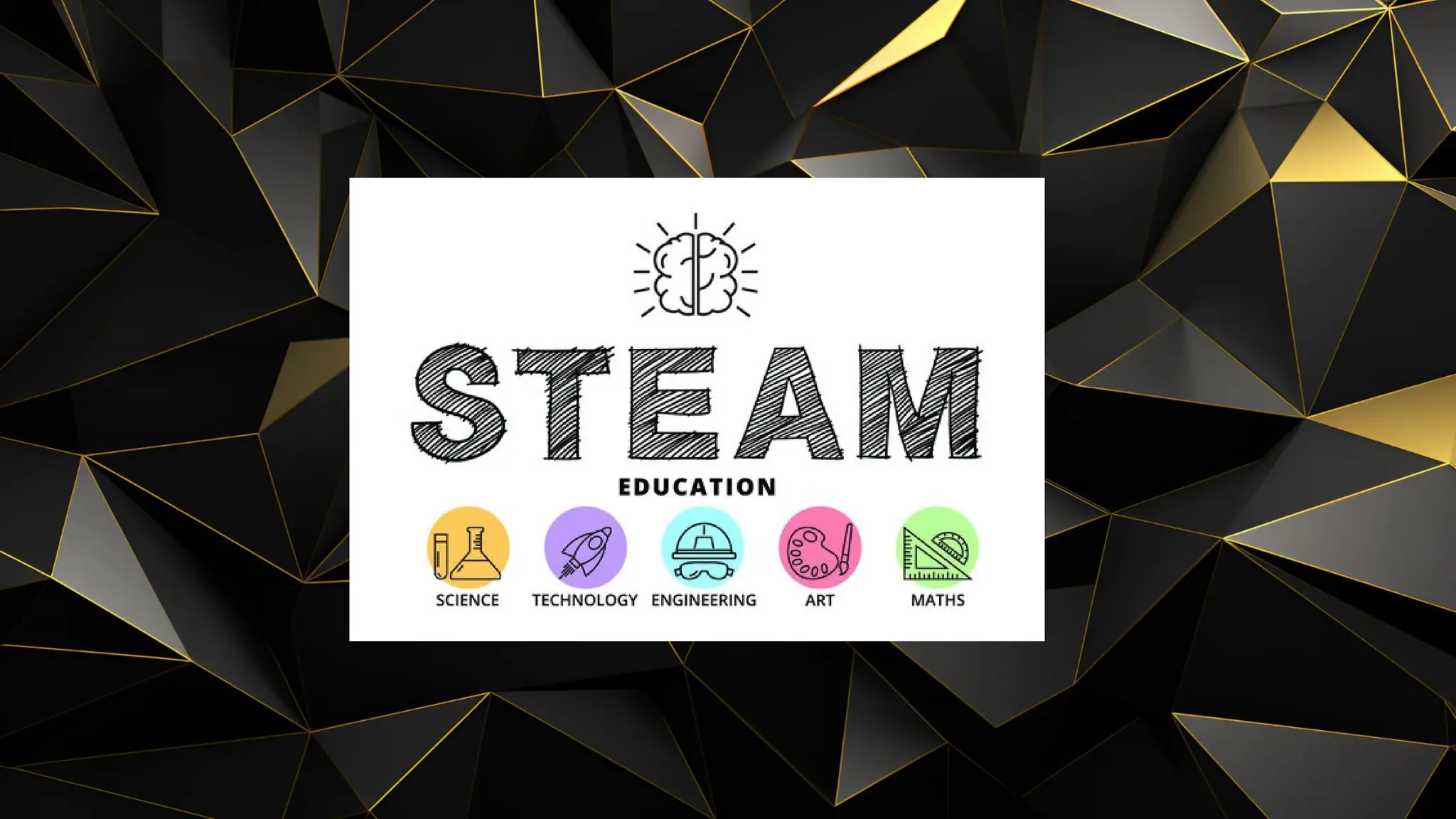
STEM
STEAM
Technical + creative = Holistic Learning
Creativity
Design thinking
Artistic skills
Scientific literacy
.
Robotics with design
Coding and music
Environmental art projects
Math and architecture
STEAM In Elementary
School
Foundation
STEAM education lays the groundwork for future learning by
sparking curiosity and providing hands-on experiences in scientific
exploration, coding, and design thinking.
Interdisciplinary Approach
STEAM subjects are integrated across the curriculum, allowing
students to see the real-world connections between different
academic disciplines.
Engaging
Fun, interactive projects like building simple robots, experimenting
with circuits, and designing bridges encourage students to think
creatively and develop a passion for STEAM.
STEAM In Middle School
Deeper Inquiry
Middle school STEAM education delves deeper into scientific
concepts, engineering principles, and technological
applications, preparing students for more advanced study.
Real-World Connections
Students engage in project-based learning, applying their
STEAM knowledge to solve authentic problems and see the
relevance of these subjects in daily life.
Diverse Pathways
Exposure to a variety of STEAM fields helps students identify
their unique interests and talents, guiding them towards
potential future careers.
STEAM In High
School
Advanced Coursework
High school STEAM curricula offer advanced classes in subjects
like AP Physics, AP Computer Science, and Honors Calculus,
enabling students to delve deeper into specialized topics.
Hands-on Learning
Students participate in project-based learning, robotics
competitions, and science fairs, honing their technical skills and
problem-solving abilities.
College and Career Preparation
STEAM education in high school equips students with the
knowledge and skills needed to succeed in STEAM-related college
majors and careers.
Challenges and Barriers to STEAM Education
Implementation
Funding
Shortages
Cash-strapped
school districts
often struggle to
allocate sufficient
resources for
STEAM programs,
from purchasing
equipment to
training teachers.
Teacher
Preparedness
Many educators
lack the specialized
knowledge and
skills required to
effectively teach
STEAM subjects,
hindering student
engagement and
learning.
Curriculum
Constraints
Rigid curriculum
frameworks and
standardized
testing can limit
the flexibility
needed to
incorporate
interdisciplinary
STEAM learning
experiences.
Equity Gaps
Socioeconomic and
gender disparities
often result in
underrepresented
students having
limited access to
quality STEAM
education and
opportunities.
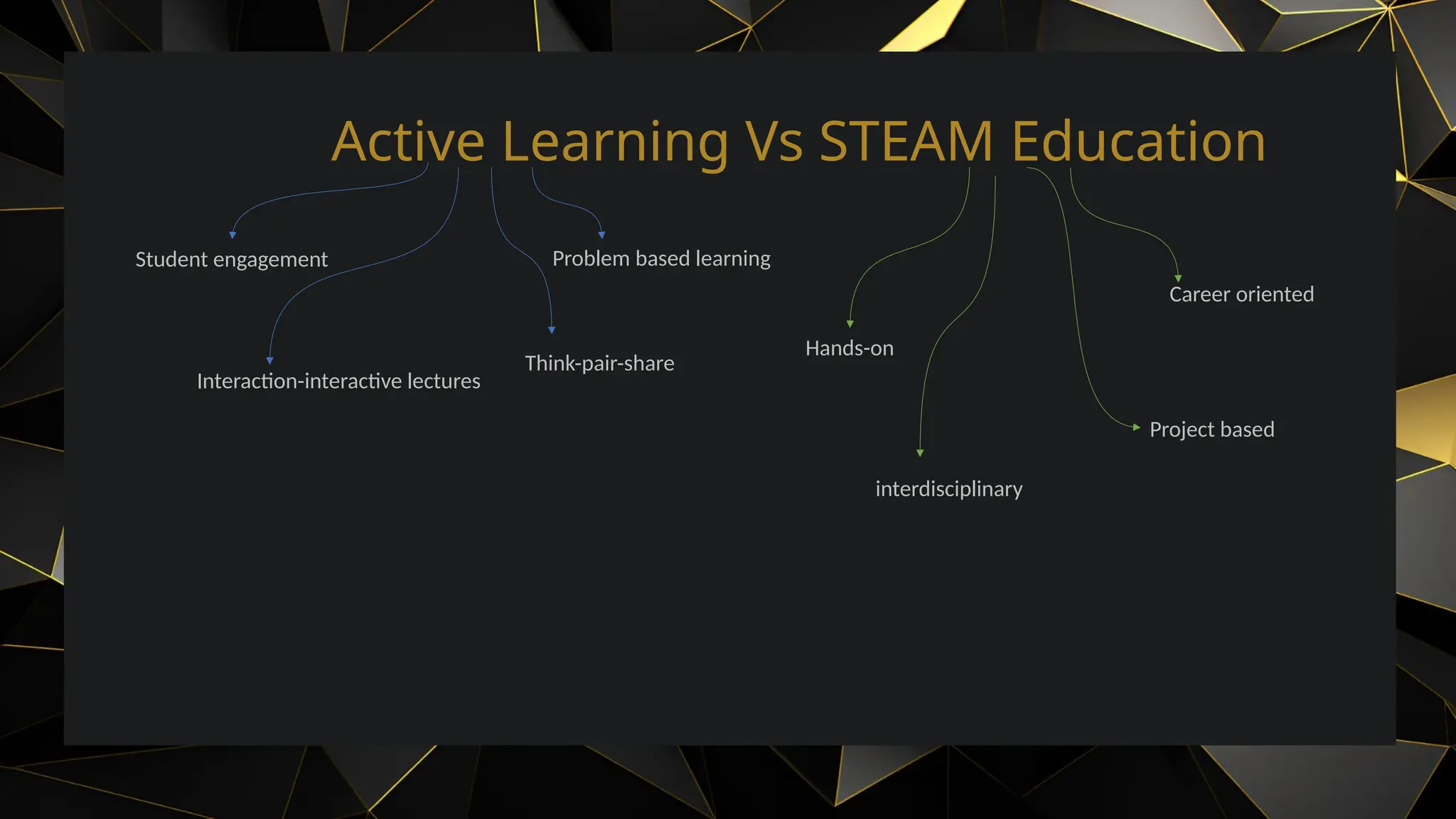
Active Learning Vs STEAM Education
Interaction-interactive lectures
Student engagement
interdisciplinary
Problem based learning
Hands-on
Think-pair-share
Career oriented
Project based
STEAM education equips students with the skills
and knowledge needed to thrive in a wide range
of high-demand, well-paying careers, positioning
them for success in the 21st-century job market.
Conclusion: The
Future of STEM Education
As far as we seen, in future, STEM education will
continue to grow , get updated, preparing
students for the jobs and challenges of tomorrow.
Integrating STEM into the curriculum will
empower the next generation to tackle complex
global problems through innovative,
interdisciplinary solutions.
Thank you for your patience…

An introduction to stem integrated education .pptx

  • 1.
    An Introduction To STEMEducation . by Pretty Emerson
  • 2.
    STEM (Science, Technology,Engineering, and Mathematics) education is a crucial foundation for preparing students to thrive in the rapidly evolving modern world. By integrating these core disciplines, STEM education fosters critical thinking, problem-solving, and innovation - essential skills for success in the 21st century.
  • 3.
    Defining STEM: Science,Technology, Engineering, and Mathematics Science The systematic study of the physical and natural world through observation, experimentation, and the application of the scientific method. Technology The application of scientific knowledge and principles to develop tools, devices, and systems that solve real-world problems. Engineering The use of scientific principles to design and build machines, structures, and systems that meet specific needs and requirements. Mathematics The study of quantities, structures, space, and change, providing the foundation for understanding and manipulating the physical and quantitative world.
  • 4.
    The Importance ofSTEM Education STEM education - encompassing Science, Technology, Engineering, and Mathematics - plays a vital role in preparing students for the rapidly evolving job market and equipping them with essential critical thinking and problem-solving skills. By fostering a strong STEM foundation, schools can empower the next generation of innovators and problem-solvers.
  • 5.
    Preparing Students forthe Future Job Market 1 Relevance of STEM Skills STEM skills are increasingly in demand as technology continues to transform the job market. Equipping students with a strong foundation in science, technology, engineering, and mathematics prepares them for a wide range of in-demand careers. 2 Cultivating Adaptability STEM education fosters critical thinking, problem- solving, and the ability to adapt to changing technologies. These flexible skills are highly valued by employers and enable students to navigate an evolving job landscape. 3 Entrepreneurial Mindset STEM curriculum encourages an entrepreneurial mindset, empowering students to think creatively, identify innovative solutions, and pursue their own ventures. This prepares them to be leaders and problem- solvers in the workforce.
  • 6.
    Preparing Students for Necessaryskills Technical Skills STEM education equips students with in-demand technical skills like coding, engineering, and data analysis that are critical for high-paying, future-proof careers. Collaboration STEM learning fosters teamwork and communication skills, allowing students to work effectively with others and adapt to the needs of dynamic workplaces. Problem-Solving The critical thinking and problem-solving abilities developed through STEM prepare students to tackle complex challenges in innovative ways, highly valued by employers.
  • 7.
    Integrating STEM intothe Curriculum 1 Hands-on Learning Incorporate project-based activities that allow students to apply STEM concepts in real-world scenarios. 2 Interdisciplinary Approach Integrate STEM subjects across the curriculum, connecting them to other disciplines like art, social studies, and language arts. 3 Technology Integration Leverage technology, such as coding, robotics, and virtual simulations, to enhance STEM learning experiences. Fostering an interdisciplinary mindset, and leveraging technology to create engaging and immersive STEM experiences for students. By taking this holistic approach, educators can help prepare students for the demands of the 21st-century workforce.
  • 8.
  • 9.
    Fostering Critical Thinkingand Problem-Solving Skills Curiosity-Driven Learning STEM education encourages students to ask questions, explore, and discover new solutions. This fosters a curious mindset that is essential for critical thinking. Hands-On Experimentation STEM-focused lessons involve practical, hands-on activities that allow students to test hypotheses, iterate, and learn from their mistakes. This hones their problem- solving abilities. Interdisciplinary Thinking STEM education teaches students to make connections across different subject areas, promoting holistic, interdisciplinary problem-solving skills.
  • 10.
  • 11.
    Promoting Interdisciplinary Learning CollaborativeProblem- Solving STEM education emphasizes hands-on, collaborative projects that require students to apply knowledge from multiple disciplines to solve complex problems. Integrated Curriculum Effective STEM programs integrate science, technology, engineering, and math concepts, encouraging students to make connections between different subject areas. Real-World Applications STEM education focuses on applying academic knowledge to real-world scenarios, preparing students to tackle the interdisciplinary challenges they'll face in the future.
  • 12.
    Integrating STEM AcrossDifferent Subjects Cross-Curricular Connections STEM concepts can be seamlessly integrated into various subjects like English, History, and the Arts. This interdisciplinary approach helps students see the real-world applications of STEM knowledge. Holistic Learning By weaving STEM into diverse curricula, students develop a more comprehensive understanding of how different fields interconnect. This prepares them to tackle complex, multifaceted problems in the future. Collaborative Projects STEM-infused projects that span multiple subjects encourage teamwork and communication skills. Students learn to combine their unique perspectives and skills to create innovative solutions. Engaging Lessons Integrating STEM into other subjects makes learning more dynamic and captivating. Students are motivated to explore scientific concepts through the lens of their other interests and passions.
  • 13.
  • 14.
    STEM STEAM Technical + creative= Holistic Learning Creativity Design thinking Artistic skills Scientific literacy
  • 15.
    . Robotics with design Codingand music Environmental art projects Math and architecture
  • 16.
    STEAM In Elementary School Foundation STEAMeducation lays the groundwork for future learning by sparking curiosity and providing hands-on experiences in scientific exploration, coding, and design thinking. Interdisciplinary Approach STEAM subjects are integrated across the curriculum, allowing students to see the real-world connections between different academic disciplines. Engaging Fun, interactive projects like building simple robots, experimenting with circuits, and designing bridges encourage students to think creatively and develop a passion for STEAM.
  • 17.
    STEAM In MiddleSchool Deeper Inquiry Middle school STEAM education delves deeper into scientific concepts, engineering principles, and technological applications, preparing students for more advanced study. Real-World Connections Students engage in project-based learning, applying their STEAM knowledge to solve authentic problems and see the relevance of these subjects in daily life. Diverse Pathways Exposure to a variety of STEAM fields helps students identify their unique interests and talents, guiding them towards potential future careers.
  • 18.
    STEAM In High School AdvancedCoursework High school STEAM curricula offer advanced classes in subjects like AP Physics, AP Computer Science, and Honors Calculus, enabling students to delve deeper into specialized topics. Hands-on Learning Students participate in project-based learning, robotics competitions, and science fairs, honing their technical skills and problem-solving abilities. College and Career Preparation STEAM education in high school equips students with the knowledge and skills needed to succeed in STEAM-related college majors and careers.
  • 19.
    Challenges and Barriersto STEAM Education Implementation Funding Shortages Cash-strapped school districts often struggle to allocate sufficient resources for STEAM programs, from purchasing equipment to training teachers. Teacher Preparedness Many educators lack the specialized knowledge and skills required to effectively teach STEAM subjects, hindering student engagement and learning. Curriculum Constraints Rigid curriculum frameworks and standardized testing can limit the flexibility needed to incorporate interdisciplinary STEAM learning experiences. Equity Gaps Socioeconomic and gender disparities often result in underrepresented students having limited access to quality STEAM education and opportunities.
  • 20.
    Active Learning VsSTEAM Education Interaction-interactive lectures Student engagement interdisciplinary Problem based learning Hands-on Think-pair-share Career oriented Project based
  • 21.
    STEAM education equipsstudents with the skills and knowledge needed to thrive in a wide range of high-demand, well-paying careers, positioning them for success in the 21st-century job market.
  • 22.
    Conclusion: The Future ofSTEM Education As far as we seen, in future, STEM education will continue to grow , get updated, preparing students for the jobs and challenges of tomorrow. Integrating STEM into the curriculum will empower the next generation to tackle complex global problems through innovative, interdisciplinary solutions.
  • 23.
    Thank you foryour patience…