STEGANOGRAPHY
AND
STEGANALYSIS
Steganography is the art and science of writing
hidden messages in such a way that no one,
apart from the sender and intended recipient,
suspects the existence of the message, a form of
security through obscurity. 
The term Steganography has Greek influences
which means “covered writing”.
 “Steganography means hiding one piece of data
within another”.
STEGANOGRAPHY
Steganography
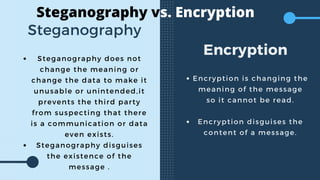
Steganography does not
change the meaning or
change the data to make it
unusable or unintended,it
prevents the third party
from suspecting that there
is a communication or data
even exists.
Steganography disguises
the existence of the
message .
Encryption
Encryption is changing the
meaning of the message
so it cannot be read.
Encryption disguises the
content of a message.
Steganography vs. Encryption
STEGANOGRAPHY
TERMS
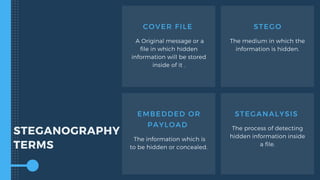
COVER FILE 
 A Original message or a
file in which hidden
information will be stored
inside of it .
EMBEDDED OR
PAYLOAD 
The information which is
to be hidden or concealed.
STEGO
The medium in which the
information is hidden.
STEGANALYSIS 
The process of detecting
hidden information inside
a file.
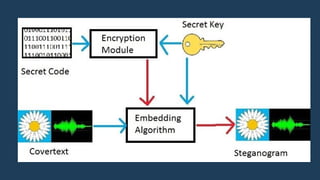
First the data that is being passed from one person to another is
encrypted (not always, but this is highly suggested).
Then the information is embedded into a covertext. This is done
according to the embedding algorithm and a secret key that modulates
the actions of the embedding process (the key is also not necessary, but
highly suggested).
This process outputs a steganogram that has the information hidden
inside.
The above diagram depicts how a steganographic algorithm works during
the embedding process.
STEGANOGRAPHIC ALGORITHM
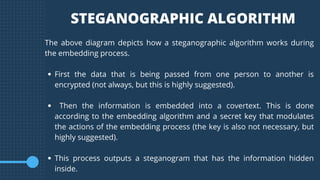
Secret key Steganography
where the secret (stego) key
is exchanged prior to
communication.
This is most susceptible to
interception. Secret Key
Steganography takes a cover
message and embeds the
secret message inside of it
by using a secret key (stego-
key).
Only the parties who know
the secret key can reverse
the process and read the
secret message.
Pure Steganography
Pure Steganography does
not require the exchange of
a cipher such as a stego-key.
It assumes that no other
party is aware of the
communication.
Public key Steganography
where a public key and a
private key is used for
secure Communication. The
sender will use the public
key during the encoding
process and only the private
key, which has a direct
mathematical relationship
with the public key, can
decipher the secret
message.
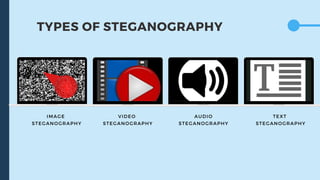
TYPES OF STEGANOGRAPHY
IMAGE
STEGANOGRAPHY
TEXT
STEGANOGRAPHY
VIDEO
STEGANOGRAPHY
AUDIO
STEGANOGRAPHY
Image Steganography
The image Steganography is used to hide a secret message
inside an image. The most widely used technique to hide
secret bit inside the LSB of the cover image. Because this
method uses bits of each pixel in the image, it is necessary to
use a lossless compression format, otherwise the hidden
information will get lost in the transformations of a lossy
compression algorithm.
When using a 24 bit color image, a bit of each of the red,
green and blue color components can be used, so a total of 3
bits can be used for each pixel, in this way we can use more
secret bit to hide data in it.
Audio Steganography
Audio stenography can conceal the secret message in the
audio file with the help of its digital representation. It can be
achieved easily as a typical 16-bit file has 216 sound levels,
and a few levels difference could not be detectable by the
human ear.
The sender embeds secret data of any type using a key in a
digital cover file to produce a stego file, in such a way that an
observer cannot detect the existence of the hidden message.
In many schemes a method of audio Steganography based
on modification of least significant bits (LSB) the audio
samples in the temporal domain or transform domain have
been proposed.
Video Steganography
Video Steganography brings more possibilities of disguising
a large amount of data because it is a combination of image
and sound. Therefore, image and audio Steganography
techniques can also be employed on the video.
Video files are generally a collection of images and sounds,
so most of the presented techniques on images and - audio
can be applied to video files too.
The great advantage of video are the large amount of data
that can be hidden inside and the fact that it is a moving
stream of images and sounds.
The Video Steganography is nothing but a combination of
Image Steganography and Audio Steganography.
Text Steganography
Text Steganography is considered to be the most difficult
kind of Steganography due to lack of redundancy in text as
compared to image or audio but still has smaller memory
occupation and simpler communication.
The method that could be used for text Steganography is
data compression. Data compression encodes information in
one representation into another representation. The new
representation of data is smaller in size.
One of the possible schemes to achieve data compression is
Huffman coding. Huffman coding assigns smaller length
code words to more frequently occurring source symbols
and longer length code-words to less frequently occurring
APPLICATION OF
STEGANOGRAPHY
Confidential
Communication and Secret
Data Storing
Protection of Data Alteration
Access Control System for
Digital Content Distribution
E-Commerce
Media
Database Systems. 
Digital watermarking.
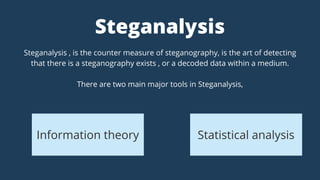
Steganalysis , is the counter measure of steganography, is the art of detecting
that there is a steganography exists , or a decoded data within a medium.
There are two main major tools in Steganalysis,
Steganalysis
Information theory Statistical analysis
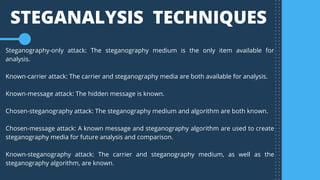
Steganography-only attack: The steganography medium is the only item available for
analysis.
Known-carrier attack: The carrier and steganography media are both available for analysis.
Known-message attack: The hidden message is known.
Chosen-steganography attack: The steganography medium and algorithm are both known.
Chosen-message attack: A known message and steganography algorithm are used to create
steganography media for future analysis and comparison.
Known-steganography attack: The carrier and steganography medium, as well as the
steganography algorithm, are known.
STEGANALYSIS  TECHNIQUES
THANK YOU

Steganography and steganalysis

  • 1.
  • 2.
    Steganography is theart and science of writing hidden messages in such a way that no one, apart from the sender and intended recipient, suspects the existence of the message, a form of security through obscurity.  The term Steganography has Greek influences which means “covered writing”.  “Steganography means hiding one piece of data within another”. STEGANOGRAPHY
  • 3.
    Steganography Steganography does not changethe meaning or change the data to make it unusable or unintended,it prevents the third party from suspecting that there is a communication or data even exists. Steganography disguises the existence of the message . Encryption Encryption is changing the meaning of the message so it cannot be read. Encryption disguises the content of a message. Steganography vs. Encryption
  • 4.
    STEGANOGRAPHY TERMS COVER FILE   A Originalmessage or a file in which hidden information will be stored inside of it . EMBEDDED OR PAYLOAD  The information which is to be hidden or concealed. STEGO The medium in which the information is hidden. STEGANALYSIS  The process of detecting hidden information inside a file.
  • 6.
    First the datathat is being passed from one person to another is encrypted (not always, but this is highly suggested). Then the information is embedded into a covertext. This is done according to the embedding algorithm and a secret key that modulates the actions of the embedding process (the key is also not necessary, but highly suggested). This process outputs a steganogram that has the information hidden inside. The above diagram depicts how a steganographic algorithm works during the embedding process. STEGANOGRAPHIC ALGORITHM
  • 7.
    Secret key Steganography Secretkey Steganography where the secret (stego) key is exchanged prior to communication. This is most susceptible to interception. Secret Key Steganography takes a cover message and embeds the secret message inside of it by using a secret key (stego- key). Only the parties who know the secret key can reverse the process and read the secret message. Pure Steganography Pure Steganography does not require the exchange of a cipher such as a stego-key. It assumes that no other party is aware of the communication. Public key Steganography Public key Steganography where a public key and a private key is used for secure Communication. The sender will use the public key during the encoding process and only the private key, which has a direct mathematical relationship with the public key, can decipher the secret message.
  • 8.
  • 9.
    Image Steganography The imageSteganography is used to hide a secret message inside an image. The most widely used technique to hide secret bit inside the LSB of the cover image. Because this method uses bits of each pixel in the image, it is necessary to use a lossless compression format, otherwise the hidden information will get lost in the transformations of a lossy compression algorithm. When using a 24 bit color image, a bit of each of the red, green and blue color components can be used, so a total of 3 bits can be used for each pixel, in this way we can use more secret bit to hide data in it.
  • 10.
    Audio Steganography Audio stenographycan conceal the secret message in the audio file with the help of its digital representation. It can be achieved easily as a typical 16-bit file has 216 sound levels, and a few levels difference could not be detectable by the human ear. The sender embeds secret data of any type using a key in a digital cover file to produce a stego file, in such a way that an observer cannot detect the existence of the hidden message. In many schemes a method of audio Steganography based on modification of least significant bits (LSB) the audio samples in the temporal domain or transform domain have been proposed.
  • 11.
    Video Steganography Video Steganographybrings more possibilities of disguising a large amount of data because it is a combination of image and sound. Therefore, image and audio Steganography techniques can also be employed on the video. Video files are generally a collection of images and sounds, so most of the presented techniques on images and - audio can be applied to video files too. The great advantage of video are the large amount of data that can be hidden inside and the fact that it is a moving stream of images and sounds. The Video Steganography is nothing but a combination of Image Steganography and Audio Steganography.
  • 12.
    Text Steganography Text Steganographyis considered to be the most difficult kind of Steganography due to lack of redundancy in text as compared to image or audio but still has smaller memory occupation and simpler communication. The method that could be used for text Steganography is data compression. Data compression encodes information in one representation into another representation. The new representation of data is smaller in size. One of the possible schemes to achieve data compression is Huffman coding. Huffman coding assigns smaller length code words to more frequently occurring source symbols and longer length code-words to less frequently occurring
  • 13.
    APPLICATION OF STEGANOGRAPHY Confidential Communication andSecret Data Storing Protection of Data Alteration Access Control System for Digital Content Distribution E-Commerce Media Database Systems.  Digital watermarking.
  • 14.
    Steganalysis , isthe counter measure of steganography, is the art of detecting that there is a steganography exists , or a decoded data within a medium. There are two main major tools in Steganalysis, Steganalysis Information theory Statistical analysis
  • 15.
    Steganography-only attack: Thesteganography medium is the only item available for analysis. Known-carrier attack: The carrier and steganography media are both available for analysis. Known-message attack: The hidden message is known. Chosen-steganography attack: The steganography medium and algorithm are both known. Chosen-message attack: A known message and steganography algorithm are used to create steganography media for future analysis and comparison. Known-steganography attack: The carrier and steganography medium, as well as the steganography algorithm, are known. STEGANALYSIS  TECHNIQUES
  • 16.