Yasser B. A. Farag
MSc. of Maritime Energy Management - - Sweden
Lecturer at Institute of Maritime Upgrading Studies
Maritime Chief Engineer
Maritime Upgrading Studies Institute - 2 0 2 0 -
Marine Engineering Knowledge
UE231
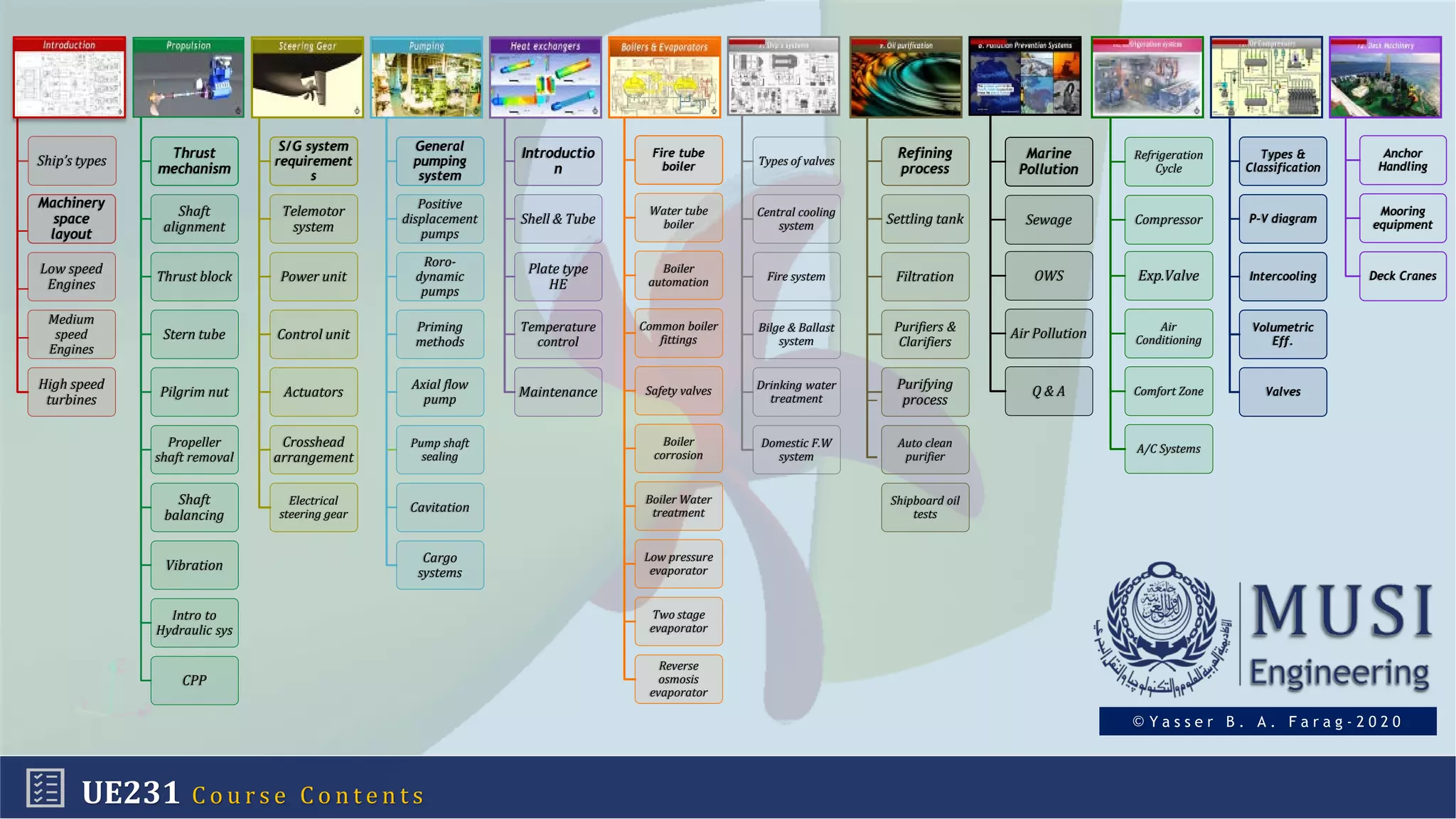
Ship’s types
Low speed
Engines
Medium
speed
Engines
High speed
turbines
Thrust
mechanism
Shaft
alignment
Thrust block
Stern tube
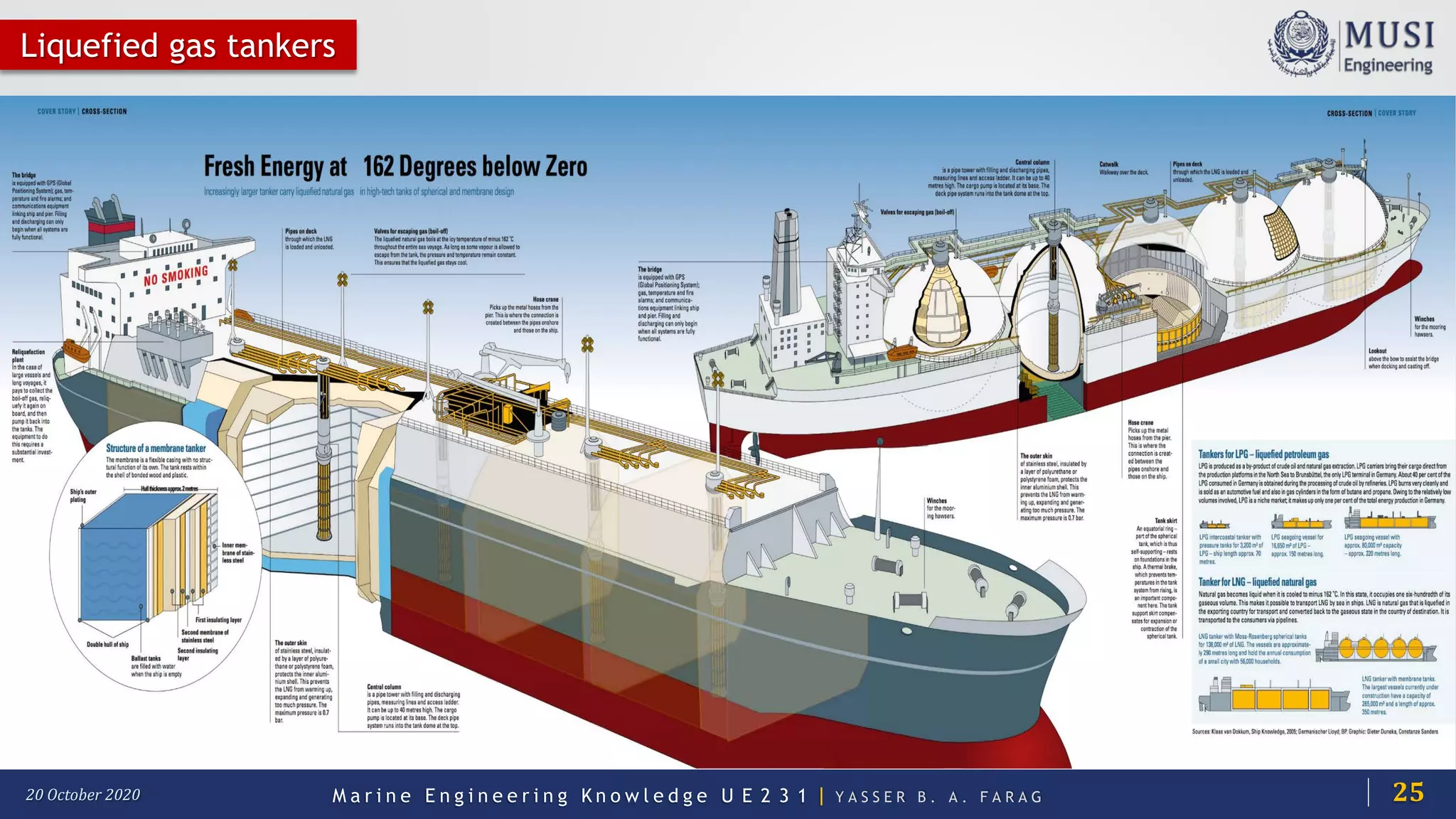
Pilgrim nut
Propeller
shaft removal
Shaft
balancing
Vibration
Intro to
Hydraulic sys
CPP
S/G system
requirement
s
Telemotor
system
Power unit
Control unit
Actuators
Crosshead
arrangement
Electrical
steering gear
General
pumping
system
Positive
displacement
pumps
Roro-
dynamic
pumps
Priming
methods
Axial flow
pump
Pump shaft
sealing
Cavitation
Cargo
systems
Introductio
n
Shell & Tube
Plate type
HE
Temperature
control
Maintenance
Fire tube
boiler
Water tube
boiler
Boiler
automation
Common boiler
fittings
Safety valves
Boiler
corrosion
Boiler Water
treatment
Low pressure
evaporator
Two stage
evaporator
Reverse
osmosis
evaporator
Types of valves
Central cooling
system
Fire system
Bilge & Ballast
system
Drinking water
treatment
Domestic F.W
system
Refining
process
Settling tank
Filtration
Purifiers &
Clarifiers
Purifying
process
Auto clean
purifier
Shipboard oil
tests
Marine
Pollution
Sewage
OWS
Air Pollution
Q & A
Refrigeration
Cycle
Compressor
Exp.Valve
Air
Conditioning
Comfort Zone
A/C Systems
Types &
Classification
P-V diagram
Intercooling
Volumetric
Eff.
Valves
Anchor
Handling
Mooring
equipment
Deck Cranes
UE231 C o u r s e C o n t e n t s
Machinery
space
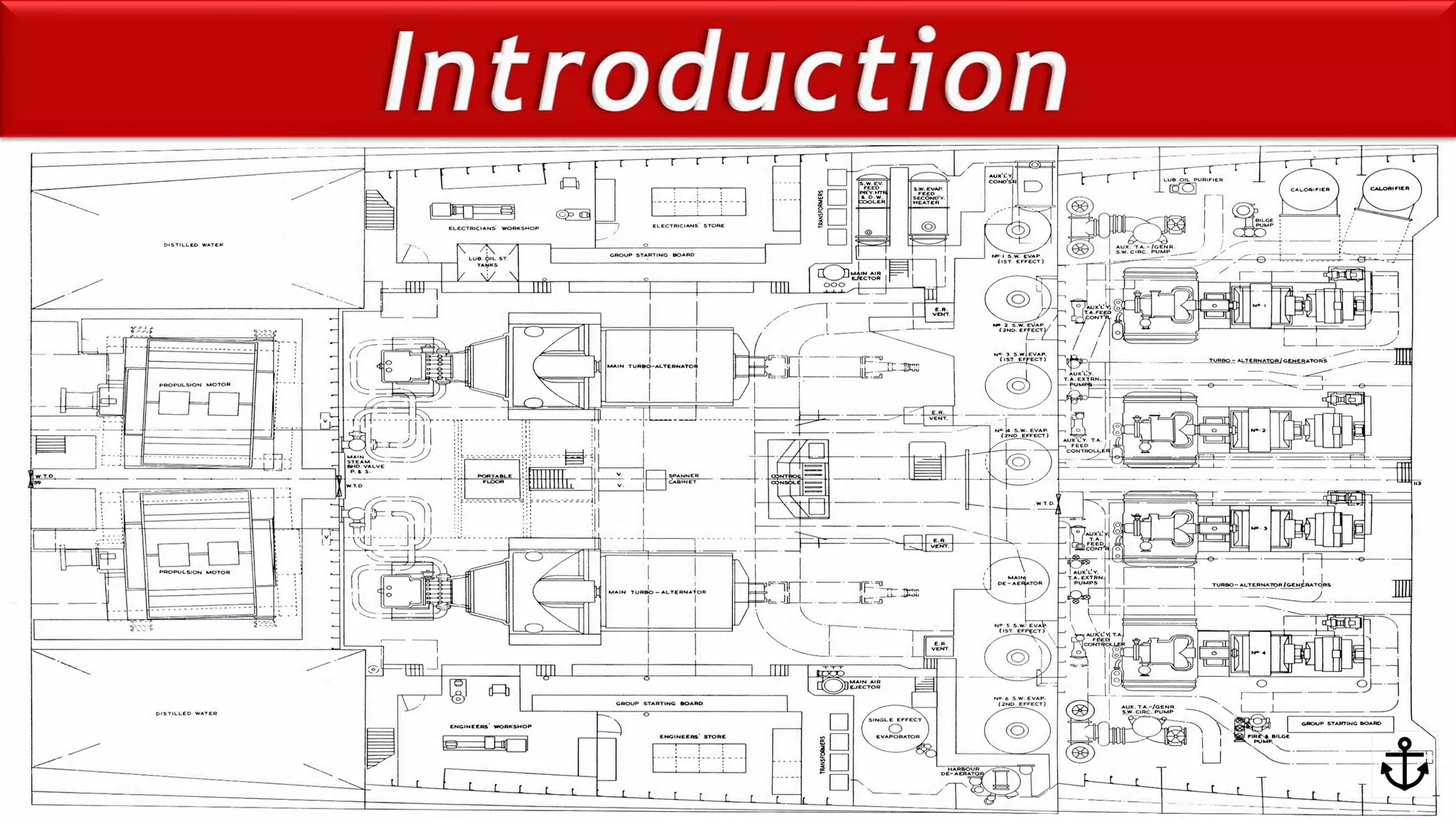
layout
© Y a s s e r B . A . F a r a g - 2 0 2 0
M a r i n e E n g i n e e r i n g K n o w l e d g e U E 2 3 1 | Y A S S E R B . A . F A R A G20 October 2020
Course Aim
This course aims to meet the mandatory minimum requirements for
knowledge, understanding and proficiency in the STCW 78 as amended. It
particularly aims to meet the specific requirements stated in Chapter III,
Section A-III/2 of STCW-78, as amended for the function 1 ”Marine
engineering at the management level” and Function 3 “Maintenance and
repair at the management level”.
By completion of this course, The trainee should have the sufficient general
marine engineering knowledge to carry out the related duties of the second
engineer in a safe and efficient manner.
3
M a r i n e E n g i n e e r i n g K n o w l e d g e U E 2 3 1 | Y A S S E R B . A . F A R A G20 October 2020
References
4
M a r i n e E n g i n e e r i n g K n o w l e d g e U E 2 3 1 | Y A S S E R B . A . F A R A G20 October 2020
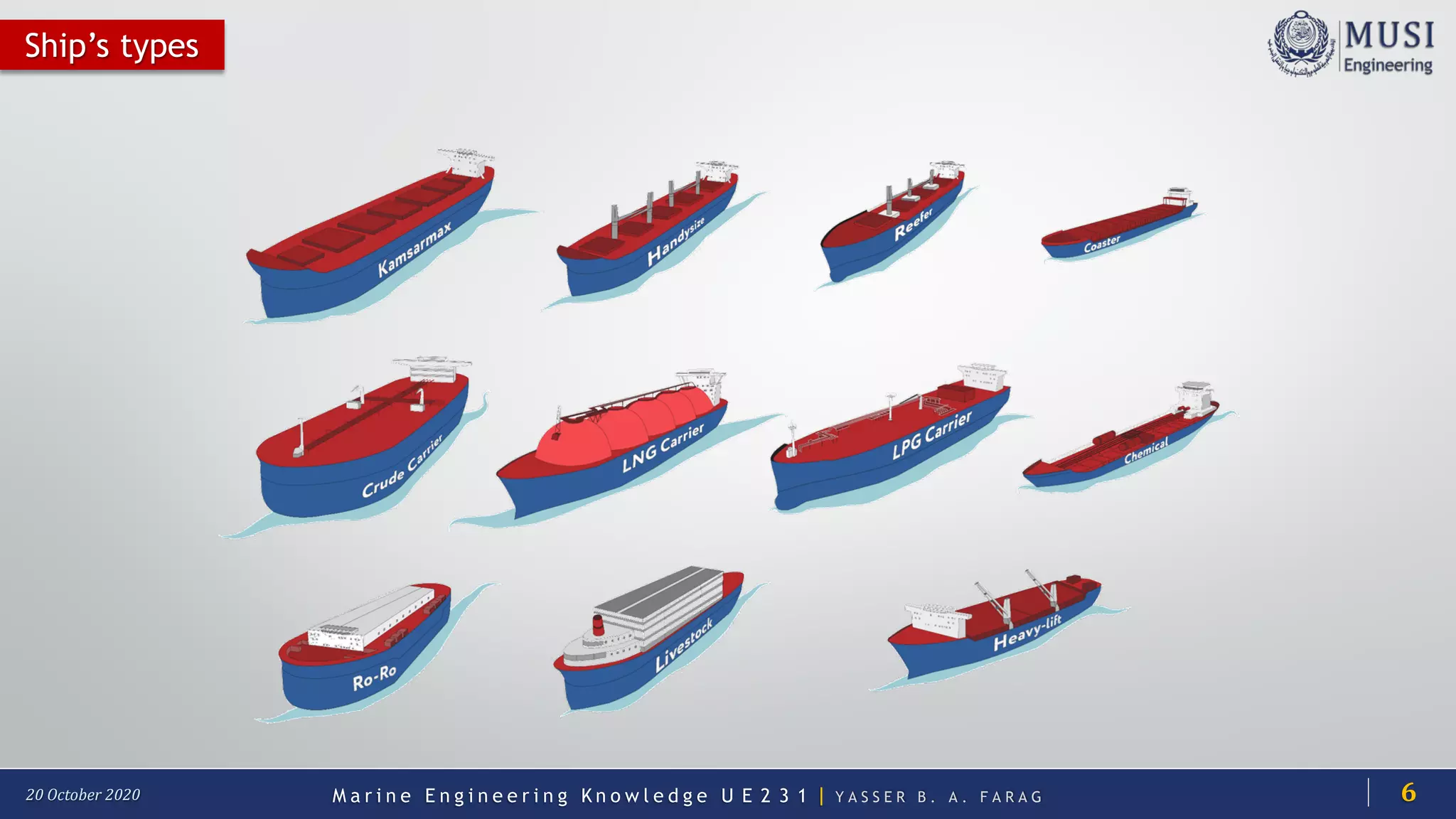
Ship’s types
6
M a r i n e E n g i n e e r i n g K n o w l e d g e U E 2 3 1 | Y A S S E R B . A . F A R A G20 October 2020
Dry Cargo ships
The basic dry cargo vessels are broadly divided into the following main categories:
1. General cargo vessels,
2. Bulk Carriers,
3. Containerships while each of them consists of several subcategories mainly
depending on their technical characteristics and/or sizes.
7
M a r i n e E n g i n e e r i n g K n o w l e d g e U E 2 3 1 | Y A S S E R B . A . F A R A G20 October 2020
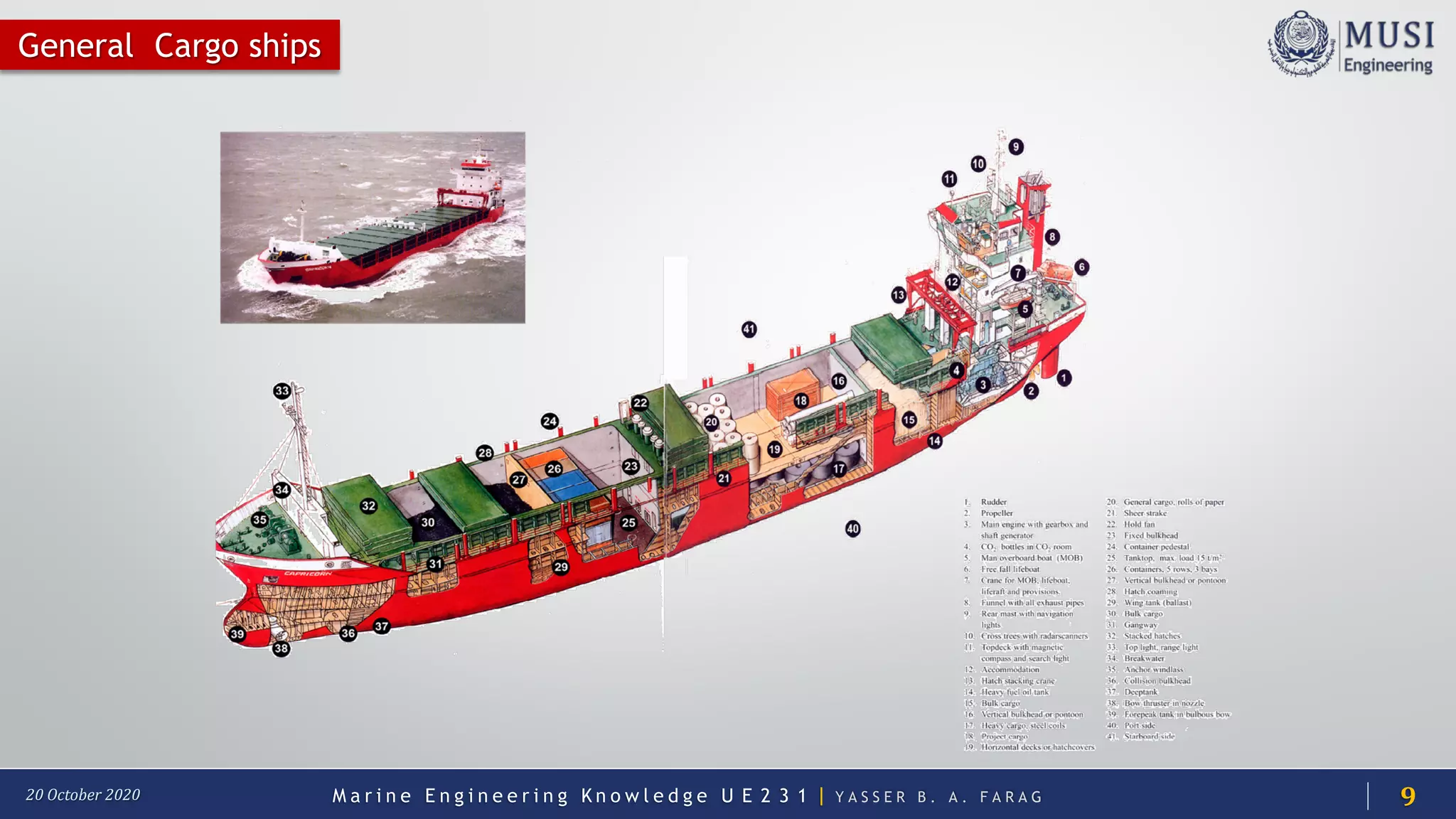
General Cargo ships
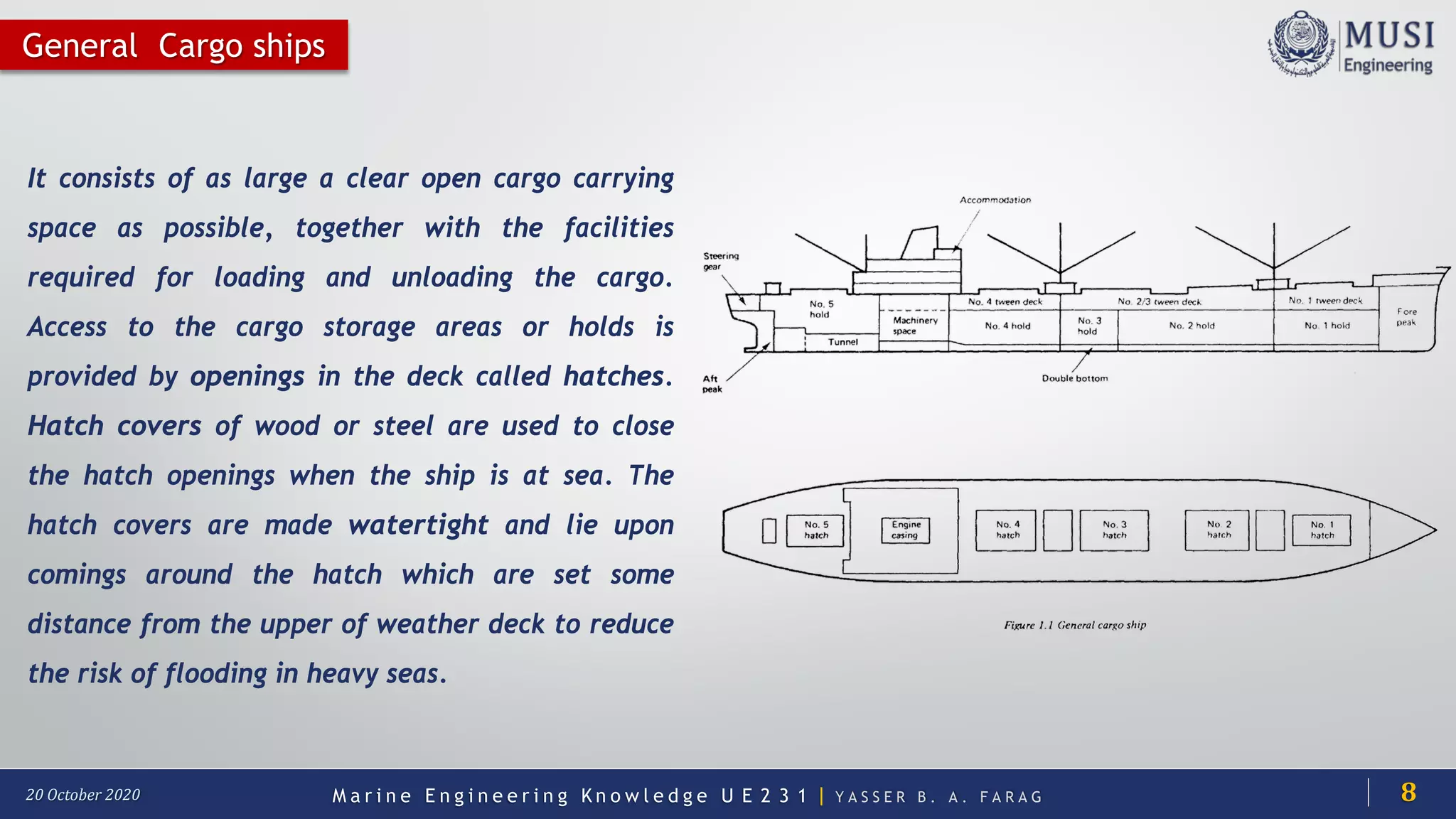
It consists of as large a clear open cargo carrying
space as possible, together with the facilities
required for loading and unloading the cargo.
Access to the cargo storage areas or holds is
provided by openings in the deck called hatches.
Hatch covers of wood or steel are used to close
the hatch openings when the ship is at sea. The
hatch covers are made watertight and lie upon
comings around the hatch which are set some
distance from the upper of weather deck to reduce
the risk of flooding in heavy seas.
8
M a r i n e E n g i n e e r i n g K n o w l e d g e U E 2 3 1 | Y A S S E R B . A . F A R A G20 October 2020
General Cargo ships
9
M a r i n e E n g i n e e r i n g K n o w l e d g e U E 2 3 1 | Y A S S E R B . A . F A R A G20 October 2020
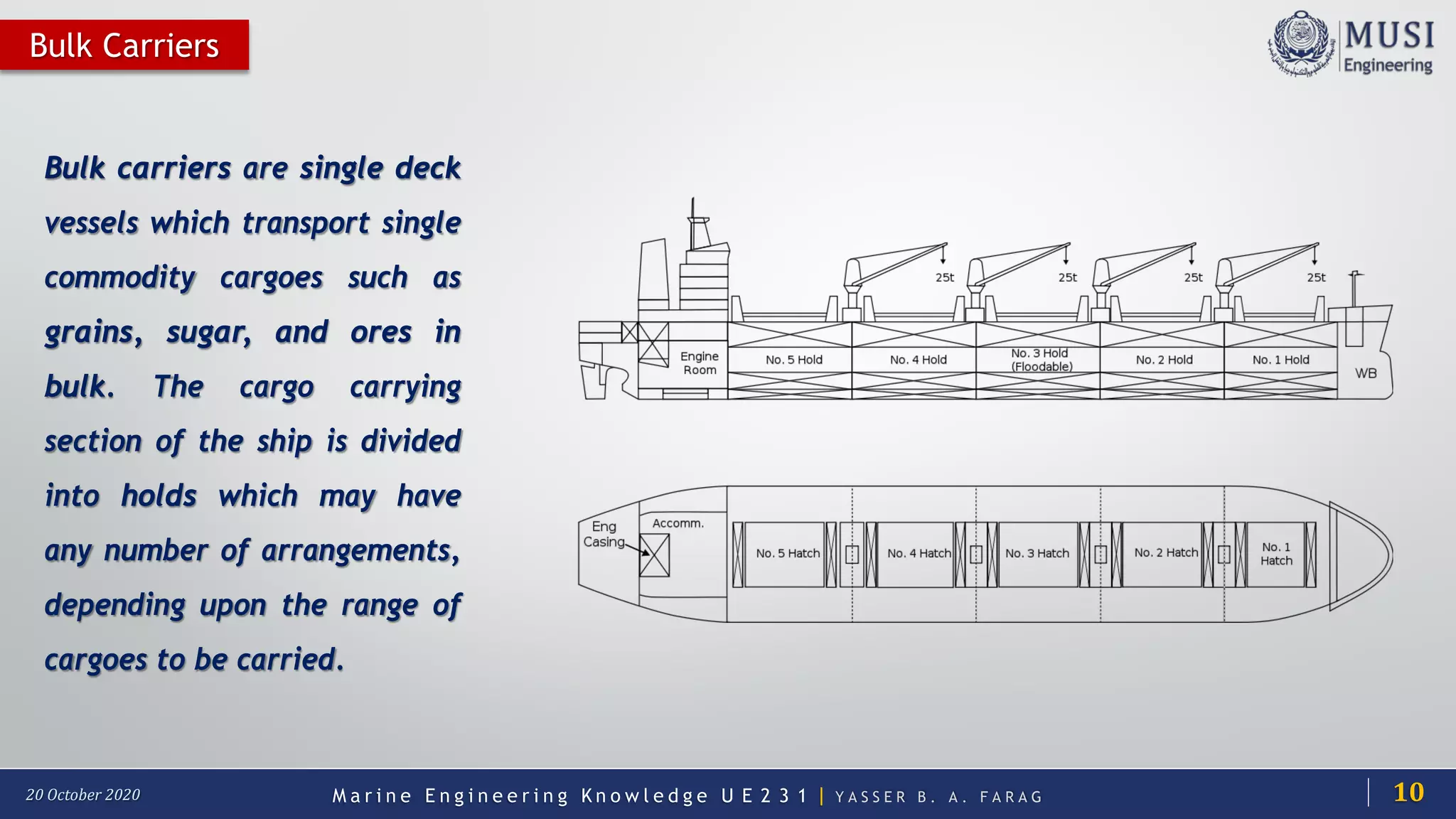
Bulk carriers are single deck
vessels which transport single
commodity cargoes such as
grains, sugar, and ores in
bulk. The cargo carrying
section of the ship is divided
into holds which may have
any number of arrangements,
depending upon the range of
cargoes to be carried.
Bulk Carriers
10
M a r i n e E n g i n e e r i n g K n o w l e d g e U E 2 3 1 | Y A S S E R B . A . F A R A G20 October 2020
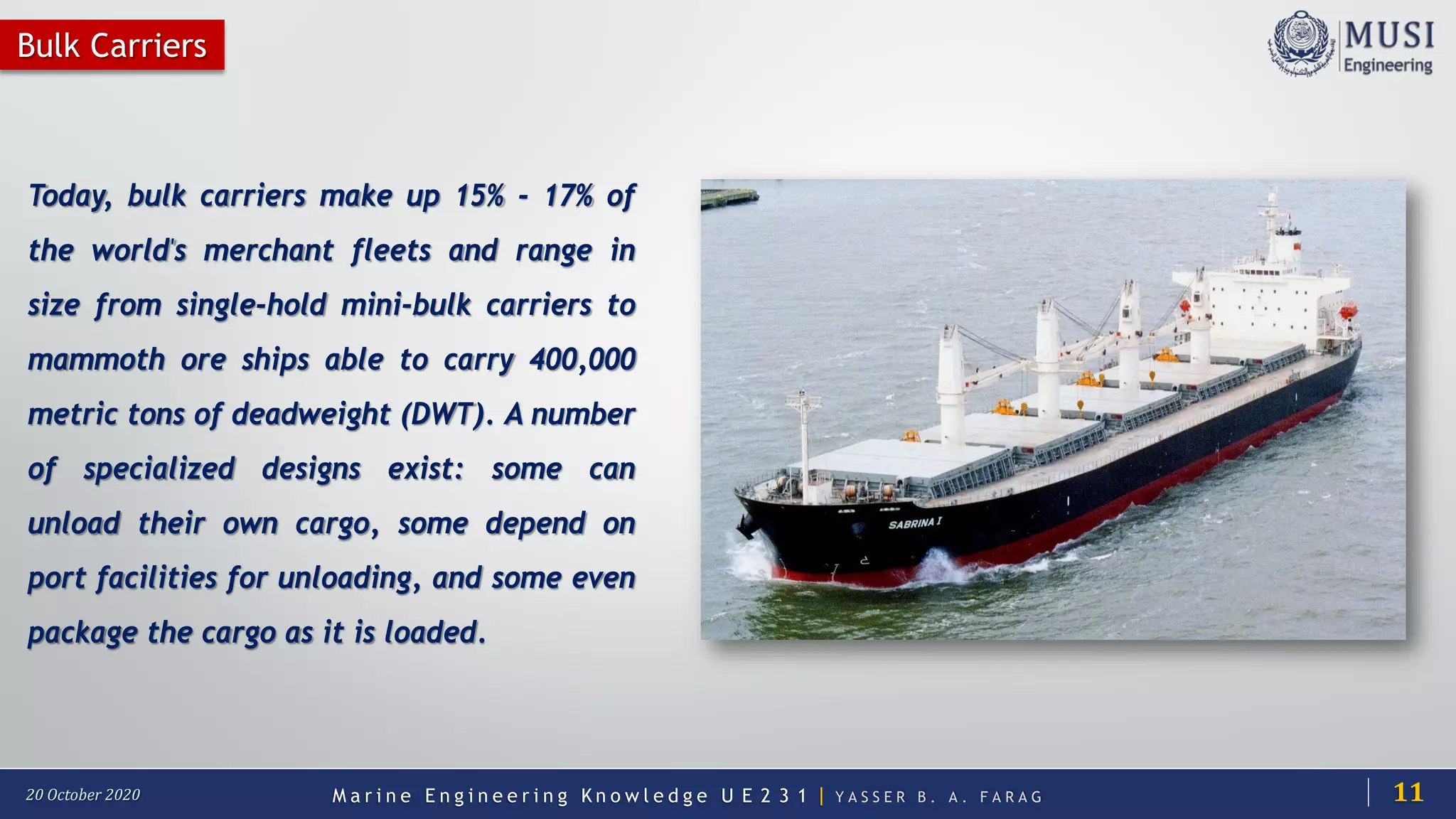
Today, bulk carriers make up 15% - 17% of
the world's merchant fleets and range in
size from single-hold mini-bulk carriers to
mammoth ore ships able to carry 400,000
metric tons of deadweight (DWT). A number
of specialized designs exist: some can
unload their own cargo, some depend on
port facilities for unloading, and some even
package the cargo as it is loaded.
Bulk Carriers
11
M a r i n e E n g i n e e r i n g K n o w l e d g e U E 2 3 1 | Y A S S E R B . A . F A R A G20 October 2020
Container ships
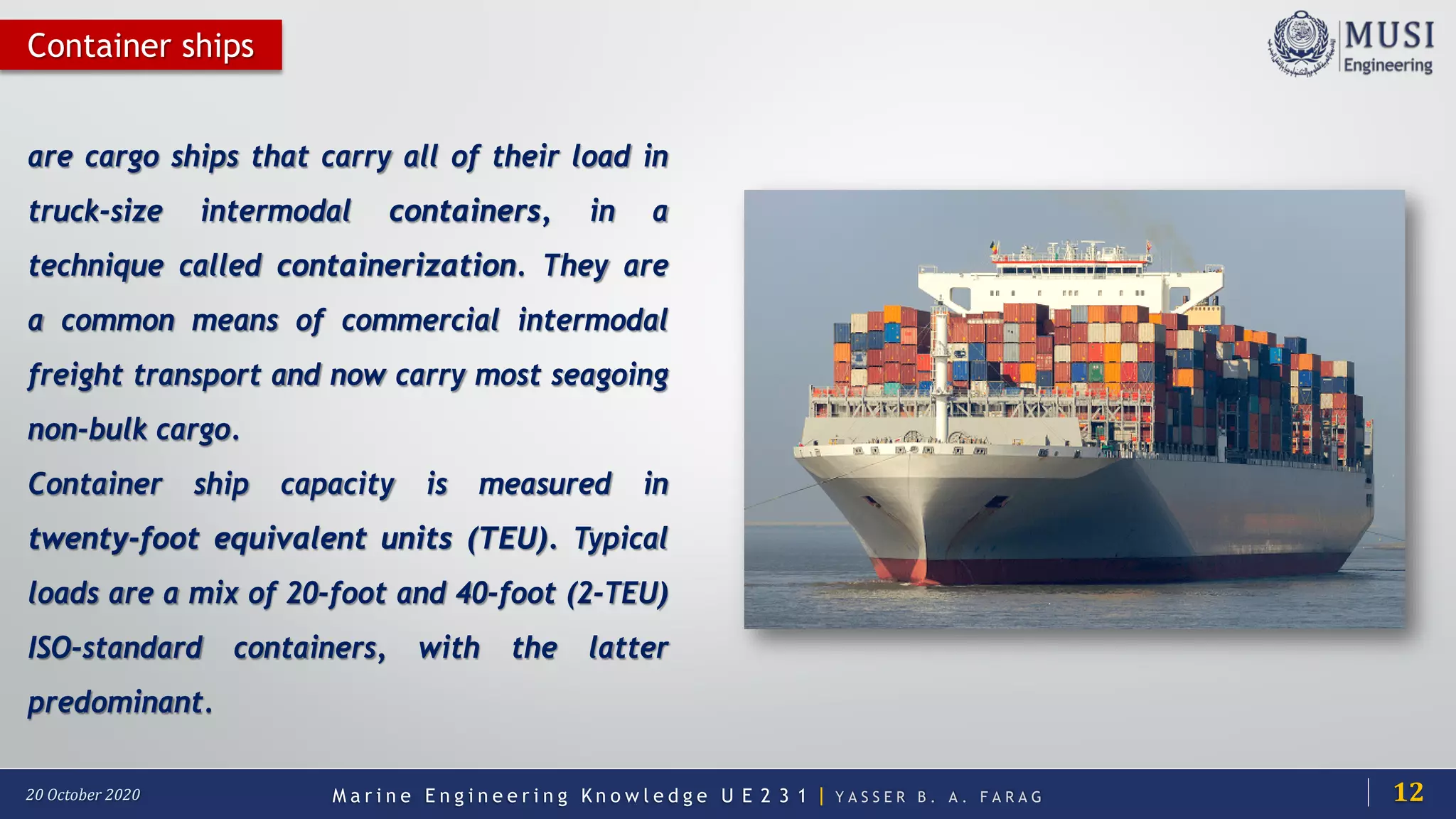
are cargo ships that carry all of their load in
truck-size intermodal containers, in a
technique called containerization. They are
a common means of commercial intermodal
freight transport and now carry most seagoing
non-bulk cargo.
Container ship capacity is measured in
twenty-foot equivalent units (TEU). Typical
loads are a mix of 20-foot and 40-foot (2-TEU)
ISO-standard containers, with the latter
predominant.
12
M a r i n e E n g i n e e r i n g K n o w l e d g e U E 2 3 1 | Y A S S E R B . A . F A R A G20 October 2020
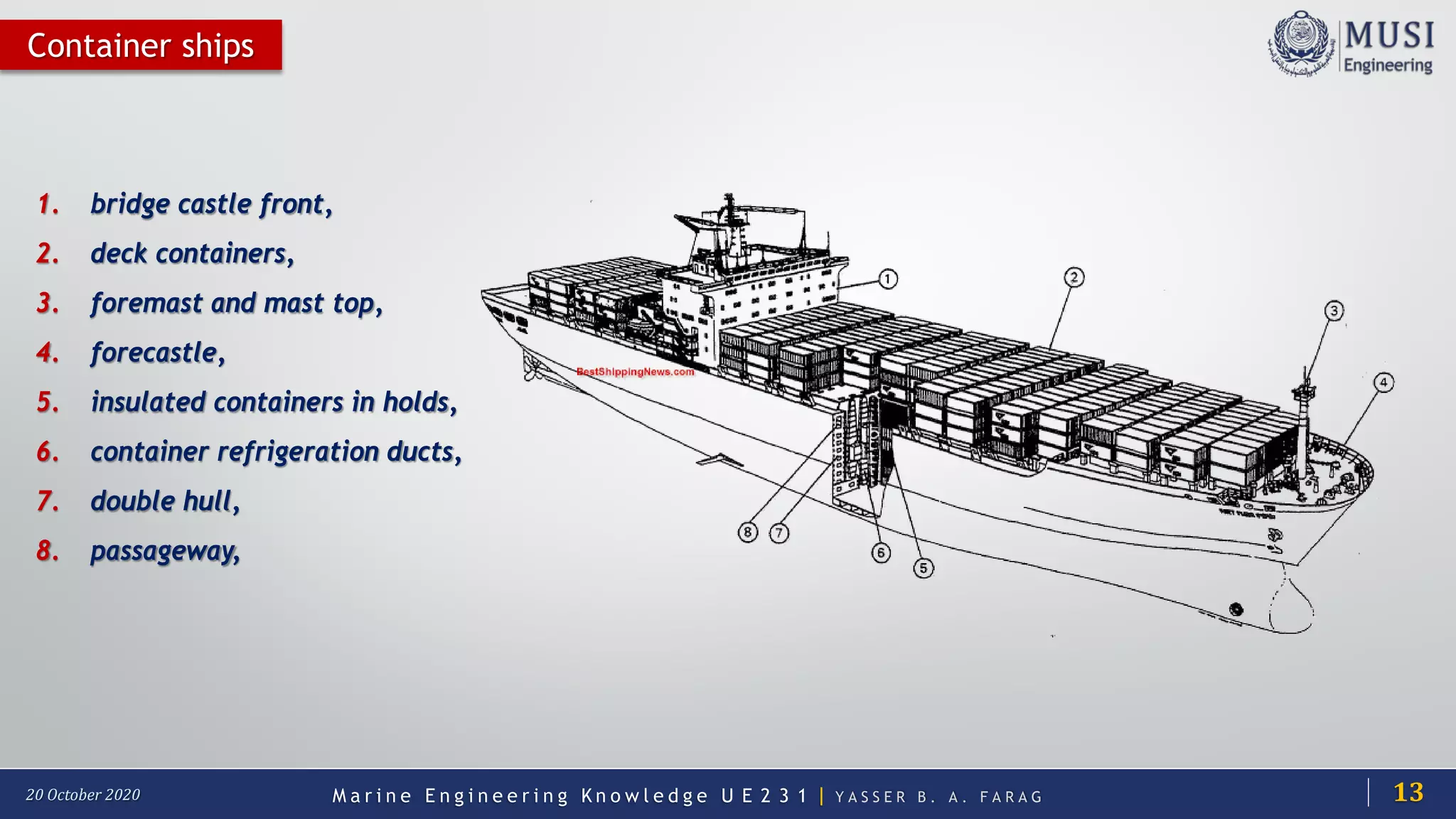
1. bridge castle front,
2. deck containers,
3. foremast and mast top,
4. forecastle,
5. insulated containers in holds,
6. container refrigeration ducts,
7. double hull,
8. passageway,
13
Container ships
M a r i n e E n g i n e e r i n g K n o w l e d g e U E 2 3 1 | Y A S S E R B . A . F A R A G20 October 2020
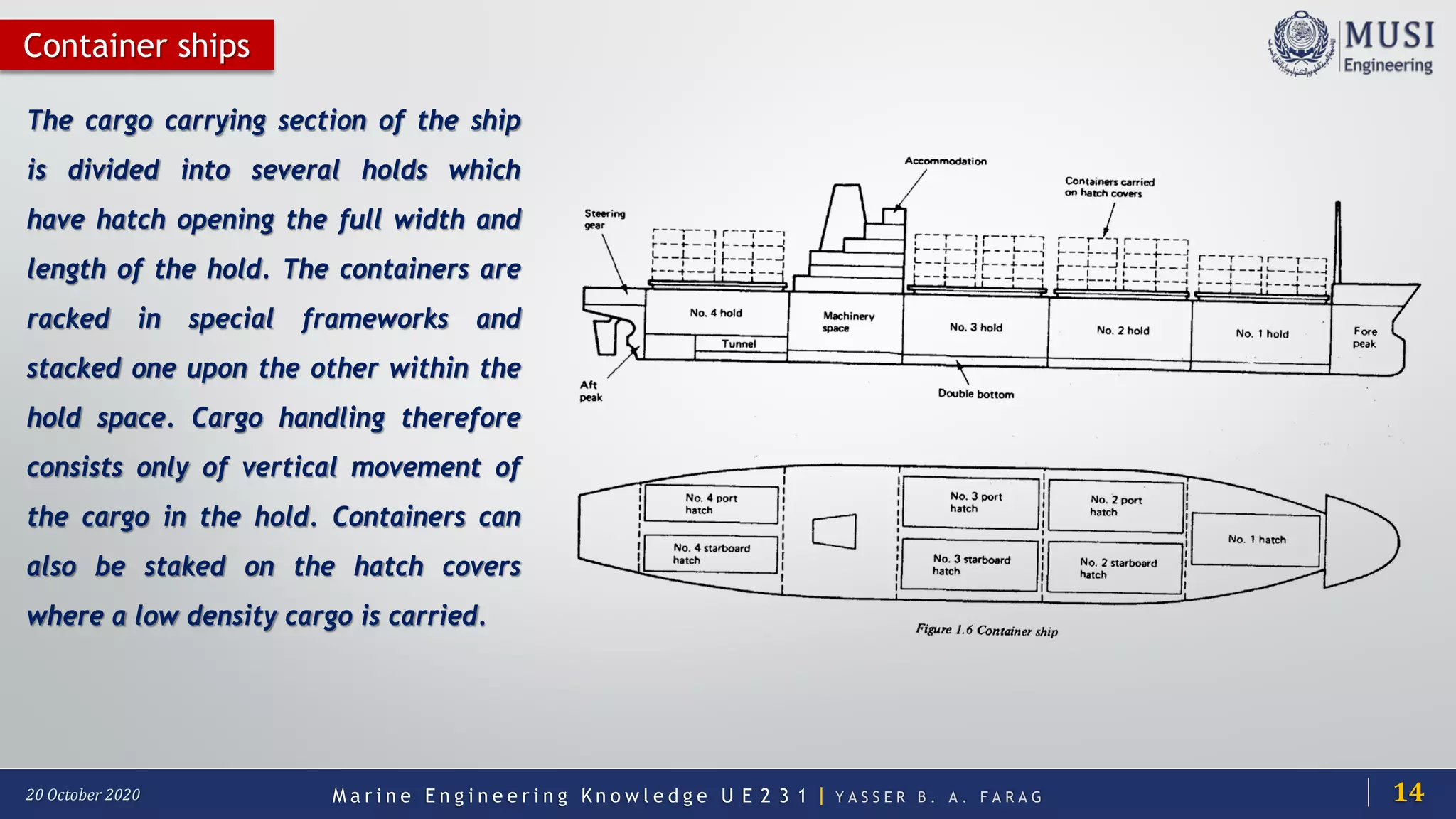
The cargo carrying section of the ship
is divided into several holds which
have hatch opening the full width and
length of the hold. The containers are
racked in special frameworks and
stacked one upon the other within the
hold space. Cargo handling therefore
consists only of vertical movement of
the cargo in the hold. Containers can
also be staked on the hatch covers
where a low density cargo is carried.
14
Container ships
M a r i n e E n g i n e e r i n g K n o w l e d g e U E 2 3 1 | Y A S S E R B . A . F A R A G20 October 2020
Container ships
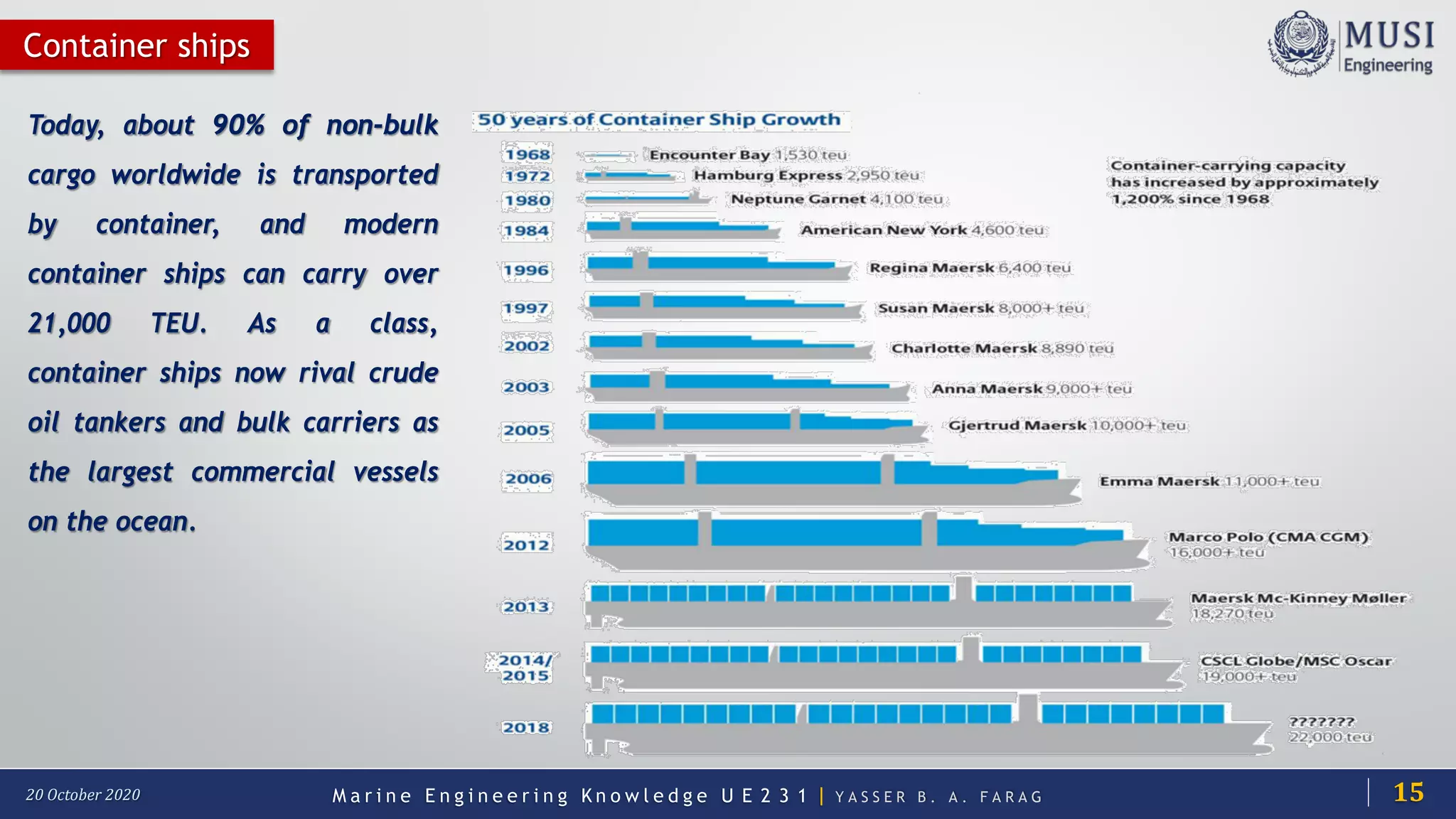
Today, about 90% of non-bulk
cargo worldwide is transported
by container, and modern
container ships can carry over
21,000 TEU. As a class,
container ships now rival crude
oil tankers and bulk carriers as
the largest commercial vessels
on the ocean.
15
M a r i n e E n g i n e e r i n g K n o w l e d g e U E 2 3 1 | Y A S S E R B . A . F A R A G20 October 2020
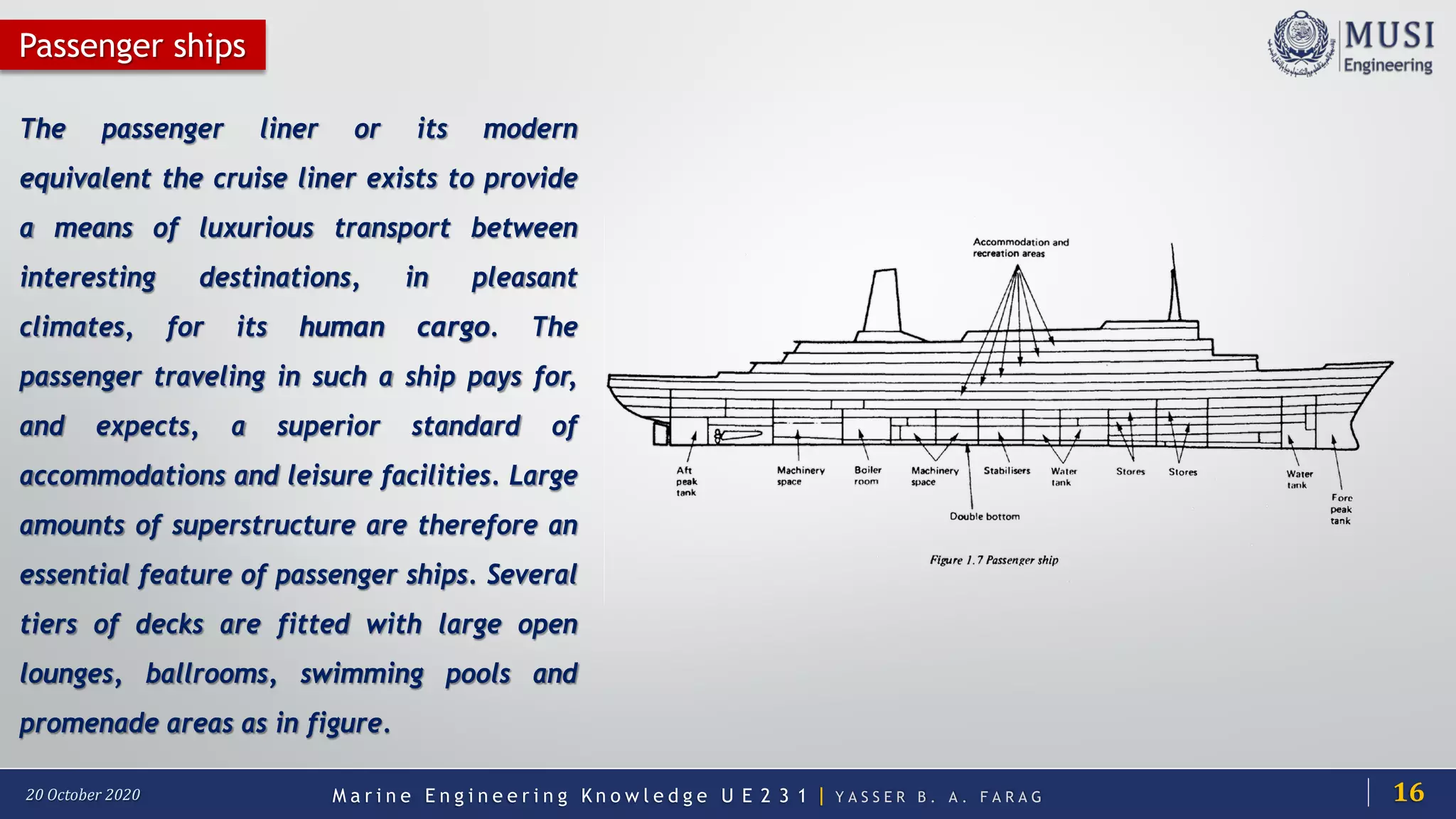
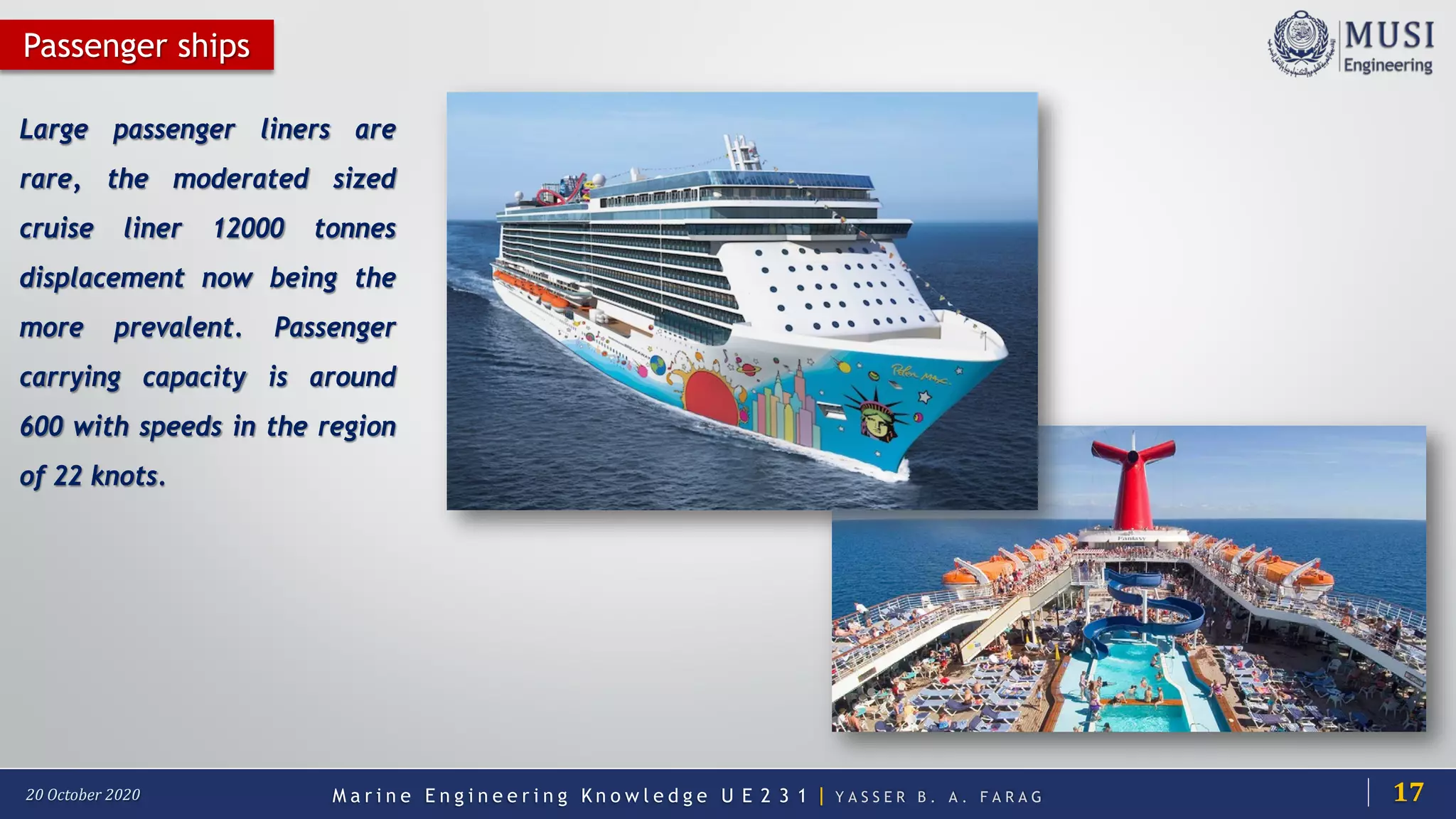
The passenger liner or its modern
equivalent the cruise liner exists to provide
a means of luxurious transport between
interesting destinations, in pleasant
climates, for its human cargo. The
passenger traveling in such a ship pays for,
and expects, a superior standard of
accommodations and leisure facilities. Large
amounts of superstructure are therefore an
essential feature of passenger ships. Several
tiers of decks are fitted with large open
lounges, ballrooms, swimming pools and
promenade areas as in figure.
Passenger ships
16
M a r i n e E n g i n e e r i n g K n o w l e d g e U E 2 3 1 | Y A S S E R B . A . F A R A G20 October 2020
Large passenger liners are
rare, the moderated sized
cruise liner 12000 tonnes
displacement now being the
more prevalent. Passenger
carrying capacity is around
600 with speeds in the region
of 22 knots.
Passenger ships
17
M a r i n e E n g i n e e r i n g K n o w l e d g e U E 2 3 1 | Y A S S E R B . A . F A R A G20 October 2020
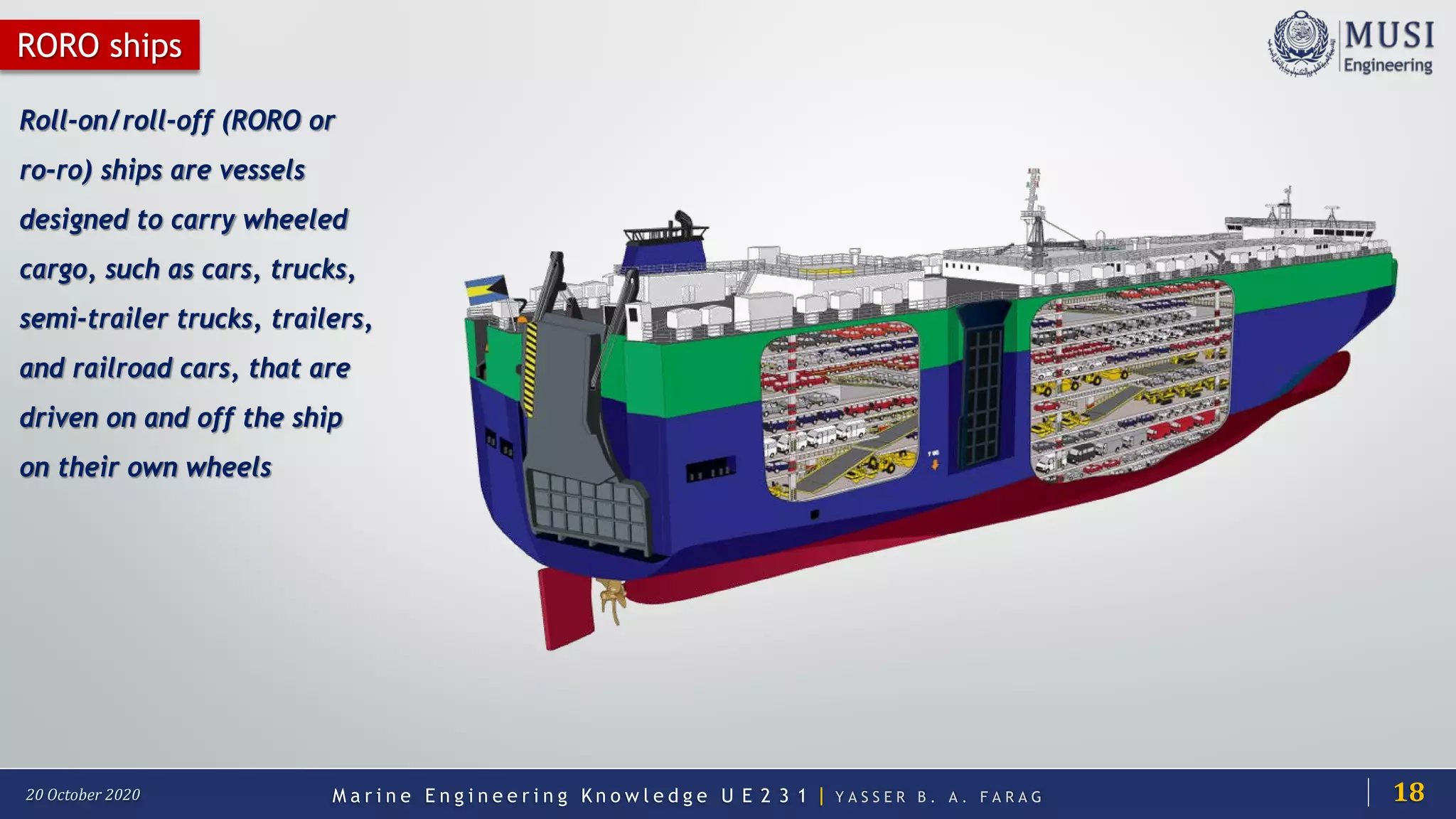
RORO ships
Roll-on/roll-off (RORO or
ro-ro) ships are vessels
designed to carry wheeled
cargo, such as cars, trucks,
semi-trailer trucks, trailers,
and railroad cars, that are
driven on and off the ship
on their own wheels
18
M a r i n e E n g i n e e r i n g K n o w l e d g e U E 2 3 1 | Y A S S E R B . A . F A R A G20 October 2020
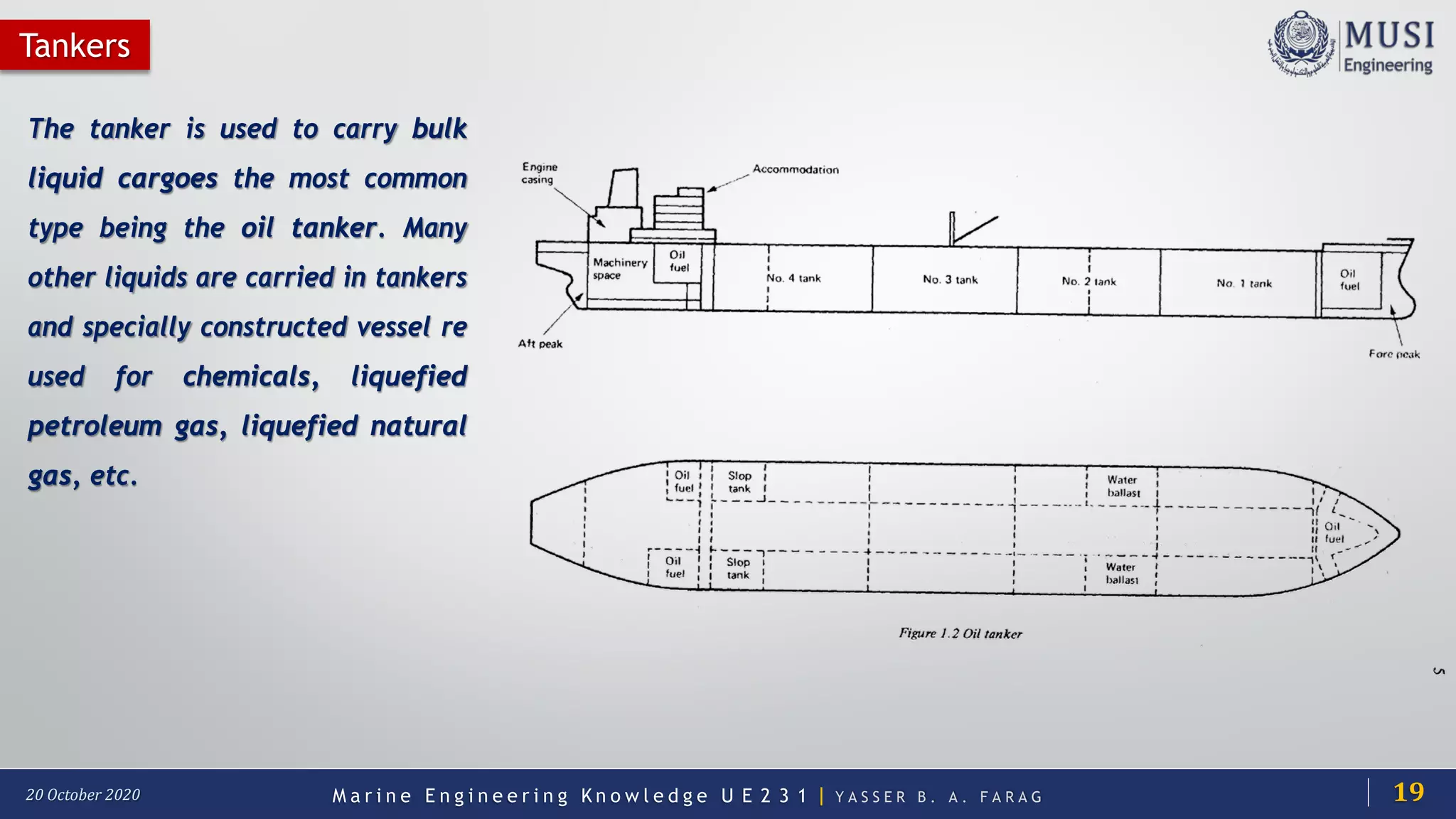
Tankers
The tanker is used to carry bulk
liquid cargoes the most common
type being the oil tanker. Many
other liquids are carried in tankers
and specially constructed vessel re
used for chemicals, liquefied
petroleum gas, liquefied natural
gas, etc.
19
M a r i n e E n g i n e e r i n g K n o w l e d g e U E 2 3 1 | Y A S S E R B . A . F A R A G20 October 2020
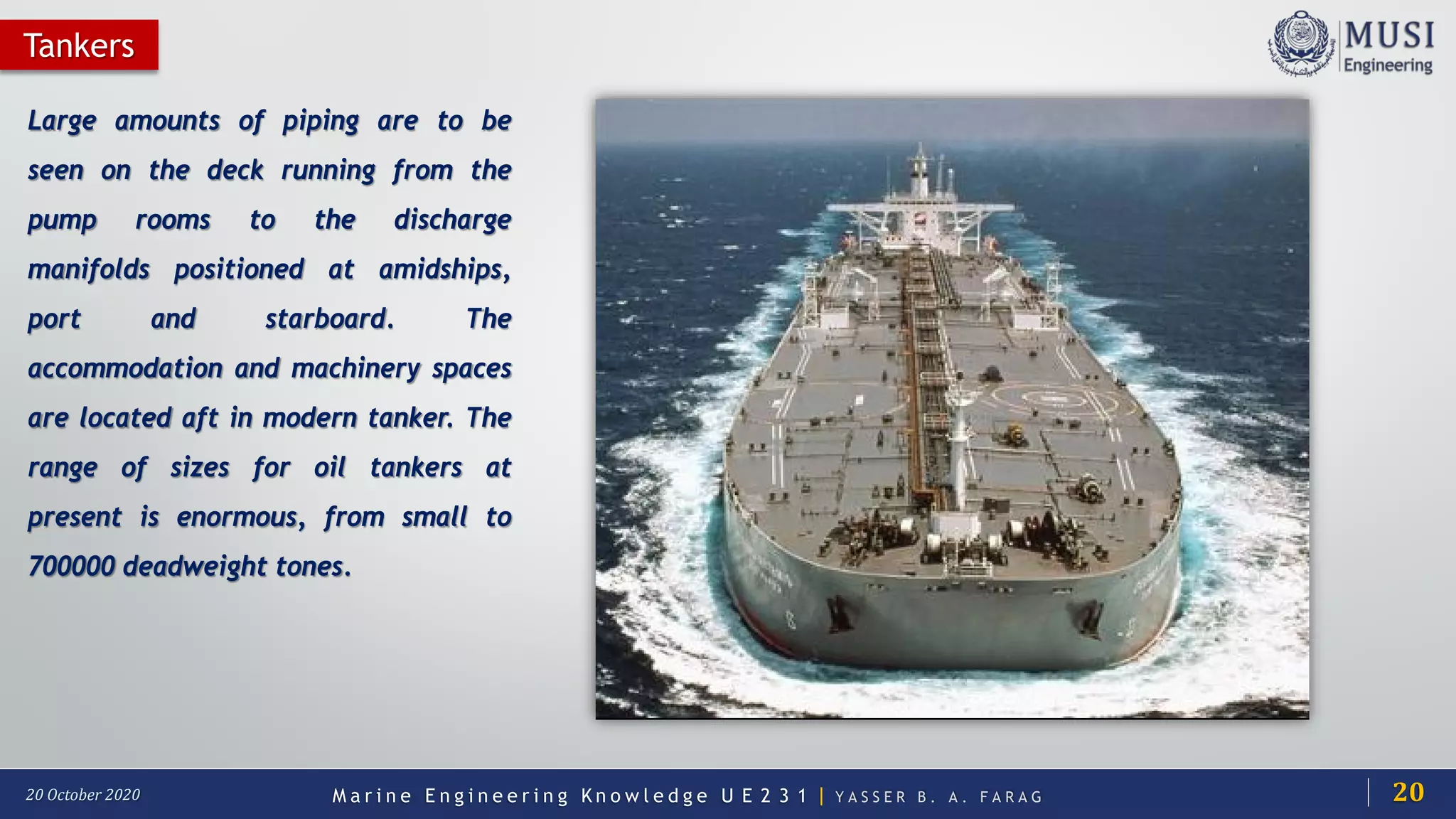
Tankers
Large amounts of piping are to be
seen on the deck running from the
pump rooms to the discharge
manifolds positioned at amidships,
port and starboard. The
accommodation and machinery spaces
are located aft in modern tanker. The
range of sizes for oil tankers at
present is enormous, from small to
700000 deadweight tones.
20
M a r i n e E n g i n e e r i n g K n o w l e d g e U E 2 3 1 | Y A S S E R B . A . F A R A G20 October 2020
Liquefied gas tankers
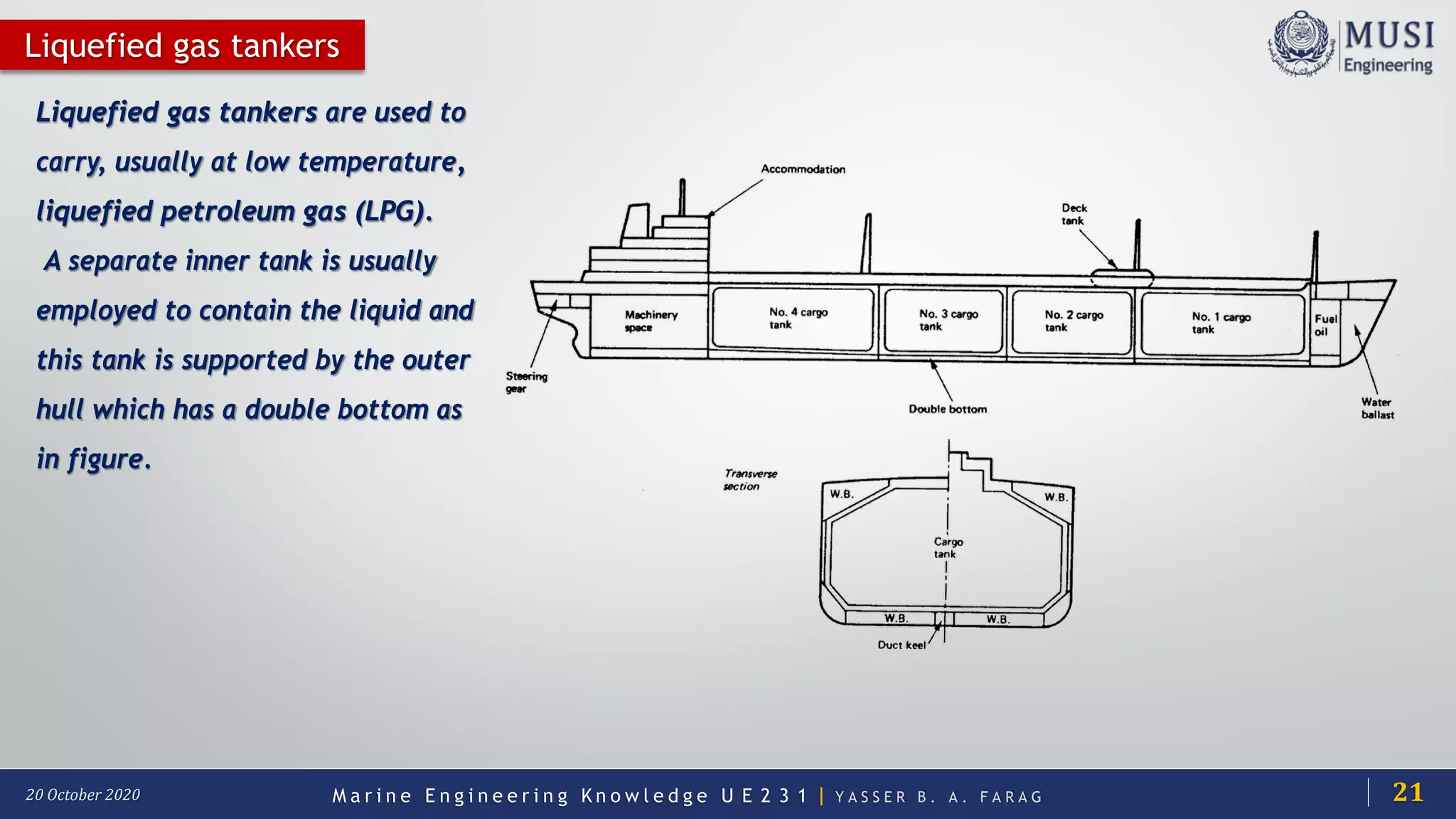
Liquefied gas tankers are used to
carry, usually at low temperature,
liquefied petroleum gas (LPG).
A separate inner tank is usually
employed to contain the liquid and
this tank is supported by the outer
hull which has a double bottom as
in figure.
21
M a r i n e E n g i n e e r i n g K n o w l e d g e U E 2 3 1 | Y A S S E R B . A . F A R A G20 October 2020
Liquefied gas tankers
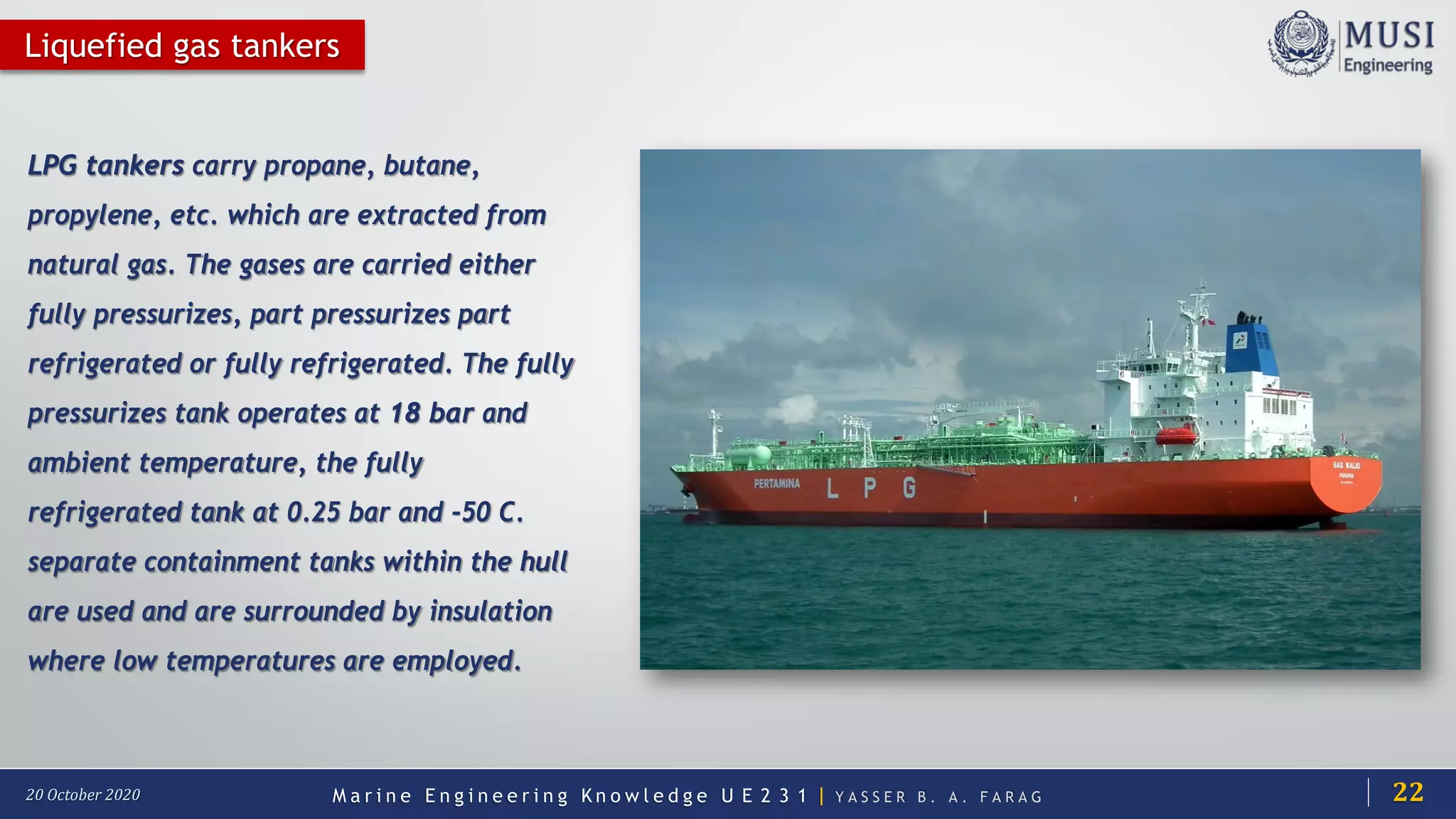
LPG tankers carry propane, butane,
propylene, etc. which are extracted from
natural gas. The gases are carried either
fully pressurizes, part pressurizes part
refrigerated or fully refrigerated. The fully
pressurizes tank operates at 18 bar and
ambient temperature, the fully
refrigerated tank at 0.25 bar and -50 C.
separate containment tanks within the hull
are used and are surrounded by insulation
where low temperatures are employed.
22
M a r i n e E n g i n e e r i n g K n o w l e d g e U E 2 3 1 | Y A S S E R B . A . F A R A G20 October 2020
Liquefied gas tankers
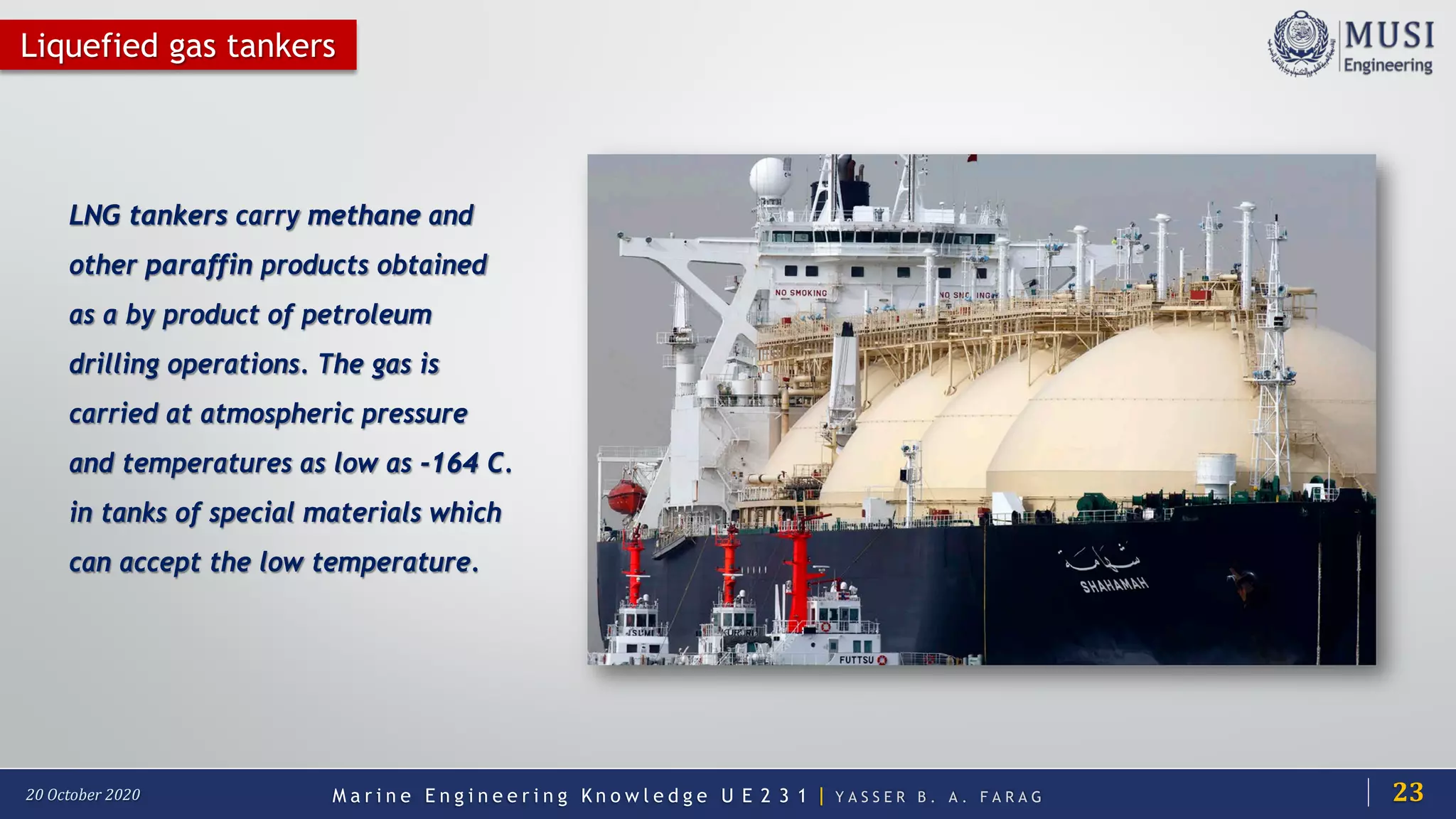
LNG tankers carry methane and
other paraffin products obtained
as a by product of petroleum
drilling operations. The gas is
carried at atmospheric pressure
and temperatures as low as -164 C.
in tanks of special materials which
can accept the low temperature.
23
M a r i n e E n g i n e e r i n g K n o w l e d g e U E 2 3 1 | Y A S S E R B . A . F A R A G20 October 2020
Liquefied gas tankers
24
M a r i n e E n g i n e e r i n g K n o w l e d g e U E 2 3 1 | Y A S S E R B . A . F A R A G20 October 2020
Liquefied gas tankers
25
M a r i n e E n g i n e e r i n g K n o w l e d g e U E 2 3 1 | Y A S S E R B . A . F A R A G20 October 2020
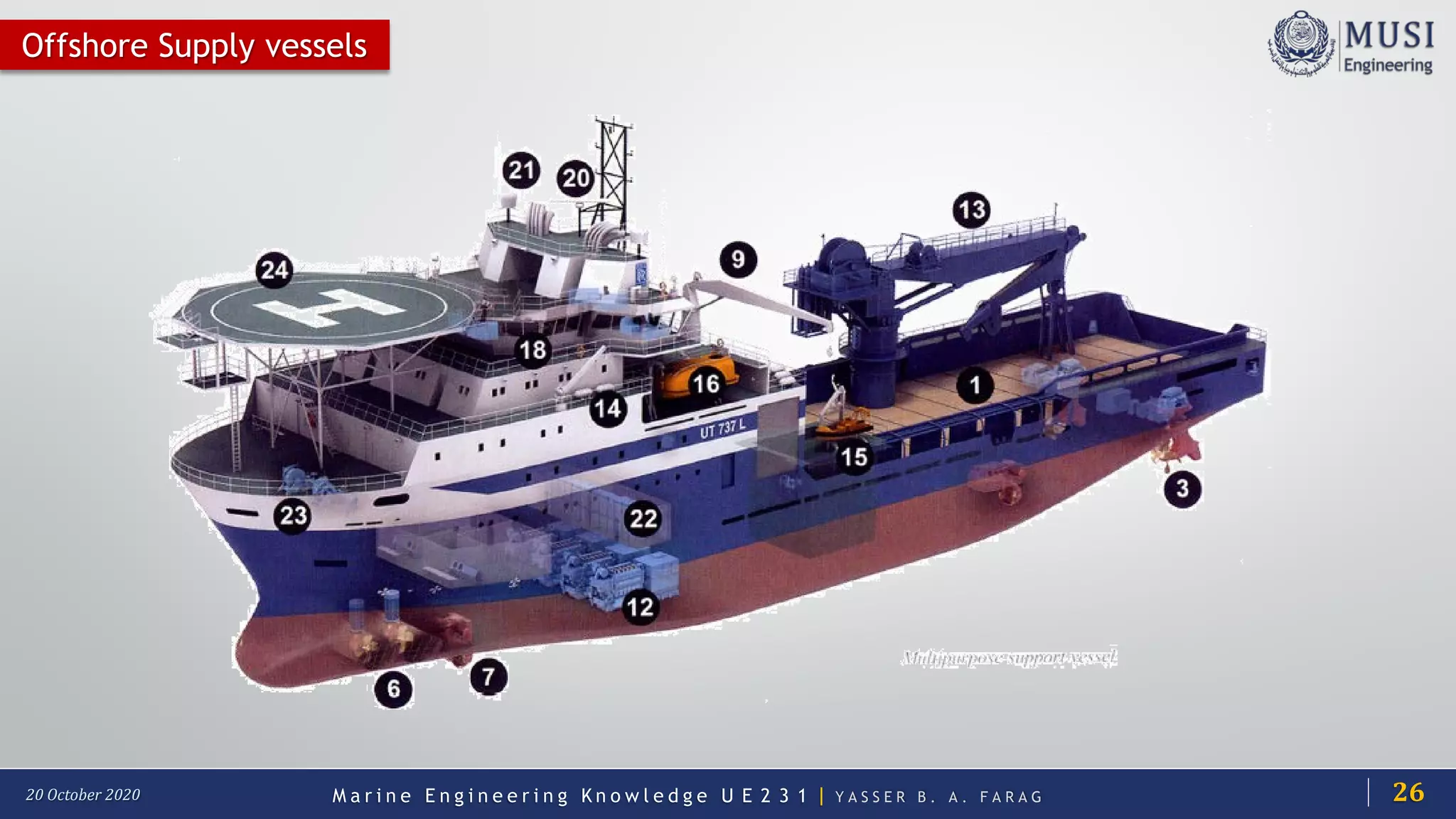
Offshore Supply vessels
26
M a r i n e E n g i n e e r i n g K n o w l e d g e U E 2 3 1 | Y A S S E R B . A . F A R A G20 October 2020
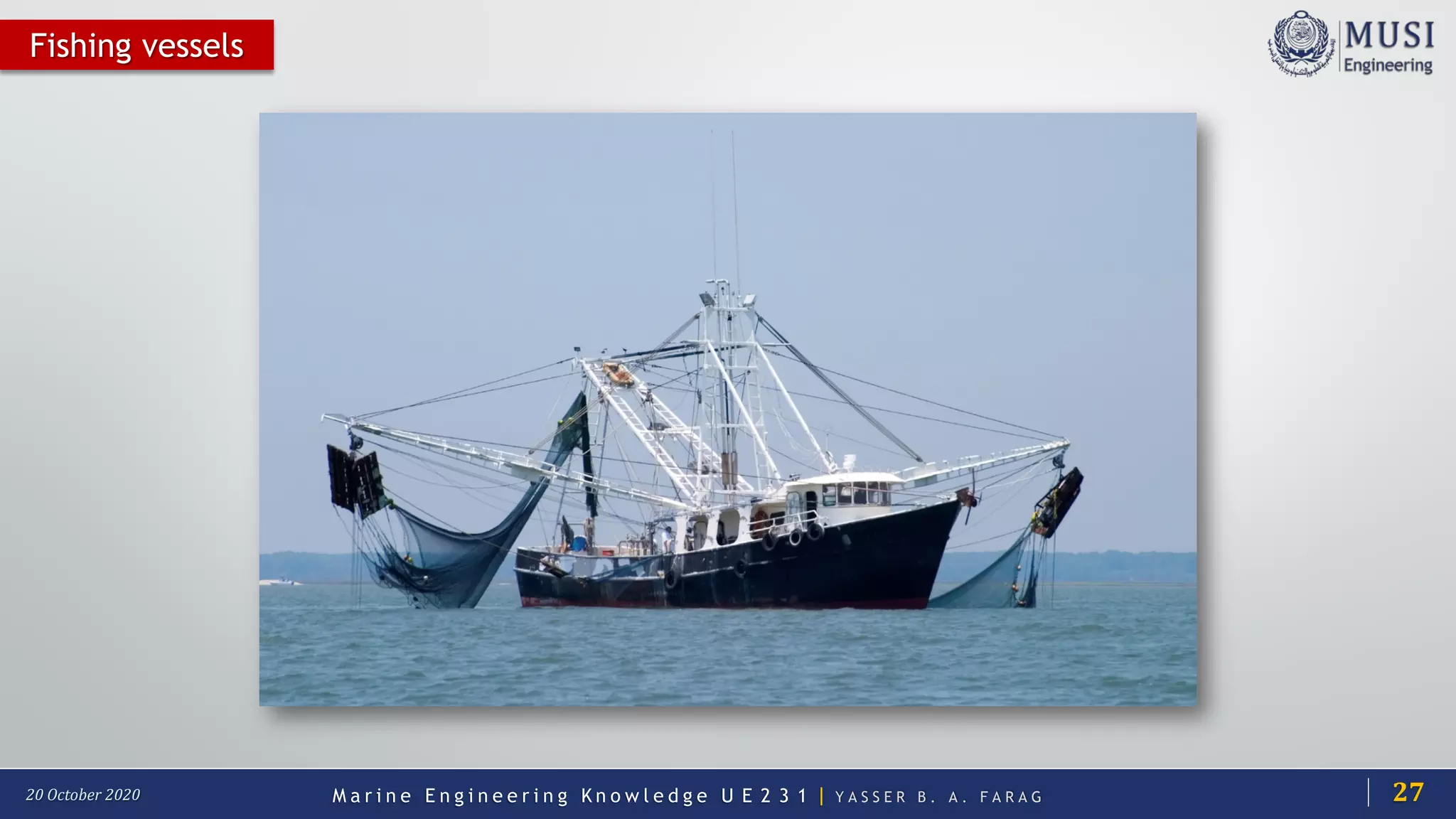
Fishing vessels
27
M a r i n e E n g i n e e r i n g K n o w l e d g e U E 2 3 1 | Y A S S E R B . A . F A R A G20 October 2020
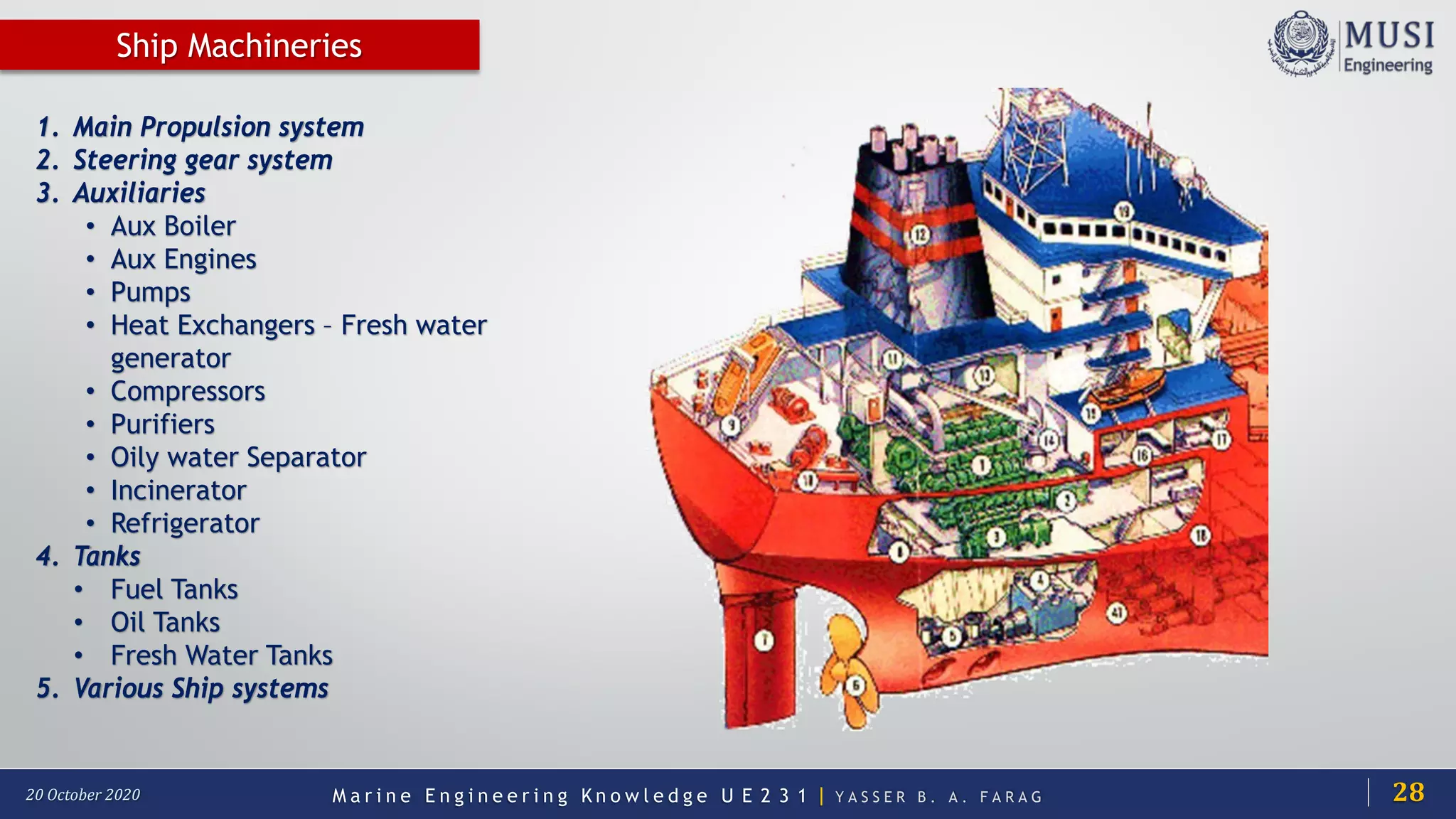
Ship Machineries
1. Main Propulsion system
2. Steering gear system
3. Auxiliaries
• Aux Boiler
• Aux Engines
• Pumps
• Heat Exchangers – Fresh water
generator
• Compressors
• Purifiers
• Oily water Separator
• Incinerator
• Refrigerator
4. Tanks
• Fuel Tanks
• Oil Tanks
• Fresh Water Tanks
5. Various Ship systems
28
M a r i n e E n g i n e e r i n g K n o w l e d g e U E 2 3 1 | Y A S S E R B . A . F A R A G20 October 2020
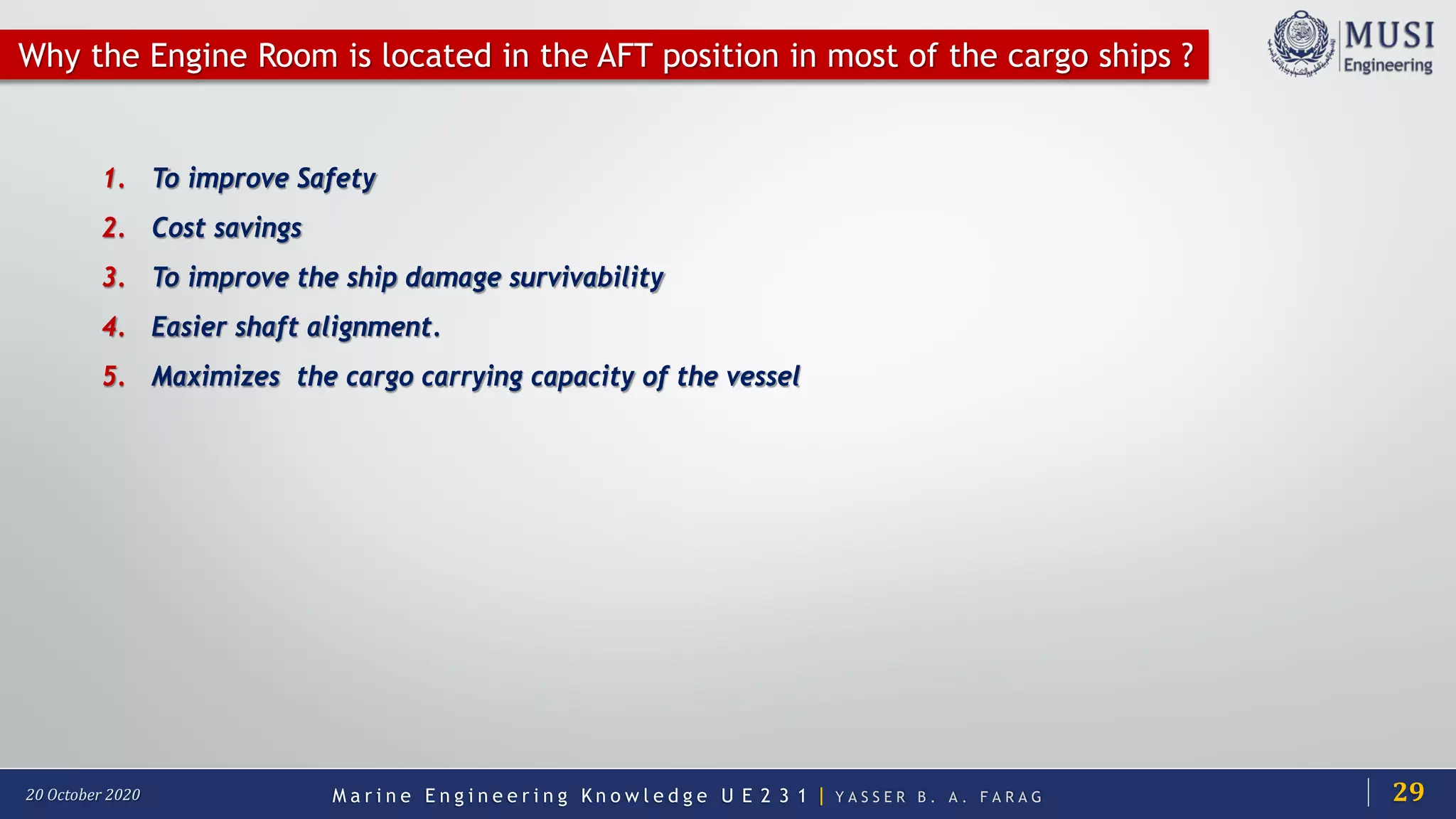
1. To improve Safety
2. Cost savings
3. To improve the ship damage survivability
4. Easier shaft alignment.
5. Maximizes the cargo carrying capacity of the vessel
Why the Engine Room is located in the AFT position in most of the cargo ships ?
29
M a r i n e E n g i n e e r i n g K n o w l e d g e U E 2 3 1 | Y A S S E R B . A . F A R A G20 October 2020
Arrangement
Three principal types of machinery installation are to be found at sea today. The three layouts involve
the use of
1. Direct-coupled slow-speed diesel engines,
2. Medium-speed diesels with a gearbox, and
3. The steam turbine with a gearbox drive to the propeller.
A propeller, in order to operate efficiently, must rotate at a relatively low speed. Thus, regardless of
the rotational speed of the prime mover, the propeller shaft must rotate at about 80 to 100 rev/min.
Engine room Layout
30
M a r i n e E n g i n e e r i n g K n o w l e d g e U E 2 3 1 | Y A S S E R B . A . F A R A G20 October 2020
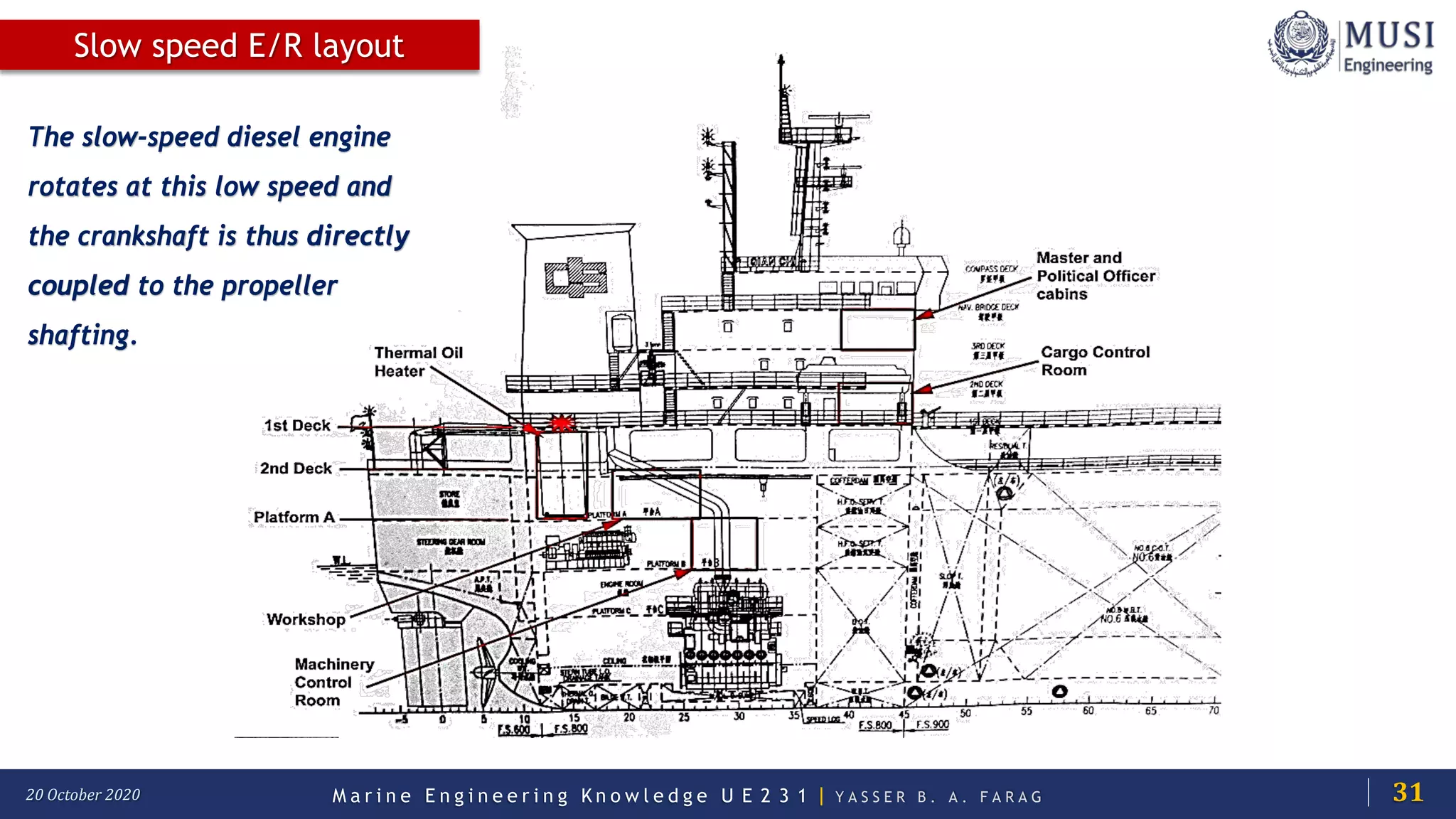
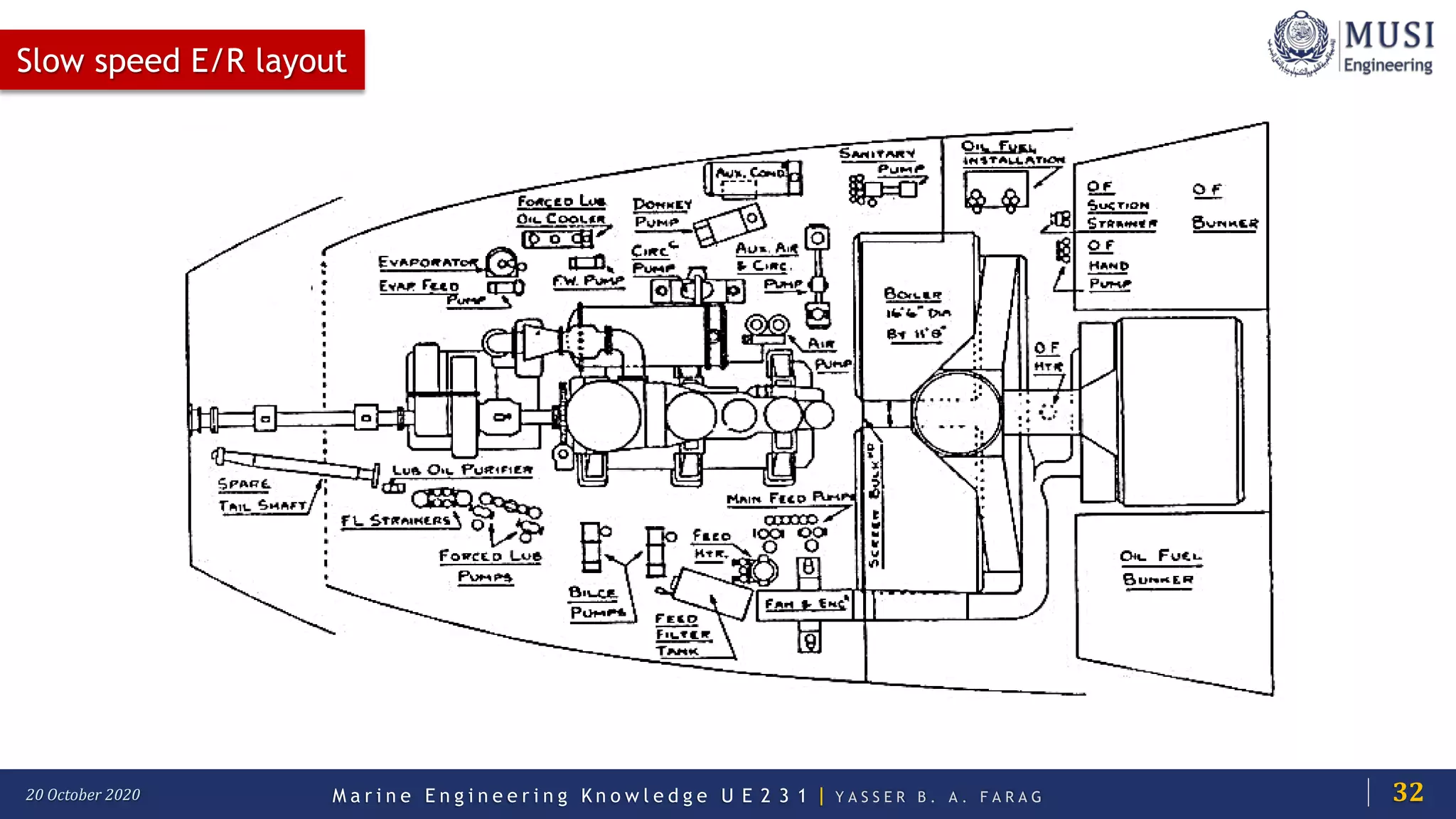
The slow-speed diesel engine
rotates at this low speed and
the crankshaft is thus directly
coupled to the propeller
shafting.
31
Slow speed E/R layout
M a r i n e E n g i n e e r i n g K n o w l e d g e U E 2 3 1 | Y A S S E R B . A . F A R A G20 October 2020
Slow speed E/R layout
32
M a r i n e E n g i n e e r i n g K n o w l e d g e U E 2 3 1 | Y A S S E R B . A . F A R A G20 October 2020
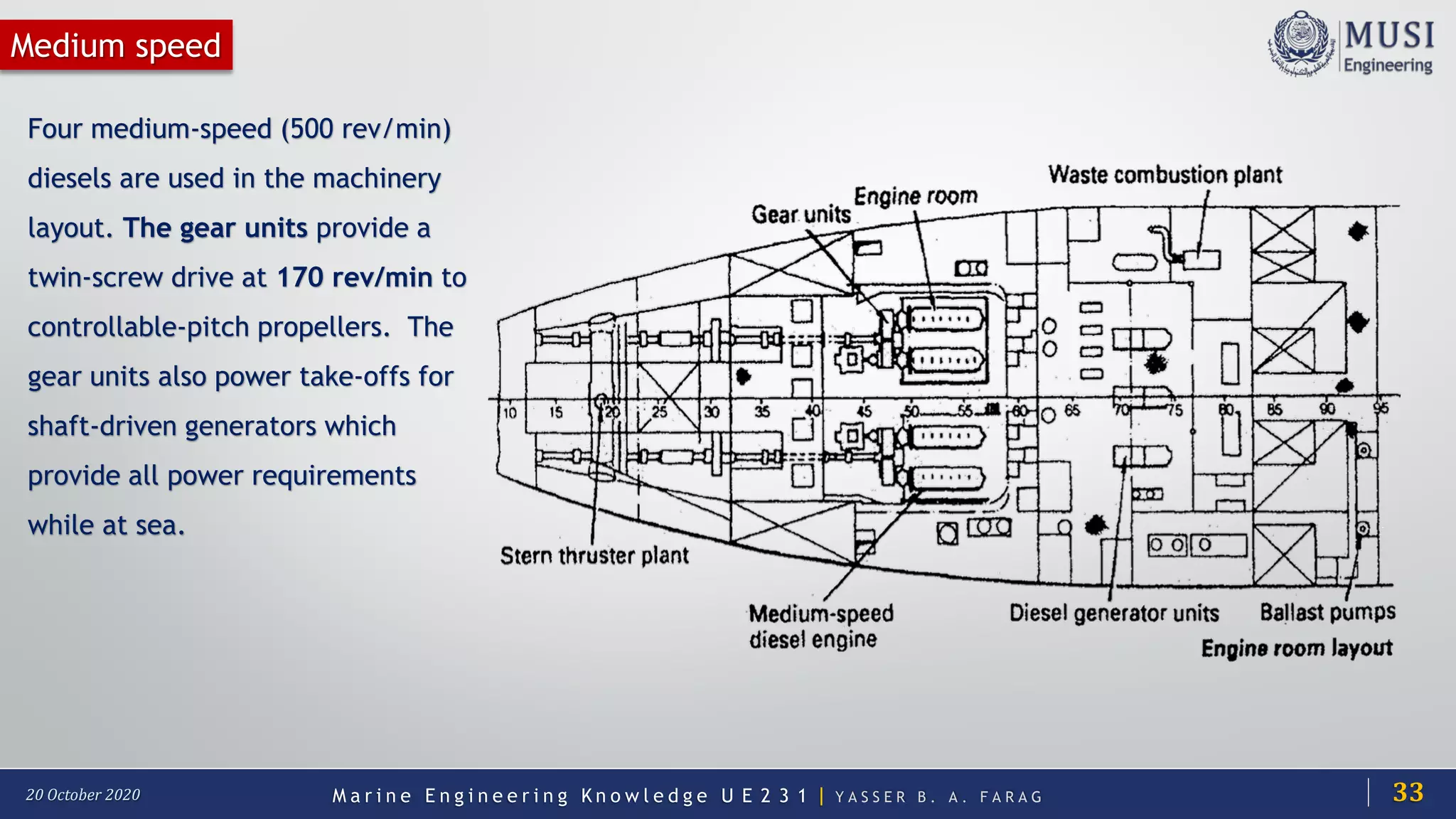
Medium speed
Four medium-speed (500 rev/min)
diesels are used in the machinery
layout. The gear units provide a
twin-screw drive at 170 rev/min to
controllable-pitch propellers. The
gear units also power take-offs for
shaft-driven generators which
provide all power requirements
while at sea.
33
M a r i n e E n g i n e e r i n g K n o w l e d g e U E 2 3 1 | Y A S S E R B . A . F A R A G20 October 2020
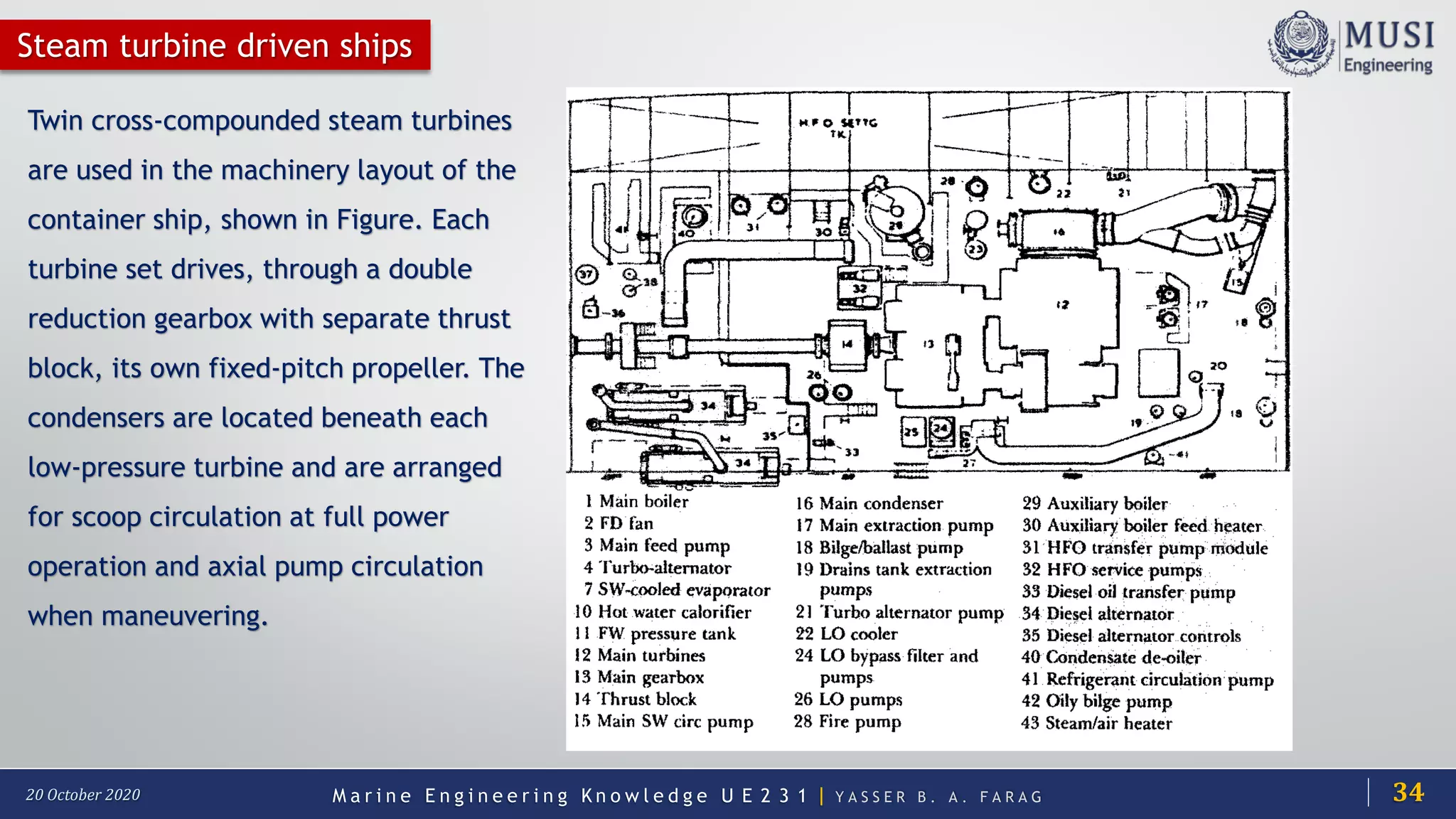
Steam turbine driven ships
Twin cross-compounded steam turbines
are used in the machinery layout of the
container ship, shown in Figure. Each
turbine set drives, through a double
reduction gearbox with separate thrust
block, its own fixed-pitch propeller. The
condensers are located beneath each
low-pressure turbine and are arranged
for scoop circulation at full power
operation and axial pump circulation
when maneuvering.
34

Ue231 course intro

  • 1.
    Yasser B. A.Farag MSc. of Maritime Energy Management - - Sweden Lecturer at Institute of Maritime Upgrading Studies Maritime Chief Engineer Maritime Upgrading Studies Institute - 2 0 2 0 - Marine Engineering Knowledge UE231
  • 2.
    Ship’s types Low speed Engines Medium speed Engines Highspeed turbines Thrust mechanism Shaft alignment Thrust block Stern tube Pilgrim nut Propeller shaft removal Shaft balancing Vibration Intro to Hydraulic sys CPP S/G system requirement s Telemotor system Power unit Control unit Actuators Crosshead arrangement Electrical steering gear General pumping system Positive displacement pumps Roro- dynamic pumps Priming methods Axial flow pump Pump shaft sealing Cavitation Cargo systems Introductio n Shell & Tube Plate type HE Temperature control Maintenance Fire tube boiler Water tube boiler Boiler automation Common boiler fittings Safety valves Boiler corrosion Boiler Water treatment Low pressure evaporator Two stage evaporator Reverse osmosis evaporator Types of valves Central cooling system Fire system Bilge & Ballast system Drinking water treatment Domestic F.W system Refining process Settling tank Filtration Purifiers & Clarifiers Purifying process Auto clean purifier Shipboard oil tests Marine Pollution Sewage OWS Air Pollution Q & A Refrigeration Cycle Compressor Exp.Valve Air Conditioning Comfort Zone A/C Systems Types & Classification P-V diagram Intercooling Volumetric Eff. Valves Anchor Handling Mooring equipment Deck Cranes UE231 C o u r s e C o n t e n t s Machinery space layout © Y a s s e r B . A . F a r a g - 2 0 2 0
  • 3.
    M a ri n e E n g i n e e r i n g K n o w l e d g e U E 2 3 1 | Y A S S E R B . A . F A R A G20 October 2020 Course Aim This course aims to meet the mandatory minimum requirements for knowledge, understanding and proficiency in the STCW 78 as amended. It particularly aims to meet the specific requirements stated in Chapter III, Section A-III/2 of STCW-78, as amended for the function 1 ”Marine engineering at the management level” and Function 3 “Maintenance and repair at the management level”. By completion of this course, The trainee should have the sufficient general marine engineering knowledge to carry out the related duties of the second engineer in a safe and efficient manner. 3
  • 4.
    M a ri n e E n g i n e e r i n g K n o w l e d g e U E 2 3 1 | Y A S S E R B . A . F A R A G20 October 2020 References 4
  • 6.
    M a ri n e E n g i n e e r i n g K n o w l e d g e U E 2 3 1 | Y A S S E R B . A . F A R A G20 October 2020 Ship’s types 6
  • 7.
    M a ri n e E n g i n e e r i n g K n o w l e d g e U E 2 3 1 | Y A S S E R B . A . F A R A G20 October 2020 Dry Cargo ships The basic dry cargo vessels are broadly divided into the following main categories: 1. General cargo vessels, 2. Bulk Carriers, 3. Containerships while each of them consists of several subcategories mainly depending on their technical characteristics and/or sizes. 7
  • 8.
    M a ri n e E n g i n e e r i n g K n o w l e d g e U E 2 3 1 | Y A S S E R B . A . F A R A G20 October 2020 General Cargo ships It consists of as large a clear open cargo carrying space as possible, together with the facilities required for loading and unloading the cargo. Access to the cargo storage areas or holds is provided by openings in the deck called hatches. Hatch covers of wood or steel are used to close the hatch openings when the ship is at sea. The hatch covers are made watertight and lie upon comings around the hatch which are set some distance from the upper of weather deck to reduce the risk of flooding in heavy seas. 8
  • 9.
    M a ri n e E n g i n e e r i n g K n o w l e d g e U E 2 3 1 | Y A S S E R B . A . F A R A G20 October 2020 General Cargo ships 9
  • 10.
    M a ri n e E n g i n e e r i n g K n o w l e d g e U E 2 3 1 | Y A S S E R B . A . F A R A G20 October 2020 Bulk carriers are single deck vessels which transport single commodity cargoes such as grains, sugar, and ores in bulk. The cargo carrying section of the ship is divided into holds which may have any number of arrangements, depending upon the range of cargoes to be carried. Bulk Carriers 10
  • 11.
    M a ri n e E n g i n e e r i n g K n o w l e d g e U E 2 3 1 | Y A S S E R B . A . F A R A G20 October 2020 Today, bulk carriers make up 15% - 17% of the world's merchant fleets and range in size from single-hold mini-bulk carriers to mammoth ore ships able to carry 400,000 metric tons of deadweight (DWT). A number of specialized designs exist: some can unload their own cargo, some depend on port facilities for unloading, and some even package the cargo as it is loaded. Bulk Carriers 11
  • 12.
    M a ri n e E n g i n e e r i n g K n o w l e d g e U E 2 3 1 | Y A S S E R B . A . F A R A G20 October 2020 Container ships are cargo ships that carry all of their load in truck-size intermodal containers, in a technique called containerization. They are a common means of commercial intermodal freight transport and now carry most seagoing non-bulk cargo. Container ship capacity is measured in twenty-foot equivalent units (TEU). Typical loads are a mix of 20-foot and 40-foot (2-TEU) ISO-standard containers, with the latter predominant. 12
  • 13.
    M a ri n e E n g i n e e r i n g K n o w l e d g e U E 2 3 1 | Y A S S E R B . A . F A R A G20 October 2020 1. bridge castle front, 2. deck containers, 3. foremast and mast top, 4. forecastle, 5. insulated containers in holds, 6. container refrigeration ducts, 7. double hull, 8. passageway, 13 Container ships
  • 14.
    M a ri n e E n g i n e e r i n g K n o w l e d g e U E 2 3 1 | Y A S S E R B . A . F A R A G20 October 2020 The cargo carrying section of the ship is divided into several holds which have hatch opening the full width and length of the hold. The containers are racked in special frameworks and stacked one upon the other within the hold space. Cargo handling therefore consists only of vertical movement of the cargo in the hold. Containers can also be staked on the hatch covers where a low density cargo is carried. 14 Container ships
  • 15.
    M a ri n e E n g i n e e r i n g K n o w l e d g e U E 2 3 1 | Y A S S E R B . A . F A R A G20 October 2020 Container ships Today, about 90% of non-bulk cargo worldwide is transported by container, and modern container ships can carry over 21,000 TEU. As a class, container ships now rival crude oil tankers and bulk carriers as the largest commercial vessels on the ocean. 15
  • 16.
    M a ri n e E n g i n e e r i n g K n o w l e d g e U E 2 3 1 | Y A S S E R B . A . F A R A G20 October 2020 The passenger liner or its modern equivalent the cruise liner exists to provide a means of luxurious transport between interesting destinations, in pleasant climates, for its human cargo. The passenger traveling in such a ship pays for, and expects, a superior standard of accommodations and leisure facilities. Large amounts of superstructure are therefore an essential feature of passenger ships. Several tiers of decks are fitted with large open lounges, ballrooms, swimming pools and promenade areas as in figure. Passenger ships 16
  • 17.
    M a ri n e E n g i n e e r i n g K n o w l e d g e U E 2 3 1 | Y A S S E R B . A . F A R A G20 October 2020 Large passenger liners are rare, the moderated sized cruise liner 12000 tonnes displacement now being the more prevalent. Passenger carrying capacity is around 600 with speeds in the region of 22 knots. Passenger ships 17
  • 18.
    M a ri n e E n g i n e e r i n g K n o w l e d g e U E 2 3 1 | Y A S S E R B . A . F A R A G20 October 2020 RORO ships Roll-on/roll-off (RORO or ro-ro) ships are vessels designed to carry wheeled cargo, such as cars, trucks, semi-trailer trucks, trailers, and railroad cars, that are driven on and off the ship on their own wheels 18
  • 19.
    M a ri n e E n g i n e e r i n g K n o w l e d g e U E 2 3 1 | Y A S S E R B . A . F A R A G20 October 2020 Tankers The tanker is used to carry bulk liquid cargoes the most common type being the oil tanker. Many other liquids are carried in tankers and specially constructed vessel re used for chemicals, liquefied petroleum gas, liquefied natural gas, etc. 19
  • 20.
    M a ri n e E n g i n e e r i n g K n o w l e d g e U E 2 3 1 | Y A S S E R B . A . F A R A G20 October 2020 Tankers Large amounts of piping are to be seen on the deck running from the pump rooms to the discharge manifolds positioned at amidships, port and starboard. The accommodation and machinery spaces are located aft in modern tanker. The range of sizes for oil tankers at present is enormous, from small to 700000 deadweight tones. 20
  • 21.
    M a ri n e E n g i n e e r i n g K n o w l e d g e U E 2 3 1 | Y A S S E R B . A . F A R A G20 October 2020 Liquefied gas tankers Liquefied gas tankers are used to carry, usually at low temperature, liquefied petroleum gas (LPG). A separate inner tank is usually employed to contain the liquid and this tank is supported by the outer hull which has a double bottom as in figure. 21
  • 22.
    M a ri n e E n g i n e e r i n g K n o w l e d g e U E 2 3 1 | Y A S S E R B . A . F A R A G20 October 2020 Liquefied gas tankers LPG tankers carry propane, butane, propylene, etc. which are extracted from natural gas. The gases are carried either fully pressurizes, part pressurizes part refrigerated or fully refrigerated. The fully pressurizes tank operates at 18 bar and ambient temperature, the fully refrigerated tank at 0.25 bar and -50 C. separate containment tanks within the hull are used and are surrounded by insulation where low temperatures are employed. 22
  • 23.
    M a ri n e E n g i n e e r i n g K n o w l e d g e U E 2 3 1 | Y A S S E R B . A . F A R A G20 October 2020 Liquefied gas tankers LNG tankers carry methane and other paraffin products obtained as a by product of petroleum drilling operations. The gas is carried at atmospheric pressure and temperatures as low as -164 C. in tanks of special materials which can accept the low temperature. 23
  • 24.
    M a ri n e E n g i n e e r i n g K n o w l e d g e U E 2 3 1 | Y A S S E R B . A . F A R A G20 October 2020 Liquefied gas tankers 24
  • 25.
    M a ri n e E n g i n e e r i n g K n o w l e d g e U E 2 3 1 | Y A S S E R B . A . F A R A G20 October 2020 Liquefied gas tankers 25
  • 26.
    M a ri n e E n g i n e e r i n g K n o w l e d g e U E 2 3 1 | Y A S S E R B . A . F A R A G20 October 2020 Offshore Supply vessels 26
  • 27.
    M a ri n e E n g i n e e r i n g K n o w l e d g e U E 2 3 1 | Y A S S E R B . A . F A R A G20 October 2020 Fishing vessels 27
  • 28.
    M a ri n e E n g i n e e r i n g K n o w l e d g e U E 2 3 1 | Y A S S E R B . A . F A R A G20 October 2020 Ship Machineries 1. Main Propulsion system 2. Steering gear system 3. Auxiliaries • Aux Boiler • Aux Engines • Pumps • Heat Exchangers – Fresh water generator • Compressors • Purifiers • Oily water Separator • Incinerator • Refrigerator 4. Tanks • Fuel Tanks • Oil Tanks • Fresh Water Tanks 5. Various Ship systems 28
  • 29.
    M a ri n e E n g i n e e r i n g K n o w l e d g e U E 2 3 1 | Y A S S E R B . A . F A R A G20 October 2020 1. To improve Safety 2. Cost savings 3. To improve the ship damage survivability 4. Easier shaft alignment. 5. Maximizes the cargo carrying capacity of the vessel Why the Engine Room is located in the AFT position in most of the cargo ships ? 29
  • 30.
    M a ri n e E n g i n e e r i n g K n o w l e d g e U E 2 3 1 | Y A S S E R B . A . F A R A G20 October 2020 Arrangement Three principal types of machinery installation are to be found at sea today. The three layouts involve the use of 1. Direct-coupled slow-speed diesel engines, 2. Medium-speed diesels with a gearbox, and 3. The steam turbine with a gearbox drive to the propeller. A propeller, in order to operate efficiently, must rotate at a relatively low speed. Thus, regardless of the rotational speed of the prime mover, the propeller shaft must rotate at about 80 to 100 rev/min. Engine room Layout 30
  • 31.
    M a ri n e E n g i n e e r i n g K n o w l e d g e U E 2 3 1 | Y A S S E R B . A . F A R A G20 October 2020 The slow-speed diesel engine rotates at this low speed and the crankshaft is thus directly coupled to the propeller shafting. 31 Slow speed E/R layout
  • 32.
    M a ri n e E n g i n e e r i n g K n o w l e d g e U E 2 3 1 | Y A S S E R B . A . F A R A G20 October 2020 Slow speed E/R layout 32
  • 33.
    M a ri n e E n g i n e e r i n g K n o w l e d g e U E 2 3 1 | Y A S S E R B . A . F A R A G20 October 2020 Medium speed Four medium-speed (500 rev/min) diesels are used in the machinery layout. The gear units provide a twin-screw drive at 170 rev/min to controllable-pitch propellers. The gear units also power take-offs for shaft-driven generators which provide all power requirements while at sea. 33
  • 34.
    M a ri n e E n g i n e e r i n g K n o w l e d g e U E 2 3 1 | Y A S S E R B . A . F A R A G20 October 2020 Steam turbine driven ships Twin cross-compounded steam turbines are used in the machinery layout of the container ship, shown in Figure. Each turbine set drives, through a double reduction gearbox with separate thrust block, its own fixed-pitch propeller. The condensers are located beneath each low-pressure turbine and are arranged for scoop circulation at full power operation and axial pump circulation when maneuvering. 34