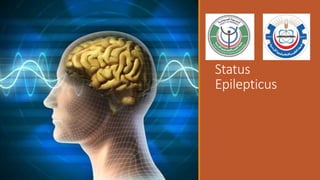
Status
Epilepticus
Status Epilepticus
•Status epilepticus is a relatively common medical and neurologic emergency that requires
prompt evaluation and treatment.
• definition of GCSE consists of the following :
●≥5 minutes of continuous seizures, or
●≥2 discrete seizures between which there is incomplete recovery of consciousness
•the incidence of status epilepticus follows a U-shaped distribution, high incidence rates in
children less than one year of age and then rising again in older adults over the age of 60 years
•Historically, the International League Against Epilepsy (ILAE) and others defined status
epilepticus as a single epileptic seizure of >30 minutes duration or a series of epileptic seizures
during which function is not regained between ictal events in a 30-minute period
•Because of the clinical urgency a 30-minute definition is neither practical nor appropriate in
clinical practice. Once seizures have continued for more than a few minutes, treatment should
begin without further delay.
Causes
Acute structural brain injury (eg, stroke, head trauma, subarachnoid hemorrhage, cerebral
anoxia or hypoxia), infection (encephalitis, meningitis, abscess), or brain tumor. Stroke is the
most common, especially in older patients.
●Remote or longstanding structural brain injury (eg, prior head injury or neurosurgery, perinatal
cerebral ischemia, cortical malformations, arteriovenous malformations, and benign brain
tumors).
●Antiseizure drug nonadherence or discontinuation in patients with prior epilepsy.
Causes
●Withdrawal syndromes associated with the discontinuation of alcohol, barbiturates, or
benzodiazepines.
●Metabolic abnormalities (eg, hypoglycemia, hepatic encephalopathy, uremia, hyponatremia,
hyperglycemia, hypocalcemia, hypomagnesemia) or sepsis.
●Use of, or overdose with, drugs that lower the seizure threshold (eg, theophylline, imipenem,
high-dose penicillin G, cefepime, quinolone antibiotics, metronidazole, isoniazid, tricyclic
antidepressants, bupropion, lithium, clozapine, flumazenil, cyclosporine, lidocaine, bupivacaine,
metrizamide, dalfampridine, and, to a lesser extent, phenothiazines, especially at higher doses).
Classification:
forms of status epilepticus with significant motor (movement) manifestations, including :
•Generalized: have obvious bilateral tonic and clonic motor activity and loss of consciousness
•focal motor:may have jerking movements restricted to one area of the body, usually with
preserved consciousness
•Myoclonic: involves much more rapid, but lower amplitude, jerking muscle activity, but with
marked variability.
•Tonic: includes slower, more sustained maintenance of a posture, or slow movement.
Diagnosis
•GCSE is a clinical diagnosis, confirmed in most cases by the presence on exam of sustained and
rhythmic generalized or focal tonic and clonic motor activity lasting for ≥5 minutes.
•Electroencephalography (EEG) is necessary in the aftermath of GCSE to exclude ongoing
nonconvulsive seizures and is mandatory for managing prolonged and refractory status
epilepticus.
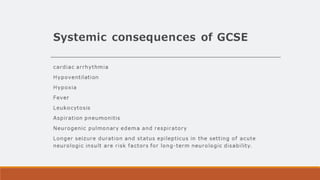
Symptoms and Complications:
Symptoms: impaired consciousness (eg, ranging from lethargy to coma); disorientation (once GCSE
is controlled); and pain associated with injuries.
Early signs: generalized convulsions; acute injuries; central nervous system (CNS) insults that cause
extensor or flexor posturing; hypothermia or fever suggestive of intercurrent illnesses (eg, sepsis or
meningitis); incontinence; normal blood pressure or hypotension; and respiratory compromise.
Late signs ( Complications):
clinical seizures may or may not be apparent; pulmonary edema with respiratory failure;
cardiac failure (dysrhythmias, arrest, or cardiogenic shock); hypotension or hypertension;
disseminated intravascular coagulation or multisystem organ failure; rhabdomyolysis; and
hyperpyrexia.
Management:
Assessment and Supportive therapy.
Initial pharmacological therapy with BZD.
urgent therapy for long term control using Non-BZD
antiseizure drug.
Assessment and Supportive:
at least 1-5 min and overlap with next phase of treatment.
-Neurological Exam
-General Evaluation with attention to Respiratory and Circulatory status
- O2 mask ± Mechanical Ventilation PRN
-at least two IV catheter.
-Blood work: Mg, Ca, P, glu, LFT, CBC, ASD level, Toxicology.
-Fingerstick glucose
-Cardiac monitoring with pulse oximetry: Frequent blood pressure.
-Frequent VS
-If hypoglycemia 70 mg/dL (treat with 100mg IV thiamine (B1) + 50ml of 50%
dextrose )
-If No IV access : IM glucagon or Intraosseous(IO) 50% dextrose
Initial therapy (BZD)
BZD are first line treatment of Convulsive SE because they control Seizure rapidly.
In First IV line:
-Lorazepam 0.1 mg/kg (Max rate 2mg/min) allowing few min(3-5) to assess its effect before
deciding to add another dose.
Alternative Fixed dose : 4mg repeated if still seizing.
NO max dose of lorazepam ; we depend on clinical effect(blood pressure and seizure control)and
EEG
-Diazepam 0.15mg/kg IV up to 10mg/dose (max rate 5mg/min)
IF NO IV ACCESS : Midazolam IM, Buccal, Intranasal (0.2mg/kg)
If wt>40kg give 10 mg
If wt<40kg give 5mg
Initial therapy(Non-BZD)
In second IV line:Long acting antiepileptic
-Fosphenytoin 20 mg/kg(PE) at a rate of 100-150 mg/min , If seizure persist after 10 min of
infusion, another dose can be given 5-10 mg/kg up to max cumulative dose of 30mg/kg.
-Phenytoin 20 mg/kg IV loading (at rate of 25-50 mg/min) If no response after 10 min I can give
another 5mg/kg
due to PEG, IF infusion rate was>50mg/minRisk of Hypotension and cardiac arryhthmia
(Cardiac monitoring required),Risk of Local pain and Injury;(purple glove syndrome,venous thrombosis)
increased with more rapid infusion.
-Valproic acid loading dose of 30 mg/kg and infused at a rate of 10 mg/kg/minute
-Levetiracetam 60mg/kg loading (Max 4500mg) Infused over 15 min .
Then Correct metabolic abnormalities if present.
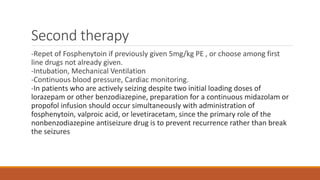
Second therapy
-Repet of Fosphenytoin if previously given 5mg/kg PE , or choose among first
line drugs not already given.
-Intubation, Mechanical Ventilation
-Continuous blood pressure, Cardiac monitoring.
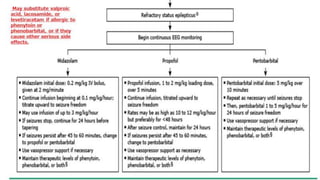
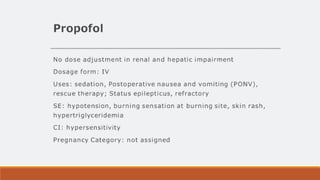
-In patients who are actively seizing despite two initial loading doses of
lorazepam or other benzodiazepine, preparation for a continuous midazolam or
propofol infusion should occur simultaneously with administration of
fosphenytoin, valproic acid, or levetiracetam, since the primary role of the
nonbenzodiazepine antiseizure drug is to prevent recurrence rather than break
the seizures
Status epilepticus.
Status epilepticus.
Status epilepticus.
Status epilepticus.
Status epilepticus.
Status epilepticus.
Status epilepticus.
Status epilepticus.

Status epilepticus.

  • 1.
  • 2.
    Status Epilepticus •Status epilepticusis a relatively common medical and neurologic emergency that requires prompt evaluation and treatment. • definition of GCSE consists of the following : ●≥5 minutes of continuous seizures, or ●≥2 discrete seizures between which there is incomplete recovery of consciousness •the incidence of status epilepticus follows a U-shaped distribution, high incidence rates in children less than one year of age and then rising again in older adults over the age of 60 years
  • 3.
    •Historically, the InternationalLeague Against Epilepsy (ILAE) and others defined status epilepticus as a single epileptic seizure of >30 minutes duration or a series of epileptic seizures during which function is not regained between ictal events in a 30-minute period •Because of the clinical urgency a 30-minute definition is neither practical nor appropriate in clinical practice. Once seizures have continued for more than a few minutes, treatment should begin without further delay.
  • 4.
    Causes Acute structural braininjury (eg, stroke, head trauma, subarachnoid hemorrhage, cerebral anoxia or hypoxia), infection (encephalitis, meningitis, abscess), or brain tumor. Stroke is the most common, especially in older patients. ●Remote or longstanding structural brain injury (eg, prior head injury or neurosurgery, perinatal cerebral ischemia, cortical malformations, arteriovenous malformations, and benign brain tumors). ●Antiseizure drug nonadherence or discontinuation in patients with prior epilepsy.
  • 5.
    Causes ●Withdrawal syndromes associatedwith the discontinuation of alcohol, barbiturates, or benzodiazepines. ●Metabolic abnormalities (eg, hypoglycemia, hepatic encephalopathy, uremia, hyponatremia, hyperglycemia, hypocalcemia, hypomagnesemia) or sepsis. ●Use of, or overdose with, drugs that lower the seizure threshold (eg, theophylline, imipenem, high-dose penicillin G, cefepime, quinolone antibiotics, metronidazole, isoniazid, tricyclic antidepressants, bupropion, lithium, clozapine, flumazenil, cyclosporine, lidocaine, bupivacaine, metrizamide, dalfampridine, and, to a lesser extent, phenothiazines, especially at higher doses).
  • 6.
    Classification: forms of statusepilepticus with significant motor (movement) manifestations, including : •Generalized: have obvious bilateral tonic and clonic motor activity and loss of consciousness •focal motor:may have jerking movements restricted to one area of the body, usually with preserved consciousness •Myoclonic: involves much more rapid, but lower amplitude, jerking muscle activity, but with marked variability. •Tonic: includes slower, more sustained maintenance of a posture, or slow movement.
  • 7.
    Diagnosis •GCSE is aclinical diagnosis, confirmed in most cases by the presence on exam of sustained and rhythmic generalized or focal tonic and clonic motor activity lasting for ≥5 minutes. •Electroencephalography (EEG) is necessary in the aftermath of GCSE to exclude ongoing nonconvulsive seizures and is mandatory for managing prolonged and refractory status epilepticus.
  • 8.
    Symptoms and Complications: Symptoms:impaired consciousness (eg, ranging from lethargy to coma); disorientation (once GCSE is controlled); and pain associated with injuries. Early signs: generalized convulsions; acute injuries; central nervous system (CNS) insults that cause extensor or flexor posturing; hypothermia or fever suggestive of intercurrent illnesses (eg, sepsis or meningitis); incontinence; normal blood pressure or hypotension; and respiratory compromise. Late signs ( Complications): clinical seizures may or may not be apparent; pulmonary edema with respiratory failure; cardiac failure (dysrhythmias, arrest, or cardiogenic shock); hypotension or hypertension; disseminated intravascular coagulation or multisystem organ failure; rhabdomyolysis; and hyperpyrexia.
  • 9.
    Management: Assessment and Supportivetherapy. Initial pharmacological therapy with BZD. urgent therapy for long term control using Non-BZD antiseizure drug.
  • 10.
    Assessment and Supportive: atleast 1-5 min and overlap with next phase of treatment. -Neurological Exam -General Evaluation with attention to Respiratory and Circulatory status - O2 mask ± Mechanical Ventilation PRN -at least two IV catheter. -Blood work: Mg, Ca, P, glu, LFT, CBC, ASD level, Toxicology. -Fingerstick glucose -Cardiac monitoring with pulse oximetry: Frequent blood pressure. -Frequent VS -If hypoglycemia 70 mg/dL (treat with 100mg IV thiamine (B1) + 50ml of 50% dextrose ) -If No IV access : IM glucagon or Intraosseous(IO) 50% dextrose
  • 11.
    Initial therapy (BZD) BZDare first line treatment of Convulsive SE because they control Seizure rapidly. In First IV line: -Lorazepam 0.1 mg/kg (Max rate 2mg/min) allowing few min(3-5) to assess its effect before deciding to add another dose. Alternative Fixed dose : 4mg repeated if still seizing. NO max dose of lorazepam ; we depend on clinical effect(blood pressure and seizure control)and EEG -Diazepam 0.15mg/kg IV up to 10mg/dose (max rate 5mg/min) IF NO IV ACCESS : Midazolam IM, Buccal, Intranasal (0.2mg/kg) If wt>40kg give 10 mg If wt<40kg give 5mg
  • 12.
    Initial therapy(Non-BZD) In secondIV line:Long acting antiepileptic -Fosphenytoin 20 mg/kg(PE) at a rate of 100-150 mg/min , If seizure persist after 10 min of infusion, another dose can be given 5-10 mg/kg up to max cumulative dose of 30mg/kg. -Phenytoin 20 mg/kg IV loading (at rate of 25-50 mg/min) If no response after 10 min I can give another 5mg/kg due to PEG, IF infusion rate was>50mg/minRisk of Hypotension and cardiac arryhthmia (Cardiac monitoring required),Risk of Local pain and Injury;(purple glove syndrome,venous thrombosis) increased with more rapid infusion. -Valproic acid loading dose of 30 mg/kg and infused at a rate of 10 mg/kg/minute -Levetiracetam 60mg/kg loading (Max 4500mg) Infused over 15 min . Then Correct metabolic abnormalities if present.
  • 13.
    Second therapy -Repet ofFosphenytoin if previously given 5mg/kg PE , or choose among first line drugs not already given. -Intubation, Mechanical Ventilation -Continuous blood pressure, Cardiac monitoring. -In patients who are actively seizing despite two initial loading doses of lorazepam or other benzodiazepine, preparation for a continuous midazolam or propofol infusion should occur simultaneously with administration of fosphenytoin, valproic acid, or levetiracetam, since the primary role of the nonbenzodiazepine antiseizure drug is to prevent recurrence rather than break the seizures

Editor's Notes

  • #13 Phenytoin (but not fosphenytoin) and any of the benzodiazepines are incompatible and will precipitate if infused through the same intravenous line; the same applies to phenytoin and any fluid with glucose/dextrose