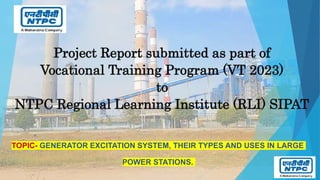
Project Report submitted as part of
Vocational Training Program (VT 2023)
to
NTPC Regional Learning Institute (RLI) SIPAT
TOPIC- GENERATOR EXCITATION SYSTEM, THEIR TYPES AND USES IN LARGE
POWER STATIONS.
Prepared by ELECT-GR-3:
NAME COLLEGE ROLL NO.
Aishwarya Dave Government Engineering College, Raipur ELECT-28
Aman Singh Bhilai Institute of Technology ELECT-29
Priyanjol Banerjee Bhilai Institute of Technology ELECT-30
Yash Raj Rathore National Institute of Technology (NIT), Raipur ELECT-31
Aditya Ghidora National Institute of Technology (NIT), Raipur ELECT-32
Priyanshu Mondal Veer Surendra Sai University of Technology, Burla ELECT-33
Arjita Mishra Government Engineering College, Bilaspur ELECT-34
Alim Khan National Institute of Technology (NIT), Raipur ELECT-35
Tushar Debta Veer Surendra Sai University of Technology ELECT-36
Gourav Priyadarsan Odisha University of Technology and Research, Bhubaneswar ELECT-37
TOPICS
Introduction
Introduction To Generator
Types Of Generator
What is Excitation?
Need for Excitation Systems and its market overview
New Technologies used for Excitation
References
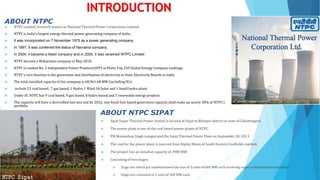
ABOUT NTPC
 NTPC Limited, formerly known as National Thermal Power Corporation Limited.
 NTPC is India’s largest energy thermal power generating company of India.
 It was incorporated on 7 November 1975 as a power generating company.
 In 1997, It was conferred the status of Navratna company.
 In 2004, it became a listed company and in 2005, it was renamed 'NTPC Limited’.
 NTPC became a Maharatna company in May 2010.
 NTPC is ranked No. 2 Independent Power Producer(IPP) in Platts Top 250 Global Energy Company rankings.
 NTPC's core function is the generation and distribution of electricity to State Electricity Boards in India.
 The total installed capacity of the company is 68,961.68 MW (including JVs)
 include 23 coal based, 7 gas based, 1 Hydro 1 Wind 18 Solar and 1 Small hydro plant.
 Under JV, NTPC has 9 coal based, 4 gas based, 8 hydro based and 5 renewable energy projects.
 The capacity will have a diversified fuel mix and by 2032, non fossil fuel-based generation capacity shall make up nearly 30% of NTPC’s
portfolio
INTRODUCTION
ABOUT NTPC SIPAT
 Sipat Super Thermal Power Station is located at Sipat in Bilaspur district in state of Chhattisgarh.
 The power plant is one of the coal based power plants of NTPC.
 PM Manmohan Singh inaugurated the Sipat Thermal Power Plant on September 20, 2013.
 The coal for the power plant is sourced from Dipika Mines of South Eastern Coalfields Limited.
 The project has an installed capacity of 2980 MW
 Consisting of two stages.
 Stage one which got commissioned late was of 3 units of 660 MW each involving super-critical boilers technology.
 Stage two consisted of 2 units of 500 MW each.
INTRODUCTION TO GENERATOR
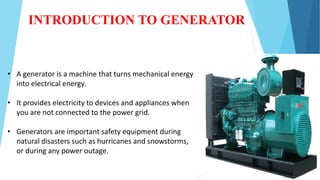
• A generator is a machine that turns mechanical energy
into electrical energy.
• It provides electricity to devices and appliances when
you are not connected to the power grid.
• Generators are important safety equipment during
natural disasters such as hurricanes and snowstorms,
or during any power outage.
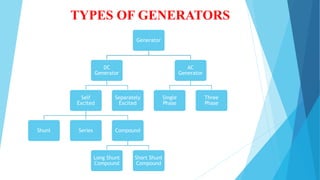
TYPES OF GENERATORS
Generator
DC
Generator
Self
Excited
Shunt Series Compound
Long Shunt
Compound
Short Shunt
Compound
Separately
Excited
AC
Generator
Single
Phase
Three
Phase
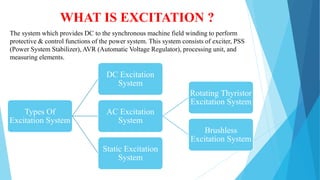
WHAT IS EXCITATION ?
The system which provides DC to the synchronous machine field winding to perform
protective & control functions of the power system. This system consists of exciter, PSS
(Power System Stabilizer), AVR (Automatic Voltage Regulator), processing unit, and
measuring elements.
Types Of
Excitation System
DC Excitation
System
AC Excitation
System
Rotating Thyristor
Excitation System
Brushless
Excitation System
Static Excitation
System
DC EXCITATION SYSTEM
The DC (Direct Current) system consists of two types of exciters they are main exciter
and pilot exciter. The exciter output is adjusted by the automatic voltage regulator to
control the alternator output terminal voltage. Across the field winding, the field discharge
resistor is connected when the field breaker is open. These two exciters in the direct
current system can be driven either by motor or by the main shaft. The main exciter
voltage rating is about 400 V.
Advantages –
The advantages of the DC system are
1) More reliable
2) Compact in size
Disadvantages –
The disadvantages of the DC system are
1) Large size
2) Voltage regulation was complex
3)Very slow response
AC EXCITATION SYSTEM
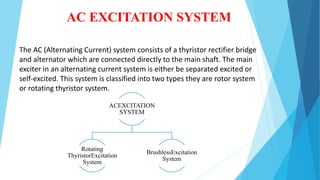
The AC (Alternating Current) system consists of a thyristor rectifier bridge
and alternator which are connected directly to the main shaft. The main
exciter in an alternating current system is either be separated excited or
self-excited. This system is classified into two types they are rotor system
or rotating thyristor system.
ACEXCITATION
SYSTEM
Rotating
ThyristorExcitation
System
BrushlessExcitation
System
Rotating Thyristor System
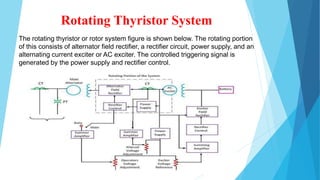
The rotating thyristor or rotor system figure is shown below. The rotating portion
of this consists of alternator field rectifier, a rectifier circuit, power supply, and an
alternating current exciter or AC exciter. The controlled triggering signal is
generated by the power supply and rectifier control.
Advantages –
The advantages of the rotating thyristor system are
1) Fast response
2) Simple
3) Low cost
Disadvantages –
The main disadvantage is the response rate of the thyristor is very low.
Brushless System
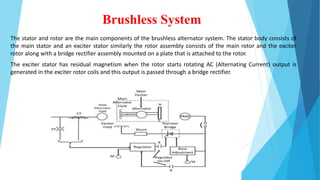
The stator and rotor are the main components of the brushless alternator system. The stator body consists of
the main stator and an exciter stator similarly the rotor assembly consists of the main rotor and the exciter
rotor along with a bridge rectifier assembly mounted on a plate that is attached to the rotor.
The exciter stator has residual magnetism when the rotor starts rotating AC (Alternating Current) output is
generated in the exciter rotor coils and this output is passed through a bridge rectifier.
Advantages –
The advantages of the brushless system are
1) Reliability is excellent
2) The flexibility of operation is good
3) System responses are good
4) There is no moving contact in the brushless system, so maintenance is low
Disadvantages –
The disadvantages of the brushless system are
1) Response is slow
2) There is no fast de-excitation
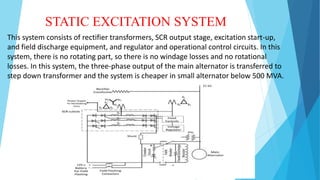
STATIC EXCITATION SYSTEM
This system consists of rectifier transformers, SCR output stage, excitation start-up,
and field discharge equipment, and regulator and operational control circuits. In this
system, there is no rotating part, so there is no windage losses and no rotational
losses. In this system, the three-phase output of the main alternator is transferred to
step down transformer and the system is cheaper in small alternator below 500 MVA.
Advantages –
The advantages of the static system are
1) Reliability is good
2) The flexibility of operation is very good
3) System responses are excellent
4) Small in size
5) Low loss
6) Simple
7) High performance
Disadvantages –
The main disadvantages of the static system are, it requires a slip ring and brush.
WHY EXCITATION IS NEEDED ?
All electrical generators require excitation to create electrical energy. The excitation system excites the
armature by creating a magnetic field on the rotor via a DC current. The output voltage of the armature
varies with the strength of the magnetic field.
Thus, the excitation system controls the output voltage of the generator by adjusting DC current to the
generator field winding. Excitation systems have two general classifications - rotating exciters or static
exciters.
Rotating exciters typically have the following characteristics:
• Usually mounted to the end of the generator shaft
• Uses an excitation current typically less than 150 amperes
• Small voltage regulator, 1 or 2 cabinets
Static Exciters have following characteristic than rotating exciters:
• Connects directly to the generator rotor using brushes and sliprings
• Capacity from 300 to 10,000 amperes
• Large voltage regulator, multiple large cabinets
EXCITATION SYSTEMS MARKET
OVERVIEW
BASED ON TYPES OF EXCITATION SYSTEMS
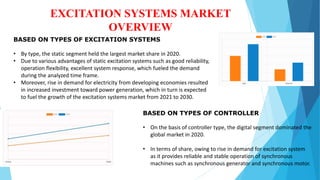
• By type, the static segment held the largest market share in 2020.
• Due to various advantages of static excitation systems such as good reliability,
operation flexibility, excellent system response, which fueled the demand
during the analyzed time frame.
• Moreover, rise in demand for electricity from developing economies resulted
in increased investment toward power generation, which in turn is expected
to fuel the growth of the excitation systems market from 2021 to 2030.
BASED ON TYPES OF CONTROLLER
• On the basis of controller type, the digital segment dominated the
global market in 2020.
• In terms of share, owing to rise in demand for excitation system
as it provides reliable and stable operation of synchronous
machines such as synchronous generator and synchronous motor.
EXCITATION SYSTEMS MARKET
OVERVIEW
BASED ON APPLICATION
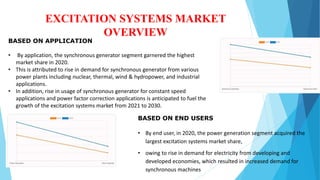
• By application, the synchronous generator segment garnered the highest
market share in 2020.
• This is attributed to rise in demand for synchronous generator from various
power plants including nuclear, thermal, wind & hydropower, and industrial
applications.
• In addition, rise in usage of synchronous generator for constant speed
applications and power factor correction applications is anticipated to fuel the
growth of the excitation systems market from 2021 to 2030.
BASED ON END USERS
• By end user, in 2020, the power generation segment acquired the
largest excitation systems market share,
• owing to rise in demand for electricity from developing and
developed economies, which resulted in increased demand for
synchronous machines
NEW TECHNOLOGIES USED IN EXCITATION
SYSTEMS
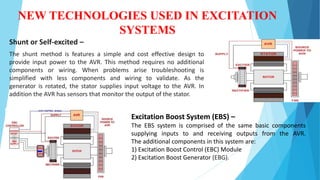
Shunt or Self-excited –
The shunt method is features a simple and cost effective design to
provide input power to the AVR. This method requires no additional
components or wiring. When problems arise troubleshooting is
simplified with less components and wiring to validate. As the
generator is rotated, the stator supplies input voltage to the AVR. In
addition the AVR has sensors that monitor the output of the stator.
Excitation Boost System (EBS) –
The EBS system is comprised of the same basic components
supplying inputs to and receiving outputs from the AVR.
The additional components in this system are:
1) Excitation Boost Control (EBC) Module
2) Excitation Boost Generator (EBG).
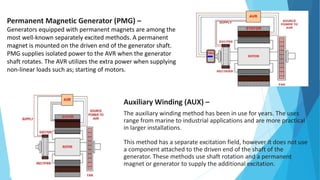
Permanent Magnetic Generator (PMG) –
Generators equipped with permanent magnets are among the
most well-known separately excited methods. A permanent
magnet is mounted on the driven end of the generator shaft.
PMG supplies isolated power to the AVR when the generator
shaft rotates. The AVR utilizes the extra power when supplying
non-linear loads such as; starting of motors.
Auxiliary Winding (AUX) –
The auxiliary winding method has been in use for years. The uses
range from marine to industrial applications and are more practical
in larger installations.
This method has a separate excitation field, however it does not use
a component attached to the driven end of the shaft of the
generator. These methods use shaft rotation and a permanent
magnet or generator to supply the additional excitation.
REFERENCES
 Chapter 1 - Introduction to Generator
1) https://www.vedantu.com/question-answer/type-of-generator-are-used-at-power-stations-class-12-physics-cbse-60da9bf7ce897353c3d8f5d6
2) https://www.homedepot.com/c/ab/generator-buying-guide/9ba683603be9fa5395fab9054dc2520
 Chapter 2 - Types Of Generator
https://byjus.com/physics
 Chapter 4 – Types of Excitation Systems
https://www.elprocus.com/what-is-an-excitation-system-types-and-its-elements/
 Chapter 5 – Why Excitation Is Needed?
https://www.alliedmarketresearch.com/excitation-systems-market-A10794
 Chapter 6 – Excitation System Market Overview
https://www.emerson.com/en-in/automation/control-and-safety-systems/distributed-control-systems-dcs/ovation-distributed-control-system/generator-exciter-
controls/what-is-an-excitation-system#:~:text=All%20electrical%20generators%20require%20excitation,strength%20of%20the%20magnetic%20field.
 Chapter 7 - How To Overcome Excitation Using New Techniques
https://www.generatorsource.com/Generator-Excitation-Methods.aspx

Ntpc project on electricity generation thermal

  • 1.
    Project Report submittedas part of Vocational Training Program (VT 2023) to NTPC Regional Learning Institute (RLI) SIPAT TOPIC- GENERATOR EXCITATION SYSTEM, THEIR TYPES AND USES IN LARGE POWER STATIONS.
  • 2.
    Prepared by ELECT-GR-3: NAMECOLLEGE ROLL NO. Aishwarya Dave Government Engineering College, Raipur ELECT-28 Aman Singh Bhilai Institute of Technology ELECT-29 Priyanjol Banerjee Bhilai Institute of Technology ELECT-30 Yash Raj Rathore National Institute of Technology (NIT), Raipur ELECT-31 Aditya Ghidora National Institute of Technology (NIT), Raipur ELECT-32 Priyanshu Mondal Veer Surendra Sai University of Technology, Burla ELECT-33 Arjita Mishra Government Engineering College, Bilaspur ELECT-34 Alim Khan National Institute of Technology (NIT), Raipur ELECT-35 Tushar Debta Veer Surendra Sai University of Technology ELECT-36 Gourav Priyadarsan Odisha University of Technology and Research, Bhubaneswar ELECT-37
  • 3.
    TOPICS Introduction Introduction To Generator TypesOf Generator What is Excitation? Need for Excitation Systems and its market overview New Technologies used for Excitation References
  • 4.
    ABOUT NTPC  NTPCLimited, formerly known as National Thermal Power Corporation Limited.  NTPC is India’s largest energy thermal power generating company of India.  It was incorporated on 7 November 1975 as a power generating company.  In 1997, It was conferred the status of Navratna company.  In 2004, it became a listed company and in 2005, it was renamed 'NTPC Limited’.  NTPC became a Maharatna company in May 2010.  NTPC is ranked No. 2 Independent Power Producer(IPP) in Platts Top 250 Global Energy Company rankings.  NTPC's core function is the generation and distribution of electricity to State Electricity Boards in India.  The total installed capacity of the company is 68,961.68 MW (including JVs)  include 23 coal based, 7 gas based, 1 Hydro 1 Wind 18 Solar and 1 Small hydro plant.  Under JV, NTPC has 9 coal based, 4 gas based, 8 hydro based and 5 renewable energy projects.  The capacity will have a diversified fuel mix and by 2032, non fossil fuel-based generation capacity shall make up nearly 30% of NTPC’s portfolio INTRODUCTION ABOUT NTPC SIPAT  Sipat Super Thermal Power Station is located at Sipat in Bilaspur district in state of Chhattisgarh.  The power plant is one of the coal based power plants of NTPC.  PM Manmohan Singh inaugurated the Sipat Thermal Power Plant on September 20, 2013.  The coal for the power plant is sourced from Dipika Mines of South Eastern Coalfields Limited.  The project has an installed capacity of 2980 MW  Consisting of two stages.  Stage one which got commissioned late was of 3 units of 660 MW each involving super-critical boilers technology.  Stage two consisted of 2 units of 500 MW each.
  • 5.
    INTRODUCTION TO GENERATOR •A generator is a machine that turns mechanical energy into electrical energy. • It provides electricity to devices and appliances when you are not connected to the power grid. • Generators are important safety equipment during natural disasters such as hurricanes and snowstorms, or during any power outage.
  • 6.
    TYPES OF GENERATORS Generator DC Generator Self Excited ShuntSeries Compound Long Shunt Compound Short Shunt Compound Separately Excited AC Generator Single Phase Three Phase
  • 7.
    WHAT IS EXCITATION? The system which provides DC to the synchronous machine field winding to perform protective & control functions of the power system. This system consists of exciter, PSS (Power System Stabilizer), AVR (Automatic Voltage Regulator), processing unit, and measuring elements. Types Of Excitation System DC Excitation System AC Excitation System Rotating Thyristor Excitation System Brushless Excitation System Static Excitation System
  • 8.
    DC EXCITATION SYSTEM TheDC (Direct Current) system consists of two types of exciters they are main exciter and pilot exciter. The exciter output is adjusted by the automatic voltage regulator to control the alternator output terminal voltage. Across the field winding, the field discharge resistor is connected when the field breaker is open. These two exciters in the direct current system can be driven either by motor or by the main shaft. The main exciter voltage rating is about 400 V.
  • 9.
    Advantages – The advantagesof the DC system are 1) More reliable 2) Compact in size Disadvantages – The disadvantages of the DC system are 1) Large size 2) Voltage regulation was complex 3)Very slow response
  • 10.
    AC EXCITATION SYSTEM TheAC (Alternating Current) system consists of a thyristor rectifier bridge and alternator which are connected directly to the main shaft. The main exciter in an alternating current system is either be separated excited or self-excited. This system is classified into two types they are rotor system or rotating thyristor system. ACEXCITATION SYSTEM Rotating ThyristorExcitation System BrushlessExcitation System
  • 11.
    Rotating Thyristor System Therotating thyristor or rotor system figure is shown below. The rotating portion of this consists of alternator field rectifier, a rectifier circuit, power supply, and an alternating current exciter or AC exciter. The controlled triggering signal is generated by the power supply and rectifier control.
  • 12.
    Advantages – The advantagesof the rotating thyristor system are 1) Fast response 2) Simple 3) Low cost Disadvantages – The main disadvantage is the response rate of the thyristor is very low.
  • 13.
    Brushless System The statorand rotor are the main components of the brushless alternator system. The stator body consists of the main stator and an exciter stator similarly the rotor assembly consists of the main rotor and the exciter rotor along with a bridge rectifier assembly mounted on a plate that is attached to the rotor. The exciter stator has residual magnetism when the rotor starts rotating AC (Alternating Current) output is generated in the exciter rotor coils and this output is passed through a bridge rectifier.
  • 14.
    Advantages – The advantagesof the brushless system are 1) Reliability is excellent 2) The flexibility of operation is good 3) System responses are good 4) There is no moving contact in the brushless system, so maintenance is low Disadvantages – The disadvantages of the brushless system are 1) Response is slow 2) There is no fast de-excitation
  • 15.
    STATIC EXCITATION SYSTEM Thissystem consists of rectifier transformers, SCR output stage, excitation start-up, and field discharge equipment, and regulator and operational control circuits. In this system, there is no rotating part, so there is no windage losses and no rotational losses. In this system, the three-phase output of the main alternator is transferred to step down transformer and the system is cheaper in small alternator below 500 MVA.
  • 16.
    Advantages – The advantagesof the static system are 1) Reliability is good 2) The flexibility of operation is very good 3) System responses are excellent 4) Small in size 5) Low loss 6) Simple 7) High performance Disadvantages – The main disadvantages of the static system are, it requires a slip ring and brush.
  • 17.
    WHY EXCITATION ISNEEDED ? All electrical generators require excitation to create electrical energy. The excitation system excites the armature by creating a magnetic field on the rotor via a DC current. The output voltage of the armature varies with the strength of the magnetic field. Thus, the excitation system controls the output voltage of the generator by adjusting DC current to the generator field winding. Excitation systems have two general classifications - rotating exciters or static exciters. Rotating exciters typically have the following characteristics: • Usually mounted to the end of the generator shaft • Uses an excitation current typically less than 150 amperes • Small voltage regulator, 1 or 2 cabinets Static Exciters have following characteristic than rotating exciters: • Connects directly to the generator rotor using brushes and sliprings • Capacity from 300 to 10,000 amperes • Large voltage regulator, multiple large cabinets
  • 18.
    EXCITATION SYSTEMS MARKET OVERVIEW BASEDON TYPES OF EXCITATION SYSTEMS • By type, the static segment held the largest market share in 2020. • Due to various advantages of static excitation systems such as good reliability, operation flexibility, excellent system response, which fueled the demand during the analyzed time frame. • Moreover, rise in demand for electricity from developing economies resulted in increased investment toward power generation, which in turn is expected to fuel the growth of the excitation systems market from 2021 to 2030. BASED ON TYPES OF CONTROLLER • On the basis of controller type, the digital segment dominated the global market in 2020. • In terms of share, owing to rise in demand for excitation system as it provides reliable and stable operation of synchronous machines such as synchronous generator and synchronous motor.
  • 19.
    EXCITATION SYSTEMS MARKET OVERVIEW BASEDON APPLICATION • By application, the synchronous generator segment garnered the highest market share in 2020. • This is attributed to rise in demand for synchronous generator from various power plants including nuclear, thermal, wind & hydropower, and industrial applications. • In addition, rise in usage of synchronous generator for constant speed applications and power factor correction applications is anticipated to fuel the growth of the excitation systems market from 2021 to 2030. BASED ON END USERS • By end user, in 2020, the power generation segment acquired the largest excitation systems market share, • owing to rise in demand for electricity from developing and developed economies, which resulted in increased demand for synchronous machines
  • 20.
    NEW TECHNOLOGIES USEDIN EXCITATION SYSTEMS Shunt or Self-excited – The shunt method is features a simple and cost effective design to provide input power to the AVR. This method requires no additional components or wiring. When problems arise troubleshooting is simplified with less components and wiring to validate. As the generator is rotated, the stator supplies input voltage to the AVR. In addition the AVR has sensors that monitor the output of the stator. Excitation Boost System (EBS) – The EBS system is comprised of the same basic components supplying inputs to and receiving outputs from the AVR. The additional components in this system are: 1) Excitation Boost Control (EBC) Module 2) Excitation Boost Generator (EBG).
  • 21.
    Permanent Magnetic Generator(PMG) – Generators equipped with permanent magnets are among the most well-known separately excited methods. A permanent magnet is mounted on the driven end of the generator shaft. PMG supplies isolated power to the AVR when the generator shaft rotates. The AVR utilizes the extra power when supplying non-linear loads such as; starting of motors. Auxiliary Winding (AUX) – The auxiliary winding method has been in use for years. The uses range from marine to industrial applications and are more practical in larger installations. This method has a separate excitation field, however it does not use a component attached to the driven end of the shaft of the generator. These methods use shaft rotation and a permanent magnet or generator to supply the additional excitation.
  • 22.
    REFERENCES  Chapter 1- Introduction to Generator 1) https://www.vedantu.com/question-answer/type-of-generator-are-used-at-power-stations-class-12-physics-cbse-60da9bf7ce897353c3d8f5d6 2) https://www.homedepot.com/c/ab/generator-buying-guide/9ba683603be9fa5395fab9054dc2520  Chapter 2 - Types Of Generator https://byjus.com/physics  Chapter 4 – Types of Excitation Systems https://www.elprocus.com/what-is-an-excitation-system-types-and-its-elements/  Chapter 5 – Why Excitation Is Needed? https://www.alliedmarketresearch.com/excitation-systems-market-A10794  Chapter 6 – Excitation System Market Overview https://www.emerson.com/en-in/automation/control-and-safety-systems/distributed-control-systems-dcs/ovation-distributed-control-system/generator-exciter- controls/what-is-an-excitation-system#:~:text=All%20electrical%20generators%20require%20excitation,strength%20of%20the%20magnetic%20field.  Chapter 7 - How To Overcome Excitation Using New Techniques https://www.generatorsource.com/Generator-Excitation-Methods.aspx