Understanding
Culture, Society
& Politics
Module 7:
Forms and
Functions of
State and Non-
state Institution
Specific Objectives:
a. identify the different forms and
functions of state and non-state
institutions;
b. describe each form of state and non-state
institutions;
c. explain how state and non-state
institutions function.
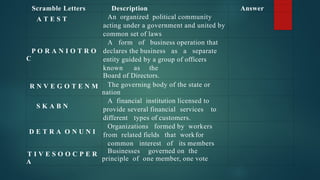
Scramble Letters Description Answer
A T E S T An organized political community
acting under a government and united by
common set of laws
P O R A N I O T R O
C
A form of business operation that
declares the business as a separate
entity guided by a group of officers
known as the
Board of Directors.
R N V E G O T E N M The governing body of the state or
nation
S K A B N
A financial institution licensed to
provide several financial services to
different types of customers.
D E T R A O N U N I
Organizations formed by workers
from related fields that workfor
common interest of its members
T I V E S O O C P E R
A
Businesses governed on the
principle of one member, one vote
STATE
 A state is an organized political community
acting under a government and united by
common set of laws. It uses absolute power in
directing the path of a society. It also uses

complete political coerciveness, which may
come in the form of armed forces personnel,
stricter laws, and rigid government policies in
order to attain its societal goals and objectives.
Market exchange
Market exchange is the primary
form of economic subsistence of
a state wherein standardized
currencies are being used to
exchange commodities.
 States differ in sovereignty, governance,
geography, and interests. It may be
classified as sovereign if they are not
dependent on, or subject to, any other
power or state. Other states are subject to
external sovereignty where ultimate
sovereignty lies another state.
 The concept of the state is different from the
concept of government. A government is the
particular group of people that controls the state
at a given time. In other words, governments are
the means through which the state power us
employed like applying the rule of law.
 The concept of the state is also different from the
concept of a nation, which refers to a large
geographical area and the people therein who
perceives themselves as having a common
identity. The state is a political geopolitical entity;
the nation is a cultural or ethnic entity.
Elements of the States
1. Population
It is the people who make the state.
Population is essential for the state.
Without population there can be no
State.
Elements of the States
2. Territory
There can be no state without a fixed
territory. People need territory to live
and organize themselves socially and
politically. It may be remembered that
the territory of the states includes land,
water and airspace.
Elements of the States
3. Government
It is the organization or machinery or
agency of the State which makes,
implements, enforces, and adjudicates
the laws of the state.
Elements of the States
4. Sovereignty
It is the most exclusive elements of State.
Without sovereignty no state can exist.
State has the exclusive title and prerogative
to exercise supreme power over all its
people and territory. It is the basis which
the State regulates all aspects of the life of
the people living in its territory.
Forms of States
States come in a variety of forms that vary on who holds power, how positions
of leadership are obtained, and how authority is maintained. These are:
a. Authoritarian Government
Authoritarian governments differ in
who holds power and in how control
they assume over those who govern. An
example of this type is Monarchy.
Forms of States
Monarchy is a form of government in which supreme power is
for life or until abdication. The person who heads a monarchy is
called a monarch. Some monarchs hold unlimited political
powers while many constitutional monarchies, such as the
United Kingdom and Thailand. Currently, 44 nations in the world
have monarchs as head of state.
Totalitarianism is a political system that strives to regulate nearly
every aspect of public and private life. It theoretically permits no
individual freedom and that seeks to subordinate all aspects of
individual life to the authority of the state. Modern examples of
totalitarian states include the Soviet Union under Joseph Stalin, Nazi
Germany under Adolf Hitler, the People’s Republic of China under
Mao Zedong, and North Korea under the Kim Dynasty.
b. Oligarchic Government
An oligarchy is a form of government in which power effectively rests with a
small-elite segment of society distinguished by royalty, wealth, family,
military, or religious hegemony. An oligarchy does not have one clear ruler,
but several powerful people who rule. One common example is
theocracy.
Theocracy is a government by divine guidance or by official who are
regarded as divinely guided. Leaders are members of the clergy, and the
state’s legal system is based on religious law. Contemporary examples of
theocracies include Saudi Arabia, Iran, and the Vatican.
 c. Democratic Government
Democracy is a form of government in which the right to governs is
held by the majority of citizens within a country or a state. The two
principles of democracy are that all citizens have equal access to
power and that all citizens enjoy universally recognized freedoms
and
liberties. People can either become country leaders through
electoral
process or elect leaders who represent the core values and beliefs.
There are 99 democratic nations globally. Examples of democratic
nations are Philippines, Norway, New Zealand, United States of
America, Canada, Columbia, Italy, and South Africa.
Roles of the States
1. State provides security against external aggressions and war. For this
purpose, the state maintains an army.
2. State ensures security against internal disturbances disorders and crimes.
For this purpose, the state maintains police.
3. State legally grants and guarantees the rights of the people.
4. The state issues and regulates currency and coinage.
5. State undertakes steps for the creation of necessary conditions for the
socio-economic-politico-cultural development of the people.
6. State grants citizenship and protects their interests and rights.
7. State conducts foreign relations, foreign trade and economic relations.
8. State secures the goals of national interest in international relations
Nonstate Institutions
 Nonstate institutions are people and/ or organization
that participate in international affairs and relations
but are not affiliated with any state or nation.
 These nonstate institutions include the following: bank
and corporations, cooperatives and trade unions,
transnational advocacy groups, and development
agencies and international organizations. These
nonstate institutions are equally capable of
influencing policy formation and implementation.
a. Banks
 A. Bank is a financial institution licensed to
provide several financial services to different
types of customers. Banks are in operation
mainly for their deposits and lending functions.
Customers are allowed to deposit their money to
banks which grow through an interest rate.
Banks also provide loans, with an interest to
customers who need money either for personal
consumption or for investment and businesses.
Banks may be categorized into major forms such
as commercial banks and investment banks.
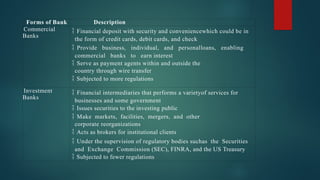
Forms of Bank Description
Commercial
Banks
 Financial deposit with security and conveniencewhich could be in
the form of credit cards, debit cards, and check
 Provide business, individual, and personalloans, enabling
commercial banks to earn interest
 Serve as payment agents within and outside the
country through wire transfer
 Subjected to more regulations
Investment
Banks
 Financial intermediaries that performs a varietyof services for
businesses and some government
 Issues securities to the investing public
 Make markets, facilities, mergers, and other
corporate reorganizations
 Acts as brokers for institutional clients
 Under the supervision of regulatory bodies suchas the Securities
and Exchange Commission (SEC), FINRA, and the US Treasury
 Subjected to fewer regulations
The two most well-known
financial institutions
 World Bank
 Asian Development Bank
b. Corporations
It is a form of business operation that declares the business as
a separate entity guided by a group of officers known as the
Board of Directors. They were created by individuals,
stockholders or shareholders, with the purpose of operating
for profit. They have all legal rights of an individual, except for
the right to vote and certain limitations. They are given the
right to exist by the state that issues their charter. Corporation
example Includes General Motors Corporation an icon of
American craftsmanship, Apple Corporation as one of the
famous tech companies, Amazon Corporation founded by
Jeff Bezos is the world’s leading ecommerce and innovation
company, Domino’s Pizza is a global food chain company
delivering quality food worldwide.
Common Types of Corporations
 For-profit entitiesform most corporations,
and they are formed to generate revenues
and provide a return to their shareholders,
according to their percentage of ownership in the
corporation. Examples: HBO in partnership with
International Rescue Committee, Ford Motors and
Lynda.com.
Common Types of Corporations
 Not-for-profit entities operate under the category of
charitable organizations, which are dedicated to a
particular social cause such as educational, religious,
scientific, or research purposes. Rather than distribute
revenues to shareholders, not-for-profit organizations use
their revenues to further their objectives. Human Rights
Campaign is a very impressive example of using Facebook
profile photos to spread the word far and wide about
campaign. Greenpeace the environmental non-profitthat
used GPS technology to inform the public about their
cause.
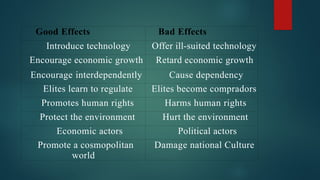
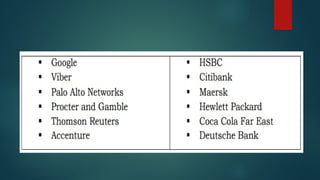
Multinational Corporations
Multinational Corporations (MNCs) are
business organization that extends
ownership, management, production,
and sales activities into several or more
countries. MNCs are boon to the
economic growth and development of
the states
Good Effects Bad Effects
Introduce technology Offer ill-suited technology
Encourage economic growth Retard economic growth
Encourage interdependently Cause dependency
Elites learn to regulate Elites become compradors
Promotes human rights Harms human rights
Protect the environment Hurt the environment
Economic actors Political actors
Promote a cosmopolitan
world
Damage national Culture
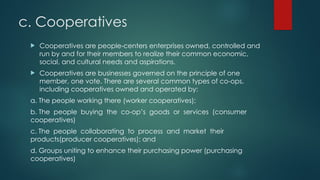
c. Cooperatives
 Cooperatives are people-centers enterprises owned, controlled and
run by and for their members to realize their common economic,
social, and cultural needs and aspirations.
 Cooperatives are businesses governed on the principle of one
member, one vote. There are several common types of co-ops,
including cooperatives owned and operated by:
a. The people working there (worker cooperatives);
b. The people buying the co-op’s goods or services (consumer
cooperatives)
c. The people collaborating to process and market their
products(producer cooperatives); and
d. Groups uniting to enhance their purchasing power (purchasing
cooperatives)
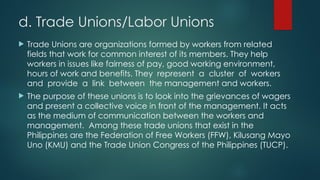
d. Trade Unions/Labor Unions
 Trade Unions are organizations formed by workers from related
fields that work for common interest of its members. They help
workers in issues like fairness of pay, good working environment,
hours of work and benefits. They represent a cluster of workers
and provide a link between the management and workers.
 The purpose of these unions is to look into the grievances of wagers
and present a collective voice in front of the management. It acts
as the medium of communication between the workers and
management. Among these trade unions that exist in the
Philippines are the Federation of Free Workers (FFW), Kilusang Mayo
Uno (KMU) and the Trade Union Congress of the Philippines (TUCP).
Functions of Trade Unions:
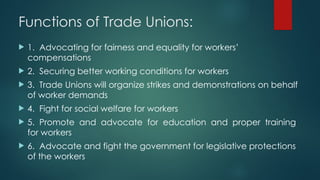
 1. Advocating for fairness and equality for workers’
compensations
 2. Securing better working conditions for workers
 3. Trade Unions will organize strikes and demonstrations on behalf
of worker demands
 4. Fight for social welfare for workers
 5. Promote and advocate for education and proper training
for workers
 6. Advocate and fight the government for legislative protections
of the workers
Functions of Trade Unions:
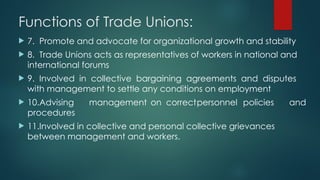
 7. Promote and advocate for organizational growth and stability
 8. Trade Unions acts as representatives of workers in national and
international forums
 9. Involved in collective bargaining agreements and disputes
with management to settle any conditions on employment
 10.Advising management on correctpersonnel policies and
procedures
 11.Involved in collective and personal collective grievances
between management and workers.
e. Transnational Advocacy Groups
 Transnational Advocacy Groups (TAGs) play an increasingly important role in
international and regional politics and have contributed to changing policies of
multilateral organizations and states. They are particularly visible in contentious
areas as human rights, environmental issues, international peace, and women’s rights.
They have specific roles to partake that can be achieved through effective
measures, case-specific methods, and activities.
 TAGs serve as international catalysts for change, aiming to achieve international
changes towards policies and practices. The very essence TAGS is the formation and
development of their advocacies and campaigns that represent causes, ideas,
values, and beliefs.
 Human Rights Watch and Amnesty are active in the human rights field. Oxfam and
Save children deal with humanitarian issues. Greenpeace and Friends of the Earth
represent environmental concerns.
f. Development Agencies
 Development Agencies have been established to
develop the cooperation between the public sector,
private sector, and civil society. These are organizations
with specific aims and goals. The common denominator
among these organizations is the term development. These
agencies concentrate on the growth, progression, and
advancement of specific concerns, which can be
infrastructure or social institutions.
Types of Development Agencies:
 International Organization is an institutionwith membership drawn from two or
more countries. Its activities transcend national boundaries as it facilitates
cooperation among its members in the performance of one or more tasks. The
international organization can be public or private. A public organization is an
international government organization (IGO) with states as its members. Prominent
examples of IGOs are United Nations, the North Atlantic Treaty
Organization (NATO),
 International Monetary Fund (IMF), European Union (EU), Association of Southeast
Asian Nations (ASEAN), and World Health Organization (WHO). A private organization
has a membership of individuals or groups and is an international nongovernment
organization (INGO) that originate for reasons other than politics such as International
Criminal Police Organization (Interpol). INGOs may lobby or work regularly with the
government and IGOs.
Types of Development Agencies:
 Non-government Organization is a non-profit group that functions independently of any
government. It serves the social or political goals such as humanitarian and
environmental causes. Most NGOs aim to promote the practice of democracy
among societies and social change through their initiatives and organizational
methods. Many NGOs have targeted their efforts toward population groups that
tend to be underserved by governmental programs, including women, the aged,
physically and mentally disabled persons, the poor, and various social groups that have
been marginalized by virtue of race, religion, ethnicity, caste, and social class.
Interrelationship of Government
and Non-state Institutions
 Government rules society. This reflects how powerful
government institution can be. If nonstate institutions
interfere with the governing body, two possible things
can happen:
 1. Integration among these two institutions may take
place to achieve precise solution towards
development
 2. Conflict and tension may also arise because one
could exceed the other in terms of societal control
and influences (Penninx, 2013)
Assessment
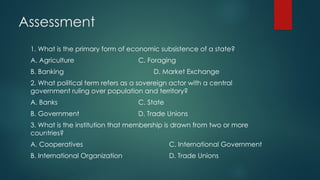
1. What is the primary form of economic subsistence of a state?
A. Agriculture C. Foraging
B. Banking D. Market Exchange
2. What political term refers as a sovereign actor with a central
government ruling over population and territory?
A. Banks C. State
B. Government D. Trade Unions
3. What is the institution that membership is drawn from two or more
countries?
A. Cooperatives C. International Government
B. International Organization D. Trade Unions
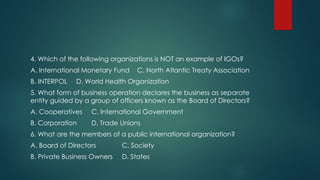
4. Which of the following organizations is NOT an example of IGOs?
A. International Monetary Fund C. North Atlantic Treaty Association
B. INTERPOL D. World Health Organization
5. What form of business operation declares the business as separate
entity guided by a group of officers known as the Board of Directors?
A. Cooperatives C. International Government
B. Corporation D. Trade Unions
6. What are the members of a public international organization?
A. Board of Directors C. Society
B. Private Business Owners D. States
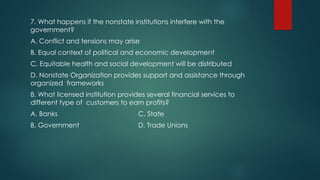
7. What happens if the nonstate institutions interfere with the
government?
A. Conflict and tensions may arise
B. Equal context of political and economic development
C. Equitable health and social development will be distributed
D. Nonstate Organization provides support and assistance through
organized frameworks
8. What licensed institution provides several financial services to
different type of customers to earn profits?
A. Banks C. State
B. Government D. Trade Unions
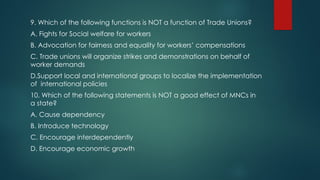
9. Which of the following functions is NOT a function of Trade Unions?
A. Fights for Social welfare for workers
B. Advocation for fairness and equality for workers’ compensations
C. Trade unions will organize strikes and demonstrations on behalf of
worker demands
D.Support local and international groups to localize the implementation
of international policies
10. Which of the following statements is NOT a good effect of MNCs in
a state?
A. Cause dependency
B. Introduce technology
C. Encourage interdependently
D. Encourage economic growth
State and Non- State Institutions Presentation

State and Non- State Institutions Presentation

  • 1.
    Understanding Culture, Society & Politics Module7: Forms and Functions of State and Non- state Institution
  • 2.
    Specific Objectives: a. identifythe different forms and functions of state and non-state institutions; b. describe each form of state and non-state institutions; c. explain how state and non-state institutions function.
  • 3.
    Scramble Letters DescriptionAnswer A T E S T An organized political community acting under a government and united by common set of laws P O R A N I O T R O C A form of business operation that declares the business as a separate entity guided by a group of officers known as the Board of Directors. R N V E G O T E N M The governing body of the state or nation S K A B N A financial institution licensed to provide several financial services to different types of customers. D E T R A O N U N I Organizations formed by workers from related fields that workfor common interest of its members T I V E S O O C P E R A Businesses governed on the principle of one member, one vote
  • 4.
    STATE  A stateis an organized political community acting under a government and united by common set of laws. It uses absolute power in directing the path of a society. It also uses complete political coerciveness, which may come in the form of armed forces personnel, stricter laws, and rigid government policies in order to attain its societal goals and objectives.
  • 5.
    Market exchange Market exchangeis the primary form of economic subsistence of a state wherein standardized currencies are being used to exchange commodities.
  • 6.
     States differin sovereignty, governance, geography, and interests. It may be classified as sovereign if they are not dependent on, or subject to, any other power or state. Other states are subject to external sovereignty where ultimate sovereignty lies another state.
  • 7.
     The conceptof the state is different from the concept of government. A government is the particular group of people that controls the state at a given time. In other words, governments are the means through which the state power us employed like applying the rule of law.  The concept of the state is also different from the concept of a nation, which refers to a large geographical area and the people therein who perceives themselves as having a common identity. The state is a political geopolitical entity; the nation is a cultural or ethnic entity.
  • 8.
    Elements of theStates 1. Population It is the people who make the state. Population is essential for the state. Without population there can be no State.
  • 9.
    Elements of theStates 2. Territory There can be no state without a fixed territory. People need territory to live and organize themselves socially and politically. It may be remembered that the territory of the states includes land, water and airspace.
  • 10.
    Elements of theStates 3. Government It is the organization or machinery or agency of the State which makes, implements, enforces, and adjudicates the laws of the state.
  • 11.
    Elements of theStates 4. Sovereignty It is the most exclusive elements of State. Without sovereignty no state can exist. State has the exclusive title and prerogative to exercise supreme power over all its people and territory. It is the basis which the State regulates all aspects of the life of the people living in its territory.
  • 12.
    Forms of States Statescome in a variety of forms that vary on who holds power, how positions of leadership are obtained, and how authority is maintained. These are: a. Authoritarian Government Authoritarian governments differ in who holds power and in how control they assume over those who govern. An example of this type is Monarchy.
  • 13.
    Forms of States Monarchyis a form of government in which supreme power is for life or until abdication. The person who heads a monarchy is called a monarch. Some monarchs hold unlimited political powers while many constitutional monarchies, such as the United Kingdom and Thailand. Currently, 44 nations in the world have monarchs as head of state. Totalitarianism is a political system that strives to regulate nearly every aspect of public and private life. It theoretically permits no individual freedom and that seeks to subordinate all aspects of individual life to the authority of the state. Modern examples of totalitarian states include the Soviet Union under Joseph Stalin, Nazi Germany under Adolf Hitler, the People’s Republic of China under Mao Zedong, and North Korea under the Kim Dynasty.
  • 14.
    b. Oligarchic Government Anoligarchy is a form of government in which power effectively rests with a small-elite segment of society distinguished by royalty, wealth, family, military, or religious hegemony. An oligarchy does not have one clear ruler, but several powerful people who rule. One common example is theocracy. Theocracy is a government by divine guidance or by official who are regarded as divinely guided. Leaders are members of the clergy, and the state’s legal system is based on religious law. Contemporary examples of theocracies include Saudi Arabia, Iran, and the Vatican.
  • 15.
     c. DemocraticGovernment Democracy is a form of government in which the right to governs is held by the majority of citizens within a country or a state. The two principles of democracy are that all citizens have equal access to power and that all citizens enjoy universally recognized freedoms and liberties. People can either become country leaders through electoral process or elect leaders who represent the core values and beliefs. There are 99 democratic nations globally. Examples of democratic nations are Philippines, Norway, New Zealand, United States of America, Canada, Columbia, Italy, and South Africa.
  • 16.
    Roles of theStates 1. State provides security against external aggressions and war. For this purpose, the state maintains an army. 2. State ensures security against internal disturbances disorders and crimes. For this purpose, the state maintains police. 3. State legally grants and guarantees the rights of the people. 4. The state issues and regulates currency and coinage. 5. State undertakes steps for the creation of necessary conditions for the socio-economic-politico-cultural development of the people. 6. State grants citizenship and protects their interests and rights. 7. State conducts foreign relations, foreign trade and economic relations. 8. State secures the goals of national interest in international relations
  • 17.
    Nonstate Institutions  Nonstateinstitutions are people and/ or organization that participate in international affairs and relations but are not affiliated with any state or nation.  These nonstate institutions include the following: bank and corporations, cooperatives and trade unions, transnational advocacy groups, and development agencies and international organizations. These nonstate institutions are equally capable of influencing policy formation and implementation.
  • 18.
    a. Banks  A.Bank is a financial institution licensed to provide several financial services to different types of customers. Banks are in operation mainly for their deposits and lending functions. Customers are allowed to deposit their money to banks which grow through an interest rate. Banks also provide loans, with an interest to customers who need money either for personal consumption or for investment and businesses. Banks may be categorized into major forms such as commercial banks and investment banks.
  • 19.
    Forms of BankDescription Commercial Banks  Financial deposit with security and conveniencewhich could be in the form of credit cards, debit cards, and check  Provide business, individual, and personalloans, enabling commercial banks to earn interest  Serve as payment agents within and outside the country through wire transfer  Subjected to more regulations Investment Banks  Financial intermediaries that performs a varietyof services for businesses and some government  Issues securities to the investing public  Make markets, facilities, mergers, and other corporate reorganizations  Acts as brokers for institutional clients  Under the supervision of regulatory bodies suchas the Securities and Exchange Commission (SEC), FINRA, and the US Treasury  Subjected to fewer regulations
  • 20.
    The two mostwell-known financial institutions  World Bank  Asian Development Bank
  • 21.
    b. Corporations It isa form of business operation that declares the business as a separate entity guided by a group of officers known as the Board of Directors. They were created by individuals, stockholders or shareholders, with the purpose of operating for profit. They have all legal rights of an individual, except for the right to vote and certain limitations. They are given the right to exist by the state that issues their charter. Corporation example Includes General Motors Corporation an icon of American craftsmanship, Apple Corporation as one of the famous tech companies, Amazon Corporation founded by Jeff Bezos is the world’s leading ecommerce and innovation company, Domino’s Pizza is a global food chain company delivering quality food worldwide.
  • 22.
    Common Types ofCorporations  For-profit entitiesform most corporations, and they are formed to generate revenues and provide a return to their shareholders, according to their percentage of ownership in the corporation. Examples: HBO in partnership with International Rescue Committee, Ford Motors and Lynda.com.
  • 23.
    Common Types ofCorporations  Not-for-profit entities operate under the category of charitable organizations, which are dedicated to a particular social cause such as educational, religious, scientific, or research purposes. Rather than distribute revenues to shareholders, not-for-profit organizations use their revenues to further their objectives. Human Rights Campaign is a very impressive example of using Facebook profile photos to spread the word far and wide about campaign. Greenpeace the environmental non-profitthat used GPS technology to inform the public about their cause.
  • 24.
    Multinational Corporations Multinational Corporations(MNCs) are business organization that extends ownership, management, production, and sales activities into several or more countries. MNCs are boon to the economic growth and development of the states
  • 25.
    Good Effects BadEffects Introduce technology Offer ill-suited technology Encourage economic growth Retard economic growth Encourage interdependently Cause dependency Elites learn to regulate Elites become compradors Promotes human rights Harms human rights Protect the environment Hurt the environment Economic actors Political actors Promote a cosmopolitan world Damage national Culture
  • 27.
    c. Cooperatives  Cooperativesare people-centers enterprises owned, controlled and run by and for their members to realize their common economic, social, and cultural needs and aspirations.  Cooperatives are businesses governed on the principle of one member, one vote. There are several common types of co-ops, including cooperatives owned and operated by: a. The people working there (worker cooperatives); b. The people buying the co-op’s goods or services (consumer cooperatives) c. The people collaborating to process and market their products(producer cooperatives); and d. Groups uniting to enhance their purchasing power (purchasing cooperatives)
  • 28.
    d. Trade Unions/LaborUnions  Trade Unions are organizations formed by workers from related fields that work for common interest of its members. They help workers in issues like fairness of pay, good working environment, hours of work and benefits. They represent a cluster of workers and provide a link between the management and workers.  The purpose of these unions is to look into the grievances of wagers and present a collective voice in front of the management. It acts as the medium of communication between the workers and management. Among these trade unions that exist in the Philippines are the Federation of Free Workers (FFW), Kilusang Mayo Uno (KMU) and the Trade Union Congress of the Philippines (TUCP).
  • 29.
    Functions of TradeUnions:  1. Advocating for fairness and equality for workers’ compensations  2. Securing better working conditions for workers  3. Trade Unions will organize strikes and demonstrations on behalf of worker demands  4. Fight for social welfare for workers  5. Promote and advocate for education and proper training for workers  6. Advocate and fight the government for legislative protections of the workers
  • 30.
    Functions of TradeUnions:  7. Promote and advocate for organizational growth and stability  8. Trade Unions acts as representatives of workers in national and international forums  9. Involved in collective bargaining agreements and disputes with management to settle any conditions on employment  10.Advising management on correctpersonnel policies and procedures  11.Involved in collective and personal collective grievances between management and workers.
  • 31.
    e. Transnational AdvocacyGroups  Transnational Advocacy Groups (TAGs) play an increasingly important role in international and regional politics and have contributed to changing policies of multilateral organizations and states. They are particularly visible in contentious areas as human rights, environmental issues, international peace, and women’s rights. They have specific roles to partake that can be achieved through effective measures, case-specific methods, and activities.  TAGs serve as international catalysts for change, aiming to achieve international changes towards policies and practices. The very essence TAGS is the formation and development of their advocacies and campaigns that represent causes, ideas, values, and beliefs.  Human Rights Watch and Amnesty are active in the human rights field. Oxfam and Save children deal with humanitarian issues. Greenpeace and Friends of the Earth represent environmental concerns.
  • 32.
    f. Development Agencies Development Agencies have been established to develop the cooperation between the public sector, private sector, and civil society. These are organizations with specific aims and goals. The common denominator among these organizations is the term development. These agencies concentrate on the growth, progression, and advancement of specific concerns, which can be infrastructure or social institutions.
  • 33.
    Types of DevelopmentAgencies:  International Organization is an institutionwith membership drawn from two or more countries. Its activities transcend national boundaries as it facilitates cooperation among its members in the performance of one or more tasks. The international organization can be public or private. A public organization is an international government organization (IGO) with states as its members. Prominent examples of IGOs are United Nations, the North Atlantic Treaty Organization (NATO),  International Monetary Fund (IMF), European Union (EU), Association of Southeast Asian Nations (ASEAN), and World Health Organization (WHO). A private organization has a membership of individuals or groups and is an international nongovernment organization (INGO) that originate for reasons other than politics such as International Criminal Police Organization (Interpol). INGOs may lobby or work regularly with the government and IGOs.
  • 34.
    Types of DevelopmentAgencies:  Non-government Organization is a non-profit group that functions independently of any government. It serves the social or political goals such as humanitarian and environmental causes. Most NGOs aim to promote the practice of democracy among societies and social change through their initiatives and organizational methods. Many NGOs have targeted their efforts toward population groups that tend to be underserved by governmental programs, including women, the aged, physically and mentally disabled persons, the poor, and various social groups that have been marginalized by virtue of race, religion, ethnicity, caste, and social class.
  • 35.
    Interrelationship of Government andNon-state Institutions  Government rules society. This reflects how powerful government institution can be. If nonstate institutions interfere with the governing body, two possible things can happen:  1. Integration among these two institutions may take place to achieve precise solution towards development  2. Conflict and tension may also arise because one could exceed the other in terms of societal control and influences (Penninx, 2013)
  • 36.
    Assessment 1. What isthe primary form of economic subsistence of a state? A. Agriculture C. Foraging B. Banking D. Market Exchange 2. What political term refers as a sovereign actor with a central government ruling over population and territory? A. Banks C. State B. Government D. Trade Unions 3. What is the institution that membership is drawn from two or more countries? A. Cooperatives C. International Government B. International Organization D. Trade Unions
  • 37.
    4. Which ofthe following organizations is NOT an example of IGOs? A. International Monetary Fund C. North Atlantic Treaty Association B. INTERPOL D. World Health Organization 5. What form of business operation declares the business as separate entity guided by a group of officers known as the Board of Directors? A. Cooperatives C. International Government B. Corporation D. Trade Unions 6. What are the members of a public international organization? A. Board of Directors C. Society B. Private Business Owners D. States
  • 39.
    7. What happensif the nonstate institutions interfere with the government? A. Conflict and tensions may arise B. Equal context of political and economic development C. Equitable health and social development will be distributed D. Nonstate Organization provides support and assistance through organized frameworks 8. What licensed institution provides several financial services to different type of customers to earn profits? A. Banks C. State B. Government D. Trade Unions
  • 40.
    9. Which ofthe following functions is NOT a function of Trade Unions? A. Fights for Social welfare for workers B. Advocation for fairness and equality for workers’ compensations C. Trade unions will organize strikes and demonstrations on behalf of worker demands D.Support local and international groups to localize the implementation of international policies 10. Which of the following statements is NOT a good effect of MNCs in a state? A. Cause dependency B. Introduce technology C. Encourage interdependently D. Encourage economic growth