Understanding
Culture Society
and
Politics
1st Semester, 2nd Quarter
S.Y. 2024-2025
MELC
s
*Explain the forms and
functions of state and non-
state institutions
Objectives
:
At the end of this lesson the learners should
be able to:
 identify the different forms and functions of state
and non-state institutions;
 describe each form of state and non-state
institutions; and
 explain how state and non-state institution's
function.
Quarter 2 – Module
1
State and
Non-state
Institutions
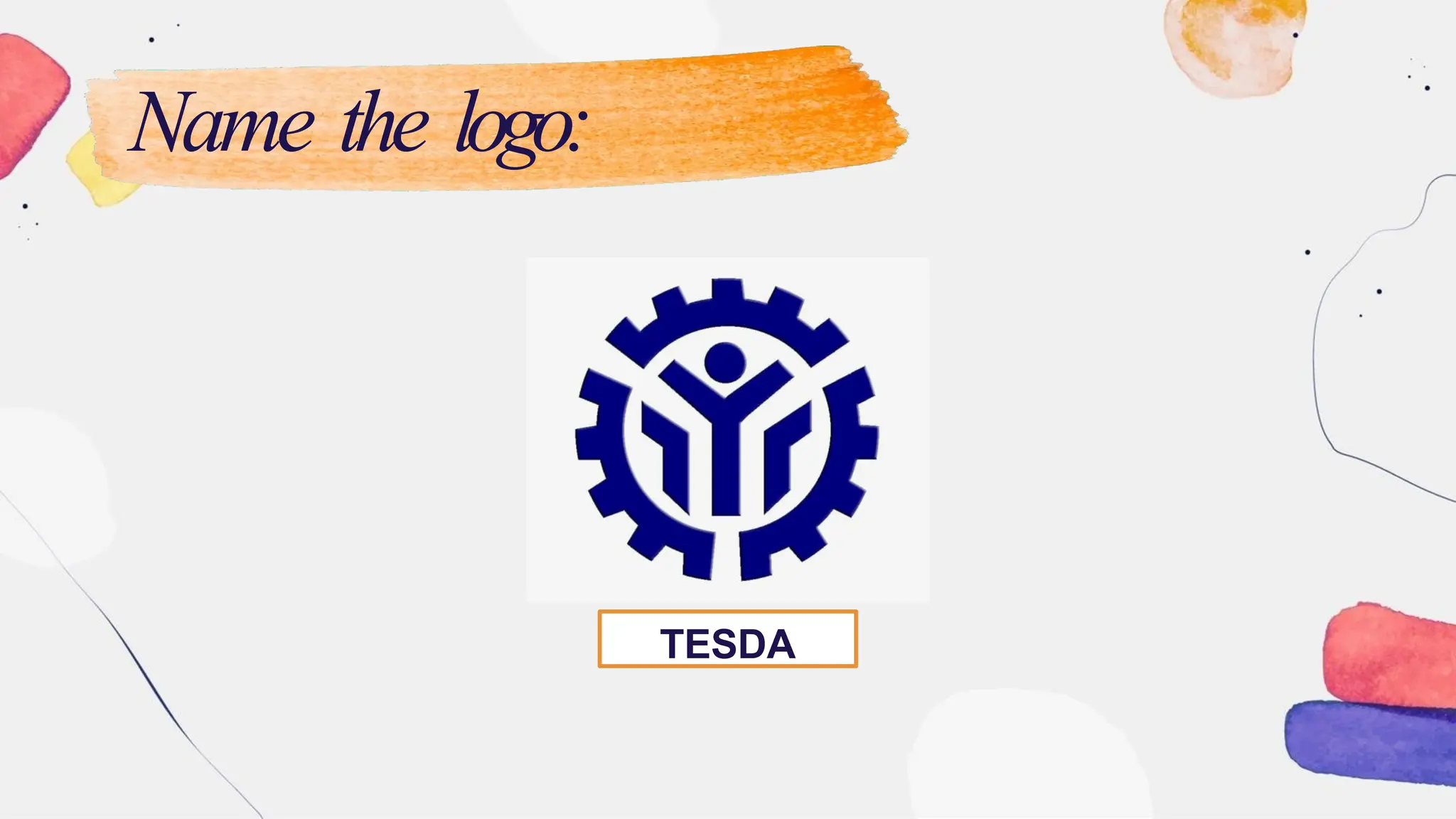
Name the logo:
TESDA
Name the logo:
DPWH
Name the logo:
Metro Bank
Name the logo:
STARBUCKS
Name the logo:
OWWA
Name the logo:
SHELL
Name the logo:
State Institution Non-State Institution
Institution
Institution:
Composed of a set of formal rules, informal
norms, or agreed upon understanding that
constraint and prescribe political actors'
behavior and interaction with one another.
(Encyclopedia Britannica)
Institution
:
Main function: is to keep society in order
and implement specific tasks assigned to
them.
State
It is a community of persons, more or
less numerous, occupying a definite
portion of
earth’s
surface,
having its
own
governme
nt
, through which
the
inhabitants render
habitual
obedienc
e
fre
e
from outside
control.
Political and Leadership Structures:
According to Max Weber as cited by
Santarita & Madrid, 2016, Political structure or
institution is defined as the organized way in
which power is allocated and decisions are
made within society.
State
Institution:
Political and Leadership Structures:
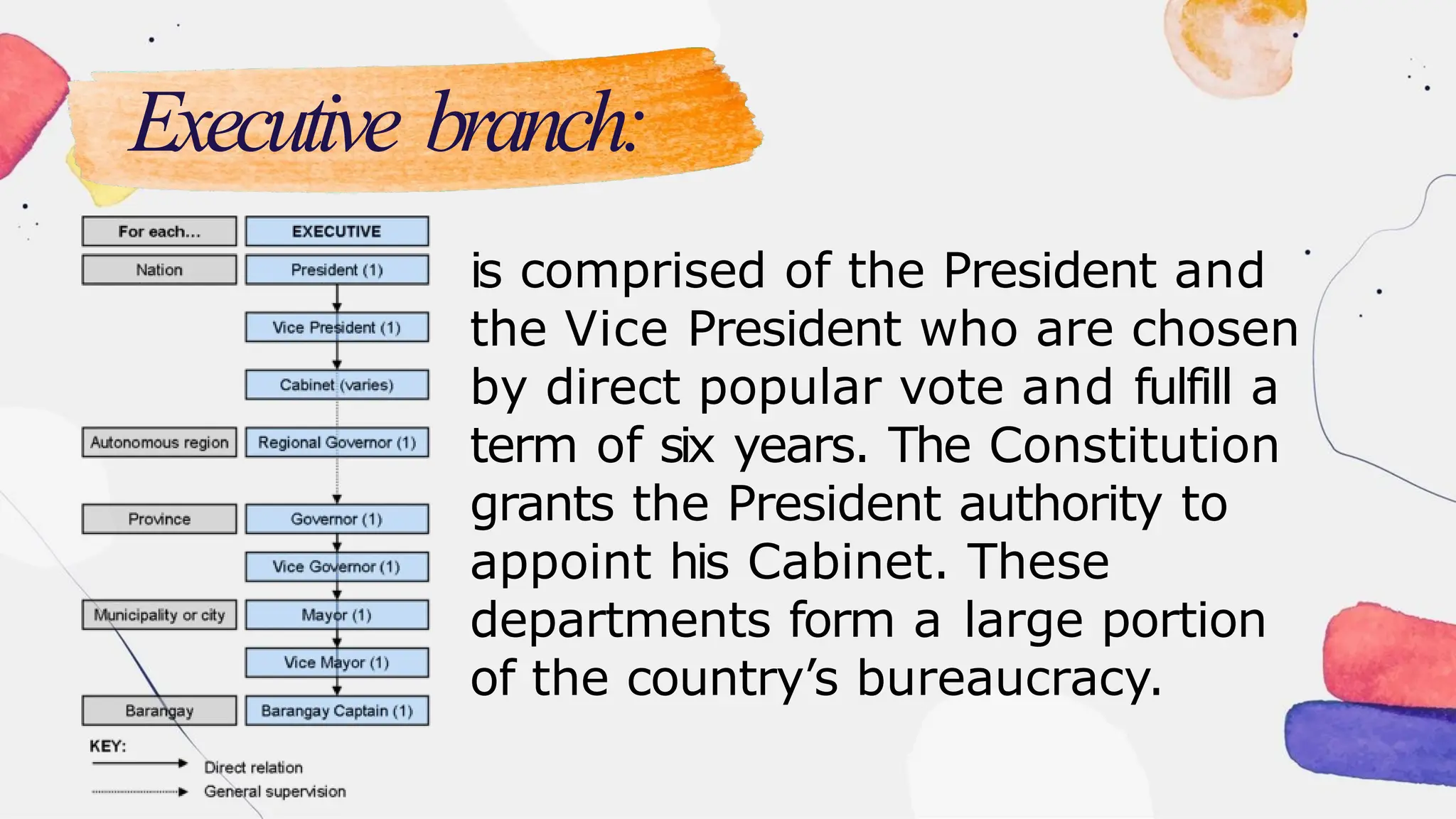
Executive branch:
is comprised of the President and
the Vice President who are chosen
by direct popular vote and fulfill a
term of six years. The Constitution
grants the President authority to
appoint his Cabinet. These
departments form a large portion
of the country’s bureaucracy.
Political and Leadership Structures:
can make laws, alter, and reverse
them through the power
bestowed in the Philippine
Congress. This institution is divided
into the Senate and the House of
Representatives
Political and Leadership Structures:
maintains the power to resolve
disputes concerning rights that
are legally demandable and
enforceable. This branch decides
whether there has been a
serious abuse of judgment
amounting to lack or excess of
authority on the part and
instrumentality of the government.
It is made up of a Supreme
Court and lower courts.
PEOPLE GOVERNMENT
TERRITORY
SOVERIGNTY
FOUR ELEMENTS OF STATE
People or
Population
0
1
1
. People or
Population
 Reproduction is
indispensable.
 It is a human political
institution.
Without a population there can be no
State.
Territory
0
2
2. Territory
The territory should
be a
fixed and bounded
portion
of the earth’s
surface
. Within it, are
natural
resources that are vital for people to live.
The inhabitants have the responsibility to
conserve and protect these resources.
Furthermore, the people must be able to
defend their state from invaders and doing
so, the use of force may be justified
03
Government
3.
Government
 This is where
that
laws to be
implemented
i
n
 The people should follow the laws and
respect authority.
 A state cannot exist without a government.
 Sovereignty belongs to the State;
the government only uses it on behalf of the
State
performs the
law-
application
functions
Executive
performs law-
making
functions
Legislativ
e
There are three branchesof
Government:
Judiciary
performs
adjudicatio
n
functions.
04 Sovereignty
4.
Sovereignty
It refers to the supreme power of the
state to rule itself without interference
from other state. This means that the
state is an independent entity where
people enjoy freedom. A territory is not
a state if it is not independent.
Sovereigntyhas two
dimensions
It means
the
power of the State to order and
regulate
the activitiesof all the people, groups and
institutions
which are
at
work within its territory. All
these
institutions always act in accordance with the
laws of the State. The State can punish them
for every violation of any of its laws.
Sovereigntyhas two
dimensions
It
means
complete independenceof the State from
external
control
. It also means the full freedom of
the
State to participate in the activities of the
community of nations. Each state has the
sovereign power to formulate and act on the
basis of its independent foreign policy
Sovereigntyhas two
dimensions
Functionsof State
 It maintains law, order and stability, resolves various
kinds of
disputes through the legal system;
 It provides common defense;
 Looks out for the welfare of the population in ways
that are beyond the means of the individual, such
as implementing public health measures;
 Provide mass education and underwrites expensive
medical
research and;
 And it operates in the interests of various dominant
Economic Institutions:
Gilliard et al., (2000) argued that an economic
institution is being defined as an enduring
organization, practice, or relationship created by
individuals to handle and cope with basic
economic dilemmas.
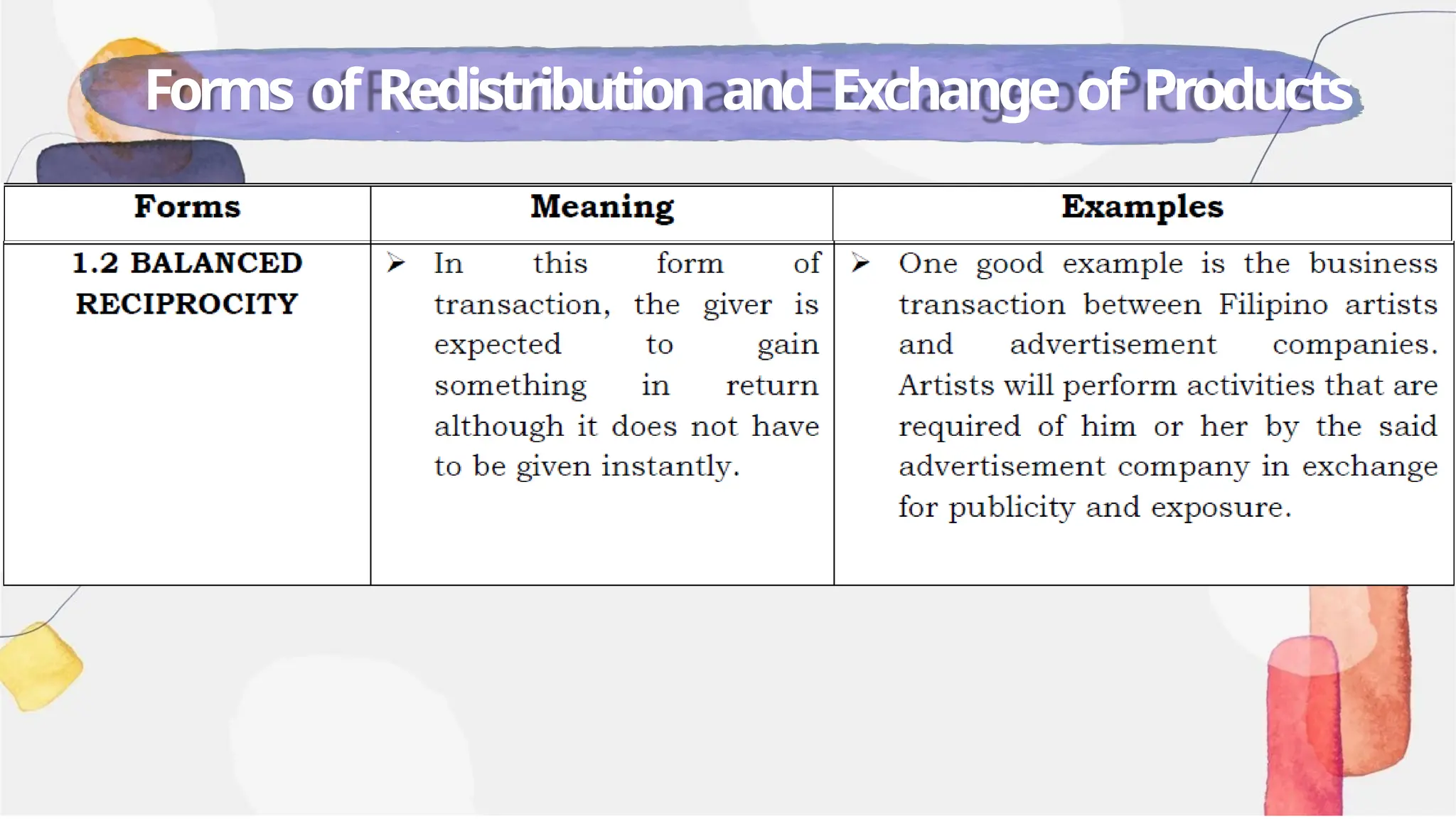
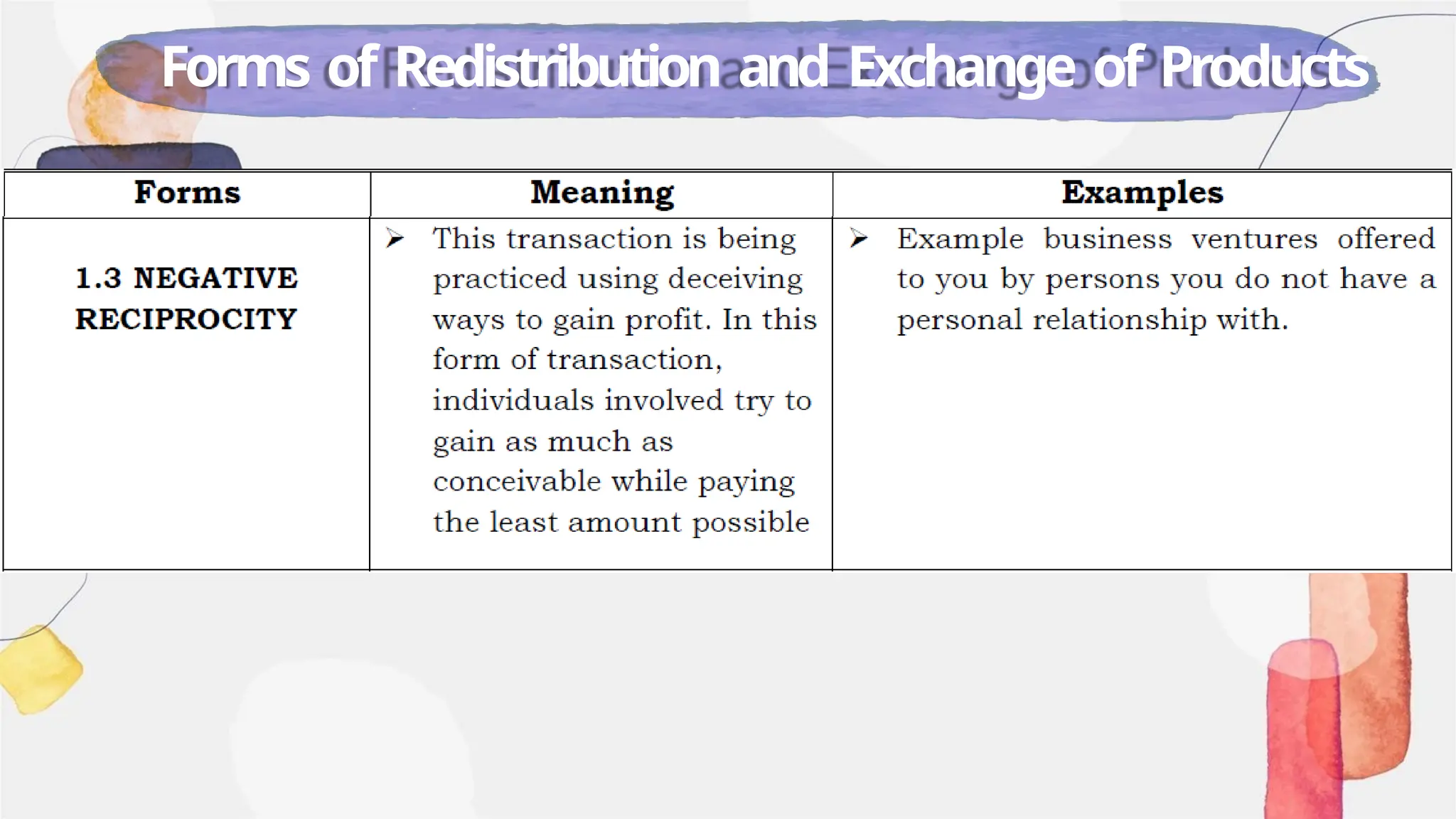
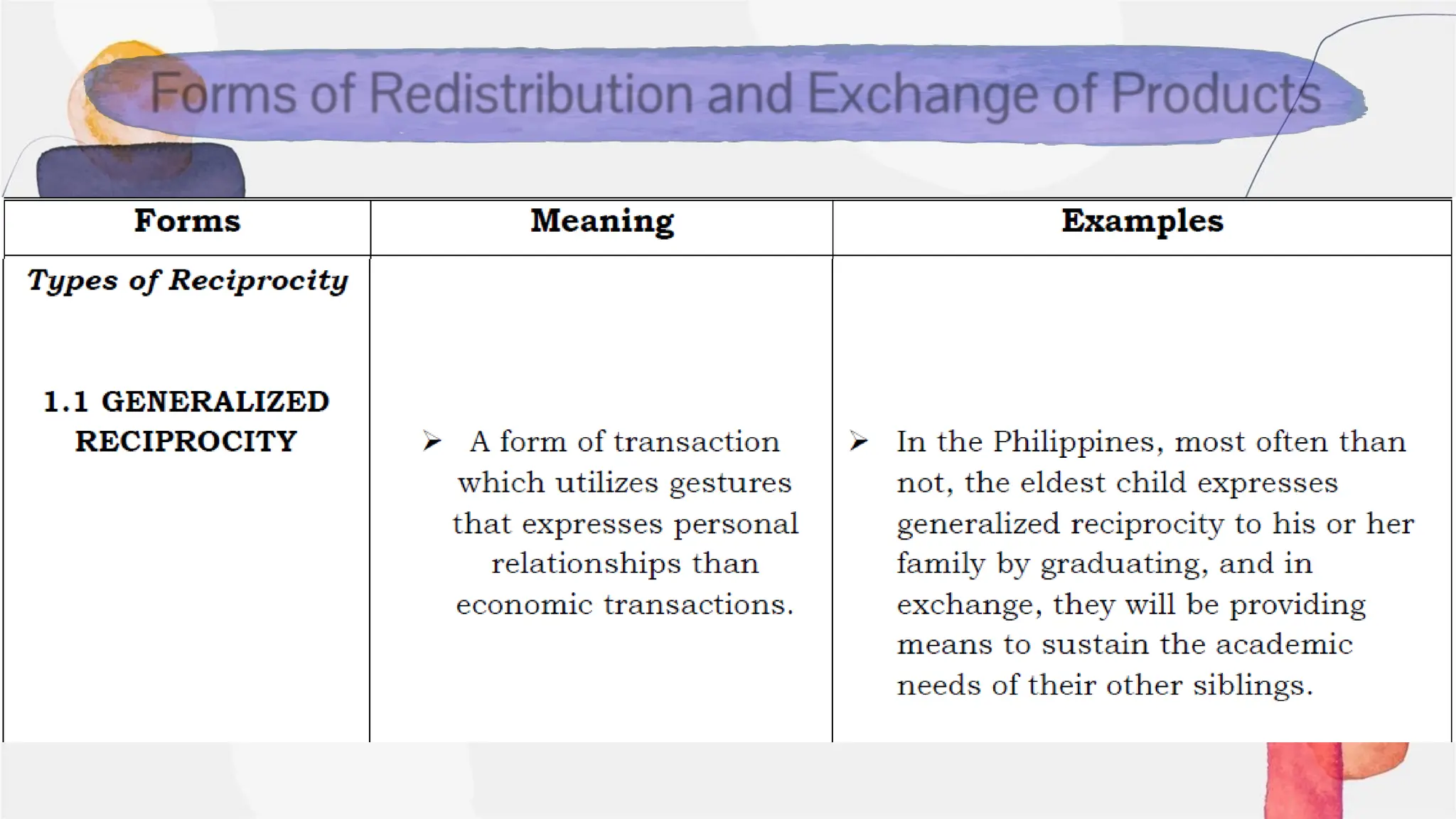
Forms of Redistribution and Exchange of Products
During the enhanced community
quarantine in your barangay, how did the
local government unit utilize the
community's taxes, funds, and resources?
Reference:
Amores, M.V., First Edition, 2020, Understanding Culture, Society, and Politics – Senior High
School Alternative Delivery Mode Quarter 2 – Module 1: State and Non-state Institutions,
Department of Education – National Capital Region, Misamis St., Bago Bantay, Quezon
City.
Rodriguez, D.C., First Edition, 2020, Understanding Culture, Society and Politics – Grade 12
Alternative Delivery Mode Quarter 2 – Module 7: State and Non-state Institutions,
Department of Education – Region III, Matalino St. D. M. Government Center, Maimpis,
City of San Fernando (P).
Lazo, MP
., H.,, First Edition, 2020, AIRs-LM in Understanding Culture, Society & Politics SHS-
Module
7: Forms and Functions of State and Non-state Institution, La Union Schools Division Region
I.
Do you have
any
questions?
Thanks!
CREDITS: This presentation template was created by Slidesgo
, including icon by Flaticon, and infographics & images from
Freepik
Please keep this slide for attribution
Understanding
Culture Society
and
Politics
1st Semester, 2nd Quarter
S.Y. 2024-2025
MELC
s
*Explain the forms and
functions of state and non-
state institutions
Objectives
:
At the end of this lesson the learners should
be able to:
 identify the different forms and functions of state
and non-state institutions;
 describe each form of state and non-state
institutions; and
 explain how state and non-state institution's
function.
State and
Non-state
Institutions
Review:
Differentiate State from Non-State
Institution.
Give the four element of the state.
Picture
Analysis:
Analyze and describe the picture using
three sentences only.
Non-State
Institution
These are institutions which
are
not
owned and controlled by
the governmen
t.
Forms of Non-
state
Institutions
Forms of Non-state
Institutions
Banks and
Corporations
Cooperatives and Trade
Unions
Transnational Advocacy
Groups
Development
Agencies
1
2
3
4
5 Non-governmental Organization
(NGOS)
Forms of Non-state
Institutions
A. Banks and Corporations
A bank is a financial institution which deals with
deposits and advances and other related services. It
receives money from those who want to save in the form of
deposits and it lends money to those who need.
According to Bangko Sentral ng Pilipinas the top 3
banks in the Philippines as of December 31, 2019 are:
1. BDO UNIBANK INC
2. METROPOLITAN BANK & TCO
3. LAND BANK OF THE PHILIPPINES
A. Banks and Corporations
There are three main functions of banks:
1.Banks are depository of savings.
2. Banks are largely responsible for the payments
system.
3.Banks issue loans to both people and companies.
Forms of Non-state
Institutions
stock
corporations
where ownership is
through own
particular shares
in the
stockholders
who
company.
A. Banks and Corporations
Corporation is a company or group of
people authorized to act as a single entity and
recognized as such in law. Usually,
corporations operate as
Forms of Non-state
Institutions
autonomous association of persons
It is an united
voluntary to meet their common economic, social, and
cultural needs and aspirations through a jointly-
owned and democratically-controlled enterprise.
B. Cooperatives and Trade Unions
Cooperative is firm owned, controlled, and
operated by a group of users for their own benefits.
Each member contributes equity capital, and shares in
the control of the firm in the basis of one-member one-
vote.
Forms of Non-state
Institutions
B. Cooperatives and Trade Unions
A trade union is an organization made
up of member (a member-based
organization) and its membership must be
made up mainly of workers. The main
purpose is to protect and advance the
interest of its members in the workplace.
Forms of Non-state
Institutions
C. Transnational Advocacy Groups
1. National and International nongovernmental organizations (NGOs)
2. Local social movements
3. Foundations
4. The media
5. Religious organizations, trade unions and consumer organizations
6. Intellectual and scholars
7. Agencies within international and regional
intergovernmental organizations
8. Parts of executive or parliamentary branches of government
Forms of Non-state
Institutions
These are organizations which provide development
assistance between national and international institutions.
Usually, these are the links that bind different states
D. Development Agencies
The most influential groups of non-state
institutions.
Forms of Non-state
Institutions
together.
The following are some of the development agencies under
UN:
1. United Nations Educational, Scientific, and Cultural
Organization (UNESCO)
2. United Nations Development Programme (UNDP)
3. United Nations Children’s Fund (UNICEF)
funded by donations
usually but some avoid formal
funding altogether and run funded and are run primarily
by volunteers. Examples of NGOs include those that
support human rights, advocate for improved health or
encourage political participation.
E. Non-governmental Organization (NGOS)
A non-governmental organization (NGO) is a not-
for-profit organization that is independent from states
and international governmental organizations. They are
Forms of Non-state
Institutions
E. Non-governmental Organization (NGOS)
Roles of Non-Governmental Organization
1. Development and Operation of Infrastructure
2. Supporting Innovation, Demonstration and
Pilots
Projects
3. Facilitating Communication
4. Technical Assistance and Training
5. Research Monitoring and Evaluation
6. Advocacy for and with the Poor
Functionsof Non-
State
 provide a safe place to save excess cash,
known as deposits;
 cooperatives and trade unions are non-
state institutions play a major role in the
economic development of the society; and
 legal entitles which are established under the
state of law that are designed to generate a
profit.
Non-state
Institution
Development
Agencies
Bank
Sovereignty
State
Reference:
Amores, M.V., First Edition, 2020, Understanding Culture, Society, and Politics – Senior High
School Alternative Delivery Mode Quarter 2 – Module 1: State and Non-state Institutions,
Department of Education – National Capital Region, Misamis St., Bago Bantay, Quezon
City.
Rodriguez, D.C., First Edition, 2020, Understanding Culture, Society and Politics – Grade 12
Alternative Delivery Mode Quarter 2 – Module 7: State and Non-state Institutions,
Department of Education – Region III, Matalino St. D. M. Government Center, Maimpis,
City of San Fernando (P).
Lazo, MP
., H.,, First Edition, 2020, AIRs-LM in Understanding Culture, Society & Politics SHS-
Module
7: Forms and Functions of State and Non-state Institution, La Union Schools Division Region
I.
Do you have
any
questions?
Thanks!
CREDITS: This presentation template was created by Slidesgo
, including icon by Flaticon, and infographics & images from
Freepik
Please keep this slide for attribution

STATE AND NON STATE INSTITUTION POWERPOINT PREENTSTION

  • 1.
  • 2.
    MELC s *Explain the formsand functions of state and non- state institutions
  • 3.
    Objectives : At the endof this lesson the learners should be able to:  identify the different forms and functions of state and non-state institutions;  describe each form of state and non-state institutions; and  explain how state and non-state institution's function.
  • 4.
    Quarter 2 –Module 1 State and Non-state Institutions
  • 5.
  • 6.
  • 7.
  • 8.
  • 9.
  • 10.
  • 11.
    Name the logo: StateInstitution Non-State Institution
  • 12.
  • 13.
    Institution: Composed of aset of formal rules, informal norms, or agreed upon understanding that constraint and prescribe political actors' behavior and interaction with one another. (Encyclopedia Britannica)
  • 14.
    Institution : Main function: isto keep society in order and implement specific tasks assigned to them.
  • 15.
  • 16.
    It is acommunity of persons, more or less numerous, occupying a definite portion of earth’s surface, having its own governme nt , through which the inhabitants render habitual obedienc e fre e from outside control.
  • 17.
    Political and LeadershipStructures: According to Max Weber as cited by Santarita & Madrid, 2016, Political structure or institution is defined as the organized way in which power is allocated and decisions are made within society. State Institution:
  • 18.
  • 19.
    Executive branch: is comprisedof the President and the Vice President who are chosen by direct popular vote and fulfill a term of six years. The Constitution grants the President authority to appoint his Cabinet. These departments form a large portion of the country’s bureaucracy.
  • 20.
    Political and LeadershipStructures: can make laws, alter, and reverse them through the power bestowed in the Philippine Congress. This institution is divided into the Senate and the House of Representatives
  • 21.
    Political and LeadershipStructures: maintains the power to resolve disputes concerning rights that are legally demandable and enforceable. This branch decides whether there has been a serious abuse of judgment amounting to lack or excess of authority on the part and instrumentality of the government. It is made up of a Supreme Court and lower courts.
  • 22.
  • 23.
  • 24.
    1 . People or Population Reproduction is indispensable.  It is a human political institution. Without a population there can be no State.
  • 25.
  • 26.
    2. Territory The territoryshould be a fixed and bounded portion of the earth’s surface . Within it, are natural resources that are vital for people to live. The inhabitants have the responsibility to conserve and protect these resources. Furthermore, the people must be able to defend their state from invaders and doing so, the use of force may be justified
  • 27.
  • 28.
    3. Government  This iswhere that laws to be implemented i n  The people should follow the laws and respect authority.  A state cannot exist without a government.  Sovereignty belongs to the State; the government only uses it on behalf of the State
  • 29.
    performs the law- application functions Executive performs law- making functions Legislativ e Thereare three branchesof Government: Judiciary performs adjudicatio n functions.
  • 30.
  • 31.
    4. Sovereignty It refers tothe supreme power of the state to rule itself without interference from other state. This means that the state is an independent entity where people enjoy freedom. A territory is not a state if it is not independent.
  • 32.
    Sovereigntyhas two dimensions It means the powerof the State to order and regulate the activitiesof all the people, groups and institutions which are at work within its territory. All these institutions always act in accordance with the laws of the State. The State can punish them for every violation of any of its laws.
  • 33.
    Sovereigntyhas two dimensions It means complete independenceofthe State from external control . It also means the full freedom of the State to participate in the activities of the community of nations. Each state has the sovereign power to formulate and act on the basis of its independent foreign policy
  • 34.
  • 36.
    Functionsof State  Itmaintains law, order and stability, resolves various kinds of disputes through the legal system;  It provides common defense;  Looks out for the welfare of the population in ways that are beyond the means of the individual, such as implementing public health measures;  Provide mass education and underwrites expensive medical research and;  And it operates in the interests of various dominant
  • 37.
    Economic Institutions: Gilliard etal., (2000) argued that an economic institution is being defined as an enduring organization, practice, or relationship created by individuals to handle and cope with basic economic dilemmas.
  • 40.
    Forms of Redistributionand Exchange of Products
  • 41.
    Forms of Redistributionand Exchange of Products
  • 42.
    Forms of Redistributionand Exchange of Products
  • 43.
    Forms of Redistributionand Exchange of Products
  • 44.
    During the enhancedcommunity quarantine in your barangay, how did the local government unit utilize the community's taxes, funds, and resources?
  • 45.
    Reference: Amores, M.V., FirstEdition, 2020, Understanding Culture, Society, and Politics – Senior High School Alternative Delivery Mode Quarter 2 – Module 1: State and Non-state Institutions, Department of Education – National Capital Region, Misamis St., Bago Bantay, Quezon City. Rodriguez, D.C., First Edition, 2020, Understanding Culture, Society and Politics – Grade 12 Alternative Delivery Mode Quarter 2 – Module 7: State and Non-state Institutions, Department of Education – Region III, Matalino St. D. M. Government Center, Maimpis, City of San Fernando (P). Lazo, MP ., H.,, First Edition, 2020, AIRs-LM in Understanding Culture, Society & Politics SHS- Module 7: Forms and Functions of State and Non-state Institution, La Union Schools Division Region I.
  • 46.
    Do you have any questions? Thanks! CREDITS:This presentation template was created by Slidesgo , including icon by Flaticon, and infographics & images from Freepik Please keep this slide for attribution
  • 47.
  • 48.
    MELC s *Explain the formsand functions of state and non- state institutions
  • 49.
    Objectives : At the endof this lesson the learners should be able to:  identify the different forms and functions of state and non-state institutions;  describe each form of state and non-state institutions; and  explain how state and non-state institution's function.
  • 50.
  • 51.
    Review: Differentiate State fromNon-State Institution. Give the four element of the state.
  • 52.
    Picture Analysis: Analyze and describethe picture using three sentences only.
  • 53.
  • 54.
    These are institutionswhich are not owned and controlled by the governmen t.
  • 55.
  • 56.
    Forms of Non-state Institutions Banksand Corporations Cooperatives and Trade Unions Transnational Advocacy Groups Development Agencies 1 2 3 4 5 Non-governmental Organization (NGOS)
  • 57.
    Forms of Non-state Institutions A.Banks and Corporations A bank is a financial institution which deals with deposits and advances and other related services. It receives money from those who want to save in the form of deposits and it lends money to those who need. According to Bangko Sentral ng Pilipinas the top 3 banks in the Philippines as of December 31, 2019 are: 1. BDO UNIBANK INC 2. METROPOLITAN BANK & TCO 3. LAND BANK OF THE PHILIPPINES
  • 58.
    A. Banks andCorporations There are three main functions of banks: 1.Banks are depository of savings. 2. Banks are largely responsible for the payments system. 3.Banks issue loans to both people and companies. Forms of Non-state Institutions
  • 59.
    stock corporations where ownership is throughown particular shares in the stockholders who company. A. Banks and Corporations Corporation is a company or group of people authorized to act as a single entity and recognized as such in law. Usually, corporations operate as Forms of Non-state Institutions
  • 63.
    autonomous association ofpersons It is an united voluntary to meet their common economic, social, and cultural needs and aspirations through a jointly- owned and democratically-controlled enterprise. B. Cooperatives and Trade Unions Cooperative is firm owned, controlled, and operated by a group of users for their own benefits. Each member contributes equity capital, and shares in the control of the firm in the basis of one-member one- vote. Forms of Non-state Institutions
  • 64.
    B. Cooperatives andTrade Unions A trade union is an organization made up of member (a member-based organization) and its membership must be made up mainly of workers. The main purpose is to protect and advance the interest of its members in the workplace. Forms of Non-state Institutions
  • 67.
    C. Transnational AdvocacyGroups 1. National and International nongovernmental organizations (NGOs) 2. Local social movements 3. Foundations 4. The media 5. Religious organizations, trade unions and consumer organizations 6. Intellectual and scholars 7. Agencies within international and regional intergovernmental organizations 8. Parts of executive or parliamentary branches of government Forms of Non-state Institutions
  • 68.
    These are organizationswhich provide development assistance between national and international institutions. Usually, these are the links that bind different states D. Development Agencies The most influential groups of non-state institutions. Forms of Non-state Institutions together. The following are some of the development agencies under UN: 1. United Nations Educational, Scientific, and Cultural Organization (UNESCO) 2. United Nations Development Programme (UNDP) 3. United Nations Children’s Fund (UNICEF)
  • 69.
    funded by donations usuallybut some avoid formal funding altogether and run funded and are run primarily by volunteers. Examples of NGOs include those that support human rights, advocate for improved health or encourage political participation. E. Non-governmental Organization (NGOS) A non-governmental organization (NGO) is a not- for-profit organization that is independent from states and international governmental organizations. They are Forms of Non-state Institutions
  • 71.
    E. Non-governmental Organization(NGOS) Roles of Non-Governmental Organization 1. Development and Operation of Infrastructure 2. Supporting Innovation, Demonstration and Pilots Projects 3. Facilitating Communication 4. Technical Assistance and Training 5. Research Monitoring and Evaluation 6. Advocacy for and with the Poor
  • 77.
    Functionsof Non- State  providea safe place to save excess cash, known as deposits;  cooperatives and trade unions are non- state institutions play a major role in the economic development of the society; and  legal entitles which are established under the state of law that are designed to generate a profit.
  • 79.
  • 80.
    Reference: Amores, M.V., FirstEdition, 2020, Understanding Culture, Society, and Politics – Senior High School Alternative Delivery Mode Quarter 2 – Module 1: State and Non-state Institutions, Department of Education – National Capital Region, Misamis St., Bago Bantay, Quezon City. Rodriguez, D.C., First Edition, 2020, Understanding Culture, Society and Politics – Grade 12 Alternative Delivery Mode Quarter 2 – Module 7: State and Non-state Institutions, Department of Education – Region III, Matalino St. D. M. Government Center, Maimpis, City of San Fernando (P). Lazo, MP ., H.,, First Edition, 2020, AIRs-LM in Understanding Culture, Society & Politics SHS- Module 7: Forms and Functions of State and Non-state Institution, La Union Schools Division Region I.
  • 81.
    Do you have any questions? Thanks! CREDITS:This presentation template was created by Slidesgo , including icon by Flaticon, and infographics & images from Freepik Please keep this slide for attribution

Editor's Notes

  • #5 Technical Education and Skills Development Authority
  • #6 DEPARTMENT OF PUBLIC WORKS AND HIGHWAYS
  • #9 Overseas Workers Welfare Administration