Startup Thinking 101 
Pre-Conference Workshop 
Participant Workbook 
Helen Kula & M.J. D’Elia 
Internet Librarian 2014 
Sunday, October 26 1:30 – 4:30 
Monterey Conference Center 
Monterey, California
2 
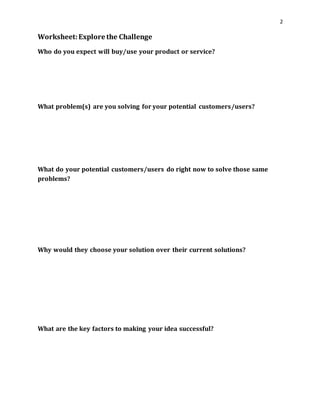
Worksheet: Explore the Challenge 
Who do you expect will buy/use your product or service? 
What problem(s) are you solving for your potential customers/users? 
What do your potential customers/users do right now to solve those same 
problems? 
Why would they choose your solution over their current solutions? 
What are the key factors to making your idea successful?
3 
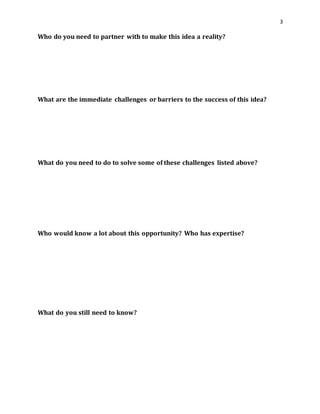
Who do you need to partner with to make this idea a reality? 
What are the immediate challenges or barriers to the success of this idea? 
What do you need to do to solve some of these challenges listed above? 
Who would know a lot about this opportunity? Who has expertise? 
What do you still need to know?
4 
Worksheet: Analogs & Antilogs 
Analogs 
List two to three successful predecessor examples (projects, organizations, etc.) that you plan to borrow 
from. Describe the parts of their approach that are worth emulating. 
Antilogs 
List two to three predecessor examples (projects, organizations, etc.) that you plan to explicitly do things 
differently from. Describe how your approach will diverge from what they do.
5 
Worksheet: Business Model Canvas 
Customer Segments 
For whom does the company create value? Who are their most important customers? 
Value Proposition 
What value does the company deliver? Which customer problem does the company help solve? Which 
customer need do they satisfy? What bundles of products/services do they offer each customer 
segment? 
Channels 
How do the customers want to be reached? How does the company reach them now? How is the 
company integrating with customer routines? 
Customer Relationships 
What type of relationship does each customer segment expect? Which relationships have been 
established? How are they integrated with the rest of the biz model? 
Revenue Streams / Return 
For what value are customers really willing to pay? For what do they currently pay? How are they 
currently paying? How much does each revenue stream contribute to overall revenue?
6 
Key Resources 
What key resources do your value propositions require? Distribution channels? Customer relationships? 
Revenue streams? 
Key Activities 
What key activities do your value proposi tions require? Distribution channels? Customer relationships? 
Revenue streams? 
Key Partners 
Who are your company’s key partners? Who are your company’s key suppliers? Which key resources do 
they get from someone else? Which key activities do partners perform? 
Cost 
What are the most important costs inherent in our business model? Which key resources are most 
expensive? Which key activities are most expensive?
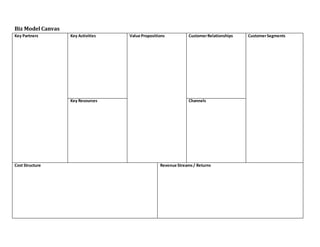
Biz Model Canvas 
Key Partners 
Key Activities 
Value Propositions 
Customer Relationships 
Customer Segments 
Key Resources 
Channels 
Cost Structure 
Revenue Streams / Returns
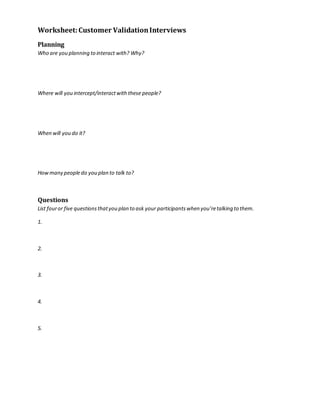
Worksheet: Customer Validation Interviews 
Planning 
Who are you planning to interact with? Why? 
Where will you intercept/interact with these people? 
When will you do it? 
How many people do you plan to talk to? 
Questions 
List four or five questions that you plan to ask your participants when you’re talking to them. 
1. 
2. 
3. 
4. 
5.
9 
9 
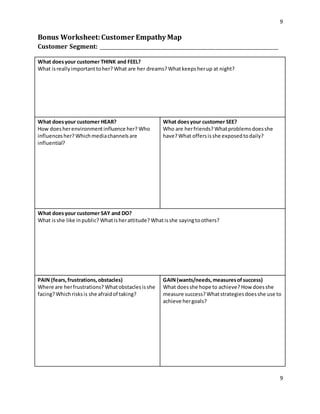
Bonus Worksheet: Customer Empathy Map 
Customer Segment: _______________________________________________________________ 
What does your customer THINK and FEEL? 
What is really important to her? What are her dreams? What keeps her up at night? 
What does your customer HEAR? 
How does her environment influence her? Who 
influences her? Which media channels are 
influential? 
What does your customer SEE? 
Who are her friends? What problems does she 
have? What offers is she exposed to daily? 
What does your customer SAY and DO? 
What is she like in public? What is her attitude? What is she saying to others? 
PAIN (fears, frustrations, obstacles) 
Where are her frustrations? What obstacles is she 
facing? Which risks is she afraid of taking? 
GAIN (wants/needs, measures of success) 
What does she hope to achieve? How does she 
measure success? What strategies does she use to 
achieve her goals?
10 
10 
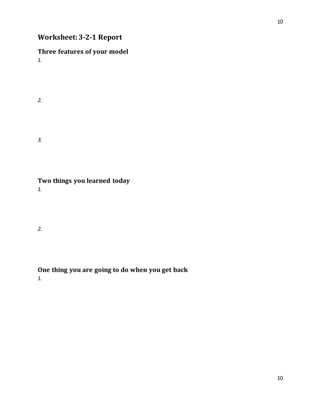
Worksheet: 3-2-1 Report 
Three features of your model 
1. 
2. 
3. 
Two things you learned today 
1. 
2. 
One thing you are going to do when you get back 
1.
11 
11 
Startup Thinking 101: Reference List 
Blank, S. (2014). Steve Blank [blog]. Retrieved from http://steveblank.com 
Blank, S. & Dorf, B. (2012). The Startup Owner’s Manual. Pescadero, CA: K&S Ranch 
Cooper, B. & Vlaskovits, P. (2010). The Entrepreneur’s Guide to Customer 
Development. Newport Beach, CA: Cooper-Vlaskovits 
Komisar, J. & Mullins, R. (2009). Getting to Plan B. Cambridge, MA: Harvard Business. 
MaRS. Entrepreneur’s Toolkit. Retrieved from http://www.marsdd.com/entrepreneurs-toolkit/ 
Mathews, B. (2012, April). Think like a Startup [white paper]. Retrieved from 
http://vtechworks.lib.vt.edu/handle/10919/18649 
Osterwalder, A. & Pigneur, Y. (2010). Business Model Generation. Hoboken, NJ: Wiley 
Ries, E. (2011). The Lean Startup. New York: Crown. 
Contact Info 
Helen Kula 
Librarian, Institute for Management and Innovation 
University of Toronto Mississauga 
helen.kula@utoronto.ca 
Twitter: @helenkula 
M.J. D’Elia 
Head, Learning & Curriculum Support 
University of Guelph 
mdelia@uoguelph.ca 
Twitter: @mjdelia
12 
12 
Notes 
Questions

Startup Thinking 101 for Libraries: Workbook

  • 1.
    Startup Thinking 101 Pre-Conference Workshop Participant Workbook Helen Kula & M.J. D’Elia Internet Librarian 2014 Sunday, October 26 1:30 – 4:30 Monterey Conference Center Monterey, California
  • 2.
    2 Worksheet: Explorethe Challenge Who do you expect will buy/use your product or service? What problem(s) are you solving for your potential customers/users? What do your potential customers/users do right now to solve those same problems? Why would they choose your solution over their current solutions? What are the key factors to making your idea successful?
  • 3.
    3 Who doyou need to partner with to make this idea a reality? What are the immediate challenges or barriers to the success of this idea? What do you need to do to solve some of these challenges listed above? Who would know a lot about this opportunity? Who has expertise? What do you still need to know?
  • 4.
    4 Worksheet: Analogs& Antilogs Analogs List two to three successful predecessor examples (projects, organizations, etc.) that you plan to borrow from. Describe the parts of their approach that are worth emulating. Antilogs List two to three predecessor examples (projects, organizations, etc.) that you plan to explicitly do things differently from. Describe how your approach will diverge from what they do.
  • 5.
    5 Worksheet: BusinessModel Canvas Customer Segments For whom does the company create value? Who are their most important customers? Value Proposition What value does the company deliver? Which customer problem does the company help solve? Which customer need do they satisfy? What bundles of products/services do they offer each customer segment? Channels How do the customers want to be reached? How does the company reach them now? How is the company integrating with customer routines? Customer Relationships What type of relationship does each customer segment expect? Which relationships have been established? How are they integrated with the rest of the biz model? Revenue Streams / Return For what value are customers really willing to pay? For what do they currently pay? How are they currently paying? How much does each revenue stream contribute to overall revenue?
  • 6.
    6 Key Resources What key resources do your value propositions require? Distribution channels? Customer relationships? Revenue streams? Key Activities What key activities do your value proposi tions require? Distribution channels? Customer relationships? Revenue streams? Key Partners Who are your company’s key partners? Who are your company’s key suppliers? Which key resources do they get from someone else? Which key activities do partners perform? Cost What are the most important costs inherent in our business model? Which key resources are most expensive? Which key activities are most expensive?
  • 7.
    Biz Model Canvas Key Partners Key Activities Value Propositions Customer Relationships Customer Segments Key Resources Channels Cost Structure Revenue Streams / Returns
  • 8.
    Worksheet: Customer ValidationInterviews Planning Who are you planning to interact with? Why? Where will you intercept/interact with these people? When will you do it? How many people do you plan to talk to? Questions List four or five questions that you plan to ask your participants when you’re talking to them. 1. 2. 3. 4. 5.
  • 9.
    9 9 BonusWorksheet: Customer Empathy Map Customer Segment: _______________________________________________________________ What does your customer THINK and FEEL? What is really important to her? What are her dreams? What keeps her up at night? What does your customer HEAR? How does her environment influence her? Who influences her? Which media channels are influential? What does your customer SEE? Who are her friends? What problems does she have? What offers is she exposed to daily? What does your customer SAY and DO? What is she like in public? What is her attitude? What is she saying to others? PAIN (fears, frustrations, obstacles) Where are her frustrations? What obstacles is she facing? Which risks is she afraid of taking? GAIN (wants/needs, measures of success) What does she hope to achieve? How does she measure success? What strategies does she use to achieve her goals?
  • 10.
    10 10 Worksheet:3-2-1 Report Three features of your model 1. 2. 3. Two things you learned today 1. 2. One thing you are going to do when you get back 1.
  • 11.
    11 11 StartupThinking 101: Reference List Blank, S. (2014). Steve Blank [blog]. Retrieved from http://steveblank.com Blank, S. & Dorf, B. (2012). The Startup Owner’s Manual. Pescadero, CA: K&S Ranch Cooper, B. & Vlaskovits, P. (2010). The Entrepreneur’s Guide to Customer Development. Newport Beach, CA: Cooper-Vlaskovits Komisar, J. & Mullins, R. (2009). Getting to Plan B. Cambridge, MA: Harvard Business. MaRS. Entrepreneur’s Toolkit. Retrieved from http://www.marsdd.com/entrepreneurs-toolkit/ Mathews, B. (2012, April). Think like a Startup [white paper]. Retrieved from http://vtechworks.lib.vt.edu/handle/10919/18649 Osterwalder, A. & Pigneur, Y. (2010). Business Model Generation. Hoboken, NJ: Wiley Ries, E. (2011). The Lean Startup. New York: Crown. Contact Info Helen Kula Librarian, Institute for Management and Innovation University of Toronto Mississauga helen.kula@utoronto.ca Twitter: @helenkula M.J. D’Elia Head, Learning & Curriculum Support University of Guelph mdelia@uoguelph.ca Twitter: @mjdelia
  • 12.
    12 12 Notes Questions