Strategy and Business Models – DIT PM Module 1
RAOMAL PERERA
raomal@pereranet.com | @raomal @LeanDisruptor | www.facebook.com/LeanDisruptor
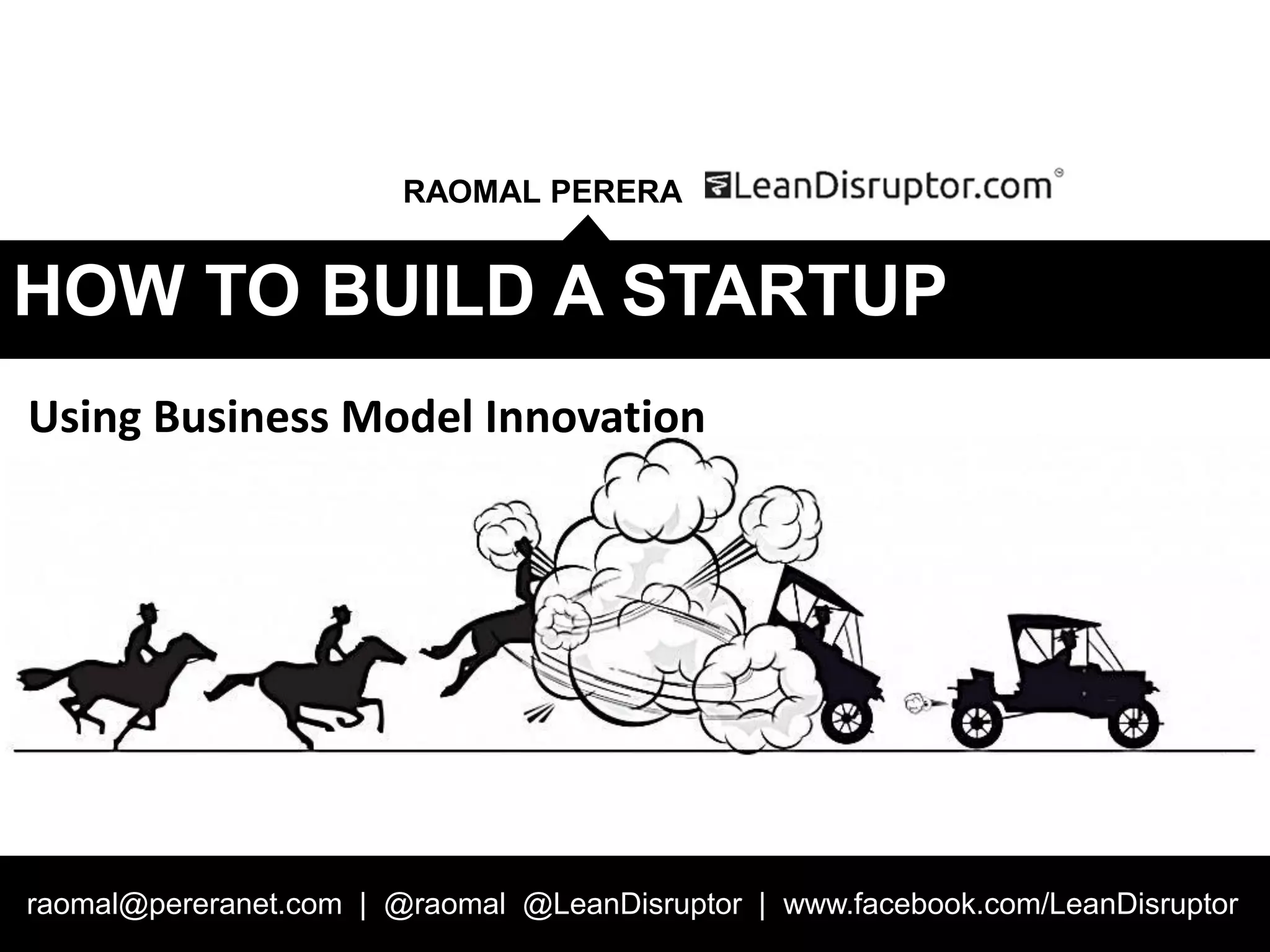
HOW TO BUILD A STARTUP
Using Business Model Innovation
RAOMAL PERERA
 Serial Entrepreneur
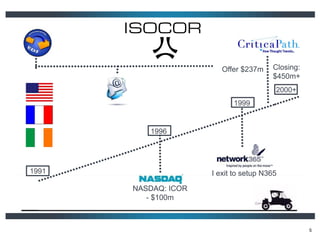
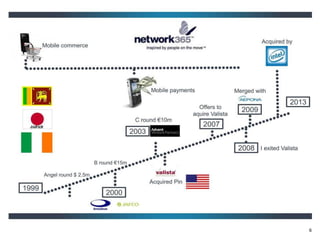
 ISOCOR (NASDAQ: icor) & Network365/Valista (Intel)
 Adjunct Professor of Entrepreneurial Studies
 INSEAD & UCD
 Business Model Innovation, Lean Startup, Leadership &
Fund Raising
 Consultant
 Clients include: MSD (Merck), HP (Hewlett Packard), IFB
(Irish Film Board), HSE (Health Service Executive), Arvato
(Bertelsman), Resmed, Openet, Glandore, SEI (Social
Entrepreneurs Ireland), DJEI (Dept of Jobs, Entreprise and
Innovation), CWIA (Cartier Women’s Initiative Awards) …
 Accolades
 Finalist Ernst & Young Entrepreneur of the Year
 Tech Pioneer World Economic Forum
 ISA Award for Outstanding Software Achievement
 Blog: www.LeanDisruptor.com 2
3
www.Facebook.com/LeanDisruptor
4
5
6
Learning Outcomes
7
• Identify the Problem/Need first before
defining the Solution.
• To introduce you to the key tools and
techniques to help you build a
successful startup or at least reduce
the risk of failure
• Learn to invent design and build
powerful new business models using a
set of business model innovation tools.
• Understand the environment in which
you operate
8
What is the 1 single
most important thing
you want to take
away by the end of
this day?
Your SOLUTION is NOT my PROBLEM
9
Take 2 minutes to write down the
PROBLEM/NEED you are addressing
Introduction
• Introduce yourself
• What is the problem/need that you
solve with your product idea
10
11
INTRODUCTION
12
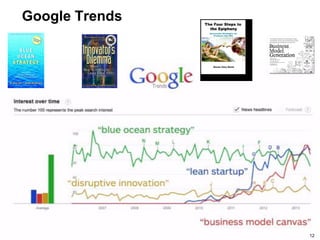
Google Trends
12
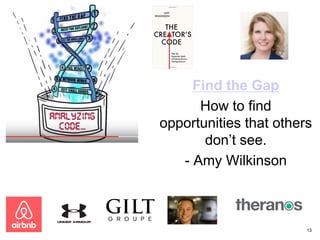
Find the Gap
How to find
opportunities that others
don’t see.
- Amy Wilkinson
13
How breakthrough ideas emerge from
small discoveries
Creative thinkers practice a set of simple but
ingenious experimental methods
• failing quickly to learn fast
• tapping into the genius of play
• engaging in highly immersed
observation
Free their minds, opening them up to making
unexpected connections and perceiving
invaluable insights.
14
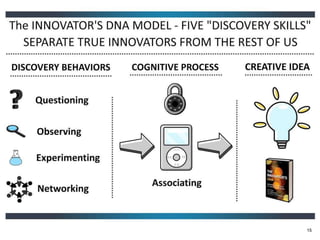
15
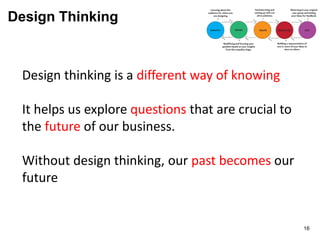
Design thinking is a different way of knowing
It helps us explore questions that are crucial to
the future of our business.
Without design thinking, our past becomes our
future
Design Thinking
16
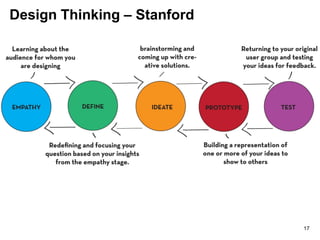
Design Thinking – Stanford
17
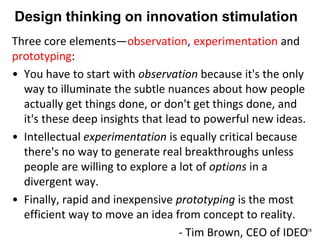
Design thinking on innovation stimulation
Three core elements—observation, experimentation and
prototyping:
• You have to start with observation because it's the only
way to illuminate the subtle nuances about how people
actually get things done, or don't get things done, and
it's these deep insights that lead to powerful new ideas.
• Intellectual experimentation is equally critical because
there's no way to generate real breakthroughs unless
people are willing to explore a lot of options in a
divergent way.
• Finally, rapid and inexpensive prototyping is the most
efficient way to move an idea from concept to reality.
- Tim Brown, CEO of IDEO18
Most successful entrepreneurs
don’t begin with brilliant ideas
– they discover them
19
Often (first-time) entrepreneurs feel that
step 1 involves writing a business
plan/building a slide deck and getting
funded!
20
21
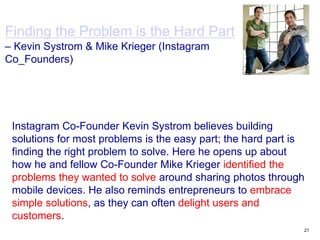
Finding the Problem is the Hard Part
– Kevin Systrom & Mike Krieger (Instagram
Co_Founders)
Instagram Co-Founder Kevin Systrom believes building
solutions for most problems is the easy part; the hard part is
finding the right problem to solve. Here he opens up about
how he and fellow Co-Founder Mike Krieger identified the
problems they wanted to solve around sharing photos through
mobile devices. He also reminds entrepreneurs to embrace
simple solutions, as they can often delight users and
customers.
22
CUSTOMER DEVELOPMENT
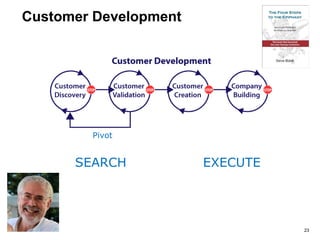
Pivot
SEARCH EXECUTE
Customer Development
23
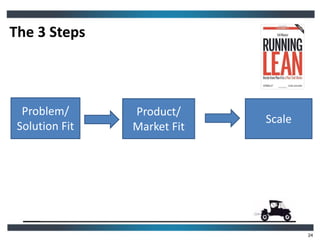
Problem/
Solution Fit
Product/
Market Fit
Scale
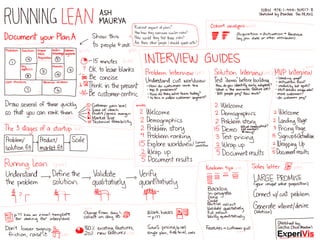
The 3 Steps
24
24
25
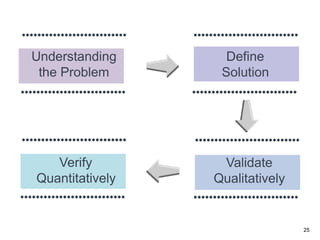
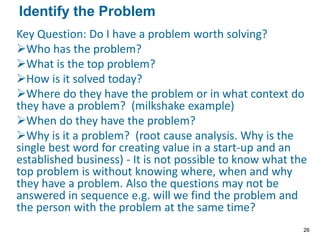
Key Question: Do I have a problem worth solving?
Who has the problem?
What is the top problem?
How is it solved today?
Where do they have the problem or in what context do
they have a problem? (milkshake example)
When do they have the problem?
Why is it a problem? (root cause analysis. Why is the
single best word for creating value in a start-up and an
established business) - It is not possible to know what the
top problem is without knowing where, when and why
they have a problem. Also the questions may not be
answered in sequence e.g. will we find the problem and
the person with the problem at the same time?
Identify the Problem
26
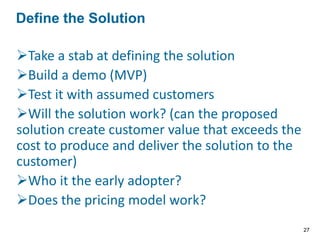
Take a stab at defining the solution
Build a demo (MVP)
Test it with assumed customers
Will the solution work? (can the proposed
solution create customer value that exceeds the
cost to produce and deliver the solution to the
customer)
Who it the early adopter?
Does the pricing model work?
Define the Solution
27
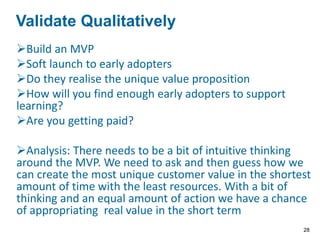
Build an MVP
Soft launch to early adopters
Do they realise the unique value proposition
How will you find enough early adopters to support
learning?
Are you getting paid?
Analysis: There needs to be a bit of intuitive thinking
around the MVP. We need to ask and then guess how we
can create the most unique customer value in the shortest
amount of time with the least resources. With a bit of
thinking and an equal amount of action we have a chance
of appropriating real value in the short term
VALIDATE THE QUALITATIVELY
Validate Qualitatively
28
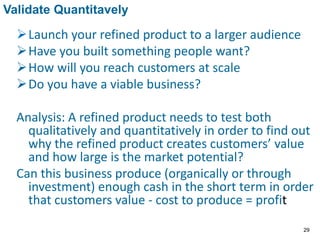
Launch your refined product to a larger audience
Have you built something people want?
How will you reach customers at scale
Do you have a viable business?
Analysis: A refined product needs to test both
qualitatively and quantitatively in order to find out
why the refined product creates customers’ value
and how large is the market potential?
Can this business produce (organically or through
investment) enough cash in the short term in order
that customers value - cost to produce = profit
Validate Quantitavely
29
30
31
32
CUSTOMER INTERVIEWING
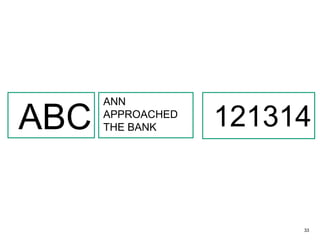
ABC
ANN
APPROACHED
THE BANK 121314
33
You may have jumped to the
“ABC” or “12 13 14” or “financial
institution”
Conclusions
Without EVEN KNOWING or
CONSIDERING alternatives!
34
I force you to use your
rational brain only?
35
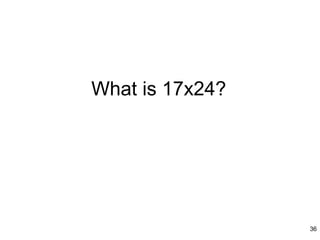
What is 17x24?
36
Our subjective judgements are
biased: we are far too willing to
believe research findings based
on inadequate evidence and
prone to collect too few
observations in our own
research
37
38
39
Knowledge is having the right answer.
Intelligence is asking the right questions
The Art of Customer Interviewing
What is a Startup?
A TEMPORARY organisation
DESIGNED to SEARCH …….
For REPEATABLE and SCALABLE
Business Models
Startups are NOT just SMALLER versions of a LARGE
Company
40
Strategy for Startups
• Planning before the Plan
• Use the Osterwalder Canvas to do two things:
– Organise our thinking
– Get out of the Building to turn the hypothesis into
facts
• SEARCH for the Business Model First and then
Write it Up (Business Plan)
41
Customer vs. Product Development
• More startups fail from a lack of
customers than from a failure of Product
Development.
• We have all the processes to manage the
Engineering Risk
• No processes to manage the Customer
Risk.
42
43
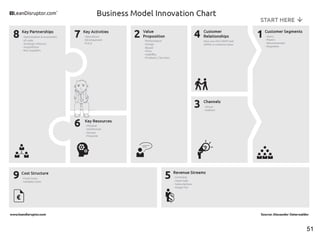
BUSINESS MODEL INNOVATION
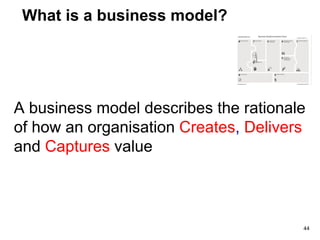
What is a business model?
A business model describes the rationale
of how an organisation Creates, Delivers
and Captures value
44
Why we need a shared language for
business models?
45
https://strategyzer.com/academy/cours
e/business-models-that-work-and-
value-propositions-that-sell/1/1
Note: You may need to license the online learning tool on Strategyzer to
view this clip from Osterwalder
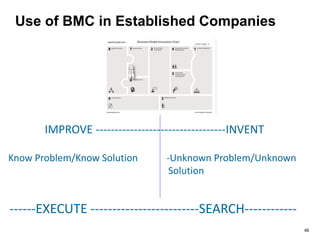
Use of BMC in Established Companies
IMPROVE ----------------------------------INVENT
Know Problem/Know Solution -Unknown Problem/Unknown
Solution
------EXECUTE -------------------------SEARCH------------
46
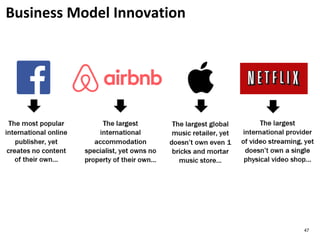
Business Model Innovation
47
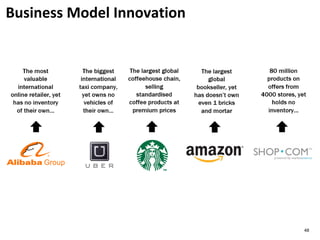
Business Model Innovation
48
49
“It is not the strongest of the
species that survive, nor the
most intelligent, but the one
most responsive to change.”
- Charles Darwin
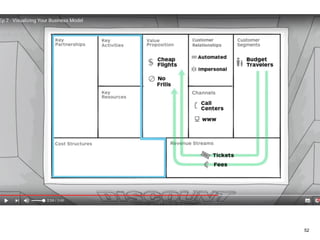
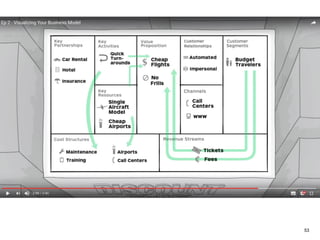
Getting from Business Idea to Business Model
50
51
52
53
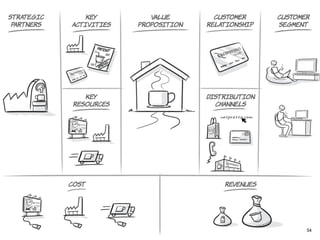
Nespresso’s Business Model
What is Nespresso’s Business Model? What
made them so successful?
5454
55
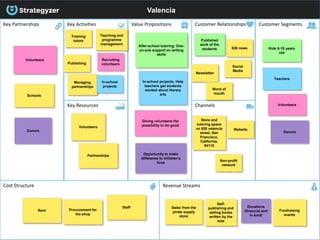
Valencia
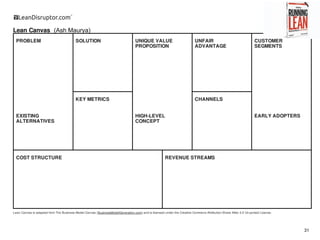
Key Partnerships Key Activities Value Propositions
Key Resources
Cost Structure Revenue Streams
Customer Relationships
Channels
Customer Segments
Recruiting
volunteers
Volunteers
Schools
Publishing
Training
tutors
In-school projects: Help
teachers get students
excited about literary
arts
Donors
Partnerships
Teaching and
programme
management
826 news
Volunteers
Giving volunteers the
possibility to do good
Non-profit
network
Published
work of the
students
Self-
publishing and
selling books
written by the
kids
Donations
(financial and
in kind)
Managing
partnerships
In-school
projects
After-school tutoring: One-
on-one support on writing
skills
Newsletter
Social
Media
Store and
tutoring space
on 826 valencia
street, San
Francisco,
California,
94110
Word of
mouth
Volunteers
Teachers
Fundraising
events
Website
Kids 6-18 years
old
Sales from the
pirate supply
store
Donors
Opportunity to make
difference to children’s
lives
Rent
Staff
Procurement for
the shop
57
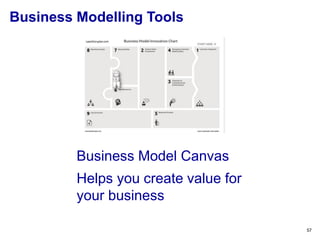
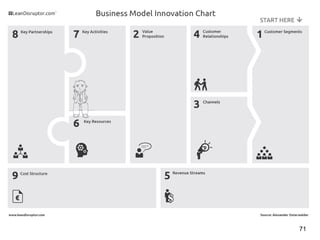
Business Model Canvas
Helps you create value for
your business
Business Modelling Tools
58
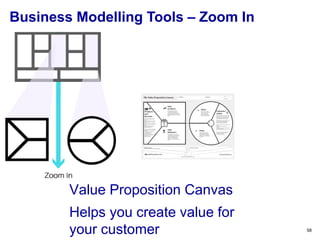
Value Proposition Canvas
Helps you create value for
your customer
Business Modelling Tools – Zoom In
59
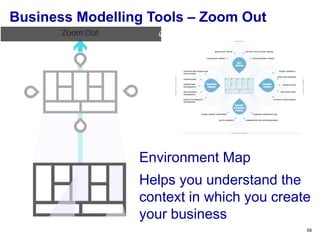
Environment Map
Helps you understand the
context in which you create
your business
Business Modelling Tools – Zoom Out
60
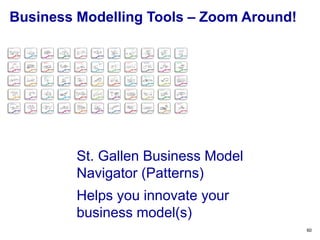
St. Gallen Business Model
Navigator (Patterns)
Helps you innovate your
business model(s)
Business Modelling Tools – Zoom Around!
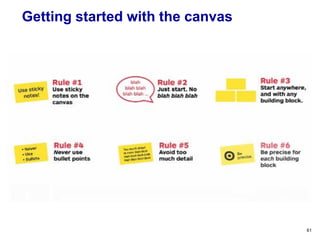
Getting started with the canvas
61
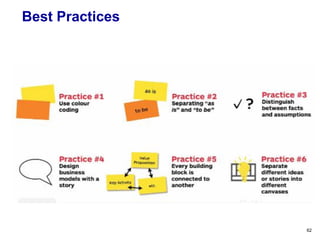
Best Practices
62
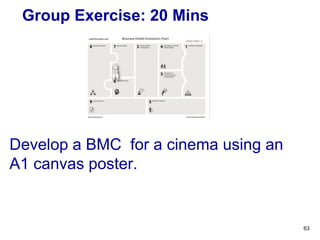
Group Exercise: 20 Mins
Develop a BMC for a cinema using an
A1 canvas poster.
63
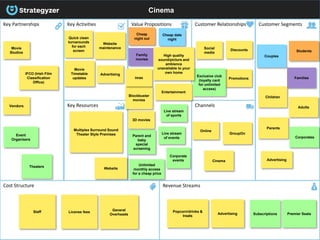
Cinema
Key Partnerships Key Activities Value Propositions
Key Resources
Cost Structure Revenue Streams
Customer Relationships
Channels
Customer Segments
Premier Seats
Cheap date
night
Website
maintenance
Parent and
baby
special
screening
Subscriptions
Popcorn/drinks &
treats
Children
Parents
Movie
Timetable
updates
Discounts
Staff
Multiplex Surround Sound
Theater Style Premises Live stream
of events
Movie
Studios
Social
media
Adults
Online
Students
Couples
GroupOn
Quick clean
turnarounds
for each
screen
Website
Entertainment
General
Overheads
Cheap
night out
Family
movies
Blockbuster
movies
Advertising
Live stream
of sports
Vendors
FamiliesPromotions
IFCO (Irish Film
Classification
Office)
Corporate
events
Unlimited
monthly access
for a cheap price
License fees
Cinema
Exclusive club
(loyalty card
for unlimited
access)
Event
Organisers
Advertising
imax
Theaters
Corporates
Advertising
3D movies
High quality
sound/picture and
ambience
unavailable to your
own home
Hypotheses or Guesses
• The canvas is a set of Hypotheses. i.e. Guesses.
• It helps us to organize our thinking! It is not
about functional organisation but about the
business.
• The real question is How do we change those
guesses into FACTS?
65
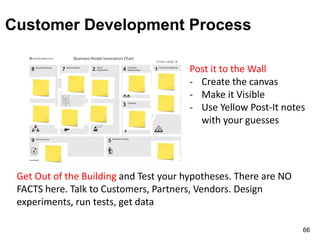
Customer Development Process
Post it to the Wall
- Create the canvas
- Make it Visible
- Use Yellow Post-It notes
with your guesses
Get Out of the Building and Test your hypotheses. There are NO
FACTS here. Talk to Customers, Partners, Vendors. Design
experiments, run tests, get data
66
What I learned…
 getting an interview right is not an easy task
 while I wanted to solve one problem I discovered another more
relevant one
 if you have a good relationship with people and you offer a proven
service they will give you a chance
 I discovered that my initial business idea was not the best idea
 through customer interviews I redefined my idea
 patience is important…I am still trying to get in touch with some of my
potential key partners
 people in our industry like to play safe where they can
Result
Pay every 6 months rather than every month
Use tangible gifts as “hooks”
Choose some major race meetings to start with
Tips and information on races and racetracks worldwide
Limit the number of TC membership to ensure the service
quality and to create a sense of exclusiveness
Consultancy, not translation or travel agency
3 job offers, 3 want to join the business, 1 willing to invest
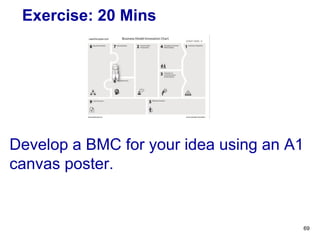
Exercise: 20 Mins
Develop a BMC for your idea using an A1
canvas poster.
69
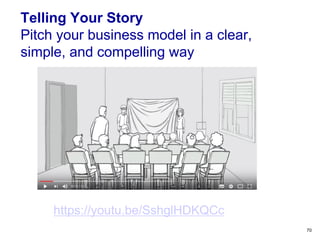
Telling Your Story
Pitch your business model in a clear,
simple, and compelling way
70
https://youtu.be/SshglHDKQCc
71
7 Questions to improve your business model
1. Switching Costs
– e.g. Apple iPod & iTunes
2. Recurring Revenues
– e.g. Nespresso
3. Earn before you Spend
– e.g. Dell
4. Game changing Cost Structures
– e.g. Skype
5. Getting others to do the work
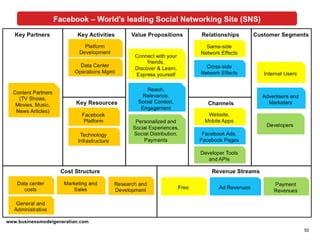
– e.g. Facebook
6. Scalability
– e.g. Diners Club
7. Protection from Competition
– e.g. Apple i-Phone (double sided market – app
developers/users) 72
“Studies comparing successful and
unsuccessful innovation have found that the
primary discriminator was the degree to
which the user needs were fully
understood.”
– David Garvin, Harvard Business School
73
#1 Target
customer
segment
#2
Customer
segment
also
overseas
market new
set of
customers
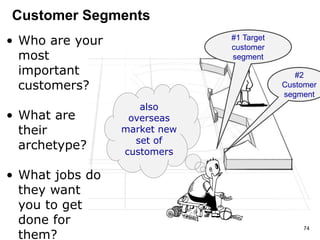
• Who are your
most
important
customers?
• What are
their
archetype?
• What jobs do
they want
you to get
done for
them?
Customer Segments
74
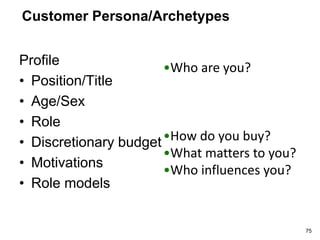
Customer Persona/Archetypes
Profile
• Position/Title
• Age/Sex
• Role
• Discretionary budget
• Motivations
• Role models
75
•Who are you?
•How do you buy?
•What matters to you?
•Who influences you?
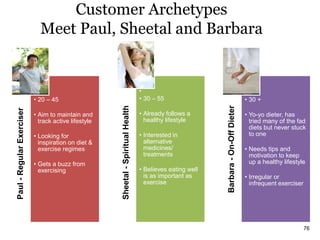
Customer Archetypes
Meet Paul, Sheetal and Barbara
Paul-RegularExerciser
• 20 – 45
• Aim to maintain and
track active lifestyle
• Looking for
inspiration on diet &
exercise regimes
• Gets a buzz from
exercising
Sheetal-SpiritualHealth
•
• 30 – 55
• Already follows a
healthy lifestyle
• Interested in
alternative
medicines/
treatments
• Believes eating well
is as important as
exercise
Barbara-On-OffDieter
•
• 30 +
• Yo-yo dieter, has
tried many of the fad
diets but never stuck
to one
• Needs tips and
motivation to keep
up a healthy lifestyle
• Irregular or
infrequent exerciser
76
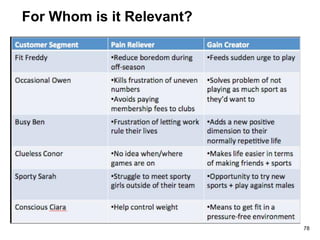
77
For Whom is it Relevant?
78
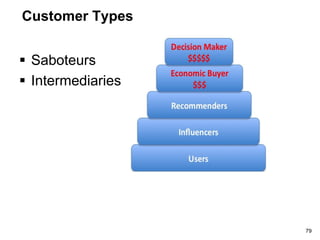
Customer Types
 Saboteurs
 Intermediaries (OEM’s and resellers)
79
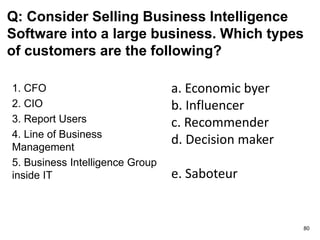
Q: Consider Selling Business Intelligence
Software into a large business. Which types
of customers are the following?
1. CFO
2. CIO
3. Report Users
4. Line of Business
Management
5. Business Intelligence Group
inside IT
a. Economic byer
b. Influencer
c. Recommender
d. Decision maker
e. Saboteur
80
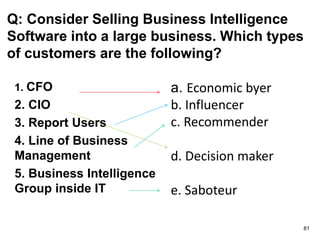
Q: Consider Selling Business Intelligence
Software into a large business. Which types
of customers are the following?
1. CFO
2. CIO
3. Report Users
4. Line of Business
Management
5. Business Intelligence
Group inside IT
a. Economic byer
b. Influencer
c. Recommender
d. Decision maker
e. Saboteur
81
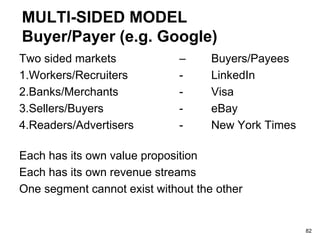
MULTI-SIDED MODEL
Buyer/Payer (e.g. Google)
Two sided markets – Buyers/Payees
1.Workers/Recruiters - LinkedIn
2.Banks/Merchants - Visa
3.Sellers/Buyers - eBay
4.Readers/Advertisers - New York Times
Each has its own value proposition
Each has its own revenue streams
One segment cannot exist without the other
82
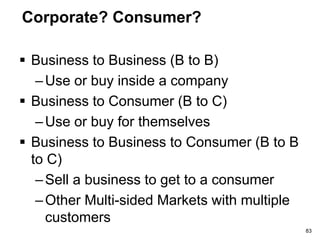
Corporate? Consumer?
 Business to Business (B to B)
–Use or buy inside a company
 Business to Consumer (B to C)
–Use or buy for themselves
 Business to Business to Consumer (B to B
to C)
–Sell a business to get to a consumer
–Other Multi-sided Markets with multiple
customers
83
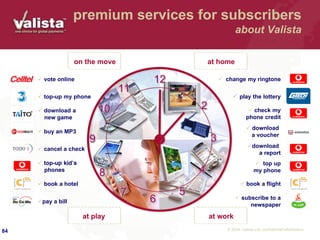
© 2004 Valista Ltd. confidential information.84
 top up
my phone
 subscribe to a
newspaper
 book a flight
download
a report
 book a hotel
pay a bill
 cancel a check
 top-up kid’s
phones
 vote online
 top-up my phone
 download a
new game
 buy an MP3
 download
a voucher
 change my ringtone
 play the lottery
 check my
phone credit
12
6
39
1
2
4
57
8
10
11
on the move at home
at play at work
premium services for subscribers
about Valista
“No one cares how much you know, until
they know how much you care”
– Theodore Roosevelt
EMPATHY MAPS
85
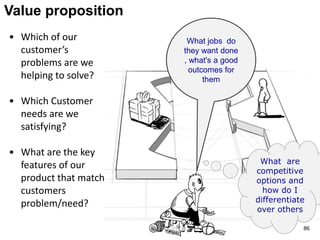
Value proposition
• Which of our
customer’s
problems are we
helping to solve?
• Which Customer
needs are we
satisfying?
• What are the key
features of our
product that match
customers
problem/need?
What jobs do
they want done
, what's a good
outcomes for
them
What are
competitive
options and
how do I
differentiate
over others
86
87
87
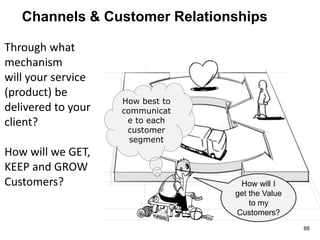
Through what
mechanism
will your service
(product) be
delivered to your
client?
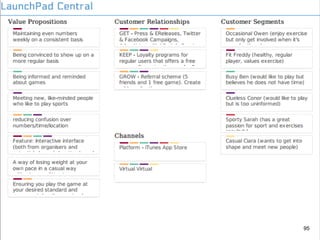
How will we GET,
KEEP and GROW
Customers? How will I
get the Value
to my
Customers?
How best to
communicat
e to each
customer
segment
Channels & Customer Relationships
88
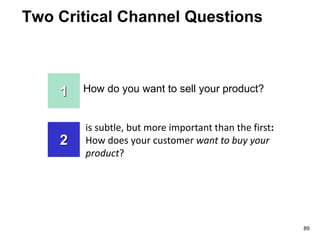
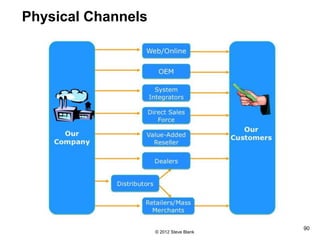
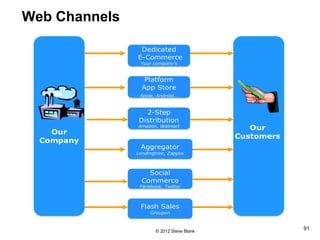
Two Critical Channel Questions
How do you want to sell your product?1
is subtle, but more important than the first:
How does your customer want to buy your
product?
2
89
Physical Channels
© 2012 Steve Blank
90
Web Channels
© 2012 Steve Blank
91
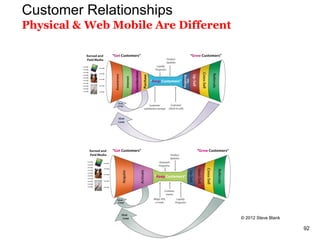
Customer Relationships
Physical & Web Mobile Are Different
© 2012 Steve Blank
92
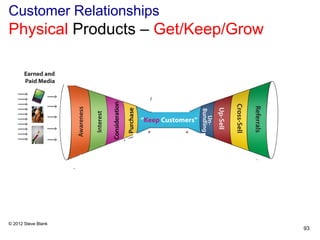
Customer Relationships
Physical Products – Get/Keep/Grow
© 2012 Steve Blank
93
Customer Relationships
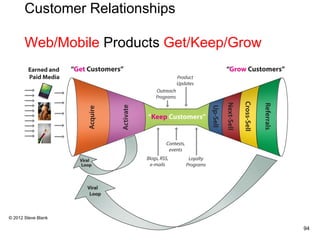
Web/Mobile Products Get/Keep/Grow
© 2012 Steve Blank
94
95
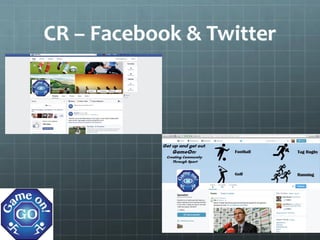
CR – Facebook & Twitter
© 2012 Steve Blank
97
How Many Will You Sell?
• How many can your channel sell?
• How much will the channel cost?
• How many customer activations?
• Revenue? Churn/Attrition rate?
customers/?
• How much will it cost to acquire a
customer?
• How many units will they buy from
each of these efforts?
98
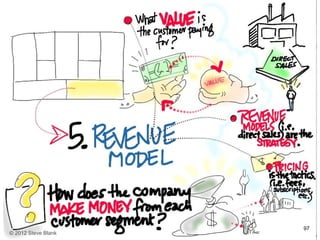
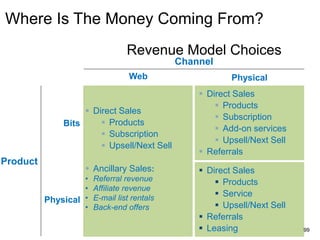
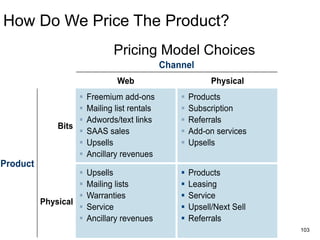
Where Is The Money Coming From?
Revenue Model Choices
Bits
Physical
Product
Web Physical
Channel
 Direct Sales
 Products
 Subscription
 Upsell/Next Sell
 Ancillary Sales:
• Referral revenue
• Affiliate revenue
• E-mail list rentals
• Back-end offers
 Direct Sales
 Products
 Service
 Upsell/Next Sell
 Referrals
 Leasing
 Direct Sales
 Products
 Subscription
 Add-on services
 Upsell/Next Sell
 Referrals
99
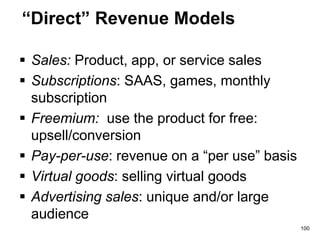
“Direct” Revenue Models
 Sales: Product, app, or service sales
 Subscriptions: SAAS, games, monthly
subscription
 Freemium: use the product for free:
upsell/conversion
 Pay-per-use: revenue on a “per use” basis
 Virtual goods: selling virtual goods
 Advertising sales: unique and/or large
audience
100
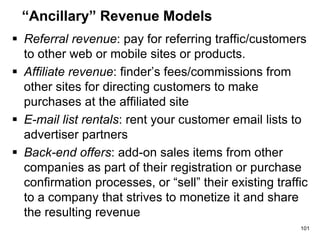
“Ancillary” Revenue Models
 Referral revenue: pay for referring traffic/customers
to other web or mobile sites or products.
 Affiliate revenue: finder’s fees/commissions from
other sites for directing customers to make
purchases at the affiliated site
 E-mail list rentals: rent your customer email lists to
advertiser partners
 Back-end offers: add-on sales items from other
companies as part of their registration or purchase
confirmation processes, or “sell” their existing traffic
to a company that strives to monetize it and share
the resulting revenue
101
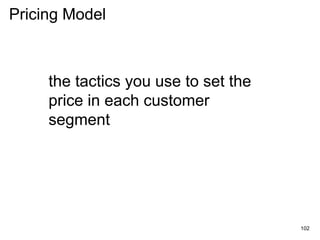
the tactics you use to set the
price in each customer
segment
Pricing Model
102
How Do We Price The Product?
Pricing Model Choices
103
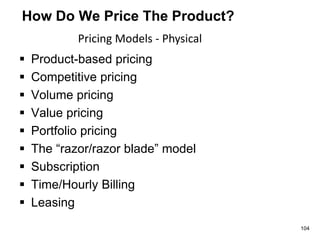
How Do We Price The Product?
 Product-based pricing
 Competitive pricing
 Volume pricing
 Value pricing
 Portfolio pricing
 The “razor/razor blade” model
 Subscription
 Time/Hourly Billing
 Leasing
Pricing Models - Physical
104
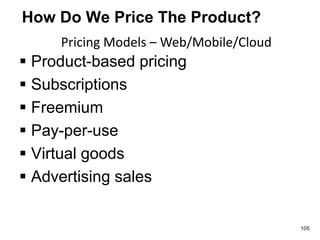
How Do We Price The Product?
 Product-based pricing
 Subscriptions
 Freemium
 Pay-per-use
 Virtual goods
 Advertising sales
Pricing Models – Web/Mobile/Cloud
105
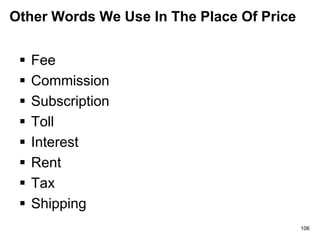
Other Words We Use In The Place Of Price
 Fee
 Commission
 Subscription
 Toll
 Interest
 Rent
 Tax
 Shipping
106
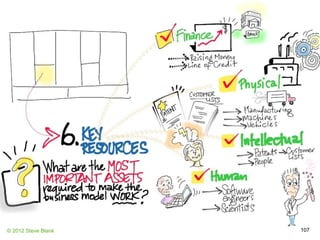
© 2012 Steve Blank 107
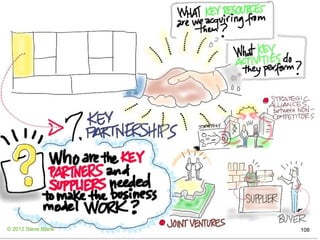
© 2012 Steve Blank 108
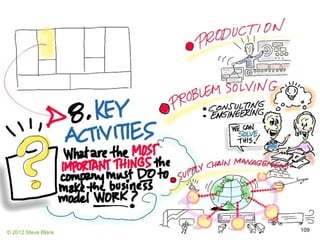
© 2012 Steve Blank 109
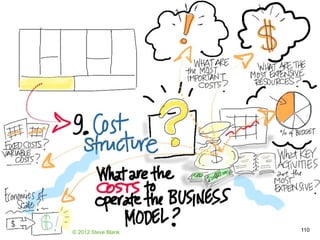
© 2012 Steve Blank 110
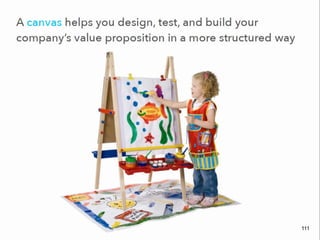
111111
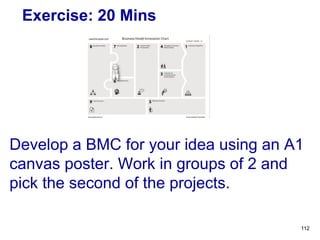
Exercise: 20 Mins
Develop a BMC for your idea using an A1
canvas poster. Work in groups of 2 and
pick the second of the projects.
112
113
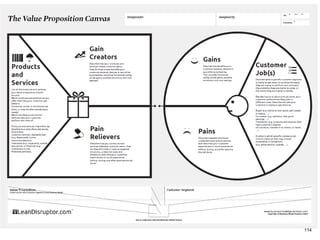
VALUE PROPOSITION CANVAS
114
115
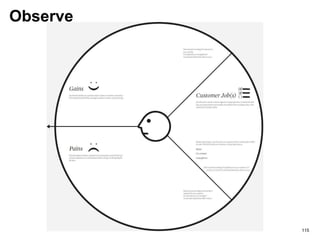
Observe
Clayton Christensen
116
Jobs to be Done
“If you understand the job,
how to improve the product
becomes just obvious”
Jobs To Be Done
• Functional Job
– Get a task done
– e.g. business travel: accommodation, appointment, eat,
sleep
• Emotional Job
– How the customer wants to feel
– e.g. business travel: stay connected with home, stay safe
• Social Job
– How the customer wants to be perceived
– e.g. business travel: look good with clients
• Supporting Job
– Purchasing and consuming value
- e.g. business travel: reserve accommodation 117
Jobs To Be Done – Generic jobs
• Search or seek information
• Fix or repair something
• Satisfy my emotional needs
• Protect property or information
• Achieve objective efficiently
• Compare or evaluate alternative
• Offer somebody else advice
• Convey an image (of success)
• Transfer ownership rights
• Evaluate performance
• Achieve main objective
• Reduce stress 118
“People buy products and services to get jobs
done. As people complete these jobs, they
have certain measurable outcomes that they
are attempting to achieve. It links a company's
value creation activities to customer-defined
metrics.” - Ulwick
OUTCOME-DRIVEN
INNOVATION
119
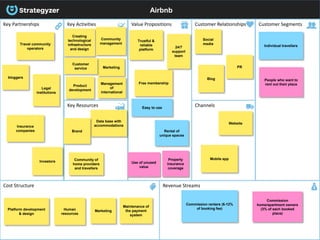
Airbnb
Key Partnerships Key Activities Value Propositions
Key Resources
Cost Structure Revenue Streams
Customer Relationships
Channels
Customer Segments
Creating
technological
infrastructure
and design
bloggers
Marketing
Easy to use
Investors
Legal
institutions
Marketing
Free membership
Travel community
operators
Insurance
companies
Community of
home providers
and travellers
Platform development
& design
Customer
service
Maintenance of
the payment
system
Individual travellers
Commission renters (6-12%
of booking fee)
Data base with
accommodations
Property
insurance
coverage
Blog
Community
management
Rental of
unique spaces
PR
Product
development
Management
of
international
Mobile app
Human
resources
Brand
Social
media
Trustful &
reliable
platform
People who want to
rent out their place
Commission
home/apartment owners
(3% of each booked
place)
24/7
support
team
Use of unused
value
Website
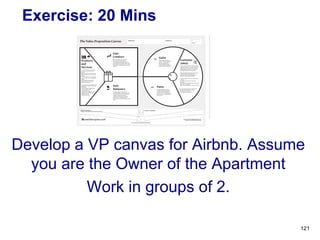
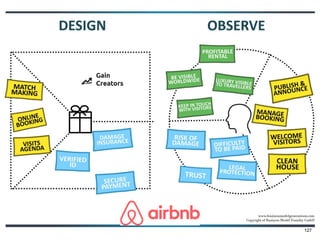
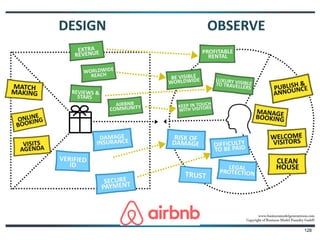
Exercise: 20 Mins
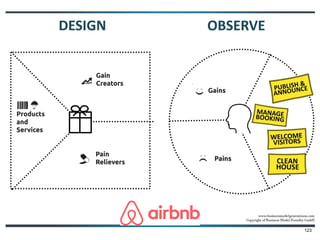
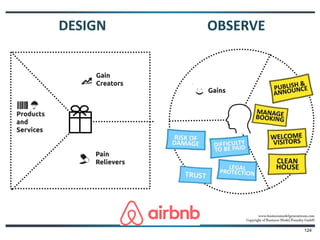
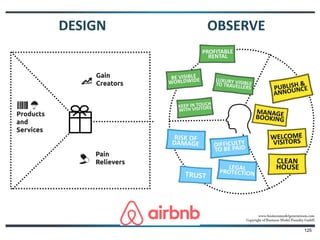
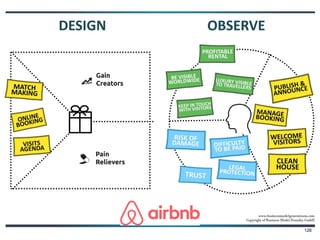
Develop a VP canvas for Airbnb. Assume
you are the Owner of the Apartment
Work in groups of 2.
121
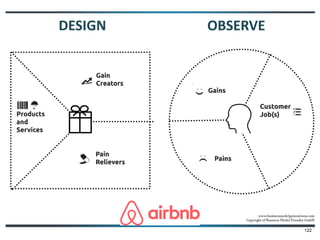
122122
123123
124124
125125
126126
127127
128128
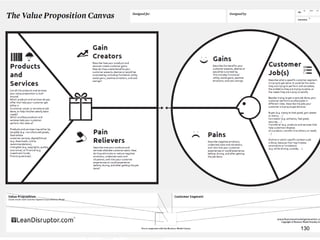
Exercise: 20 Mins Each
Develop a VP canvas for a CS in your
BMC
Work in groups of 2.
129
© 2004 Valista Ltd. confidential information.130
Back and forth between Business Model
and Value Proposition
131
Note: You may need to license the online learning tool on Strategyzer to
view this clip from Osterwalder
https://strategyzer.com/platform/training/
courses/mastering-business-models/1/1/4
MVP
A Minimum Viable Product (MVP) is
“that product which has just those
features and no more that allows you
to ship a product that early adopters
see and, at least some of whom
resonate with, pay you money for, and
start to give you feedback on”
132
MVP #1 Explainer video
Explainer video is a short video that explains
what your product does and why people should
buy it.
A simple, 90 seconds animation is sufficient.
e.g. Dropbox
How to make an explainer video
133
MVP #2 A Landing Place
A landing page is a web page where
visitors “land” after clicking a link from
an ad, e-mail or another type of a
campaign.
134
MVP #2 A Landing Page
• Craft your Landing Page
• Set up a Google AdWord campaign and drive traffic
to your new landing page. Even here you can let the
AdWord engine rotate different messages and test
what works best on your prospects
• Set up Google Analytics. The most important thing to
measure is conversions – percent of visitors that sign
up (or perform another desired action)
• Set up a chat to make it easy for the visitors to raise
questions
• Set up a service like Qualaroo to survey your visitors
135
MVP #3 Wizard of Oz
A “Wizard of Oz” MVP is when you put up a
front that looks like a real working product, but
you manually carry out product functions. It’s
also known as “Flinstoning”.
Zappos shoes is the biggest online shoe
retailer, with annual sales exceeding $1 billion.
In his Lean Startup book, Eric Ries describes
how the founder started with a Wizard of Oz
product.
136
MVP #4 The Concierge MVP
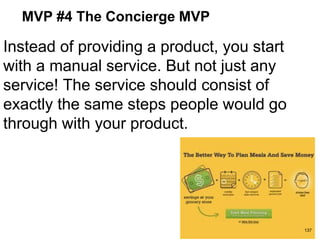
Instead of providing a product, you start
with a manual service. But not just any
service! The service should consist of
exactly the same steps people would go
through with your product.
137
MVP #5 Piecemeal MVP
This strategy is a blend between the “Wizard
of Oz” and “Concierge” approaches. Again,
you emulate the steps people would go
through using your product – as you envision
it.
138
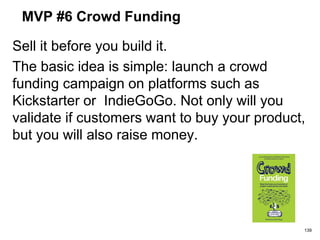
MVP #6 Crowd Funding
Sell it before you build it.
The basic idea is simple: launch a crowd
funding campaign on platforms such as
Kickstarter or IndieGoGo. Not only will you
validate if customers want to buy your product,
but you will also raise money.
139
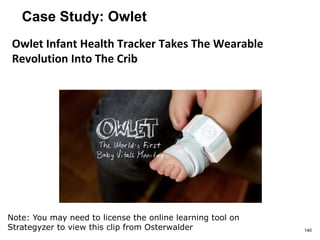
Case Study: Owlet
Owlet Infant Health Tracker Takes The Wearable
Revolution Into The Crib
140
Note: You may need to license the online learning tool on
Strategyzer to view this clip from Osterwalder
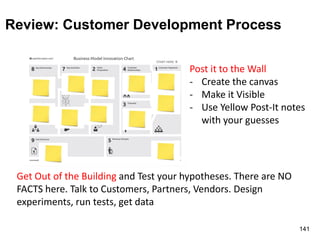
Review: Customer Development Process
Post it to the Wall
- Create the canvas
- Make it Visible
- Use Yellow Post-It notes
with your guesses
Get Out of the Building and Test your hypotheses. There are NO
FACTS here. Talk to Customers, Partners, Vendors. Design
experiments, run tests, get data
141
Strategy and Business Models – DIT PM Module 1
raomal@pereranet.com | @raomal @LeanDisruptor | www.linkedin.com/in/raomal
RAOMAL PERERA
THANK YOU!
Fit for Purpose UCD @raomal
143
APPENDIX
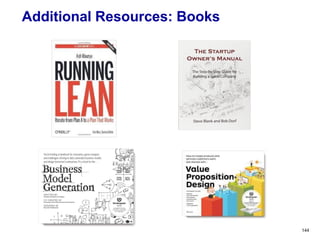
Additional Resources: Books
144
Additional Resources Books
145
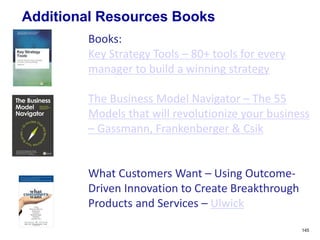
Books:
Key Strategy Tools – 80+ tools for every
manager to build a winning strategy
The Business Model Navigator – The 55
Models that will revolutionize your business
– Gassmann, Frankenberger & Csik
What Customers Want – Using Outcome-
Driven Innovation to Create Breakthrough
Products and Services – Ulwick
Additional Resources
146
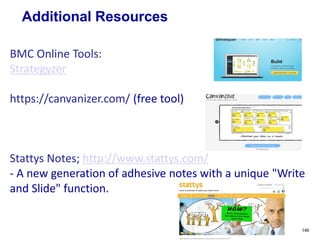
BMC Online Tools:
Strategyzer
https://canvanizer.com/ (free tool)
Stattys Notes; http://www.stattys.com/
- A new generation of adhesive notes with a unique "Write
and Slide" function.
Additional Resources
147
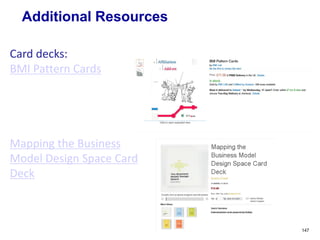
Card decks:
BMI Pattern Cards
Mapping the Business
Model Design Space Card
Deck
148
BUSINESS MODEL ENVIRONMENT
149
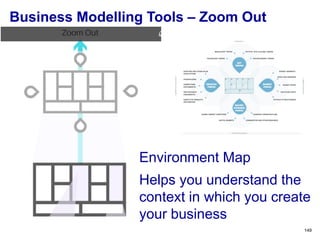
Environment Map
Helps you understand the
context in which you create
your business
Business Modelling Tools – Zoom Out
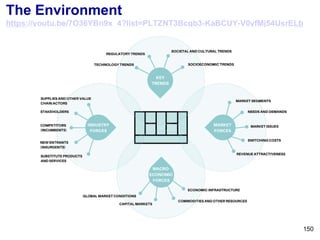
The Environment
https://youtu.be/7O36YBn9x_4?list=PLTZNT3Bcgb3-KaBCUY-V0yfMj54UsrELb
150
KEY TRENDS
Technology Trends
Regulatory Trends
Societal & Cultural Trends
Socioeconomic Trends
151
Technology Trends
Identifies technology trends that could threaten
your business model or enable it to evolve or
improve
•What are the major technology trends both inside
and outside your market?
•Which technologies represent important
opportunities or disruptive threats?
•Which emerging technologies are peripheral
customer adopting?
152
Regulatory Trends
Describes regulations and regulatory trends that
influence your business model
•Which regulatory trends influence your market?
•What rules may affect your business model?
•Which regulations and taxes affect customer
demand?
153
Socioeconomic Trends
Outlines major socioeconomic trends relevant to
your business model
•What are the key demographic trends?
•How would you characterize income and wealth
distribution in your market?
•How high are disposable incomes?
•Describe spending patterns in your market (e.g.
housing, healthcare, entertainment, etc.)?
•What portion of the population lives in urban
areas as opposed to rural settings? 154
Societal and Cultural Trends
Identifies major societal trends that may influence
your business model
•Describe key societal trends. Which shifts in
cultural or societal values affect your business
model?
•Which trends might influence buyer behavior?
155
Market Issues
Market Segments
Needs & Demands
Switching Costs
Revenue Attractiveness
MARKET FORCES
156
Market Issues
Identifies key issues driving and transforming your
market from Customer and Offer perspectives
•What are the crucial issues affecting the
customer landscape?
•Which shifts are underway?
•Where is the market heading?
157
Market Segments
Identifies the major market segments, describes
their attractiveness and seeks to spot new
segments
•What are the most important Customer
Segments?
•Where is the biggest growth potential?
•Which segments are declining?
•Which peripheral segments deserve attention?
158
Needs & Demands
Outlines market needs and analyzes how well
they are served
•What do Customers Need?
•Where are the biggest unsatisfied Customer
Needs?
•What do Customers’ really want to get done?
•Where is demand increasing?
Declining?
159
Switching Costs
Describes elements related to customers
switching business to competitors
•What binds customers to a company and its
offer?
•What switching costs prevent customers from
defecting to competitors?
•Is it easy for customers to find and purchase
similar offers?
•How important is brand?
160
Revenue Attractiveness
Identifies elements related to revenue
attractiveness and pricing power
•What are customers really willing to pay for?
•Where can the largest margins be achieved?
•Can customers easily find and purchase cheaper
products and services?
161
MACRO ECONOMIC FORCES
Global Market Conditions
Capital Markets
Commodities and Other Resources
Economic Infrastructure
162
Global Market Conditions
Outlines current overall conditions from a
macroeconomic perspective
•Is the economy in a boom or bust phase?
•Describe general market sentiment.
•What is the GDP growth rate?
•How high is the unemployment rate?
163
Capital Markets
Describes current capital market conditions as
they relate to your capital needs
•What is the state of the capital markets?
•How easy is it to obtain funding in your particular
market?
•Is seed capital, venture capital, public funding,
market capital or credit readily available?
•How costly is it to procure funds?
164
Commodities and Other Resources
Highlights current prices and price trends for
resources required for your business model
•Describe the current status of markets for
commodities and other resources essential to
your business (e.g. oil prices and labor costs).
•How easy is it to obtain the resources needed to
execute your business model? (e.g. attract prime
talent)?
•How costly are they?
•Where are prices headed? 165
Economic Infrastructure
Describes the economic infrastructure of the
market in which your business operates
•How good is the (public) infrastructure in your
market?
•How would you characterize transportation,
trade, school quality and access to suppliers and
customers?
•How high are individual and corporate taxes?
•How good are public services for organizations?
•How would you rate the quality of life?
166
INDUSTRY FORCES
Competitors (Incumbents)
New entrants (Insurgents)
Substitute Products & Services
Stakeholders
Suppliers & other Value Chain Actors 167
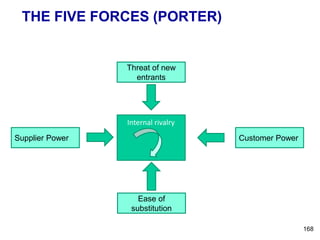
THE FIVE FORCES (PORTER)
Threat of new
entrants
Supplier Power Customer Power
Ease of
substitution
Internal rivalry
168
Competitors (Incumbents)
Identifies incumbent competitors and their relative strengths
•Who are your competitors?
•Who are the dominant players in our particular sector?
•What are their competitive advantages and disadvantages?
•Describe their main offers.
•Which Customer Segments are they focusing on?
•What is their Cost Structure?
•How much influence do they exert on our Customer
Segments, Revenue Streams, and Margins?
169
New Entrants (Insurgents)
Identifies new insurgent players and determines whether they
compete with a business model different from yours
•Who are the new entrants in your market?
•How are they different?
•What competitive advantages or disadvantages do they
have?
•Which barriers must they overcome?
•What are their Value Propositions?
•Which Customer Segments are they focused on?
•What is their cost structure?
•To what extent do they influence your Customer Segments,
Revenue Streams and Margins?
170
Substitute Products and Services
Describes potential substitutes for your offers-
including those from other markets and industries
•Which products or services could replace ours?
•How much do they cost compared to ours?
•How easy it is for customers to switch to these
substitutes?
•What business model traditions do these substitute
products stem from (e.g. high-speed trains versus
airplanes, mobile phones versus cameras, Skype
versus long-distance telephone companies)?
171
Stakeholders
Specifies which actors influence your organization
and business model
•Which stakeholders might influence your
business model?
•How influential are shareholders? Workers? The
government? Lobbyists?
172
Suppliers and other Value Chain Actors
Describes Potential substitutes for your offers-
including those from other markets and industries
•Who are the key players in your industry value
chain?
•To what extent does your business model
depend on other players?
•Are peripheral players emerging?
•Which are most profitable?
173
174
Strategy and Business Models – DIT PM Module 1
raomal@LeanDisruptor.com | @raomal @LeanDisruptor | www.facebook.com/LeanDisruptor
RAOMAL PERERA
THANK YOU!

How to build a startup may 2017

  • 1.
    Strategy and BusinessModels – DIT PM Module 1 RAOMAL PERERA raomal@pereranet.com | @raomal @LeanDisruptor | www.facebook.com/LeanDisruptor HOW TO BUILD A STARTUP Using Business Model Innovation
  • 2.
    RAOMAL PERERA  SerialEntrepreneur  ISOCOR (NASDAQ: icor) & Network365/Valista (Intel)  Adjunct Professor of Entrepreneurial Studies  INSEAD & UCD  Business Model Innovation, Lean Startup, Leadership & Fund Raising  Consultant  Clients include: MSD (Merck), HP (Hewlett Packard), IFB (Irish Film Board), HSE (Health Service Executive), Arvato (Bertelsman), Resmed, Openet, Glandore, SEI (Social Entrepreneurs Ireland), DJEI (Dept of Jobs, Entreprise and Innovation), CWIA (Cartier Women’s Initiative Awards) …  Accolades  Finalist Ernst & Young Entrepreneur of the Year  Tech Pioneer World Economic Forum  ISA Award for Outstanding Software Achievement  Blog: www.LeanDisruptor.com 2
  • 3.
  • 4.
  • 5.
  • 6.
  • 7.
    Learning Outcomes 7 • Identifythe Problem/Need first before defining the Solution. • To introduce you to the key tools and techniques to help you build a successful startup or at least reduce the risk of failure • Learn to invent design and build powerful new business models using a set of business model innovation tools. • Understand the environment in which you operate
  • 8.
    8 What is the1 single most important thing you want to take away by the end of this day?
  • 9.
    Your SOLUTION isNOT my PROBLEM 9 Take 2 minutes to write down the PROBLEM/NEED you are addressing
  • 10.
    Introduction • Introduce yourself •What is the problem/need that you solve with your product idea 10
  • 11.
  • 12.
  • 13.
    Find the Gap Howto find opportunities that others don’t see. - Amy Wilkinson 13
  • 14.
    How breakthrough ideasemerge from small discoveries Creative thinkers practice a set of simple but ingenious experimental methods • failing quickly to learn fast • tapping into the genius of play • engaging in highly immersed observation Free their minds, opening them up to making unexpected connections and perceiving invaluable insights. 14
  • 15.
  • 16.
    Design thinking isa different way of knowing It helps us explore questions that are crucial to the future of our business. Without design thinking, our past becomes our future Design Thinking 16
  • 17.
  • 18.
    Design thinking oninnovation stimulation Three core elements—observation, experimentation and prototyping: • You have to start with observation because it's the only way to illuminate the subtle nuances about how people actually get things done, or don't get things done, and it's these deep insights that lead to powerful new ideas. • Intellectual experimentation is equally critical because there's no way to generate real breakthroughs unless people are willing to explore a lot of options in a divergent way. • Finally, rapid and inexpensive prototyping is the most efficient way to move an idea from concept to reality. - Tim Brown, CEO of IDEO18
  • 19.
    Most successful entrepreneurs don’tbegin with brilliant ideas – they discover them 19
  • 20.
    Often (first-time) entrepreneursfeel that step 1 involves writing a business plan/building a slide deck and getting funded! 20
  • 21.
    21 Finding the Problemis the Hard Part – Kevin Systrom & Mike Krieger (Instagram Co_Founders) Instagram Co-Founder Kevin Systrom believes building solutions for most problems is the easy part; the hard part is finding the right problem to solve. Here he opens up about how he and fellow Co-Founder Mike Krieger identified the problems they wanted to solve around sharing photos through mobile devices. He also reminds entrepreneurs to embrace simple solutions, as they can often delight users and customers.
  • 22.
  • 23.
  • 24.
  • 25.
  • 26.
    Key Question: DoI have a problem worth solving? Who has the problem? What is the top problem? How is it solved today? Where do they have the problem or in what context do they have a problem? (milkshake example) When do they have the problem? Why is it a problem? (root cause analysis. Why is the single best word for creating value in a start-up and an established business) - It is not possible to know what the top problem is without knowing where, when and why they have a problem. Also the questions may not be answered in sequence e.g. will we find the problem and the person with the problem at the same time? Identify the Problem 26
  • 27.
    Take a stabat defining the solution Build a demo (MVP) Test it with assumed customers Will the solution work? (can the proposed solution create customer value that exceeds the cost to produce and deliver the solution to the customer) Who it the early adopter? Does the pricing model work? Define the Solution 27
  • 28.
    Build an MVP Softlaunch to early adopters Do they realise the unique value proposition How will you find enough early adopters to support learning? Are you getting paid? Analysis: There needs to be a bit of intuitive thinking around the MVP. We need to ask and then guess how we can create the most unique customer value in the shortest amount of time with the least resources. With a bit of thinking and an equal amount of action we have a chance of appropriating real value in the short term VALIDATE THE QUALITATIVELY Validate Qualitatively 28
  • 29.
    Launch your refinedproduct to a larger audience Have you built something people want? How will you reach customers at scale Do you have a viable business? Analysis: A refined product needs to test both qualitatively and quantitatively in order to find out why the refined product creates customers’ value and how large is the market potential? Can this business produce (organically or through investment) enough cash in the short term in order that customers value - cost to produce = profit Validate Quantitavely 29
  • 30.
  • 31.
  • 32.
  • 33.
  • 34.
    You may havejumped to the “ABC” or “12 13 14” or “financial institution” Conclusions Without EVEN KNOWING or CONSIDERING alternatives! 34
  • 35.
    I force youto use your rational brain only? 35
  • 36.
  • 37.
    Our subjective judgementsare biased: we are far too willing to believe research findings based on inadequate evidence and prone to collect too few observations in our own research 37
  • 38.
  • 39.
    39 Knowledge is havingthe right answer. Intelligence is asking the right questions The Art of Customer Interviewing
  • 40.
    What is aStartup? A TEMPORARY organisation DESIGNED to SEARCH ……. For REPEATABLE and SCALABLE Business Models Startups are NOT just SMALLER versions of a LARGE Company 40
  • 41.
    Strategy for Startups •Planning before the Plan • Use the Osterwalder Canvas to do two things: – Organise our thinking – Get out of the Building to turn the hypothesis into facts • SEARCH for the Business Model First and then Write it Up (Business Plan) 41
  • 42.
    Customer vs. ProductDevelopment • More startups fail from a lack of customers than from a failure of Product Development. • We have all the processes to manage the Engineering Risk • No processes to manage the Customer Risk. 42
  • 43.
  • 44.
    What is abusiness model? A business model describes the rationale of how an organisation Creates, Delivers and Captures value 44
  • 45.
    Why we needa shared language for business models? 45 https://strategyzer.com/academy/cours e/business-models-that-work-and- value-propositions-that-sell/1/1 Note: You may need to license the online learning tool on Strategyzer to view this clip from Osterwalder
  • 46.
    Use of BMCin Established Companies IMPROVE ----------------------------------INVENT Know Problem/Know Solution -Unknown Problem/Unknown Solution ------EXECUTE -------------------------SEARCH------------ 46
  • 47.
  • 48.
  • 49.
    49 “It is notthe strongest of the species that survive, nor the most intelligent, but the one most responsive to change.” - Charles Darwin
  • 50.
    Getting from BusinessIdea to Business Model 50
  • 51.
  • 52.
  • 53.
  • 54.
    Nespresso’s Business Model Whatis Nespresso’s Business Model? What made them so successful? 5454
  • 55.
  • 56.
    Valencia Key Partnerships KeyActivities Value Propositions Key Resources Cost Structure Revenue Streams Customer Relationships Channels Customer Segments Recruiting volunteers Volunteers Schools Publishing Training tutors In-school projects: Help teachers get students excited about literary arts Donors Partnerships Teaching and programme management 826 news Volunteers Giving volunteers the possibility to do good Non-profit network Published work of the students Self- publishing and selling books written by the kids Donations (financial and in kind) Managing partnerships In-school projects After-school tutoring: One- on-one support on writing skills Newsletter Social Media Store and tutoring space on 826 valencia street, San Francisco, California, 94110 Word of mouth Volunteers Teachers Fundraising events Website Kids 6-18 years old Sales from the pirate supply store Donors Opportunity to make difference to children’s lives Rent Staff Procurement for the shop
  • 57.
    57 Business Model Canvas Helpsyou create value for your business Business Modelling Tools
  • 58.
    58 Value Proposition Canvas Helpsyou create value for your customer Business Modelling Tools – Zoom In
  • 59.
    59 Environment Map Helps youunderstand the context in which you create your business Business Modelling Tools – Zoom Out
  • 60.
    60 St. Gallen BusinessModel Navigator (Patterns) Helps you innovate your business model(s) Business Modelling Tools – Zoom Around!
  • 61.
    Getting started withthe canvas 61
  • 62.
  • 63.
    Group Exercise: 20Mins Develop a BMC for a cinema using an A1 canvas poster. 63
  • 64.
    Cinema Key Partnerships KeyActivities Value Propositions Key Resources Cost Structure Revenue Streams Customer Relationships Channels Customer Segments Premier Seats Cheap date night Website maintenance Parent and baby special screening Subscriptions Popcorn/drinks & treats Children Parents Movie Timetable updates Discounts Staff Multiplex Surround Sound Theater Style Premises Live stream of events Movie Studios Social media Adults Online Students Couples GroupOn Quick clean turnarounds for each screen Website Entertainment General Overheads Cheap night out Family movies Blockbuster movies Advertising Live stream of sports Vendors FamiliesPromotions IFCO (Irish Film Classification Office) Corporate events Unlimited monthly access for a cheap price License fees Cinema Exclusive club (loyalty card for unlimited access) Event Organisers Advertising imax Theaters Corporates Advertising 3D movies High quality sound/picture and ambience unavailable to your own home
  • 65.
    Hypotheses or Guesses •The canvas is a set of Hypotheses. i.e. Guesses. • It helps us to organize our thinking! It is not about functional organisation but about the business. • The real question is How do we change those guesses into FACTS? 65
  • 66.
    Customer Development Process Postit to the Wall - Create the canvas - Make it Visible - Use Yellow Post-It notes with your guesses Get Out of the Building and Test your hypotheses. There are NO FACTS here. Talk to Customers, Partners, Vendors. Design experiments, run tests, get data 66
  • 67.
    What I learned… getting an interview right is not an easy task  while I wanted to solve one problem I discovered another more relevant one  if you have a good relationship with people and you offer a proven service they will give you a chance  I discovered that my initial business idea was not the best idea  through customer interviews I redefined my idea  patience is important…I am still trying to get in touch with some of my potential key partners  people in our industry like to play safe where they can
  • 68.
    Result Pay every 6months rather than every month Use tangible gifts as “hooks” Choose some major race meetings to start with Tips and information on races and racetracks worldwide Limit the number of TC membership to ensure the service quality and to create a sense of exclusiveness Consultancy, not translation or travel agency 3 job offers, 3 want to join the business, 1 willing to invest
  • 69.
    Exercise: 20 Mins Developa BMC for your idea using an A1 canvas poster. 69
  • 70.
    Telling Your Story Pitchyour business model in a clear, simple, and compelling way 70 https://youtu.be/SshglHDKQCc
  • 71.
  • 72.
    7 Questions toimprove your business model 1. Switching Costs – e.g. Apple iPod & iTunes 2. Recurring Revenues – e.g. Nespresso 3. Earn before you Spend – e.g. Dell 4. Game changing Cost Structures – e.g. Skype 5. Getting others to do the work – e.g. Facebook 6. Scalability – e.g. Diners Club 7. Protection from Competition – e.g. Apple i-Phone (double sided market – app developers/users) 72
  • 73.
    “Studies comparing successfuland unsuccessful innovation have found that the primary discriminator was the degree to which the user needs were fully understood.” – David Garvin, Harvard Business School 73
  • 74.
    #1 Target customer segment #2 Customer segment also overseas market new setof customers • Who are your most important customers? • What are their archetype? • What jobs do they want you to get done for them? Customer Segments 74
  • 75.
    Customer Persona/Archetypes Profile • Position/Title •Age/Sex • Role • Discretionary budget • Motivations • Role models 75 •Who are you? •How do you buy? •What matters to you? •Who influences you?
  • 76.
    Customer Archetypes Meet Paul,Sheetal and Barbara Paul-RegularExerciser • 20 – 45 • Aim to maintain and track active lifestyle • Looking for inspiration on diet & exercise regimes • Gets a buzz from exercising Sheetal-SpiritualHealth • • 30 – 55 • Already follows a healthy lifestyle • Interested in alternative medicines/ treatments • Believes eating well is as important as exercise Barbara-On-OffDieter • • 30 + • Yo-yo dieter, has tried many of the fad diets but never stuck to one • Needs tips and motivation to keep up a healthy lifestyle • Irregular or infrequent exerciser 76
  • 77.
  • 78.
    For Whom isit Relevant? 78
  • 79.
    Customer Types  Saboteurs Intermediaries (OEM’s and resellers) 79
  • 80.
    Q: Consider SellingBusiness Intelligence Software into a large business. Which types of customers are the following? 1. CFO 2. CIO 3. Report Users 4. Line of Business Management 5. Business Intelligence Group inside IT a. Economic byer b. Influencer c. Recommender d. Decision maker e. Saboteur 80
  • 81.
    Q: Consider SellingBusiness Intelligence Software into a large business. Which types of customers are the following? 1. CFO 2. CIO 3. Report Users 4. Line of Business Management 5. Business Intelligence Group inside IT a. Economic byer b. Influencer c. Recommender d. Decision maker e. Saboteur 81
  • 82.
    MULTI-SIDED MODEL Buyer/Payer (e.g.Google) Two sided markets – Buyers/Payees 1.Workers/Recruiters - LinkedIn 2.Banks/Merchants - Visa 3.Sellers/Buyers - eBay 4.Readers/Advertisers - New York Times Each has its own value proposition Each has its own revenue streams One segment cannot exist without the other 82
  • 83.
    Corporate? Consumer?  Businessto Business (B to B) –Use or buy inside a company  Business to Consumer (B to C) –Use or buy for themselves  Business to Business to Consumer (B to B to C) –Sell a business to get to a consumer –Other Multi-sided Markets with multiple customers 83
  • 84.
    © 2004 ValistaLtd. confidential information.84  top up my phone  subscribe to a newspaper  book a flight download a report  book a hotel pay a bill  cancel a check  top-up kid’s phones  vote online  top-up my phone  download a new game  buy an MP3  download a voucher  change my ringtone  play the lottery  check my phone credit 12 6 39 1 2 4 57 8 10 11 on the move at home at play at work premium services for subscribers about Valista
  • 85.
    “No one careshow much you know, until they know how much you care” – Theodore Roosevelt EMPATHY MAPS 85
  • 86.
    Value proposition • Whichof our customer’s problems are we helping to solve? • Which Customer needs are we satisfying? • What are the key features of our product that match customers problem/need? What jobs do they want done , what's a good outcomes for them What are competitive options and how do I differentiate over others 86
  • 87.
  • 88.
    Through what mechanism will yourservice (product) be delivered to your client? How will we GET, KEEP and GROW Customers? How will I get the Value to my Customers? How best to communicat e to each customer segment Channels & Customer Relationships 88
  • 89.
    Two Critical ChannelQuestions How do you want to sell your product?1 is subtle, but more important than the first: How does your customer want to buy your product? 2 89
  • 90.
  • 91.
    Web Channels © 2012Steve Blank 91
  • 92.
    Customer Relationships Physical &Web Mobile Are Different © 2012 Steve Blank 92
  • 93.
    Customer Relationships Physical Products– Get/Keep/Grow © 2012 Steve Blank 93
  • 94.
    Customer Relationships Web/Mobile ProductsGet/Keep/Grow © 2012 Steve Blank 94
  • 95.
  • 96.
    CR – Facebook& Twitter
  • 97.
    © 2012 SteveBlank 97
  • 98.
    How Many WillYou Sell? • How many can your channel sell? • How much will the channel cost? • How many customer activations? • Revenue? Churn/Attrition rate? customers/? • How much will it cost to acquire a customer? • How many units will they buy from each of these efforts? 98
  • 99.
    Where Is TheMoney Coming From? Revenue Model Choices Bits Physical Product Web Physical Channel  Direct Sales  Products  Subscription  Upsell/Next Sell  Ancillary Sales: • Referral revenue • Affiliate revenue • E-mail list rentals • Back-end offers  Direct Sales  Products  Service  Upsell/Next Sell  Referrals  Leasing  Direct Sales  Products  Subscription  Add-on services  Upsell/Next Sell  Referrals 99
  • 100.
    “Direct” Revenue Models Sales: Product, app, or service sales  Subscriptions: SAAS, games, monthly subscription  Freemium: use the product for free: upsell/conversion  Pay-per-use: revenue on a “per use” basis  Virtual goods: selling virtual goods  Advertising sales: unique and/or large audience 100
  • 101.
    “Ancillary” Revenue Models Referral revenue: pay for referring traffic/customers to other web or mobile sites or products.  Affiliate revenue: finder’s fees/commissions from other sites for directing customers to make purchases at the affiliated site  E-mail list rentals: rent your customer email lists to advertiser partners  Back-end offers: add-on sales items from other companies as part of their registration or purchase confirmation processes, or “sell” their existing traffic to a company that strives to monetize it and share the resulting revenue 101
  • 102.
    the tactics youuse to set the price in each customer segment Pricing Model 102
  • 103.
    How Do WePrice The Product? Pricing Model Choices 103
  • 104.
    How Do WePrice The Product?  Product-based pricing  Competitive pricing  Volume pricing  Value pricing  Portfolio pricing  The “razor/razor blade” model  Subscription  Time/Hourly Billing  Leasing Pricing Models - Physical 104
  • 105.
    How Do WePrice The Product?  Product-based pricing  Subscriptions  Freemium  Pay-per-use  Virtual goods  Advertising sales Pricing Models – Web/Mobile/Cloud 105
  • 106.
    Other Words WeUse In The Place Of Price  Fee  Commission  Subscription  Toll  Interest  Rent  Tax  Shipping 106
  • 107.
    © 2012 SteveBlank 107
  • 108.
    © 2012 SteveBlank 108
  • 109.
    © 2012 SteveBlank 109
  • 110.
    © 2012 SteveBlank 110
  • 111.
  • 112.
    Exercise: 20 Mins Developa BMC for your idea using an A1 canvas poster. Work in groups of 2 and pick the second of the projects. 112
  • 113.
  • 114.
  • 115.
  • 116.
    Clayton Christensen 116 Jobs tobe Done “If you understand the job, how to improve the product becomes just obvious”
  • 117.
    Jobs To BeDone • Functional Job – Get a task done – e.g. business travel: accommodation, appointment, eat, sleep • Emotional Job – How the customer wants to feel – e.g. business travel: stay connected with home, stay safe • Social Job – How the customer wants to be perceived – e.g. business travel: look good with clients • Supporting Job – Purchasing and consuming value - e.g. business travel: reserve accommodation 117
  • 118.
    Jobs To BeDone – Generic jobs • Search or seek information • Fix or repair something • Satisfy my emotional needs • Protect property or information • Achieve objective efficiently • Compare or evaluate alternative • Offer somebody else advice • Convey an image (of success) • Transfer ownership rights • Evaluate performance • Achieve main objective • Reduce stress 118
  • 119.
    “People buy productsand services to get jobs done. As people complete these jobs, they have certain measurable outcomes that they are attempting to achieve. It links a company's value creation activities to customer-defined metrics.” - Ulwick OUTCOME-DRIVEN INNOVATION 119
  • 120.
    Airbnb Key Partnerships KeyActivities Value Propositions Key Resources Cost Structure Revenue Streams Customer Relationships Channels Customer Segments Creating technological infrastructure and design bloggers Marketing Easy to use Investors Legal institutions Marketing Free membership Travel community operators Insurance companies Community of home providers and travellers Platform development & design Customer service Maintenance of the payment system Individual travellers Commission renters (6-12% of booking fee) Data base with accommodations Property insurance coverage Blog Community management Rental of unique spaces PR Product development Management of international Mobile app Human resources Brand Social media Trustful & reliable platform People who want to rent out their place Commission home/apartment owners (3% of each booked place) 24/7 support team Use of unused value Website
  • 121.
    Exercise: 20 Mins Developa VP canvas for Airbnb. Assume you are the Owner of the Apartment Work in groups of 2. 121
  • 122.
  • 123.
  • 124.
  • 125.
  • 126.
  • 127.
  • 128.
  • 129.
    Exercise: 20 MinsEach Develop a VP canvas for a CS in your BMC Work in groups of 2. 129
  • 130.
    © 2004 ValistaLtd. confidential information.130
  • 131.
    Back and forthbetween Business Model and Value Proposition 131 Note: You may need to license the online learning tool on Strategyzer to view this clip from Osterwalder https://strategyzer.com/platform/training/ courses/mastering-business-models/1/1/4
  • 132.
    MVP A Minimum ViableProduct (MVP) is “that product which has just those features and no more that allows you to ship a product that early adopters see and, at least some of whom resonate with, pay you money for, and start to give you feedback on” 132
  • 133.
    MVP #1 Explainervideo Explainer video is a short video that explains what your product does and why people should buy it. A simple, 90 seconds animation is sufficient. e.g. Dropbox How to make an explainer video 133
  • 134.
    MVP #2 ALanding Place A landing page is a web page where visitors “land” after clicking a link from an ad, e-mail or another type of a campaign. 134
  • 135.
    MVP #2 ALanding Page • Craft your Landing Page • Set up a Google AdWord campaign and drive traffic to your new landing page. Even here you can let the AdWord engine rotate different messages and test what works best on your prospects • Set up Google Analytics. The most important thing to measure is conversions – percent of visitors that sign up (or perform another desired action) • Set up a chat to make it easy for the visitors to raise questions • Set up a service like Qualaroo to survey your visitors 135
  • 136.
    MVP #3 Wizardof Oz A “Wizard of Oz” MVP is when you put up a front that looks like a real working product, but you manually carry out product functions. It’s also known as “Flinstoning”. Zappos shoes is the biggest online shoe retailer, with annual sales exceeding $1 billion. In his Lean Startup book, Eric Ries describes how the founder started with a Wizard of Oz product. 136
  • 137.
    MVP #4 TheConcierge MVP Instead of providing a product, you start with a manual service. But not just any service! The service should consist of exactly the same steps people would go through with your product. 137
  • 138.
    MVP #5 PiecemealMVP This strategy is a blend between the “Wizard of Oz” and “Concierge” approaches. Again, you emulate the steps people would go through using your product – as you envision it. 138
  • 139.
    MVP #6 CrowdFunding Sell it before you build it. The basic idea is simple: launch a crowd funding campaign on platforms such as Kickstarter or IndieGoGo. Not only will you validate if customers want to buy your product, but you will also raise money. 139
  • 140.
    Case Study: Owlet OwletInfant Health Tracker Takes The Wearable Revolution Into The Crib 140 Note: You may need to license the online learning tool on Strategyzer to view this clip from Osterwalder
  • 141.
    Review: Customer DevelopmentProcess Post it to the Wall - Create the canvas - Make it Visible - Use Yellow Post-It notes with your guesses Get Out of the Building and Test your hypotheses. There are NO FACTS here. Talk to Customers, Partners, Vendors. Design experiments, run tests, get data 141
  • 142.
    Strategy and BusinessModels – DIT PM Module 1 raomal@pereranet.com | @raomal @LeanDisruptor | www.linkedin.com/in/raomal RAOMAL PERERA THANK YOU!
  • 143.
    Fit for PurposeUCD @raomal 143 APPENDIX
  • 144.
  • 145.
    Additional Resources Books 145 Books: KeyStrategy Tools – 80+ tools for every manager to build a winning strategy The Business Model Navigator – The 55 Models that will revolutionize your business – Gassmann, Frankenberger & Csik What Customers Want – Using Outcome- Driven Innovation to Create Breakthrough Products and Services – Ulwick
  • 146.
    Additional Resources 146 BMC OnlineTools: Strategyzer https://canvanizer.com/ (free tool) Stattys Notes; http://www.stattys.com/ - A new generation of adhesive notes with a unique "Write and Slide" function.
  • 147.
    Additional Resources 147 Card decks: BMIPattern Cards Mapping the Business Model Design Space Card Deck
  • 148.
  • 149.
    149 Environment Map Helps youunderstand the context in which you create your business Business Modelling Tools – Zoom Out
  • 150.
  • 151.
    KEY TRENDS Technology Trends RegulatoryTrends Societal & Cultural Trends Socioeconomic Trends 151
  • 152.
    Technology Trends Identifies technologytrends that could threaten your business model or enable it to evolve or improve •What are the major technology trends both inside and outside your market? •Which technologies represent important opportunities or disruptive threats? •Which emerging technologies are peripheral customer adopting? 152
  • 153.
    Regulatory Trends Describes regulationsand regulatory trends that influence your business model •Which regulatory trends influence your market? •What rules may affect your business model? •Which regulations and taxes affect customer demand? 153
  • 154.
    Socioeconomic Trends Outlines majorsocioeconomic trends relevant to your business model •What are the key demographic trends? •How would you characterize income and wealth distribution in your market? •How high are disposable incomes? •Describe spending patterns in your market (e.g. housing, healthcare, entertainment, etc.)? •What portion of the population lives in urban areas as opposed to rural settings? 154
  • 155.
    Societal and CulturalTrends Identifies major societal trends that may influence your business model •Describe key societal trends. Which shifts in cultural or societal values affect your business model? •Which trends might influence buyer behavior? 155
  • 156.
    Market Issues Market Segments Needs& Demands Switching Costs Revenue Attractiveness MARKET FORCES 156
  • 157.
    Market Issues Identifies keyissues driving and transforming your market from Customer and Offer perspectives •What are the crucial issues affecting the customer landscape? •Which shifts are underway? •Where is the market heading? 157
  • 158.
    Market Segments Identifies themajor market segments, describes their attractiveness and seeks to spot new segments •What are the most important Customer Segments? •Where is the biggest growth potential? •Which segments are declining? •Which peripheral segments deserve attention? 158
  • 159.
    Needs & Demands Outlinesmarket needs and analyzes how well they are served •What do Customers Need? •Where are the biggest unsatisfied Customer Needs? •What do Customers’ really want to get done? •Where is demand increasing? Declining? 159
  • 160.
    Switching Costs Describes elementsrelated to customers switching business to competitors •What binds customers to a company and its offer? •What switching costs prevent customers from defecting to competitors? •Is it easy for customers to find and purchase similar offers? •How important is brand? 160
  • 161.
    Revenue Attractiveness Identifies elementsrelated to revenue attractiveness and pricing power •What are customers really willing to pay for? •Where can the largest margins be achieved? •Can customers easily find and purchase cheaper products and services? 161
  • 162.
    MACRO ECONOMIC FORCES GlobalMarket Conditions Capital Markets Commodities and Other Resources Economic Infrastructure 162
  • 163.
    Global Market Conditions Outlinescurrent overall conditions from a macroeconomic perspective •Is the economy in a boom or bust phase? •Describe general market sentiment. •What is the GDP growth rate? •How high is the unemployment rate? 163
  • 164.
    Capital Markets Describes currentcapital market conditions as they relate to your capital needs •What is the state of the capital markets? •How easy is it to obtain funding in your particular market? •Is seed capital, venture capital, public funding, market capital or credit readily available? •How costly is it to procure funds? 164
  • 165.
    Commodities and OtherResources Highlights current prices and price trends for resources required for your business model •Describe the current status of markets for commodities and other resources essential to your business (e.g. oil prices and labor costs). •How easy is it to obtain the resources needed to execute your business model? (e.g. attract prime talent)? •How costly are they? •Where are prices headed? 165
  • 166.
    Economic Infrastructure Describes theeconomic infrastructure of the market in which your business operates •How good is the (public) infrastructure in your market? •How would you characterize transportation, trade, school quality and access to suppliers and customers? •How high are individual and corporate taxes? •How good are public services for organizations? •How would you rate the quality of life? 166
  • 167.
    INDUSTRY FORCES Competitors (Incumbents) Newentrants (Insurgents) Substitute Products & Services Stakeholders Suppliers & other Value Chain Actors 167
  • 168.
    THE FIVE FORCES(PORTER) Threat of new entrants Supplier Power Customer Power Ease of substitution Internal rivalry 168
  • 169.
    Competitors (Incumbents) Identifies incumbentcompetitors and their relative strengths •Who are your competitors? •Who are the dominant players in our particular sector? •What are their competitive advantages and disadvantages? •Describe their main offers. •Which Customer Segments are they focusing on? •What is their Cost Structure? •How much influence do they exert on our Customer Segments, Revenue Streams, and Margins? 169
  • 170.
    New Entrants (Insurgents) Identifiesnew insurgent players and determines whether they compete with a business model different from yours •Who are the new entrants in your market? •How are they different? •What competitive advantages or disadvantages do they have? •Which barriers must they overcome? •What are their Value Propositions? •Which Customer Segments are they focused on? •What is their cost structure? •To what extent do they influence your Customer Segments, Revenue Streams and Margins? 170
  • 171.
    Substitute Products andServices Describes potential substitutes for your offers- including those from other markets and industries •Which products or services could replace ours? •How much do they cost compared to ours? •How easy it is for customers to switch to these substitutes? •What business model traditions do these substitute products stem from (e.g. high-speed trains versus airplanes, mobile phones versus cameras, Skype versus long-distance telephone companies)? 171
  • 172.
    Stakeholders Specifies which actorsinfluence your organization and business model •Which stakeholders might influence your business model? •How influential are shareholders? Workers? The government? Lobbyists? 172
  • 173.
    Suppliers and otherValue Chain Actors Describes Potential substitutes for your offers- including those from other markets and industries •Who are the key players in your industry value chain? •To what extent does your business model depend on other players? •Are peripheral players emerging? •Which are most profitable? 173
  • 174.
  • 176.
    Strategy and BusinessModels – DIT PM Module 1 raomal@LeanDisruptor.com | @raomal @LeanDisruptor | www.facebook.com/LeanDisruptor RAOMAL PERERA THANK YOU!