BusinessModels
forlibrary
success
M.J. D’Elia : University of Guelph
Computers in Libraries 2015 : Washington, DC
Welcome
Agenda
๏ Business plans and models
๏ Business model canvas
๏ Customer profile map
๏ Value map
๏ Value propositions
Objectives
๏ Learn fundamentals of business model design
๏ Map different models for libraries
๏ Develop customer profiles
๏ Articulate a clear value proposition
BusinessPlans
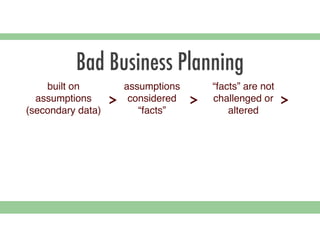
Bad Business Planning
built on
assumptions
(secondary data)
assumptions
considered
“facts”
“facts” are not
challenged or
altered
> > >
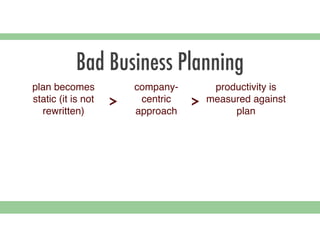
Bad Business Planning
plan becomes
static (it is not
rewritten)
company-
centric
approach
productivity is
measured against
plan
> >
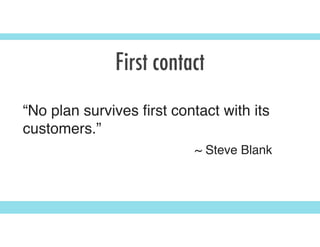
First contact
“No plan survives first contact with its
customers.”
~ Steve Blank
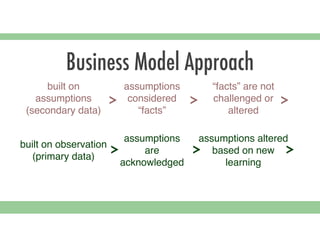
Business Model Approach
built on
assumptions
(secondary data)
assumptions
considered
“facts”
“facts” are not
challenged or
altered
> > >
built on observation
(primary data)
assumptions
are
acknowledged
assumptions altered
based on new
learning
> > >
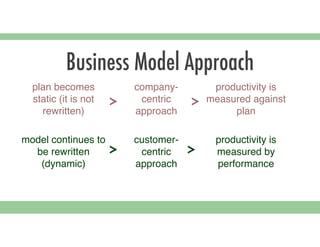
Business Model Approach
plan becomes
static (it is not
rewritten)
company-
centric
approach
productivity is
measured against
plan
> >
model continues to
be rewritten
(dynamic)
customer-
centric
approach
productivity is
measured by
performance
> >
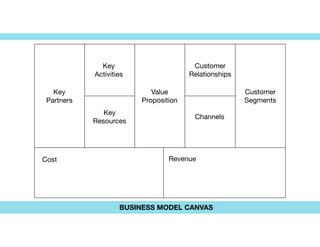
BusinessModels
Key

Partners
Key

Activities
Value

Proposition
Customer

Relationships
Channels
Customer

Segments
Cost Revenue
Key

Resources
BUSINESS MODEL CANVAS
Key

Partners
Key

Activities
Value

Proposition
Customer

Relationships
Channels
Customer

Segments
Cost Revenue
CUSTOMER
EMOTION
Key

Resources
Key

Partners
Key

Activities
Value

Proposition
Customer

Relationships
Channels
Customer

Segments
Cost Revenue
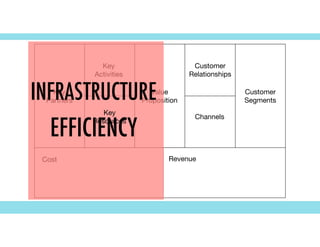
INFRASTRUCTURE
EFFICIENCY
Key

Resources
Key

Partners
Key

Activities
Value

Proposition
Customer

Relationships
Channels
Customer

Segments
Cost Revenue
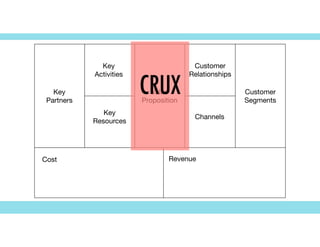
CRUX
Key

Resources
Key

Partners
Key

Activities
Value

Proposition
Key

Resources
Customer

Relationships
Channels
Customer

Segments
Cost Revenue
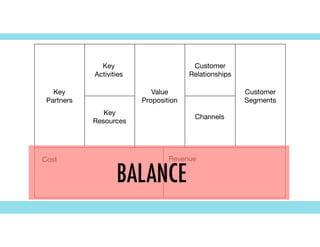
BALANCE
BuildingBlocks
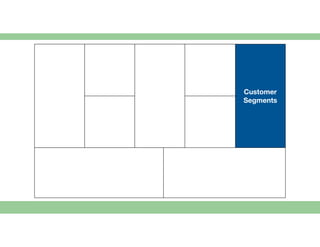
Customer
Segments
Customer segments
“...defines the different groups of people or
organizations an enterprise aims to reach and
serve.”
~BMG, p. 20
Customer segments: Questions
๏ For whom does the library create value?
๏ Who are the most important customers/users?
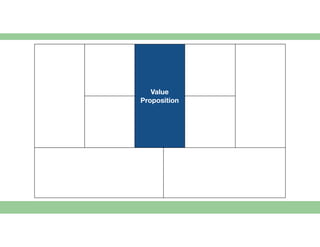
Value
Proposition
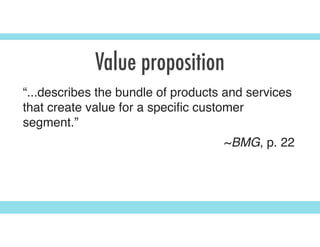
Value proposition
“...describes the bundle of products and services
that create value for a specific customer
segment.”
~BMG, p. 22
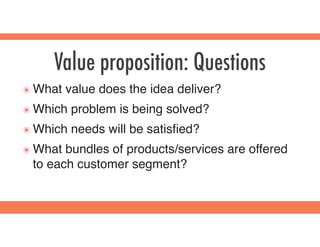
Value proposition: Questions
๏ What value does the idea deliver?
๏ Which problem is being solved?
๏ Which needs will be satisfied?
๏ What bundles of products/services are offered
to each customer segment?
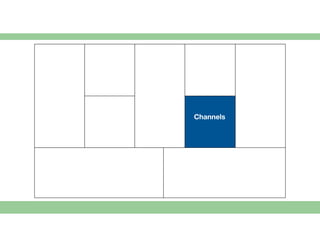
Channels
Channels
“...describes how a company communicates with
and reaches its customer segments to deliver a
value proposition.”
~BMG, p. 26
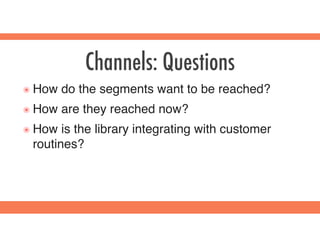
Channels: Questions
๏ How do the segments want to be reached?
๏ How are they reached now?
๏ How is the library integrating with customer
routines?
Customer
Relationships
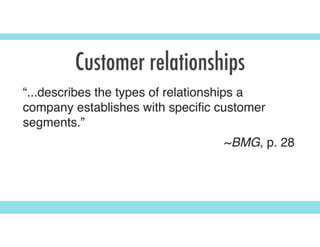
Customer relationships
“...describes the types of relationships a
company establishes with specific customer
segments.”
~BMG, p. 28
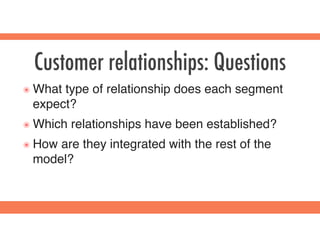
Customer relationships: Questions
๏ What type of relationship does each segment
expect?
๏ Which relationships have been established?
๏ How are they integrated with the rest of the
model?
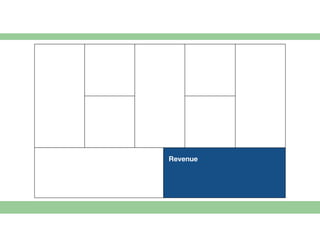
Revenue
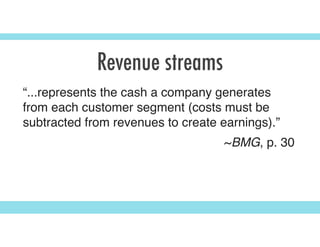
Revenue streams
“...represents the cash a company generates
from each customer segment (costs must be
subtracted from revenues to create earnings).”
~BMG, p. 30
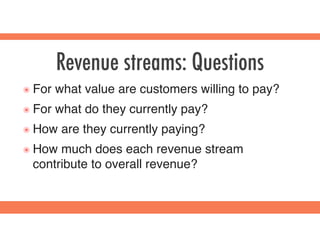
Revenue streams: Questions
๏ For what value are customers willing to pay?
๏ For what do they currently pay?
๏ How are they currently paying?
๏ How much does each revenue stream
contribute to overall revenue?
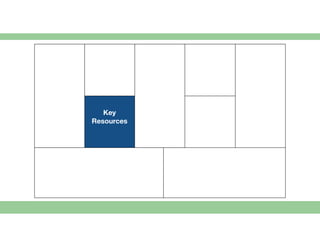
Key
Resources
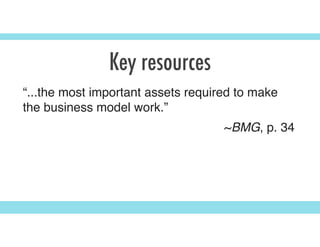
Key resources
“...the most important assets required to make
the business model work.”
~BMG, p. 34
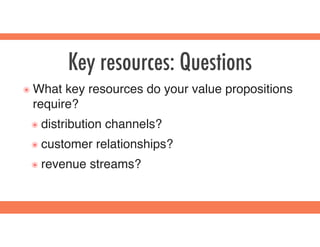
Key resources: Questions
๏ What key resources do your value propositions
require?
๏ distribution channels?
๏ customer relationships?
๏ revenue streams?
Key
Activities
Key activities
“...describes the most important things a
company must do to make its business model
work.”
~BMG, p. 36
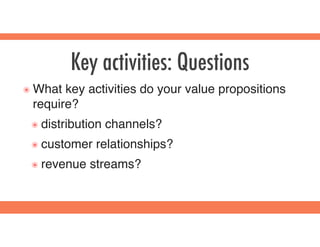
Key activities: Questions
๏ What key activities do your value propositions
require?
๏ distribution channels?
๏ customer relationships?
๏ revenue streams?
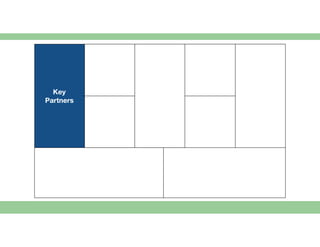
Key
Partners
Key partners
“...describes the network of suppliers and
partners that make the business model work.”
~BMG, p. 38
Key partners: Questions
๏ Who are the key partners?
๏ Who are the key suppliers?
๏ Which key resources do you need from
someone else?
๏ Which key activities do partners perform?
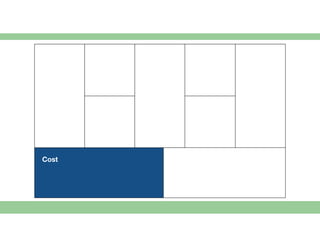
Cost
Cost
“...describes all costs incurred to operate the
business model.”
~BMG, p. 40
Cost: Questions
๏ What are the most important costs inherent in
our business model?
๏ Which key resources are most expensive?
๏ Which key activities are most expensive?
Review
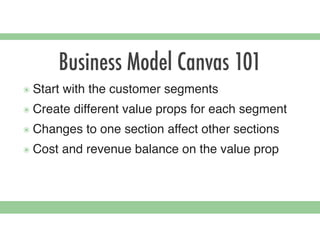
Business Model Canvas 101
๏ Start with the customer segments
๏ Create different value props for each segment
๏ Changes to one section affect other sections
๏ Cost and revenue balance on the value prop
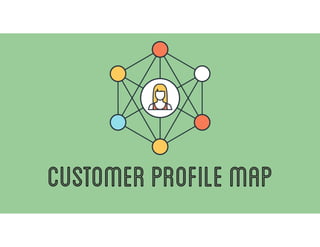
CustomerProfileMap
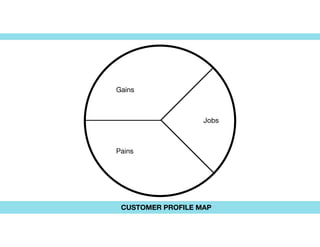
CUSTOMER PROFILE MAP
Revenue
Pains
Gains
Jobs
Jobs
“Jobs describe the things your customers are
trying to get done in their work or in their life.”
~VPD
Jobs: Questions
๏ What is your customer trying to accomplish?
๏ What tasks do they need to perform at work or
at home?
๏ What is one thing that your customer absolutely
needs to accomplish?
Pains
“Pains describe anything that annoys your
customers before, during, and after trying to get
a job done or simply prevents them from getting
a job done.”
~VPD
Pains: Questions
๏ What are your customers frustrations and
annoyances?
๏ What keeps them up at night? What are their
big fears?
๏ What takes them too much time? costs too
much money? requires too much effort?
Gains
Gains describe the outcomes and benefits your
customers want.”
~VPD
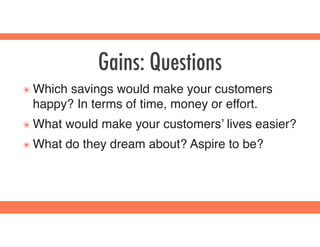
Gains: Questions
๏ Which savings would make your customers
happy? In terms of time, money or effort.
๏ What would make your customers’ lives easier?
๏ What do they dream about? Aspire to be?
ValueMap
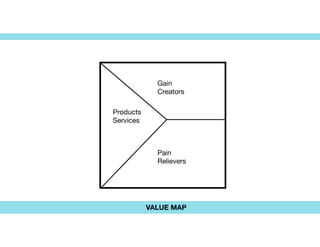
VALUE MAP
Pain
Relievers
Gain

Creators
Products

Services
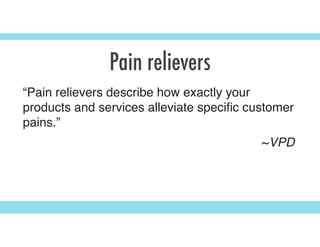
Pain relievers
“Pain relievers describe how exactly your
products and services alleviate specific customer
pains.”
~VPD
Pain relievers: Questions
๏ What could you do to produce savings?
๏ What might make customers feel better?
๏ What could you do to solve under-performing
solutions?
Gain creators
Gain creators describe how you intend to
produce outcomes and benefits that your
customer expects and wants.
~VPD
Gain creators: Questions
๏ What could you do to exceed customer
expectations?
๏ How can you help your customers look good?
๏ What desires can you fulfill for them?
challenge
Draft a clear
value proposition
Value Prop: Ad-Libs
๏ Use the “fill-in-the-blanks” worksheet provided
๏ Borrow from your customer profile map and
value map
wrap
one
Business models
summarize essential
components
two
Business models depend
on clearly stated
value propositions
three
Business models are
dynamic - changes
are expected
four
Business models track
assumptions that
require validation
five
Business models align
resources to meet
customer need
References
References
Blank, S. & Dorf, B. (2012). The Startup Owner’s Manual. Pescadero, CA:
K&S Ranch.
Osterwalder, A. & Pigneur, Y. (2010). Business model generation.
Hoboken, NJ: Wiley.
Osterwalder, A., Pigneur, Y., Bernarda, G. & Smith, A. (2014). Value
proposition design. Hoboken, NJ: Wiley.
Ries, E. (2011). The Lean Startup. New York: Crown Business.
Icons by: Maxim Basinski (aka vasabii) via Creative Market
BusinessModelsfor
librarysuccess
M.J. D’Elia
Computers in Libraries 2015 : Washington, DC
mdelia@uoguelph.ca
@mjdelia

Business Models for Library Success