Stars Extension Project- Extra
Credit By: Liling Class: L
Star and Categories
 What is a star? A star is a collection of duct and gas in ball
form that is gathered together by gravity.
 What are the characteristics? The characteristics are stars are
temperatures, luminosity, types of stars and spectral class
and sizes which we can use to classified the stars.
Characteristics
Temperature: how hot is it.
Luminosity: how bright is it.
Types of stars: Main Sequence, Giant, Supergiant, Dwarf
Spectral class: O,B,A,F,G,K,M (from hottest to coldest)
Sizes: how large is it.
Types of stars
 Main Sequence: A major grouping of stars that transfer hydrogen into
energy, it has longest period in a stars lifetime.
 Dwarf: A star has low mass, small size and average or below luminosity.
 Giant: bigger than main sequence and hotter than main sequence but with
the same surface temperature.
 Supergiant: most massive (big) and brightest stars
H-R Diagram & Nuclear Fusion
H-R Diagram is a graph that classified the stars according to sizes, types of
stars, temperature, color and luminosity.
Nuclear Fusion is a process that transfer 2 hydrogen molecules into 1 helium
molecule, it creates energy.
Life of a star
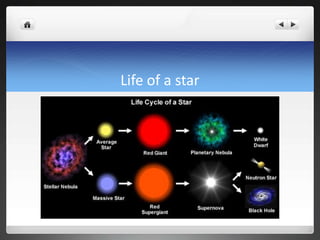
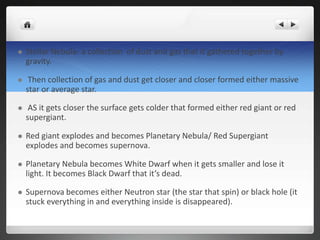
 Stellar Nebula- a collection of dust and gas that it gathered together by
gravity.
 Then collection of gas and dust get closer and closer formed either massive
star or average star.
 AS it gets closer the surface gets colder that formed either red giant or red
supergiant.
 Red giant explodes and becomes Planetary Nebula/ Red Supergiant
explodes and becomes supernova.
 Planetary Nebula becomes White Dwarf when it gets smaller and lose it
light. It becomes Black Dwarf that it’s dead.
 Supernova becomes either Neutron star (the star that spin) or black hole (it
stuck everything in and everything inside is disappeared).

Stars - Liling

  • 1.
    Stars Extension Project-Extra Credit By: Liling Class: L
  • 2.
    Star and Categories What is a star? A star is a collection of duct and gas in ball form that is gathered together by gravity.  What are the characteristics? The characteristics are stars are temperatures, luminosity, types of stars and spectral class and sizes which we can use to classified the stars.
  • 3.
    Characteristics Temperature: how hotis it. Luminosity: how bright is it. Types of stars: Main Sequence, Giant, Supergiant, Dwarf Spectral class: O,B,A,F,G,K,M (from hottest to coldest) Sizes: how large is it.
  • 4.
    Types of stars Main Sequence: A major grouping of stars that transfer hydrogen into energy, it has longest period in a stars lifetime.  Dwarf: A star has low mass, small size and average or below luminosity.  Giant: bigger than main sequence and hotter than main sequence but with the same surface temperature.  Supergiant: most massive (big) and brightest stars
  • 5.
    H-R Diagram &Nuclear Fusion H-R Diagram is a graph that classified the stars according to sizes, types of stars, temperature, color and luminosity. Nuclear Fusion is a process that transfer 2 hydrogen molecules into 1 helium molecule, it creates energy.
  • 6.
  • 7.
     Stellar Nebula-a collection of dust and gas that it gathered together by gravity.  Then collection of gas and dust get closer and closer formed either massive star or average star.  AS it gets closer the surface gets colder that formed either red giant or red supergiant.  Red giant explodes and becomes Planetary Nebula/ Red Supergiant explodes and becomes supernova.  Planetary Nebula becomes White Dwarf when it gets smaller and lose it light. It becomes Black Dwarf that it’s dead.  Supernova becomes either Neutron star (the star that spin) or black hole (it stuck everything in and everything inside is disappeared).