SCIENCE
GRADUATION
PORTFOLIO
Experimental Design Lab
Report
By Osama
TITLE
The Effect of different colors on the
changes of temperature of the fabric.
RESEARCH
QUESTION
How does different colors
affect the temperature of
the fabric?
BACKGROUND
Colors affects the temperature because the absorption
of the light raises the kinetic energy which heats the
objects. Pappas said that when light hits the object it
reflects some of the color back to the human’s eyes and it
depends on the object's properties.
HYPOTHESIS
My background research showed that
the darker colors absorbs more heat
because it has longer wavelength.
My hypothesis is the darker the color
is, the more heat it will absorb.
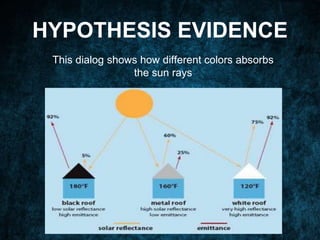
HYPOTHESIS EVIDENCE
This dialog shows how different colors absorbs
the sun rays
LAB SET-UP
PROCEDURE VIDEOS
PROCEDURE VIDEOS
PROCEDURE VIDEOS
PROCEDURE VIDEOS
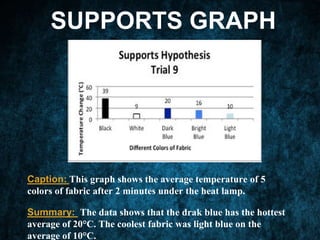
SUPPORTS GRAPH
Caption: This graph shows the average temperature of 5
colors of fabric after 2 minutes under the heat lamp.
Summary: The data shows that the drak blue has the hottest
average of 20°C. The coolest fabric was light blue on the
average of 10°C.
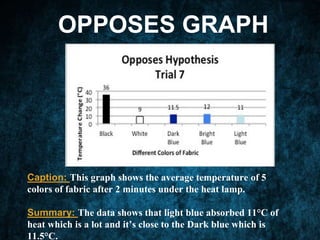
OPPOSES GRAPH
Caption: This graph shows the average temperature of 5
colors of fabric after 2 minutes under the heat lamp.
Summary: The data shows that light blue absorbed 11°C of
heat which is a lot and it’s close to the Dark blue which is
11.5°C.
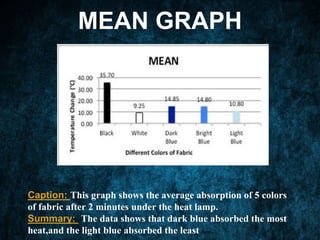
MEAN GRAPH
Caption: This graph shows the average absorption of 5 colors
of fabric after 2 minutes under the heat lamp.
Summary: The data shows that dark blue absorbed the most
heat,and the light blue absorbed the least heat.
STANDARD DEVIATION
GRAPH
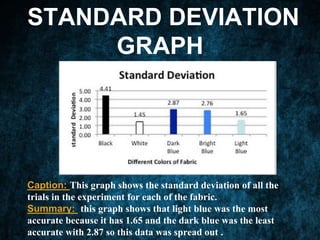
Caption: This graph shows the standard deviation of all the
trials in the experiment for each of the fabric.
Summary: this graph shows that light blue was the most
accurate because it has 1.65 and the dark blue was the least
accurate with 2.87 so this data was spread out .
CONCLUSIONS
Based on the results of this experiment it can be
concluded that darker colors absorbs more heat than
the lighter colors. Based on my research, this happened
because darker colors has a longer wavelength than the
lighter colors. The independent variable was different
colors of fabric and the dependent variable was the
changes of the temperature of the fabric.

Science Portfolio Presentation - Color and Temperature

  • 1.
  • 2.
    TITLE The Effect ofdifferent colors on the changes of temperature of the fabric.
  • 3.
    RESEARCH QUESTION How does differentcolors affect the temperature of the fabric?
  • 4.
    BACKGROUND Colors affects thetemperature because the absorption of the light raises the kinetic energy which heats the objects. Pappas said that when light hits the object it reflects some of the color back to the human’s eyes and it depends on the object's properties.
  • 5.
    HYPOTHESIS My background researchshowed that the darker colors absorbs more heat because it has longer wavelength. My hypothesis is the darker the color is, the more heat it will absorb.
  • 6.
    HYPOTHESIS EVIDENCE This dialogshows how different colors absorbs the sun rays
  • 7.
  • 8.
  • 9.
  • 10.
  • 11.
  • 12.
    SUPPORTS GRAPH Caption: Thisgraph shows the average temperature of 5 colors of fabric after 2 minutes under the heat lamp. Summary: The data shows that the drak blue has the hottest average of 20°C. The coolest fabric was light blue on the average of 10°C.
  • 13.
    OPPOSES GRAPH Caption: Thisgraph shows the average temperature of 5 colors of fabric after 2 minutes under the heat lamp. Summary: The data shows that light blue absorbed 11°C of heat which is a lot and it’s close to the Dark blue which is 11.5°C.
  • 14.
    MEAN GRAPH Caption: Thisgraph shows the average absorption of 5 colors of fabric after 2 minutes under the heat lamp. Summary: The data shows that dark blue absorbed the most heat,and the light blue absorbed the least heat.
  • 15.
    STANDARD DEVIATION GRAPH Caption: Thisgraph shows the standard deviation of all the trials in the experiment for each of the fabric. Summary: this graph shows that light blue was the most accurate because it has 1.65 and the dark blue was the least accurate with 2.87 so this data was spread out .
  • 16.
    CONCLUSIONS Based on theresults of this experiment it can be concluded that darker colors absorbs more heat than the lighter colors. Based on my research, this happened because darker colors has a longer wavelength than the lighter colors. The independent variable was different colors of fabric and the dependent variable was the changes of the temperature of the fabric.