Experimental Design Lab
Report
By Victor Liang Z
SCIENCE
GRADUATION
PORTFOLIO
TITLE
The Effect of Different
Material’s Conductivity on
Water’s Temperature
How Does Different
Material’s Conductivity
Affect on Water’s
Temperature ?
RESEARCH
QUESTION
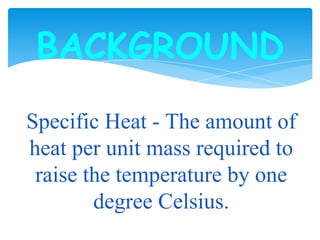
BACKGROUND
Specific Heat - The amount of
heat per unit mass required to
raise the temperature by one
degree Celsius.
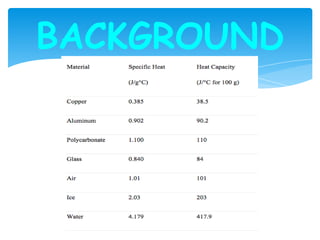
BACKGROUND
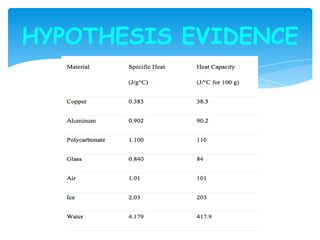
HYPOTHESIS
Copper would be the faster
substance to transfer thermal
energy
HYPOTHESIS EVIDENCE
LAB SET-UP
PROCEDURE VIDEOS
PROCEDURE VIDEOS
PROCEDURE VIDEOS
PROCEDURE VIDEOS
PROCEDURE VIDEOS
PROCEDURE VIDEOS
GRAPH
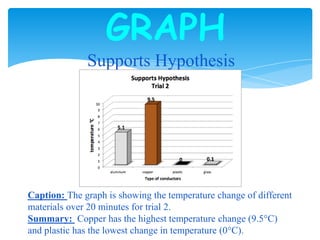
Supports Hypothesis
Caption: The graph is showing the temperature change of different
materials over 20 minutes for trial 2.
Summary: Copper has the highest temperature change (9.5°C)
and plastic has the lowest change in temperature (0°C).
GRAPH
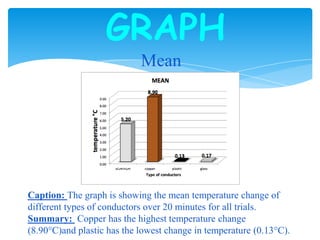
Mean
Caption: The graph is showing the mean temperature change of
different types of conductors over 20 minutes for all trials.
Summary: Copper has the highest temperature change
(8.90°C)and plastic has the lowest change in temperature (0.13°C).
GRAPH
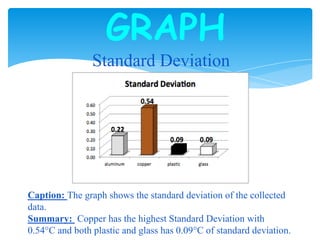
Standard Deviation
Caption: The graph shows the standard deviation of the collected
data.
Summary: Copper has the highest Standard Deviation with
0.54°C and both plastic and glass has 0.09°C of standard deviation.
∗ In conclusion, copper would be a better conductor comparing
with aluminum, plastic and glass.
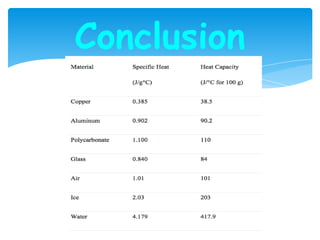
∗ Based on the results of this experiment it can be concluded that
the smaller specific heat capacity, the faster the substance can
transfer thermal energy.
∗ Based on my research, this happened because copper has a
smaller rate of specific heat capacity than other three materials.
∗ The independent variable was conductivity of different materials
and the dependent variable was water’s temperature.
CONCLUSIONS
Conclusion

Science portfolio Presentation - Conductors