PORTFOLIO
 Experimental Design Lab Report Example
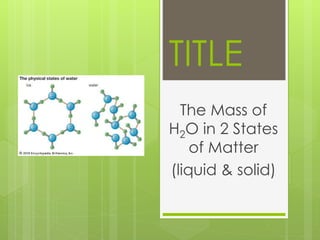
TITLE
The Mass of
H2O in 2 States
of Matter
(liquid & solid)
BACKGROUND
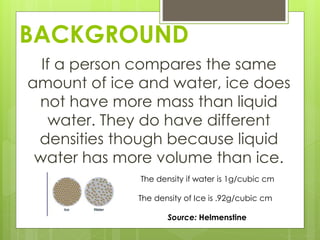
If a person compares the same
amount of ice and water, ice does
not have more mass than liquid
water. They do have different
densities though because liquid
water has more volume than ice.
The density if water is 1g/cubic cm
The density of Ice is .92g/cubic cm
Source: Helmenstine
PROBLEM QUESTION
Does H2O have the same
mass in liquid and solid
form?
REAL-WORLD CONNECTION
You need to carry a large
amount of water and want to
know if you should take it
frozen or in liquid form so that
it weighs less to carry.
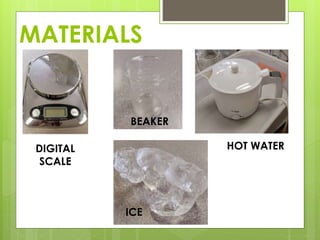
MATERIALS
DIGITAL
SCALE
BEAKER
HOT WATER
ICE
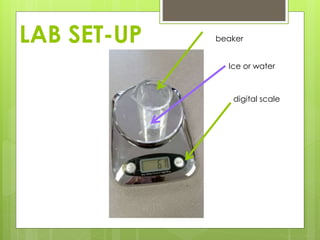
LAB SET-UP beaker
Ice or water
digital scale
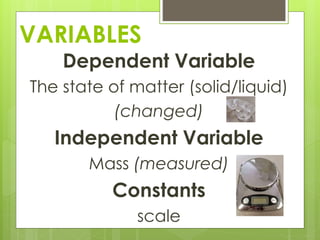
VARIABLES
Dependent Variable
The state of matter (solid/liquid)
(changed)
Independent Variable
Mass (measured)
Constants
scale
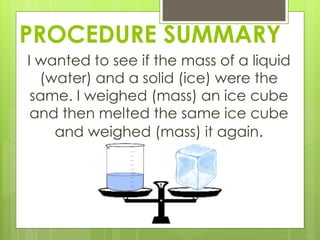
PROCEDURE SUMMARY
I wanted to see if the mass of a liquid
(water) and a solid (ice) were the
same. I weighed (mass) an ice cube
and then melted the same ice cube
and weighed (mass) it again.
HYPOTHESIS
What do you think will
happen?
What is your hypothesis?
HYPOTHESIS
If I measure the mass of
water as a solid (ice) and as
a liquid their masses will be
equal because they are the
same substance H2O.
PROCEDURE
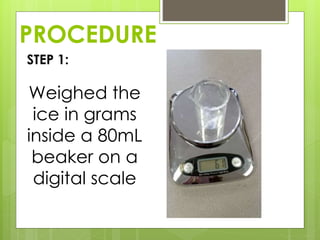
STEP 1:
Weighed the
ice in grams
inside a 80mL
beaker on a
digital scale
PROCEDURE
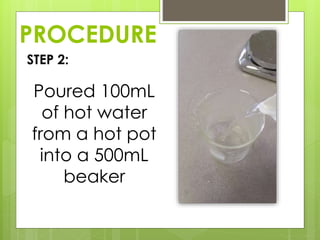
STEP 2:
Poured 100mL
of hot water
from a hot pot
into a 500mL
beaker
PROCEDURE
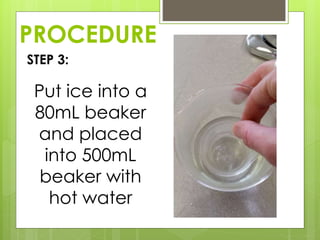
STEP 3:
Put ice into a
80mL beaker
and placed
into 500mL
beaker with
hot water
PROCEDURE
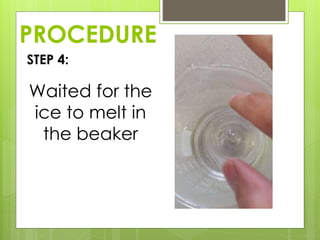
STEP 4:
Waited for the
ice to melt in
the beaker
PROCEDURE
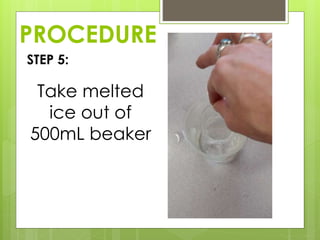
STEP 5:
Take melted
ice out of
500mL beaker
PROCEDURE
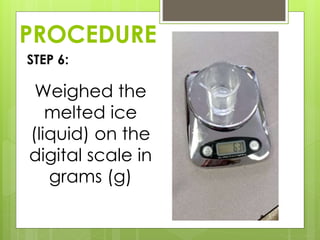
STEP 6:
Weighed the
melted ice
(liquid) on the
digital scale in
grams (g)
DEMONSTRATION
I will now demonstrate a
portion of the lab.
( ONLY if you have a demonstration)
DATA
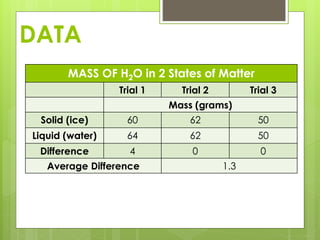
MASS OF H2O in 2 States of Matter
Trial 1 Trial 2 Trial 3
Mass (grams)
Solid (ice) 60 62 50
Liquid (water) 64 62 50
Difference 4 0 0
Average Difference 1.3
GRAPH
0
10
20
30
40
50
60
70
1 2 3
60 62
50
64 62
50
Mass(grams)
Trials
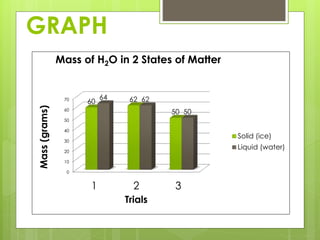
Mass of H2O in 2 States of Matter
Solid (ice)
Liquid (water)
ANALYSIS & RESULTS
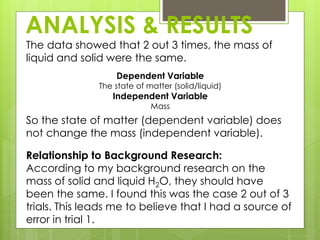
The data showed that 2 out 3 times, the mass of
liquid and solid were the same.
Dependent Variable
The state of matter (solid/liquid)
Independent Variable
Mass
So the state of matter (dependent variable) does
not change the mass (independent variable).
Relationship to Background Research:
According to my background research on the
mass of solid and liquid H2O, they should have
been the same. I found this was the case 2 out of 3
trials. This leads me to believe that I had a source of
error in trial 1.
SOURCES OF ERROR
ERROR #1
I may have forgotten to wipe off the excess
water when I removed it from the hot water.
EFFECT
This may have added mass to the liquid
ERROR #2
When I put the beaker with ice into the hot
water it tipped over, some water may have
gotten in
EFFECT
This may have added mass to the liquid
POSSIBLE REVISIONS
REVISION #1
I would try and use the same size ice cube
EFFECT
This will keep the masses more similar
REVISION #2
More trials
EFFECT
There would be more data to compare
CONCLUSIONS
If I measure the mass of water as a solid
(ice) and as a liquid their masses will be
equal because they are the same
substance H2O. I found that in most cases
they are the same.
Supporting Evidence:
Trial 2
Solid = 62g and Liquid = 62g
Trial 3
Solid = 50g and Liquid = 50g
CONCLUSIONS continued
Hypothesis: If I measure the mass of water as a solid
(ice) and as a liquid their masses will be equal
because they are the same substance H2O.
Supported:
My hypothesis was supported according trials 2 and 3 but
not in trial 1.
Trial 2 Trial 3
Solid = 62g /Liquid = 62g Solid = 50g / Liquid = 50g
Trial 1 (Not supported)
Solid = 60g and Liquid = 64g
(4 grams different – liquid had a higher mass)
CONCLUSIONS continued
NOW CAN YOU ANSWER THE
PROBLEM QUESTION?
Problem Question: Does H2O have the
same mass in liquid and solid form?
CONCLUSIONS continued
Answer: Yes, it looks
like the mass of H2O in
liquid and solid form is
nearly the same.
FURTHER RESEARCH
QUESTION #1
Do liquid and solid (ice) H2O have
the same volume?
QUESTION #2
Do liquid and solid (ice) H2O have the
same density?
QUESTION #3
Would there be the same results with
another type of liquid, juice for example?
SOURCES
"Density of Ice." Density of Ice. N.p., n.d. Web. 06 May 2015.
<http://elmhcx9.elmhurst.edu/~chm/vchembook/122Adensityice.html>.
"If Ice Is Just Water in Its Solid State Why Does It Float? • /r/askscience." Reddit. N.p., n.d.
Web. 06 May 2015.
<http://www.reddit.com/r/askscience/comments/1rk606/if_ice_is_just_water_in_its_solid_
state_why_does/>.
Helmenstine, Ph.D. Anne Marie. "Why Is Water More Dense Than Ice?" N.p., n.d. Web. 06
May 2015. <http://chemistry.about.com/od/waterchemistry/fl/Why-Is-Water-Less-Dense-
Than-Ice.htm>.
"Stock Photos & Video Footage." Stock Photos, Royalty Free Images & Video Footage By
Dreamstime Stock Photography. N.p., n.d. Web. 06 May 2015.
<http://www.dreamstime.com/>.

Scientific Method - Portfolio Presentation Example

  • 1.
  • 2.
    TITLE The Mass of H2Oin 2 States of Matter (liquid & solid)
  • 3.
    BACKGROUND If a personcompares the same amount of ice and water, ice does not have more mass than liquid water. They do have different densities though because liquid water has more volume than ice. The density if water is 1g/cubic cm The density of Ice is .92g/cubic cm Source: Helmenstine
  • 4.
    PROBLEM QUESTION Does H2Ohave the same mass in liquid and solid form?
  • 5.
    REAL-WORLD CONNECTION You needto carry a large amount of water and want to know if you should take it frozen or in liquid form so that it weighs less to carry.
  • 6.
  • 7.
    LAB SET-UP beaker Iceor water digital scale
  • 8.
    VARIABLES Dependent Variable The stateof matter (solid/liquid) (changed) Independent Variable Mass (measured) Constants scale
  • 9.
    PROCEDURE SUMMARY I wantedto see if the mass of a liquid (water) and a solid (ice) were the same. I weighed (mass) an ice cube and then melted the same ice cube and weighed (mass) it again.
  • 10.
    HYPOTHESIS What do youthink will happen? What is your hypothesis?
  • 11.
    HYPOTHESIS If I measurethe mass of water as a solid (ice) and as a liquid their masses will be equal because they are the same substance H2O.
  • 12.
    PROCEDURE STEP 1: Weighed the icein grams inside a 80mL beaker on a digital scale
  • 13.
    PROCEDURE STEP 2: Poured 100mL ofhot water from a hot pot into a 500mL beaker
  • 14.
    PROCEDURE STEP 3: Put iceinto a 80mL beaker and placed into 500mL beaker with hot water
  • 15.
    PROCEDURE STEP 4: Waited forthe ice to melt in the beaker
  • 16.
  • 17.
    PROCEDURE STEP 6: Weighed the meltedice (liquid) on the digital scale in grams (g)
  • 18.
    DEMONSTRATION I will nowdemonstrate a portion of the lab. ( ONLY if you have a demonstration)
  • 19.
    DATA MASS OF H2Oin 2 States of Matter Trial 1 Trial 2 Trial 3 Mass (grams) Solid (ice) 60 62 50 Liquid (water) 64 62 50 Difference 4 0 0 Average Difference 1.3
  • 20.
    GRAPH 0 10 20 30 40 50 60 70 1 2 3 6062 50 64 62 50 Mass(grams) Trials Mass of H2O in 2 States of Matter Solid (ice) Liquid (water)
  • 21.
    ANALYSIS & RESULTS Thedata showed that 2 out 3 times, the mass of liquid and solid were the same. Dependent Variable The state of matter (solid/liquid) Independent Variable Mass So the state of matter (dependent variable) does not change the mass (independent variable). Relationship to Background Research: According to my background research on the mass of solid and liquid H2O, they should have been the same. I found this was the case 2 out of 3 trials. This leads me to believe that I had a source of error in trial 1.
  • 22.
    SOURCES OF ERROR ERROR#1 I may have forgotten to wipe off the excess water when I removed it from the hot water. EFFECT This may have added mass to the liquid ERROR #2 When I put the beaker with ice into the hot water it tipped over, some water may have gotten in EFFECT This may have added mass to the liquid
  • 23.
    POSSIBLE REVISIONS REVISION #1 Iwould try and use the same size ice cube EFFECT This will keep the masses more similar REVISION #2 More trials EFFECT There would be more data to compare
  • 24.
    CONCLUSIONS If I measurethe mass of water as a solid (ice) and as a liquid their masses will be equal because they are the same substance H2O. I found that in most cases they are the same. Supporting Evidence: Trial 2 Solid = 62g and Liquid = 62g Trial 3 Solid = 50g and Liquid = 50g
  • 25.
    CONCLUSIONS continued Hypothesis: IfI measure the mass of water as a solid (ice) and as a liquid their masses will be equal because they are the same substance H2O. Supported: My hypothesis was supported according trials 2 and 3 but not in trial 1. Trial 2 Trial 3 Solid = 62g /Liquid = 62g Solid = 50g / Liquid = 50g Trial 1 (Not supported) Solid = 60g and Liquid = 64g (4 grams different – liquid had a higher mass)
  • 26.
    CONCLUSIONS continued NOW CANYOU ANSWER THE PROBLEM QUESTION? Problem Question: Does H2O have the same mass in liquid and solid form?
  • 27.
    CONCLUSIONS continued Answer: Yes,it looks like the mass of H2O in liquid and solid form is nearly the same.
  • 28.
    FURTHER RESEARCH QUESTION #1 Doliquid and solid (ice) H2O have the same volume? QUESTION #2 Do liquid and solid (ice) H2O have the same density? QUESTION #3 Would there be the same results with another type of liquid, juice for example?
  • 29.
    SOURCES "Density of Ice."Density of Ice. N.p., n.d. Web. 06 May 2015. <http://elmhcx9.elmhurst.edu/~chm/vchembook/122Adensityice.html>. "If Ice Is Just Water in Its Solid State Why Does It Float? • /r/askscience." Reddit. N.p., n.d. Web. 06 May 2015. <http://www.reddit.com/r/askscience/comments/1rk606/if_ice_is_just_water_in_its_solid_ state_why_does/>. Helmenstine, Ph.D. Anne Marie. "Why Is Water More Dense Than Ice?" N.p., n.d. Web. 06 May 2015. <http://chemistry.about.com/od/waterchemistry/fl/Why-Is-Water-Less-Dense- Than-Ice.htm>. "Stock Photos & Video Footage." Stock Photos, Royalty Free Images & Video Footage By Dreamstime Stock Photography. N.p., n.d. Web. 06 May 2015. <http://www.dreamstime.com/>.