STARBUCKS Presented by: VIBHA BEHL
Presentation Outline INTRODUCTION HISTORY BACKGROUND MISSION LOGO CHANGES PRINCIPLES COMPETITORS CORPORATE STRATEGY SWOT ANALYSIS PEST ANALYSIS FINANCIAL SUMMARY WRAP UP
INTRODUCTION   Type   Public Company Industry  Restaurants   Retail coffee and tea  Retail beverages   Entertainment Founded  Pike Place Market  in  Seattle , Washington (March 30, 1971)) Founder(s)  Jerry  Baldwin , Gordon   Bowker , Zev   Siegl Headquarters , ,  Number of locations  17,009 (FY 2010) 1 Area served  57 countries Key people  Howard  Schultz (Chairman, President and CEO) Products  Whole bean coffee   Boxed tea   Made-to-order beverages   Bottled beverages   Baked goods   Merchandise   Frappuccino  beverages   Smoothies
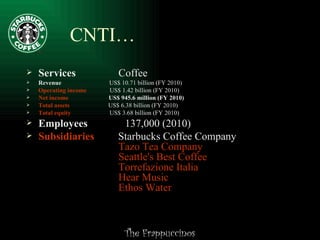
CNTI… Services  Coffee Revenue  US$ 10.71 billion (FY 2010) Operating income   US$ 1.42 billion (FY 2010) Net income   US$ 945.6 million (FY 2010) Total assets   US$ 6.38 billion (FY 2010) Total equity   US$ 3.68 billion (FY 2010) Employees  137,000 (2010) Subsidiaries   Starbucks Coffee Company   Tazo  Tea Company   Seattle's Best Coffee   Torrefazione  Italia   Hear Music   Ethos Water
HISTORY In 1971, the first store of Starbucks was opened in Seattle. Howard Schultz acquired the company in 1987. Then Starbucks started setting up cafes where customers could sit and sip their favourite lattes and espressos. 16,120 stores in more than 49 countries by early 2008.
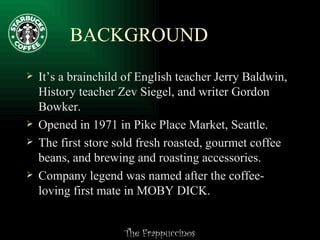
BACKGROUND It’s a brainchild of English teacher Jerry Baldwin, History teacher Zev Siegel, and writer Gordon Bowker.  Opened in 1971 in Pike Place Market, Seattle.  The first store sold fresh roasted, gourmet coffee beans, and brewing and roasting accessories.  Company legend was named after the coffee-loving first mate in MOBY DICK.
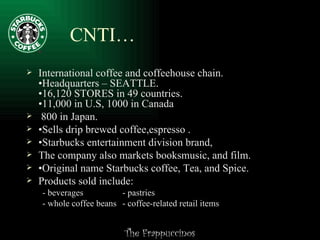
CNTI… International coffee and coffeehouse chain. •Headquarters – SEATTLE. •16,120 STORES in 49 countries. •11,000 in U.S, 1000 in Canada 800 in Japan.  • Sells drip brewed coffee,espresso .  • Starbucks entertainment division brand,  The company also markets booksmusic, and film.  • Original name Starbucks coffee, Tea, and Spice. Products sold include: - beverages - pastries - whole coffee beans - coffee-related retail items
MISSION Company Mission Statement:  “  Establish  Starbucks  as the premier purveyor of the finest coffee in the world while maintaining our uncompromising principles while we grow.”  Environmental Mission Statement:  “  Starbucks  is committed to a role of environmental leadership in all facets of our business.”  Our mission: to inspire and nurture the human spirit – one person, one cup and one neighborhood at a time
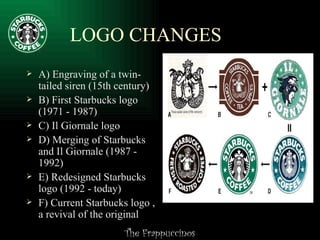
LOGO CHANGES A) Engraving of a twin-tailed siren (15th century)  B) First Starbucks logo (1971 - 1987)  C) Il Giornale logo  D) Merging of Starbucks and Il Giornale (1987 - 1992)  E) Redesigned Starbucks logo (1992 - today)  F) Current Starbucks logo , a revival of the original
PRINCIPLES Provide a great work environment and treat each other with respect  and dignity.  Embrace diversity as an essential component in the business is done.  Apply the highest standards of excellence to the purchasing, roasting  and fresh delivery of coffee.  Develop enthusiastically satisfied customers all of the time.  Contribute positively to communities and environment.  Recognize that profitability is essential for future success.
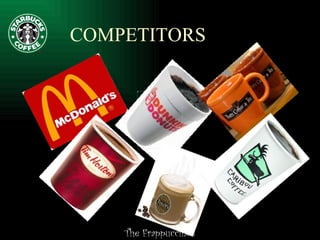
COMPETITORS
Starbucks Corporate Strategy Maximize market penetration Provide a relaxing, attractive social atmosphere Offer high-quality products Create a great working environment Achieve profitability
Starbucks SWOT Analysis Strengths Largest market share in industry Differentiated atmosphere Weaknesses Aggressive expansion could lead to managerial / financial problems Opportunities Whole bean sales in supermarkets Threats Lack of ownership of coffee farms can lead to price fluctuations
Industry PEST Analysis Political Influences Relationships between coffee producing nations and US State & Local government controls Economic Influences Constant demand for food and beverages Changes in disposable income could influence purchase levels Social Influences Consumer preferences could shift from coffee to other beverages Technological Influences Use of technology can  improve operational efficiencies
FINANCIAL SUMMARY
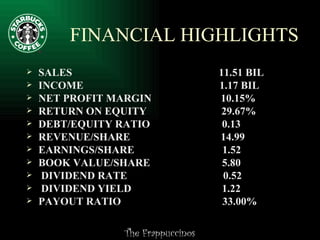
FINANCIAL HIGHLIGHTS SALES  11.51 BIL  INCOME  1.17 BIL  NET PROFIT MARGIN  10.15%  RETURN ON EQUITY  29.67%  DEBT/EQUITY RATIO  0.13  REVENUE/SHARE  14.99  EARNINGS/SHARE  1.52  BOOK VALUE/SHARE  5.80 DIVIDEND RATE  0.52 DIVIDEND YIELD  1.22  PAYOUT RATIO  33.00%
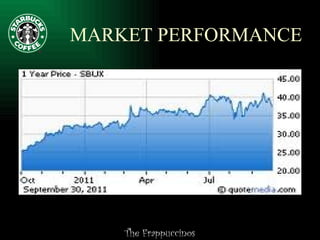
MARKET PERFORMANCE
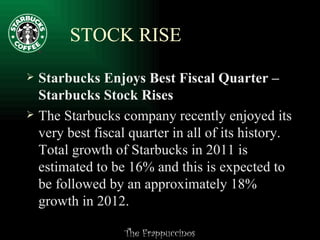
STOCK RISE Starbucks Enjoys Best Fiscal Quarter – Starbucks Stock Rises The Starbucks company recently enjoyed its very best fiscal quarter in all of its history. Total growth of Starbucks in 2011 is estimated to be 16% and this is expected to be followed by an approximately 18% growth in 2012.
Wrap-Up Starbucks is the market leader in a growing market segment Starbucks is known world-wide for its high-quality food products and differentiated “Third Place” atmosphere The ideals of the corporate mission is taken care and has been very profitable, but there are still opportunities for improvement
 

Starbucks

  • 1.
  • 2.
    Presentation Outline INTRODUCTIONHISTORY BACKGROUND MISSION LOGO CHANGES PRINCIPLES COMPETITORS CORPORATE STRATEGY SWOT ANALYSIS PEST ANALYSIS FINANCIAL SUMMARY WRAP UP
  • 3.
    INTRODUCTION Type Public Company Industry Restaurants Retail coffee and tea Retail beverages Entertainment Founded Pike Place Market in Seattle , Washington (March 30, 1971)) Founder(s) Jerry Baldwin , Gordon Bowker , Zev Siegl Headquarters , , Number of locations 17,009 (FY 2010) 1 Area served 57 countries Key people Howard Schultz (Chairman, President and CEO) Products Whole bean coffee Boxed tea Made-to-order beverages Bottled beverages Baked goods Merchandise Frappuccino beverages Smoothies
  • 4.
    CNTI… Services Coffee Revenue US$ 10.71 billion (FY 2010) Operating income US$ 1.42 billion (FY 2010) Net income US$ 945.6 million (FY 2010) Total assets US$ 6.38 billion (FY 2010) Total equity US$ 3.68 billion (FY 2010) Employees 137,000 (2010) Subsidiaries Starbucks Coffee Company Tazo Tea Company Seattle's Best Coffee Torrefazione Italia Hear Music Ethos Water
  • 5.
    HISTORY In 1971,the first store of Starbucks was opened in Seattle. Howard Schultz acquired the company in 1987. Then Starbucks started setting up cafes where customers could sit and sip their favourite lattes and espressos. 16,120 stores in more than 49 countries by early 2008.
  • 6.
    BACKGROUND It’s abrainchild of English teacher Jerry Baldwin, History teacher Zev Siegel, and writer Gordon Bowker. Opened in 1971 in Pike Place Market, Seattle. The first store sold fresh roasted, gourmet coffee beans, and brewing and roasting accessories. Company legend was named after the coffee-loving first mate in MOBY DICK.
  • 7.
    CNTI… International coffeeand coffeehouse chain. •Headquarters – SEATTLE. •16,120 STORES in 49 countries. •11,000 in U.S, 1000 in Canada 800 in Japan. • Sells drip brewed coffee,espresso . • Starbucks entertainment division brand, The company also markets booksmusic, and film. • Original name Starbucks coffee, Tea, and Spice. Products sold include: - beverages - pastries - whole coffee beans - coffee-related retail items
  • 8.
    MISSION Company MissionStatement: “ Establish Starbucks as the premier purveyor of the finest coffee in the world while maintaining our uncompromising principles while we grow.” Environmental Mission Statement: “ Starbucks is committed to a role of environmental leadership in all facets of our business.” Our mission: to inspire and nurture the human spirit – one person, one cup and one neighborhood at a time
  • 9.
    LOGO CHANGES A)Engraving of a twin-tailed siren (15th century) B) First Starbucks logo (1971 - 1987) C) Il Giornale logo D) Merging of Starbucks and Il Giornale (1987 - 1992) E) Redesigned Starbucks logo (1992 - today) F) Current Starbucks logo , a revival of the original
  • 10.
    PRINCIPLES Provide agreat work environment and treat each other with respect and dignity. Embrace diversity as an essential component in the business is done. Apply the highest standards of excellence to the purchasing, roasting and fresh delivery of coffee. Develop enthusiastically satisfied customers all of the time. Contribute positively to communities and environment. Recognize that profitability is essential for future success.
  • 11.
  • 12.
    Starbucks Corporate StrategyMaximize market penetration Provide a relaxing, attractive social atmosphere Offer high-quality products Create a great working environment Achieve profitability
  • 13.
    Starbucks SWOT AnalysisStrengths Largest market share in industry Differentiated atmosphere Weaknesses Aggressive expansion could lead to managerial / financial problems Opportunities Whole bean sales in supermarkets Threats Lack of ownership of coffee farms can lead to price fluctuations
  • 14.
    Industry PEST AnalysisPolitical Influences Relationships between coffee producing nations and US State & Local government controls Economic Influences Constant demand for food and beverages Changes in disposable income could influence purchase levels Social Influences Consumer preferences could shift from coffee to other beverages Technological Influences Use of technology can improve operational efficiencies
  • 15.
  • 16.
    FINANCIAL HIGHLIGHTS SALES 11.51 BIL INCOME 1.17 BIL NET PROFIT MARGIN 10.15% RETURN ON EQUITY 29.67% DEBT/EQUITY RATIO 0.13 REVENUE/SHARE 14.99 EARNINGS/SHARE 1.52 BOOK VALUE/SHARE 5.80 DIVIDEND RATE 0.52 DIVIDEND YIELD 1.22 PAYOUT RATIO 33.00%
  • 17.
  • 18.
    STOCK RISE StarbucksEnjoys Best Fiscal Quarter – Starbucks Stock Rises The Starbucks company recently enjoyed its very best fiscal quarter in all of its history. Total growth of Starbucks in 2011 is estimated to be 16% and this is expected to be followed by an approximately 18% growth in 2012.
  • 19.
    Wrap-Up Starbucks isthe market leader in a growing market segment Starbucks is known world-wide for its high-quality food products and differentiated “Third Place” atmosphere The ideals of the corporate mission is taken care and has been very profitable, but there are still opportunities for improvement
  • 20.