STARBUCKS MARKETING
STRATGEY
Presented By:
Suman Kumari
MBA 1st ‘B’
Roll No. 90
Introduction
• Starbucks Corporation is an American global chain of
coffeehouse and roastery reserves headquartered in
Seattle, Washington.
• It is the world’s largest coffeehouse chain. The company
has over 35,711 stores in 84 countries.
• Starbucks ranks 114th on the Fortune 500 companies
and 288th on the Forbes Global 2000.
• The company sells a variety of premium coffees,
handcrafted beverages, tea and other products.
Vision & Mission
• Vision:
This instilled a vision at Starbucks to “treat people like family,
and they will be loyal and give their all.”
The vision statement is articulated around the concept
of family, loyalty, and generosity.
• Mission:
Starbucks highlights its mission as “to inspire and nurture the
human spirit – one person, one cup and one neighborhood at
a time.“
From this mission statement, a set of core principles make up
the core of Starbucks’ company culture.
History
• Starbucks originally opened in Seattle, Washington, on
March 30, 1971.
• It was founded by business partners Jerry Baldwin,
Zen Siegl and Gordon Bowker who met as students at
the University of San Francisco.
• The 1st Starbucks store opened in Seattle’s Pike Place
Market in 1971.
• In 1981, Howard Schultz, recognized a great
opportunity and began working with the founder
Jerry Baldwin.
• The company experienced rapid growth going public
in 1992 and growing tenfold by 1997, with locations
around the United States, Japan and Singapore.
Starbuck’s Marketing Mix (4P’s)
Analysis
 Starbucks corporation (Starbucks Coffee
Company) has a marketing mix (4P’s) that
supports the firm’s industry position as the
leading coffeehouse chain in the world.
 The marketing mix identifies the main
components of the coffee company’s marketing
plan, namely: product, price, place and promotion.
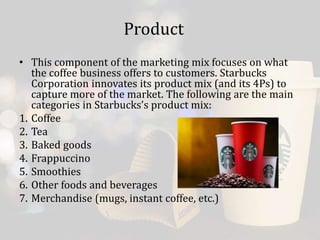
• This component of the marketing mix focuses on what
the coffee business offers to customers. Starbucks
Corporation innovates its product mix (and its 4Ps) to
capture more of the market. The following are the main
categories in Starbucks’s product mix:
1. Coffee
2. Tea
3. Baked goods
4. Frappuccino
5. Smoothies
6. Other foods and beverages
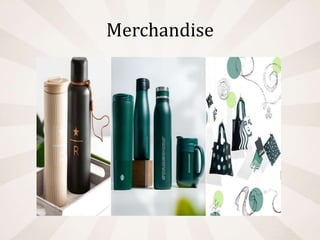
7. Merchandise (mugs, instant coffee, etc.)
Product
Prices and Pricing Strategy in Starbucks Coffee
Company’s 4P
• Starbucks uses a premium pricing strategy: (This
strategy involves relatively high price points and price
ranges for products that the coffeehouse business
presents as superior-quality or high-end (“premium
prices” for “premium products”).
• Advantage of the behavioral tendency of consumers:
(In the marketing mix context, Starbucks’s pricing
strategy takes advantage of the behavioral tendency of
consumers to purchase expensive products based on the
perception that high prices mean high quality, high value,
and high status.)
Contd.
• This part of the 4Ps also helps strengthen the premium
brand against competitors like McDonald’s Premium
Roast.
• Starbucks’s Operations Management: Optimizes quality
and costs to support the pricing strategy in this marketing
mix.
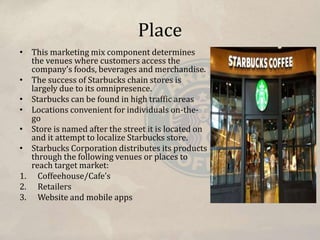
Place
• This marketing mix component determines
the venues where customers access the
company’s foods, beverages and merchandise.
• The success of Starbucks chain stores is
largely due to its omnipresence.
• Starbucks can be found in high traffic areas
• Locations convenient for individuals on-the-
go
• Store is named after the street it is located on
and it attempt to localize Starbucks store.
• Starbucks Corporation distributes its products
through the following venues or places to
reach target market:
1. Coffeehouse/Cafe’s
2. Retailers
3. Website and mobile apps
Promotion
• In the marketing mix, promotions which is also known as the
marketing communications mix, refers to communication strategies
and tactics for the goal of improving Starbuck’s brand, revenues,
and market share.
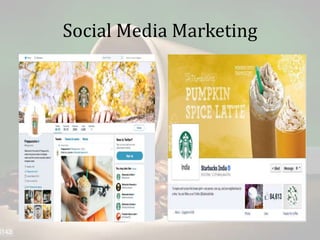
• Starbucks actively promotes its products on social media platforms
such as Facebook, Instagram, in addition to paid advertisement .
• Starbucks offers reward programs to existing customers to
encourage them to stay loyal to the brand. It employs multi-channel
promotional strategy.
• Word-of-mouth marketing
• Sales
Free coffee in determinate period
Receipt as coupon
Online coupon
Cards
Special offer in website (buy 2 get 1 free)
Merchandise
Social Media Marketing
Market Segments which Starbucks
Targets
• Every age group
• High disposable income
• Brand focused
• Savvy and avid coffee lovers who enjoy the
Starbucks Experience.
Starbucks has positioned itself as an upscale brand which
provide rich experience.
Positioning
Branding consistency
• Starbucks as an internationally recognized
brand, must maintain consistent branding at all
times.
• The classic siren logo is iconic, despite various
redesigns, it has remained unchanged.
• Their posts, colours and even language are
consistent across all channels.
• The company now operates more than 24,000
retail stores in 70 countries.
Marketing strategies used by
Starbucks
• Usage of social media
• Loyalty programs : customers are given stars as part of the
Starbucks Rewards program. Customers who earn stars receive
free coffee and products. Aside from a free treat on their
birthday.
• Strategic alliances: Starbuck is collaborated with different
organizations such as; Barnes & Noble, Nestle, PepsiCo, Itunes,
and other companies.
• In-store Marketing
• Mobile App: Starbucks first released a mobile app in 2009 and
in 2011, it began offering in-app payments. It introduced mobile
pre-ordering and payment in 2014.
• Social responsibility: the three pillars of Starbucks social
responsibility strategy are community, ethical sourcing, and the
environment.
Starbucks presence in India
• Tata Starbucks, which launched in India in 2012, is a joint
venture between Starbucks and India’s Tata Consumer
Products.
• The company operates nearly 252 Starbucks stores in 26
cities across India.
• Net revenue of Tata Starbucks is $80million in FY2022.
Net Revenue
• Starbucks net revenue reached $32.25billion in 2022.
Subsidiaries
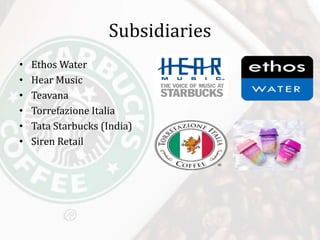
• Ethos Water
• Hear Music
• Teavana
• Torrefazione Italia
• Tata Starbucks (India)
• Siren Retail
Presentation on Starbucks Marketing Strategy

Presentation on Starbucks Marketing Strategy

  • 1.
    STARBUCKS MARKETING STRATGEY Presented By: SumanKumari MBA 1st ‘B’ Roll No. 90
  • 2.
    Introduction • Starbucks Corporationis an American global chain of coffeehouse and roastery reserves headquartered in Seattle, Washington. • It is the world’s largest coffeehouse chain. The company has over 35,711 stores in 84 countries. • Starbucks ranks 114th on the Fortune 500 companies and 288th on the Forbes Global 2000. • The company sells a variety of premium coffees, handcrafted beverages, tea and other products.
  • 3.
    Vision & Mission •Vision: This instilled a vision at Starbucks to “treat people like family, and they will be loyal and give their all.” The vision statement is articulated around the concept of family, loyalty, and generosity. • Mission: Starbucks highlights its mission as “to inspire and nurture the human spirit – one person, one cup and one neighborhood at a time.“ From this mission statement, a set of core principles make up the core of Starbucks’ company culture.
  • 4.
    History • Starbucks originallyopened in Seattle, Washington, on March 30, 1971. • It was founded by business partners Jerry Baldwin, Zen Siegl and Gordon Bowker who met as students at the University of San Francisco. • The 1st Starbucks store opened in Seattle’s Pike Place Market in 1971. • In 1981, Howard Schultz, recognized a great opportunity and began working with the founder Jerry Baldwin. • The company experienced rapid growth going public in 1992 and growing tenfold by 1997, with locations around the United States, Japan and Singapore.
  • 5.
    Starbuck’s Marketing Mix(4P’s) Analysis  Starbucks corporation (Starbucks Coffee Company) has a marketing mix (4P’s) that supports the firm’s industry position as the leading coffeehouse chain in the world.  The marketing mix identifies the main components of the coffee company’s marketing plan, namely: product, price, place and promotion.
  • 6.
    • This componentof the marketing mix focuses on what the coffee business offers to customers. Starbucks Corporation innovates its product mix (and its 4Ps) to capture more of the market. The following are the main categories in Starbucks’s product mix: 1. Coffee 2. Tea 3. Baked goods 4. Frappuccino 5. Smoothies 6. Other foods and beverages 7. Merchandise (mugs, instant coffee, etc.) Product
  • 7.
    Prices and PricingStrategy in Starbucks Coffee Company’s 4P • Starbucks uses a premium pricing strategy: (This strategy involves relatively high price points and price ranges for products that the coffeehouse business presents as superior-quality or high-end (“premium prices” for “premium products”). • Advantage of the behavioral tendency of consumers: (In the marketing mix context, Starbucks’s pricing strategy takes advantage of the behavioral tendency of consumers to purchase expensive products based on the perception that high prices mean high quality, high value, and high status.)
  • 8.
    Contd. • This partof the 4Ps also helps strengthen the premium brand against competitors like McDonald’s Premium Roast. • Starbucks’s Operations Management: Optimizes quality and costs to support the pricing strategy in this marketing mix.
  • 9.
    Place • This marketingmix component determines the venues where customers access the company’s foods, beverages and merchandise. • The success of Starbucks chain stores is largely due to its omnipresence. • Starbucks can be found in high traffic areas • Locations convenient for individuals on-the- go • Store is named after the street it is located on and it attempt to localize Starbucks store. • Starbucks Corporation distributes its products through the following venues or places to reach target market: 1. Coffeehouse/Cafe’s 2. Retailers 3. Website and mobile apps
  • 10.
    Promotion • In themarketing mix, promotions which is also known as the marketing communications mix, refers to communication strategies and tactics for the goal of improving Starbuck’s brand, revenues, and market share. • Starbucks actively promotes its products on social media platforms such as Facebook, Instagram, in addition to paid advertisement . • Starbucks offers reward programs to existing customers to encourage them to stay loyal to the brand. It employs multi-channel promotional strategy. • Word-of-mouth marketing • Sales Free coffee in determinate period Receipt as coupon Online coupon Cards Special offer in website (buy 2 get 1 free)
  • 11.
  • 12.
  • 13.
    Market Segments whichStarbucks Targets • Every age group • High disposable income • Brand focused • Savvy and avid coffee lovers who enjoy the Starbucks Experience. Starbucks has positioned itself as an upscale brand which provide rich experience. Positioning
  • 14.
    Branding consistency • Starbucksas an internationally recognized brand, must maintain consistent branding at all times. • The classic siren logo is iconic, despite various redesigns, it has remained unchanged. • Their posts, colours and even language are consistent across all channels. • The company now operates more than 24,000 retail stores in 70 countries.
  • 15.
    Marketing strategies usedby Starbucks • Usage of social media • Loyalty programs : customers are given stars as part of the Starbucks Rewards program. Customers who earn stars receive free coffee and products. Aside from a free treat on their birthday. • Strategic alliances: Starbuck is collaborated with different organizations such as; Barnes & Noble, Nestle, PepsiCo, Itunes, and other companies. • In-store Marketing • Mobile App: Starbucks first released a mobile app in 2009 and in 2011, it began offering in-app payments. It introduced mobile pre-ordering and payment in 2014. • Social responsibility: the three pillars of Starbucks social responsibility strategy are community, ethical sourcing, and the environment.
  • 16.
    Starbucks presence inIndia • Tata Starbucks, which launched in India in 2012, is a joint venture between Starbucks and India’s Tata Consumer Products. • The company operates nearly 252 Starbucks stores in 26 cities across India. • Net revenue of Tata Starbucks is $80million in FY2022. Net Revenue • Starbucks net revenue reached $32.25billion in 2022.
  • 17.
    Subsidiaries • Ethos Water •Hear Music • Teavana • Torrefazione Italia • Tata Starbucks (India) • Siren Retail