
Starbucks
Michael Fensterstock
Lena Feygin
Edward ’Tj’ Gerety
Robert Matthews
Overview
- Starbucks Corporation (SBUX) –- Starbucks Corporation (SBUX) –
international coffeehouse –international coffeehouse –
“Starbucks Experience”“Starbucks Experience”
-High-quality Coffee and “thirdHigh-quality Coffee and “third
place” between work and homeplace” between work and home
-Revenue driversRevenue drivers
- Company-operated retail storesCompany-operated retail stores
- Specialty OperationsSpecialty Operations
Overview
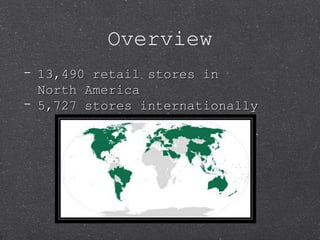
- 13,490 retail stores in13,490 retail stores in
North AmericaNorth America
- 5,727 stores internationally5,727 stores internationally
Third Place
Experience
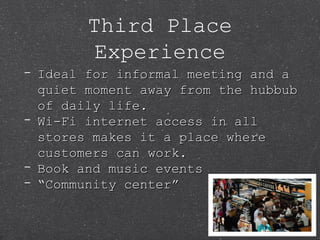
- Ideal for informal meeting and aIdeal for informal meeting and a
quiet moment away from the hubbubquiet moment away from the hubbub
of daily life.of daily life.
- Wi-Fi internet access in allWi-Fi internet access in all
stores makes it a place wherestores makes it a place where
customers can work.customers can work.
- Book and music eventsBook and music events
- ““Community center”Community center”
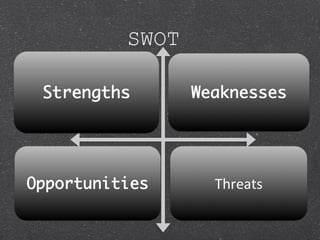
SWOT
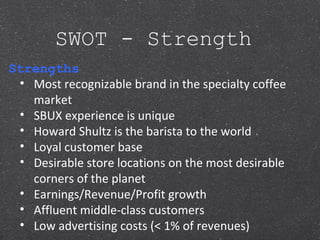
SWOT - Strength
Strengths
• Most recognizable brand in the specialty coffee
market
• SBUX experience is unique
• Howard Shultz is the barista to the world
• Loyal customer base
• Desirable store locations on the most desirable
corners of the planet
• Earnings/Revenue/Profit growth
• Affluent middle-class customers
• Low advertising costs (< 1% of revenues)
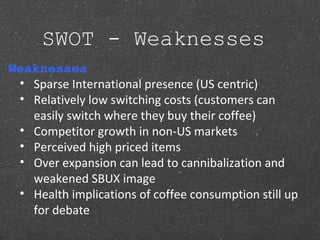
SWOT - Weaknesses
Weaknesses
• Sparse International presence (US centric)
• Relatively low switching costs (customers can
easily switch where they buy their coffee)
• Competitor growth in non-US markets
• Perceived high priced items
• Over expansion can lead to cannibalization and
weakened SBUX image
• Health implications of coffee consumption still up
for debate
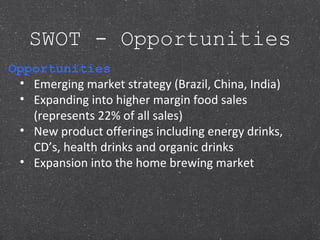
SWOT - Opportunities
Opportunities
• Emerging market strategy (Brazil, China, India)
• Expanding into higher margin food sales
(represents 22% of all sales)
• New product offerings including energy drinks,
CD’s, health drinks and organic drinks
• Expansion into the home brewing market
SWOT - Threats
Threats
• Increasing competition (Dunkin Donuts,
McDonalds, Panera)
• Increasing costs (higher coffee beans, labor, new
store openings): exposure to commodity price
fluctuation
• Smaller private-owned local coffee houses
• Coffee supply, distribution channel
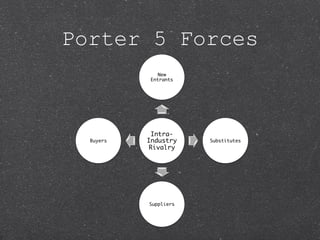
Porter 5 Forces
Porter 5 Forces
Rivalry Among ExistingRivalry Among Existing
PlayersPlayers
•High threat among existing playersHigh threat among existing players
•The inputs are fairlyThe inputs are fairly
undifferentiatedundifferentiated
Porter 5 Forces
Threat of SubstitutesThreat of Substitutes
• Very high threat from substitutesVery high threat from substitutes
• Many coffee drinkers considerMany coffee drinkers consider
tea, hot chocolate, and energytea, hot chocolate, and energy
drinks to be reasonable substitutesdrinks to be reasonable substitutes
for coffee.for coffee.
• Additionally, customers canAdditionally, customers can
choose to brew their own coffeechoose to brew their own coffee
rather than buy it from a shop.rather than buy it from a shop.
Porter 5 Forces
Bargaining Power of SuppliersBargaining Power of Suppliers
• Very low threat from SuppliersVery low threat from Suppliers
• Inputs for the industry areInputs for the industry are
standard as opposed tostandard as opposed to
differentiateddifferentiated
• SBUX can switch easily betweenSBUX can switch easily between
non-bean suppliers and suppliersnon-bean suppliers and suppliers
not locked into specific firmsnot locked into specific firms
Porter 5 Forces
Bargaining Power of BuyersBargaining Power of Buyers
• There is a relatively low level ofThere is a relatively low level of
threat from the bargaining power ofthreat from the bargaining power of
buyers. There are a large number ofbuyers. There are a large number of
buyers with relatively smallbuyers with relatively small
purchases.purchases.
• Customers do not face anyCustomers do not face any
significant switching costs whensignificant switching costs when
moving between coffee shopsmoving between coffee shops
Porter 5 Forces
Threat of New EntrantsThreat of New Entrants
• Relatively low threat of newRelatively low threat of new
entrants because SBUX has a costentrants because SBUX has a cost
and performance advantage.and performance advantage.
• SBUX is well-established and hasSBUX is well-established and has
already learned how to continuallyalready learned how to continually
lower costs and improvelower costs and improve
performance.performance.
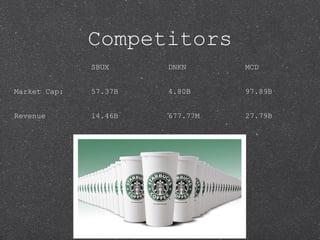
Competitors
SBUX DNKN MCD
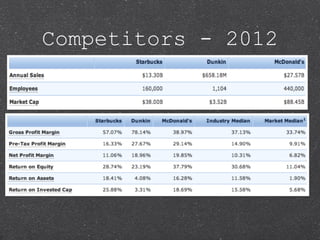
Market Cap: 57.37B 4.80B 97.89B
Revenue 14.46B 677.77M 27.79B
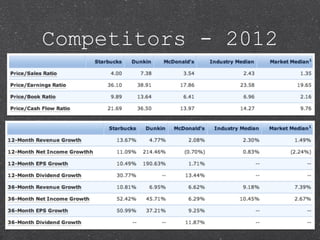
Competitors - 2012
Competitors - 2012
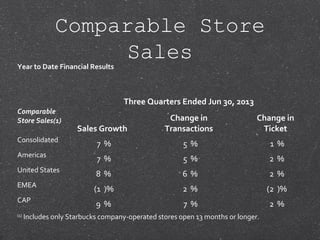
Comparable Store
SalesYear to Date Financial Results


Three Quarters Ended Jun 30, 2013
Comparable
Store Sales(1)
  Sales Growth
  Change in
Transactions
  Change in
Ticket
Consolidated
  7 %  
5 %   1 %
Americas
  7 %  
5 %   2 %
United States
  8 %  
6 %   2 %
EMEA
  (1 )%  
2 %   (2 )%
CAP
  9 %  
7 %   2 %
(1)
 Includes only Starbucks company-operated stores open 13 months or longer.
Risk
Saturated marketSaturated market
• Started with 17 coffee shops, currentlyStarted with 17 coffee shops, currently
19,209 in 44 countries. In Seattle there19,209 in 44 countries. In Seattle there
is one shop per 9,400 pplis one shop per 9,400 ppl
Rushed into Markets – Cost capitalRushed into Markets – Cost capital
• Forced to shutdown stores in WesternForced to shutdown stores in Western
Europe due to high rents and slow retailEurope due to high rents and slow retail
outlet growthoutlet growth
International Markets made up 21% of company’sInternational Markets made up 21% of company’s
revenue.revenue.
Risks
Emerging Markets are unstable.
• Retail growth unpredictable in these areas
• Currency Markets remain unstable
• Access to their Supplies/Products supply
chain could be jeopardized by political
and/or monetary disruptions.
Risks
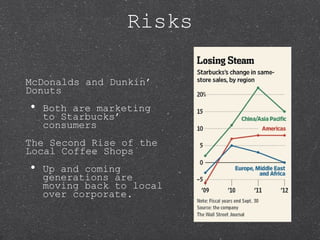
McDonalds and Dunkin’
Donuts
• Both are marketing
to Starbucks’
consumers
The Second Rise of the
Local Coffee Shops
• Up and coming
generations are
moving back to local
over corporate.
Analyst Estimates
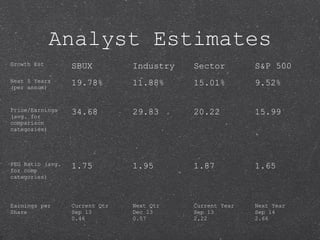
Growth Est SBUX Industry Sector S&P 500
Next 5 Years
(per annum)
19.78% 11.88% 15.01% 9.52%
Price/Earnings
(avg. for
comparison
categories)
34.68 29.83 20.22 15.99
PEG Ratio (avg.
for comp
categories)
1.75 1.95 1.87 1.65
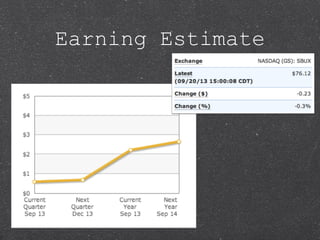
Earnings per
Share
Current Qtr
Sep 13
0.46
Next Qtr
Dec 13
0.57
Current Year
Sep 13
2.22
Next Year
Sep 14
2.66
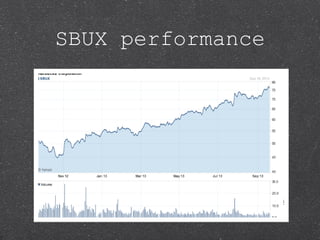
SBUX performance
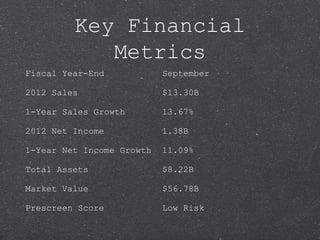
Key Financial
Metrics
Fiscal Year-End September
2012 Sales $13.30B
1-Year Sales Growth 13.67%
2012 Net Income 1.38B
1-Year Net Income Growth 11.09%
Total Assets $8.22B
Market Value $56.78B
Prescreen Score Low Risk
Earning Estimate
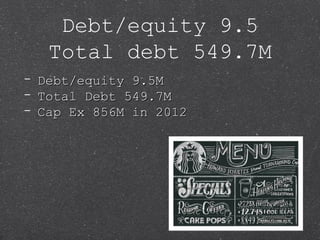
Debt/equity 9.5
Total debt 549.7M
- Debt/equity 9.5MDebt/equity 9.5M
- Total Debt 549.7MTotal Debt 549.7M
- Cap Ex 856M in 2012Cap Ex 856M in 2012
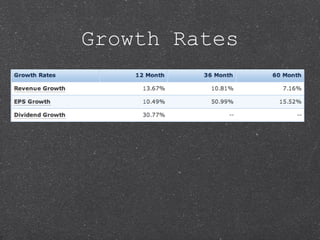
Growth Rates
Recommendation
QUESTIONS

Starbucks presentation final_final_v2

  • 1.
  • 2.
    Overview - Starbucks Corporation(SBUX) –- Starbucks Corporation (SBUX) – international coffeehouse –international coffeehouse – “Starbucks Experience”“Starbucks Experience” -High-quality Coffee and “thirdHigh-quality Coffee and “third place” between work and homeplace” between work and home -Revenue driversRevenue drivers - Company-operated retail storesCompany-operated retail stores - Specialty OperationsSpecialty Operations
  • 3.
    Overview - 13,490 retailstores in13,490 retail stores in North AmericaNorth America - 5,727 stores internationally5,727 stores internationally
  • 4.
    Third Place Experience - Idealfor informal meeting and aIdeal for informal meeting and a quiet moment away from the hubbubquiet moment away from the hubbub of daily life.of daily life. - Wi-Fi internet access in allWi-Fi internet access in all stores makes it a place wherestores makes it a place where customers can work.customers can work. - Book and music eventsBook and music events - ““Community center”Community center”
  • 5.
  • 6.
    SWOT - Strength Strengths •Most recognizable brand in the specialty coffee market • SBUX experience is unique • Howard Shultz is the barista to the world • Loyal customer base • Desirable store locations on the most desirable corners of the planet • Earnings/Revenue/Profit growth • Affluent middle-class customers • Low advertising costs (< 1% of revenues)
  • 7.
    SWOT - Weaknesses Weaknesses •Sparse International presence (US centric) • Relatively low switching costs (customers can easily switch where they buy their coffee) • Competitor growth in non-US markets • Perceived high priced items • Over expansion can lead to cannibalization and weakened SBUX image • Health implications of coffee consumption still up for debate
  • 8.
    SWOT - Opportunities Opportunities •Emerging market strategy (Brazil, China, India) • Expanding into higher margin food sales (represents 22% of all sales) • New product offerings including energy drinks, CD’s, health drinks and organic drinks • Expansion into the home brewing market
  • 9.
    SWOT - Threats Threats •Increasing competition (Dunkin Donuts, McDonalds, Panera) • Increasing costs (higher coffee beans, labor, new store openings): exposure to commodity price fluctuation • Smaller private-owned local coffee houses • Coffee supply, distribution channel
  • 10.
  • 11.
    Porter 5 Forces RivalryAmong ExistingRivalry Among Existing PlayersPlayers •High threat among existing playersHigh threat among existing players •The inputs are fairlyThe inputs are fairly undifferentiatedundifferentiated
  • 12.
    Porter 5 Forces Threatof SubstitutesThreat of Substitutes • Very high threat from substitutesVery high threat from substitutes • Many coffee drinkers considerMany coffee drinkers consider tea, hot chocolate, and energytea, hot chocolate, and energy drinks to be reasonable substitutesdrinks to be reasonable substitutes for coffee.for coffee. • Additionally, customers canAdditionally, customers can choose to brew their own coffeechoose to brew their own coffee rather than buy it from a shop.rather than buy it from a shop.
  • 13.
    Porter 5 Forces BargainingPower of SuppliersBargaining Power of Suppliers • Very low threat from SuppliersVery low threat from Suppliers • Inputs for the industry areInputs for the industry are standard as opposed tostandard as opposed to differentiateddifferentiated • SBUX can switch easily betweenSBUX can switch easily between non-bean suppliers and suppliersnon-bean suppliers and suppliers not locked into specific firmsnot locked into specific firms
  • 14.
    Porter 5 Forces BargainingPower of BuyersBargaining Power of Buyers • There is a relatively low level ofThere is a relatively low level of threat from the bargaining power ofthreat from the bargaining power of buyers. There are a large number ofbuyers. There are a large number of buyers with relatively smallbuyers with relatively small purchases.purchases. • Customers do not face anyCustomers do not face any significant switching costs whensignificant switching costs when moving between coffee shopsmoving between coffee shops
  • 15.
    Porter 5 Forces Threatof New EntrantsThreat of New Entrants • Relatively low threat of newRelatively low threat of new entrants because SBUX has a costentrants because SBUX has a cost and performance advantage.and performance advantage. • SBUX is well-established and hasSBUX is well-established and has already learned how to continuallyalready learned how to continually lower costs and improvelower costs and improve performance.performance.
  • 16.
    Competitors SBUX DNKN MCD MarketCap: 57.37B 4.80B 97.89B Revenue 14.46B 677.77M 27.79B
  • 17.
  • 18.
  • 19.
    Comparable Store SalesYear toDate Financial Results         Three Quarters Ended Jun 30, 2013 Comparable Store Sales(1)   Sales Growth   Change in Transactions   Change in Ticket Consolidated   7 %   5 %   1 % Americas   7 %   5 %   2 % United States   8 %   6 %   2 % EMEA   (1 )%   2 %   (2 )% CAP   9 %   7 %   2 % (1)  Includes only Starbucks company-operated stores open 13 months or longer.
  • 20.
    Risk Saturated marketSaturated market •Started with 17 coffee shops, currentlyStarted with 17 coffee shops, currently 19,209 in 44 countries. In Seattle there19,209 in 44 countries. In Seattle there is one shop per 9,400 pplis one shop per 9,400 ppl Rushed into Markets – Cost capitalRushed into Markets – Cost capital • Forced to shutdown stores in WesternForced to shutdown stores in Western Europe due to high rents and slow retailEurope due to high rents and slow retail outlet growthoutlet growth International Markets made up 21% of company’sInternational Markets made up 21% of company’s revenue.revenue.
  • 21.
    Risks Emerging Markets areunstable. • Retail growth unpredictable in these areas • Currency Markets remain unstable • Access to their Supplies/Products supply chain could be jeopardized by political and/or monetary disruptions.
  • 22.
    Risks McDonalds and Dunkin’ Donuts •Both are marketing to Starbucks’ consumers The Second Rise of the Local Coffee Shops • Up and coming generations are moving back to local over corporate.
  • 23.
    Analyst Estimates Growth EstSBUX Industry Sector S&P 500 Next 5 Years (per annum) 19.78% 11.88% 15.01% 9.52% Price/Earnings (avg. for comparison categories) 34.68 29.83 20.22 15.99 PEG Ratio (avg. for comp categories) 1.75 1.95 1.87 1.65 Earnings per Share Current Qtr Sep 13 0.46 Next Qtr Dec 13 0.57 Current Year Sep 13 2.22 Next Year Sep 14 2.66
  • 24.
  • 25.
    Key Financial Metrics Fiscal Year-EndSeptember 2012 Sales $13.30B 1-Year Sales Growth 13.67% 2012 Net Income 1.38B 1-Year Net Income Growth 11.09% Total Assets $8.22B Market Value $56.78B Prescreen Score Low Risk
  • 26.
  • 27.
    Debt/equity 9.5 Total debt549.7M - Debt/equity 9.5MDebt/equity 9.5M - Total Debt 549.7MTotal Debt 549.7M - Cap Ex 856M in 2012Cap Ex 856M in 2012
  • 28.
  • 29.
  • 30.

Editor's Notes

  • #11 At the center of the five forces model about which SBUX must be aware is industry competition arising from the rivalries among existing firms. http://g.virbcdn.com/_f/files/24/FileItem-248845-BusinessAnalysisFinal.pdf
  • #12 At the center of the five forces model about which SBUX must be aware is industry competition arising from the rivalries among existing firms. http://g.virbcdn.com/_f/files/24/FileItem-248845-BusinessAnalysisFinal.pdf
  • #13 At the center of the five forces model about which SBUX must be aware is industry competition arising from the rivalries among existing firms. http://g.virbcdn.com/_f/files/24/FileItem-248845-BusinessAnalysisFinal.pdf
  • #14 At the center of the five forces model about which SBUX must be aware is industry competition arising from the rivalries among existing firms. http://g.virbcdn.com/_f/files/24/FileItem-248845-BusinessAnalysisFinal.pdf
  • #15 At the center of the five forces model about which SBUX must be aware is industry competition arising from the rivalries among existing firms. http://g.virbcdn.com/_f/files/24/FileItem-248845-BusinessAnalysisFinal.pdf
  • #16 At the center of the five forces model about which SBUX must be aware is industry competition arising from the rivalries among existing firms. http://g.virbcdn.com/_f/files/24/FileItem-248845-BusinessAnalysisFinal.pdf
  • #17 *Starbucks trades at 33 times trailing earnings. *Heavily tilted toward domestic market, but is growing in the international market (Brazil, India, China – with a growing affluence, which are the kinds of customers Starbucks needs) *Investors must decide if the company can fend off the competition before investing. Will Starbucks&apos; store environment and great-tasting coffee keep customers paying high prices, or will customers eventually go to Dunkin or McDonald&apos;s for lower-priced coffee? Dunkin *Reaches a different market but can siphon off some of Starbucks customers who do not want to pay $4 for a cup of coffee. *Extensive network of domestic stores McDonalds *poses a price threat *already has an extensive international network (something Starbucks hasn’ t built yet) to capture customers *advertises that $4 coffee is ridiculous, siphon off the cheaper customer *it is trying to increase its image as a place of more quality, which could be a threat to Starbucks (However, nobody is going to confuse McDonald&apos;s and Starbucks on the basis of quality; more likely, price-sensitive consumers will increasingly view McDonald&apos;s coffee as a viable substitute for Starbucks&apos;, while more affluent customers will not switch.)
  • #25 Lena, et al I put in the graph showing Stock Price for Starbucks, courtesy of Yahoo F
  • #26 Lena, et al I put in the graph showing Stock Price for Starbucks, courtesy of Yahoo F