StarbuckS’ Global QueSt in
2006:
iS the beSt Yet to come?
Danny Nugroho RP – 13967/PS/MM/06
Retnowulan – 19421/PS/MM/06
Presentation Outline
 Introduction to Starbucks
 Industry Overview
 Company Overview
 Site Analysis
 Recommendations for Improvement
 Focused Recommendation for Improvement
 Final Action Plan
 Impact Analysis
 Wrap Up
Presentation Outline
 About Starbucks
 Overview
 Timeline
 Corporate Values and
Business Principles
 Mission Statements
 Corporate Social
Responsibility
 Starbucks’ Strategy
 Store expansion strategy
 Product line
 Coffee purchasing strategy
 Industry and Competitive
Analysis
● Coffee industry
● Competitor analysis
● Generic competitive strategy
● PEST analysis
● Site 7-S analysis
 Conclusion
 Recommendation
Presentation Outline
 About Starbucks
 Starbucks’ Strategy
 Industry and Competitive Analysis
 Conclusion
 Recommendation
About Starbucks
● Overview
● Timeline
● Corporate Values and
Business Principles
● Mission Statements
● Corporate Social
Responsibility
 Established in 1971 at Seattle, Washington
 Famous for its quality fresh-roasted coffee beans
and stylish atmosphere.
 Over 9,000 stores worldwide
 Product lines include :
− beverages (coffee, Tazo tea, soda, juices)
− pastries
− whole coffee beans
− coffee-related hardware and equipment
− merchandise (mug, CDs)
Overview
1971 – Starbucks Coffee, Tea, and Spice store (coffee bean roasting)
opened in Seattle’s Pike Place Market.
1982 – Howard Schultz joined Starbucks.
1986 – Howard Schultz established Il Giornale Coffee Company.
1987 – Il Giornale acquired Starbucks and changed the name into
Starbucks Corporation.
1992 – Starbucks decertified the union and made IPO.
1995 – Starbucks Coffee International opens in Japan
− Starbucks implemented ESOP.
Timeline
Timeline
 1996 – Starbucks’ began selling bottled Frappuccino.
 1999 – Starbucks acquired Tazo Tea.
 2000 – Acquired Hear Music, a San Francisco-based company
 2003 – Starbucks acquired Seattle’s Best Coffee
 2005 – Introduced Starbucks Coffee Liqueur; Acquires Ethos Wate
Corporate Values and
Business Principles
 Building a Company with Soul
 Opposing Franchising because of Quality Control and
Culture
 Only selling coffee beans without artificial flavors.
 Satisfy customers by all means.
 Employees’ contribution and involvement in making
Starbucks a better company
About Starbucks
Mission Statements
 Company Mission Statement:
 “Establish Starbucks as the premier
purveyor of the finest coffee in the
world while maintaining our
uncompromising principles while we
grow.”
 Environmental Mission Statement:
 “Starbucks is committed to a role of
environmental leadership in all facets
of our business.”
Mission Statement
Six guiding principles:
• Provide a great work environment and treat each other with respect
and dignity.
• Embrace diversity as an essential component in the way we do
business.
• Apply the highest standards of excellence to the purchasing,
roasting, and fresh delivery of our coffee.
• Develop enthusiastically satisfied customers all of the time.
• Contribute positively to our communities and our environment.
• Recognize that profitability is essential to our future success.
Corporate Social Responsibility
 “Starbucks focuses its efforts on improving social and economic
conditions for coffee farmers; minimizing environmental impact;
making a positive contribution in the communities where they do
business; and providing a great work environment for their partners
(employees).”
 Establish the Starbucks Foundation in 1997
 A major contributor of CARE, worldwide relief and development
organization (Health, Education, and Humanitarian aid)
 Provides financial support to community literacy organizations
 Participate in local charitable projects.
 2004 EnviroStars Recognized Leader Award – for its community
service and environmental activities
Starbucks’ Strategy
 Rapid store expansion strategy
• Domestic store expansion
• International store expansion
• Employee Training and Recognition
• Real Estate, Store Design, Planning, and Construction
• Store ambience
 Product Line
 Coffee purchasing strategy
Starbucks’ Strategy
Rapid store expansion strategy
• Domestic store expansion
− A three-year expansion strategy
− “Starbucks everywhere” approach
• International store expansion
− Company-owned and company-operated stores or licensing
− Created a new subsidiary, Starbucks Coffee International
− Expanded its consumer products channel in South Pacific region
Starbucks’ Strategy
• Employee Training and Recognition
− Systems to recruit, hire and train baristas and store managers
 screening
 training programs
 awards for partners
• Real Estate, Store Design, Planning, and Construction
− A broad range of store formats (the right image and character)
− A “stores of the future” project team
− High-traffic, high-visibility store locations
− Control of average store opening costs
− Wi-Fi availability at stores
Starbucks’ Strategy
• Store ambience
− The concept of “everything matters”
− Assessment of standards
Starbucks’ Strategy
Product Line
•Wide range of products choices
•Special product promotion
•Selling music CDs
•Joint ventures
PepsiCo
Dreyer’s Grand Ice Cream
 Jim Beam Brands
•Acquisitions
 Hear Music
 Ethos Water
•Starbucks Cards
•Partnership with Bank One
Starbucks’ Strategy
Coffee purchasing strategy
• Building relationship with growers and exporters, checking on
agricultural conditions and crop yields, and searching out varieties
and sources that would meet Starbucks’ standards.
• Using fixed-price purchase commitment and purchasing coffee
future contracts
• Contributing to the sustainability of coffee growers and helping
environment conservation
• Purchasing and marketing Fair Trade Certified coffee
• Promoting coffee cultivation methods that protected biodiversity and
maintained a healthy environment
Industry and Competitive
Analysis
● Coffee Industry
● C
● Corporate Values and
Business Principles
● Mission Statements
● Corporate Social
Responsibility
Industry and Competitive Analysis
 Coffee industry
• Coffee drinking trend
• Coffee beans production
 Competitor analysis
• Future goals
• Current strategy
• Assumptions
• Capabilities
 Generic competitive strategy
 PEST analysis
 Site 7S analysis
Industry and Competitive
Analysis
Coffee industry
Coffee drinking trend
− Coffee is the second most consumed drink after water.
− Americans substitute specialty coffee for alcohol.
− Coffee shops are a great place to meet people.
− Coffee is an affordable luxury.
− Consumers are more knowledgeable about coffee.
Coffee beans production
− In 1994, coffee was the second most traded commodity after
Oil.
− There are two types of Coffee, namely “basic” and
“specialty”.
Industry and Competitive
Analysis
Competitor analysis
2 Types of Competitor:
 Coffee shops and restaurants
 Nationwide coffee manufacturers (rival brands
of specialty coffee)
Industry and Competitive
Analysis
Competitor analysis
Future goals
 To grow bigger
 To better position themselves as an alternative to Starbucks
 Current strategy
Merger of local and regional chains of coffee shops etc.
 Assumptions
− Competitors’ assumptions about themselves
− Competitors’ assumptions about the industry and other companies in it
Industry and Competitive
Analysis
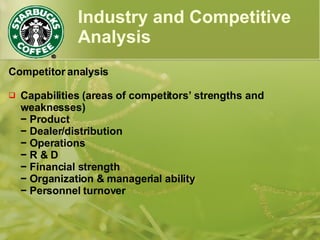
Competitor analysis
 Capabilities (areas of competitors’ strengths and
weaknesses)
− Product
− Dealer/distribution
− Operations
− R & D
− Financial strength
− Organization & managerial ability
− Personnel turnover
Industry and Competitive
Analysis
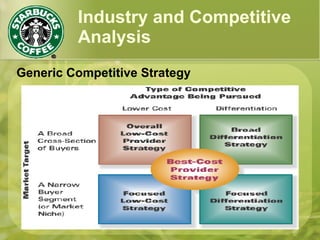
Generic Competitive Strategy
Industry and Competitive
Analysis
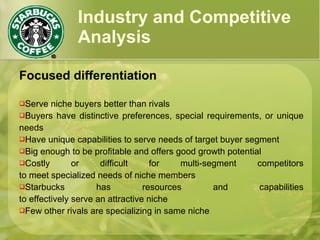
Focused differentiation
Serve niche buyers better than rivals
Buyers have distinctive preferences, special requirements, or unique
needs
Have unique capabilities to serve needs of target buyer segment
Big enough to be profitable and offers good growth potential
Costly or difficult for multi-segment competitors
to meet specialized needs of niche members
Starbucks has resources and capabilities
to effectively serve an attractive niche
Few other rivals are specializing in same niche
PEST Analysis
Political Influences
− Relationships between U.S. and countries producing coffee
beans
− Environmental regulations
− Industry-specific regulations
Economic Influences
− Demand for food and beverages
− Customers’ buying power
− Exchange rate & taxation
PEST Analysis
Social Influences
− Trend
− Consumer preferences
− Changes in lifestyle and occupation
− Education
Technological Influences
− advances in manufacture
− biotech and agricultural development
− IT developments
Site 7S Model
Strategy
Rapid store expansion strategy
Product Line
Coffee purchasing strategy
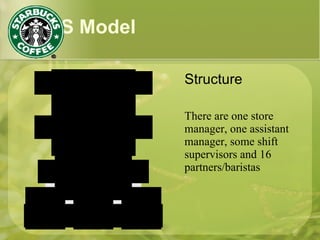
Site 7S Model
Structure
There are one store
manager, one assistant
manager, some shift
supervisors and 16
partners/baristas
B a ris ta s B a ris ta s B a ris ta s
S h ift S u p e rv is o rs
A s s is ta n t M a n a g e r
S to re M a n a g e r
Site 7S Analysis
Staffing
●Employee benefits package includes base salary, health care
benefits, stock option plan, and
− Health care benefits include preventive care, crisis counseling,
dental care, eye care, mental health, chemical dependency, and
medical costs for terminal illness up for 29 months.
− Employees trainings that include basic 24 hour-training, Star Skills,
Coffee Master Program, Servant Leadership W
orkshop, Career
Power and Career Power for Coaches W
orkshop.
− Awards for partners, which range from frequent awards to high-
level cash awards.
Site 7S Analysis
Systems
− Centralized control over individual stores by
headquarters
− Total Quality Management (i.e. Just-In-Time)
− Information system to support business operations.
−
Site 7S Analysis
Skills
− coffee making
− customer service
− sales techniques
Site 7S Model
Style
● Increase motivation through reviews and raises.
● Employees are allowed to make decisions and participate in
Site 7S Model
Shared Values
− Fun working environment
− Treat each other with respect and care
− Diversity is encouraged.
− Maintain highest quality standards for products
− Satisfy customers and compensate the unsatisfied
ones.
− CSR.
− Respect employees by calling them partner.
− The importance of profitability for future success
Conclusion
 Focuser can defend against challengers via
superior ability to serve niche members
Recommendation
 Focuser can defend against challengers via
superior ability to serve niche members
Starbucks Corporate Strategy

starbucks-danny-1217991083487419-9.pdf

  • 1.
    StarbuckS’ Global QueStin 2006: iS the beSt Yet to come? Danny Nugroho RP – 13967/PS/MM/06 Retnowulan – 19421/PS/MM/06
  • 2.
    Presentation Outline  Introductionto Starbucks  Industry Overview  Company Overview  Site Analysis  Recommendations for Improvement  Focused Recommendation for Improvement  Final Action Plan  Impact Analysis  Wrap Up
  • 3.
    Presentation Outline  AboutStarbucks  Overview  Timeline  Corporate Values and Business Principles  Mission Statements  Corporate Social Responsibility  Starbucks’ Strategy  Store expansion strategy  Product line  Coffee purchasing strategy  Industry and Competitive Analysis ● Coffee industry ● Competitor analysis ● Generic competitive strategy ● PEST analysis ● Site 7-S analysis  Conclusion  Recommendation
  • 4.
    Presentation Outline  AboutStarbucks  Starbucks’ Strategy  Industry and Competitive Analysis  Conclusion  Recommendation
  • 5.
    About Starbucks ● Overview ●Timeline ● Corporate Values and Business Principles ● Mission Statements ● Corporate Social Responsibility
  • 6.
     Established in1971 at Seattle, Washington  Famous for its quality fresh-roasted coffee beans and stylish atmosphere.  Over 9,000 stores worldwide  Product lines include : − beverages (coffee, Tazo tea, soda, juices) − pastries − whole coffee beans − coffee-related hardware and equipment − merchandise (mug, CDs) Overview
  • 7.
    1971 – StarbucksCoffee, Tea, and Spice store (coffee bean roasting) opened in Seattle’s Pike Place Market. 1982 – Howard Schultz joined Starbucks. 1986 – Howard Schultz established Il Giornale Coffee Company. 1987 – Il Giornale acquired Starbucks and changed the name into Starbucks Corporation. 1992 – Starbucks decertified the union and made IPO. 1995 – Starbucks Coffee International opens in Japan − Starbucks implemented ESOP. Timeline
  • 8.
    Timeline  1996 –Starbucks’ began selling bottled Frappuccino.  1999 – Starbucks acquired Tazo Tea.  2000 – Acquired Hear Music, a San Francisco-based company  2003 – Starbucks acquired Seattle’s Best Coffee  2005 – Introduced Starbucks Coffee Liqueur; Acquires Ethos Wate
  • 9.
    Corporate Values and BusinessPrinciples  Building a Company with Soul  Opposing Franchising because of Quality Control and Culture  Only selling coffee beans without artificial flavors.  Satisfy customers by all means.  Employees’ contribution and involvement in making Starbucks a better company
  • 10.
    About Starbucks Mission Statements Company Mission Statement:  “Establish Starbucks as the premier purveyor of the finest coffee in the world while maintaining our uncompromising principles while we grow.”  Environmental Mission Statement:  “Starbucks is committed to a role of environmental leadership in all facets of our business.”
  • 11.
    Mission Statement Six guidingprinciples: • Provide a great work environment and treat each other with respect and dignity. • Embrace diversity as an essential component in the way we do business. • Apply the highest standards of excellence to the purchasing, roasting, and fresh delivery of our coffee. • Develop enthusiastically satisfied customers all of the time. • Contribute positively to our communities and our environment. • Recognize that profitability is essential to our future success.
  • 12.
    Corporate Social Responsibility “Starbucks focuses its efforts on improving social and economic conditions for coffee farmers; minimizing environmental impact; making a positive contribution in the communities where they do business; and providing a great work environment for their partners (employees).”  Establish the Starbucks Foundation in 1997  A major contributor of CARE, worldwide relief and development organization (Health, Education, and Humanitarian aid)  Provides financial support to community literacy organizations  Participate in local charitable projects.  2004 EnviroStars Recognized Leader Award – for its community service and environmental activities
  • 13.
    Starbucks’ Strategy  Rapidstore expansion strategy • Domestic store expansion • International store expansion • Employee Training and Recognition • Real Estate, Store Design, Planning, and Construction • Store ambience  Product Line  Coffee purchasing strategy
  • 14.
    Starbucks’ Strategy Rapid storeexpansion strategy • Domestic store expansion − A three-year expansion strategy − “Starbucks everywhere” approach • International store expansion − Company-owned and company-operated stores or licensing − Created a new subsidiary, Starbucks Coffee International − Expanded its consumer products channel in South Pacific region
  • 15.
    Starbucks’ Strategy • EmployeeTraining and Recognition − Systems to recruit, hire and train baristas and store managers  screening  training programs  awards for partners • Real Estate, Store Design, Planning, and Construction − A broad range of store formats (the right image and character) − A “stores of the future” project team − High-traffic, high-visibility store locations − Control of average store opening costs − Wi-Fi availability at stores
  • 16.
    Starbucks’ Strategy • Storeambience − The concept of “everything matters” − Assessment of standards
  • 17.
    Starbucks’ Strategy Product Line •Widerange of products choices •Special product promotion •Selling music CDs •Joint ventures PepsiCo Dreyer’s Grand Ice Cream  Jim Beam Brands •Acquisitions  Hear Music  Ethos Water •Starbucks Cards •Partnership with Bank One
  • 18.
    Starbucks’ Strategy Coffee purchasingstrategy • Building relationship with growers and exporters, checking on agricultural conditions and crop yields, and searching out varieties and sources that would meet Starbucks’ standards. • Using fixed-price purchase commitment and purchasing coffee future contracts • Contributing to the sustainability of coffee growers and helping environment conservation • Purchasing and marketing Fair Trade Certified coffee • Promoting coffee cultivation methods that protected biodiversity and maintained a healthy environment
  • 19.
    Industry and Competitive Analysis ●Coffee Industry ● C ● Corporate Values and Business Principles ● Mission Statements ● Corporate Social Responsibility
  • 20.
    Industry and CompetitiveAnalysis  Coffee industry • Coffee drinking trend • Coffee beans production  Competitor analysis • Future goals • Current strategy • Assumptions • Capabilities  Generic competitive strategy  PEST analysis  Site 7S analysis
  • 21.
    Industry and Competitive Analysis Coffeeindustry Coffee drinking trend − Coffee is the second most consumed drink after water. − Americans substitute specialty coffee for alcohol. − Coffee shops are a great place to meet people. − Coffee is an affordable luxury. − Consumers are more knowledgeable about coffee. Coffee beans production − In 1994, coffee was the second most traded commodity after Oil. − There are two types of Coffee, namely “basic” and “specialty”.
  • 22.
    Industry and Competitive Analysis Competitoranalysis 2 Types of Competitor:  Coffee shops and restaurants  Nationwide coffee manufacturers (rival brands of specialty coffee)
  • 23.
    Industry and Competitive Analysis Competitoranalysis Future goals  To grow bigger  To better position themselves as an alternative to Starbucks  Current strategy Merger of local and regional chains of coffee shops etc.  Assumptions − Competitors’ assumptions about themselves − Competitors’ assumptions about the industry and other companies in it
  • 24.
    Industry and Competitive Analysis Competitoranalysis  Capabilities (areas of competitors’ strengths and weaknesses) − Product − Dealer/distribution − Operations − R & D − Financial strength − Organization & managerial ability − Personnel turnover
  • 25.
  • 26.
    Industry and Competitive Analysis Focuseddifferentiation Serve niche buyers better than rivals Buyers have distinctive preferences, special requirements, or unique needs Have unique capabilities to serve needs of target buyer segment Big enough to be profitable and offers good growth potential Costly or difficult for multi-segment competitors to meet specialized needs of niche members Starbucks has resources and capabilities to effectively serve an attractive niche Few other rivals are specializing in same niche
  • 27.
    PEST Analysis Political Influences −Relationships between U.S. and countries producing coffee beans − Environmental regulations − Industry-specific regulations Economic Influences − Demand for food and beverages − Customers’ buying power − Exchange rate & taxation
  • 28.
    PEST Analysis Social Influences −Trend − Consumer preferences − Changes in lifestyle and occupation − Education Technological Influences − advances in manufacture − biotech and agricultural development − IT developments
  • 29.
    Site 7S Model Strategy Rapidstore expansion strategy Product Line Coffee purchasing strategy
  • 30.
    Site 7S Model Structure Thereare one store manager, one assistant manager, some shift supervisors and 16 partners/baristas B a ris ta s B a ris ta s B a ris ta s S h ift S u p e rv is o rs A s s is ta n t M a n a g e r S to re M a n a g e r
  • 31.
    Site 7S Analysis Staffing ●Employeebenefits package includes base salary, health care benefits, stock option plan, and − Health care benefits include preventive care, crisis counseling, dental care, eye care, mental health, chemical dependency, and medical costs for terminal illness up for 29 months. − Employees trainings that include basic 24 hour-training, Star Skills, Coffee Master Program, Servant Leadership W orkshop, Career Power and Career Power for Coaches W orkshop. − Awards for partners, which range from frequent awards to high- level cash awards.
  • 32.
    Site 7S Analysis Systems −Centralized control over individual stores by headquarters − Total Quality Management (i.e. Just-In-Time) − Information system to support business operations. −
  • 33.
    Site 7S Analysis Skills −coffee making − customer service − sales techniques
  • 34.
    Site 7S Model Style ●Increase motivation through reviews and raises. ● Employees are allowed to make decisions and participate in
  • 35.
    Site 7S Model SharedValues − Fun working environment − Treat each other with respect and care − Diversity is encouraged. − Maintain highest quality standards for products − Satisfy customers and compensate the unsatisfied ones. − CSR. − Respect employees by calling them partner. − The importance of profitability for future success
  • 36.
    Conclusion  Focuser candefend against challengers via superior ability to serve niche members
  • 37.
    Recommendation  Focuser candefend against challengers via superior ability to serve niche members
  • 38.