Constant velocity 
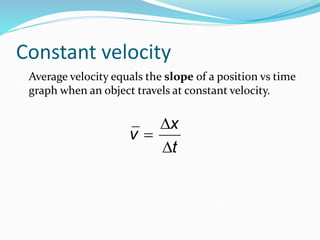
Average velocity equals the slope of a position vs time 
graph when an object travels at constant velocity. 
 
v  
x 
t
Displacement when object 
moves with constant velocity 
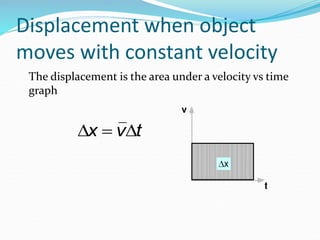
The displacement is the area under a velocity vs time 
graph 
 
x  v t
Uniform acceleration 
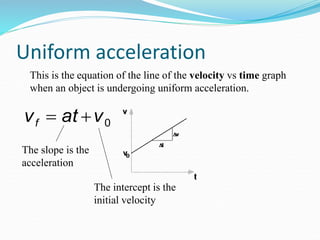
This is the equation of the line of the velocity vs time graph 
when an object is undergoing uniform acceleration. 
The slope is the 
acceleration 
The intercept is the 
initial velocity 
vf  at v0
Displacement when object 
accelerates from rest 
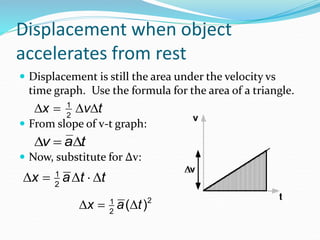
 Displacement is still the area under the velocity vs 
time graph. Use the formula for the area of a triangle. 
x  1 
2 
vt 
 From slope of v-t graph: 
v  a t 
 Now, substitute for Δv: 
x  1 
2 
a t  t 
x  1 
2 
a (t )2
Displacement when object 
accelerates with initial velocity 
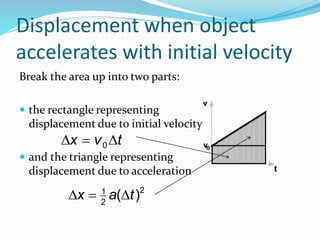
Break the area up into two parts: 
 the rectangle representing 
displacement due to initial velocity 
 and the triangle representing 
displacement due to acceleration 
 
x  v0t 
x  1 
2 
a(t )2
Displacement when object 
accelerates with initial velocity 
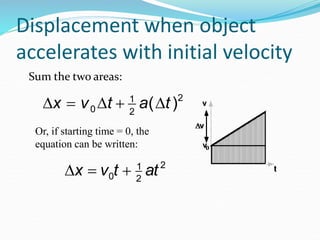
Sum the two areas: 
x  v0 t  1 
2 
a( t )2 
Or, if starting time = 0, the 
equation can be written: 
 
x  v0t  1 
2 
at 2
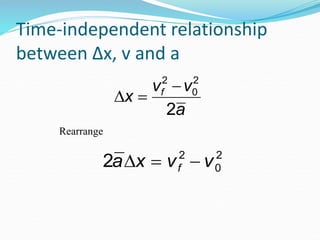
Time-independent relationship 
between Δx, v and a 
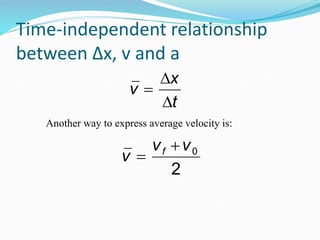
Another way to express average velocity is: 
 
v  
x 
t 
 
v  
vf v0 
2
Time-independent relationship 
between Δx, v and a 
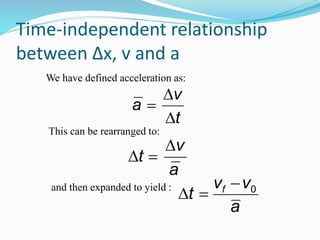
We have defined acceleration as: 
a  
This can be rearranged to: 
v 
t 
and then expanded to yield : 
 
 
t  
v 
a 
t  
vf v0 
a
Time-independent relationship 
between Δx, v and a 
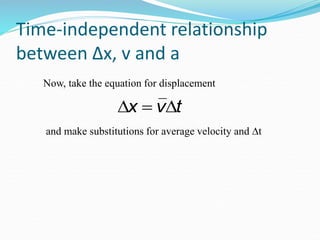
Now, take the equation for displacement 
and make substitutions for average velocity and Δt 
 
x  v t
Time-independent relationship 
between Δx, v and a 
 
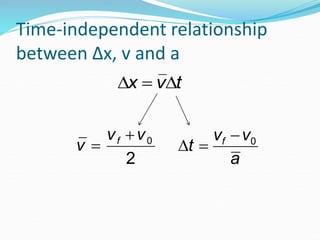
x  v t 
 
v  
vf v0 
2 
 
t  
vf v0 
a
Time-independent relationship 
between Δx, v and a 
 
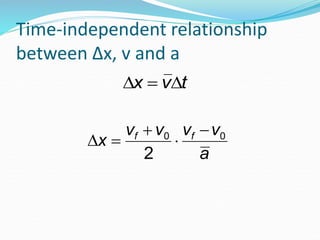
x  v t 
 
x  
vf  v0 
2 
 
vf v0 
a
Time-independent relationship 
between Δx, v and a 
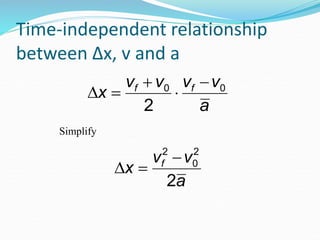
Simplify 
 
x  
vf  v0 
2 
 
vf v0 
a 
x  
2 v0 
vf 
2 
2a
Time-independent relationship 
between Δx, v and a 
Rearrange 
 
x  
2 v0 
vf 
2 
2a 
 
2  v0 
2a x  vf 
2
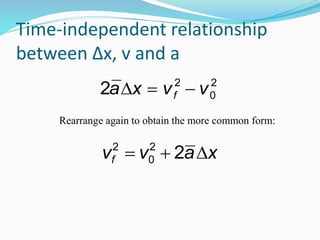
Time-independent relationship 
between Δx, v and a 
2  v0 
Rearrange again to obtain the more common form: 
 
2a x  vf 
2 
 
2  v0 
vf 
2  2a x
Which equation do I use? 
 First, decide what model is appropriate 
 Is the object moving at constant velocity? 
 Or, is it accelerating uniformly? 
 Next, decide whether it’s easier to use an algebraic or a 
graphical representation.
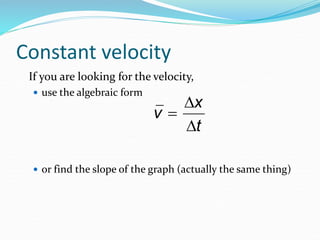
Constant velocity 
If you are looking for the velocity, 
 use the algebraic form 
 or find the slope of the graph (actually the same thing) 
 
v  
x 
t
Constant velocity 
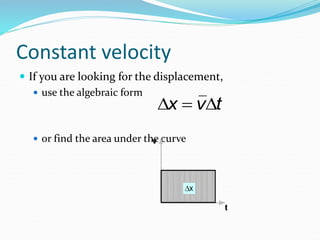
 If you are looking for the displacement, 
 use the algebraic form 
 or find the area under the curve 
 
x  v t
Uniform acceleration 
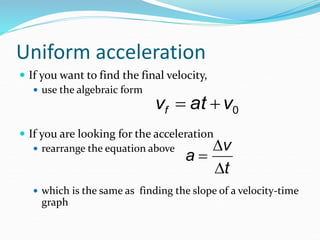
 If you want to find the final velocity, 
 use the algebraic form 
vf  at  v0 
 If you are looking for the acceleration 
 rearrange the equation above 
 
 which is the same as finding the slope of a velocity-time 
graph 
 
a  
v 
t
Uniform acceleration 
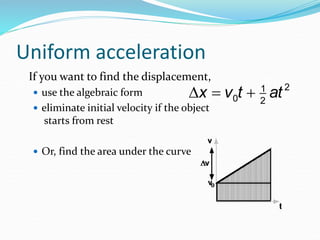
If you want to find the displacement, 
 use the algebraic form 
 eliminate initial velocity if the object 
starts from rest 
 Or, find the area under the curve 
 
x  v0t  1 
2 
at 2
If you don’t know the time… 
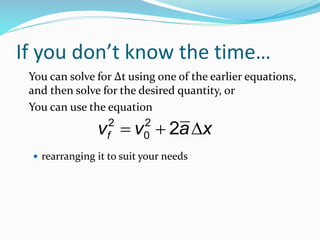
You can solve for Δt using one of the earlier equations, 
and then solve for the desired quantity, or 
You can use the equation 
2  v0 
 rearranging it to suit your needs 
 
vf 
2  2a x
All the equations in one place 
constant velocity uniform acceleration 
2  v0 
vf 
2  2ax 
x  v t 
 
x  v0t  1 
2 
at 2 
 
a  
v 
t 
 
vf  at v0 
v  
x 
t 


Derivation of Kinematic Equations

  • 2.
    Constant velocity Averagevelocity equals the slope of a position vs time graph when an object travels at constant velocity.  v  x t
  • 3.
    Displacement when object moves with constant velocity The displacement is the area under a velocity vs time graph  x  v t
  • 4.
    Uniform acceleration Thisis the equation of the line of the velocity vs time graph when an object is undergoing uniform acceleration. The slope is the acceleration The intercept is the initial velocity vf  at v0
  • 5.
    Displacement when object accelerates from rest  Displacement is still the area under the velocity vs time graph. Use the formula for the area of a triangle. x  1 2 vt  From slope of v-t graph: v  a t  Now, substitute for Δv: x  1 2 a t  t x  1 2 a (t )2
  • 6.
    Displacement when object accelerates with initial velocity Break the area up into two parts:  the rectangle representing displacement due to initial velocity  and the triangle representing displacement due to acceleration  x  v0t x  1 2 a(t )2
  • 7.
    Displacement when object accelerates with initial velocity Sum the two areas: x  v0 t  1 2 a( t )2 Or, if starting time = 0, the equation can be written:  x  v0t  1 2 at 2
  • 8.
    Time-independent relationship betweenΔx, v and a Another way to express average velocity is:  v  x t  v  vf v0 2
  • 9.
    Time-independent relationship betweenΔx, v and a We have defined acceleration as: a  This can be rearranged to: v t and then expanded to yield :   t  v a t  vf v0 a
  • 10.
    Time-independent relationship betweenΔx, v and a Now, take the equation for displacement and make substitutions for average velocity and Δt  x  v t
  • 11.
    Time-independent relationship betweenΔx, v and a  x  v t  v  vf v0 2  t  vf v0 a
  • 12.
    Time-independent relationship betweenΔx, v and a  x  v t  x  vf  v0 2  vf v0 a
  • 13.
    Time-independent relationship betweenΔx, v and a Simplify  x  vf  v0 2  vf v0 a x  2 v0 vf 2 2a
  • 14.
    Time-independent relationship betweenΔx, v and a Rearrange  x  2 v0 vf 2 2a  2  v0 2a x  vf 2
  • 15.
    Time-independent relationship betweenΔx, v and a 2  v0 Rearrange again to obtain the more common form:  2a x  vf 2  2  v0 vf 2  2a x
  • 16.
    Which equation doI use?  First, decide what model is appropriate  Is the object moving at constant velocity?  Or, is it accelerating uniformly?  Next, decide whether it’s easier to use an algebraic or a graphical representation.
  • 17.
    Constant velocity Ifyou are looking for the velocity,  use the algebraic form  or find the slope of the graph (actually the same thing)  v  x t
  • 18.
    Constant velocity If you are looking for the displacement,  use the algebraic form  or find the area under the curve  x  v t
  • 19.
    Uniform acceleration If you want to find the final velocity,  use the algebraic form vf  at  v0  If you are looking for the acceleration  rearrange the equation above   which is the same as finding the slope of a velocity-time graph  a  v t
  • 20.
    Uniform acceleration Ifyou want to find the displacement,  use the algebraic form  eliminate initial velocity if the object starts from rest  Or, find the area under the curve  x  v0t  1 2 at 2
  • 21.
    If you don’tknow the time… You can solve for Δt using one of the earlier equations, and then solve for the desired quantity, or You can use the equation 2  v0  rearranging it to suit your needs  vf 2  2a x
  • 22.
    All the equationsin one place constant velocity uniform acceleration 2  v0 vf 2  2ax x  v t  x  v0t  1 2 at 2  a  v t  vf  at v0 v  x t 