ULTRASONICS
 Introduction to Ultrasonics
 Properties of Ultrasonic waves
Ultrasonic Production- Magnetostriction Method
Piezo Electric Method
 Detection Methods
 Applications of Ultrasonics
 Worked Problem
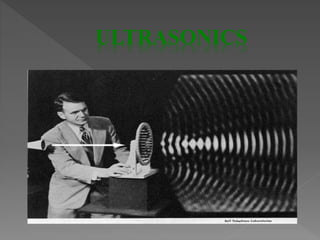
ULTRASONICS
INTRODUCTION
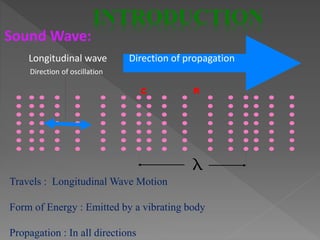
Sound Wave:
Travels : Longitudinal Wave Motion
Form of Energy : Emitted by a vibrating body
Propagation : In all directions
Direction of oscillation
Direction of propagationLongitudinal wave
C R
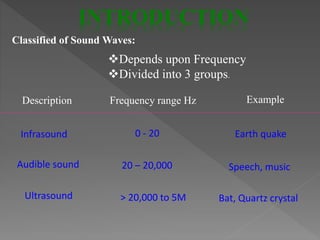
Classified of Sound Waves:
Depends upon Frequency
Divided into 3 groups.
Description
Infrasound
Ultrasound
Audible sound
Frequency range Hz
0 - 20
20 – 20,000
> 20,000 to 5M
Earth quake
Speech, music
Bat, Quartz crystal
Example
INTRODUCTION
(1) They have a high energy content (high freq)
(2) Speed of ultrasonic waves depends on frequency .
(3) To propagation the ultrasonic waves --
Medium is compulsory
(4)Just like ordinary sound waves, ultrasonic waves get
reflected, refracted and absorbed.
(5) Polarisation: can not be polarized.
(6) Shows negligible diffraction.
(7) Acoustic grating can be constructed.
 Ultrasonic waves are produced by the following
methods.
(1) Magneto-striction generator or oscillator
(2) Piezo-electric generator or oscillator
To produce low frequency Ultrasonics
Principle: Magnetostriction effect
When a magnetic field is applied parallel to the
length of a ferromagnetic rod made of ferromagnetic
materials such as iron or nickel, a small elongation
or contraction occurs in its length.
The change in length (increase or decrease) produced in the rod
depends upon
i) the strength of the magnetic field,
ii) the nature of the ferromagnetic materials
iii) does not depend of the direction of the field.
b
c
e
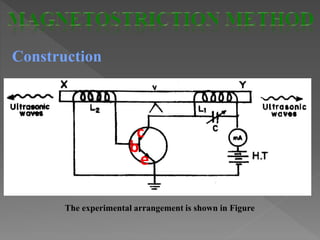
The experimental arrangement is shown in Figure
Construction
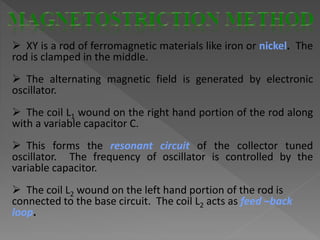
 XY is a rod of ferromagnetic materials like iron or nickel. The
rod is clamped in the middle.
 The alternating magnetic field is generated by electronic
oscillator.
 The coil L1 wound on the right hand portion of the rod along
with a variable capacitor C.
 This forms the resonant circuit of the collector tuned
oscillator. The frequency of oscillator is controlled by the
variable capacitor.
 The coil L2 wound on the left hand portion of the rod is
connected to the base circuit. The coil L2 acts as feed –back
loop.
Working
 When High Tension (H.T) battery is switched on, the
collector circuit oscillates with a frequency,
f =
 This alternating current flowing through the coil L1
produces an alternating magnetic field along the
length of the rod. The result is that the rod starts
vibrating due to magnetostrictive effect.
1
1
2 L C
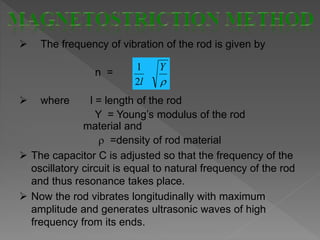
 The frequency of vibration of the rod is given by
n =
 where l = length of the rod
Y = Young’s modulus of the rod
material and
 =density of rod material
 The capacitor C is adjusted so that the frequency of the
oscillatory circuit is equal to natural frequency of the rod
and thus resonance takes place.
 Now the rod vibrates longitudinally with maximum
amplitude and generates ultrasonic waves of high
frequency from its ends.

Y
l2
1
Advantages
1. The design of this oscillator is very simple and its
production cost is low
2. At low ultrasonic frequencies, the large power output can
be produced without the risk of damage of the oscillatory
circuit.
1.It has low upper frequency limit and cannot generate ultrasonic
frequency above 3000 kHz (ie. 3MHz).
2.The frequency of oscillations depends on temperature.
3.There will be losses of energy due to hysteresis and eddy current.
Disadvantages
 If mechanical pressure is applied to one pair of opposite
faces of certain crystals like quartz, equal and opposite
electrical charges appear across its other faces. This is
called as piezo-electric effect.
 The converse of piezo electric effect is also true.
 If an electric field is applied to one pair of faces, the
corresponding changes in the dimensions of the other
pair of faces of the crystal are produced. This is known
as inverse piezo electric effect or electrostriction.
Principle : Inverse piezo electric effect
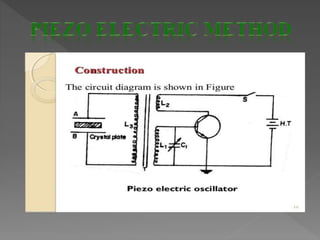
 The quartz crystal is placed between two metal plates A and B.
 The plates are connected to the primary (L3) of a transformer
which is inductively coupled to the electronics oscillator.
 The electronic oscillator circuit is a base tuned oscillator circuit.
 The coils L1 and L2 of oscillator circuit are taken from the
secondary of a transformer T.
 The collector coil L2 is inductively coupled to base coil L1.
 The coil L1 and variable capacitor C1 form the tank circuit of the
oscillator.
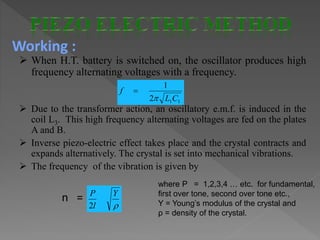
 When H.T. battery is switched on, the oscillator produces high
frequency alternating voltages with a frequency.
 Due to the transformer action, an oscillatory e.m.f. is induced in the
coil L3. This high frequency alternating voltages are fed on the plates
A and B.
 Inverse piezo-electric effect takes place and the crystal contracts and
expands alternatively. The crystal is set into mechanical vibrations.
 The frequency of the vibration is given by
n =
112
1
CL
f



Y
l
P
2
where P = 1,2,3,4 … etc. for fundamental,
first over tone, second over tone etc.,
Y = Young’s modulus of the crystal and
ρ = density of the crystal.
Working :
Advantages
 Ultrasonic frequencies as high as 5 x 10⁸Hz or 500 MHz can be
obtained with this arrangement.
 The output of this oscillator is very high.
 It is not affected by temperature and humidity.
Disadvantages
 The cost of piezo electric quartz is very high
 The cutting and shaping of quartz crystal are very complex.
Applications of Ultrasonic Waves in Engineering
(1) Detection of flaws in metals
(Non Destructive Testing –NDT)
Principle:
 Ultrasonic waves are used to detect the presence of
flaws or defects in the form of cracks, blowholes
porosity etc., in the internal structure of a material
 By sending out ultrasonic beam and by measuring the
time interval of the reflected beam, flaws in the metal
block can be determined.
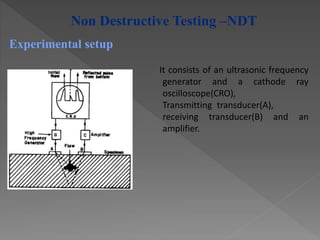
It consists of an ultrasonic frequency
generator and a cathode ray
oscilloscope(CRO),
Transmitting transducer(A),
receiving transducer(B) and an
amplifier.
Experimental setup
Non Destructive Testing –NDT
• In flaws, there is a change of medium and this produces
reflection of ultrasonic at the cavities or cracks.
• The reflected beam (echoes) is recorded by using cathode
ray oscilloscope.
• The time interval between initial and flaw echoes depends
on the range of flaw.
• By examining echoes on CRO, flaws can be detected and
their sizes can be estimated.
Working
• This method is used to detect flaws in all
common structural metals and other materials
like rubber tyres etc.
• The method is very cheap and of high speed of
operation.
• It is more accurate than radiography.
Features

ULTRASONICS

  • 1.
  • 2.
     Introduction toUltrasonics  Properties of Ultrasonic waves Ultrasonic Production- Magnetostriction Method Piezo Electric Method  Detection Methods  Applications of Ultrasonics  Worked Problem ULTRASONICS
  • 3.
    INTRODUCTION Sound Wave: Travels :Longitudinal Wave Motion Form of Energy : Emitted by a vibrating body Propagation : In all directions Direction of oscillation Direction of propagationLongitudinal wave C R
  • 4.
    Classified of SoundWaves: Depends upon Frequency Divided into 3 groups. Description Infrasound Ultrasound Audible sound Frequency range Hz 0 - 20 20 – 20,000 > 20,000 to 5M Earth quake Speech, music Bat, Quartz crystal Example INTRODUCTION
  • 5.
    (1) They havea high energy content (high freq) (2) Speed of ultrasonic waves depends on frequency . (3) To propagation the ultrasonic waves -- Medium is compulsory (4)Just like ordinary sound waves, ultrasonic waves get reflected, refracted and absorbed. (5) Polarisation: can not be polarized. (6) Shows negligible diffraction. (7) Acoustic grating can be constructed.
  • 6.
     Ultrasonic wavesare produced by the following methods. (1) Magneto-striction generator or oscillator (2) Piezo-electric generator or oscillator
  • 7.
    To produce lowfrequency Ultrasonics Principle: Magnetostriction effect When a magnetic field is applied parallel to the length of a ferromagnetic rod made of ferromagnetic materials such as iron or nickel, a small elongation or contraction occurs in its length.
  • 8.
    The change inlength (increase or decrease) produced in the rod depends upon i) the strength of the magnetic field, ii) the nature of the ferromagnetic materials iii) does not depend of the direction of the field.
  • 9.
    b c e The experimental arrangementis shown in Figure Construction
  • 10.
     XY isa rod of ferromagnetic materials like iron or nickel. The rod is clamped in the middle.  The alternating magnetic field is generated by electronic oscillator.  The coil L1 wound on the right hand portion of the rod along with a variable capacitor C.  This forms the resonant circuit of the collector tuned oscillator. The frequency of oscillator is controlled by the variable capacitor.  The coil L2 wound on the left hand portion of the rod is connected to the base circuit. The coil L2 acts as feed –back loop.
  • 11.
    Working  When HighTension (H.T) battery is switched on, the collector circuit oscillates with a frequency, f =  This alternating current flowing through the coil L1 produces an alternating magnetic field along the length of the rod. The result is that the rod starts vibrating due to magnetostrictive effect. 1 1 2 L C
  • 12.
     The frequencyof vibration of the rod is given by n =  where l = length of the rod Y = Young’s modulus of the rod material and  =density of rod material  The capacitor C is adjusted so that the frequency of the oscillatory circuit is equal to natural frequency of the rod and thus resonance takes place.  Now the rod vibrates longitudinally with maximum amplitude and generates ultrasonic waves of high frequency from its ends.  Y l2 1
  • 13.
    Advantages 1. The designof this oscillator is very simple and its production cost is low 2. At low ultrasonic frequencies, the large power output can be produced without the risk of damage of the oscillatory circuit. 1.It has low upper frequency limit and cannot generate ultrasonic frequency above 3000 kHz (ie. 3MHz). 2.The frequency of oscillations depends on temperature. 3.There will be losses of energy due to hysteresis and eddy current. Disadvantages
  • 14.
     If mechanicalpressure is applied to one pair of opposite faces of certain crystals like quartz, equal and opposite electrical charges appear across its other faces. This is called as piezo-electric effect.  The converse of piezo electric effect is also true.  If an electric field is applied to one pair of faces, the corresponding changes in the dimensions of the other pair of faces of the crystal are produced. This is known as inverse piezo electric effect or electrostriction. Principle : Inverse piezo electric effect
  • 16.
     The quartzcrystal is placed between two metal plates A and B.  The plates are connected to the primary (L3) of a transformer which is inductively coupled to the electronics oscillator.  The electronic oscillator circuit is a base tuned oscillator circuit.  The coils L1 and L2 of oscillator circuit are taken from the secondary of a transformer T.  The collector coil L2 is inductively coupled to base coil L1.  The coil L1 and variable capacitor C1 form the tank circuit of the oscillator.
  • 17.
     When H.T.battery is switched on, the oscillator produces high frequency alternating voltages with a frequency.  Due to the transformer action, an oscillatory e.m.f. is induced in the coil L3. This high frequency alternating voltages are fed on the plates A and B.  Inverse piezo-electric effect takes place and the crystal contracts and expands alternatively. The crystal is set into mechanical vibrations.  The frequency of the vibration is given by n = 112 1 CL f    Y l P 2 where P = 1,2,3,4 … etc. for fundamental, first over tone, second over tone etc., Y = Young’s modulus of the crystal and ρ = density of the crystal. Working :
  • 18.
    Advantages  Ultrasonic frequenciesas high as 5 x 10⁸Hz or 500 MHz can be obtained with this arrangement.  The output of this oscillator is very high.  It is not affected by temperature and humidity. Disadvantages  The cost of piezo electric quartz is very high  The cutting and shaping of quartz crystal are very complex.
  • 19.
    Applications of UltrasonicWaves in Engineering (1) Detection of flaws in metals (Non Destructive Testing –NDT) Principle:  Ultrasonic waves are used to detect the presence of flaws or defects in the form of cracks, blowholes porosity etc., in the internal structure of a material  By sending out ultrasonic beam and by measuring the time interval of the reflected beam, flaws in the metal block can be determined.
  • 20.
    It consists ofan ultrasonic frequency generator and a cathode ray oscilloscope(CRO), Transmitting transducer(A), receiving transducer(B) and an amplifier. Experimental setup Non Destructive Testing –NDT
  • 21.
    • In flaws,there is a change of medium and this produces reflection of ultrasonic at the cavities or cracks. • The reflected beam (echoes) is recorded by using cathode ray oscilloscope. • The time interval between initial and flaw echoes depends on the range of flaw. • By examining echoes on CRO, flaws can be detected and their sizes can be estimated. Working
  • 22.
    • This methodis used to detect flaws in all common structural metals and other materials like rubber tyres etc. • The method is very cheap and of high speed of operation. • It is more accurate than radiography. Features