Classroom
Practices for
English Learners
(Els) Instruction
STANDARDS-BASED INSTRUCTION
 Standards consist of:
 Content standards: what students should
know/ learn
 Benchmarks: what skills/knowledge are
expected to be gained
 Performance standards: progress indicators
that show whether the requirements have
been met
KEY POINTS OF STANDARDS-BASED
INSTRUCTION
A purposeful and meaningful context that
establishes not only what but also why
students must learn the content (framed
with standards)
 Creates high expectations for all students
and motivation for the teacher
 The standards for the grade-level are
aligned with the English language
standards
STANDARDS-BASED INSTRUCTION TIPS FOR
NOVICE TEACHERS
 Familiarize yourselves with standards of
level and subject & align them with your
TESOL standards
Let’s see what standards-based classrooms
look like
http://www.ciclt.net/ul/garesa/Pic%20webpage.
htm
(We will be able to look at one of them in
the class. You can check the others
later.)
NATIONAL STANDARDS
TESOL STANDARDS
TESOL standards do not replace state
curriculum standards. Rather they are to
be used alongside your other standards
- Based on content standards
- Focus on all 4 skills: listening, speaking,
writing and reading
- Tested via sample performance indicators
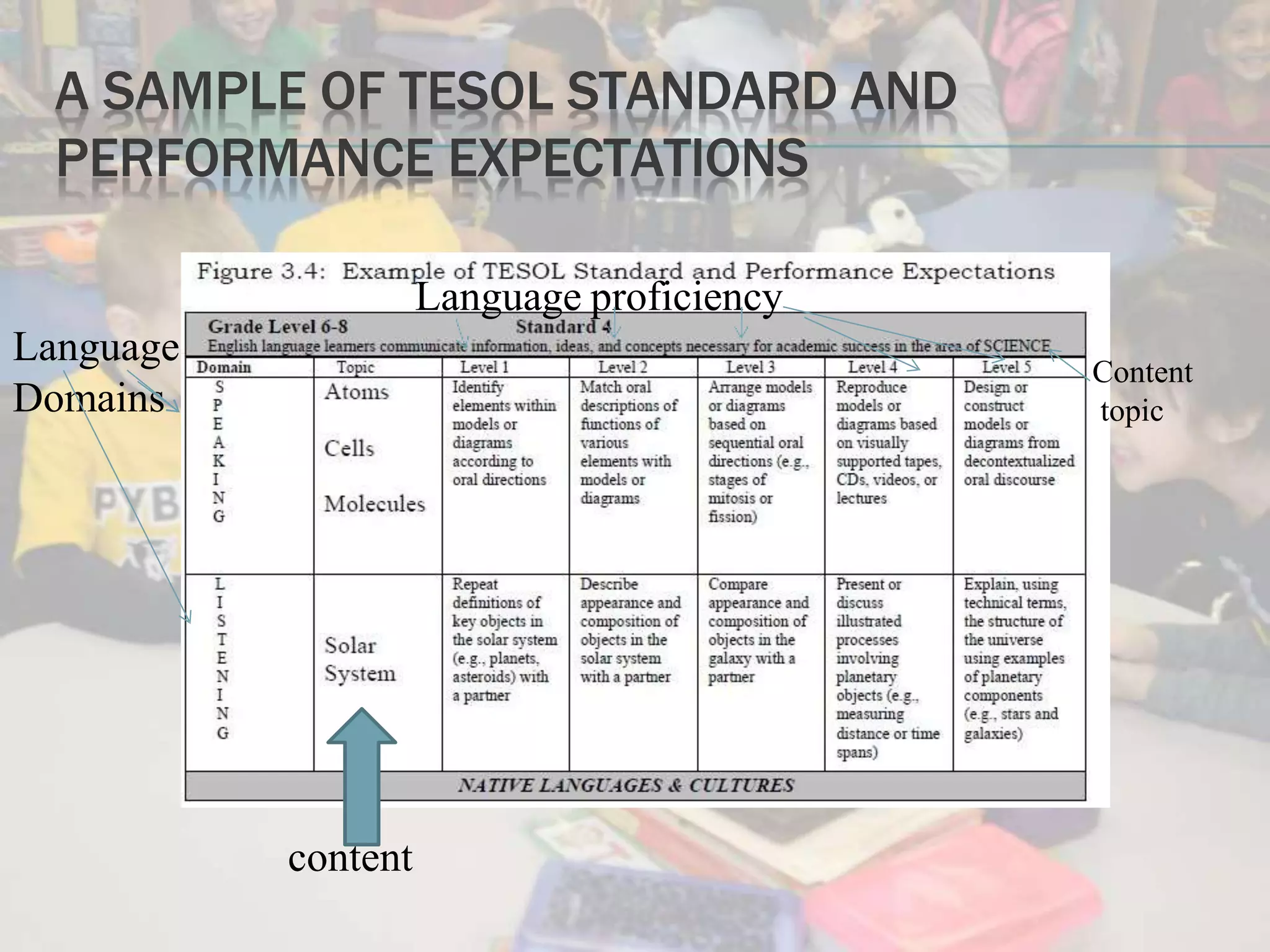
A SAMPLE OF TESOL STANDARD AND
PERFORMANCE EXPECTATIONS
Language
Domains
Content
topic
Language proficiency
content
KEY POINTS OF THE TESOL STANDARDS
 The higher level the higher & more
complex linguistic expectations from
students
 Facilitate English acquisition for
various purposes
 Conceptualize grade-appropriate curriculum
& assessment
FOUR COMPONENTS OF STANDARDS-BASED
INSTRUCTION
 Inquiry and problem solving
 Collaborative learning
 Continual assessment embedded in
instruction
 Higher-order questioning
DIFFERENTIATED INSTRUCTION (DI)
One of the cornerstones inherent in the
TESOL standards
 Teachers acknowledge, respect,
accommodate and build upon student
differences to facilitate optimal growth for all
 Students’ strength and preferences
for processing information are
considered
DI CONT.
 Ongoing assessment to prepare the
students for learning
 Mutual respect and caring is promoted
 Differentiated instruction calls for variety
and flexibility in classroom, learning
materials and grouping
 Emphasis on individual differences
DIFFERENTIATED ASSESSMENT STEPS
 Before instruction: check prior knowledge
 During instruction: check
student understanding, student
needs
 After instruction: assess student
understanding and explain next steps for
teaching
 Specially Designed Academic Instruction
in English (SDAIE) is a type of
differentiated instruction
CONTENT BASED INSTRUCTION (CBI)
Using the target language as a medium of
instruction to teach language and content
simultaneously.
The idea behind CBI is to relate the language
learning experience to a meaningful
subject.
 Examples of CBI: French immersion
programs in Canada, university level
language classes
ESSENTIALS OF CBI
 Promotes SLA and oral – written
academic skills
 Modified teacher language
Instructional language is used as
“comprehensible input” by pairing visuals
to convey the meaning
 Explicit instruction for an excellence in
skills acquisition
 Content-oriented tasks are encouraged
in student group activities
CBI & TESOL STANDARDS
 CBI supports ELs achievement of
TESOL standards by
- integrating language & content learning
- addressing language domains of
listening, reading, speaking and writing
- Providing support for various English
language proficiency levels
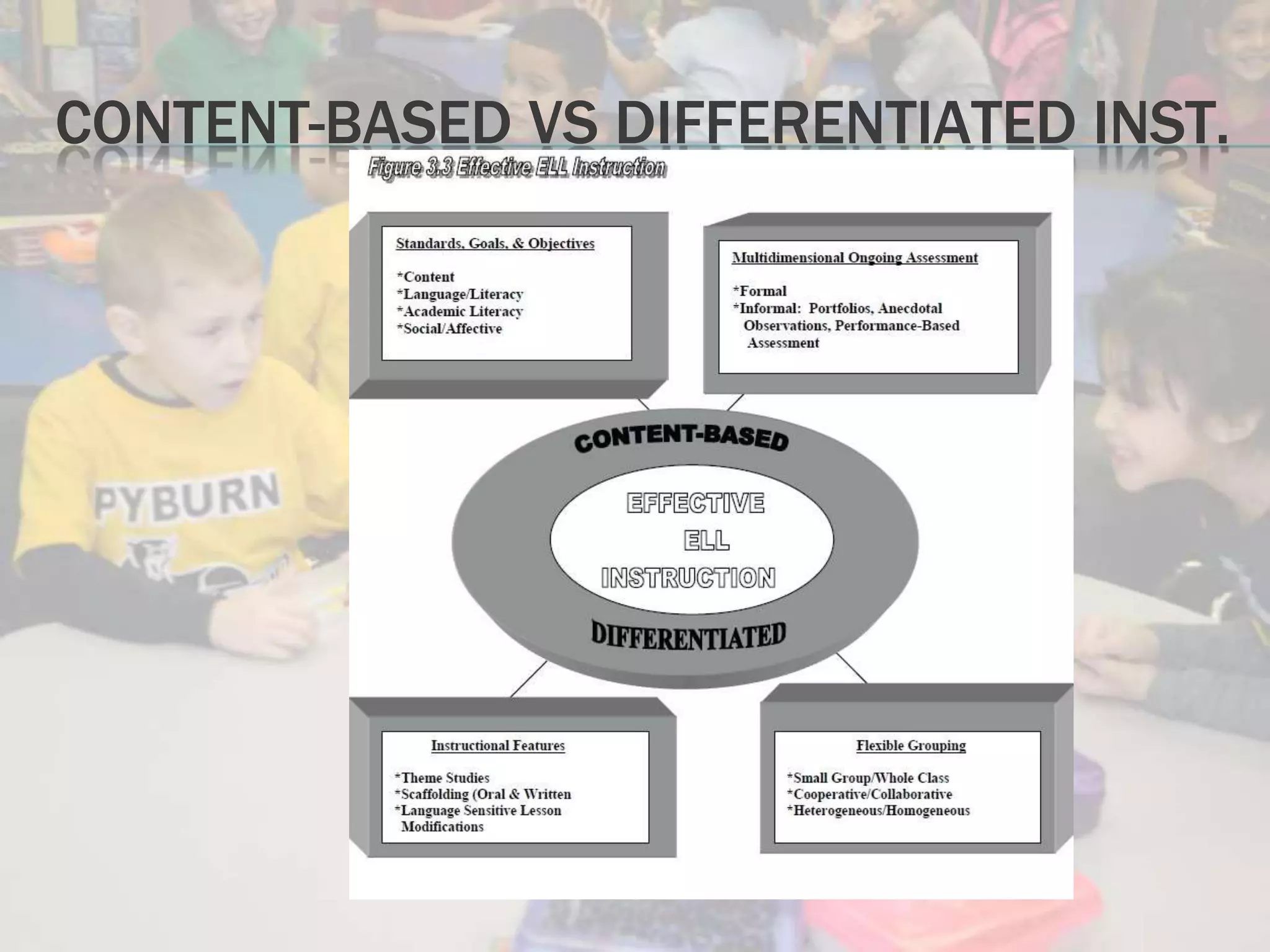
CONTENT-BASED VS DIFFERENTIATED INST.
SHELTERED INSTRUCTION OR SPECIALLY
DESIGNED ACADEMIC INSTRUCTION IN ENGLISH
(SDAIE)
Goal of SDAIE is to help the ELs succeed
in school
Content with target language + special
modifications based on student
needs
SDAIE
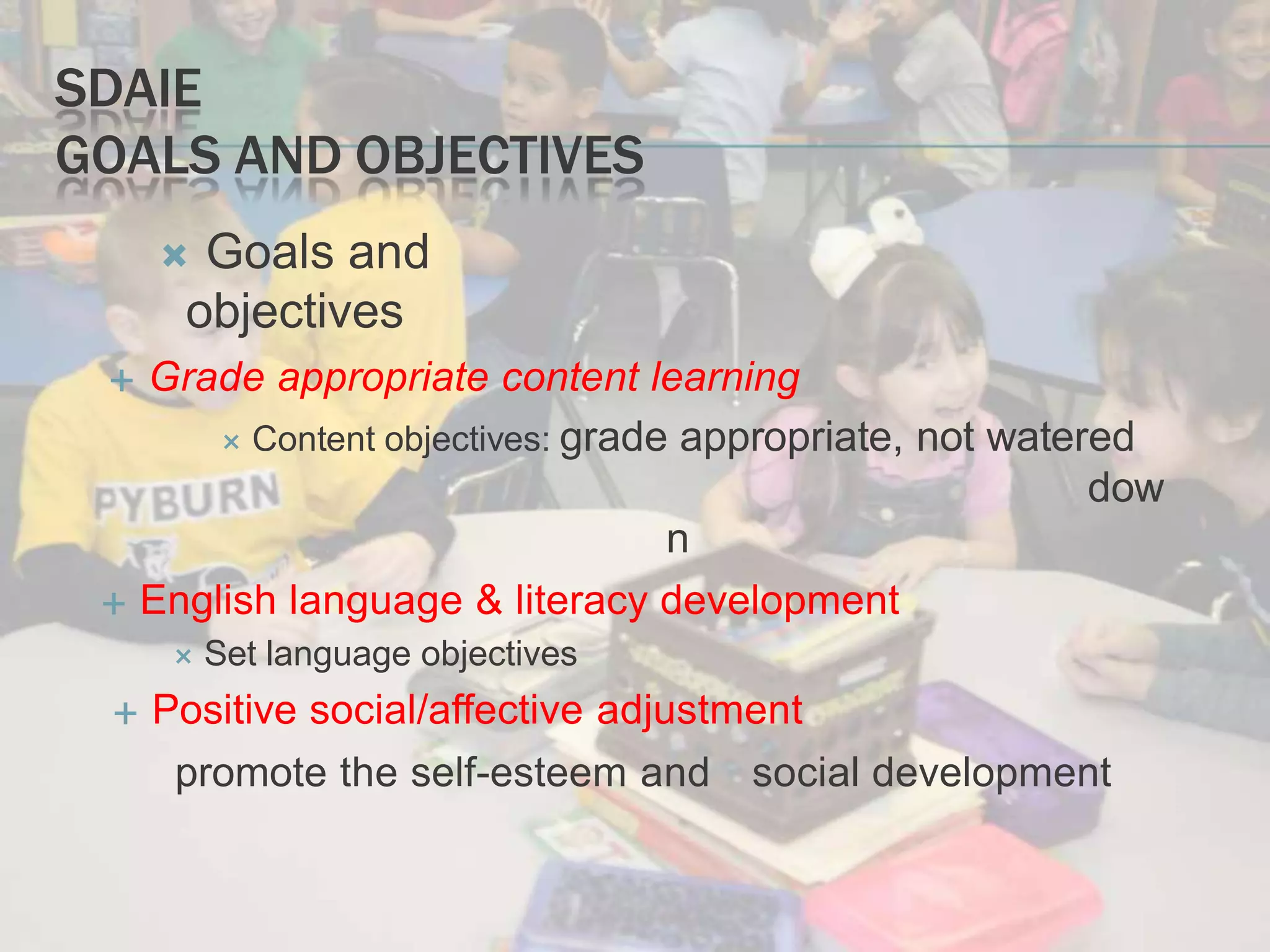
GOALS AND OBJECTIVES
 Goals and
objectives
 Grade appropriate content learning
 Content objectives: grade appropriate, not watered
dow
n
 English language & literacy development
 Set language objectives
 Positive social/affective adjustment
promote the self-esteem and social development
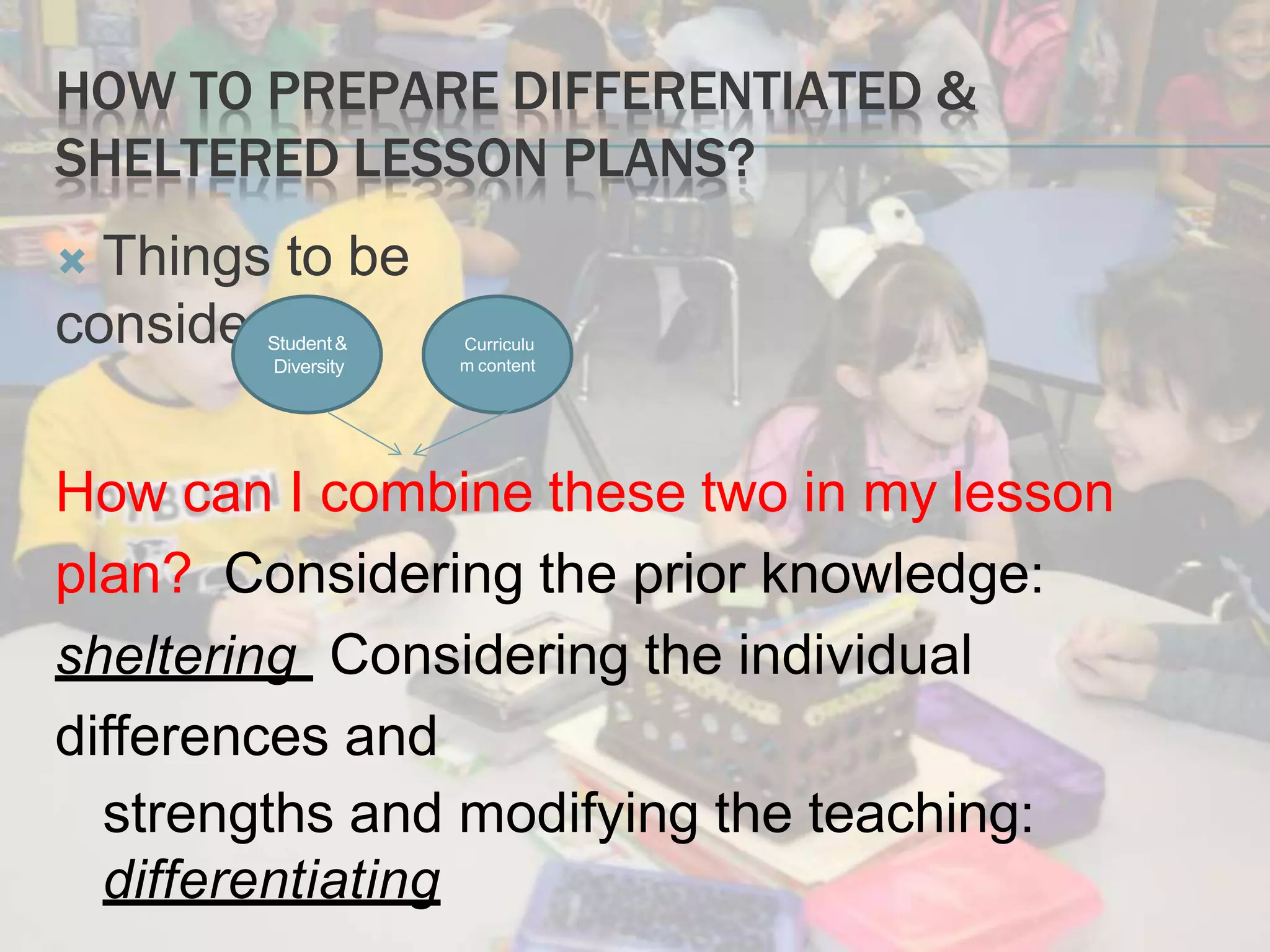
HOW TO PREPARE DIFFERENTIATED &
SHELTERED LESSON PLANS?
 Things to be
considered:
How can I combine these two in my lesson
plan? Considering the prior knowledge:
sheltering Considering the individual
differences and
strengths and modifying the teaching:
differentiating
Student&
Diversity
Curriculu
m content
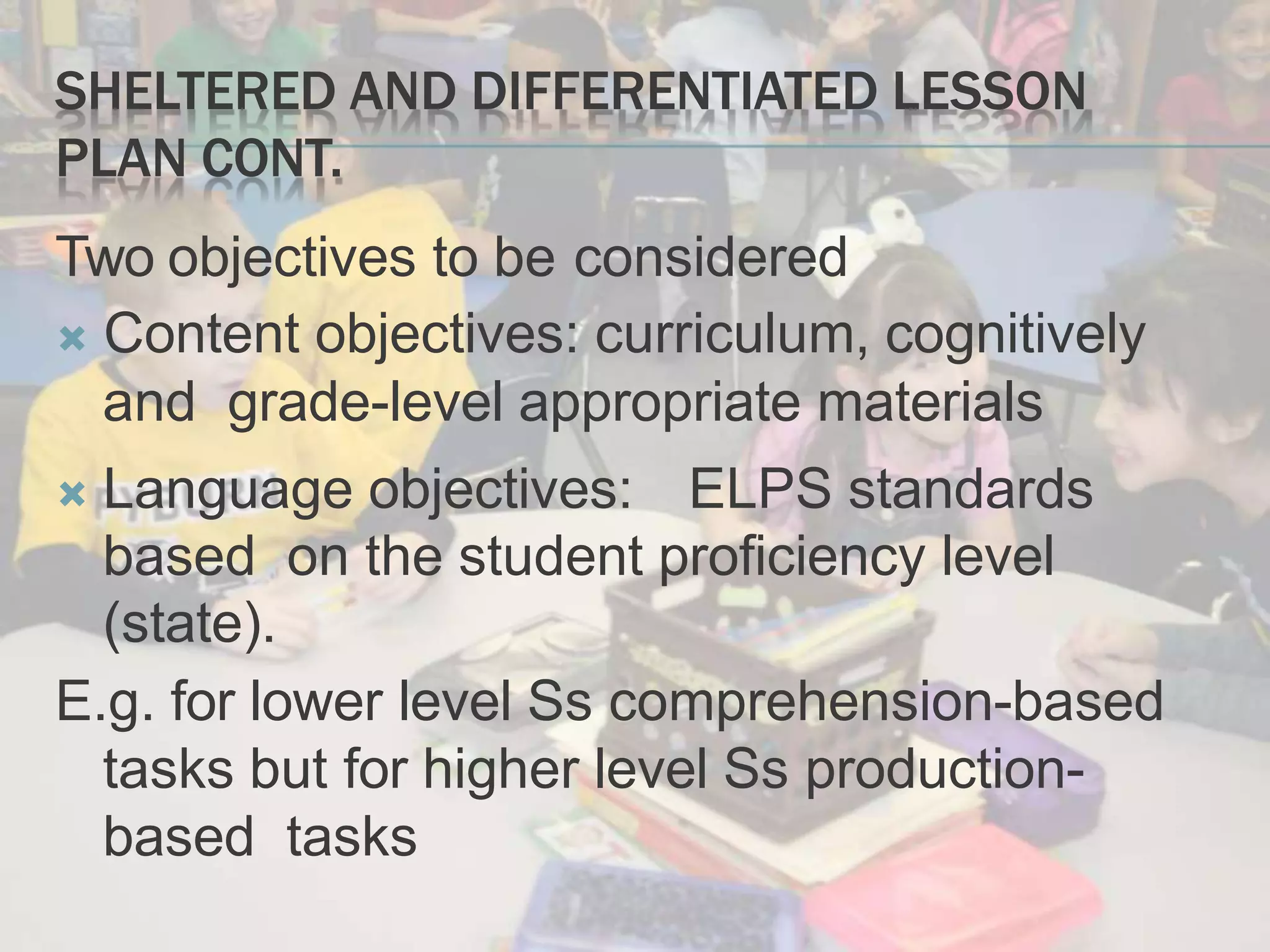
SHELTERED AND DIFFERENTIATED LESSON
PLAN CONT.
Two objectives to be considered
 Content objectives: curriculum, cognitively
and grade-level appropriate materials
 Language objectives: ELPS standards
based on the student proficiency level
(state).
E.g. for lower level Ss comprehension-based
tasks but for higher level Ss production-
based tasks
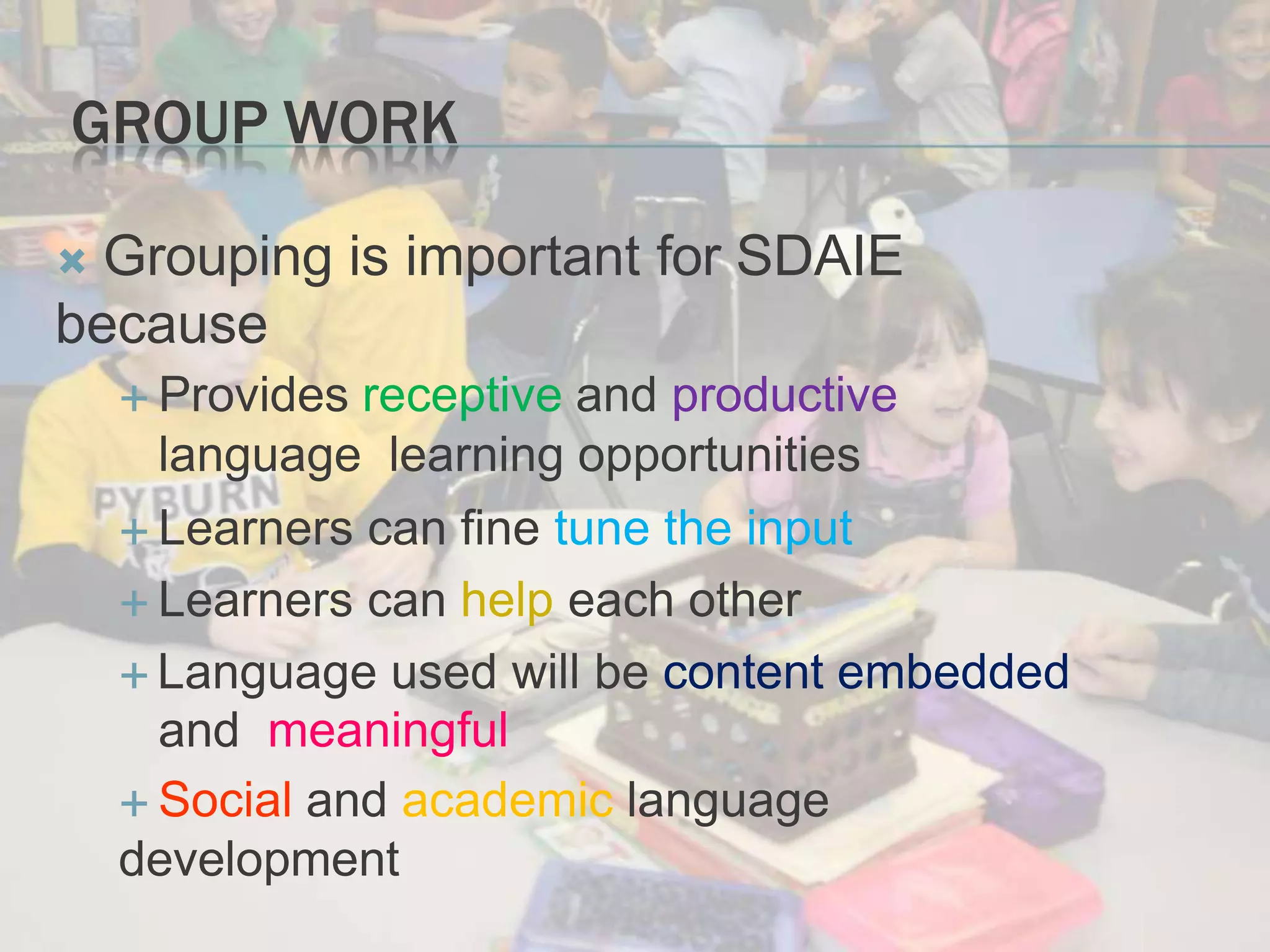
GROUP WORK
 Grouping is important for SDAIE
because
 Provides receptive and productive
language learning opportunities
 Learners can fine tune the input
 Learners can help each other
 Language used will be content embedded
and meaningful
 Social and academic language
development
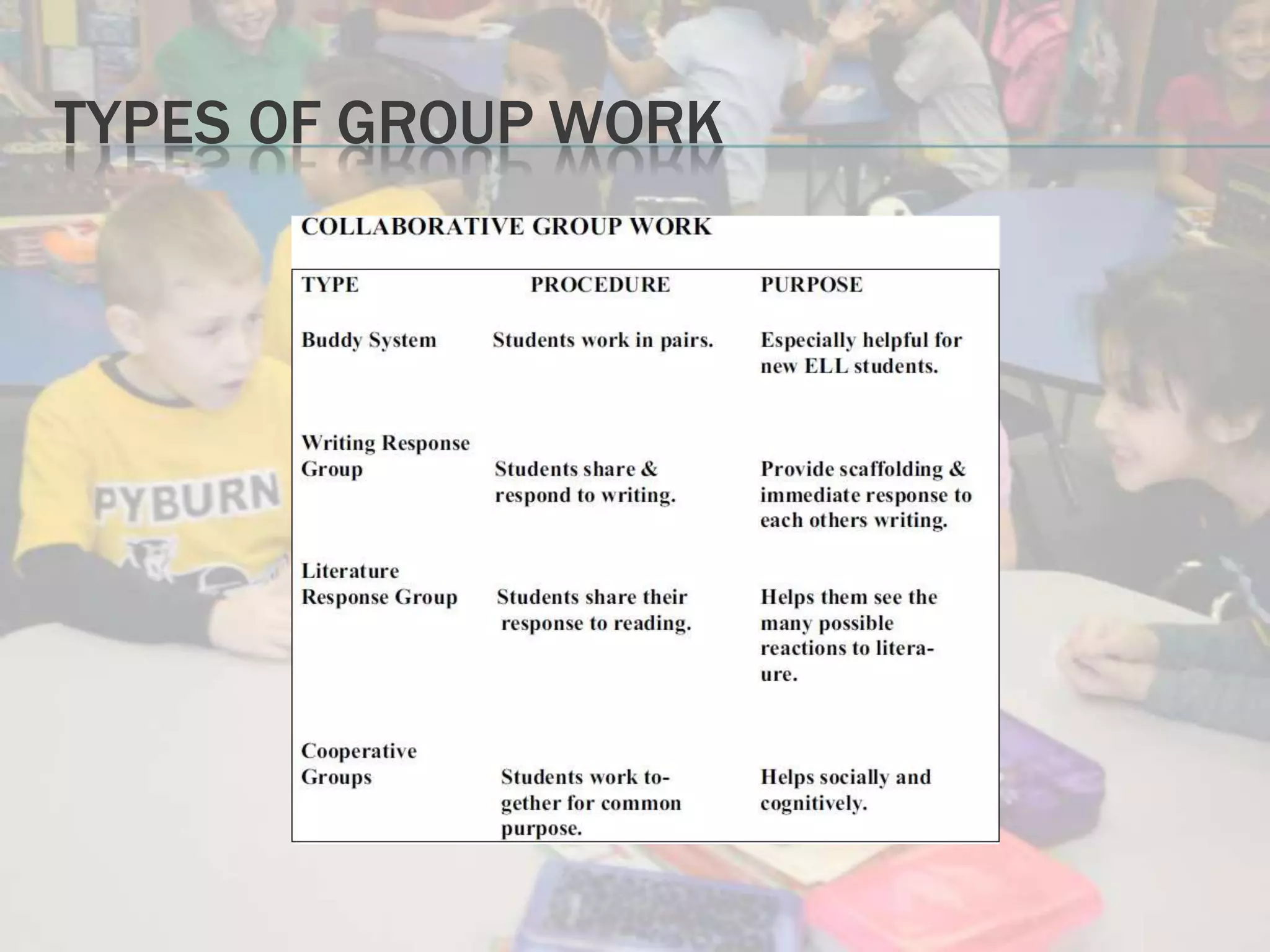
TYPES OF GROUP WORK
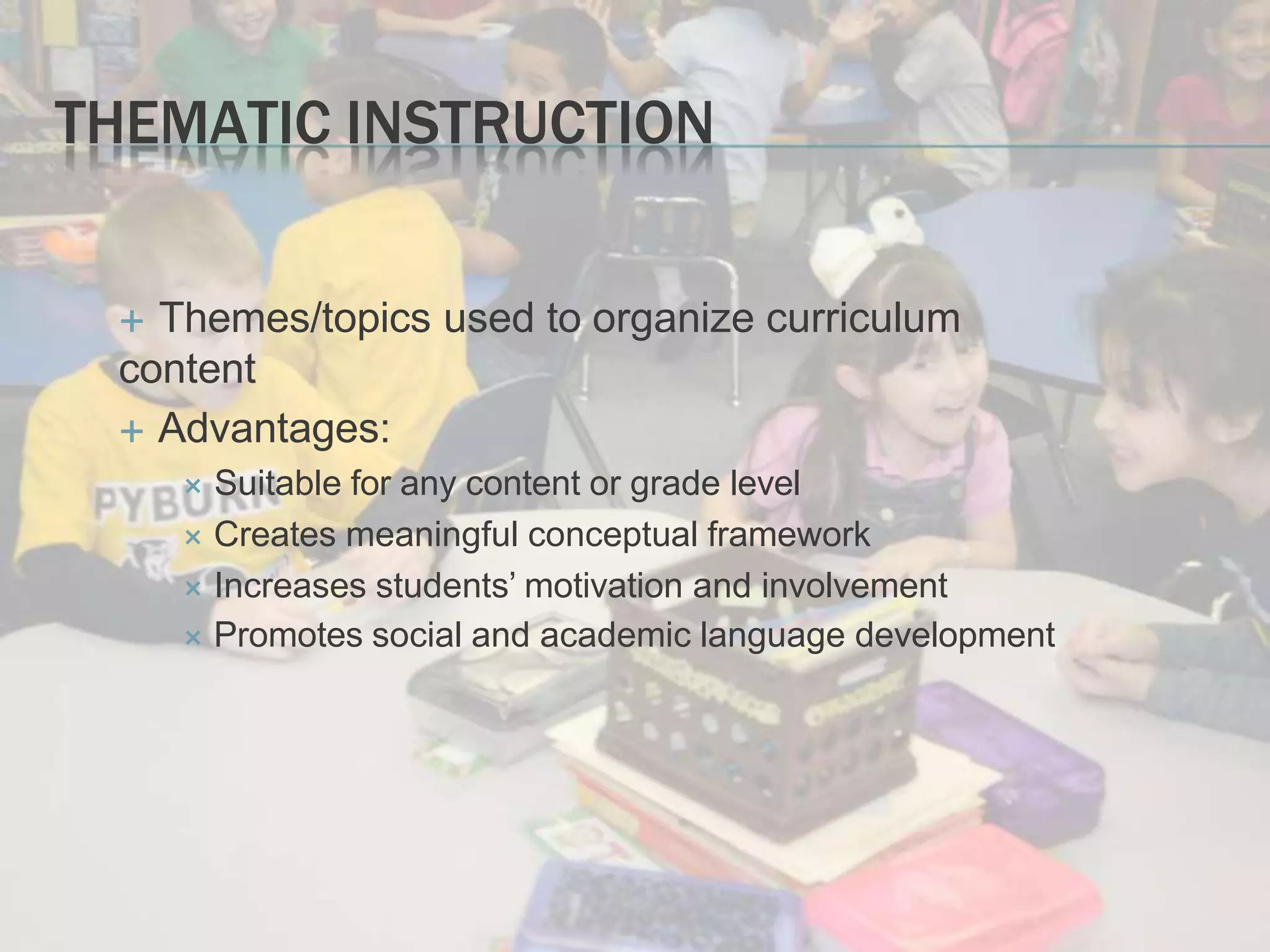
THEMATIC INSTRUCTION
 Themes/topics used to organize curriculum
content
 Advantages:
 Suitable for any content or grade level
 Creates meaningful conceptual framework
 Increases students’ motivation and involvement
 Promotes social and academic language development
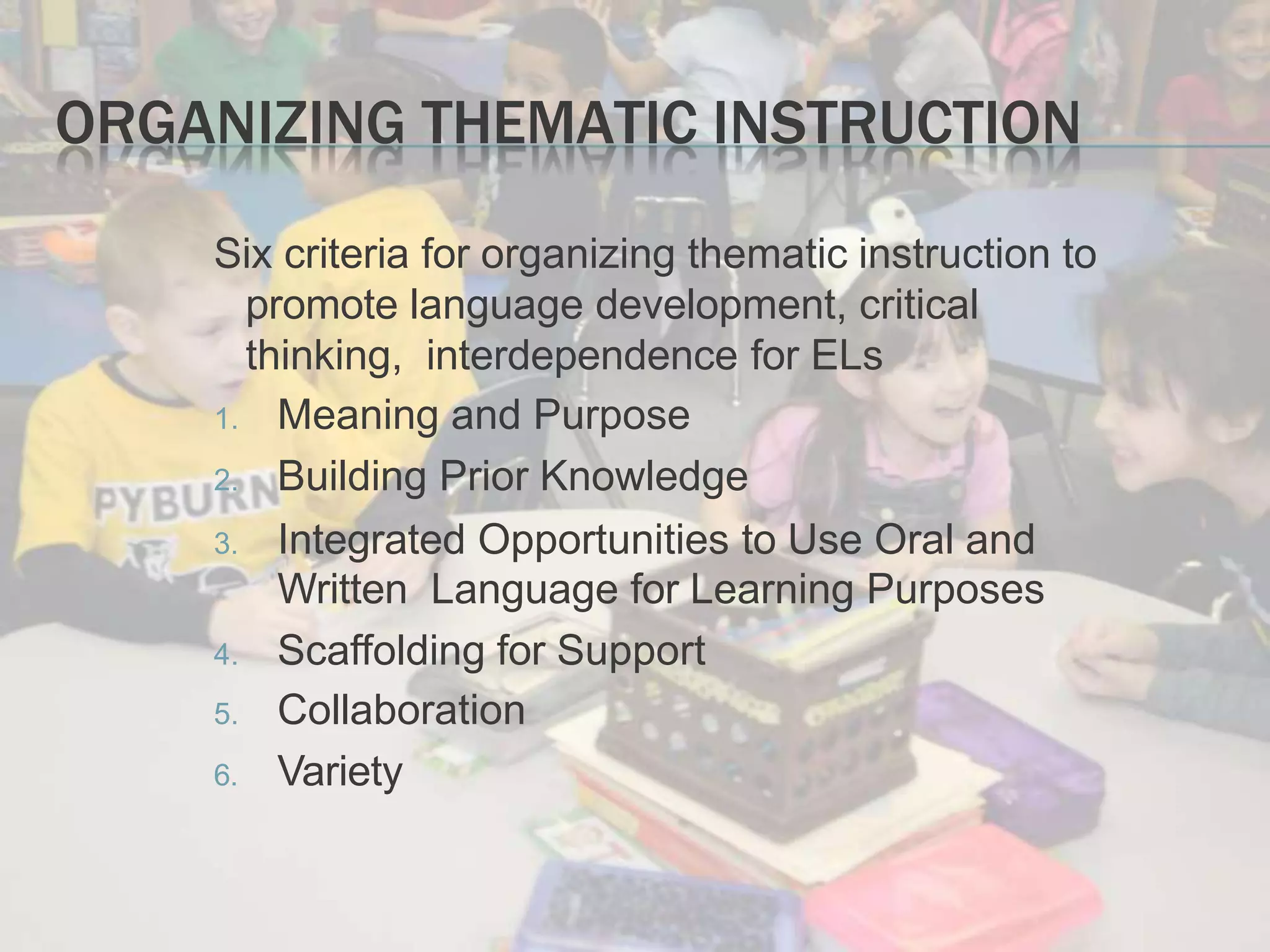
ORGANIZING THEMATIC INSTRUCTION
Six criteria for organizing thematic instruction to
promote language development, critical
thinking, interdependence for ELs
1. Meaning and Purpose
2. Building Prior Knowledge
3. Integrated Opportunities to Use Oral and
Written Language for Learning Purposes
4. Scaffolding for Support
5. Collaboration
6. Variety
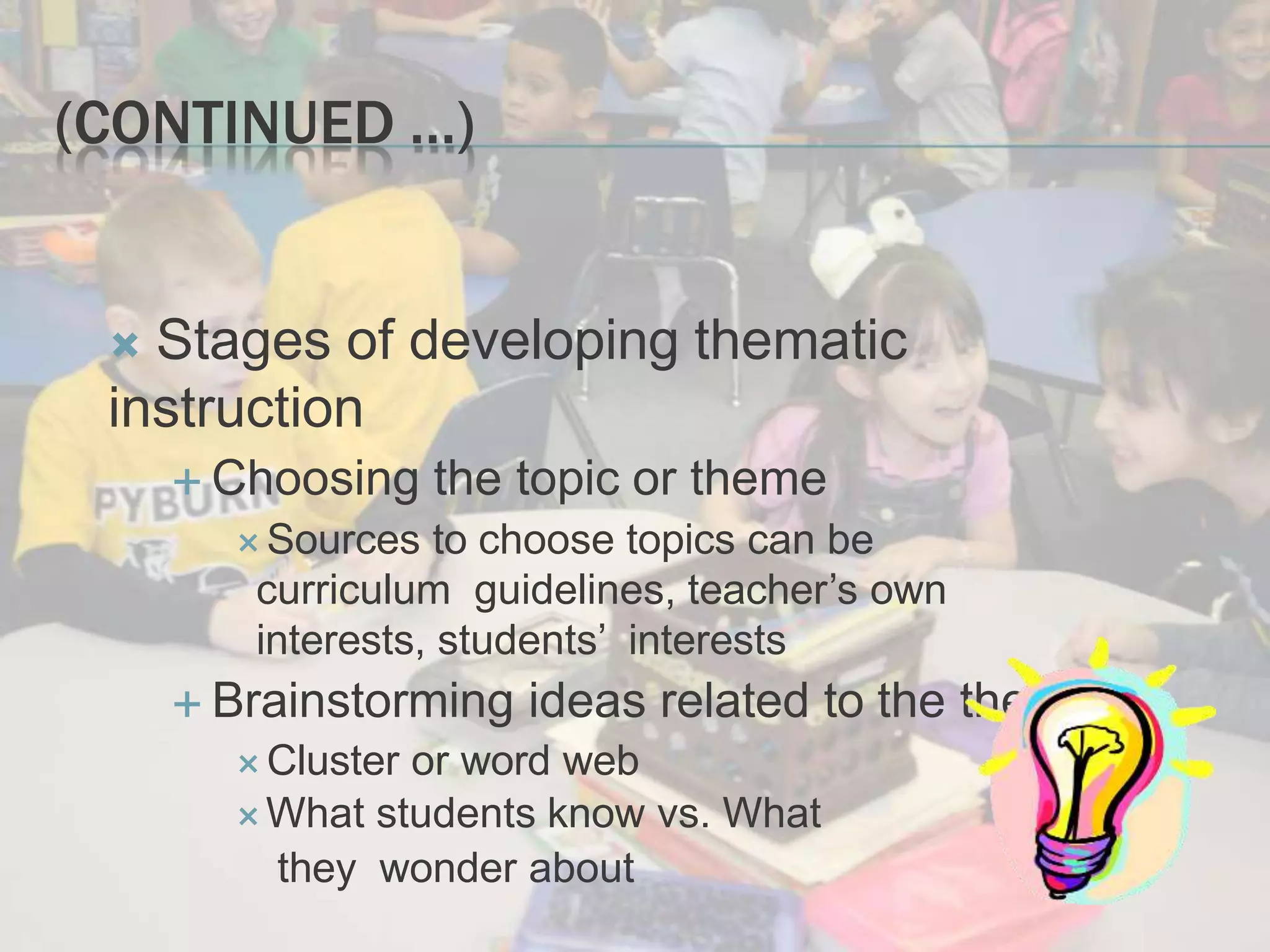
(CONTINUED …)
 Stages of developing thematic
instruction
 Choosing the topic or theme
 Sources to choose topics can be
curriculum guidelines, teacher’s own
interests, students’ interests
 Brainstorming ideas related to the theme
 Cluster or word web
What students know vs. What
they wonder about
(CONTINUED …)
 Scaffolding
-Support the students whose language
proficiency is limited
 Collaboration
-Students work together on theme-related
projects
 Variety
- Variety permeates learning processes
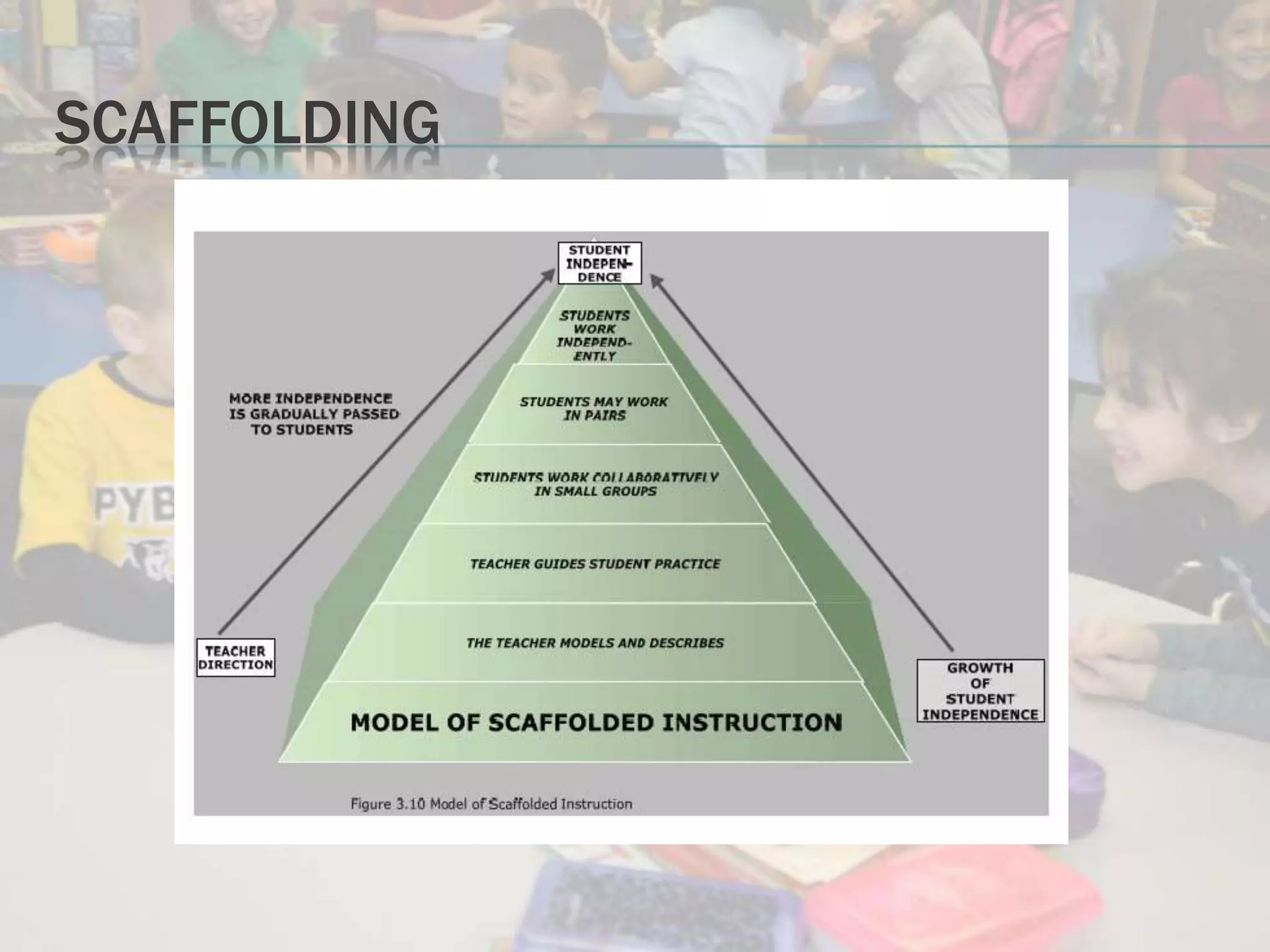
SCAFFOLDING
MULTIDIMENSIONAL ASSESSMENT
 What is assessment
 Formal assessment
 Standardized tests
 Informal assessment
 Teacher made test
 Validity: what you like to assess and whether it
is reflected to assessment tool
 Reliability: whether we get similar results with
the same test
MULTIDIMENSIONAL ASSESSMENT
(CONTINUED …)
 What is performance as assessment?
 Portfolio assessment?
 Identification and placement of
students needing language education
support
 Home language survey
 Oral/written English proficiency test
MULTIDIMENSIONAL ASSESSMENT
(CONTINUED …)
 Limitations of standardized
languageproficiency tests
 Score based on a single
performance The effect of non-
linguistic variables  Affective factors
 Different tests produce different
results
MULTIDIMENSIONAL ASSESSMENT
(CONTINUED …)
 Authentic assessment or classroom
based assessment
 Guidelines
 Planning systematic classroom-based
assessment
 Portfolios and working folders

Classroom Practices for English Learners (ELs) Instruction

  • 1.
  • 2.
    STANDARDS-BASED INSTRUCTION  Standardsconsist of:  Content standards: what students should know/ learn  Benchmarks: what skills/knowledge are expected to be gained  Performance standards: progress indicators that show whether the requirements have been met
  • 3.
    KEY POINTS OFSTANDARDS-BASED INSTRUCTION A purposeful and meaningful context that establishes not only what but also why students must learn the content (framed with standards)  Creates high expectations for all students and motivation for the teacher  The standards for the grade-level are aligned with the English language standards
  • 4.
    STANDARDS-BASED INSTRUCTION TIPSFOR NOVICE TEACHERS  Familiarize yourselves with standards of level and subject & align them with your TESOL standards Let’s see what standards-based classrooms look like http://www.ciclt.net/ul/garesa/Pic%20webpage. htm (We will be able to look at one of them in the class. You can check the others later.)
  • 5.
    NATIONAL STANDARDS TESOL STANDARDS TESOLstandards do not replace state curriculum standards. Rather they are to be used alongside your other standards - Based on content standards - Focus on all 4 skills: listening, speaking, writing and reading - Tested via sample performance indicators
  • 6.
    A SAMPLE OFTESOL STANDARD AND PERFORMANCE EXPECTATIONS Language Domains Content topic Language proficiency content
  • 7.
    KEY POINTS OFTHE TESOL STANDARDS  The higher level the higher & more complex linguistic expectations from students  Facilitate English acquisition for various purposes  Conceptualize grade-appropriate curriculum & assessment
  • 8.
    FOUR COMPONENTS OFSTANDARDS-BASED INSTRUCTION  Inquiry and problem solving  Collaborative learning  Continual assessment embedded in instruction  Higher-order questioning
  • 9.
    DIFFERENTIATED INSTRUCTION (DI) Oneof the cornerstones inherent in the TESOL standards  Teachers acknowledge, respect, accommodate and build upon student differences to facilitate optimal growth for all  Students’ strength and preferences for processing information are considered
  • 10.
    DI CONT.  Ongoingassessment to prepare the students for learning  Mutual respect and caring is promoted  Differentiated instruction calls for variety and flexibility in classroom, learning materials and grouping  Emphasis on individual differences
  • 11.
    DIFFERENTIATED ASSESSMENT STEPS Before instruction: check prior knowledge  During instruction: check student understanding, student needs  After instruction: assess student understanding and explain next steps for teaching  Specially Designed Academic Instruction in English (SDAIE) is a type of differentiated instruction
  • 12.
    CONTENT BASED INSTRUCTION(CBI) Using the target language as a medium of instruction to teach language and content simultaneously. The idea behind CBI is to relate the language learning experience to a meaningful subject.  Examples of CBI: French immersion programs in Canada, university level language classes
  • 13.
    ESSENTIALS OF CBI Promotes SLA and oral – written academic skills  Modified teacher language Instructional language is used as “comprehensible input” by pairing visuals to convey the meaning  Explicit instruction for an excellence in skills acquisition  Content-oriented tasks are encouraged in student group activities
  • 14.
    CBI & TESOLSTANDARDS  CBI supports ELs achievement of TESOL standards by - integrating language & content learning - addressing language domains of listening, reading, speaking and writing - Providing support for various English language proficiency levels
  • 15.
  • 16.
    SHELTERED INSTRUCTION ORSPECIALLY DESIGNED ACADEMIC INSTRUCTION IN ENGLISH (SDAIE) Goal of SDAIE is to help the ELs succeed in school Content with target language + special modifications based on student needs
  • 17.
    SDAIE GOALS AND OBJECTIVES Goals and objectives  Grade appropriate content learning  Content objectives: grade appropriate, not watered dow n  English language & literacy development  Set language objectives  Positive social/affective adjustment promote the self-esteem and social development
  • 18.
    HOW TO PREPAREDIFFERENTIATED & SHELTERED LESSON PLANS?  Things to be considered: How can I combine these two in my lesson plan? Considering the prior knowledge: sheltering Considering the individual differences and strengths and modifying the teaching: differentiating Student& Diversity Curriculu m content
  • 19.
    SHELTERED AND DIFFERENTIATEDLESSON PLAN CONT. Two objectives to be considered  Content objectives: curriculum, cognitively and grade-level appropriate materials  Language objectives: ELPS standards based on the student proficiency level (state). E.g. for lower level Ss comprehension-based tasks but for higher level Ss production- based tasks
  • 20.
    GROUP WORK  Groupingis important for SDAIE because  Provides receptive and productive language learning opportunities  Learners can fine tune the input  Learners can help each other  Language used will be content embedded and meaningful  Social and academic language development
  • 21.
  • 22.
    THEMATIC INSTRUCTION  Themes/topicsused to organize curriculum content  Advantages:  Suitable for any content or grade level  Creates meaningful conceptual framework  Increases students’ motivation and involvement  Promotes social and academic language development
  • 23.
    ORGANIZING THEMATIC INSTRUCTION Sixcriteria for organizing thematic instruction to promote language development, critical thinking, interdependence for ELs 1. Meaning and Purpose 2. Building Prior Knowledge 3. Integrated Opportunities to Use Oral and Written Language for Learning Purposes 4. Scaffolding for Support 5. Collaboration 6. Variety
  • 24.
    (CONTINUED …)  Stagesof developing thematic instruction  Choosing the topic or theme  Sources to choose topics can be curriculum guidelines, teacher’s own interests, students’ interests  Brainstorming ideas related to the theme  Cluster or word web What students know vs. What they wonder about
  • 25.
    (CONTINUED …)  Scaffolding -Supportthe students whose language proficiency is limited  Collaboration -Students work together on theme-related projects  Variety - Variety permeates learning processes
  • 26.
  • 27.
    MULTIDIMENSIONAL ASSESSMENT  Whatis assessment  Formal assessment  Standardized tests  Informal assessment  Teacher made test  Validity: what you like to assess and whether it is reflected to assessment tool  Reliability: whether we get similar results with the same test
  • 28.
    MULTIDIMENSIONAL ASSESSMENT (CONTINUED …) What is performance as assessment?  Portfolio assessment?  Identification and placement of students needing language education support  Home language survey  Oral/written English proficiency test
  • 29.
    MULTIDIMENSIONAL ASSESSMENT (CONTINUED …) Limitations of standardized languageproficiency tests  Score based on a single performance The effect of non- linguistic variables  Affective factors  Different tests produce different results
  • 30.
    MULTIDIMENSIONAL ASSESSMENT (CONTINUED …) Authentic assessment or classroom based assessment  Guidelines  Planning systematic classroom-based assessment  Portfolios and working folders