Presented by: Mbarek Elfarhaoui
Outline
I. Introduction
II. Definition of CL
III. Origins
VI. Areas of Application
V. Approaches in CL
IV. Conclusion
I. Introduction
 The Association for Computational linguistics defines CL as the
scientific study of language from a computational perspective.
Computational linguists are interested in providing computational
models of various kinds of linguistic phenomena.
 Work in computational linguistics is in some cases motivated
from a scientific perspective in that one is trying to provide a
computational explanation for a particular linguistic or
psycholinguistic phenomenon.
II. Definition of CL
 Computational linguistics is the application of linguistic
theories and computational techniques to problems of
natural language processing.
 Grishman (1986) defines Computational linguistics as
the study of computer systems for understanding and
generating natural language.
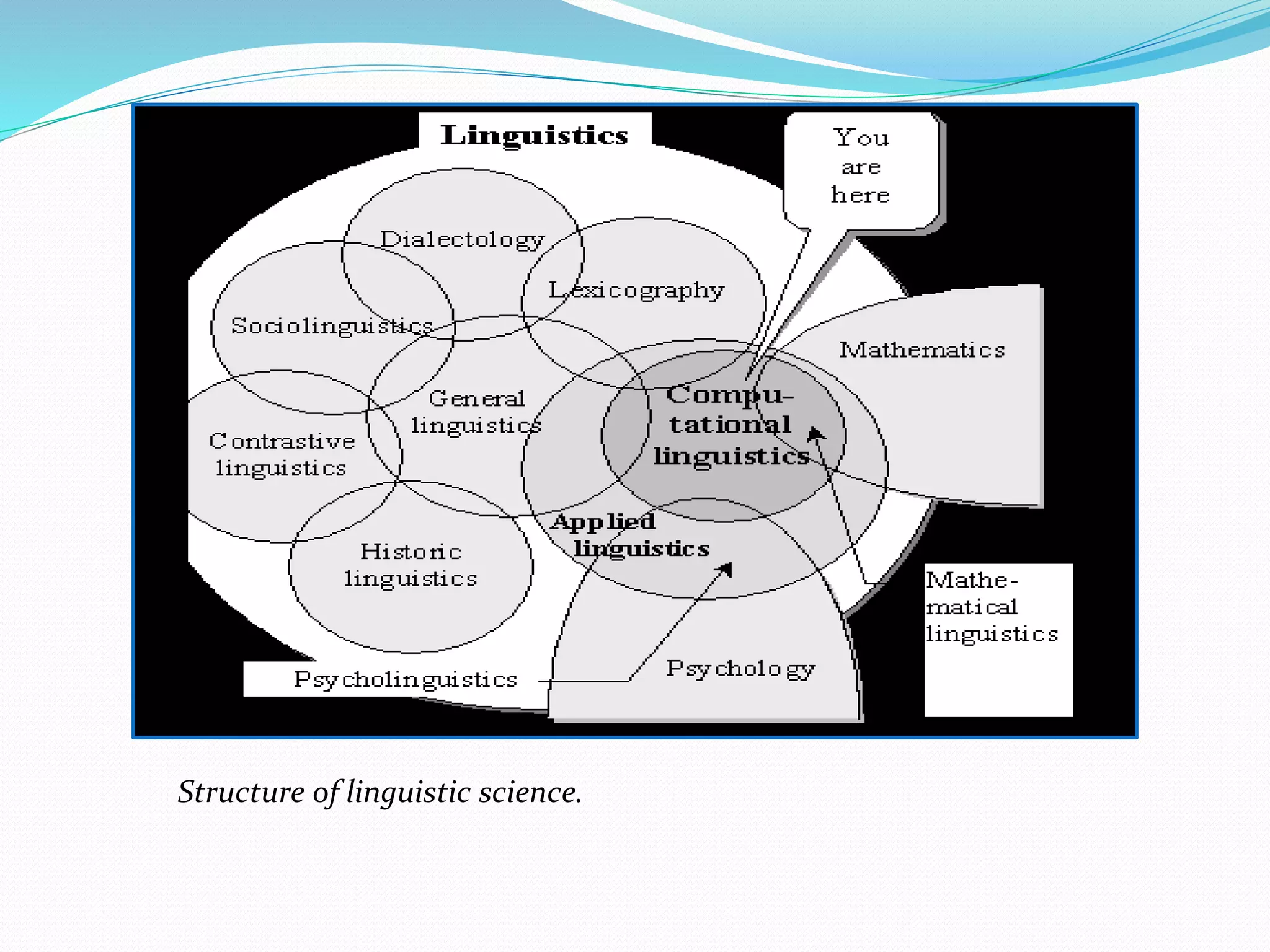
Structure of linguistic science.
 The purpose of CL is to develop applications that deal with computer
tasks realted to human language, like development of software for
grammar correction, word sense disembiguation, compilation of
dictionaries and corpora, automatic translation from one language to
another, etc.
III.origins
 Computational linguistics originated in the United States
in the 1950s to use computers to automatically translate
texts from foreign languages, particularly Russian scientific
journals into English.
 CL was born as the name of the new field of study
devoted to developing algorithms and software for
intelligently processing language data.
 Computers were first used for automatic/ mechanical
translation.Then, their use was extended to deal with
linguistics.
 In order to translate a text, it was observed that one had
to understand the grammar of both languages, including
morphology, syntax, semantic, pragmatics, ..etc.
 One of the earliest and best known examples of a
computer program is the s-called the ELIZA program
developed by Joseph Weizenbaumat in 1966.
VI. Approaches in CL
 Rule-Based Systems
 Explicit encoding of linguistic knowledge
Usually consisting of a set of hand-crafted, grammatical rules
Require considerable human effort
Often fail to reach sufficient domain coverage
 Data-Driven Systems
 Implicit encoding of linguistic knowledge
Often using statistical methods or machine learning methods
 Require less human effort
 Are data-driven and require large-scale data source
V. Application Areas
 machine translation
 speech recognition
 man-machine interfaces
 intelligent word processing: spelling correction,
 grammar correction
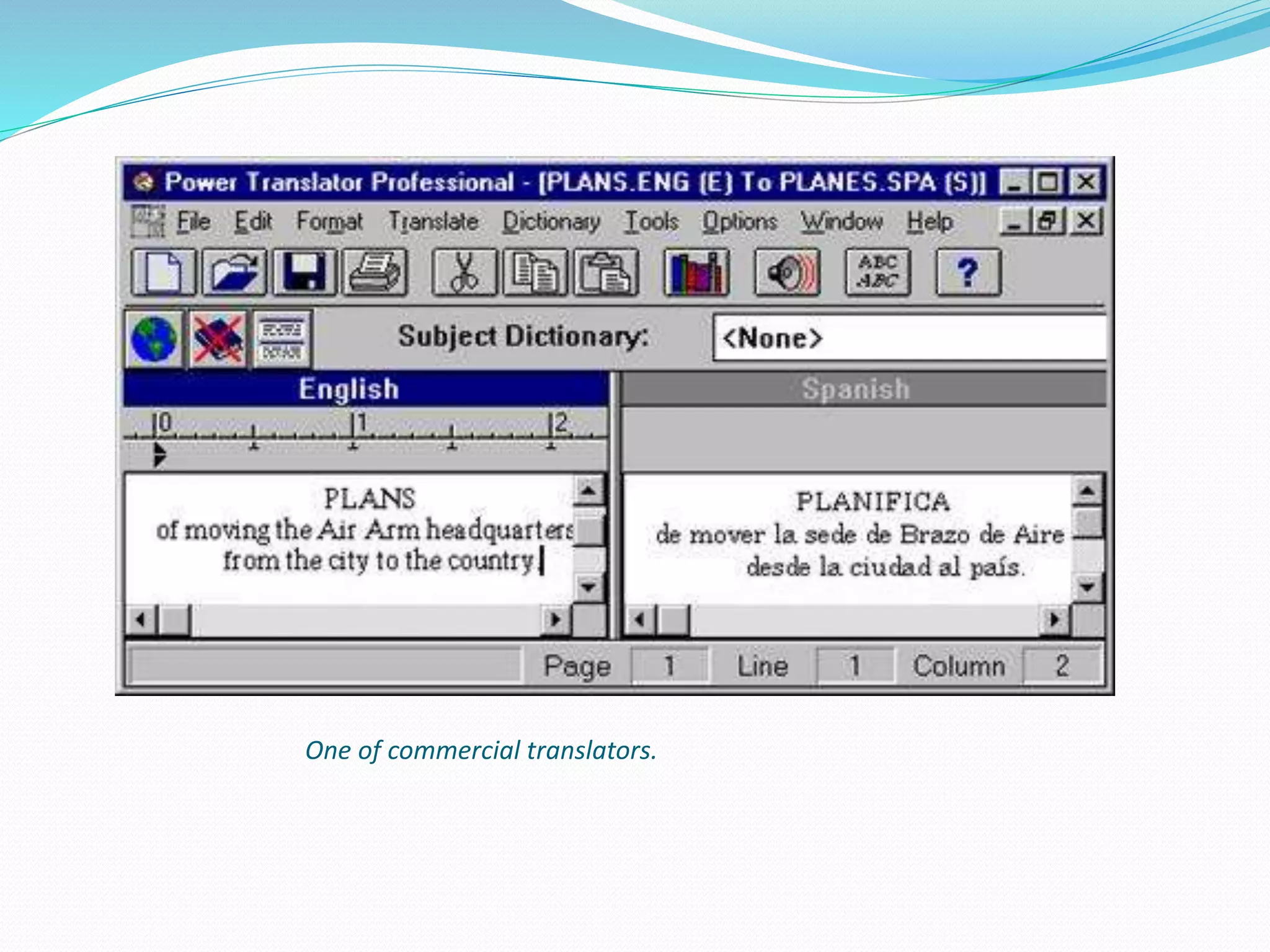
One of commercial translators.
 document management
 find relevant documents in collections
 catch plagiarism
 extract information from documents
 classify documents
 summarize documents
 summarize document collections
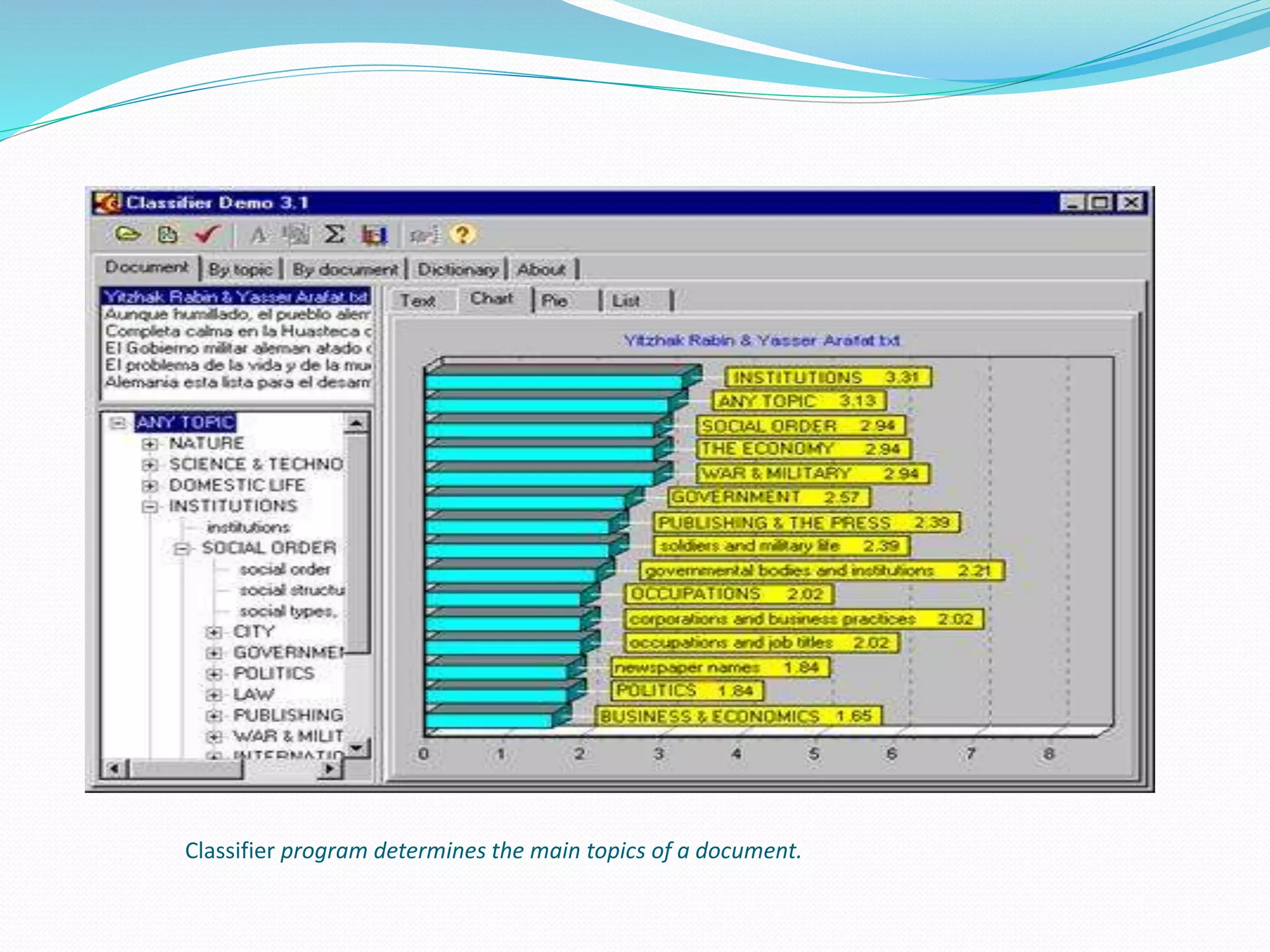
Classifier program determines the main topics of a document.
Conclusion
Nowdays research within the scope of CL is done
at computational linguistics departments, CL
laboratories, computer science departments, and
linguistics departments.
 Bolshakov,Igor A., Gelbuck,Alexder.(2004).Computational Linguistics:
Models, Resources, Applications.
 Aronoff, Mark and Miller,Janie Rees-. (2001). The Handbook of
Linguistics. Blackwell Publishers.
 Brown, Keith. (1991). Encyclopedia of Language and Linguistics.
Second Edition. Volume I.
References

Computational linguistics

  • 1.
  • 2.
    Outline I. Introduction II. Definitionof CL III. Origins VI. Areas of Application V. Approaches in CL IV. Conclusion
  • 3.
  • 4.
     The Associationfor Computational linguistics defines CL as the scientific study of language from a computational perspective. Computational linguists are interested in providing computational models of various kinds of linguistic phenomena.  Work in computational linguistics is in some cases motivated from a scientific perspective in that one is trying to provide a computational explanation for a particular linguistic or psycholinguistic phenomenon. II. Definition of CL
  • 5.
     Computational linguisticsis the application of linguistic theories and computational techniques to problems of natural language processing.  Grishman (1986) defines Computational linguistics as the study of computer systems for understanding and generating natural language.
  • 6.
  • 7.
     The purposeof CL is to develop applications that deal with computer tasks realted to human language, like development of software for grammar correction, word sense disembiguation, compilation of dictionaries and corpora, automatic translation from one language to another, etc.
  • 8.
    III.origins  Computational linguisticsoriginated in the United States in the 1950s to use computers to automatically translate texts from foreign languages, particularly Russian scientific journals into English.  CL was born as the name of the new field of study devoted to developing algorithms and software for intelligently processing language data.
  • 9.
     Computers werefirst used for automatic/ mechanical translation.Then, their use was extended to deal with linguistics.  In order to translate a text, it was observed that one had to understand the grammar of both languages, including morphology, syntax, semantic, pragmatics, ..etc.  One of the earliest and best known examples of a computer program is the s-called the ELIZA program developed by Joseph Weizenbaumat in 1966.
  • 10.
    VI. Approaches inCL  Rule-Based Systems  Explicit encoding of linguistic knowledge Usually consisting of a set of hand-crafted, grammatical rules Require considerable human effort Often fail to reach sufficient domain coverage
  • 11.
     Data-Driven Systems Implicit encoding of linguistic knowledge Often using statistical methods or machine learning methods  Require less human effort  Are data-driven and require large-scale data source
  • 12.
    V. Application Areas machine translation  speech recognition  man-machine interfaces  intelligent word processing: spelling correction,  grammar correction
  • 13.
    One of commercialtranslators.
  • 14.
     document management find relevant documents in collections  catch plagiarism  extract information from documents  classify documents  summarize documents  summarize document collections
  • 15.
    Classifier program determinesthe main topics of a document.
  • 16.
    Conclusion Nowdays research withinthe scope of CL is done at computational linguistics departments, CL laboratories, computer science departments, and linguistics departments.
  • 17.
     Bolshakov,Igor A.,Gelbuck,Alexder.(2004).Computational Linguistics: Models, Resources, Applications.  Aronoff, Mark and Miller,Janie Rees-. (2001). The Handbook of Linguistics. Blackwell Publishers.  Brown, Keith. (1991). Encyclopedia of Language and Linguistics. Second Edition. Volume I. References