SOP
Standard
Operating
Procedure
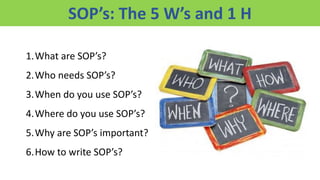
1.What are SOP’s?
2.Who needs SOP’s?
3.When do you use SOP’s?
4.Where do you use SOP’s?
5.Why are SOP’s important?
6.How to write SOP’s?
SOP’s: The 5 W’s and 1 H
1. What is SOP?
Standard Operating Procedure (SOP) is a set of written instructions
that document a routine activity within your company/division/work
group.
A documents which describes the operations of a certain work or job
in order to ensure it’s quality.
A set of compulsory instructions, systems, procedures or steps which
is written so that other individuals can follow to complete the job
safely.
2. Who needs SOP’s?
The person who will perform a particular job such as:
managers
Engineers
Planners
safety officers
company representatives
anybody performing the work.
3. When do you use SOP’s?
Every Day
In preparation for an audit/review
During an audit/review
Orienting new staff
Annual training
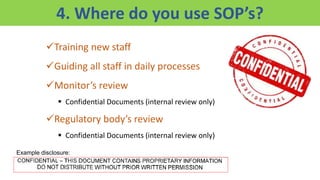
4. Where do you use SOP’s?
Training new staff
Guiding all staff in daily processes
Monitor’s review
 Confidential Documents (internal review only)
Regulatory body’s review
 Confidential Documents (internal review only)
Example disclosure:
5. Why are SOP’s important?
 Describe how to perform routine activities
 Provide a training aid
 Guide & standardise working procedures
 Ensure quality & integrity of data generated/information captured
 Reconstruction/repeatability
 Provide an auditing tool
 Consistency
 Written documentation of proper procedures
 Toolbox for staff
 Documentation of staff training
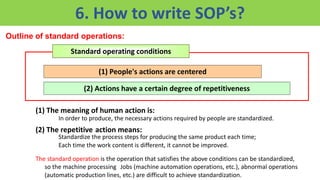
Outline of standard operations:
Standard operating conditions
(1) People's actions are centered
(2) Actions have a certain degree of repetitiveness
The standard operation is the operation that satisfies the above conditions can be standardized,
so the machine processing Jobs (machine automation operations, etc.), abnormal operations
(automatic production lines, etc.) are difficult to achieve standardization.
Each time the work content is different, it cannot be improved.
Standardize the process steps for producing the same product each time;
(2) The repetitive action means:
In order to produce, the necessary actions required by people are standardized.
(1) The meaning of human action is:
6. How to write SOP’s?
SOP
write,
execute
and
update
process
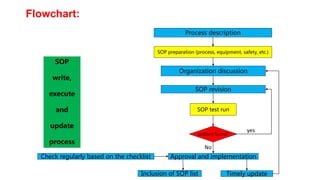
Process description
SOP preparation (process, equipment, safety, etc.)
Organization discussion
SOP revision
SOP test run
problem found?
Approval and implementation
Check regularly based on the checklist
Inclusion of SOP list Timely update
Flowchart:
yes
No
1.Process Description:
Based on the production departmentm, describe the work processes.
(from the beginning of work, what to do first, then what to do and what to
do)
First write the corresponding main process, and then make the
corresponding sub-processes are detailed job steps.
 Full participation and collaboration
 Meet the requirements of technical documents and standards
 Meet the operational and equipment adaptability
 keep improve
 Prepare personnel for computer operations, have field experience, and have a certain writing basis employee
 Give support: special time, provide relevant information etc.
2. SOP preparation
Write the corresponding key factors in the job according to the description of the job
steps in each sub-process (process, safety, quality, equipment, environmental
protection, etc.)
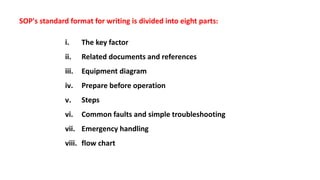
SOP's standard format for writing is divided into eight parts:
i. The key factor
ii. Related documents and references
iii. Equipment diagram
iv. Prepare before operation
v. Steps
vi. Common faults and simple troubleshooting
vii. Emergency handling
viii. flow chart
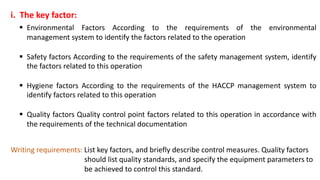
i. The key factor:
 Environmental Factors According to the requirements of the environmental
management system to identify the factors related to the operation
 Safety factors According to the requirements of the safety management system, identify
the factors related to this operation
 Hygiene factors According to the requirements of the HACCP management system to
identify factors related to this operation
 Quality factors Quality control point factors related to this operation in accordance with
the requirements of the technical documentation
Writing requirements: List key factors, and briefly describe control measures. Quality factors
should list quality standards, and specify the equipment parameters to
be achieved to control this standard.
Describe the documents and information that should be known and familiar before
reading and operating this SOP.
ii. Related documents and references:
Show the main equipment involved in the SOP in the form of pictures or photos
Develop and specify the number of equipment components such as valves, pumps and
buttons
iii. Equipment diagram:
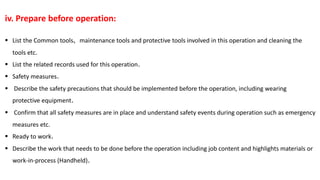
iv. Prepare before operation:
 List the Common tools, maintenance tools and protective tools involved in this operation and cleaning the
tools etc.
 List the related records used for this operation.
 Safety measures.
 Describe the safety precautions that should be implemented before the operation, including wearing
protective equipment.
 Confirm that all safety measures are in place and understand safety events during operation such as emergency
measures etc.
 Ready to work.
 Describe the work that needs to be done before the operation including job content and highlights materials or
work-in-process (Handheld).
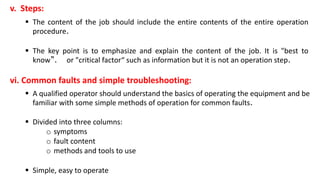
 The content of the job should include the entire contents of the entire operation
procedure.
 The key point is to emphasize and explain the content of the job. It is "best to
know”. or "critical factor“ such as information but it is not an operation step.
v. Steps:
vi. Common faults and simple troubleshooting:
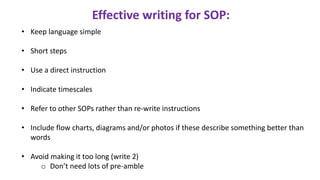
 A qualified operator should understand the basics of operating the equipment and be
familiar with some simple methods of operation for common faults.
 Divided into three columns:
o symptoms
o fault content
o methods and tools to use
 Simple, easy to operate
vii. Emergency handling:
 Any operator must understand the action plan to be taken to avoid unnecessary losses
 Divided into two columns: emergency actions and special tips
 Simple, easy to operate
viii. Flowchart:
Use correct flowchart symbols
 The beginning and ending of the operation
 A specific step or event
 Specify the direction of the process
 Need to judge or make decisions
Effective writing for SOP:
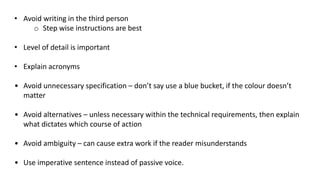
• Keep language simple
• Short steps
• Use a direct instruction
• Indicate timescales
• Refer to other SOPs rather than re-write instructions
• Include flow charts, diagrams and/or photos if these describe something better than
words
• Avoid making it too long (write 2)
o Don’t need lots of pre-amble
• Avoid writing in the third person
o Step wise instructions are best
• Level of detail is important
• Explain acronyms
• Avoid unnecessary specification – don’t say use a blue bucket, if the colour doesn’t
matter
• Avoid alternatives – unless necessary within the technical requirements, then explain
what dictates which course of action
• Avoid ambiguity – can cause extra work if the reader misunderstands
• Use imperative sentence instead of passive voice.
What to include in SOP?
• A title – short and to the point
• Edition number – gives document control
• Issue date – when did it come into use
• Author – who to speak to if you have questions
• An introduction – set the scene
• Scope or exclusions
• Safety considerations
• Materials & Equipment
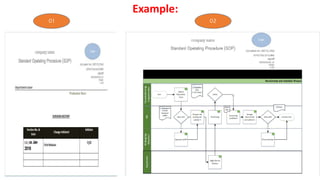
Example:
01 02
03 04
06
05
References:
i. http://www.mc.vanderbilt.edu/crc/workshop_files/2014-02-07.ppt
ii. http://ec.europa.eu/enlargement/taiex/dyn/create_speech.jsp?speechID=32811&key=203d1be05fa84ee3a3
0888eaf30881fe
iii. https://www.slideshare.net/afifmuneer/standard-operating-procedure-11759663
iv. http://www.who.int/hiv/pub/drugresistance/HIVDR_Mod_10_SOPs.ppt
v. https://www.slideshare.net/ShaimaaAhmadeen/sop-14411046
vi. www.leanpop.com.cn

standardoperatingproceduresop-180310100856.pdf

  • 1.
  • 2.
    1.What are SOP’s? 2.Whoneeds SOP’s? 3.When do you use SOP’s? 4.Where do you use SOP’s? 5.Why are SOP’s important? 6.How to write SOP’s? SOP’s: The 5 W’s and 1 H
  • 3.
    1. What isSOP? Standard Operating Procedure (SOP) is a set of written instructions that document a routine activity within your company/division/work group. A documents which describes the operations of a certain work or job in order to ensure it’s quality. A set of compulsory instructions, systems, procedures or steps which is written so that other individuals can follow to complete the job safely.
  • 4.
    2. Who needsSOP’s? The person who will perform a particular job such as: managers Engineers Planners safety officers company representatives anybody performing the work.
  • 5.
    3. When doyou use SOP’s? Every Day In preparation for an audit/review During an audit/review Orienting new staff Annual training
  • 6.
    4. Where doyou use SOP’s? Training new staff Guiding all staff in daily processes Monitor’s review  Confidential Documents (internal review only) Regulatory body’s review  Confidential Documents (internal review only) Example disclosure:
  • 7.
    5. Why areSOP’s important?  Describe how to perform routine activities  Provide a training aid  Guide & standardise working procedures  Ensure quality & integrity of data generated/information captured  Reconstruction/repeatability  Provide an auditing tool  Consistency  Written documentation of proper procedures  Toolbox for staff  Documentation of staff training
  • 8.
    Outline of standardoperations: Standard operating conditions (1) People's actions are centered (2) Actions have a certain degree of repetitiveness The standard operation is the operation that satisfies the above conditions can be standardized, so the machine processing Jobs (machine automation operations, etc.), abnormal operations (automatic production lines, etc.) are difficult to achieve standardization. Each time the work content is different, it cannot be improved. Standardize the process steps for producing the same product each time; (2) The repetitive action means: In order to produce, the necessary actions required by people are standardized. (1) The meaning of human action is: 6. How to write SOP’s?
  • 9.
    SOP write, execute and update process Process description SOP preparation(process, equipment, safety, etc.) Organization discussion SOP revision SOP test run problem found? Approval and implementation Check regularly based on the checklist Inclusion of SOP list Timely update Flowchart: yes No
  • 10.
    1.Process Description: Based onthe production departmentm, describe the work processes. (from the beginning of work, what to do first, then what to do and what to do) First write the corresponding main process, and then make the corresponding sub-processes are detailed job steps.
  • 11.
     Full participationand collaboration  Meet the requirements of technical documents and standards  Meet the operational and equipment adaptability  keep improve  Prepare personnel for computer operations, have field experience, and have a certain writing basis employee  Give support: special time, provide relevant information etc. 2. SOP preparation Write the corresponding key factors in the job according to the description of the job steps in each sub-process (process, safety, quality, equipment, environmental protection, etc.)
  • 12.
    SOP's standard formatfor writing is divided into eight parts: i. The key factor ii. Related documents and references iii. Equipment diagram iv. Prepare before operation v. Steps vi. Common faults and simple troubleshooting vii. Emergency handling viii. flow chart
  • 13.
    i. The keyfactor:  Environmental Factors According to the requirements of the environmental management system to identify the factors related to the operation  Safety factors According to the requirements of the safety management system, identify the factors related to this operation  Hygiene factors According to the requirements of the HACCP management system to identify factors related to this operation  Quality factors Quality control point factors related to this operation in accordance with the requirements of the technical documentation Writing requirements: List key factors, and briefly describe control measures. Quality factors should list quality standards, and specify the equipment parameters to be achieved to control this standard.
  • 14.
    Describe the documentsand information that should be known and familiar before reading and operating this SOP. ii. Related documents and references: Show the main equipment involved in the SOP in the form of pictures or photos Develop and specify the number of equipment components such as valves, pumps and buttons iii. Equipment diagram:
  • 15.
    iv. Prepare beforeoperation:  List the Common tools, maintenance tools and protective tools involved in this operation and cleaning the tools etc.  List the related records used for this operation.  Safety measures.  Describe the safety precautions that should be implemented before the operation, including wearing protective equipment.  Confirm that all safety measures are in place and understand safety events during operation such as emergency measures etc.  Ready to work.  Describe the work that needs to be done before the operation including job content and highlights materials or work-in-process (Handheld).
  • 16.
     The contentof the job should include the entire contents of the entire operation procedure.  The key point is to emphasize and explain the content of the job. It is "best to know”. or "critical factor“ such as information but it is not an operation step. v. Steps: vi. Common faults and simple troubleshooting:  A qualified operator should understand the basics of operating the equipment and be familiar with some simple methods of operation for common faults.  Divided into three columns: o symptoms o fault content o methods and tools to use  Simple, easy to operate
  • 17.
    vii. Emergency handling: Any operator must understand the action plan to be taken to avoid unnecessary losses  Divided into two columns: emergency actions and special tips  Simple, easy to operate viii. Flowchart: Use correct flowchart symbols  The beginning and ending of the operation  A specific step or event  Specify the direction of the process  Need to judge or make decisions
  • 18.
    Effective writing forSOP: • Keep language simple • Short steps • Use a direct instruction • Indicate timescales • Refer to other SOPs rather than re-write instructions • Include flow charts, diagrams and/or photos if these describe something better than words • Avoid making it too long (write 2) o Don’t need lots of pre-amble
  • 19.
    • Avoid writingin the third person o Step wise instructions are best • Level of detail is important • Explain acronyms • Avoid unnecessary specification – don’t say use a blue bucket, if the colour doesn’t matter • Avoid alternatives – unless necessary within the technical requirements, then explain what dictates which course of action • Avoid ambiguity – can cause extra work if the reader misunderstands • Use imperative sentence instead of passive voice.
  • 20.
    What to includein SOP? • A title – short and to the point • Edition number – gives document control • Issue date – when did it come into use • Author – who to speak to if you have questions • An introduction – set the scene • Scope or exclusions • Safety considerations • Materials & Equipment
  • 21.
  • 22.
  • 23.
  • 24.
    References: i. http://www.mc.vanderbilt.edu/crc/workshop_files/2014-02-07.ppt ii. http://ec.europa.eu/enlargement/taiex/dyn/create_speech.jsp?speechID=32811&key=203d1be05fa84ee3a3 0888eaf30881fe iii.https://www.slideshare.net/afifmuneer/standard-operating-procedure-11759663 iv. http://www.who.int/hiv/pub/drugresistance/HIVDR_Mod_10_SOPs.ppt v. https://www.slideshare.net/ShaimaaAhmadeen/sop-14411046 vi. www.leanpop.com.cn