ENGLISH LANGUAGE
PROFICIENCY
Conjunctions
POSITION
Coordinating conjunctions always come
between the words or clauses that they join.
Subordinating conjunctions usually come at
the beginning of the subordinate clause.
Coordinating
Conjunctions
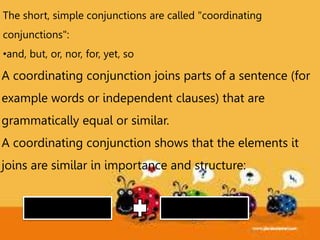
The short, simple conjunctions are called "coordinating
conjunctions":
•and, but, or, nor, for, yet, so
A coordinating conjunction joins parts of a sentence (for
example words or independent clauses) that are
grammatically equal or similar.
A coordinating conjunction shows that the elements it
joins are similar in importance and structure:
the two elements that the coordinating conjunction joins are
shown in square brackets [ ]:
examples
•I like [tea] and [coffee].
•[Ram likes tea], but [Anthony likes coffee].
Coordinating conjunctions always come between the words or
clauses that they join.
When a coordinating conjunction joins independent clauses, it
is always correct to place a comma before the conjunction:
•I want to work as an interpreter in the future, so I am studying
Russian at university.
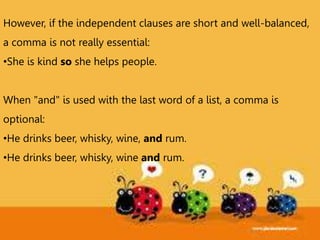
However, if the independent clauses are short and well-balanced,
a comma is not really essential:
•She is kind so she helps people.
When "and" is used with the last word of a list, a comma is
optional:
•He drinks beer, whisky, wine, and rum.
•He drinks beer, whisky, wine and rum.
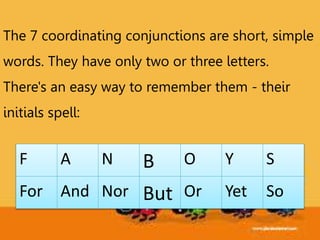
F A N B O Y S
For And Nor But Or Yet So
The 7 coordinating conjunctions are short, simple
words. They have only two or three letters.
There's an easy way to remember them - their
initials spell:
Subordinating
Conjunctions
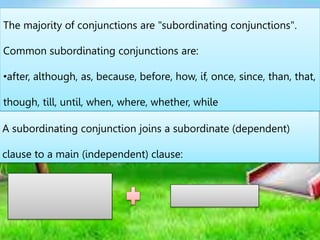
The majority of conjunctions are "subordinating conjunctions".
Common subordinating conjunctions are:
•after, although, as, because, before, how, if, once, since, than, that,
though, till, until, when, where, whether, while
A subordinating conjunction joins a subordinate (dependent)
clause to a main (independent) clause:
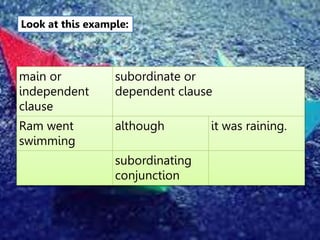
Look at this example:
main or
independent
clause
subordinate or
dependent clause
Ram went
swimming
although it was raining.
subordinating
conjunction
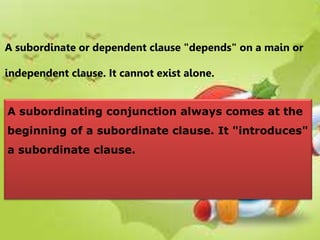
A subordinate or dependent clause "depends" on a main or
independent clause. It cannot exist alone.
A subordinating conjunction always comes at the
beginning of a subordinate clause. It "introduces"
a subordinate clause.
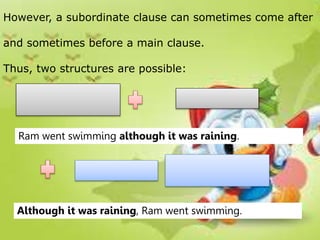
However, a subordinate clause can sometimes come after
and sometimes before a main clause.
Thus, two structures are possible:
Ram went swimming although it was raining.
Although it was raining, Ram went swimming.
IDENTIFYING COORDINATING & SUBORDINATING
CONJUCTIONS
Reading passage
THANK YOU !!!

English language proficiency

  • 1.
  • 2.
  • 3.
    Coordinating conjunctions alwayscome between the words or clauses that they join. Subordinating conjunctions usually come at the beginning of the subordinate clause.
  • 4.
  • 5.
    The short, simpleconjunctions are called "coordinating conjunctions": •and, but, or, nor, for, yet, so A coordinating conjunction joins parts of a sentence (for example words or independent clauses) that are grammatically equal or similar. A coordinating conjunction shows that the elements it joins are similar in importance and structure:
  • 6.
    the two elementsthat the coordinating conjunction joins are shown in square brackets [ ]: examples •I like [tea] and [coffee]. •[Ram likes tea], but [Anthony likes coffee]. Coordinating conjunctions always come between the words or clauses that they join. When a coordinating conjunction joins independent clauses, it is always correct to place a comma before the conjunction: •I want to work as an interpreter in the future, so I am studying Russian at university.
  • 7.
    However, if theindependent clauses are short and well-balanced, a comma is not really essential: •She is kind so she helps people. When "and" is used with the last word of a list, a comma is optional: •He drinks beer, whisky, wine, and rum. •He drinks beer, whisky, wine and rum.
  • 8.
    F A NB O Y S For And Nor But Or Yet So The 7 coordinating conjunctions are short, simple words. They have only two or three letters. There's an easy way to remember them - their initials spell:
  • 9.
  • 10.
    The majority ofconjunctions are "subordinating conjunctions". Common subordinating conjunctions are: •after, although, as, because, before, how, if, once, since, than, that, though, till, until, when, where, whether, while A subordinating conjunction joins a subordinate (dependent) clause to a main (independent) clause:
  • 11.
    Look at thisexample: main or independent clause subordinate or dependent clause Ram went swimming although it was raining. subordinating conjunction
  • 12.
    A subordinate ordependent clause "depends" on a main or independent clause. It cannot exist alone. A subordinating conjunction always comes at the beginning of a subordinate clause. It "introduces" a subordinate clause.
  • 13.
    However, a subordinateclause can sometimes come after and sometimes before a main clause. Thus, two structures are possible: Ram went swimming although it was raining. Although it was raining, Ram went swimming.
  • 14.
    IDENTIFYING COORDINATING &SUBORDINATING CONJUCTIONS Reading passage
  • 15.