The model of stages of
behaviour change develop by
Prochaska and DiClemente
for alcohol intervention
Dr Gargi Sinha
MBBS(India), Post Grad. Dip. Acupuncture(India)
Grad. Dip Public health(Edith Cowan University ,Australia )
What is the purpose of the stages of change
model ?
precontemplation
contemplation
preparationaction
maintenance
relapse
Useful framework to
understand how people
change their behaviour
To evaluate how ready they
are to change
Stage one : Precontemplation
Not ready to change
Not at all motivated to take advice
May not aware of harmful effect of alcohol
Never thought of changing behaviour of
drinking pattern
Don’t negotiate at this stage ,wait and give them
time to think
Stage two :Contemplation
Ambivalent about alcohol use
Have some awareness about harm cause by alcohol but not fully
ready to change
Intervention focus on providing information ,encouraging them to
find out their own reason to cut down alcohol
Stage three: Preparation
Individual at this stage are prepared to act.
Individual will often express I am ready to cut
down on alcohol.
Goal setting strategies are useful at this stage.
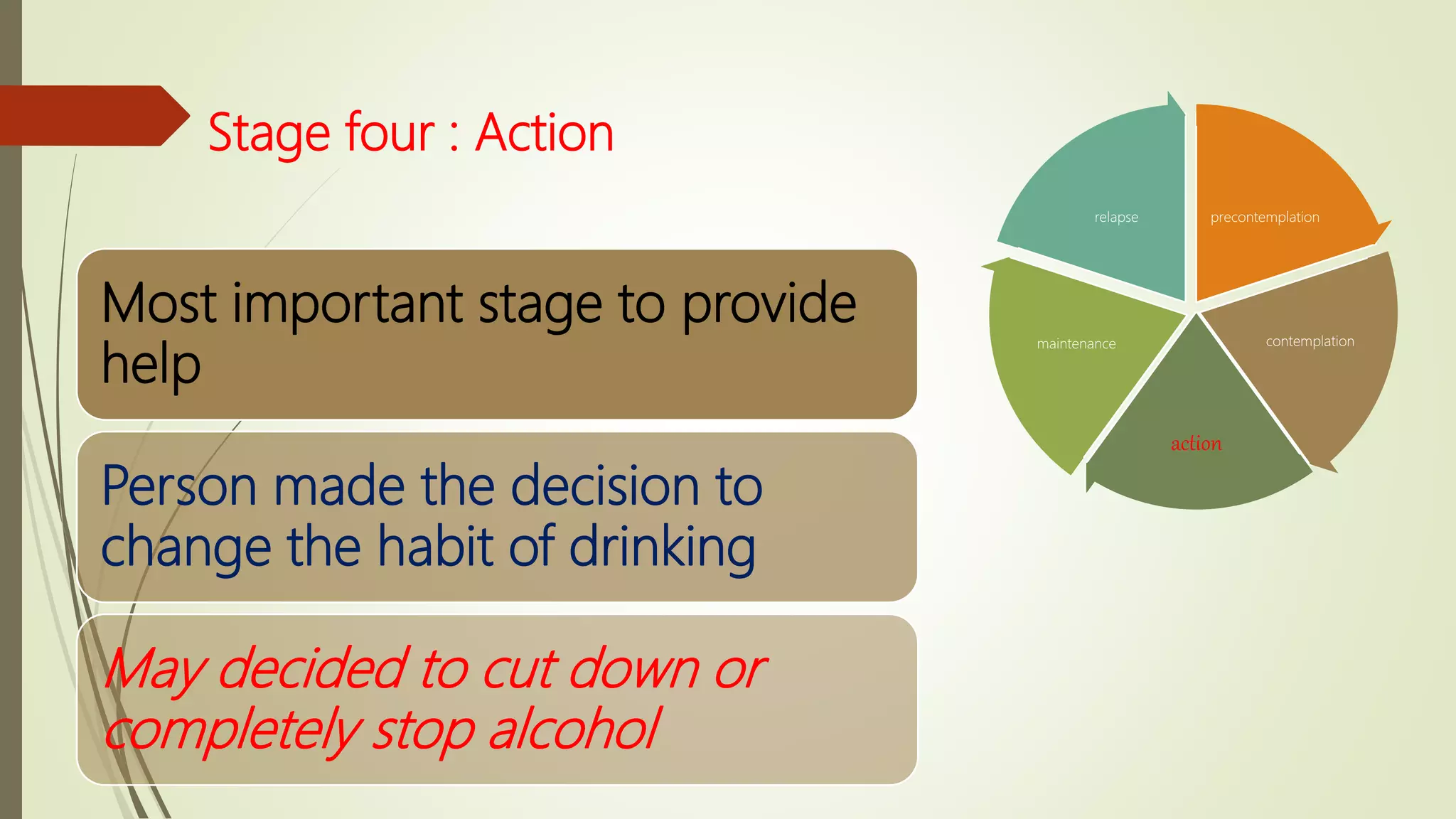
Stage four : Action
precontemplation
contemplation
action
maintenance
relapse
Most important stage to provide
help
Person made the decision to
change the habit of drinking
May decided to cut down or
completely stop alcohol
Stage Five: Maintenance
Individual decide to adopt the new behaviour
In case of alcohol ,one of the critical stage
Remanning at this stage means success of the programme .Thus, encourage
,support and appreciate the person .
Stage Six: Relapse
Will go back to the alcohol use
Help the person ,instead of criticising
Tell person that it is expected and encourage to try again to make a positive
change
Support the person at this stage
Summary
Action
maintenance
relapsePre
contemplation
contemplation
preparation
Keep on supporting a person
till he is confidently able to
give up alcohol
references
Babor, T.F. & Higgins-Biddle, J.C. (2001) Brief Intervention for Hazardous and Harmful
Drinking: A Manual for use in Primary Care. World Health Organisation, Document No.
WHO/MSD/MSB/01.6b
Miller, W. R., & Rollnick, S. (2002). Motivational interviewing : preparing people for change
(2nd ed. ed.). New York :: Guilford Press.

Stages of change slideshare

  • 1.
    The model ofstages of behaviour change develop by Prochaska and DiClemente for alcohol intervention Dr Gargi Sinha MBBS(India), Post Grad. Dip. Acupuncture(India) Grad. Dip Public health(Edith Cowan University ,Australia )
  • 2.
    What is thepurpose of the stages of change model ? precontemplation contemplation preparationaction maintenance relapse Useful framework to understand how people change their behaviour To evaluate how ready they are to change
  • 3.
    Stage one :Precontemplation Not ready to change Not at all motivated to take advice May not aware of harmful effect of alcohol Never thought of changing behaviour of drinking pattern Don’t negotiate at this stage ,wait and give them time to think
  • 4.
    Stage two :Contemplation Ambivalentabout alcohol use Have some awareness about harm cause by alcohol but not fully ready to change Intervention focus on providing information ,encouraging them to find out their own reason to cut down alcohol
  • 5.
    Stage three: Preparation Individualat this stage are prepared to act. Individual will often express I am ready to cut down on alcohol. Goal setting strategies are useful at this stage.
  • 6.
    Stage four :Action precontemplation contemplation action maintenance relapse Most important stage to provide help Person made the decision to change the habit of drinking May decided to cut down or completely stop alcohol
  • 7.
    Stage Five: Maintenance Individualdecide to adopt the new behaviour In case of alcohol ,one of the critical stage Remanning at this stage means success of the programme .Thus, encourage ,support and appreciate the person .
  • 8.
    Stage Six: Relapse Willgo back to the alcohol use Help the person ,instead of criticising Tell person that it is expected and encourage to try again to make a positive change Support the person at this stage
  • 9.
  • 10.
    references Babor, T.F. &Higgins-Biddle, J.C. (2001) Brief Intervention for Hazardous and Harmful Drinking: A Manual for use in Primary Care. World Health Organisation, Document No. WHO/MSD/MSB/01.6b Miller, W. R., & Rollnick, S. (2002). Motivational interviewing : preparing people for change (2nd ed. ed.). New York :: Guilford Press.