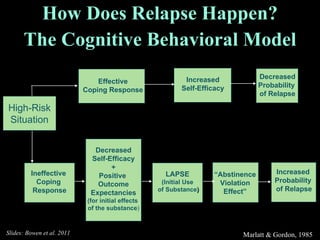


How Does Relapse Happen? The Cognitive Behavioral Model Marlatt & Gordon, 1985 High-Risk Situation Effective Coping Response Increased Self-Efficacy Decreased Probability  of Relapse Ineffective  Coping  Response Decreased Self-Efficacy + Positive  Outcome Expectancies (for initial effects  of the substance ) LAPSE (Initial Use of Substance ) Increased  Probability  of Relapse “ Abstinence Violation Effect” Slides: Bowen et al. 2011
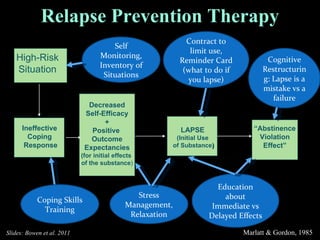
Relapse Prevention Therapy Marlatt & Gordon, 1985 High-Risk Situation Ineffective  Coping  Response Decreased Self-Efficacy + Positive  Outcome Expectancies (for initial effects  of the substance ) LAPSE (Initial Use of Substance ) “ Abstinence Violation Effect” Self Monitoring, Inventory of Situations Coping Skills Training Stress Management, Relaxation Education about Immediate vs Delayed Effects Contract to limit use, Reminder Card (what to do if you lapse) Cognitive Restructuring: Lapse is a mistake vs a failure Slides: Bowen et al. 2011
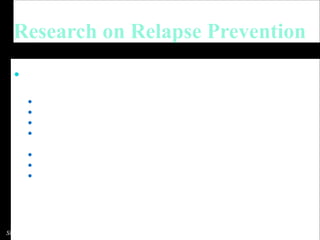
Research on Relapse Prevention Meta-analyses and reviews   (Irvin, et al., 1999; Carroll, 1996)   support RP as an   effective treatment across disorders Alcohol  (Dimeff & Marlatt, 1998; Kadden et al., 1992; Larimer & Marlatt, 1990; Monti et al., 2002)  Cocaine  (Schmitz, et al., 2001)   Marijuana   (Roffman, et al., 1990)   Smoking   (Killen, et al., 1984)   Eating disorders   (Mitchell & Carr, 2000) Gambling   (Echeburua, et al., 2000)   Sexual Offenses   (Laws, 1995)   Slides: Bowen et al. 2011
Review of 24 Randomized Trials  (Carroll, 1996) Does not prevent a lapse better than other treatments, but is more effective at delaying and reducing duration and intensity of lapses Effective at maintaining treatment effects over long term follow-up (1-2 years or more) “ Delayed emergence effects” - greater improvement in coping over time May be most effective for more severe substance abuse, greater levels of negative affect, and greater deficits in coping skills  Slides: Bowen et al. 2011
Enhancing Relapse Prevention with Mindfulness Slides: Bowen et al. 2011
What is Mindfulness? “ Awareness that emerges through paying attention on purpose, in the present moment, and non-judgmentally to the unfolding of experience moment by moment”  (Kabat-Zinn, 2003)  Slides: Bowen et al. 2011
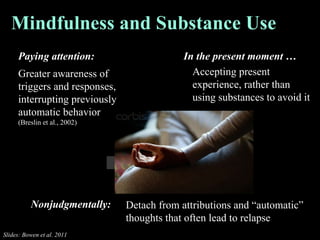
Paying attention: In the present moment … Nonjudgmentally: Mindfulness and Substance Use Greater awareness of triggers and  responses, interrupting previously automatic behavior  ( Breslin et al. , 2002) Accepting present experience, rather than using substances to avoid it Detach from attributions and “automatic” thoughts that often lead to relapse Slides: Bowen et al. 2011
Mindfulness-Based Relapse Prevention  (MBRP) NIDA  Grant # R21 DA010562; PI Marlatt Slides: Bowen et al. 2011
MBRP Structure Integrates mindfulness with Relapse Prevention Patterned after Mindfulness-Based Stress Reduction  (Kabat-Zinn)  and Mindfulness-Based Cognitive Therapy for depression  (Segal et al.) Outpatient Aftercare Treatment 8 weekly 2 hour sessions; daily home practice Therapists have ongoing meditation practice Components of MBRP Formal mindfulness practice Informal practice Coping strategies (Bowen, Chawla & Marlatt, 2010; Witkiewitz et al., 2005) Slides: Bowen et al. 2011
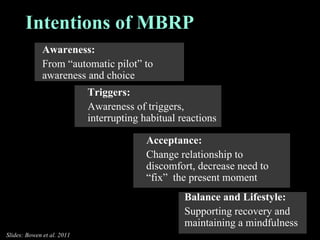
Awareness: From “automatic pilot” to awareness and choice  Triggers: Awareness of triggers, interrupting habitual reactions Acceptance: Change relationship to discomfort, decrease need to “fix”  the present moment Intentions of MBRP Balance and Lifestyle: Supporting recovery and maintaining a mindfulness Slides: Bowen et al. 2011
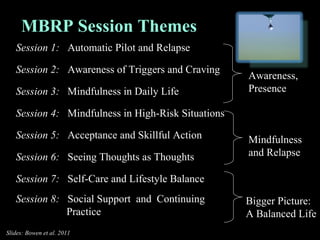
Session 1:   Automatic Pilot and Relapse Session 2:   Awareness of Triggers and Craving Session 3:   Mindfulness in Daily Life Session 4:   Mindfulness in High-Risk Situations Session 5:   Acceptance and Skillful Action Session 6:   Seeing Thoughts as Thoughts Session 7:   Self-Care and Lifestyle Balance Session 8:   Social Support  and  Continuing    Practice Awareness, Presence MBRP Session Themes Mindfulness and Relapse Bigger Picture: A Balanced Life Slides: Bowen et al. 2011
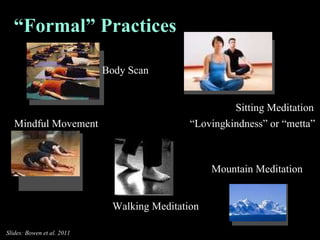
“ Formal” Practices Body Scan Sitting Meditation  Walking Meditation Mindful Movement Mountain Meditation “ Lovingkindness” or “metta”  Slides: Bowen et al. 2011
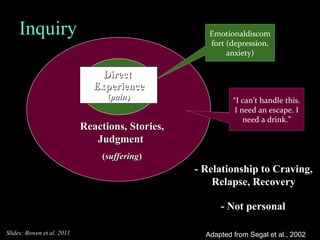
Direct  Experience ( pain ) Reactions, Stories, Judgment  ( suffering ) Adapted from Segal et al., 2002 Inquiry Pain in left knee, Restlessness “ I can’t do this” Emotionaldiscomfort (depression, anxiety) “ I can’t handle this. I need an escape. I need a drink.” - Relationship to Craving, Relapse, Recovery - Not personal Slides: Bowen et al. 2011
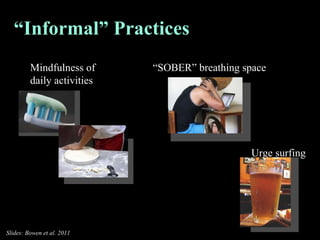
“ Informal” Practices Mindfulness of  daily activities “ SOBER” breathing space Urge surfing Slides: Bowen et al. 2011
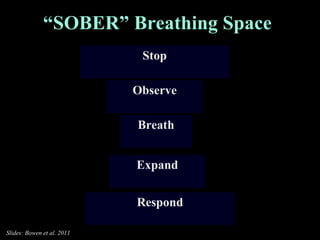
Stop Observe Breath “ SOBER” Breathing Space Expand Respond Slides: Bowen et al. 2011
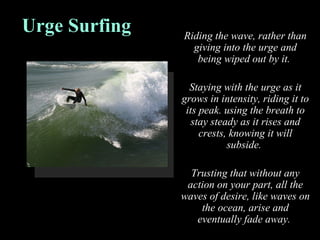
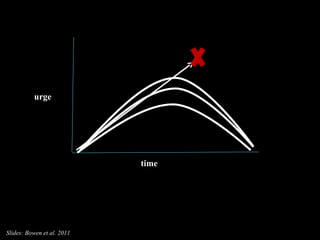
Urge Surfing Riding the wave, rather than giving into the urge and being wiped out by it.  Staying with the urge as it grows in intensity, riding it to its peak. using the breath to stay steady as it rises and crests, knowing it will subside.  Trusting that without any action on your part, all the waves of desire, like waves on the ocean, arise and eventually fade away.
urge time Slides: Bowen et al. 2011
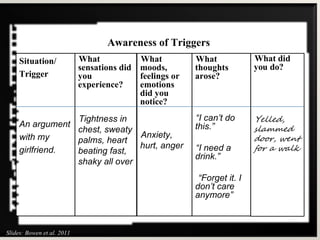
Awareness of Triggers  Situation/ Trigger An argument with my girlfriend . What moods, feelings or emotions did you notice? Anxiety, hurt, anger What sensations did you experience?  Tightness in chest, sweaty palms, heart beating fast, shaky all over What thoughts arose?  “ I can’t do this.”  “ I need a drink.” “ Forget it. I don’t care anymore” Slides: Bowen et al. 2011
Mindfulness and Substance Use Disorders: The Research Slides: Bowen et al. 2011
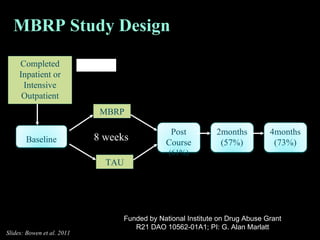
N = 168 Funded by National Institute on Drug Abuse Grant R21 DAO 10562-01A1; PI: G. Alan Marlatt MBRP Study Design Completed Inpatient or Intensive Outpatient 8 weeks MBRP TAU Slides: Bowen et al. 2011 Post Course  (61%) 2months (57%) 4months (73%) Baseline
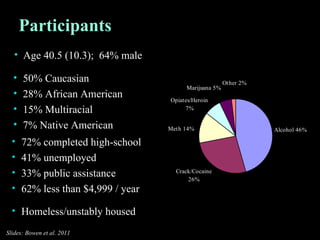
Participants 72% completed high-school 41% unemployed  33% public assistance  62% less than $4,999 / year Homeless/unstably housed 50% Caucasian  28% African American 15% Multiracial 7% Native American Age 40.5 (10.3);  64% male  Slides: Bowen et al. 2011
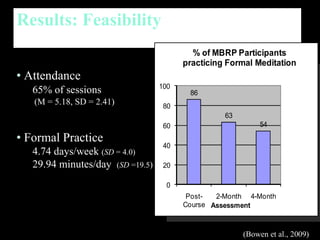
Results: Feasibility Attendance 65% of sessions   (M = 5.18, SD   = 2.41) Formal Practice 4.74 days/week  ( SD  = 4.0)   29.94 minutes/day  ( SD  =19.5 ) (Bowen et al., 2009)
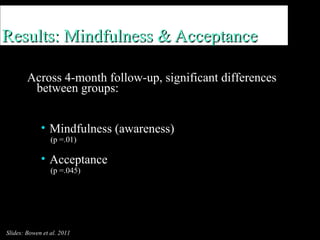
Results: Mindfulness & Acceptance Across 4-month follow-up, significant differences between groups: Mindfulness (awareness)  (p =.01) Acceptance (p =.045) Slides: Bowen et al. 2011
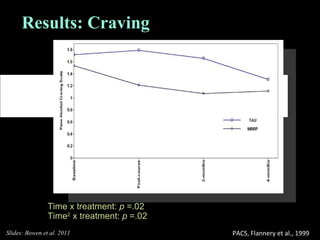
Time x treatment:  p  =.02 Time 2  x treatment:  p  =.02 PACS, Flannery et al., 1999 Results: Craving Slides: Bowen et al. 2011
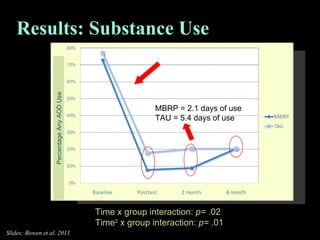
Time x group interaction:  p=  .02 Time 2  x group interaction:  p=  .01 Percentage Any AOD Use Results: Substance Use MBRP = 2.1 days of use TAU = 5.4 days of use Slides: Bowen et al. 2011
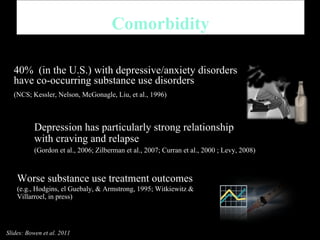
Comorbidity Worse substance use treatment outcomes  (e.g., Hodgins, el Guebaly, & Armstrong, 1995; Witkiewitz & Villarroel, in press)  Depression has particularly strong relationship  with craving and relapse  (Gordon et al., 2006; Zilberman et al., 2007; Curran et al., 2000 ; Levy, 2008) 40%  (in the U.S.) with depressive/anxiety disorders have co-occurring substance use disorders  (NCS; Kessler, Nelson, McGonagle, Liu, et al., 1996) Slides: Bowen et al. 2011
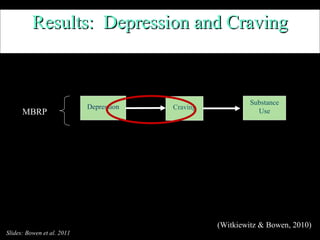
Results:  Depression and Craving Substance Use Craving Depression MBRP (Witkiewitz & Bowen, 2010) Slides: Bowen et al. 2011
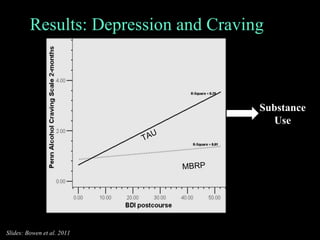
Results: Depression and Craving TAU MBRP Substance Use Slides: Bowen et al. 2011
Summary of Results Increased awareness and acceptance Reduction in craving Decreased rates of substance use Weaker relationship between depressive symptoms and substance  Thereby weakened relationship between depression and substance use Slides: Bowen et al. 2011
Implications Findings consistent with intention and hypothesized mechanisms Experience discomfort without “automatically” reacting Decrease craving in the presence of internal (e.g., depression) and external (e.g., environment) cues. Consistent with findings from other mindfulness-based interventions  (Dahl et al., 2004; Bowen & Marlatt, 2009; Gifford et al., 2004; Hayes et al., 1999; Levitt, et al., 2004)  Relationship between depression and craving: Negative affect doesn’t have to lead to relapse  (Gifford et al, 2004; Bowen & Marlatt, 2009) May be helpful in treating dual-diagnosis clients May enhance Relapse Prevention by offering additional skills Slides: Bowen et al. 2011
Is this for everyone?  Gender  Dependence severity  Dual diagnosis (depression, anxiety, trauma) Long term effects Latency to first lapse Pattern of use following the first lapse Physiological and Neurological effects  Stress reactivity to triggers Brain activation Neuroplasticity Underlying “Automatic” Cognitive Processes Cognitive Inhibition (ability to disengage attention from triggers) Metacognition Future Directions  Slides: Bowen et al. 2011
Thank you! Slides: Bowen et al. 2011
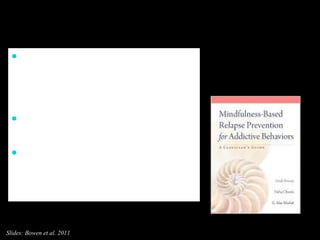
Mindfulness-Based Relapse Prevention for Addictive Behaviors: A Clinician’s Guide Guilford Press, November 2010 www.mindfulrp.com Slides: Bowen et al. 2011

Mindfulness-Based Relapse Prevention

  • 1.
    How Does RelapseHappen? The Cognitive Behavioral Model Marlatt & Gordon, 1985 High-Risk Situation Effective Coping Response Increased Self-Efficacy Decreased Probability of Relapse Ineffective Coping Response Decreased Self-Efficacy + Positive Outcome Expectancies (for initial effects of the substance ) LAPSE (Initial Use of Substance ) Increased Probability of Relapse “ Abstinence Violation Effect” Slides: Bowen et al. 2011
  • 2.
    Relapse Prevention TherapyMarlatt & Gordon, 1985 High-Risk Situation Ineffective Coping Response Decreased Self-Efficacy + Positive Outcome Expectancies (for initial effects of the substance ) LAPSE (Initial Use of Substance ) “ Abstinence Violation Effect” Self Monitoring, Inventory of Situations Coping Skills Training Stress Management, Relaxation Education about Immediate vs Delayed Effects Contract to limit use, Reminder Card (what to do if you lapse) Cognitive Restructuring: Lapse is a mistake vs a failure Slides: Bowen et al. 2011
  • 3.
    Research on RelapsePrevention Meta-analyses and reviews (Irvin, et al., 1999; Carroll, 1996) support RP as an effective treatment across disorders Alcohol (Dimeff & Marlatt, 1998; Kadden et al., 1992; Larimer & Marlatt, 1990; Monti et al., 2002) Cocaine (Schmitz, et al., 2001) Marijuana (Roffman, et al., 1990) Smoking (Killen, et al., 1984) Eating disorders (Mitchell & Carr, 2000) Gambling (Echeburua, et al., 2000) Sexual Offenses (Laws, 1995) Slides: Bowen et al. 2011
  • 4.
    Review of 24Randomized Trials (Carroll, 1996) Does not prevent a lapse better than other treatments, but is more effective at delaying and reducing duration and intensity of lapses Effective at maintaining treatment effects over long term follow-up (1-2 years or more) “ Delayed emergence effects” - greater improvement in coping over time May be most effective for more severe substance abuse, greater levels of negative affect, and greater deficits in coping skills Slides: Bowen et al. 2011
  • 5.
    Enhancing Relapse Preventionwith Mindfulness Slides: Bowen et al. 2011
  • 6.
    What is Mindfulness?“ Awareness that emerges through paying attention on purpose, in the present moment, and non-judgmentally to the unfolding of experience moment by moment” (Kabat-Zinn, 2003) Slides: Bowen et al. 2011
  • 7.
    Paying attention: Inthe present moment … Nonjudgmentally: Mindfulness and Substance Use Greater awareness of triggers and responses, interrupting previously automatic behavior ( Breslin et al. , 2002) Accepting present experience, rather than using substances to avoid it Detach from attributions and “automatic” thoughts that often lead to relapse Slides: Bowen et al. 2011
  • 8.
    Mindfulness-Based Relapse Prevention (MBRP) NIDA Grant # R21 DA010562; PI Marlatt Slides: Bowen et al. 2011
  • 9.
    MBRP Structure Integratesmindfulness with Relapse Prevention Patterned after Mindfulness-Based Stress Reduction (Kabat-Zinn) and Mindfulness-Based Cognitive Therapy for depression (Segal et al.) Outpatient Aftercare Treatment 8 weekly 2 hour sessions; daily home practice Therapists have ongoing meditation practice Components of MBRP Formal mindfulness practice Informal practice Coping strategies (Bowen, Chawla & Marlatt, 2010; Witkiewitz et al., 2005) Slides: Bowen et al. 2011
  • 10.
    Awareness: From “automaticpilot” to awareness and choice Triggers: Awareness of triggers, interrupting habitual reactions Acceptance: Change relationship to discomfort, decrease need to “fix” the present moment Intentions of MBRP Balance and Lifestyle: Supporting recovery and maintaining a mindfulness Slides: Bowen et al. 2011
  • 11.
    Session 1: Automatic Pilot and Relapse Session 2: Awareness of Triggers and Craving Session 3: Mindfulness in Daily Life Session 4: Mindfulness in High-Risk Situations Session 5: Acceptance and Skillful Action Session 6: Seeing Thoughts as Thoughts Session 7: Self-Care and Lifestyle Balance Session 8: Social Support and Continuing Practice Awareness, Presence MBRP Session Themes Mindfulness and Relapse Bigger Picture: A Balanced Life Slides: Bowen et al. 2011
  • 12.
    “ Formal” PracticesBody Scan Sitting Meditation Walking Meditation Mindful Movement Mountain Meditation “ Lovingkindness” or “metta” Slides: Bowen et al. 2011
  • 13.
    Direct Experience( pain ) Reactions, Stories, Judgment ( suffering ) Adapted from Segal et al., 2002 Inquiry Pain in left knee, Restlessness “ I can’t do this” Emotionaldiscomfort (depression, anxiety) “ I can’t handle this. I need an escape. I need a drink.” - Relationship to Craving, Relapse, Recovery - Not personal Slides: Bowen et al. 2011
  • 14.
    “ Informal” PracticesMindfulness of daily activities “ SOBER” breathing space Urge surfing Slides: Bowen et al. 2011
  • 15.
    Stop Observe Breath“ SOBER” Breathing Space Expand Respond Slides: Bowen et al. 2011
  • 16.
    Urge Surfing Ridingthe wave, rather than giving into the urge and being wiped out by it. Staying with the urge as it grows in intensity, riding it to its peak. using the breath to stay steady as it rises and crests, knowing it will subside. Trusting that without any action on your part, all the waves of desire, like waves on the ocean, arise and eventually fade away.
  • 17.
    urge time Slides:Bowen et al. 2011
  • 18.
    Awareness of Triggers Situation/ Trigger An argument with my girlfriend . What moods, feelings or emotions did you notice? Anxiety, hurt, anger What sensations did you experience? Tightness in chest, sweaty palms, heart beating fast, shaky all over What thoughts arose? “ I can’t do this.” “ I need a drink.” “ Forget it. I don’t care anymore” Slides: Bowen et al. 2011
  • 19.
    Mindfulness and SubstanceUse Disorders: The Research Slides: Bowen et al. 2011
  • 20.
    N = 168Funded by National Institute on Drug Abuse Grant R21 DAO 10562-01A1; PI: G. Alan Marlatt MBRP Study Design Completed Inpatient or Intensive Outpatient 8 weeks MBRP TAU Slides: Bowen et al. 2011 Post Course (61%) 2months (57%) 4months (73%) Baseline
  • 21.
    Participants 72% completedhigh-school 41% unemployed 33% public assistance 62% less than $4,999 / year Homeless/unstably housed 50% Caucasian 28% African American 15% Multiracial 7% Native American Age 40.5 (10.3); 64% male Slides: Bowen et al. 2011
  • 22.
    Results: Feasibility Attendance65% of sessions (M = 5.18, SD = 2.41) Formal Practice 4.74 days/week ( SD = 4.0) 29.94 minutes/day ( SD =19.5 ) (Bowen et al., 2009)
  • 23.
    Results: Mindfulness &Acceptance Across 4-month follow-up, significant differences between groups: Mindfulness (awareness) (p =.01) Acceptance (p =.045) Slides: Bowen et al. 2011
  • 24.
    Time x treatment: p =.02 Time 2 x treatment: p =.02 PACS, Flannery et al., 1999 Results: Craving Slides: Bowen et al. 2011
  • 25.
    Time x groupinteraction: p= .02 Time 2 x group interaction: p= .01 Percentage Any AOD Use Results: Substance Use MBRP = 2.1 days of use TAU = 5.4 days of use Slides: Bowen et al. 2011
  • 26.
    Comorbidity Worse substanceuse treatment outcomes (e.g., Hodgins, el Guebaly, & Armstrong, 1995; Witkiewitz & Villarroel, in press) Depression has particularly strong relationship with craving and relapse (Gordon et al., 2006; Zilberman et al., 2007; Curran et al., 2000 ; Levy, 2008) 40% (in the U.S.) with depressive/anxiety disorders have co-occurring substance use disorders (NCS; Kessler, Nelson, McGonagle, Liu, et al., 1996) Slides: Bowen et al. 2011
  • 27.
    Results: Depressionand Craving Substance Use Craving Depression MBRP (Witkiewitz & Bowen, 2010) Slides: Bowen et al. 2011
  • 28.
    Results: Depression andCraving TAU MBRP Substance Use Slides: Bowen et al. 2011
  • 29.
    Summary of ResultsIncreased awareness and acceptance Reduction in craving Decreased rates of substance use Weaker relationship between depressive symptoms and substance Thereby weakened relationship between depression and substance use Slides: Bowen et al. 2011
  • 30.
    Implications Findings consistentwith intention and hypothesized mechanisms Experience discomfort without “automatically” reacting Decrease craving in the presence of internal (e.g., depression) and external (e.g., environment) cues. Consistent with findings from other mindfulness-based interventions (Dahl et al., 2004; Bowen & Marlatt, 2009; Gifford et al., 2004; Hayes et al., 1999; Levitt, et al., 2004) Relationship between depression and craving: Negative affect doesn’t have to lead to relapse (Gifford et al, 2004; Bowen & Marlatt, 2009) May be helpful in treating dual-diagnosis clients May enhance Relapse Prevention by offering additional skills Slides: Bowen et al. 2011
  • 31.
    Is this foreveryone? Gender Dependence severity Dual diagnosis (depression, anxiety, trauma) Long term effects Latency to first lapse Pattern of use following the first lapse Physiological and Neurological effects Stress reactivity to triggers Brain activation Neuroplasticity Underlying “Automatic” Cognitive Processes Cognitive Inhibition (ability to disengage attention from triggers) Metacognition Future Directions Slides: Bowen et al. 2011
  • 32.
    Thank you! Slides:Bowen et al. 2011
  • 33.
    Mindfulness-Based Relapse Preventionfor Addictive Behaviors: A Clinician’s Guide Guilford Press, November 2010 www.mindfulrp.com Slides: Bowen et al. 2011

Editor's Notes

  • #4 Designed for use with individuals in aftercare Used as a stand-alone addictions treatment Treatment for addictive and non addictive disorders show support for efficacy, alone and combined with other techniques. A meta-analysis (Irvin, et al., 1999), reviews the use of RP across varying addictive behaviors, supporting RP as an effective treatment across substances.
  • #6 Designed for use with individuals in aftercare Used as a stand-alone addictions treatment Treatment for addictive and non addictive disorders show support for efficacy, alone and combined with other techniques. A meta-analysis (Irvin, et al., 1999), reviews the use of RP across varying addictive behaviors, supporting RP as an effective treatment across substances.
  • #10 MBRP is the first treatment to integrate core mindfulness practices with cognitive-behavioral skills for the prevention of relapse It is currently designed as an aftercare program , that follows the same structure as MBSR and MBCT Components include formal mindfulness practices such as the body scan, sitting meditation and yoga, as well as informal practices such as mindfulness of routine activities and using mindfulness in the midst of stressful situations. This is combined with cognitive-behavioral strategies for coping with triggers, high-risk situations, cravings and urges.
  • #30 More aware, nonjudgmental stance Increasing ability to experience emotion (e.g., depression) without “automatically” reacting, thereby altering conditioned response of drug craving to negative affect Further, the effect of MBRP on substance use appears to be in part explained by a decrease in craving. We also found an interesting relationship between treatment, craving and negative affect which I do not have time to discuss here, but will be presented as a poster……