The
Transtheoretical
Model
/Stages of
Change Model
• Developed by Prochaska and Di Clemente,
1984 to address the intentional behavioral
change.
• Research conducted on the experience of
smokers who quit smoking on their own.
• Aimed at understanding individuals behavioral
changes ( addictive behavior)
• Posits that health behavior change involves
progress through six stages of change
• They are:
What is Transtheoretical
Model?
Stages Of Changes Model
Maintainence
/Relapse
prevention
3
1
4
2
Preparation
Precontemplation
Action
Contemplation
5
That people move through
stages of change
The processes involved at
each different stage
Two broad assumptions that
TTM makes
 Places more emphasis on the cons than the pros of
changing behavior.
 Individuals are more likely to be using denial and/or
may report lower self-efficacy (to change) beliefs and
more barriers to change. ( I love smoking).
 People do not intend to take action in the near future.
 Completely unaware that their lifestyle is problematic
 (consciousness raising, dramatic relief, environmental re-evaluation).
1.Precontemplation
2.contemplation
• People are now made aware that their behavior is
unhealthy and can lead to serious consequences.
• The intention is there to start living a healthy
behavior in the foreseeable future(in the next
6months)(self reevaluation) I cant quit but I know the consequences
• People are more likely to seek information and
may report reduced barriers to change and
increased benefits, although they may still
underestimate their susceptibility to the health
threat concerned
3.preparation
 People are ready to take an action within next 30 days.
 I want to change but don’t know how to?
 Small efforts are being made as they believe that it will
lead to a healthier life. (social, self liberation).
 People start to set their goals and priorities, and some will
make concrete plans (similar to implementation intentions
as described in an earlier section) and small changes in
behavior (e.g. joining a gym).
 People have changed their behavior over the past six
months and intends to continue to maintain those
changes( helping relationships, counter conditioning, reinforcement management)
 Changes can be seen when people modify their
problematic behavior or adapt to healthier behaviors.
 Realistic goal setting is crucial if action is to be
maintained
4.Action
 People have changed and stuck to their new or
modified behavioral practices for the past six months
intend to continue(stimulus control).
 They make every effort not to relapse into earlier
stages
 Maintenance can be enhanced by self-monitoring and
reinforcement
5.Maintenance
Cognitive
 To progress through the stages of change, people
apply
 These processes result in strategies that help people
make and maintain change
Affective Evaluative
processes
Process of change
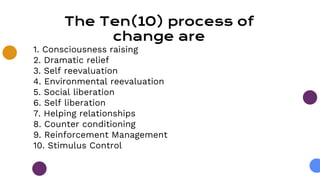
The Ten(10) process of
change are
1. Consciousness raising
2. Dramatic relief
3. Self reevaluation
4. Environmental reevaluation
5. Social liberation
6. Self liberation
7. Helping relationships
8. Counter conditioning
9. Reinforcement Management
10. Stimulus Control
Falling back is
part of the
process.
 Decisional balance where the costs of behavior are
weighed up against the benefits of that behavior.
 Self efficacy to an individual’s belief in his or her
capacity for execute behaviors necessary to produce
specific performance attainments.(Bandura, 1977, 1986,
1997)
 Perceived barrier:
keywords
What is
stopping
you?
The barriers which are stopping you
Levels of
change:
Five levels of change:
1.syptom/situational
2.Maladaptive cognition
3.Interpersonal conflicts
4.Family systems problems
5.Intrapersonal cognition.
The limitations of TTM should be considered especially
when using the theory in public health. They’re simple
● This model gives the exact time period for change
● Not focusing on environmental factors like SES etc
will influence the individual.
And the important thing: readiness to change.
Limitations

transtheoritical model ppt.pptx

  • 1.
  • 3.
    • Developed byProchaska and Di Clemente, 1984 to address the intentional behavioral change. • Research conducted on the experience of smokers who quit smoking on their own. • Aimed at understanding individuals behavioral changes ( addictive behavior) • Posits that health behavior change involves progress through six stages of change • They are: What is Transtheoretical Model?
  • 4.
    Stages Of ChangesModel Maintainence /Relapse prevention 3 1 4 2 Preparation Precontemplation Action Contemplation 5
  • 5.
    That people movethrough stages of change The processes involved at each different stage Two broad assumptions that TTM makes
  • 6.
     Places moreemphasis on the cons than the pros of changing behavior.  Individuals are more likely to be using denial and/or may report lower self-efficacy (to change) beliefs and more barriers to change. ( I love smoking).  People do not intend to take action in the near future.  Completely unaware that their lifestyle is problematic  (consciousness raising, dramatic relief, environmental re-evaluation). 1.Precontemplation
  • 7.
    2.contemplation • People arenow made aware that their behavior is unhealthy and can lead to serious consequences. • The intention is there to start living a healthy behavior in the foreseeable future(in the next 6months)(self reevaluation) I cant quit but I know the consequences • People are more likely to seek information and may report reduced barriers to change and increased benefits, although they may still underestimate their susceptibility to the health threat concerned
  • 8.
    3.preparation  People areready to take an action within next 30 days.  I want to change but don’t know how to?  Small efforts are being made as they believe that it will lead to a healthier life. (social, self liberation).  People start to set their goals and priorities, and some will make concrete plans (similar to implementation intentions as described in an earlier section) and small changes in behavior (e.g. joining a gym).
  • 9.
     People havechanged their behavior over the past six months and intends to continue to maintain those changes( helping relationships, counter conditioning, reinforcement management)  Changes can be seen when people modify their problematic behavior or adapt to healthier behaviors.  Realistic goal setting is crucial if action is to be maintained 4.Action
  • 10.
     People havechanged and stuck to their new or modified behavioral practices for the past six months intend to continue(stimulus control).  They make every effort not to relapse into earlier stages  Maintenance can be enhanced by self-monitoring and reinforcement 5.Maintenance
  • 12.
    Cognitive  To progressthrough the stages of change, people apply  These processes result in strategies that help people make and maintain change Affective Evaluative processes Process of change
  • 13.
    The Ten(10) processof change are 1. Consciousness raising 2. Dramatic relief 3. Self reevaluation 4. Environmental reevaluation 5. Social liberation 6. Self liberation 7. Helping relationships 8. Counter conditioning 9. Reinforcement Management 10. Stimulus Control
  • 14.
    Falling back is partof the process.
  • 15.
     Decisional balancewhere the costs of behavior are weighed up against the benefits of that behavior.  Self efficacy to an individual’s belief in his or her capacity for execute behaviors necessary to produce specific performance attainments.(Bandura, 1977, 1986, 1997)  Perceived barrier: keywords
  • 16.
    What is stopping you? The barrierswhich are stopping you
  • 17.
    Levels of change: Five levelsof change: 1.syptom/situational 2.Maladaptive cognition 3.Interpersonal conflicts 4.Family systems problems 5.Intrapersonal cognition.
  • 18.
    The limitations ofTTM should be considered especially when using the theory in public health. They’re simple ● This model gives the exact time period for change ● Not focusing on environmental factors like SES etc will influence the individual. And the important thing: readiness to change. Limitations