Roberto Peretto
University of Padova
 Self-efficacy
 Strategies to improve Self-efficacy
 Self-confidence
 Vealey’s model of Sport Confidence
 Strategies to improve Sport Confidence
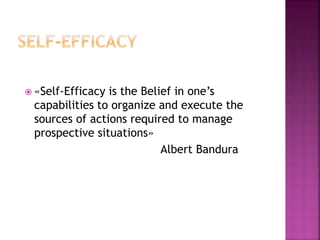
 «Self-Efficacy is the Belief in one’s
capabilities to organize and execute the
sources of actions required to manage
prospective situations»
Albert Bandura
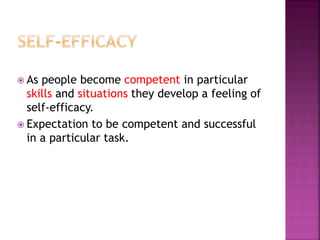
 As people become competent in particular
skills and situations they develop a feeling of
self-efficacy.
 Expectation to be competent and successful
in a particular task.
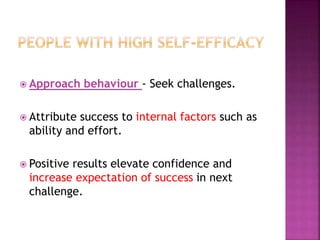
 Approach behaviour - Seek challenges.
 Attribute success to internal factors such as
ability and effort.
 Positive results elevate confidence and
increase expectation of success in next
challenge.
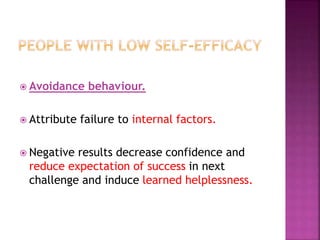
 Avoidance behaviour.
 Attribute failure to internal factors.
 Negative results decrease confidence and
reduce expectation of success in next
challenge and induce learned helplessness.
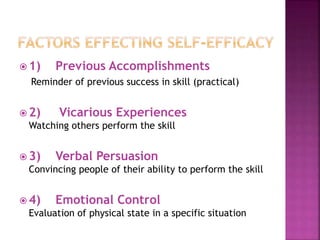
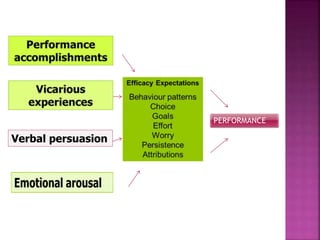
 1) Previous Accomplishments
Reminder of previous success in skill (practical)
 2) Vicarious Experiences
Watching others perform the skill
 3) Verbal Persuasion
Convincing people of their ability to perform the skill
 4) Emotional Control
Evaluation of physical state in a specific situation
Verbal persuasion
PERFORMANCE
 A global term
 Belief that one has the internal resources,
particularly abilities, to achieve success.
 “Rooted in beliefs and expectations”
(Advances in Sport Psychology, Thelma S. Horn, 2008)
Self-efficacy is Self-confidence in a
specific situation.
 Someone may be generally self confident
in sport but when it came to playing golf
which they weren’t particularly good at,
they may have low self efficacy in that
situation.
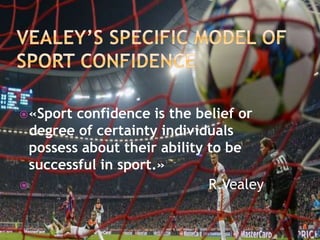
«Sport confidence is the belief or
degree of certainty individuals
possess about their ability to be
successful in sport.»
 R.Vealey
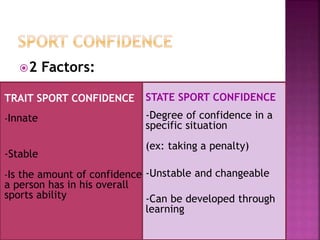
2 Factors:
TRAIT SPORT CONFIDENCE
-Innate
-Stable
-Is the amount of confidence
a person has in his overall
sports ability
STATE SPORT CONFIDENCE
-Degree of confidence in a
specific situation
(ex: taking a penalty)
-Unstable and changeable
-Can be developed through
learning
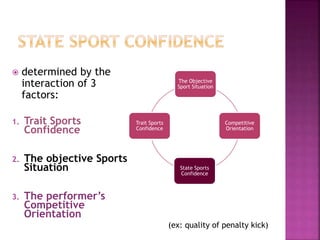
 determined by the
interaction of 3
factors:
1. Trait Sports
Confidence
2. The objective Sports
Situation
3. The performer’s
Competitive
Orientation
The Objective
Sport Situation
Competitive
Orientation
State Sports
Confidence
Trait Sports
Confidence
(ex: quality of penalty kick)
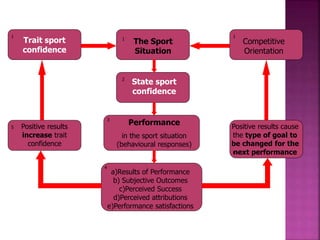
a)Results of Performance
b) Subjective Outcomes
c)Perceived Success
d)Perceived attributions
e)Performance satisfactions
Trait sport
confidence
The Sport
Situation
Competitive
Orientation
Positive results
increase trait
confidence
State sport
confidence
Performance
in the sport situation
(behavioural responses)
Positive results cause
the type of goal to
be changed for the
next performance
1
1 1
2
3
4
5
6
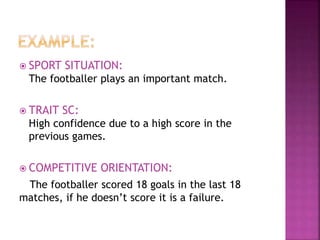
 SPORT SITUATION:
The footballer plays an important match.
 TRAIT SC:
High confidence due to a high score in the
previous games.
 COMPETITIVE ORIENTATION:
The footballer scored 18 goals in the last 18
matches, if he doesn’t score it is a failure.
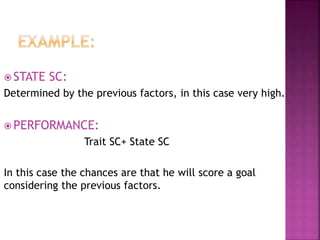
 STATE SC:
Determined by the previous factors, in this case very high.
 PERFORMANCE:
Trait SC+ State SC
In this case the chances are that he will score a goal
considering the previous factors.
 Depending on the performance of the footballer:
a. RESULTS OF PERFORMANCE (was he successful
or not according to his goal)
b. SUBJECTIVE OUTCOME (How did other people
rate the performance)
c. PERCEIVED SUCCESS (whether the goal was met
or not, did he feel like he succeeded?)
d. PERCEIVED ATTRIBUTION (Why did he perform
well / badly. Was it internal / external
reasons)
e. PERFORMANCE SATISFACTION (Was he happy
with the performance)
If the outcomes of PERFORMANCE are positive
then this will lead to an increase in:
 TRAIT SPORT-CONFIDENCE
 COMPETITIVE ORIENTATION
If the ourcomes are negative:
STATE and TRAIT CONFIDENCE decrease.
 Trait Sports Confidence and Competitiveness
will increase
 Increased Trait Confidence will increase
State Confidence for future competition
 Trait Sports Confidence and Competitiveness
will decrease
 Decreased Trait Confidence will decrease
State Confidence for future competition
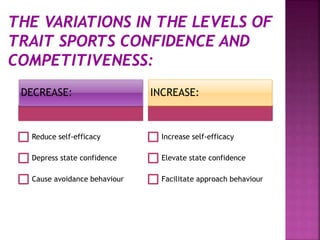
DECREASE:
Reduce self-efficacy
Depress state confidence
Cause avoidance behaviour
INCREASE:
Increase self-efficacy
Elevate state confidence
Facilitate approach behaviour
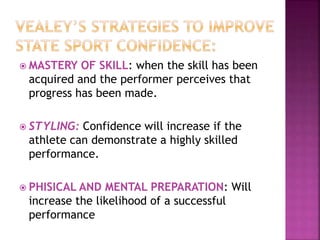
 MASTERY OF SKILL: when the skill has been
acquired and the performer perceives that
progress has been made.
 STYLING: Confidence will increase if the
athlete can demonstrate a highly skilled
performance.
 PHISICAL AND MENTAL PREPARATION: Will
increase the likelihood of a successful
performance
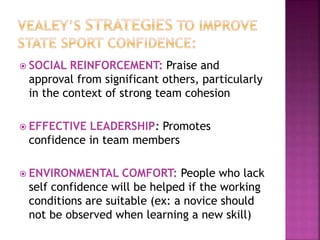
 SOCIAL REINFORCEMENT: Praise and
approval from significant others, particularly
in the context of strong team cohesion
 EFFECTIVE LEADERSHIP: Promotes
confidence in team members
 ENVIRONMENTAL COMFORT: People who lack
self confidence will be helped if the working
conditions are suitable (ex: a novice should
not be observed when learning a new skill)
Self Efficacy and Sport Confidence

Self Efficacy and Sport Confidence

  • 1.
  • 2.
     Self-efficacy  Strategiesto improve Self-efficacy  Self-confidence  Vealey’s model of Sport Confidence  Strategies to improve Sport Confidence
  • 3.
     «Self-Efficacy isthe Belief in one’s capabilities to organize and execute the sources of actions required to manage prospective situations» Albert Bandura
  • 4.
     As peoplebecome competent in particular skills and situations they develop a feeling of self-efficacy.  Expectation to be competent and successful in a particular task.
  • 5.
     Approach behaviour- Seek challenges.  Attribute success to internal factors such as ability and effort.  Positive results elevate confidence and increase expectation of success in next challenge.
  • 6.
     Avoidance behaviour. Attribute failure to internal factors.  Negative results decrease confidence and reduce expectation of success in next challenge and induce learned helplessness.
  • 7.
     1) PreviousAccomplishments Reminder of previous success in skill (practical)  2) Vicarious Experiences Watching others perform the skill  3) Verbal Persuasion Convincing people of their ability to perform the skill  4) Emotional Control Evaluation of physical state in a specific situation
  • 8.
  • 9.
     A globalterm  Belief that one has the internal resources, particularly abilities, to achieve success.  “Rooted in beliefs and expectations” (Advances in Sport Psychology, Thelma S. Horn, 2008)
  • 10.
    Self-efficacy is Self-confidencein a specific situation.  Someone may be generally self confident in sport but when it came to playing golf which they weren’t particularly good at, they may have low self efficacy in that situation.
  • 11.
    «Sport confidence isthe belief or degree of certainty individuals possess about their ability to be successful in sport.»  R.Vealey
  • 12.
    2 Factors: TRAIT SPORTCONFIDENCE -Innate -Stable -Is the amount of confidence a person has in his overall sports ability STATE SPORT CONFIDENCE -Degree of confidence in a specific situation (ex: taking a penalty) -Unstable and changeable -Can be developed through learning
  • 13.
     determined bythe interaction of 3 factors: 1. Trait Sports Confidence 2. The objective Sports Situation 3. The performer’s Competitive Orientation The Objective Sport Situation Competitive Orientation State Sports Confidence Trait Sports Confidence (ex: quality of penalty kick)
  • 14.
    a)Results of Performance b)Subjective Outcomes c)Perceived Success d)Perceived attributions e)Performance satisfactions Trait sport confidence The Sport Situation Competitive Orientation Positive results increase trait confidence State sport confidence Performance in the sport situation (behavioural responses) Positive results cause the type of goal to be changed for the next performance 1 1 1 2 3 4 5 6
  • 15.
     SPORT SITUATION: Thefootballer plays an important match.  TRAIT SC: High confidence due to a high score in the previous games.  COMPETITIVE ORIENTATION: The footballer scored 18 goals in the last 18 matches, if he doesn’t score it is a failure.
  • 16.
     STATE SC: Determinedby the previous factors, in this case very high.  PERFORMANCE: Trait SC+ State SC In this case the chances are that he will score a goal considering the previous factors.
  • 17.
     Depending onthe performance of the footballer: a. RESULTS OF PERFORMANCE (was he successful or not according to his goal) b. SUBJECTIVE OUTCOME (How did other people rate the performance) c. PERCEIVED SUCCESS (whether the goal was met or not, did he feel like he succeeded?) d. PERCEIVED ATTRIBUTION (Why did he perform well / badly. Was it internal / external reasons) e. PERFORMANCE SATISFACTION (Was he happy with the performance)
  • 18.
    If the outcomesof PERFORMANCE are positive then this will lead to an increase in:  TRAIT SPORT-CONFIDENCE  COMPETITIVE ORIENTATION If the ourcomes are negative: STATE and TRAIT CONFIDENCE decrease.
  • 19.
     Trait SportsConfidence and Competitiveness will increase  Increased Trait Confidence will increase State Confidence for future competition
  • 20.
     Trait SportsConfidence and Competitiveness will decrease  Decreased Trait Confidence will decrease State Confidence for future competition
  • 21.
    DECREASE: Reduce self-efficacy Depress stateconfidence Cause avoidance behaviour INCREASE: Increase self-efficacy Elevate state confidence Facilitate approach behaviour
  • 22.
     MASTERY OFSKILL: when the skill has been acquired and the performer perceives that progress has been made.  STYLING: Confidence will increase if the athlete can demonstrate a highly skilled performance.  PHISICAL AND MENTAL PREPARATION: Will increase the likelihood of a successful performance
  • 23.
     SOCIAL REINFORCEMENT:Praise and approval from significant others, particularly in the context of strong team cohesion  EFFECTIVE LEADERSHIP: Promotes confidence in team members  ENVIRONMENTAL COMFORT: People who lack self confidence will be helped if the working conditions are suitable (ex: a novice should not be observed when learning a new skill)