Stage gate, portfolios, agile systems
Michal Hron, PhD
How to direct the innovation process?
▪ Innovation is an imperative. It needs to be ongoing.
▪ How to systematically manage this unbounded creative
process?
▪ Companies need an organisational process to reliably and
consistently manage a pipeline of innovation, from concept to
launch
2
3
▪ radical projects are managed less flexibly than
incremental projects
▪ Instead of being an offshoot of less strategic planning, radical
projects are just as strategically aligned as incremental
projects
▪ Instead of being informally introduced entrepreneurial
adventures, radical projects are often the result of
more formal ideation methods
▪ As the level of innovativeness increased, so too did the amount of
controls imposed
Holahan, Patricia J., Zhen Z. Sullivan, and Stephen K. Markham. "Product development as core competence: How formal product development practices differ for
radical, more innovative, and incremental product innovations." Journal of Product Innovation Management 31.2 (2014): 329-345.
Radical innovation needs formal control
Agenda
4
▪ 1. Stage-gate models: Controlling innovation funnel within an organization
▪ II Project Portfolios: Selecting a good mix of projects
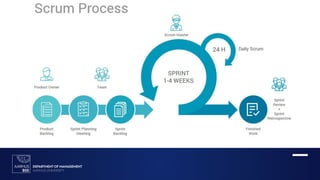
▪ III Agile systems: Execution under unforeseeable uncertainty
1. Stage-gate models
Controlling innovation funnel within an organization
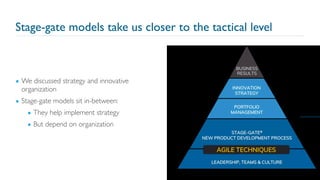
Stage-gate models take us closer to the tactical level
6
▪ We discussed strategy and innovative
organization
▪ Stage-gate models sit in-between:
▪ They help implement strategy
▪ But depend on organization
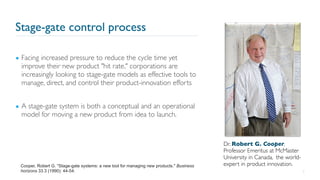
Stage-gate control process
▪ Facing increased pressure to reduce the cycle time yet
improve their new product "hit rate," corporations are
increasingly looking to stage-gate models as effective tools to
manage, direct, and control their product-innovation efforts
▪ A stage-gate system is both a conceptual and an operational
model for moving a new product from idea to launch.
7
Cooper, Robert G. "Stage-gate systems: a new tool for managing new products." Business
horizons 33.3 (1990): 44-54.
Dr. Robert G. Cooper,
Professor Emeritus at McMaster
University in Canada, the world-
expert in product innovation.
Stage-gate control process
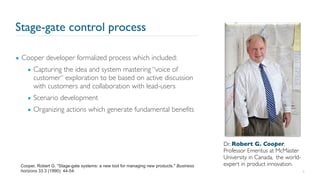
▪ Cooper developer formalized process which included:
▪ Capturing the idea and system mastering “voice of
customer“ exploration to be based on active discussion
with customers and collaboration with lead-users
▪ Scenario development
▪ Organizing actions which generate fundamental benefits
8
Cooper, Robert G. "Stage-gate systems: a new tool for managing new products." Business
horizons 33.3 (1990): 44-54.
Dr. Robert G. Cooper,
Professor Emeritus at McMaster
University in Canada, the world-
expert in product innovation.
Stage-gate control process
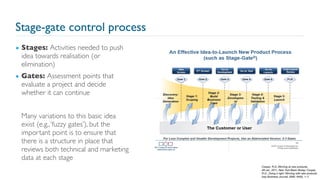
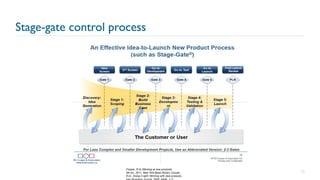
▪ Stages: Activities needed to push
idea towards realisation (or
elimination)
▪ Gates: Assessment points that
evaluate a project and decide
whether it can continue
Many variations to this basic idea
exist (e.g.,‘fuzzy gates’), but the
important point is to ensure that
there is a structure in place that
reviews both technical and marketing
data at each stage
9
Cooper, R.G.,Winning at new products.
4th ed., 2011, New York:Basic Books; Cooper,
R.G., Doing it right: Winning with new products.
Ivey Business Journal, 2000. 64(6), 1–7.
10
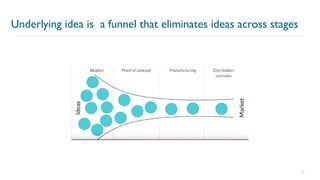
Underlying idea is a funnel that eliminates ideas across stages
11
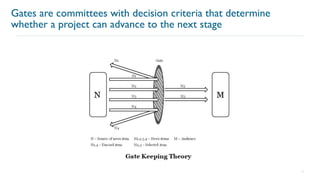
Gates are committees with decision criteria that determine
whether a project can advance to the next stage
12
Gates make four types of decisions…
Go The project is good enough to move on to the next stage.
Kill The project is not good enough to develop further and is
shut down right away.
Hold The project is not good enough to continue to develop it
at this moment, but not so bad that it needs to be shut down
immediately. It is put on hold to possibly be resumed at a later
date.
Recycle The project is good enough to develop further,
provided some changes are made
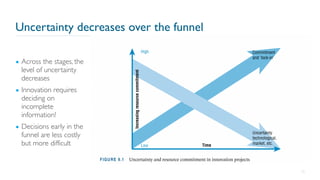
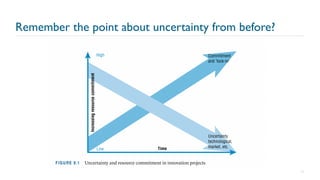
Uncertainty decreases over the funnel
▪ Across the stages, the
level of uncertainty
decreases
▪ Innovation requires
deciding on
incomplete
information!
▪ Decisions early in the
funnel are less costly
but more difficult
13
Stage 1: Discovery
▪ Activities designed to discover opportunities and to generate
new ideas concerning a product.
▪ Design thinking, technology roadmapping etc.
▪ The term Fuzzy front end is sometimes used to describe the
emerging frontier of innovation before it takes shape
14
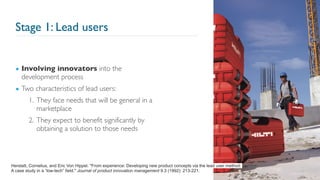
Stage 1: Lead users
▪ Involving innovators into the
development process
▪ Two characteristics of lead users:
1. They face needs that will be general in a
marketplace
2. They expect to benefit significantly by
obtaining a solution to those needs
15
Herstatt, Cornelius, and Eric Von Hippel. "From experience: Developing new product concepts via the lead user method:
A case study in a “low-tech” field." Journal of product innovation management 9.3 (1992): 213-221.
How Hilti used Lead users
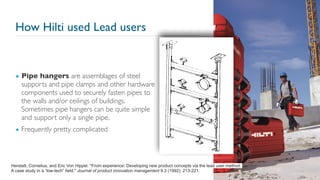
▪ Pipe hangers are assemblages of steel
supports and pipe clamps and other hardware
components used to securely fasten pipes to
the walls and/or ceilings of buildings.
Sometimes pipe hangers can be quite simple
and support only a single pipe.
▪ Frequently pretty complicated
16
Herstatt, Cornelius, and Eric Von Hippel. "From experience: Developing new product concepts via the lead user method:
A case study in a “low-tech” field." Journal of product innovation management 9.3 (1992): 213-221.
How Hilti used Lead users
17
Herstatt, Cornelius, and Eric Von Hippel. "From experience: Developing new product concepts via the lead user method:
A case study in a “low-tech” field." Journal of product innovation management 9.3 (1992): 213-221.
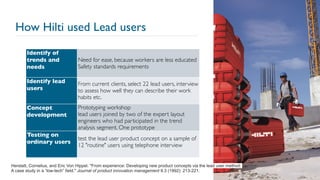
Identify of
trends and
needs
Need for ease, because workers are less educated
Safety standards requirements
Identify lead
users
From current clients, select 22 lead users, interview
to assess how well they can describe their work
habits etc.
Concept
development
Prototyping workshop
lead users joined by two of the expert layout
engineers who had participated in the trend
analysis segment. One prototype
Testing on
ordinary users
test the lead user product concept on a sample of
12 "routine" users using telephone interview
Stage 2: Scoping
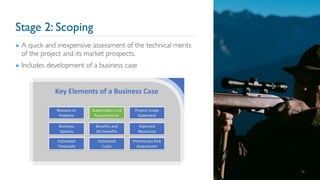
▪ A quick and inexpensive assessment of the technical merits
of the project and its market prospects.
▪ Includes development of a business case
18
Stage 3: Development
19
Midler, C. (2019). Crossing the Valley of Death: Managing the When, What, and How of Innovative Development Projects.
Project Management Journal, 875697281985788. doi:10.1177/8756972819857881
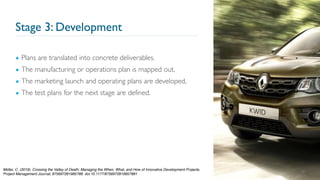
▪ Plans are translated into concrete deliverables.
▪ The manufacturing or operations plan is mapped out,
▪ The marketing launch and operating plans are developed,
▪ The test plans for the next stage are defined.
Stage 3: Development
20
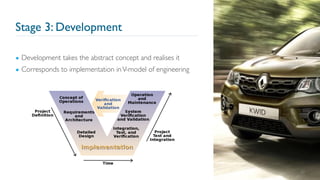
▪ Development takes the abstract concept and realises it
▪ Corresponds to implementation inV-model of engineering
Renault Kwid
Renault Kwid…
22
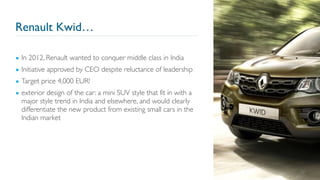
▪ In 2012, Renault wanted to conquer middle class in India
▪ Initiative approved by CEO despite reluctance of leadership
▪ Target price 4,000 EUR!
▪ exterior design of the car: a mini SUV style that fit in with a
major style trend in India and elsewhere, and would clearly
differentiate the new product from existing small cars in the
Indian market
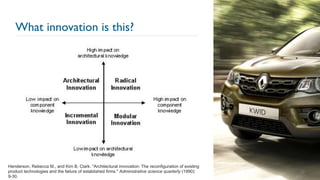
What innovation is this?
23
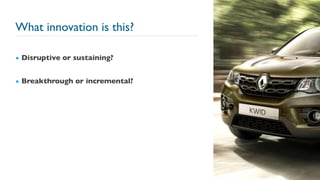
▪ Disruptive or sustaining?
▪ Breakthrough or incremental?
What innovation is this?
24
▪ Disruptive or sustaining?
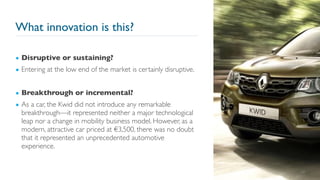
▪ Entering at the low end of the market is certainly disruptive.
▪ Breakthrough or incremental?
▪ As a car, the Kwid did not introduce any remarkable
breakthrough—it represented neither a major technological
leap nor a change in mobility business model. However, as a
modern, attractive car priced at €3,500, there was no doubt
that it represented an unprecedented automotive
experience.
What innovation is this?
25
Henderson, Rebecca M., and Kim B. Clark. "Architectural innovation: The reconfiguration of existing
product technologies and the failure of established firms." Administrative science quarterly (1990):
9-30.
What innovation is this?
26
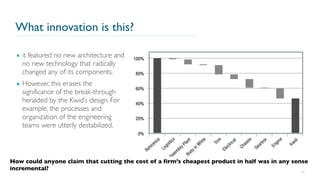
▪ it featured no new architecture and
no new technology that radically
changed any of its components.
▪ However, this erases the
significance of the break-through
heralded by the Kwid’s design. For
example, the processes and
organization of the engineering
teams were utterly destabilized.
How could anyone claim that cutting the cost of a firm’s cheapest product in half was in any sense
incremental?
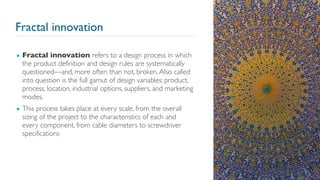
Fractal innovation
27
▪ Fractal innovation refers to a design process in which
the product definition and design rules are systematically
questioned—and, more often than not, broken.Also called
into question is the full gamut of design variables: product,
process, location, industrial options, suppliers, and marketing
modes.
▪ This process takes place at every scale, from the overall
sizing of the project to the characteristics of each and
every component, from cable diameters to screwdriver
specifications
28
Midler, Christophe. "Crossing the valley of death: managing the when, what, and how of innovative development projects." Project Management Journal 50.4 (2019):
447-459.
Development: Feedback loops to the vision!
many upfront creative endeavors still encounter
an innovation valley of death when they move into
the rigid and risk-averse development phase.Thus,
the frontier of innovative project organization
seems to be the ongoing quest to reconcile the
emergence of breakthrough innovations in the
upfront phase with the more rationalized nature
of development phases
29
Midler, Christophe. "Crossing the valley of death: managing the when, what, and how of
innovative development projects." Project Management Journal 50.4 (2019): 447-459.
Development: Feedback loops to the vision!
complex capital goods have specific innovation
management problems that are not found to the
same extent in simple products.This is because
they have large numbers of systemically related
subcomponents and an increased possibility that
redesigning one sub-component will produce
design changes in sensitive subcomponents.This
creates the potential for a redesign feedback
loops whereby small changes have
disproportionate effects on the innovation process.
30
Nightingale, Paul. "The product–process–organisation relationship in complex development
projects." Research policy 29.7-8 (2000): 913-930.
Stage 3, 4, 5:Test,Validation & Launch
▪ Stage 4 -Testing and Validation:
The purpose of this stage is to provide validation of the
entire project: the product itself, the production/
manufacturing process, customer acceptance, and the
economics of the project.
▪ Stage 5 -Launch:
Full commercialisation of the product - the beginning of full
production and commercial launch.
31
Attendance
32
Stage-gate control process
33
Cooper, R.G.,Winning at new products.
4th ed., 2011, New York:Basic Books; Cooper,
R.G., Doing it right: Winning with new products.
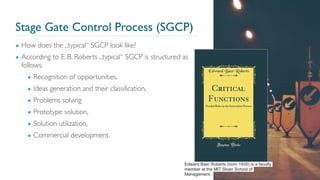
Stage Gate Control Process (SGCP)
▪ How does the „typical“ SGCP look like?
▪ According to E. B. Roberts „typical“ SGCP is structured as
follows:
▪ Recognition of opportunities,
▪ Ideas generation and their classification,
▪ Problems solving
▪ Prototype solution,
▪ Solution utilization,
▪ Commercial development.
34
Edward Baer Roberts (born 1935) is a faculty
member at the MIT Sloan School of
Management.
Criticisms of stage gate
▪ the logic of strategic alignment that underlies the selection in
the stage gate has devastating effects on
exploratory projects that have precisely the function of
preparing strategic disruptions (Christensen, Kaufman, & Shih,
2008)
▪ the widely used stage-gate process may lead to project
inflexibility that ultimately has disastrous effects on
exploratory projects (Sehti & Iqbal, 2008).
▪ Learning from successive projects is not captured in the
stage-gate system
35
Lenfle, Sylvain, Christophe Midler, and Markus Hällgren. "Exploratory
projects: From strangeness to theory." Project management journal 50.5
(2019): 519-523.
II. Project Portfolios
Selecting a good mix of projects
Portfolios
▪ A project portfolio is a collection of projects, programs and
processes that are managed together and optimized for the
financial and strategic goals of an organization
▪ A stage-gate system manages a portfolio projects at various
stages
37
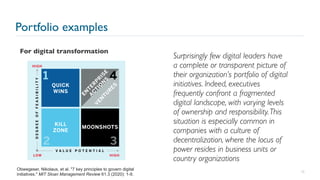
Portfolio examples
38
Obwegeser, Nikolaus, et al. "7 key principles to govern digital
initiatives." MIT Sloan Management Review 61.3 (2020): 1-9.
For digital transformation
Surprisingly few digital leaders have
a complete or transparent picture of
their organization’s portfolio of digital
initiatives. Indeed, executives
frequently confront a fragmented
digital landscape, with varying levels
of ownership and responsibility.This
situation is especially common in
companies with a culture of
decentralization, where the locus of
power resides in business units or
country organizations
Portfolio examples
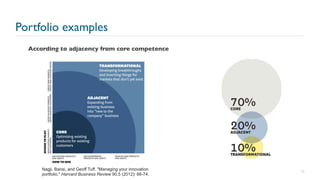
39
Nagji, Bansi, and Geoff Tuff. "Managing your innovation
portfolio." Harvard Business Review 90.5 (2012): 66-74.
According to adjacency from core competence
Portfolio examples
40
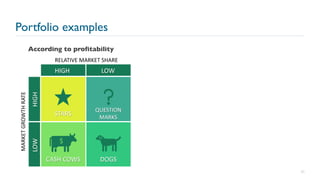
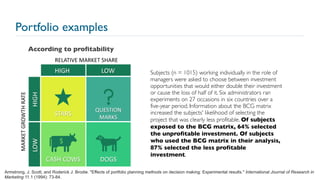
According to profitability
Remember the point about uncertainty from before?
41
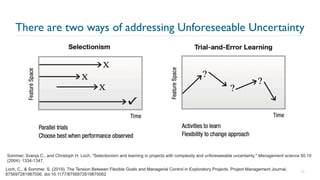
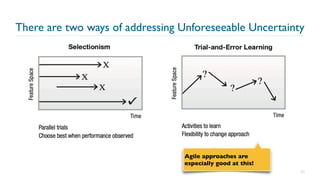
There are two ways of addressing Unforeseeable Uncertainty
42
Sommer, Svenja C., and Christoph H. Loch. "Selectionism and learning in projects with complexity and unforeseeable uncertainty." Management science 50.10
(2004): 1334-1347.
Loch, C., & Sommer, S. (2019). The Tension Between Flexible Goals and Managerial Control in Exploratory Projects. Project Management Journal,
875697281987006. doi:10.1177/8756972819870062
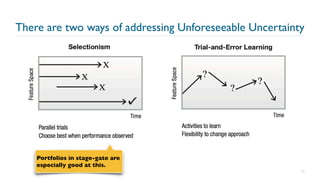
There are two ways of addressing Unforeseeable Uncertainty
43
Portfolios in stage-gate are
especially good at this.
Standard portfolios have limits
▪ Portfolio objectives have become overly
standardized Most companies seek similar portfolio
objectives, such as achieving a balance between making
incremental improvements and applying new technologies.
▪ Executives often evaluate individual projects along
standard performance metrics like net present
value, but they spend little time thinking about what types of
projects the company’s competitive positioning needs
beyond the general notion of diversification reducing risks.
▪ As a result, companies’ innovation projects tend
to be weakly related to their distinctive
strategic goals, and at worst, they work against its
strategy
44
Christoph Loch, Stelios Kavadias. “A New Approach to Strategic Innovation.” Harvard Business Reveiw sept-oct 2023
Portfolio examples
45
According to profitability
Armstrong, J. Scott, and Roderick J. Brodie. "Effects of portfolio planning methods on decision making: Experimental results." International Journal of Research in
Marketing 11.1 (1994): 73-84.
Subjects (n = 1015) working individually in the role of
managers were asked to choose between investment
opportunities that would either double their investment
or cause the loss of half of it. Six administrators ran
experiments on 27 occasions in six countries over a
five-year period. Information about the BCG matrix
increased the subjects' likelihood of selecting the
project that was clearly less profitable. Of subjects
exposed to the BCG matrix, 64% selected
the unprofitable investment. Of subjects
who used the BCG matrix in their analysis,
87% selected the less profitable
investment.
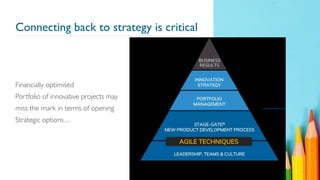
Connecting back to strategy is critical
Financially optimised
Portfolio of innovative projects may
miss the mark in terms of opening
Strategic options…
46
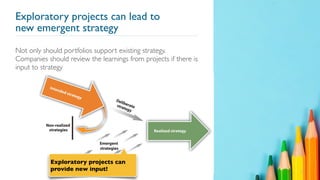
Exploratory projects can lead to
new emergent strategy
47
Exploratory projects can
provide new input!
Not only should portfolios support existing strategy.
Companies should review the learnings from projects if there is
input to strategy
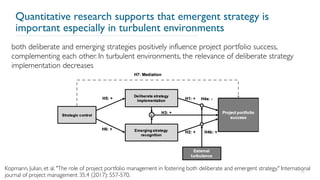
Quantitative research supports that emergent strategy is
important especially in turbulent environments
48
Kopmann, Julian, et al. "The role of project portfolio management in fostering both deliberate and emergent strategy." International
journal of project management 35.4 (2017): 557-570.
both deliberate and emerging strategies positively influence project portfolio success,
complementing each other. In turbulent environments, the relevance of deliberate strategy
implementation decreases
III. Agile systems
Execution under unforeseeable uncertainty
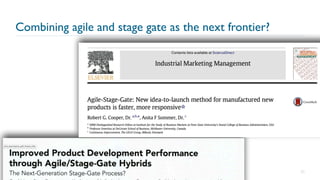
Combining agile and stage gate as the next frontier?
50
51
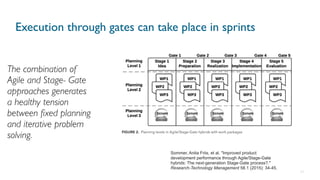
Sommer, Anita Friis, et al. "Improved product
development performance through Agile/Stage-Gate
hybrids: The next-generation Stage-Gate process?."
Research-Technology Management 58.1 (2015): 34-45.
Execution through gates can take place in sprints
The combination of
Agile and Stage- Gate
approaches generates
a healthy tension
between fixed planning
and iterative problem
solving.
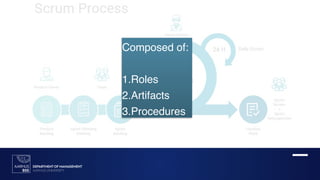
Composed of:
1.Roles
2.Artifacts
3.Procedures
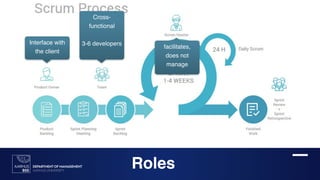
Interface with
the client
Cross-
functional
3-6 developers
facilitates,
does not
manage
Roles
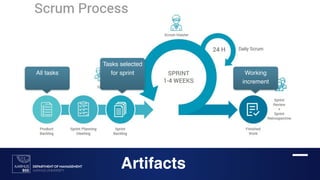
All tasks
Tasks selected
for sprint Working
increment
Artifacts
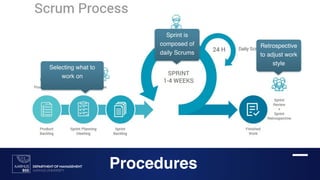
Selecting what to
work on
Sprint is
composed of
daily Scrums
Retrospective
to adjust work
style
Procedures
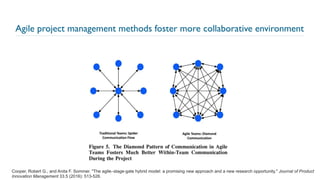
Agile project management methods foster more collaborative environment
58
Cooper, Robert G., and Anita F. Sommer. "The agile–stage
‐
gate hybrid model: a promising new approach and a new research opportunity." Journal of Product
Innovation Management 33.5 (2016): 513-526.
59
There are two ways of addressing Unforeseeable Uncertainty
60
Agile approaches are
especially good at this!
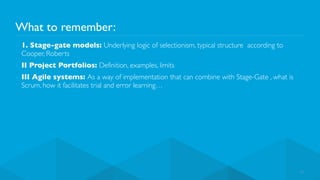
What to remember:
61
▪ 1. Stage-gate models: Underlying logic of selectionism, typical structure according to
Cooper, Roberts
▪ II Project Portfolios: Definition, examples, limits
▪ III Agile systems: As a way of implementation that can combine with Stage-Gate , what is
Scrum, how it facilitates trial and error learning…
The Logan Epic case
Michal Hron
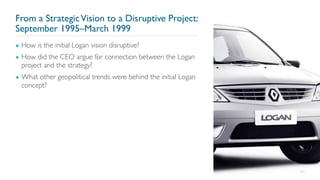
From a StrategicVision to a Disruptive Project:
September 1995–March 1999
▪ How is the initial Logan vision disruptive?
▪ How did the CEO argue for connection between the Logan
project and the strategy?
▪ What other geopolitical trends were behind the initial Logan
concept?
64
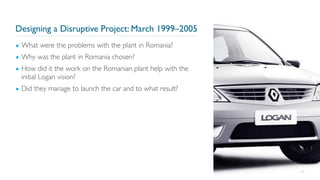
Designing a Disruptive Project: March 1999–2005
▪ What were the problems with the plant in Romania?
▪ Why was the plant in Romania chosen?
▪ How did it the work on the Romanian plant help with the
initial Logan vision?
▪ Did they manage to launch the car and to what result?
65
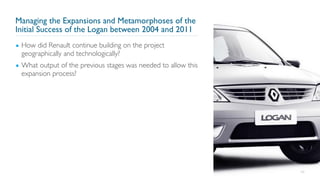
Managing the Expansions and Metamorphoses of the
Initial Success of the Logan between 2004 and 2011
▪ How did Renault continue building on the project
geographically and technologically?
▪ What output of the previous stages was needed to allow this
expansion process?
66
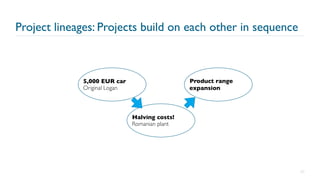
Project lineages: Projects build on each other in sequence
67
5,000 EUR car
Original Logan
Halving costs!
Romanian plant
Product range
expansion
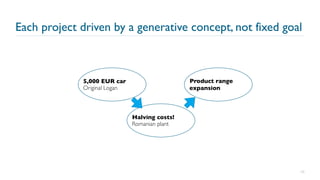
Each project driven by a generative concept, not fixed goal
68
5,000 EUR car
Original Logan
Halving costs!
Romanian plant
Product range
expansion
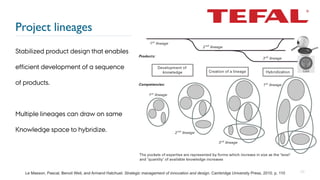
Project lineages
Stabilized product design that enables
efficient development of a sequence
of products.
Multiple lineages can draw on same
Knowledge space to hybridize.
69
Le Masson, Pascal, Benoit Weil, and Armand Hatchuel. Strategic management of innovation and design. Cambridge University Press, 2010. p. 110
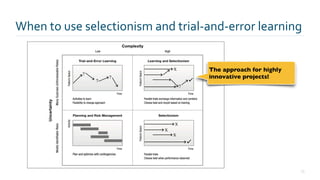
When to use selectionism and trial-and-error learning
70
The approach for highly
innovative projects!
Faculty of Business Administration
Prague University of Economics
and Business
W. Churchill Sq. 4
130 67 Prague 3, Czech Republic
Thank you
Michal Hron, PhD
Assistant professor
michal.hron@vse.cz
hronmichal.net
72

Stage gate, portfolios, agile systems

  • 1.
    Stage gate, portfolios,agile systems Michal Hron, PhD
  • 2.
    How to directthe innovation process? ▪ Innovation is an imperative. It needs to be ongoing. ▪ How to systematically manage this unbounded creative process? ▪ Companies need an organisational process to reliably and consistently manage a pipeline of innovation, from concept to launch 2
  • 3.
    3 ▪ radical projectsare managed less flexibly than incremental projects ▪ Instead of being an offshoot of less strategic planning, radical projects are just as strategically aligned as incremental projects ▪ Instead of being informally introduced entrepreneurial adventures, radical projects are often the result of more formal ideation methods ▪ As the level of innovativeness increased, so too did the amount of controls imposed Holahan, Patricia J., Zhen Z. Sullivan, and Stephen K. Markham. "Product development as core competence: How formal product development practices differ for radical, more innovative, and incremental product innovations." Journal of Product Innovation Management 31.2 (2014): 329-345. Radical innovation needs formal control
  • 4.
    Agenda 4 ▪ 1. Stage-gatemodels: Controlling innovation funnel within an organization ▪ II Project Portfolios: Selecting a good mix of projects ▪ III Agile systems: Execution under unforeseeable uncertainty
  • 5.
    1. Stage-gate models Controllinginnovation funnel within an organization
  • 6.
    Stage-gate models takeus closer to the tactical level 6 ▪ We discussed strategy and innovative organization ▪ Stage-gate models sit in-between: ▪ They help implement strategy ▪ But depend on organization
  • 7.
    Stage-gate control process ▪Facing increased pressure to reduce the cycle time yet improve their new product "hit rate," corporations are increasingly looking to stage-gate models as effective tools to manage, direct, and control their product-innovation efforts ▪ A stage-gate system is both a conceptual and an operational model for moving a new product from idea to launch. 7 Cooper, Robert G. "Stage-gate systems: a new tool for managing new products." Business horizons 33.3 (1990): 44-54. Dr. Robert G. Cooper, Professor Emeritus at McMaster University in Canada, the world- expert in product innovation.
  • 8.
    Stage-gate control process ▪Cooper developer formalized process which included: ▪ Capturing the idea and system mastering “voice of customer“ exploration to be based on active discussion with customers and collaboration with lead-users ▪ Scenario development ▪ Organizing actions which generate fundamental benefits 8 Cooper, Robert G. "Stage-gate systems: a new tool for managing new products." Business horizons 33.3 (1990): 44-54. Dr. Robert G. Cooper, Professor Emeritus at McMaster University in Canada, the world- expert in product innovation.
  • 9.
    Stage-gate control process ▪Stages: Activities needed to push idea towards realisation (or elimination) ▪ Gates: Assessment points that evaluate a project and decide whether it can continue Many variations to this basic idea exist (e.g.,‘fuzzy gates’), but the important point is to ensure that there is a structure in place that reviews both technical and marketing data at each stage 9 Cooper, R.G.,Winning at new products. 4th ed., 2011, New York:Basic Books; Cooper, R.G., Doing it right: Winning with new products. Ivey Business Journal, 2000. 64(6), 1–7.
  • 10.
    10 Underlying idea isa funnel that eliminates ideas across stages
  • 11.
    11 Gates are committeeswith decision criteria that determine whether a project can advance to the next stage
  • 12.
    12 Gates make fourtypes of decisions… Go The project is good enough to move on to the next stage. Kill The project is not good enough to develop further and is shut down right away. Hold The project is not good enough to continue to develop it at this moment, but not so bad that it needs to be shut down immediately. It is put on hold to possibly be resumed at a later date. Recycle The project is good enough to develop further, provided some changes are made
  • 13.
    Uncertainty decreases overthe funnel ▪ Across the stages, the level of uncertainty decreases ▪ Innovation requires deciding on incomplete information! ▪ Decisions early in the funnel are less costly but more difficult 13
  • 14.
    Stage 1: Discovery ▪Activities designed to discover opportunities and to generate new ideas concerning a product. ▪ Design thinking, technology roadmapping etc. ▪ The term Fuzzy front end is sometimes used to describe the emerging frontier of innovation before it takes shape 14
  • 15.
    Stage 1: Leadusers ▪ Involving innovators into the development process ▪ Two characteristics of lead users: 1. They face needs that will be general in a marketplace 2. They expect to benefit significantly by obtaining a solution to those needs 15 Herstatt, Cornelius, and Eric Von Hippel. "From experience: Developing new product concepts via the lead user method: A case study in a “low-tech” field." Journal of product innovation management 9.3 (1992): 213-221.
  • 16.
    How Hilti usedLead users ▪ Pipe hangers are assemblages of steel supports and pipe clamps and other hardware components used to securely fasten pipes to the walls and/or ceilings of buildings. Sometimes pipe hangers can be quite simple and support only a single pipe. ▪ Frequently pretty complicated 16 Herstatt, Cornelius, and Eric Von Hippel. "From experience: Developing new product concepts via the lead user method: A case study in a “low-tech” field." Journal of product innovation management 9.3 (1992): 213-221.
  • 17.
    How Hilti usedLead users 17 Herstatt, Cornelius, and Eric Von Hippel. "From experience: Developing new product concepts via the lead user method: A case study in a “low-tech” field." Journal of product innovation management 9.3 (1992): 213-221. Identify of trends and needs Need for ease, because workers are less educated Safety standards requirements Identify lead users From current clients, select 22 lead users, interview to assess how well they can describe their work habits etc. Concept development Prototyping workshop lead users joined by two of the expert layout engineers who had participated in the trend analysis segment. One prototype Testing on ordinary users test the lead user product concept on a sample of 12 "routine" users using telephone interview
  • 18.
    Stage 2: Scoping ▪A quick and inexpensive assessment of the technical merits of the project and its market prospects. ▪ Includes development of a business case 18
  • 19.
    Stage 3: Development 19 Midler,C. (2019). Crossing the Valley of Death: Managing the When, What, and How of Innovative Development Projects. Project Management Journal, 875697281985788. doi:10.1177/8756972819857881 ▪ Plans are translated into concrete deliverables. ▪ The manufacturing or operations plan is mapped out, ▪ The marketing launch and operating plans are developed, ▪ The test plans for the next stage are defined.
  • 20.
    Stage 3: Development 20 ▪Development takes the abstract concept and realises it ▪ Corresponds to implementation inV-model of engineering
  • 21.
  • 22.
    Renault Kwid… 22 ▪ In2012, Renault wanted to conquer middle class in India ▪ Initiative approved by CEO despite reluctance of leadership ▪ Target price 4,000 EUR! ▪ exterior design of the car: a mini SUV style that fit in with a major style trend in India and elsewhere, and would clearly differentiate the new product from existing small cars in the Indian market
  • 23.
    What innovation isthis? 23 ▪ Disruptive or sustaining? ▪ Breakthrough or incremental?
  • 24.
    What innovation isthis? 24 ▪ Disruptive or sustaining? ▪ Entering at the low end of the market is certainly disruptive. ▪ Breakthrough or incremental? ▪ As a car, the Kwid did not introduce any remarkable breakthrough—it represented neither a major technological leap nor a change in mobility business model. However, as a modern, attractive car priced at €3,500, there was no doubt that it represented an unprecedented automotive experience.
  • 25.
    What innovation isthis? 25 Henderson, Rebecca M., and Kim B. Clark. "Architectural innovation: The reconfiguration of existing product technologies and the failure of established firms." Administrative science quarterly (1990): 9-30.
  • 26.
    What innovation isthis? 26 ▪ it featured no new architecture and no new technology that radically changed any of its components. ▪ However, this erases the significance of the break-through heralded by the Kwid’s design. For example, the processes and organization of the engineering teams were utterly destabilized. How could anyone claim that cutting the cost of a firm’s cheapest product in half was in any sense incremental?
  • 27.
    Fractal innovation 27 ▪ Fractalinnovation refers to a design process in which the product definition and design rules are systematically questioned—and, more often than not, broken.Also called into question is the full gamut of design variables: product, process, location, industrial options, suppliers, and marketing modes. ▪ This process takes place at every scale, from the overall sizing of the project to the characteristics of each and every component, from cable diameters to screwdriver specifications
  • 28.
    28 Midler, Christophe. "Crossingthe valley of death: managing the when, what, and how of innovative development projects." Project Management Journal 50.4 (2019): 447-459.
  • 29.
    Development: Feedback loopsto the vision! many upfront creative endeavors still encounter an innovation valley of death when they move into the rigid and risk-averse development phase.Thus, the frontier of innovative project organization seems to be the ongoing quest to reconcile the emergence of breakthrough innovations in the upfront phase with the more rationalized nature of development phases 29 Midler, Christophe. "Crossing the valley of death: managing the when, what, and how of innovative development projects." Project Management Journal 50.4 (2019): 447-459.
  • 30.
    Development: Feedback loopsto the vision! complex capital goods have specific innovation management problems that are not found to the same extent in simple products.This is because they have large numbers of systemically related subcomponents and an increased possibility that redesigning one sub-component will produce design changes in sensitive subcomponents.This creates the potential for a redesign feedback loops whereby small changes have disproportionate effects on the innovation process. 30 Nightingale, Paul. "The product–process–organisation relationship in complex development projects." Research policy 29.7-8 (2000): 913-930.
  • 31.
    Stage 3, 4,5:Test,Validation & Launch ▪ Stage 4 -Testing and Validation: The purpose of this stage is to provide validation of the entire project: the product itself, the production/ manufacturing process, customer acceptance, and the economics of the project. ▪ Stage 5 -Launch: Full commercialisation of the product - the beginning of full production and commercial launch. 31
  • 32.
  • 33.
    Stage-gate control process 33 Cooper,R.G.,Winning at new products. 4th ed., 2011, New York:Basic Books; Cooper, R.G., Doing it right: Winning with new products.
  • 34.
    Stage Gate ControlProcess (SGCP) ▪ How does the „typical“ SGCP look like? ▪ According to E. B. Roberts „typical“ SGCP is structured as follows: ▪ Recognition of opportunities, ▪ Ideas generation and their classification, ▪ Problems solving ▪ Prototype solution, ▪ Solution utilization, ▪ Commercial development. 34 Edward Baer Roberts (born 1935) is a faculty member at the MIT Sloan School of Management.
  • 35.
    Criticisms of stagegate ▪ the logic of strategic alignment that underlies the selection in the stage gate has devastating effects on exploratory projects that have precisely the function of preparing strategic disruptions (Christensen, Kaufman, & Shih, 2008) ▪ the widely used stage-gate process may lead to project inflexibility that ultimately has disastrous effects on exploratory projects (Sehti & Iqbal, 2008). ▪ Learning from successive projects is not captured in the stage-gate system 35 Lenfle, Sylvain, Christophe Midler, and Markus Hällgren. "Exploratory projects: From strangeness to theory." Project management journal 50.5 (2019): 519-523.
  • 36.
    II. Project Portfolios Selectinga good mix of projects
  • 37.
    Portfolios ▪ A projectportfolio is a collection of projects, programs and processes that are managed together and optimized for the financial and strategic goals of an organization ▪ A stage-gate system manages a portfolio projects at various stages 37
  • 38.
    Portfolio examples 38 Obwegeser, Nikolaus,et al. "7 key principles to govern digital initiatives." MIT Sloan Management Review 61.3 (2020): 1-9. For digital transformation Surprisingly few digital leaders have a complete or transparent picture of their organization’s portfolio of digital initiatives. Indeed, executives frequently confront a fragmented digital landscape, with varying levels of ownership and responsibility.This situation is especially common in companies with a culture of decentralization, where the locus of power resides in business units or country organizations
  • 39.
    Portfolio examples 39 Nagji, Bansi,and Geoff Tuff. "Managing your innovation portfolio." Harvard Business Review 90.5 (2012): 66-74. According to adjacency from core competence
  • 40.
  • 41.
    Remember the pointabout uncertainty from before? 41
  • 42.
    There are twoways of addressing Unforeseeable Uncertainty 42 Sommer, Svenja C., and Christoph H. Loch. "Selectionism and learning in projects with complexity and unforeseeable uncertainty." Management science 50.10 (2004): 1334-1347. Loch, C., & Sommer, S. (2019). The Tension Between Flexible Goals and Managerial Control in Exploratory Projects. Project Management Journal, 875697281987006. doi:10.1177/8756972819870062
  • 43.
    There are twoways of addressing Unforeseeable Uncertainty 43 Portfolios in stage-gate are especially good at this.
  • 44.
    Standard portfolios havelimits ▪ Portfolio objectives have become overly standardized Most companies seek similar portfolio objectives, such as achieving a balance between making incremental improvements and applying new technologies. ▪ Executives often evaluate individual projects along standard performance metrics like net present value, but they spend little time thinking about what types of projects the company’s competitive positioning needs beyond the general notion of diversification reducing risks. ▪ As a result, companies’ innovation projects tend to be weakly related to their distinctive strategic goals, and at worst, they work against its strategy 44 Christoph Loch, Stelios Kavadias. “A New Approach to Strategic Innovation.” Harvard Business Reveiw sept-oct 2023
  • 45.
    Portfolio examples 45 According toprofitability Armstrong, J. Scott, and Roderick J. Brodie. "Effects of portfolio planning methods on decision making: Experimental results." International Journal of Research in Marketing 11.1 (1994): 73-84. Subjects (n = 1015) working individually in the role of managers were asked to choose between investment opportunities that would either double their investment or cause the loss of half of it. Six administrators ran experiments on 27 occasions in six countries over a five-year period. Information about the BCG matrix increased the subjects' likelihood of selecting the project that was clearly less profitable. Of subjects exposed to the BCG matrix, 64% selected the unprofitable investment. Of subjects who used the BCG matrix in their analysis, 87% selected the less profitable investment.
  • 46.
    Connecting back tostrategy is critical Financially optimised Portfolio of innovative projects may miss the mark in terms of opening Strategic options… 46
  • 47.
    Exploratory projects canlead to new emergent strategy 47 Exploratory projects can provide new input! Not only should portfolios support existing strategy. Companies should review the learnings from projects if there is input to strategy
  • 48.
    Quantitative research supportsthat emergent strategy is important especially in turbulent environments 48 Kopmann, Julian, et al. "The role of project portfolio management in fostering both deliberate and emergent strategy." International journal of project management 35.4 (2017): 557-570. both deliberate and emerging strategies positively influence project portfolio success, complementing each other. In turbulent environments, the relevance of deliberate strategy implementation decreases
  • 49.
    III. Agile systems Executionunder unforeseeable uncertainty
  • 50.
    Combining agile andstage gate as the next frontier? 50
  • 51.
    51 Sommer, Anita Friis,et al. "Improved product development performance through Agile/Stage-Gate hybrids: The next-generation Stage-Gate process?." Research-Technology Management 58.1 (2015): 34-45. Execution through gates can take place in sprints The combination of Agile and Stage- Gate approaches generates a healthy tension between fixed planning and iterative problem solving.
  • 54.
  • 55.
    Interface with the client Cross- functional 3-6developers facilitates, does not manage Roles
  • 56.
    All tasks Tasks selected forsprint Working increment Artifacts
  • 57.
    Selecting what to workon Sprint is composed of daily Scrums Retrospective to adjust work style Procedures
  • 58.
    Agile project managementmethods foster more collaborative environment 58 Cooper, Robert G., and Anita F. Sommer. "The agile–stage ‐ gate hybrid model: a promising new approach and a new research opportunity." Journal of Product Innovation Management 33.5 (2016): 513-526.
  • 59.
  • 60.
    There are twoways of addressing Unforeseeable Uncertainty 60 Agile approaches are especially good at this!
  • 61.
    What to remember: 61 ▪1. Stage-gate models: Underlying logic of selectionism, typical structure according to Cooper, Roberts ▪ II Project Portfolios: Definition, examples, limits ▪ III Agile systems: As a way of implementation that can combine with Stage-Gate , what is Scrum, how it facilitates trial and error learning…
  • 62.
    The Logan Epiccase Michal Hron
  • 64.
    From a StrategicVisionto a Disruptive Project: September 1995–March 1999 ▪ How is the initial Logan vision disruptive? ▪ How did the CEO argue for connection between the Logan project and the strategy? ▪ What other geopolitical trends were behind the initial Logan concept? 64
  • 65.
    Designing a DisruptiveProject: March 1999–2005 ▪ What were the problems with the plant in Romania? ▪ Why was the plant in Romania chosen? ▪ How did it the work on the Romanian plant help with the initial Logan vision? ▪ Did they manage to launch the car and to what result? 65
  • 66.
    Managing the Expansionsand Metamorphoses of the Initial Success of the Logan between 2004 and 2011 ▪ How did Renault continue building on the project geographically and technologically? ▪ What output of the previous stages was needed to allow this expansion process? 66
  • 67.
    Project lineages: Projectsbuild on each other in sequence 67 5,000 EUR car Original Logan Halving costs! Romanian plant Product range expansion
  • 68.
    Each project drivenby a generative concept, not fixed goal 68 5,000 EUR car Original Logan Halving costs! Romanian plant Product range expansion
  • 69.
    Project lineages Stabilized productdesign that enables efficient development of a sequence of products. Multiple lineages can draw on same Knowledge space to hybridize. 69 Le Masson, Pascal, Benoit Weil, and Armand Hatchuel. Strategic management of innovation and design. Cambridge University Press, 2010. p. 110
  • 70.
    When to useselectionism and trial-and-error learning 70 The approach for highly innovative projects!
  • 71.
    Faculty of BusinessAdministration Prague University of Economics and Business W. Churchill Sq. 4 130 67 Prague 3, Czech Republic Thank you Michal Hron, PhD Assistant professor michal.hron@vse.cz hronmichal.net
  • 72.