Consumer Durables
Presented by Rashmi K R
Plan of presentation
 Classification of goods
 Major players
 Indian consumer durables industry
 Key growth drivers
 Challenges
 Porter’s five force model
 SWOT Analysis of Dell
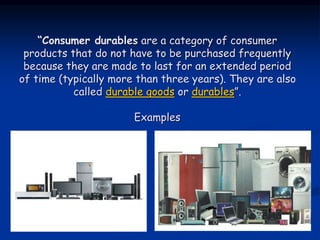
“Consumer durables are a category of consumer
products that do not have to be purchased frequently
because they are made to last for an extended period
of time (typically more than three years). They are also
called durable goods or durables”.
Examples
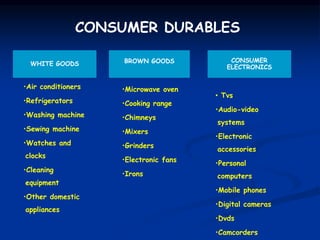
CONSUMER DURABLES
WHITE GOODS BROWN GOODS CONSUMER
ELECTRONICS
•Air conditioners
•Refrigerators
•Washing machine
•Sewing machine
•Watches and
clocks
•Cleaning
equipment
•Other domestic
appliances
•Microwave oven
•Cooking range
•Chimneys
•Mixers
•Grinders
•Electronic fans
•Irons
• Tvs
•Audio-video
systems
•Electronic
accessories
•Personal
computers
•Mobile phones
•Digital cameras
•Dvds
•Camcorders
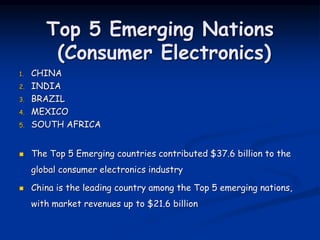
Top 5 Emerging Nations
(Consumer Electronics)
1. CHINA
2. INDIA
3. BRAZIL
4. MEXICO
5. SOUTH AFRICA
 The Top 5 Emerging countries contributed $37.6 billion to the
global consumer electronics industry
 China is the leading country among the Top 5 emerging nations,
with market revenues up to $21.6 billion
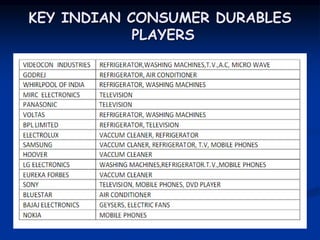
KEY INDIAN CONSUMER DURABLES
PLAYERS
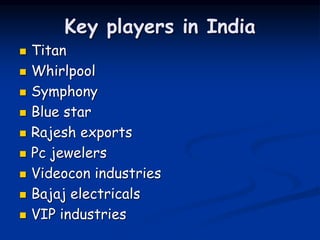
Key players in India
 Titan
 Whirlpool
 Symphony
 Blue star
 Rajesh exports
 Pc jewelers
 Videocon industries
 Bajaj electricals
 VIP industries
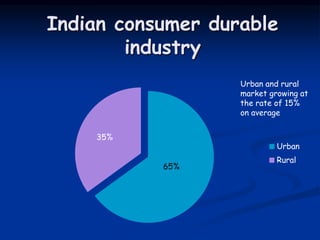
Indian consumer durable
industry
Urban
Rural
65%
Urban and rural
market growing at
the rate of 15%
on average
35%
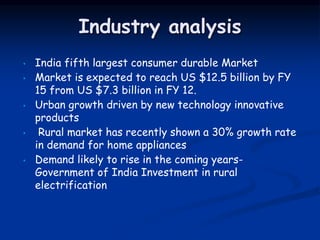
Industry analysis
• India fifth largest consumer durable Market
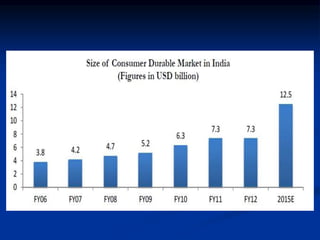
• Market is expected to reach US $12.5 billion by FY
15 from US $7.3 billion in FY 12.
• Urban growth driven by new technology innovative
products
• Rural market has recently shown a 30% growth rate
in demand for home appliances
• Demand likely to rise in the coming years-
Government of India Investment in rural
electrification
Key Growth Drivers
 Rise in disposable income
 Availability of new and innovative
products
 Pricing of the products
 Rise in the share of organized retail
 Innovative advertising and brand
promotion
 Festive season sales
Challenges
 Threat from new entrants, especially
global companies
 Rivalry and competition
 Potential market remaining yet untapped
 Threats from substitute products
 Availability of choice
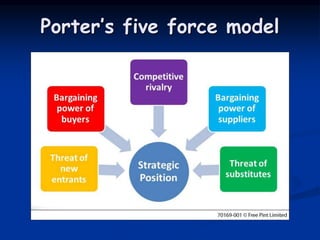
Porter’s five force model
PRODUCT ANALYSIS
 THREAT OF NEW ENTRANTS
Most current players are global players• New entrants will need to
invest in brand, technology, distribution
 CUSTOMER POWER
Multitude of brands across price points — wide variety of choice
for customers
 SUPPLIER POWER
Indigenous supply base limited — most raw materials are imported
 COMPETITIVE RIVALRY
Number of well-established players; several new players entering
Good technological capability
 THREAT OF SUBSTITUTES
Unbranded products and cheaper imports could enter the market
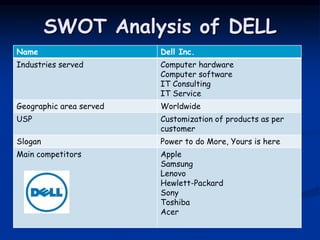
SWOT Analysis of DELL
Name Dell Inc.
Industries served Computer hardware
Computer software
IT Consulting
IT Service
Geographic area served Worldwide
USP Customization of products as per
customer
Slogan Power to do More, Yours is here
Main competitors Apple
Samsung
Lenovo
Hewlett-Packard
Sony
Toshiba
Acer
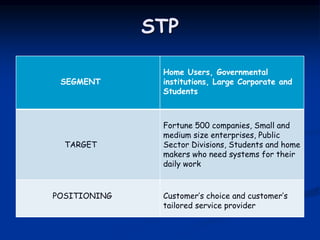
STP
SEGMENT
Home Users, Governmental
institutions, Large Corporate and
Students
TARGET
Fortune 500 companies, Small and
medium size enterprises, Public
Sector Divisions, Students and home
makers who need systems for their
daily work
POSITIONING Customer’s choice and customer’s
tailored service provider
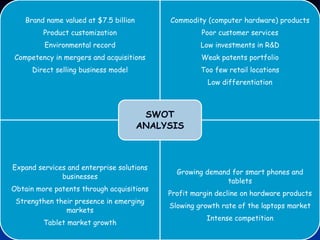
Brand name valued at $7.5 billion
Product customization
Environmental record
Competency in mergers and acquisitions
Direct selling business model
Commodity (computer hardware) products
Poor customer services
Low investments in R&D
Weak patents portfolio
Too few retail locations
Low differentiation
Expand services and enterprise solutions
businesses
Obtain more patents through acquisitions
Strengthen their presence in emerging
markets
Tablet market growth
Growing demand for smart phones and
tablets
Profit margin decline on hardware products
Slowing growth rate of the laptops market
Intense competition
SWOT
ANALYSIS

Consumer durables

  • 1.
  • 2.
    Plan of presentation Classification of goods  Major players  Indian consumer durables industry  Key growth drivers  Challenges  Porter’s five force model  SWOT Analysis of Dell
  • 3.
    “Consumer durables area category of consumer products that do not have to be purchased frequently because they are made to last for an extended period of time (typically more than three years). They are also called durable goods or durables”. Examples
  • 4.
    CONSUMER DURABLES WHITE GOODSBROWN GOODS CONSUMER ELECTRONICS •Air conditioners •Refrigerators •Washing machine •Sewing machine •Watches and clocks •Cleaning equipment •Other domestic appliances •Microwave oven •Cooking range •Chimneys •Mixers •Grinders •Electronic fans •Irons • Tvs •Audio-video systems •Electronic accessories •Personal computers •Mobile phones •Digital cameras •Dvds •Camcorders
  • 5.
    Top 5 EmergingNations (Consumer Electronics) 1. CHINA 2. INDIA 3. BRAZIL 4. MEXICO 5. SOUTH AFRICA  The Top 5 Emerging countries contributed $37.6 billion to the global consumer electronics industry  China is the leading country among the Top 5 emerging nations, with market revenues up to $21.6 billion
  • 6.
    KEY INDIAN CONSUMERDURABLES PLAYERS
  • 7.
    Key players inIndia  Titan  Whirlpool  Symphony  Blue star  Rajesh exports  Pc jewelers  Videocon industries  Bajaj electricals  VIP industries
  • 8.
    Indian consumer durable industry Urban Rural 65% Urbanand rural market growing at the rate of 15% on average 35%
  • 9.
    Industry analysis • Indiafifth largest consumer durable Market • Market is expected to reach US $12.5 billion by FY 15 from US $7.3 billion in FY 12. • Urban growth driven by new technology innovative products • Rural market has recently shown a 30% growth rate in demand for home appliances • Demand likely to rise in the coming years- Government of India Investment in rural electrification
  • 12.
    Key Growth Drivers Rise in disposable income  Availability of new and innovative products  Pricing of the products  Rise in the share of organized retail  Innovative advertising and brand promotion  Festive season sales
  • 13.
    Challenges  Threat fromnew entrants, especially global companies  Rivalry and competition  Potential market remaining yet untapped  Threats from substitute products  Availability of choice
  • 14.
  • 15.
    PRODUCT ANALYSIS  THREATOF NEW ENTRANTS Most current players are global players• New entrants will need to invest in brand, technology, distribution  CUSTOMER POWER Multitude of brands across price points — wide variety of choice for customers  SUPPLIER POWER Indigenous supply base limited — most raw materials are imported  COMPETITIVE RIVALRY Number of well-established players; several new players entering Good technological capability  THREAT OF SUBSTITUTES Unbranded products and cheaper imports could enter the market
  • 16.
    SWOT Analysis ofDELL Name Dell Inc. Industries served Computer hardware Computer software IT Consulting IT Service Geographic area served Worldwide USP Customization of products as per customer Slogan Power to do More, Yours is here Main competitors Apple Samsung Lenovo Hewlett-Packard Sony Toshiba Acer
  • 17.
    STP SEGMENT Home Users, Governmental institutions,Large Corporate and Students TARGET Fortune 500 companies, Small and medium size enterprises, Public Sector Divisions, Students and home makers who need systems for their daily work POSITIONING Customer’s choice and customer’s tailored service provider
  • 18.
    Brand name valuedat $7.5 billion Product customization Environmental record Competency in mergers and acquisitions Direct selling business model Commodity (computer hardware) products Poor customer services Low investments in R&D Weak patents portfolio Too few retail locations Low differentiation Expand services and enterprise solutions businesses Obtain more patents through acquisitions Strengthen their presence in emerging markets Tablet market growth Growing demand for smart phones and tablets Profit margin decline on hardware products Slowing growth rate of the laptops market Intense competition SWOT ANALYSIS