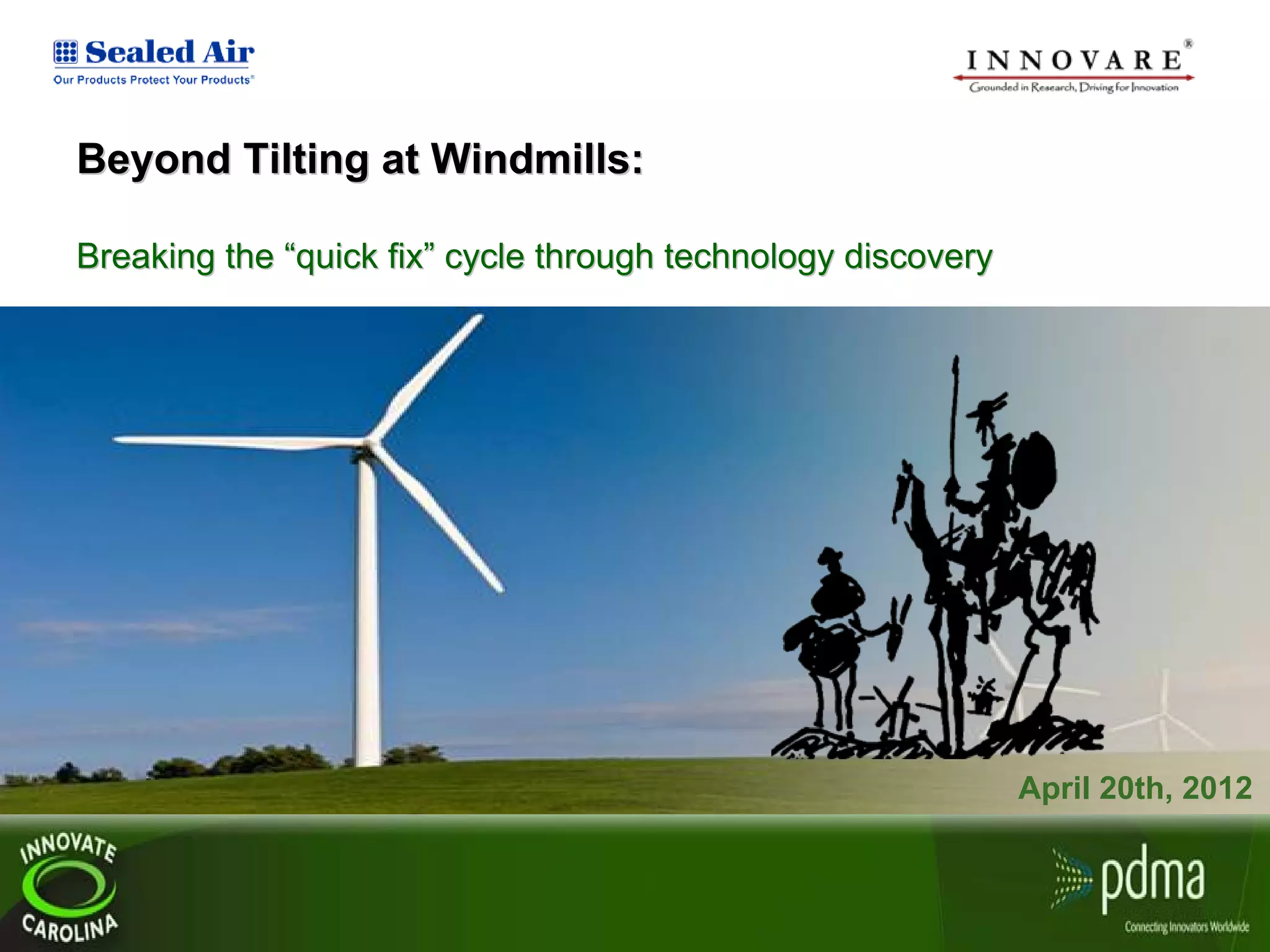
Beyond Tilting at Windmills:

Breaking the “quick fix” cycle through technology discovery


                                                              April 20th, 2012
Speakers
       Blaine Childress
                 – Sealed Air’s Manager of Open Innovation
                 – 32 years in Technology and Innovation
                 – Focus on technology protection, product innovation, and
                   technology scouting
                 – Role of project leader and problem owner
                 – Blaine.childress@sealedair.com


      Don Ross
                 – Innovare’s Founder and President
                 – 35 years as an innovation practitioner
                 – Focuses on the front end of innovation including discovery, concept
                   development and validation
                 – Role of team facilitator and process owner
                 – donross@innovare-inc.com
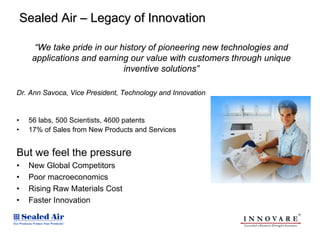
Sealed Air – Legacy of Innovation

       “We take pride in our history of pioneering new technologies and
      applications and earning our value with customers through unique
                              inventive solutions”

Dr. Ann Savoca, Vice President, Technology and Innovation


•    56 labs, 500 Scientists, 4600 patents
•    17% of Sales from New Products and Services


But we feel the pressure
•    New Global Competitors
•    Poor macroeconomics
•    Rising Raw Materials Cost
•    Faster Innovation
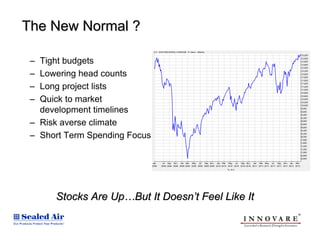
The New Normal ?

 – Tight budgets
 – Lowering head counts
 – Long project lists
 – Quick to market
   development timelines
 – Risk averse climate
 – Short Term Spending Focus


      Stocks Are Up…But It Doesn’t Feel Like It
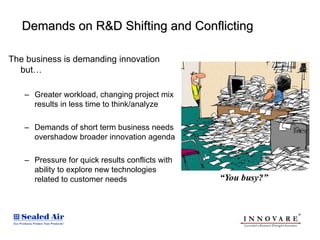
Demands on R&D Shifting and Conflicting

The business is demanding innovation
  but…

   – Greater workload, changing project mix
     results in less time to think/analyze

   – Demands of short term business needs
     overshadow broader innovation agenda

   – Pressure for quick results conflicts with
     ability to explore new technologies
     related to customer needs
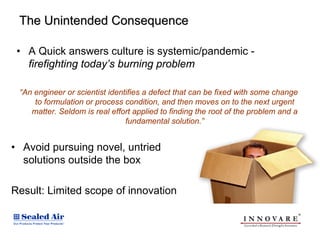
The Unintended Consequence

 • A Quick answers culture is systemic/pandemic -
   firefighting today’s burning problem

 “An engineer or scientist identifies a defect that can be fixed with some change
     to formulation or process condition, and then moves on to the next urgent
    matter. Seldom is real effort applied to finding the root of the problem and a
                                fundamental solution.”


• Avoid pursuing novel, untried
  solutions outside the box

Result: Limited scope of innovation
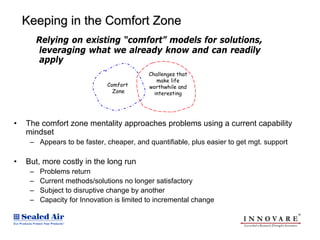
Keeping in the Comfort Zone
         Relying on existing “comfort” models for solutions,
          leveraging what we already know and can readily
          apply
                                           Challenges that
                                              make life
                              Comfort      worthwhile and
                                Zone         interesting


•   The comfort zone mentality approaches problems using a current capability
    mindset
     – Appears to be faster, cheaper, and quantifiable, plus easier to get mgt. support

•   But, more costly in the long run
     –   Problems return
     –   Current methods/solutions no longer satisfactory
     –   Subject to disruptive change by another
     –   Capacity for Innovation is limited to incremental change
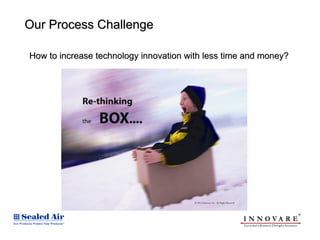
Our Process Challenge

How to increase technology innovation with less time and money?
Other People’s Money & Minds


•   Increase innovation capacity while reducing R&D costs and time
    by reaching out to external expertise and inventions
a Forum for Technology Discovery


•   Connect to customer needs
•   Engage multidisciplinary team
•   Provide a strong external perspective
•   Move beyond what is already known
•   Broaden the opportunity space
•   Apply Serendipity


SAC adapted Innovare’s Tech Explorer technology discovery approach
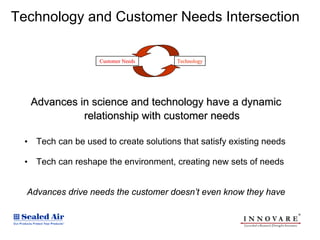
Technology and Customer Needs Intersection

                   Customer Needs      Technology


  Advances in science and technology have a dynamic
            relationship with customer needs

 • Tech can be used to create solutions that satisfy existing needs

 • Tech can reshape the environment, creating new sets of needs


  Advances drive needs the customer doesn’t even know they have
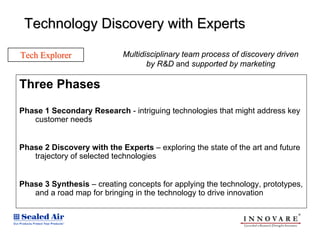
Technology Discovery with Experts

Tech Explorer               Multidisciplinary team process of discovery driven
                                   by R&D and supported by marketing

Three Phases

Phase 1 Secondary Research - intriguing technologies that might address key
   customer needs


Phase 2 Discovery with the Experts – exploring the state of the art and future
   trajectory of selected technologies


Phase 3 Synthesis – creating concepts for applying the technology, prototypes,
   and a road map for bringing in the technology to drive innovation
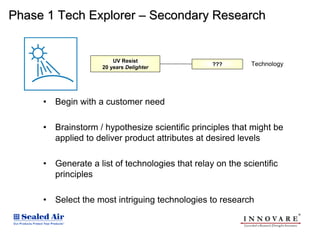
Phase 1 Tech Explorer – Secondary Research


    Categorized             UV Resist
                        20 years Delighter
                                                      ???       Technology
  Requirement level


        •   Begin with a customer need

        •   Brainstorm / hypothesize scientific principles that might be
            applied to deliver product attributes at desired levels

        •   Generate a list of technologies that relay on the scientific
            principles

        •   Select the most intriguing technologies to research
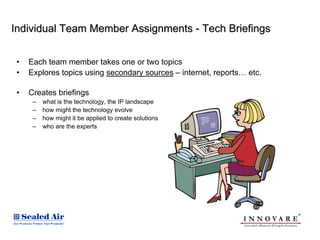
Individual Team Member Assignments - Tech Briefings


 •   Each team member takes one or two topics
 •   Explores topics using secondary sources – internet, reports… etc.

 •   Creates briefings
      –   what is the technology, the IP landscape
      –   how might the technology evolve
      –   how might it be applied to create solutions
      –   who are the experts
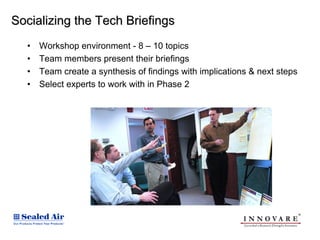
Socializing the Tech Briefings
  •   Workshop environment - 8 – 10 topics
  •   Team members present their briefings
  •   Team create a synthesis of findings with implications & next steps
  •   Select experts to work with in Phase 2
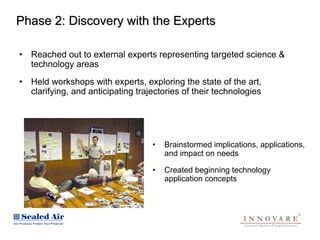
Phase 2: Discovery with the Experts

• Reached out to external experts representing targeted science &
  technology areas
• Held workshops with experts, exploring the state of the art,
  clarifying, and anticipating trajectories of their technologies


                                   •   Brainstormed implications, applications,
                                       and impact on needs

                                   •   Created beginning technology
                                       application concepts
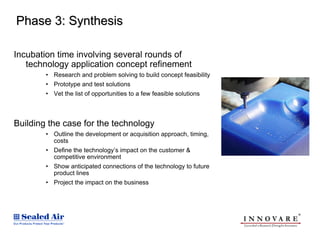
Phase 3: Synthesis

Incubation time involving several rounds of
   technology application concept refinement
        • Research and problem solving to build concept feasibility
        • Prototype and test solutions
        • Vet the list of opportunities to a few feasible solutions


Building the case for the technology
        • Outline the development or acquisition approach, timing,
          costs
        • Define the technology’s impact on the customer &
          competitive environment
        • Show anticipated connections of the technology to future
          product lines
        • Project the impact on the business
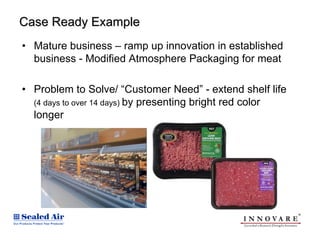
Case Ready Example
• Mature business – ramp up innovation in established
  business - Modified Atmosphere Packaging for meat

• Problem to Solve/ “Customer Need” - extend shelf life
  (4 days to over 14 days) by presenting bright red color
  longer
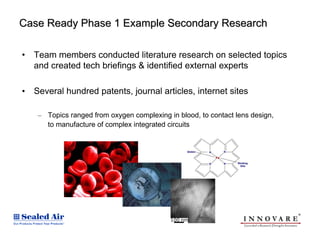
Case Ready Phase 1 Example Secondary Research

•   Team members conducted literature research on selected topics
    and created tech briefings & identified external experts

•   Several hundred patents, journal articles, internet sites

     – Topics ranged from oxygen complexing in blood, to contact lens design,
       to manufacture of complex integrated circuits
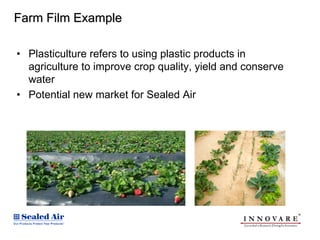
Farm Film Example

• Plasticulture refers to using plastic products in
  agriculture to improve crop quality, yield and conserve
  water
• Potential new market for Sealed Air
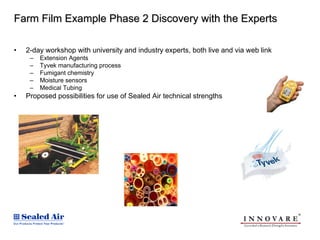
Farm Film Example Phase 2 Discovery with the Experts

•   2-day workshop with university and industry experts, both live and via web link
     –   Extension Agents
     –   Tyvek manufacturing process
     –   Fumigant chemistry
     –   Moisture sensors
     –   Medical Tubing
•   Proposed possibilities for use of Sealed Air technical strengths
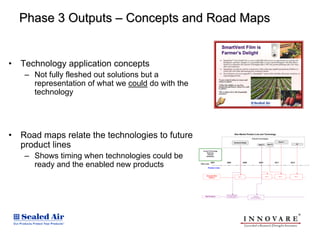
Phase 3 Outputs – Concepts and Road Maps


•   Technology application concepts
    – Not fully fleshed out solutions but a
      representation of what we could do with the
      technology


•   Road maps relate the technologies to future                                        New Market Product Line and Technology

                                                                                                               Potential Technologies


    product lines                                                                      Advanced Design                                             Green T
                                                                                                                           New T1      New T2                         UV


                                                      Current Technology
                                                           Extrusion


    – Shows timing when technologies could be               Thermal
                                                          Distillation


      ready and the enabled new products            Time Line
                                                                2007

                                                           Product Lines
                                                                           2008                        2009                2010                 2011           2012


                                                          Advanced New                                                              Gen 2              Gen 3      Gen 4
                                                                                               Gen 1
                                                            Platform


                                                                           Enhanced Design
                                                         New Products       First Generation                      Enhanced
                                                                                                              Second Generation
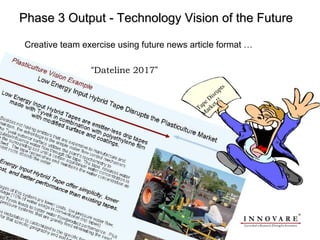
Phase 3 Output - Technology Vision of the Future

Creative team exercise using future news article format …

                “Dateline 2017”

                                                         p   ts
                                                  i s ru
                                             p e D et !!
                                           Ta ark
                                             M
Foundations of a Successful Tech Discovery Approach

                         •   Well connected to customer needs
                         •   Engaged multidisciplinary team
                         •   Strong external perspective
                         •   Broad opportunity space
                         •   Diligent use of synthesis process to
                             identify value paths
                         •   Embrace well considered sciences and
                             pursue opportunities outside the
                             comfort zone
Lessons Learned-
         Make Time For Synthesis

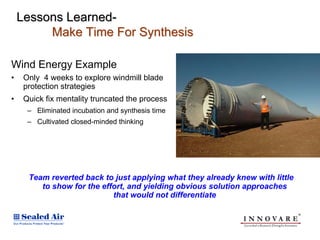
Wind Energy Example
•    Only 4 weeks to explore windmill blade
     protection strategies
•    Quick fix mentality truncated the process
      – Eliminated incubation and synthesis time
      – Cultivated closed-minded thinking


      Team reverted back to just applying what they already knew with little
         to show for the effort, and yielding obvious solution approaches
                            that would not differentiate
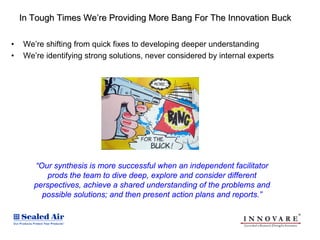
In Tough Times We’re Providing More Bang For The Innovation Buck

•   We’re shifting from quick fixes to developing deeper understanding
•   We’re identifying strong solutions, never considered by internal experts


       “Our synthesis is more successful when an independent facilitator
           prods the team to dive deep, explore and consider different
       perspectives, achieve a shared understanding of the problems and
         possible solutions; and then present action plans and reports.”
Thank You

Innovare's Tech Explorer at Sealed Air

  • 1.
    Beyond Tilting atWindmills: Breaking the “quick fix” cycle through technology discovery April 20th, 2012
  • 2.
    Speakers Blaine Childress – Sealed Air’s Manager of Open Innovation – 32 years in Technology and Innovation – Focus on technology protection, product innovation, and technology scouting – Role of project leader and problem owner – Blaine.childress@sealedair.com Don Ross – Innovare’s Founder and President – 35 years as an innovation practitioner – Focuses on the front end of innovation including discovery, concept development and validation – Role of team facilitator and process owner – donross@innovare-inc.com
  • 3.
    Sealed Air –Legacy of Innovation “We take pride in our history of pioneering new technologies and applications and earning our value with customers through unique inventive solutions” Dr. Ann Savoca, Vice President, Technology and Innovation • 56 labs, 500 Scientists, 4600 patents • 17% of Sales from New Products and Services But we feel the pressure • New Global Competitors • Poor macroeconomics • Rising Raw Materials Cost • Faster Innovation
  • 4.
    The New Normal? – Tight budgets – Lowering head counts – Long project lists – Quick to market development timelines – Risk averse climate – Short Term Spending Focus Stocks Are Up…But It Doesn’t Feel Like It
  • 5.
    Demands on R&DShifting and Conflicting The business is demanding innovation but… – Greater workload, changing project mix results in less time to think/analyze – Demands of short term business needs overshadow broader innovation agenda – Pressure for quick results conflicts with ability to explore new technologies related to customer needs
  • 6.
    The Unintended Consequence • A Quick answers culture is systemic/pandemic - firefighting today’s burning problem “An engineer or scientist identifies a defect that can be fixed with some change to formulation or process condition, and then moves on to the next urgent matter. Seldom is real effort applied to finding the root of the problem and a fundamental solution.” • Avoid pursuing novel, untried solutions outside the box Result: Limited scope of innovation
  • 7.
    Keeping in theComfort Zone Relying on existing “comfort” models for solutions, leveraging what we already know and can readily apply Challenges that make life Comfort worthwhile and Zone interesting • The comfort zone mentality approaches problems using a current capability mindset – Appears to be faster, cheaper, and quantifiable, plus easier to get mgt. support • But, more costly in the long run – Problems return – Current methods/solutions no longer satisfactory – Subject to disruptive change by another – Capacity for Innovation is limited to incremental change
  • 8.
    Our Process Challenge Howto increase technology innovation with less time and money?
  • 9.
    Other People’s Money& Minds • Increase innovation capacity while reducing R&D costs and time by reaching out to external expertise and inventions
  • 10.
    a Forum forTechnology Discovery • Connect to customer needs • Engage multidisciplinary team • Provide a strong external perspective • Move beyond what is already known • Broaden the opportunity space • Apply Serendipity SAC adapted Innovare’s Tech Explorer technology discovery approach
  • 11.
    Technology and CustomerNeeds Intersection Customer Needs Technology Advances in science and technology have a dynamic relationship with customer needs • Tech can be used to create solutions that satisfy existing needs • Tech can reshape the environment, creating new sets of needs Advances drive needs the customer doesn’t even know they have
  • 12.
    Technology Discovery withExperts Tech Explorer Multidisciplinary team process of discovery driven by R&D and supported by marketing Three Phases Phase 1 Secondary Research - intriguing technologies that might address key customer needs Phase 2 Discovery with the Experts – exploring the state of the art and future trajectory of selected technologies Phase 3 Synthesis – creating concepts for applying the technology, prototypes, and a road map for bringing in the technology to drive innovation
  • 13.
    Phase 1 TechExplorer – Secondary Research Categorized UV Resist 20 years Delighter ??? Technology Requirement level • Begin with a customer need • Brainstorm / hypothesize scientific principles that might be applied to deliver product attributes at desired levels • Generate a list of technologies that relay on the scientific principles • Select the most intriguing technologies to research
  • 14.
    Individual Team MemberAssignments - Tech Briefings • Each team member takes one or two topics • Explores topics using secondary sources – internet, reports… etc. • Creates briefings – what is the technology, the IP landscape – how might the technology evolve – how might it be applied to create solutions – who are the experts
  • 15.
    Socializing the TechBriefings • Workshop environment - 8 – 10 topics • Team members present their briefings • Team create a synthesis of findings with implications & next steps • Select experts to work with in Phase 2
  • 16.
    Phase 2: Discoverywith the Experts • Reached out to external experts representing targeted science & technology areas • Held workshops with experts, exploring the state of the art, clarifying, and anticipating trajectories of their technologies • Brainstormed implications, applications, and impact on needs • Created beginning technology application concepts
  • 17.
    Phase 3: Synthesis Incubationtime involving several rounds of technology application concept refinement • Research and problem solving to build concept feasibility • Prototype and test solutions • Vet the list of opportunities to a few feasible solutions Building the case for the technology • Outline the development or acquisition approach, timing, costs • Define the technology’s impact on the customer & competitive environment • Show anticipated connections of the technology to future product lines • Project the impact on the business
  • 18.
    Case Ready Example •Mature business – ramp up innovation in established business - Modified Atmosphere Packaging for meat • Problem to Solve/ “Customer Need” - extend shelf life (4 days to over 14 days) by presenting bright red color longer
  • 19.
    Case Ready Phase1 Example Secondary Research • Team members conducted literature research on selected topics and created tech briefings & identified external experts • Several hundred patents, journal articles, internet sites – Topics ranged from oxygen complexing in blood, to contact lens design, to manufacture of complex integrated circuits
  • 20.
    Farm Film Example •Plasticulture refers to using plastic products in agriculture to improve crop quality, yield and conserve water • Potential new market for Sealed Air
  • 21.
    Farm Film ExamplePhase 2 Discovery with the Experts • 2-day workshop with university and industry experts, both live and via web link – Extension Agents – Tyvek manufacturing process – Fumigant chemistry – Moisture sensors – Medical Tubing • Proposed possibilities for use of Sealed Air technical strengths
  • 22.
    Phase 3 Outputs– Concepts and Road Maps • Technology application concepts – Not fully fleshed out solutions but a representation of what we could do with the technology • Road maps relate the technologies to future New Market Product Line and Technology Potential Technologies product lines Advanced Design Green T New T1 New T2 UV Current Technology Extrusion – Shows timing when technologies could be Thermal Distillation ready and the enabled new products Time Line 2007 Product Lines 2008 2009 2010 2011 2012 Advanced New Gen 2 Gen 3 Gen 4 Gen 1 Platform Enhanced Design New Products First Generation Enhanced Second Generation
  • 23.
    Phase 3 Output- Technology Vision of the Future Creative team exercise using future news article format … “Dateline 2017” p ts i s ru p e D et !! Ta ark M
  • 24.
    Foundations of aSuccessful Tech Discovery Approach • Well connected to customer needs • Engaged multidisciplinary team • Strong external perspective • Broad opportunity space • Diligent use of synthesis process to identify value paths • Embrace well considered sciences and pursue opportunities outside the comfort zone
  • 25.
    Lessons Learned- Make Time For Synthesis Wind Energy Example • Only 4 weeks to explore windmill blade protection strategies • Quick fix mentality truncated the process – Eliminated incubation and synthesis time – Cultivated closed-minded thinking Team reverted back to just applying what they already knew with little to show for the effort, and yielding obvious solution approaches that would not differentiate
  • 26.
    In Tough TimesWe’re Providing More Bang For The Innovation Buck • We’re shifting from quick fixes to developing deeper understanding • We’re identifying strong solutions, never considered by internal experts “Our synthesis is more successful when an independent facilitator prods the team to dive deep, explore and consider different perspectives, achieve a shared understanding of the problems and possible solutions; and then present action plans and reports.”
  • 27.