BY:MANISHA VAGHELA   1


     PLACEMENT


      BY
      MANISHA VAGHELA


vaghela_manisha
 13@yahoo.com
FLOW OF PRESENTATION
2


   What is placement
   Definition of placement
   Introduction of placement
   Significance of placement
   Concept of placement
   Problems of placement
   Process of placement


                            BY:MANISHA VAGHELA   vaghela_manisha13@yahoo.com
   Differential of placement
       Importance of placement
3
       Benefits of placement
       Conclusion
       Review of the topic
       Bibliography


                                BY:MANISHA VAGHELA   vaghela_manisha13@yahoo.com
WHAT IS PLACEMENT
4


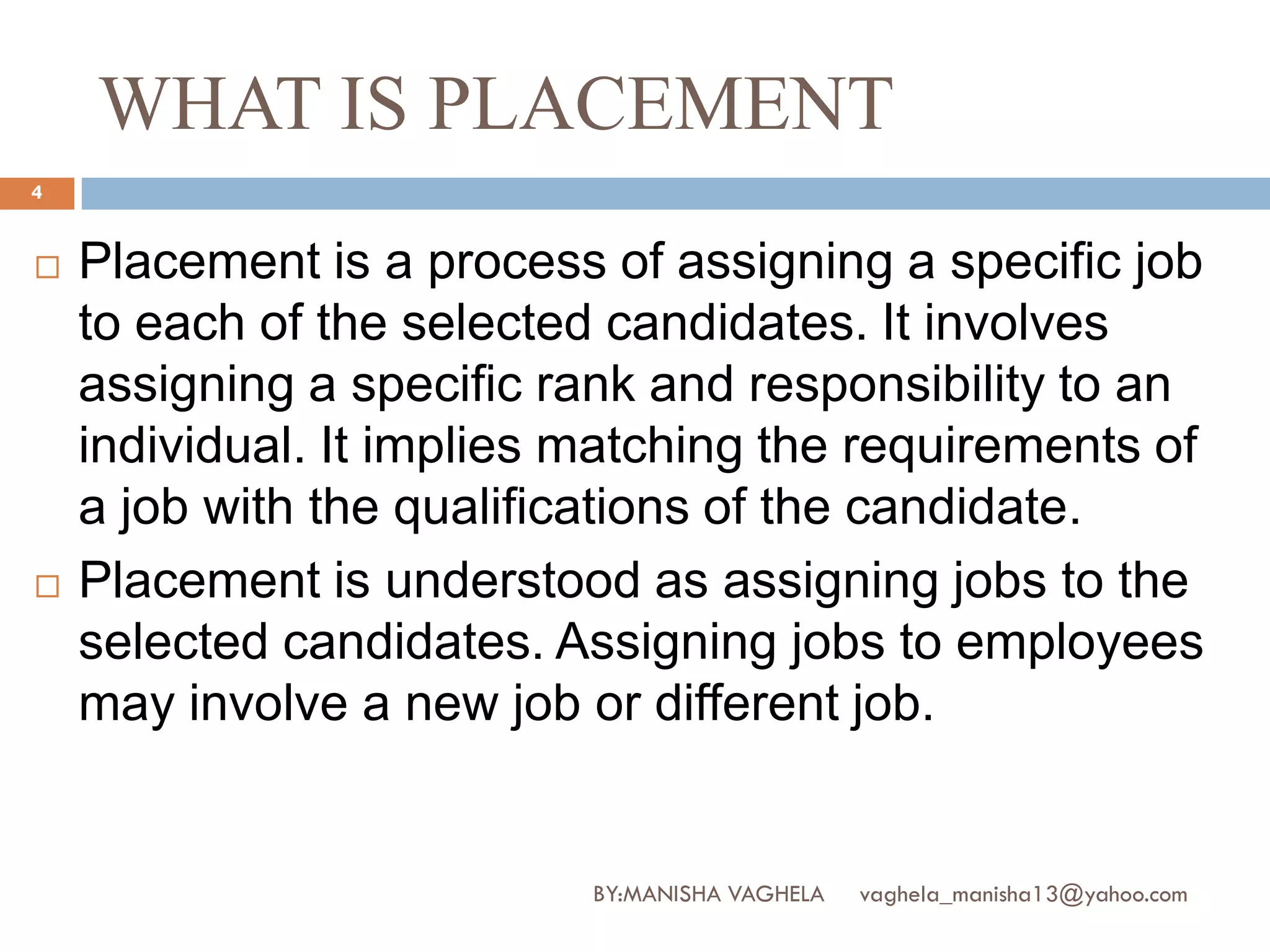
   Placement is a process of assigning a specific job
    to each of the selected candidates. It involves
    assigning a specific rank and responsibility to an
    individual. It implies matching the requirements of
    a job with the qualifications of the candidate.
   Placement is understood as assigning jobs to the
    selected candidates. Assigning jobs to employees
    may involve a new job or different job.


                           BY:MANISHA VAGHELA   vaghela_manisha13@yahoo.com
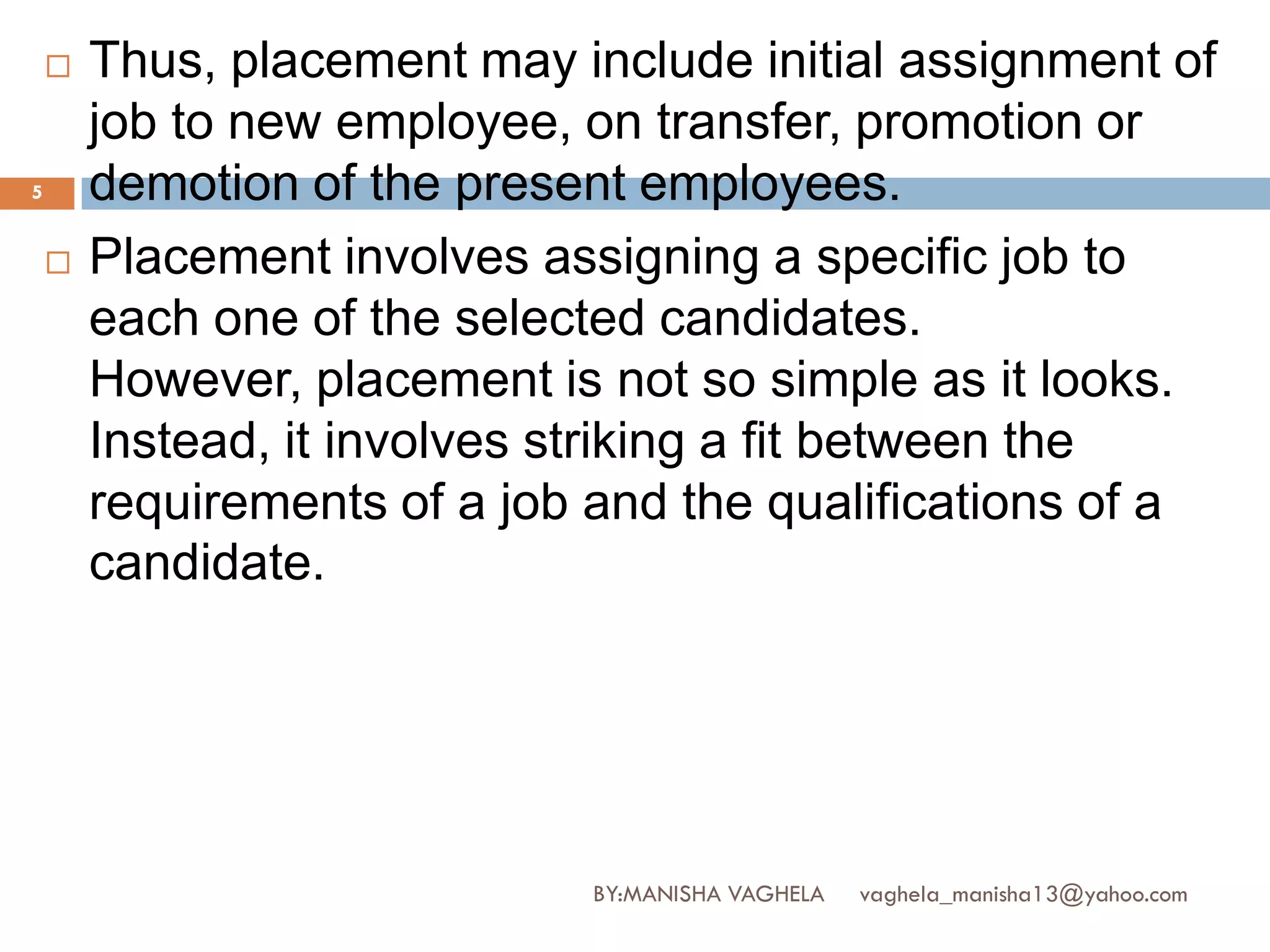
   Thus, placement may include initial assignment of
        job to new employee, on transfer, promotion or
5       demotion of the present employees.
       Placement involves assigning a specific job to
        each one of the selected candidates.
        However, placement is not so simple as it looks.
        Instead, it involves striking a fit between the
        requirements of a job and the qualifications of a
        candidate.


                             BY:MANISHA VAGHELA   vaghela_manisha13@yahoo.com
DEFINITION OF PLACEMENT
6


       “placement” may be defined as “the determination
        of the job to which an accepted candidate is to be
        assigned, and his assignement to that job. It is a
        matching of what the supervisor has reason to think
        he can do with the job demands (job requirements):
        it is a matching of what he imposes (in
        strain, working conditions),” and what he offers in
        the form of pay roll, companionship with
        others, promotional possibilities, etc.
            A proper placement of a worker reduces
        employee turnover, absenteeism and accident
        rates, and improves morale.
                              BY:MANISHA VAGHELA   vaghela_manisha13@yahoo.com
   “Placement refers to the allocations of people to
        job. It includes initials assignment of new
7       employees and promotion transfer or demotion of
        present employees.”
        Placement can also be defined as the internal
        filling of vacancies as distinguished from external
        recruitment. Placement is a process of assigning a
        specific job to each of the selected candidates. It
        involves assigning a specific rank and
        responsibility to an individual. It implies matching
        the requirements of a job with the qualifications of
        the candidate.


                               BY:MANISHA VAGHELA   vaghela_manisha13@yahoo.com
INTRODUCTION OF PLACEMENT
8


       After an employee has been hired and oriented, he
        or she must be placed in his/her right job.
        Placement is understood as the allocation of people
        to jobs. It is the assignment or re-assignment of an
        employee to a new or different job. Placement
        includes initial assignment of new employee and
        promotion, transfer, or demotion of present
        employee. Placement arising out of
        transfer, promotions, and demotions. Once we
        establish this unique profile for each
        individual, people and jobs can be matched
        optimally within the constraints set by available jobs
        and available people. BY:MANISHA VAGHELA vaghela_manisha13@yahoo.com
CONTINUE
9
       If the number of individuals is large in relation to the
        available jobs, only the best qualified persons can
        be selected and placed. On the other hand, when
        more jobs are available, optimal placement is
        possible. Thus, the number of people and the
        number of jobs determine the placement process in
        any organisation. Placement refers to assigning
        rank and responsibility to an individual, identifying
        him with a particular job. If the person adjusts
        himself to the job and continues to perform as per
        expectations, it might mean that the candidate is
        properly placed.
                                BY:MANISHA VAGHELA   vaghela_manisha13@yahoo.com
CONTINUE
10
    However, if the candidate is seen to have problems
     in adjusting himself to the job, the supervisor must
     find out whether the person is properly placed as
     per the latter’s aptitude and potential.
     Usually, placement problems arises out of wrong
     selection or improper placement or both.
     Therefore, organizations need to constantly review
     cases of employees performing below
     expectations/potential and employee related
     problems such as turnover, absenteeism, accidents
     and assess how far they are related to
     inappropriate placement decisions and remedy the
                              BY:MANISHA VAGHELA vaghela_manisha13@yahoo.com
     situation without delay.
SIGNIFICANCE OF PLACEMENT
11


    It improves employee morale.
    It helps in reducing employee turnover.
    It helps in reducing absenteeism.
    It helps in reducing accident rates.
    It avoids misfit between the candidate and the job.
    It helps the candidate to work as per the
     predetermined objectives of the organization.


                            BY:MANISHA VAGHELA   vaghela_manisha13@yahoo.com
CONCEPT OF PLACEMENT
12


    Placement is the process of assigning a specific job
     to each one of the selected, candidates. It involves
     assigning specific rank and responsibility to an
     individual. It implies matching the requirements of a
     job with the qualifications of a candidate. In the
     words of pigors and Myers, “placement is the
     determination of the job to which an accepted
     candidate is to be assigned, and his assignment to
     that job. It is a matching of what the supervisor has
     reason to think he can do with the job demands.
                             BY:MANISHA VAGHELA   vaghela_manisha13@yahoo.com
   It is a matching of what he imposes in
     strain, working conditions, and what he offers in the
13   form of payroll, companionship with
     others, promotional possibilities, etc. proper
     placement helps to improve employee morale. It
     also helps to reduce employee
     turnover, absenteeism and accident rates. If a
     candidate adjusts himself to the job and continuous
     to perform as per expectations, it might mean that
     the candidate is properly placed. However, if the
     candidate has problems in adjusting himself to the
     job and he continues to perform below
     expectations, he might be misplaced.
     Supervisors/executives should review all such
     cases to find out cases BY:MANISHA VAGHELA vaghela_manisha13@yahoo.com
                              of misplacement.
   Such candidates should be assigned some other
     more suitable jobs. Alternatives they may be given
14   further training to make them fit for the job.


                           BY:MANISHA VAGHELA   vaghela_manisha13@yahoo.com
PROBLEMS OF PLACEMENT
15


    The difficulty with placement is that we tend to
     look at the individual but not at the job. Often, the
     individual does not work independent of others.
     Whether the employee works independent of
     others or is dependent depends on the type of
     jobs. Jobs in this context may be classified into
     three categories-(1) independent, (2) sequential
     and (3) pooled.
    In certain cases, jobs are independent, for
     example, postal service or field sales. Here, non-
     overlapping routes or territories are alloted to each
     worker.
                            BY:MANISHA VAGHELA   vaghela_manisha13@yahoo.com
   In sequential jobs, activities of one worker are
     dependent on the activities of a fellow worker.
16
    Where jobs are pooled in nature, there is high
     interdependence among activities. The final output
     is the result of contribution of all the workers.
     Project teams, temporary task forces and assembly
     teams represent pooled jobs.
    Independent jobs do not pose great problems in
     placement, for each employee needs only to be
     evaluated relative to the match between his or her
     capabilities and interests, and those required on the
     job.

                            BY:MANISHA VAGHELA   vaghela_manisha13@yahoo.com
    But independent jobs are becoming rarer and
     rarer, as most jobs are dependent (sequential or
17
     pooled). In order to match individuals with
     jobs, organisations use the assessment-
     classification model. In this model, details about the
     employee’s skills, interests, past performance (if
     any), and biographical details are collected.
    Just as individuals are placed in subgroups, jobs are
     also categorised into subgroups, each subgroup
     having identical characteristics. The next step is to
     match subgroup profiles with job-family profiles to
     determine the likelihood of success and satisfaction
     in a particular job family. Once assignment to a job
     family is made, individuals can be placed in specific
     jobs within the job family after further counselling
     and possible assessment.  BY:MANISHA VAGHELA vaghela_manisha13@yahoo.com
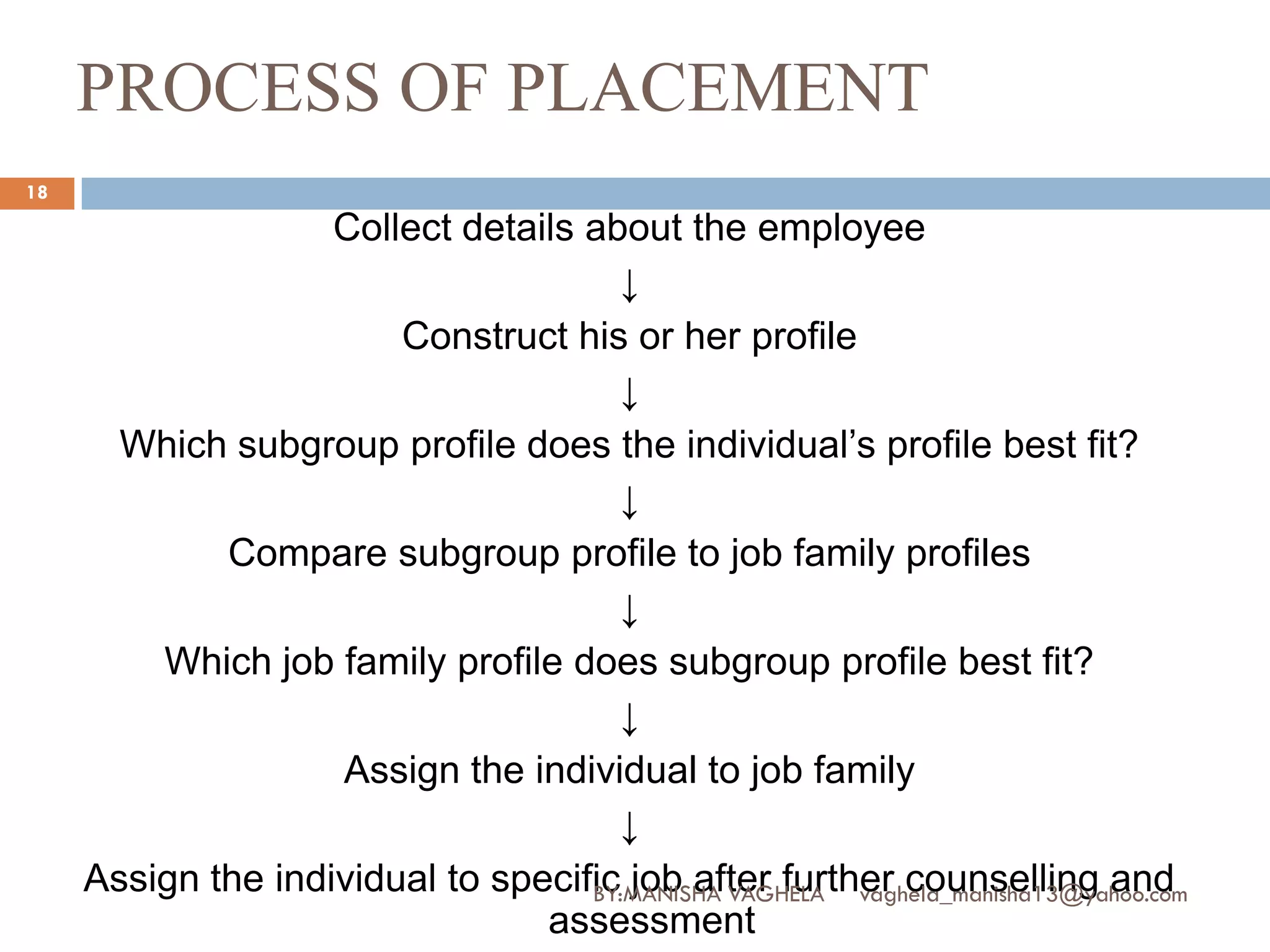
PROCESS OF PLACEMENT
18
                    Collect details about the employee
                                      ↓
                        Construct his or her profile
                                      ↓
       Which subgroup profile does the individual’s profile best fit?
                                      ↓
             Compare subgroup profile to job family profiles
                                      ↓
         Which job family profile does subgroup profile best fit?
                                      ↓
                    Assign the individual to job family
                                      ↓
     Assign the individual to specific job after further counselling and
                                    BY:MANISHA VAGHELA vaghela_manisha13@yahoo.com
                                 assessment
DIFFERENTIAL OF PLACEMENT
19


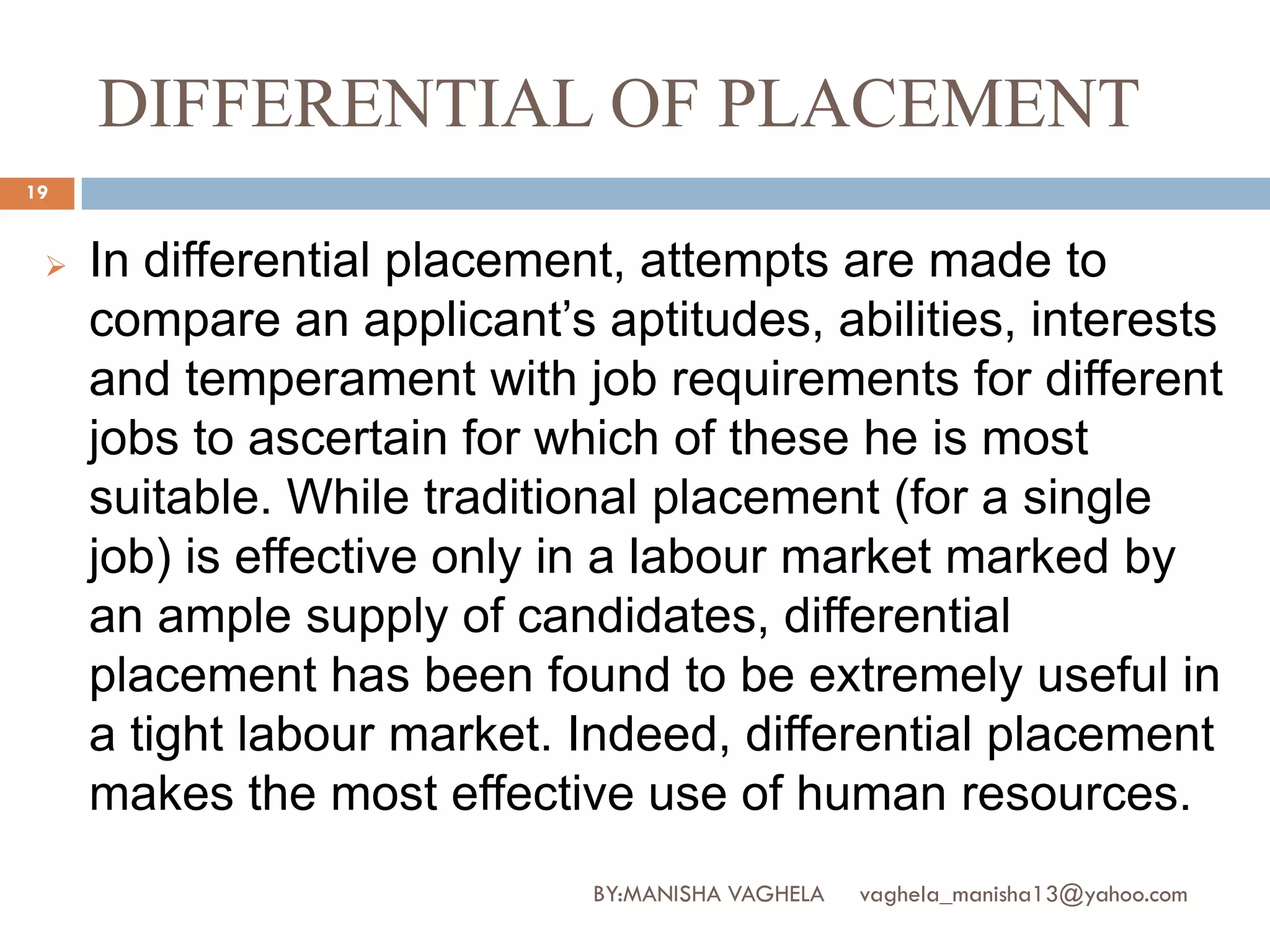
    In differential placement, attempts are made to
     compare an applicant’s aptitudes, abilities, interests
     and temperament with job requirements for different
     jobs to ascertain for which of these he is most
     suitable. While traditional placement (for a single
     job) is effective only in a labour market marked by
     an ample supply of candidates, differential
     placement has been found to be extremely useful in
     a tight labour market. Indeed, differential placement
     makes the most effective use of human resources.
                            BY:MANISHA VAGHELA   vaghela_manisha13@yahoo.com
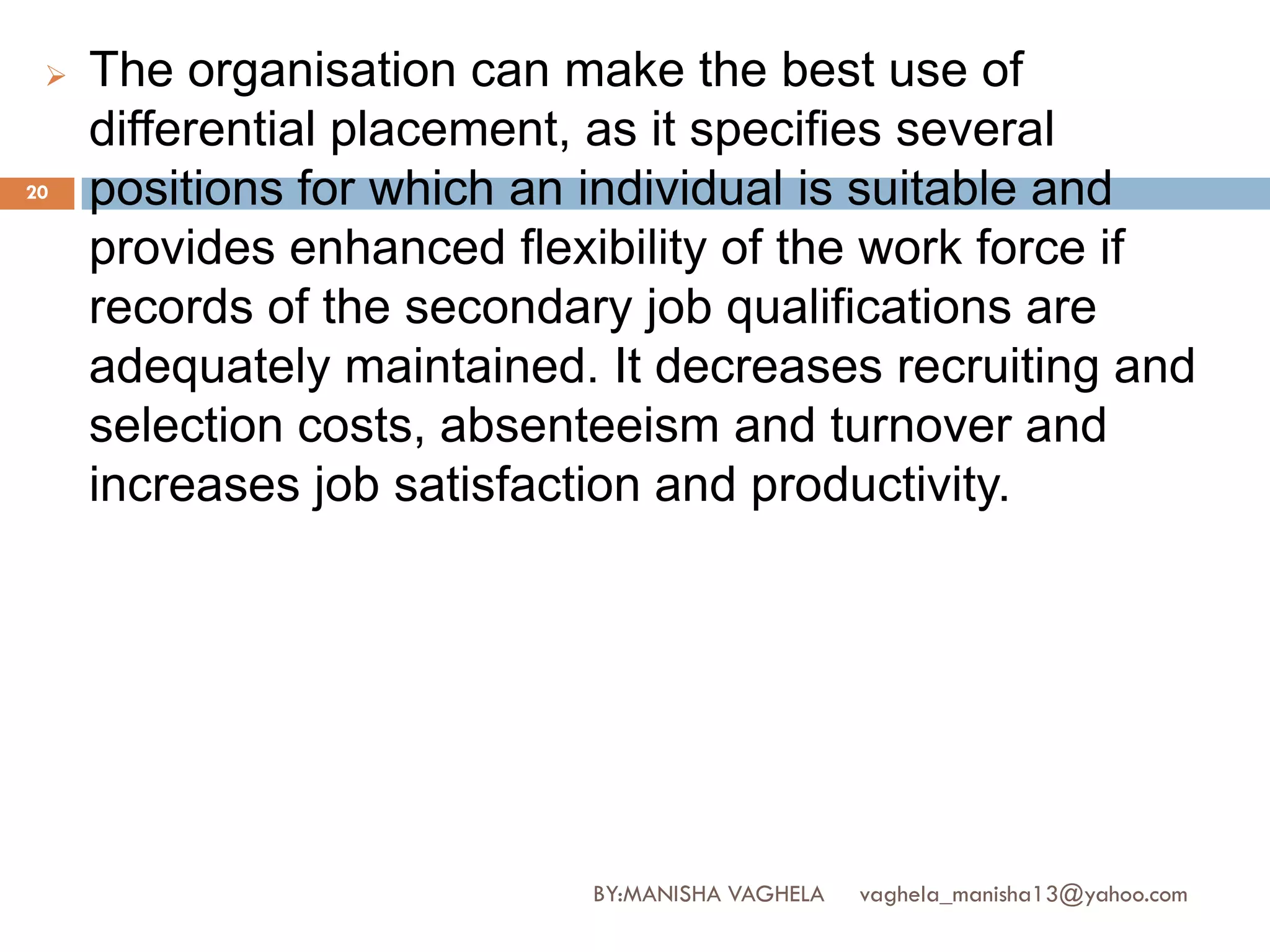
   The organisation can make the best use of
     differential placement, as it specifies several
20   positions for which an individual is suitable and
     provides enhanced flexibility of the work force if
     records of the secondary job qualifications are
     adequately maintained. It decreases recruiting and
     selection costs, absenteeism and turnover and
     increases job satisfaction and productivity.


                           BY:MANISHA VAGHELA   vaghela_manisha13@yahoo.com
IMPORTANCE OF PLACEMENT
21


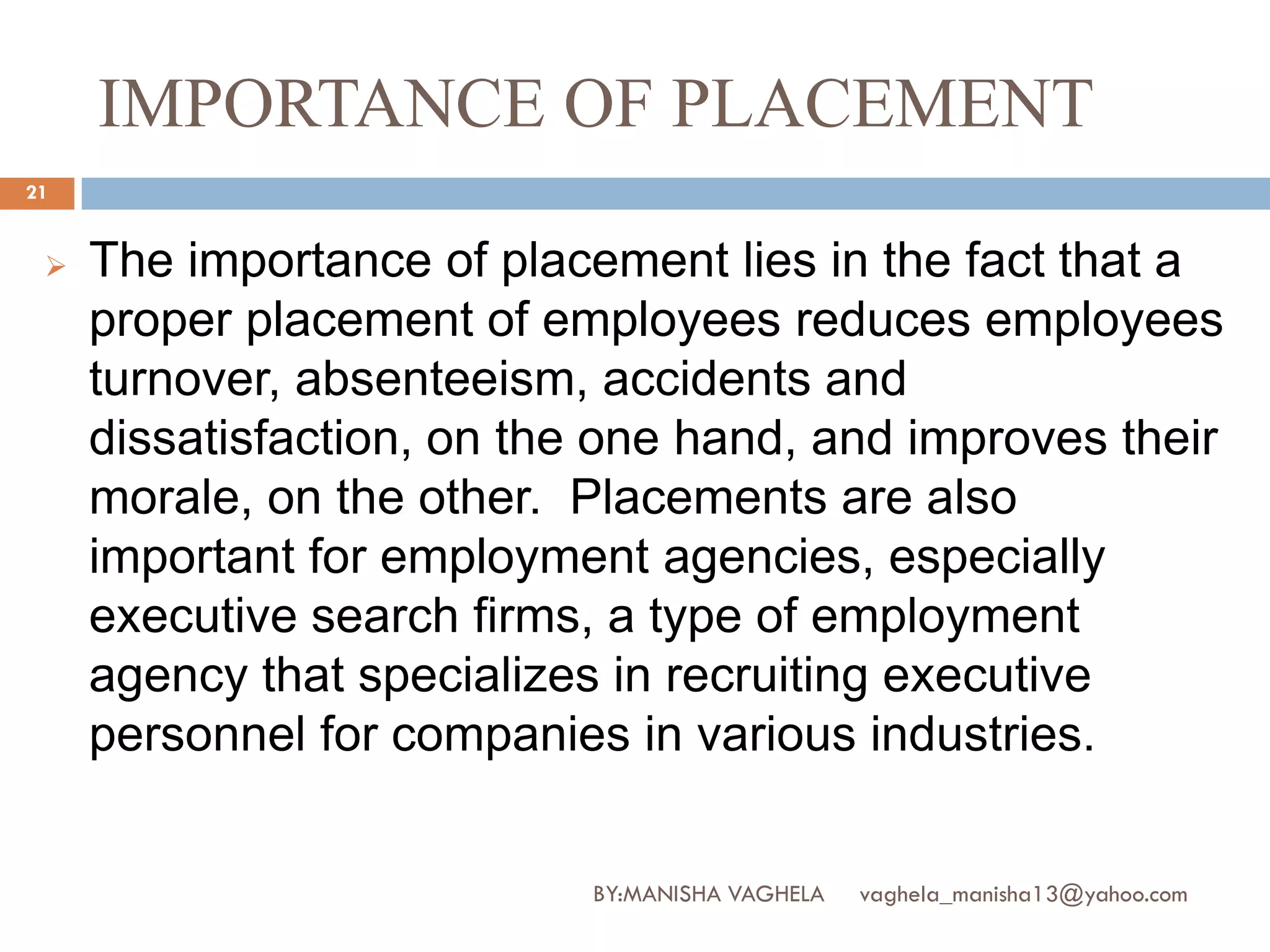
    The importance of placement lies in the fact that a
     proper placement of employees reduces employees
     turnover, absenteeism, accidents and
     dissatisfaction, on the one hand, and improves their
     morale, on the other. Placements are also
     important for employment agencies, especially
     executive search firms, a type of employment
     agency that specializes in recruiting executive
     personnel for companies in various industries.


                            BY:MANISHA VAGHELA   vaghela_manisha13@yahoo.com
BENEFITS OF PLACEMENT
22


    Employing a placement or work experience student
     can be viewed as part of the interview process for
     future company employees.
    Gain an intelligent, motivated, cost-effective labour
     resource with valuable skills, knowledge and fresh
     ideas.
    Projects which otherwise would not be done due to
     a shortage of resources, can be moved forward.
    Offer solution to short term staff shortages.

                            BY:MANISHA VAGHELA   vaghela_manisha13@yahoo.com
CONCLUSION
23


    Placement is understood as the allocation of
     people to jobs. If the number of individuals is large
     in relation to the available jobs, only the best
     qualified persons can be selected and placed.
     Once we establish this unique profile for each
     individual, people and jobs can be matched
     optimally within the constraints set by available
     jobs and available people.


                            BY:MANISHA VAGHELA   vaghela_manisha13@yahoo.com
REVIEW OF THE TOPIC
24

    What is placement
    Definition of placement
    Introduction of placement
    Significance of placement
    Concept of placement
    Problems of placement
    Process of placement
    Differential of placement
    Importance of placement
    Benefits of placement
    Conclusion
                                 BY:MANISHA VAGHELA   vaghela_manisha13@yahoo.com
BIBLIOGRAPHY
25


 Personnel management text & cases
  by :- C. B Mamoria
        S. V Gankar
Himalaya publishing house
 Human resource and personnel management

 by:- K. Aswathappa
Tata McGraw – hill publishing company limited new
  Delhi

                         BY:MANISHA VAGHELA   vaghela_manisha13@yahoo.com
  Personnel management
   by:- Arun Monappa
26
 Tata McGraw – hill publishing company limited. New
   Delhi
  Personnel management

   by:- C. B. Mamoria
  Personnel management and human resources

   by:- C. S Venkata Ratnam
        B. k Srivastavea
 Tata McGraw – hill publishing company limited.


                         BY:MANISHA VAGHELA   vaghela_manisha13@yahoo.com
  Human resource management
   by:- C. B Gupta
27
 Sultan chand & sons
  Human resource management text and cases

   by:- S. S. Khanka
 Sultan chand & company ltd. Ram nagar, new Delhi
  Essentials of human resource management of industrial

   relations
   by:- Dr. P. Subba rao
 Himalaya publishing house


                          BY:MANISHA VAGHELA   vaghela_manisha13@yahoo.com
28


     BY:MANISHA VAGHELA   vaghela_manisha13@yahoo.com

Placement

  • 1.
    BY:MANISHA VAGHELA 1 PLACEMENT BY MANISHA VAGHELA vaghela_manisha 13@yahoo.com
  • 2.
    FLOW OF PRESENTATION 2  What is placement  Definition of placement  Introduction of placement  Significance of placement  Concept of placement  Problems of placement  Process of placement BY:MANISHA VAGHELA vaghela_manisha13@yahoo.com
  • 3.
    Differential of placement  Importance of placement 3  Benefits of placement  Conclusion  Review of the topic  Bibliography BY:MANISHA VAGHELA vaghela_manisha13@yahoo.com
  • 4.
    WHAT IS PLACEMENT 4  Placement is a process of assigning a specific job to each of the selected candidates. It involves assigning a specific rank and responsibility to an individual. It implies matching the requirements of a job with the qualifications of the candidate.  Placement is understood as assigning jobs to the selected candidates. Assigning jobs to employees may involve a new job or different job. BY:MANISHA VAGHELA vaghela_manisha13@yahoo.com
  • 5.
    Thus, placement may include initial assignment of job to new employee, on transfer, promotion or 5 demotion of the present employees.  Placement involves assigning a specific job to each one of the selected candidates. However, placement is not so simple as it looks. Instead, it involves striking a fit between the requirements of a job and the qualifications of a candidate. BY:MANISHA VAGHELA vaghela_manisha13@yahoo.com
  • 6.
    DEFINITION OF PLACEMENT 6  “placement” may be defined as “the determination of the job to which an accepted candidate is to be assigned, and his assignement to that job. It is a matching of what the supervisor has reason to think he can do with the job demands (job requirements): it is a matching of what he imposes (in strain, working conditions),” and what he offers in the form of pay roll, companionship with others, promotional possibilities, etc.  A proper placement of a worker reduces employee turnover, absenteeism and accident rates, and improves morale. BY:MANISHA VAGHELA vaghela_manisha13@yahoo.com
  • 7.
    “Placement refers to the allocations of people to job. It includes initials assignment of new 7 employees and promotion transfer or demotion of present employees.”  Placement can also be defined as the internal filling of vacancies as distinguished from external recruitment. Placement is a process of assigning a specific job to each of the selected candidates. It involves assigning a specific rank and responsibility to an individual. It implies matching the requirements of a job with the qualifications of the candidate. BY:MANISHA VAGHELA vaghela_manisha13@yahoo.com
  • 8.
    INTRODUCTION OF PLACEMENT 8  After an employee has been hired and oriented, he or she must be placed in his/her right job. Placement is understood as the allocation of people to jobs. It is the assignment or re-assignment of an employee to a new or different job. Placement includes initial assignment of new employee and promotion, transfer, or demotion of present employee. Placement arising out of transfer, promotions, and demotions. Once we establish this unique profile for each individual, people and jobs can be matched optimally within the constraints set by available jobs and available people. BY:MANISHA VAGHELA vaghela_manisha13@yahoo.com
  • 9.
    CONTINUE 9  If the number of individuals is large in relation to the available jobs, only the best qualified persons can be selected and placed. On the other hand, when more jobs are available, optimal placement is possible. Thus, the number of people and the number of jobs determine the placement process in any organisation. Placement refers to assigning rank and responsibility to an individual, identifying him with a particular job. If the person adjusts himself to the job and continues to perform as per expectations, it might mean that the candidate is properly placed. BY:MANISHA VAGHELA vaghela_manisha13@yahoo.com
  • 10.
    CONTINUE 10  However, if the candidate is seen to have problems in adjusting himself to the job, the supervisor must find out whether the person is properly placed as per the latter’s aptitude and potential. Usually, placement problems arises out of wrong selection or improper placement or both. Therefore, organizations need to constantly review cases of employees performing below expectations/potential and employee related problems such as turnover, absenteeism, accidents and assess how far they are related to inappropriate placement decisions and remedy the BY:MANISHA VAGHELA vaghela_manisha13@yahoo.com situation without delay.
  • 11.
    SIGNIFICANCE OF PLACEMENT 11  It improves employee morale.  It helps in reducing employee turnover.  It helps in reducing absenteeism.  It helps in reducing accident rates.  It avoids misfit between the candidate and the job.  It helps the candidate to work as per the predetermined objectives of the organization. BY:MANISHA VAGHELA vaghela_manisha13@yahoo.com
  • 12.
    CONCEPT OF PLACEMENT 12  Placement is the process of assigning a specific job to each one of the selected, candidates. It involves assigning specific rank and responsibility to an individual. It implies matching the requirements of a job with the qualifications of a candidate. In the words of pigors and Myers, “placement is the determination of the job to which an accepted candidate is to be assigned, and his assignment to that job. It is a matching of what the supervisor has reason to think he can do with the job demands. BY:MANISHA VAGHELA vaghela_manisha13@yahoo.com
  • 13.
    It is a matching of what he imposes in strain, working conditions, and what he offers in the 13 form of payroll, companionship with others, promotional possibilities, etc. proper placement helps to improve employee morale. It also helps to reduce employee turnover, absenteeism and accident rates. If a candidate adjusts himself to the job and continuous to perform as per expectations, it might mean that the candidate is properly placed. However, if the candidate has problems in adjusting himself to the job and he continues to perform below expectations, he might be misplaced. Supervisors/executives should review all such cases to find out cases BY:MANISHA VAGHELA vaghela_manisha13@yahoo.com of misplacement.
  • 14.
    Such candidates should be assigned some other more suitable jobs. Alternatives they may be given 14 further training to make them fit for the job. BY:MANISHA VAGHELA vaghela_manisha13@yahoo.com
  • 15.
    PROBLEMS OF PLACEMENT 15  The difficulty with placement is that we tend to look at the individual but not at the job. Often, the individual does not work independent of others. Whether the employee works independent of others or is dependent depends on the type of jobs. Jobs in this context may be classified into three categories-(1) independent, (2) sequential and (3) pooled.  In certain cases, jobs are independent, for example, postal service or field sales. Here, non- overlapping routes or territories are alloted to each worker. BY:MANISHA VAGHELA vaghela_manisha13@yahoo.com
  • 16.
    In sequential jobs, activities of one worker are dependent on the activities of a fellow worker. 16  Where jobs are pooled in nature, there is high interdependence among activities. The final output is the result of contribution of all the workers. Project teams, temporary task forces and assembly teams represent pooled jobs.  Independent jobs do not pose great problems in placement, for each employee needs only to be evaluated relative to the match between his or her capabilities and interests, and those required on the job. BY:MANISHA VAGHELA vaghela_manisha13@yahoo.com
  • 17.
    But independent jobs are becoming rarer and rarer, as most jobs are dependent (sequential or 17 pooled). In order to match individuals with jobs, organisations use the assessment- classification model. In this model, details about the employee’s skills, interests, past performance (if any), and biographical details are collected.  Just as individuals are placed in subgroups, jobs are also categorised into subgroups, each subgroup having identical characteristics. The next step is to match subgroup profiles with job-family profiles to determine the likelihood of success and satisfaction in a particular job family. Once assignment to a job family is made, individuals can be placed in specific jobs within the job family after further counselling and possible assessment. BY:MANISHA VAGHELA vaghela_manisha13@yahoo.com
  • 18.
    PROCESS OF PLACEMENT 18 Collect details about the employee ↓ Construct his or her profile ↓ Which subgroup profile does the individual’s profile best fit? ↓ Compare subgroup profile to job family profiles ↓ Which job family profile does subgroup profile best fit? ↓ Assign the individual to job family ↓ Assign the individual to specific job after further counselling and BY:MANISHA VAGHELA vaghela_manisha13@yahoo.com assessment
  • 19.
    DIFFERENTIAL OF PLACEMENT 19  In differential placement, attempts are made to compare an applicant’s aptitudes, abilities, interests and temperament with job requirements for different jobs to ascertain for which of these he is most suitable. While traditional placement (for a single job) is effective only in a labour market marked by an ample supply of candidates, differential placement has been found to be extremely useful in a tight labour market. Indeed, differential placement makes the most effective use of human resources. BY:MANISHA VAGHELA vaghela_manisha13@yahoo.com
  • 20.
    The organisation can make the best use of differential placement, as it specifies several 20 positions for which an individual is suitable and provides enhanced flexibility of the work force if records of the secondary job qualifications are adequately maintained. It decreases recruiting and selection costs, absenteeism and turnover and increases job satisfaction and productivity. BY:MANISHA VAGHELA vaghela_manisha13@yahoo.com
  • 21.
    IMPORTANCE OF PLACEMENT 21  The importance of placement lies in the fact that a proper placement of employees reduces employees turnover, absenteeism, accidents and dissatisfaction, on the one hand, and improves their morale, on the other. Placements are also important for employment agencies, especially executive search firms, a type of employment agency that specializes in recruiting executive personnel for companies in various industries. BY:MANISHA VAGHELA vaghela_manisha13@yahoo.com
  • 22.
    BENEFITS OF PLACEMENT 22  Employing a placement or work experience student can be viewed as part of the interview process for future company employees.  Gain an intelligent, motivated, cost-effective labour resource with valuable skills, knowledge and fresh ideas.  Projects which otherwise would not be done due to a shortage of resources, can be moved forward.  Offer solution to short term staff shortages. BY:MANISHA VAGHELA vaghela_manisha13@yahoo.com
  • 23.
    CONCLUSION 23  Placement is understood as the allocation of people to jobs. If the number of individuals is large in relation to the available jobs, only the best qualified persons can be selected and placed. Once we establish this unique profile for each individual, people and jobs can be matched optimally within the constraints set by available jobs and available people. BY:MANISHA VAGHELA vaghela_manisha13@yahoo.com
  • 24.
    REVIEW OF THETOPIC 24  What is placement  Definition of placement  Introduction of placement  Significance of placement  Concept of placement  Problems of placement  Process of placement  Differential of placement  Importance of placement  Benefits of placement  Conclusion BY:MANISHA VAGHELA vaghela_manisha13@yahoo.com
  • 25.
    BIBLIOGRAPHY 25  Personnel managementtext & cases by :- C. B Mamoria S. V Gankar Himalaya publishing house  Human resource and personnel management by:- K. Aswathappa Tata McGraw – hill publishing company limited new Delhi BY:MANISHA VAGHELA vaghela_manisha13@yahoo.com
  • 26.
     Personnelmanagement by:- Arun Monappa 26 Tata McGraw – hill publishing company limited. New Delhi  Personnel management by:- C. B. Mamoria  Personnel management and human resources by:- C. S Venkata Ratnam B. k Srivastavea Tata McGraw – hill publishing company limited. BY:MANISHA VAGHELA vaghela_manisha13@yahoo.com
  • 27.
     Humanresource management by:- C. B Gupta 27 Sultan chand & sons  Human resource management text and cases by:- S. S. Khanka Sultan chand & company ltd. Ram nagar, new Delhi  Essentials of human resource management of industrial relations by:- Dr. P. Subba rao Himalaya publishing house BY:MANISHA VAGHELA vaghela_manisha13@yahoo.com
  • 28.
    28 BY:MANISHA VAGHELA vaghela_manisha13@yahoo.com