

RECRUITMENT
AND
SELECTION
Akhil D.C Haridas
MIM-2016
RECRUITMENT AND SELECTION
Recruitment refers to the process of attracting, screening,
and selecting a qualified person for a job.
Recruitment process involves a systematic procedure
from sourcing the candidates to arranging and conducting
the interviews and requires many resources and time.
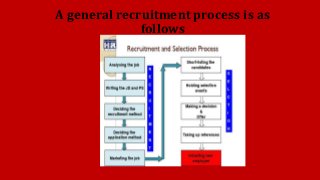
A general recruitment process is as
follows
Identifying the vacancy
The recruitment process begins with the workforce planning which involves
estimating future human resource requirements and ensuring the firm has
the right number of people, in the right place, with right skills at the right
time.
These contain:
• Posts to be filled
• Number of persons
• Duties to be performed
• Qualifications required
SECOND LEVEL
• Preparing the job description and person specification.
• Locating and developing the sources of required number and type
of employees (Advertising etc).
• Short-listing and identifying the prospective employee with
required characteristics.
• Arranging the interviews with the selected candidates.
• Conducting the interview and decision making.
JOB ANALYSIS
• The procedure for determining the duties and skill requirements of
a job and the kind of person who should be hired for it
• Job analysis produces information used for writing job descriptions
and job specifications
• Job description : A list of job’s duties, responsibilities, reporting
relationships, working conditions, and supervisory responsibilities
• Job Specifications: A list of job’s “human requirements", that is, the
requisite education, skills, personality, and so on.
Methods of job Analysis Data Collection
(1) Observation method
 Direct observation
 Work methods analysis, including time and motion study
 The critical incident technique.
(2) Interview method
 Structured
 Unstructured
(3) Questionnaires, including job inventories or checklists
Job inventories
List that itemizes all of the task involved in the
performance of a specific job. Used in human resource
management, it summarizes information collected from
documented studies, interviews, observation, and
questionnaires.
EMPLOYMENT ARRANGEMENTS IN
BUSINESS ORGANIZATIONS
1. Permanent employees, regular employees are paid directly by
that employer. In addition to their wages, they often receive benefits
like subsidized health care, paid vacations, holidays, sick time, or
contributions to a retirement plan.
• Rarely permanent employment means employment of an individual
that is guaranteed throughout the employee's working life
2. Temporary or contractual staffing
Temporary or contractual staffing is a short term based assignment, for
which a talent is hired. This kind of hiring decreases the liability of an
organization, as this assignment may not include all the benefits which
the organization may offer its full time employees.
3. Apprentice/trainee
An apprentice/trainee is employed on a fixed term contract that
enables the person to become qualified in a particular trade or skill
through a combination of work and structured training.
4. Full-time employment
• Full-time employment is employment in which a person
works a full 40 hours defined as such by his/her employer.
• Full-time employment often comes with benefits that are not
typically offered to part-time, temporary, or flexible workers,
such as annual leave, sick leave, and health insurance.
• Full-time jobs are often considered careers. They generally pay
more than part-time jobs, and usually carry more hours per
week
5. Part Time Hiring
A part-time job is a form of employment that carries fewer hours
per week than a full-time job. Workers are considered to be part
time if they commonly work fewer than 30 or 35 hours per week.
6. Contract Jobs
A n organization offers contract jobs when a specific task needs
to be completed. The job description is given, and a person or
company must apply for it.
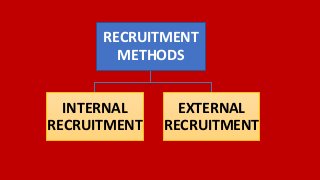
RECRUITMENT
METHODS
INTERNAL
RECRUITMENT
EXTERNAL
RECRUITMENT
INTERNAL SOURCES OF RECRUITMENT
• Internal sources of recruitment
• Present permanent employees (based on programs of career
development).
• Present temporary / casual employees.
• Retired employees.
• Dependents of deceased disabled, retired and present employees.
Methods of internal recruitment
• Intranets.
• Staff notice boards.
• In-house magazines / newsletters.
• Internal notices.
• Meetings.
• Personal recommendation – often referred to as ‘word of mouth’
Advantages of internal recruitment
• Cheaper and quicker to recruit.
• People already familiar with the business and how it operates.
• Provides opportunities for promotion with in the business – can be
motivating.
• Business already knows the strengths and weaknesses of candidates.
Disadvantages of internal recruitment
• Limits the number of potential applicants.
• No new ideas can be introduced from outside the business.
• External candidates might be better suited / qualified for the job.
• May cause resentment amongst candidates not appointed.
• Creates another vacancy which needs to be filled.
• Longer process.
EXTERNAL RECRUITMENT
External recruitment is when organizations looks to fill
the vacancy from any suitable applicant outside organizations.
Methods of external recruitment
• Campus
• Job center
• Head hunting
• Advertisements
• Database search on job sites
• Employee referral
Advantages of external recruitment:
• • Outside people bring in new ideas
• Larger pool of workers from which to find the best candidate
• People have a wider range of experience
Disadvantages of external recruitment:
• Longer process
• More expensive process due to
• advertisements and interviews required
• Selection process may not be effective enough to reveal the best
candidate
RECRUITMENT PROCESS OUTSOURCING
• Recruitment Process Outsourcing is a form of business process
outsourcing (BPO) where an employer outsources or transfers all or
part of its recruitment activities to an external service provider.
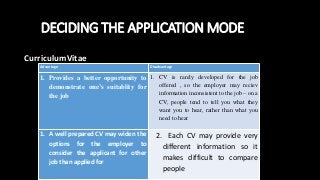
DECIDING THE APPLICATION MODE
CurriculumVitae
Advantage Disadvantage
1. Provides a better opportunity to
demonstrate one’s suitablity for
the job
1. CV is rarely developed for the job
offered , so the employer may reciev
information inconsistent to the job – on a
CV, people tend to tell you what they
want you to hear, rather than what you
need to hear
1. A well prepared CV may widen the
options for the employer to
consider the applicant for other
job than applied for
2. Each CV may provide very
different information so it
makes difficult to compare
people
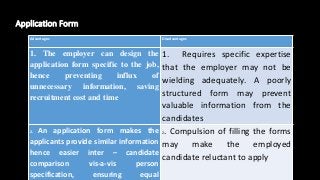
Application Form
Advantages Disadvantages
1. The employer can design the
application form specific to the job,
hence preventing influx of
unnecessary information, saving
recruitment cost and time
1. Requires specific expertise
that the employer may not be
wielding adequately. A poorly
structured form may prevent
valuable information from the
candidates
2. An application form makes the
applicants provide similar information
hence easier inter – candidate
comparison vis-a-vis person
specification, ensuring equal
2. Compulsion of filling the forms
may make the employed
candidate reluctant to apply
JOB ADVERTISEMENT
• The Objective of Recruitment Advertising
• The objectives of recruitment advertising are to:
• (1) Attract suitable candidates, and
• (2) Deter unsuitable candidates
• What makes a good job advert?
Features Of Effective Advertisement:
• Accurate - describes the job and its requirements accurately
• Short - not too long-winded; covers just the important ground
• Honest - does not make claims about the job or the business
that will later prove false to applicants
• Positive - gives the potential applicant a positive feel about
joining the business
• Relevant - provides details that prospective applicants need to
know at the application stage (e.g. is shift-working required;
are there any qualifications required)
Content of a job advert
• Most job adverts contain:
• - Details of the business/organization (name, brand, location,
type of business)
• - Outline details of the job (title, main duties)
• - Conditions (special factors affecting the job)
• - Experience / qualifications required (e.g. minimum
qualifications, amount of experience)
• - Rewards (financial and non-financial)
• - Application process (how should applicants apply, how to;
deadlines)
Choice of medium
• Type of job: senior management jobs merit adverts in the national
newspapers and/or specialist management magazines (e.g. the
Economist, Business Week). Many semi-skilled jobs need only be
advertised locally to attract sufficient good quality candidates
• Cost of advertising: National newspapers and television cost
significantly more than local newspapers etc
• Readership and circulation: how many relevant people do the medium
reach? How frequently like weekly, monthly, annually. Is the target
audience actually only a small fraction of the total readership or Viewer
ship?
• Frequency: how often does the business want to advertise the post?
SELECTION
“Selection is the process of putting right men
on right job”
HOLDING THE SELECTION EVENTS
1. SCREENING RESUMES
Screening resumes is the process of sorting resumes to
disqualify candidates using successively more detailed
examinations of the resumes.
SCREENING RESUMES
(Resumes Evaluation)
• Sorting resumes based on the qualifications
• qualification –job requirements
• Eliminate candidates that do not meet the job requirements.
• skills and talents required for identifying the eligible candidates
• conducting examinations –technology (manually)
• computer, aid automation
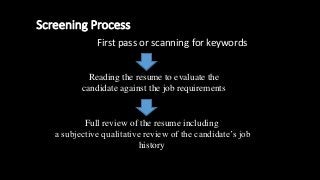
Screening Process
First pass or scanning for keywords
Reading the resume to evaluate the
candidate against the job requirements
Full review of the resume including
a subjective qualitative review of the candidate’s job
history
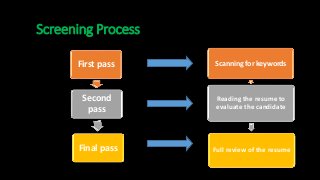
Screening Process
Scanning for keywords
Reading the resume to
evaluate the candidate
Full review of the resume
First pass
Second
pass
Final pass
First step -Keywords
• The keywords selected are derived from required skills or activities
in the job description.
• This step of the process can often be aided by computers
Second step- Evaluation
• This second pass is designed to verify some of the second order
criteria of the job description are met
• Level of education, years of experience required by the position,
salary range and current location
Final step -Qualitative review
• This final pass is to examine the more subtle subjective qualities of
the candidate.
• The objective is remove candidates with red flags
HOLDING THE SELECTION EVENTS
PROCESS OF PUTTING RIGHT MEN ON RIGHT JOB
• It is a procedure of matching organizational requirements with the
skills and qualifications of people
1. Preliminary Interviews-
It is used to eliminate those candidates who do not meet the minimum
eligibility criteria laid down by the organization.
The skills, academic and family background, competencies and
interests of the candidate are examined during preliminary interview.
2. Application blanks-
The candidates who clear the preliminary interview are required
to fill application blank.
It contains age, qualifications, reason for leaving previous job,
experience, etc.
Weighted application blank(WAB)
• It is a printed form completed by candidate wherein
each item is weighted and scored based on its
importance as a determinant of job success
• It helps a company to cross-compare candidates having
more or less similar qualifications and reject those not
meeting the job criteria strictly
Weighted application blank(WAB)
• On the negative side, it is difficult to develop an appropriate
WAB, the exercise could be quite costly, and it needs frequent
updating so as to be in line with changing job requirements.
3. Written Tests-
• Aptitude test
• Intelligence test
• Reasoning test
• Personality test
These tests are used to objectively assess the potential candidate.
They should not be biased.
INTELLIGENCE TESTS
• Tests of general intellectual abilities. They measures not a single trait
but rather a range of abilities such as- reasoning, vocabulary, verbal
fluency, numerical abilities, memory etc.
APTITUDE TESTS
• It measures whether an individual has the capacity or latent ability to
learn a given job if given adequate training.
• A capacity to learn in the future.
• To select person who will show a higher degree of success after the
training period.
• Specific capacities or aptitudes are- mechanical, clerical, linguistic,
musical, academic etc.
PERSONALITY TESTS
• It measures personality attributes of candidate such as emotional
stability, confirmity, agreeableness, extroversion, smartness etc.
Interest tests/Vocational tests
In this test applicants is asked whether s/he likes, dislikes the
particular occupation, activities, peoples.
Interest in specific profession and occupation is tested.
Measures candidates preference in different types of job.
SITUATION TESTS
• It evaluates the candidate’s behaviour in a particular situation or
in a situation which is similar to some aspects of the job to be
done in the future.
4. Employment Interviews-
• An interview is a procedure designed to obtain information from a
person through oral responses to oral inquiries.
• Managers uses several types of interviews, such as:
 Selection
 Appraisal
 Exit interviews
Trough oral responses to oral inquiries.
Effective Interviewing
 Conducting an Effective Interview
 Planning the interview
 Controlling the interview
 Using proper questioning techniques
 Question types to avoid in interviews
 Yes/No questions
 Questions that rarely produce a true answer
 Illegal questions
 Questions that are not job related
Types of selection interviews
1. Structured or Directive interview:
An interview following a set sequence of questions. The
questions and acceptable responses are specified in advance
and the responses are rated for appropriateness of content.
• Situational interview:
• A series of job related questions that focus on how the
candidate would behave in a given situation. Asks
interviewees to describe how they would react to a
hypothetical situation today or tomorrow.
• Behavioural interview:
A series of job related questions that focuses on how the
candidate reacted to actual situations in the past. Asks
interviewees to describe how they reacted to actual
situations in the past.
Job related interview:
A series of job related questions that focuses on relevant past
job related behaviors. Asks job related questions to draw
conclusions about what the applicant’s on the job performance
will be based on his or her answers to questions about past
experiences.
Stress interview:
An interview in which the applicant is made uncomfortable by a
series of often rude questions. This technique helps identify
hypersensitive applicants and those with low or high stress
tolerance.
2.Unstructured or Nondirective interview:
• An unstructured interview or non-directive interview is
an interview in which questions are not prearranged
• An unstructured conversational- style interview in which the
interviewer pursues points of interest as they come up in response to
questions.
• Generally no set format to follow. Interview for the same job may or
may not get the similar questions. A few questions may be specified
in advance.
• Semi-structured interview:
Major questions to be asked are planned in advance and are same
for all candidates but other questions vary from candidate to
candidate. Interviewer are provided some flexibility.
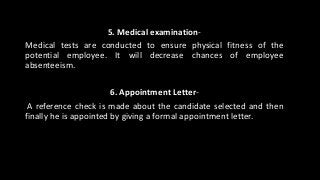
5. Medical examination-
Medical tests are conducted to ensure physical fitness of the
potential employee. It will decrease chances of employee
absenteeism.
6. Appointment Letter-
A reference check is made about the candidate selected and then
finally he is appointed by giving a formal appointment letter.
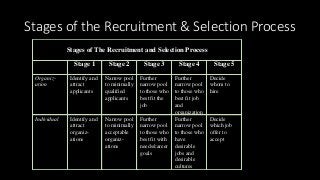
Stages of the Recruitment & Selection Process
Stages of The Recruitment and Selection Process
Stage 1 Stage 2 Stage 3 Stage 4 Stage 5
Organiz-
ation
Identify and
attract
applicants
Narrow pool
to minimally
qualified
applicants
Further
narrow pool
to those who
best fit the
job
Further
narrow pool
to those who
best fit job
and
organization
Decide
whom to
hire
Individual Identify and
attract
organiz-
ations
Narrow pool
to minimally
acceptable
organiz-
ations
Further
narrow pool
to those who
best fit with
needs/career
goals
Further
narrow pool
to those who
have
desirable
jobs and
desirable
cultures
Decide
which job
offer to
accept
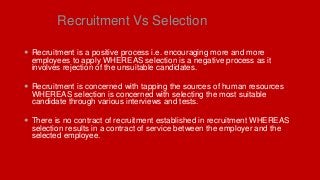
Recruitment Vs Selection
 Recruitment is a positive process i.e. encouraging more and more
employees to apply WHEREAS selection is a negative process as it
involves rejection of the unsuitable candidates.
 Recruitment is concerned with tapping the sources of human resources
WHEREAS selection is concerned with selecting the most suitable
candidate through various interviews and tests.
 There is no contract of recruitment established in recruitment WHEREAS
selection results in a contract of service between the employer and the
selected employee.
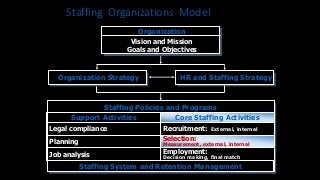
Organization Strategy HR and Staffing Strategy
Staffing Policies and Programs
Staffing System and Retention Management
Support Activities
Legal compliance
Planning
Job analysis
Core Staffing Activities
Recruitment: External, internal
Selection:
Measurement, external, internal
Employment:
Decision making, final match
Organization
Vision and Mission
Goals and Objectives
Staffing Organizations Model
59
10 golden rules of
recruitment and selection
1.Develop a Recruitment Plan
2.Conduct Research
3.Personalize the Recruitment Process
4.Select and Train the Right People as Recruiters
5.Build Strong Partnerships
6.Develop an Employee Referral Program
7.Improve the Selection Process
8. Develop an Advertising Plan
9. Develop an Internet Presence
10.Employ Effective Recruitment Strategies
RESUME, C.V., BIO-DATA
RESUME
• Signifies a summary of one's employment, education, and other
skills, used in applying for a new position.
• They do not list out all the education and qualifications.
• A resume is usually broken into bullets and written in the third
person to appear objective and formal.
RESUME
A good resume starts with.
A brief Summary of Qualifications.
 Followed by Areas of Strength or Industry Expertise in keywords.
Followed by Professional Experience in reverse chronological
order. Focus is on the most recent experiences, and prior
experiences summarized.
After Work experience come Professional Affiliations, Computer
Skills, and Education.
C.V. (CURRICULUM VITAE)
courseof life
• Curriculum Vitae (C.V.) is therefore a regular or particular course
of study pertaining to education and life.
• A C.V. is more detailed than a resume
• A C.V. generally lists out every skills, jobs, degrees, and
professional affiliations
• A C.V. displays general talent rather than specific skills for any
specific positions.
BIO-DATA
Bio Data the short form for Biographical Data is the old-fashioned
terminology for Resume or C.V.
The emphasis in a bio data is on personal particulars like date of
birth, religion, sex, race, nationality, residence, marital status, and
the like.
 Next comes a chronological listing of education and experience.
 The things normally found in a resume, that is specific skills for the
job in question comes last, and are seldom included.
Make or Buy Human Resources?
• Make
• Hire trainable employees.
• Buy
• Hire fully trained employees.
• Make & buy
• Buy fully trained employees for critical jobs.
• Hire trainable employees for all other jobs.
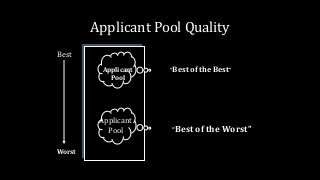
Applicant Pool Quality
Best
Worst
Applicant
Pool
“Best of the Best”
“Best of the Worst”
Applicant
Pool
WHY CAREFUL SELECTION ???
PERFORMANCE
Employee with the right skills and
attributes will you a better job for
you and company
COST
Hiring an employee can cost too much for a
company so it is much important to carefully
Select an employee
LEGAL OBLIGATION
The employee selected should not
have any criminal record
BASICTESTINGCONCEPT:
There are basically two basic testing concepts..
1) Reliability.
2) Validity.
validity:
BASICTESTINGCONCEPT:
The accuracy with which a test,
interview and so on measures what it
purpose to measure or fulfills the
function it was designed to fill.
HUMAN RESOURCE PLANNING ( H R P )
Translation of objectives into HR numbers
“HRP is a process of translating organizational objectives and plans
into the number of workers needed to meet those objectives.”
PURPOSE OF HRP
• In simple words HRP is understood as the process of forecasting an
organization’s future demand for and supply of the right type of
people in the right numbers.
• It is only after HRP is done, that the company can initiate and plan the
recruitment and selection process.
• HRP is a sub-system in the total organizational planning.
• HRP is important because without a clear-cut manpower planning,
estimation of a organization’s human resource need is reduced to
mere guesswork.
NEED & IMPORTANCE OF HRP
Forecast future personnel needs
Cope with change
Creating highly talented personnel
Protection of weaker sections
International strategies
Foundation of personnel functions:
Resistance to change & move
Organizational Objectives & Policies:
The objectives of HR plan must be derived from organizational
objectives like specific requirements of numbers and characteristics
of employees etc.
• Internal Hiring or External Hiring?
• Training & Development plans
• Job enrichment issues
• Rightsizing organization
• Continuous availability of adaptive and flexible workforce
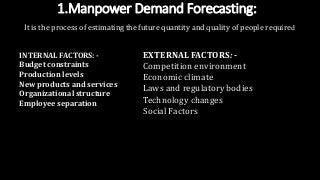
1.Manpower Demand Forecasting:
It is the process of estimating the future quantity and quality of people required
EXTERNAL FACTORS: -
Competition environment
Economic climate
Laws and regulatory bodies
Technology changes
Social Factors
INTERNAL FACTORS: -
Budget constraints
Production levels
New products and services
Organizational structure
Employee separation
1.1 Reasons for Manpower Demand Forecasting
To quantify jobs
To determine the Staff-mix
To assess staffing levels and avoid unnecessary costs
Prevent shortages of people
Monitor compliances of legal requirements with regards to
reservations
2. Manpower Supply Forecasting
• This process measures the number of people likely to be available
from within and outside the organization
Reasons for Manpower Supply Forecasting:
 Clarify Staff-mixes exist in the future
 Assess existing staff levels
 Prevent shortages
2.1 Supply Analysis covers
Existing Human Resources
HR Audits facilitate analysis of existing employees with skills and abilities. The
existing employees can be categorized as skills inventories (non-managers) and
managerial inventories (managers)
External Supply: -
 External sources are required for following reasons
 New blood,
 New experiences
 Replenish lost personnel
 Organizational growth
 Diversification
 External sources can be colleges and universities,
consultants, competitors and unsolicited applications.
Internal Supply: -
 Internal supply techniques help to assess the following
 Inflows and outflows (transfers, promotions, separations, resignations, retirements etc.)
 Turnover rate (No. Of separations p.a. / Average employees p.a. X 100)
 Conditions of work (working hours, overtime, etc.)
 Absenteeism (leaves, absences)
 Productivity level
 Job movements (Job rotations or cross functional utilizations)
HR Plan Implementation
• Recruitment & Selection : Employees are hired against the job
vacancies. Based on the manpower demand and supply forecasts
made, hiring of employees is initiated based on supply forecasts. For
this internal and external sources of manpower are utilized.
• Training and Development: The training and development program is
charted out to cover the number of trainees, existing staff etc.
• Retraining and Redeployment; New skills are to be imparted to
existing staff when technology changes or product line discontinued.
Employees need to be redeployed to other departments where they
could be gainfully employed.
• Retention Plan: Retention plans cover actions, which would reduce
avoidable separations of employees. Using compensation plans,
performance appraisals, avoiding conflicts, providing green pastures
etc, can do this.
CONTROL & EVALUATION OF HRP
• HR Plan must also clarify responsibilities for control and establish
reporting procedures, which will enable achievements to be monitored
against the plan. The HR Plan should include budgets, targets and
standards. These plans may simply be reports on the numbers
employed, recruited against targets etc.
JOB ANALYSIS
• Definition 1: (Process of Collecting Information)
“Job Analysis is a process of studying and collecting information relating
to operations and responsibilities of a specific job. The immediate
products of this analysis are ‘Job Description’ and ‘Job Specifications’.”
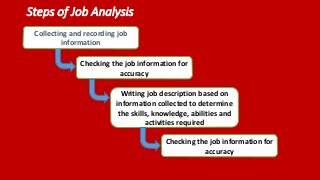
Steps of Job Analysis
Collecting and recording job
information
Checking the job information for
accuracy
Writing job description based on
information collected to determine
the skills, knowledge, abilities and
activities required
Checking the job information for
accuracy
BARRIERS OF JOB ANALYSIS
1. Support from Top Management
2. Single means and source, reliance on single method rather than
combination
3. No Training or Motivation to Jobholders
4. Activities and Data may be Distorted
Contents of Job Description
• Job Identification
• Job Summary
• Job Duties and Responsibilities
• Supervision specification
• Machines, tools and materials
• Work conditions
• Work hazards
• Definition of unusual terms
JOB DESCRIPTION
•
“Job Description implies objective listing of the job title, tasks, and
responsibilities involved in a job.”
Format of Job Description
• Job Title
• Region/Location
• Department
• Reporting to (Operational and Managerial)
• Objective
• Principal duties and responsibilities
Features of Good Job Description
1. Up to date
2. Proper Job Title
3. Comprehensive Job Summary
4. Clear duties and responsibilities
5. Easily understandable
6. State job requirements
7. Specify reporting relationships
8. Showcase degrees of difficulties
9. Indicates opportunities for career development
10. Offer bird’s-eye-view of primary responsibilities
JOB SPECIFICATIONS
•
“Job Specification involves listing of employee qualifications, skills and
abilities required to meet the job description. These specifications are
needed to do job satisfactorily.”
Contents of Job Specifications
• Physical Characteristics
• Psychological characteristics
• Personal characteristics
• Responsibilities
• Demographic features
PURPOSE AND IMPORTANCE OF RECRUITMENT: -
1. Determine the present and future requirements in conjunction with personnel
planning and job analysis activities
2. Increase the pool of job candidates at minimum cost
3. Help increase success rate of selection process by reducing number of under-
qualified or over-qualified applications.
4. Reduce the probability that job applicants once selected would leave shortly
5. Meet legal and social obligations
6. Identify and prepare potential job applicants
7. Evaluate effectiveness of various recruitment techniques and sources for job
applicants.
FACTORS GOVERNING RECRUITMENT
External Factors:
Demand and Supply (Specific Skills)
Unemployment Rate (Area-wise)
Labor Market Conditions
Political and Legal Environment
(Reservations, Labor laws)
Image
Internal Factors
Recruitment Policy (Internal Hiring or
External Hiring?)
Human Resource Planning (Planning of
resources required)
Size of the Organization (Bigger the
size lesser the recruitment problems)
Cost
Growth and Expansion Plans

Recruitment and selection notes

  • 1.
  • 2.
    RECRUITMENT AND SELECTION Recruitmentrefers to the process of attracting, screening, and selecting a qualified person for a job. Recruitment process involves a systematic procedure from sourcing the candidates to arranging and conducting the interviews and requires many resources and time.
  • 3.
    A general recruitmentprocess is as follows
  • 4.
    Identifying the vacancy Therecruitment process begins with the workforce planning which involves estimating future human resource requirements and ensuring the firm has the right number of people, in the right place, with right skills at the right time. These contain: • Posts to be filled • Number of persons • Duties to be performed • Qualifications required
  • 5.
    SECOND LEVEL • Preparingthe job description and person specification. • Locating and developing the sources of required number and type of employees (Advertising etc). • Short-listing and identifying the prospective employee with required characteristics. • Arranging the interviews with the selected candidates. • Conducting the interview and decision making.
  • 6.
    JOB ANALYSIS • Theprocedure for determining the duties and skill requirements of a job and the kind of person who should be hired for it • Job analysis produces information used for writing job descriptions and job specifications • Job description : A list of job’s duties, responsibilities, reporting relationships, working conditions, and supervisory responsibilities • Job Specifications: A list of job’s “human requirements", that is, the requisite education, skills, personality, and so on.
  • 7.
    Methods of jobAnalysis Data Collection (1) Observation method  Direct observation  Work methods analysis, including time and motion study  The critical incident technique. (2) Interview method  Structured  Unstructured (3) Questionnaires, including job inventories or checklists
  • 8.
    Job inventories List thatitemizes all of the task involved in the performance of a specific job. Used in human resource management, it summarizes information collected from documented studies, interviews, observation, and questionnaires.
  • 9.
    EMPLOYMENT ARRANGEMENTS IN BUSINESSORGANIZATIONS 1. Permanent employees, regular employees are paid directly by that employer. In addition to their wages, they often receive benefits like subsidized health care, paid vacations, holidays, sick time, or contributions to a retirement plan. • Rarely permanent employment means employment of an individual that is guaranteed throughout the employee's working life
  • 10.
    2. Temporary orcontractual staffing Temporary or contractual staffing is a short term based assignment, for which a talent is hired. This kind of hiring decreases the liability of an organization, as this assignment may not include all the benefits which the organization may offer its full time employees. 3. Apprentice/trainee An apprentice/trainee is employed on a fixed term contract that enables the person to become qualified in a particular trade or skill through a combination of work and structured training.
  • 11.
    4. Full-time employment •Full-time employment is employment in which a person works a full 40 hours defined as such by his/her employer. • Full-time employment often comes with benefits that are not typically offered to part-time, temporary, or flexible workers, such as annual leave, sick leave, and health insurance. • Full-time jobs are often considered careers. They generally pay more than part-time jobs, and usually carry more hours per week
  • 12.
    5. Part TimeHiring A part-time job is a form of employment that carries fewer hours per week than a full-time job. Workers are considered to be part time if they commonly work fewer than 30 or 35 hours per week. 6. Contract Jobs A n organization offers contract jobs when a specific task needs to be completed. The job description is given, and a person or company must apply for it.
  • 13.
  • 14.
    INTERNAL SOURCES OFRECRUITMENT • Internal sources of recruitment • Present permanent employees (based on programs of career development). • Present temporary / casual employees. • Retired employees. • Dependents of deceased disabled, retired and present employees.
  • 15.
    Methods of internalrecruitment • Intranets. • Staff notice boards. • In-house magazines / newsletters. • Internal notices. • Meetings. • Personal recommendation – often referred to as ‘word of mouth’
  • 16.
    Advantages of internalrecruitment • Cheaper and quicker to recruit. • People already familiar with the business and how it operates. • Provides opportunities for promotion with in the business – can be motivating. • Business already knows the strengths and weaknesses of candidates. Disadvantages of internal recruitment • Limits the number of potential applicants. • No new ideas can be introduced from outside the business. • External candidates might be better suited / qualified for the job. • May cause resentment amongst candidates not appointed. • Creates another vacancy which needs to be filled. • Longer process.
  • 17.
    EXTERNAL RECRUITMENT External recruitmentis when organizations looks to fill the vacancy from any suitable applicant outside organizations.
  • 18.
    Methods of externalrecruitment • Campus • Job center • Head hunting • Advertisements • Database search on job sites • Employee referral
  • 19.
    Advantages of externalrecruitment: • • Outside people bring in new ideas • Larger pool of workers from which to find the best candidate • People have a wider range of experience Disadvantages of external recruitment: • Longer process • More expensive process due to • advertisements and interviews required • Selection process may not be effective enough to reveal the best candidate
  • 20.
    RECRUITMENT PROCESS OUTSOURCING •Recruitment Process Outsourcing is a form of business process outsourcing (BPO) where an employer outsources or transfers all or part of its recruitment activities to an external service provider.
  • 21.
    DECIDING THE APPLICATIONMODE CurriculumVitae Advantage Disadvantage 1. Provides a better opportunity to demonstrate one’s suitablity for the job 1. CV is rarely developed for the job offered , so the employer may reciev information inconsistent to the job – on a CV, people tend to tell you what they want you to hear, rather than what you need to hear 1. A well prepared CV may widen the options for the employer to consider the applicant for other job than applied for 2. Each CV may provide very different information so it makes difficult to compare people
  • 22.
    Application Form Advantages Disadvantages 1.The employer can design the application form specific to the job, hence preventing influx of unnecessary information, saving recruitment cost and time 1. Requires specific expertise that the employer may not be wielding adequately. A poorly structured form may prevent valuable information from the candidates 2. An application form makes the applicants provide similar information hence easier inter – candidate comparison vis-a-vis person specification, ensuring equal 2. Compulsion of filling the forms may make the employed candidate reluctant to apply
  • 23.
    JOB ADVERTISEMENT • TheObjective of Recruitment Advertising • The objectives of recruitment advertising are to: • (1) Attract suitable candidates, and • (2) Deter unsuitable candidates • What makes a good job advert?
  • 25.
    Features Of EffectiveAdvertisement: • Accurate - describes the job and its requirements accurately • Short - not too long-winded; covers just the important ground • Honest - does not make claims about the job or the business that will later prove false to applicants • Positive - gives the potential applicant a positive feel about joining the business • Relevant - provides details that prospective applicants need to know at the application stage (e.g. is shift-working required; are there any qualifications required)
  • 26.
    Content of ajob advert • Most job adverts contain: • - Details of the business/organization (name, brand, location, type of business) • - Outline details of the job (title, main duties) • - Conditions (special factors affecting the job) • - Experience / qualifications required (e.g. minimum qualifications, amount of experience) • - Rewards (financial and non-financial) • - Application process (how should applicants apply, how to; deadlines)
  • 27.
    Choice of medium •Type of job: senior management jobs merit adverts in the national newspapers and/or specialist management magazines (e.g. the Economist, Business Week). Many semi-skilled jobs need only be advertised locally to attract sufficient good quality candidates • Cost of advertising: National newspapers and television cost significantly more than local newspapers etc • Readership and circulation: how many relevant people do the medium reach? How frequently like weekly, monthly, annually. Is the target audience actually only a small fraction of the total readership or Viewer ship? • Frequency: how often does the business want to advertise the post?
  • 28.
    SELECTION “Selection is theprocess of putting right men on right job”
  • 29.
    HOLDING THE SELECTIONEVENTS 1. SCREENING RESUMES Screening resumes is the process of sorting resumes to disqualify candidates using successively more detailed examinations of the resumes.
  • 30.
    SCREENING RESUMES (Resumes Evaluation) •Sorting resumes based on the qualifications • qualification –job requirements • Eliminate candidates that do not meet the job requirements. • skills and talents required for identifying the eligible candidates • conducting examinations –technology (manually) • computer, aid automation
  • 31.
    Screening Process First passor scanning for keywords Reading the resume to evaluate the candidate against the job requirements Full review of the resume including a subjective qualitative review of the candidate’s job history
  • 32.
    Screening Process Scanning forkeywords Reading the resume to evaluate the candidate Full review of the resume First pass Second pass Final pass
  • 33.
    First step -Keywords •The keywords selected are derived from required skills or activities in the job description. • This step of the process can often be aided by computers
  • 34.
    Second step- Evaluation •This second pass is designed to verify some of the second order criteria of the job description are met • Level of education, years of experience required by the position, salary range and current location
  • 35.
    Final step -Qualitativereview • This final pass is to examine the more subtle subjective qualities of the candidate. • The objective is remove candidates with red flags
  • 36.
    HOLDING THE SELECTIONEVENTS PROCESS OF PUTTING RIGHT MEN ON RIGHT JOB • It is a procedure of matching organizational requirements with the skills and qualifications of people
  • 37.
    1. Preliminary Interviews- Itis used to eliminate those candidates who do not meet the minimum eligibility criteria laid down by the organization. The skills, academic and family background, competencies and interests of the candidate are examined during preliminary interview.
  • 38.
    2. Application blanks- Thecandidates who clear the preliminary interview are required to fill application blank. It contains age, qualifications, reason for leaving previous job, experience, etc.
  • 40.
    Weighted application blank(WAB) •It is a printed form completed by candidate wherein each item is weighted and scored based on its importance as a determinant of job success • It helps a company to cross-compare candidates having more or less similar qualifications and reject those not meeting the job criteria strictly
  • 41.
    Weighted application blank(WAB) •On the negative side, it is difficult to develop an appropriate WAB, the exercise could be quite costly, and it needs frequent updating so as to be in line with changing job requirements.
  • 42.
    3. Written Tests- •Aptitude test • Intelligence test • Reasoning test • Personality test These tests are used to objectively assess the potential candidate. They should not be biased.
  • 43.
    INTELLIGENCE TESTS • Testsof general intellectual abilities. They measures not a single trait but rather a range of abilities such as- reasoning, vocabulary, verbal fluency, numerical abilities, memory etc.
  • 44.
    APTITUDE TESTS • Itmeasures whether an individual has the capacity or latent ability to learn a given job if given adequate training. • A capacity to learn in the future. • To select person who will show a higher degree of success after the training period. • Specific capacities or aptitudes are- mechanical, clerical, linguistic, musical, academic etc.
  • 45.
    PERSONALITY TESTS • Itmeasures personality attributes of candidate such as emotional stability, confirmity, agreeableness, extroversion, smartness etc.
  • 46.
    Interest tests/Vocational tests Inthis test applicants is asked whether s/he likes, dislikes the particular occupation, activities, peoples. Interest in specific profession and occupation is tested. Measures candidates preference in different types of job.
  • 47.
    SITUATION TESTS • Itevaluates the candidate’s behaviour in a particular situation or in a situation which is similar to some aspects of the job to be done in the future.
  • 48.
    4. Employment Interviews- •An interview is a procedure designed to obtain information from a person through oral responses to oral inquiries. • Managers uses several types of interviews, such as:  Selection  Appraisal  Exit interviews Trough oral responses to oral inquiries.
  • 49.
    Effective Interviewing  Conductingan Effective Interview  Planning the interview  Controlling the interview  Using proper questioning techniques  Question types to avoid in interviews  Yes/No questions  Questions that rarely produce a true answer  Illegal questions  Questions that are not job related
  • 50.
    Types of selectioninterviews 1. Structured or Directive interview: An interview following a set sequence of questions. The questions and acceptable responses are specified in advance and the responses are rated for appropriateness of content.
  • 51.
    • Situational interview: •A series of job related questions that focus on how the candidate would behave in a given situation. Asks interviewees to describe how they would react to a hypothetical situation today or tomorrow. • Behavioural interview: A series of job related questions that focuses on how the candidate reacted to actual situations in the past. Asks interviewees to describe how they reacted to actual situations in the past.
  • 52.
    Job related interview: Aseries of job related questions that focuses on relevant past job related behaviors. Asks job related questions to draw conclusions about what the applicant’s on the job performance will be based on his or her answers to questions about past experiences. Stress interview: An interview in which the applicant is made uncomfortable by a series of often rude questions. This technique helps identify hypersensitive applicants and those with low or high stress tolerance.
  • 53.
    2.Unstructured or Nondirectiveinterview: • An unstructured interview or non-directive interview is an interview in which questions are not prearranged • An unstructured conversational- style interview in which the interviewer pursues points of interest as they come up in response to questions. • Generally no set format to follow. Interview for the same job may or may not get the similar questions. A few questions may be specified in advance.
  • 54.
    • Semi-structured interview: Majorquestions to be asked are planned in advance and are same for all candidates but other questions vary from candidate to candidate. Interviewer are provided some flexibility.
  • 55.
    5. Medical examination- Medicaltests are conducted to ensure physical fitness of the potential employee. It will decrease chances of employee absenteeism. 6. Appointment Letter- A reference check is made about the candidate selected and then finally he is appointed by giving a formal appointment letter.
  • 56.
    Stages of theRecruitment & Selection Process Stages of The Recruitment and Selection Process Stage 1 Stage 2 Stage 3 Stage 4 Stage 5 Organiz- ation Identify and attract applicants Narrow pool to minimally qualified applicants Further narrow pool to those who best fit the job Further narrow pool to those who best fit job and organization Decide whom to hire Individual Identify and attract organiz- ations Narrow pool to minimally acceptable organiz- ations Further narrow pool to those who best fit with needs/career goals Further narrow pool to those who have desirable jobs and desirable cultures Decide which job offer to accept
  • 57.
    Recruitment Vs Selection Recruitment is a positive process i.e. encouraging more and more employees to apply WHEREAS selection is a negative process as it involves rejection of the unsuitable candidates.  Recruitment is concerned with tapping the sources of human resources WHEREAS selection is concerned with selecting the most suitable candidate through various interviews and tests.  There is no contract of recruitment established in recruitment WHEREAS selection results in a contract of service between the employer and the selected employee.
  • 58.
    Organization Strategy HRand Staffing Strategy Staffing Policies and Programs Staffing System and Retention Management Support Activities Legal compliance Planning Job analysis Core Staffing Activities Recruitment: External, internal Selection: Measurement, external, internal Employment: Decision making, final match Organization Vision and Mission Goals and Objectives Staffing Organizations Model
  • 59.
    59 10 golden rulesof recruitment and selection 1.Develop a Recruitment Plan 2.Conduct Research 3.Personalize the Recruitment Process 4.Select and Train the Right People as Recruiters 5.Build Strong Partnerships 6.Develop an Employee Referral Program 7.Improve the Selection Process 8. Develop an Advertising Plan 9. Develop an Internet Presence 10.Employ Effective Recruitment Strategies
  • 60.
    RESUME, C.V., BIO-DATA RESUME •Signifies a summary of one's employment, education, and other skills, used in applying for a new position. • They do not list out all the education and qualifications. • A resume is usually broken into bullets and written in the third person to appear objective and formal.
  • 61.
    RESUME A good resumestarts with. A brief Summary of Qualifications.  Followed by Areas of Strength or Industry Expertise in keywords. Followed by Professional Experience in reverse chronological order. Focus is on the most recent experiences, and prior experiences summarized. After Work experience come Professional Affiliations, Computer Skills, and Education.
  • 62.
    C.V. (CURRICULUM VITAE) courseoflife • Curriculum Vitae (C.V.) is therefore a regular or particular course of study pertaining to education and life. • A C.V. is more detailed than a resume • A C.V. generally lists out every skills, jobs, degrees, and professional affiliations • A C.V. displays general talent rather than specific skills for any specific positions.
  • 63.
    BIO-DATA Bio Data theshort form for Biographical Data is the old-fashioned terminology for Resume or C.V. The emphasis in a bio data is on personal particulars like date of birth, religion, sex, race, nationality, residence, marital status, and the like.  Next comes a chronological listing of education and experience.  The things normally found in a resume, that is specific skills for the job in question comes last, and are seldom included.
  • 64.
    Make or BuyHuman Resources? • Make • Hire trainable employees. • Buy • Hire fully trained employees. • Make & buy • Buy fully trained employees for critical jobs. • Hire trainable employees for all other jobs.
  • 65.
    Applicant Pool Quality Best Worst Applicant Pool “Bestof the Best” “Best of the Worst” Applicant Pool
  • 66.
    WHY CAREFUL SELECTION??? PERFORMANCE Employee with the right skills and attributes will you a better job for you and company
  • 67.
    COST Hiring an employeecan cost too much for a company so it is much important to carefully Select an employee LEGAL OBLIGATION The employee selected should not have any criminal record
  • 68.
    BASICTESTINGCONCEPT: There are basicallytwo basic testing concepts.. 1) Reliability. 2) Validity.
  • 69.
    validity: BASICTESTINGCONCEPT: The accuracy withwhich a test, interview and so on measures what it purpose to measure or fulfills the function it was designed to fill.
  • 70.
    HUMAN RESOURCE PLANNING( H R P ) Translation of objectives into HR numbers “HRP is a process of translating organizational objectives and plans into the number of workers needed to meet those objectives.”
  • 71.
    PURPOSE OF HRP •In simple words HRP is understood as the process of forecasting an organization’s future demand for and supply of the right type of people in the right numbers. • It is only after HRP is done, that the company can initiate and plan the recruitment and selection process. • HRP is a sub-system in the total organizational planning. • HRP is important because without a clear-cut manpower planning, estimation of a organization’s human resource need is reduced to mere guesswork.
  • 72.
    NEED & IMPORTANCEOF HRP Forecast future personnel needs Cope with change Creating highly talented personnel Protection of weaker sections International strategies Foundation of personnel functions: Resistance to change & move
  • 73.
    Organizational Objectives &Policies: The objectives of HR plan must be derived from organizational objectives like specific requirements of numbers and characteristics of employees etc. • Internal Hiring or External Hiring? • Training & Development plans • Job enrichment issues • Rightsizing organization • Continuous availability of adaptive and flexible workforce
  • 74.
    1.Manpower Demand Forecasting: Itis the process of estimating the future quantity and quality of people required EXTERNAL FACTORS: - Competition environment Economic climate Laws and regulatory bodies Technology changes Social Factors INTERNAL FACTORS: - Budget constraints Production levels New products and services Organizational structure Employee separation
  • 75.
    1.1 Reasons forManpower Demand Forecasting To quantify jobs To determine the Staff-mix To assess staffing levels and avoid unnecessary costs Prevent shortages of people Monitor compliances of legal requirements with regards to reservations
  • 76.
    2. Manpower SupplyForecasting • This process measures the number of people likely to be available from within and outside the organization Reasons for Manpower Supply Forecasting:  Clarify Staff-mixes exist in the future  Assess existing staff levels  Prevent shortages
  • 77.
    2.1 Supply Analysiscovers Existing Human Resources HR Audits facilitate analysis of existing employees with skills and abilities. The existing employees can be categorized as skills inventories (non-managers) and managerial inventories (managers)
  • 78.
    External Supply: - External sources are required for following reasons  New blood,  New experiences  Replenish lost personnel  Organizational growth  Diversification  External sources can be colleges and universities, consultants, competitors and unsolicited applications. Internal Supply: -  Internal supply techniques help to assess the following  Inflows and outflows (transfers, promotions, separations, resignations, retirements etc.)  Turnover rate (No. Of separations p.a. / Average employees p.a. X 100)  Conditions of work (working hours, overtime, etc.)  Absenteeism (leaves, absences)  Productivity level  Job movements (Job rotations or cross functional utilizations)
  • 79.
    HR Plan Implementation •Recruitment & Selection : Employees are hired against the job vacancies. Based on the manpower demand and supply forecasts made, hiring of employees is initiated based on supply forecasts. For this internal and external sources of manpower are utilized. • Training and Development: The training and development program is charted out to cover the number of trainees, existing staff etc. • Retraining and Redeployment; New skills are to be imparted to existing staff when technology changes or product line discontinued. Employees need to be redeployed to other departments where they could be gainfully employed.
  • 80.
    • Retention Plan:Retention plans cover actions, which would reduce avoidable separations of employees. Using compensation plans, performance appraisals, avoiding conflicts, providing green pastures etc, can do this.
  • 81.
    CONTROL & EVALUATIONOF HRP • HR Plan must also clarify responsibilities for control and establish reporting procedures, which will enable achievements to be monitored against the plan. The HR Plan should include budgets, targets and standards. These plans may simply be reports on the numbers employed, recruited against targets etc.
  • 82.
    JOB ANALYSIS • Definition1: (Process of Collecting Information) “Job Analysis is a process of studying and collecting information relating to operations and responsibilities of a specific job. The immediate products of this analysis are ‘Job Description’ and ‘Job Specifications’.”
  • 83.
    Steps of JobAnalysis Collecting and recording job information Checking the job information for accuracy Writing job description based on information collected to determine the skills, knowledge, abilities and activities required Checking the job information for accuracy
  • 84.
    BARRIERS OF JOBANALYSIS 1. Support from Top Management 2. Single means and source, reliance on single method rather than combination 3. No Training or Motivation to Jobholders 4. Activities and Data may be Distorted
  • 85.
    Contents of JobDescription • Job Identification • Job Summary • Job Duties and Responsibilities • Supervision specification • Machines, tools and materials • Work conditions • Work hazards • Definition of unusual terms
  • 86.
    JOB DESCRIPTION • “Job Descriptionimplies objective listing of the job title, tasks, and responsibilities involved in a job.”
  • 87.
    Format of JobDescription • Job Title • Region/Location • Department • Reporting to (Operational and Managerial) • Objective • Principal duties and responsibilities
  • 88.
    Features of GoodJob Description 1. Up to date 2. Proper Job Title 3. Comprehensive Job Summary 4. Clear duties and responsibilities 5. Easily understandable 6. State job requirements 7. Specify reporting relationships 8. Showcase degrees of difficulties 9. Indicates opportunities for career development 10. Offer bird’s-eye-view of primary responsibilities
  • 89.
    JOB SPECIFICATIONS • “Job Specificationinvolves listing of employee qualifications, skills and abilities required to meet the job description. These specifications are needed to do job satisfactorily.”
  • 90.
    Contents of JobSpecifications • Physical Characteristics • Psychological characteristics • Personal characteristics • Responsibilities • Demographic features
  • 91.
    PURPOSE AND IMPORTANCEOF RECRUITMENT: - 1. Determine the present and future requirements in conjunction with personnel planning and job analysis activities 2. Increase the pool of job candidates at minimum cost 3. Help increase success rate of selection process by reducing number of under- qualified or over-qualified applications. 4. Reduce the probability that job applicants once selected would leave shortly 5. Meet legal and social obligations 6. Identify and prepare potential job applicants 7. Evaluate effectiveness of various recruitment techniques and sources for job applicants.
  • 92.
    FACTORS GOVERNING RECRUITMENT ExternalFactors: Demand and Supply (Specific Skills) Unemployment Rate (Area-wise) Labor Market Conditions Political and Legal Environment (Reservations, Labor laws) Image Internal Factors Recruitment Policy (Internal Hiring or External Hiring?) Human Resource Planning (Planning of resources required) Size of the Organization (Bigger the size lesser the recruitment problems) Cost Growth and Expansion Plans