RECRUITMENT
Recruitment
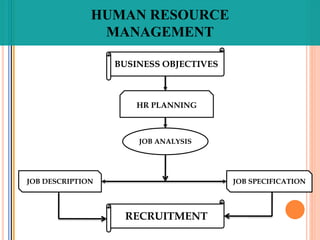
HUMAN RESOURCE
MANAGEMENT
BUSINESS OBJECTIVES
RECRUITMENT
HR PLANNING
JOB DESCRIPTION JOB SPECIFICATION
JOB ANALYSIS
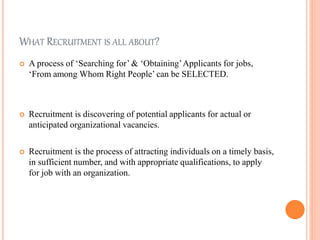
WHAT RECRUITMENT IS ALL ABOUT?
 A process of ‘Searching for’ & ‘Obtaining’Applicants for jobs,
‘From among Whom Right People’ can be SELECTED.
 Recruitment is discovering of potential applicants for actual or
anticipated organizational vacancies.
 Recruitment is the process of attracting individuals on a timely basis,
in sufficient number, and with appropriate qualifications, to apply
for job with an organization.
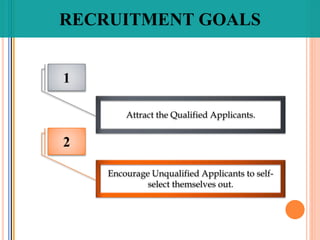
RECRUITMENT GOALS
1
Attract the Qualified Applicants.
2
Encourage Unqualified Applicants to self-
select themselves out.
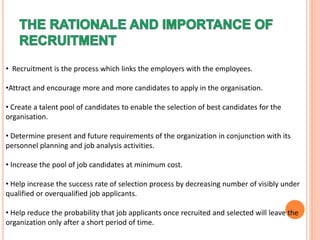
• Recruitment is the process which links the employers with the employees.
•Attract and encourage more and more candidates to apply in the organisation.
• Create a talent pool of candidates to enable the selection of best candidates for the
organisation.
• Determine present and future requirements of the organization in conjunction with its
personnel planning and job analysis activities.
• Increase the pool of job candidates at minimum cost.
• Help increase the success rate of selection process by decreasing number of visibly under
qualified or overqualified job applicants.
• Help reduce the probability that job applicants once recruited and selected will leave the
organization only after a short period of time.
• Meet the organizations legal and social obligations regarding the composition of its workforce.
• Begin identifying and preparing potential job applicants who will be appropriate candidates.
• Increase organization and individual effectiveness of various recruiting techniques and sources
for all types of job applicants
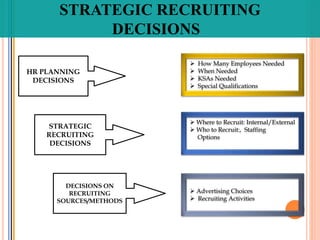
STRATEGIC RECRUITING
DECISIONS
HR PLANNING
DECISIONS
STRATEGIC
RECRUITING
DECISIONS
DECISIONS ON
RECRUITING
SOURCES/METHODS
 How Many Employees Needed
 When Needed
 KSAs Needed
 Special Qualifications
 Where to Recruit: Internal/External
 Who to Recruit:, Staffing
Options
 Advertising Choices
 Recruiting Activities
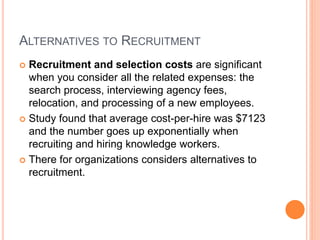
ALTERNATIVES TO RECRUITMENT
 Recruitment and selection costs are significant
when you consider all the related expenses: the
search process, interviewing agency fees,
relocation, and processing of a new employees.
 Study found that average cost-per-hire was $7123
and the number goes up exponentially when
recruiting and hiring knowledge workers.
 There for organizations considers alternatives to
recruitment.
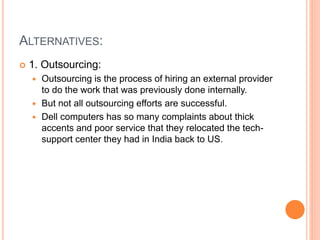
ALTERNATIVES:
 1. Outsourcing:
 Outsourcing is the process of hiring an external provider
to do the work that was previously done internally.
 But not all outsourcing efforts are successful.
 Dell computers has so many complaints about thick
accents and poor service that they relocated the tech-
support center they had in India back to US.
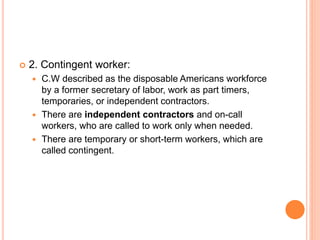
 2. Contingent worker:
 C.W described as the disposable Americans workforce
by a former secretary of labor, work as part timers,
temporaries, or independent contractors.
 There are independent contractors and on-call
workers, who are called to work only when needed.
 There are temporary or short-term workers, which are
called contingent.
 3. Professional employer organizations (Employee
leasing)
 A professional employer organization is a company that
leases employees to other business.
 It the PEO that pays the employees; it also pays
workers’ compensation premiums, payroll-related taxes,
and employee benefits,
 PEO is the employees’ legal employer therefore the
leasing company is responsible for recruiting activities.
 4. Overtime:
 The most commonly used alternative to recruitment,
especially in meeting short-term fluctuations in work
volumes, is overtime.
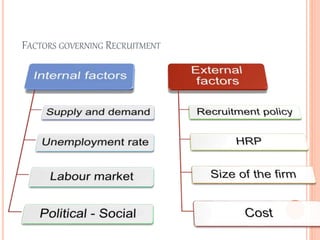
FACTORS GOVERNING RECRUITMENT
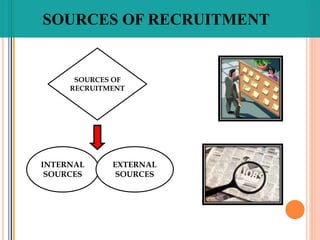
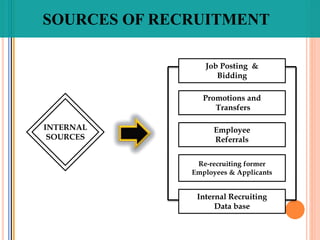
SOURCES OF RECRUITMENT
INTERNAL
SOURCES
EXTERNAL
SOURCES
SOURCES OF
RECRUITMENT
Internal Recruiting
Data base
Promotions and
Transfers
Job Posting &
Bidding
Employee
Referrals
Re-recruiting former
Employees & Applicants
INTERNAL
SOURCES
SOURCES OF RECRUITMENT
INTERNAL RECRUITMENT METHODS
 Management should be able to identify current
employees who are capable of filling positions as
they become available.
 Hiring managers usually want to give internal
candidates priority. Internal candidates already
understand the company's current culture and know
its mission, goals and priorities.
INTERNAL SOURCES OF CANDIDATES:
HIRING FROM WITHIN
 Advantages
 Foreknowledge of candidates’ strengths and
weaknesses
 More accurate view of candidate’s skills
 Candidates have a stronger commitment to the
company
 Increases employee morale
 Less training and orientation required
 Job posting: is a procedure for informing
employees that job opening exists.
 Job bidding: is a procedure that permits
employees who believe that they possess the
required qualifications to apply for a posted job.
 Rehiring former employees (pros and cons)
 Succession planning: Process of ensuring that
qualified persons are available to assume key
managerial positions once the positions are vacant.
 Employee Referrals:
 Applicants who are referred to the organization by current
employees
 Peer referrals are the most powerful recruiting tool.
When I get a referral in-house I know the candidate is
going to have the skills and the interest, because a
colleague has already made the contact.
 Employees actively solicit applications from their friends
and associations.
 Some firms even pay bonuses for successful referrals.
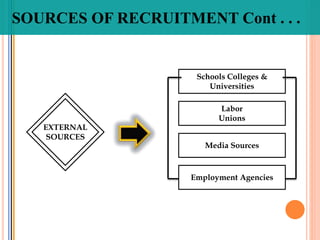
SOURCES OF RECRUITMENT Cont . . .
Schools Colleges &
Universities
Labor
Unions
Media Sources
Employment Agencies
EXTERNAL
SOURCES
EXTERNAL RECRUITMENT
 A firm must look beyond its own borders to find
employees, particularly when expanding its
workforce.
 External recruitment is needed to:
 Filling entry-level jobs
 Acquire skills not possessed by current employees
 Obtain employees with different backgrounds to provide
a diversity of ideas.
SOURCES OF EXTERNAL RECRUITMENT
 Competitors in market
 Former employees
 Unemployed
 Companies may downsize their operations, go out of
business, or merge with other firms, leaving qualified
workers without jobs.
 Military personnel
• Campus recruitment refers to the process whereby employers undertake an
organised program of attracting and hiring students who are about to graduate
from schools, colleges and universities.
• Employers commonly attend campuses to promote employment vacancies and
career opportunities to students who are considering these options following
graduation.
• Selection methods used by employers include interviews, aptitude tests, role
plays, written assessments, group discussions and presentations.
• Many schools, colleges and universities provide their students with independent
advice through a career advisory service which is staffed by professional career
advisors.
• The career advisory service often organises a career fair or job fair where a large
number of employers visit the campus at once giving students the opportunity to
meet a range of potential employers.
 Online Recruitment Methods
 Advantages of Internet recruiting
 Cost-effective way to publicize job openings
 More applicants attracted over a longer period
 Immediate applicant responses
 Online prescreening of applicants
 Links to other job search sites
 Automation of applicant tracking and evaluation
• Such sites have two main features: job boards and a résumé/Curriculum Vitae (CV)
database.
• Job boards allow member companies to post job vacancies.
• Candidates can upload a résumé to be included in searches by member companies. Fees
are charged for job postings and access to search resumes.
• Key players in this sector provide e-recruitment software and services to organisations of
all sizes and within numerous industry sectors, who want to e-enable entirely or partly their
recruitment process in order to improve business performance.
• The online software provided by those who specialise in online recruitment helps
organisations attract, test, recruit, employ and retain quality staff with a minimal amount of
administration.
General employment websites
monster.com Hotjobs.com Careerbuilder.com
Bayt.com
EXAMPLE RECRUITMENT WEB SITES
 Virtual job fair
 Corporate career websites
 Weblogs (blogs)
• Use blogs to post job descriptions and vacancies.
• Advertise on websites like Facebook or Orkut.
• Due to ever-increasing membership of people on these networking sites, there is a good
chance of people responding to these ads and blogs.
• Youth these days spend a lot of time on the internet.
TRADITIONAL EXTERNAL RECRUITMENT
METHODS
 Advertising
 The Media: selection of the best medium depends on
the positions for which the firm is recruiting.
 Newspapers (local and specific labor markets)
 Trade and professional journals
 Internet job sites
 Marketing programs
 Constructing an effective ad
 Wording related to job interest factors should evoke the
applicant’s attention, interest, desire, and action (AIDA)
and create a positive impression of the firm.
 Employment Agencies
 Job Fairs
 Internships
 Professional Associations (i.e Society of Human
Resource Management)
 Unsolicited Applicants

Recruitment.pptx

  • 1.
  • 2.
    HUMAN RESOURCE MANAGEMENT BUSINESS OBJECTIVES RECRUITMENT HRPLANNING JOB DESCRIPTION JOB SPECIFICATION JOB ANALYSIS
  • 3.
    WHAT RECRUITMENT ISALL ABOUT?  A process of ‘Searching for’ & ‘Obtaining’Applicants for jobs, ‘From among Whom Right People’ can be SELECTED.  Recruitment is discovering of potential applicants for actual or anticipated organizational vacancies.  Recruitment is the process of attracting individuals on a timely basis, in sufficient number, and with appropriate qualifications, to apply for job with an organization.
  • 4.
    RECRUITMENT GOALS 1 Attract theQualified Applicants. 2 Encourage Unqualified Applicants to self- select themselves out.
  • 5.
    • Recruitment isthe process which links the employers with the employees. •Attract and encourage more and more candidates to apply in the organisation. • Create a talent pool of candidates to enable the selection of best candidates for the organisation. • Determine present and future requirements of the organization in conjunction with its personnel planning and job analysis activities. • Increase the pool of job candidates at minimum cost. • Help increase the success rate of selection process by decreasing number of visibly under qualified or overqualified job applicants. • Help reduce the probability that job applicants once recruited and selected will leave the organization only after a short period of time.
  • 6.
    • Meet theorganizations legal and social obligations regarding the composition of its workforce. • Begin identifying and preparing potential job applicants who will be appropriate candidates. • Increase organization and individual effectiveness of various recruiting techniques and sources for all types of job applicants
  • 7.
    STRATEGIC RECRUITING DECISIONS HR PLANNING DECISIONS STRATEGIC RECRUITING DECISIONS DECISIONSON RECRUITING SOURCES/METHODS  How Many Employees Needed  When Needed  KSAs Needed  Special Qualifications  Where to Recruit: Internal/External  Who to Recruit:, Staffing Options  Advertising Choices  Recruiting Activities
  • 8.
    ALTERNATIVES TO RECRUITMENT Recruitment and selection costs are significant when you consider all the related expenses: the search process, interviewing agency fees, relocation, and processing of a new employees.  Study found that average cost-per-hire was $7123 and the number goes up exponentially when recruiting and hiring knowledge workers.  There for organizations considers alternatives to recruitment.
  • 9.
    ALTERNATIVES:  1. Outsourcing: Outsourcing is the process of hiring an external provider to do the work that was previously done internally.  But not all outsourcing efforts are successful.  Dell computers has so many complaints about thick accents and poor service that they relocated the tech- support center they had in India back to US.
  • 10.
     2. Contingentworker:  C.W described as the disposable Americans workforce by a former secretary of labor, work as part timers, temporaries, or independent contractors.  There are independent contractors and on-call workers, who are called to work only when needed.  There are temporary or short-term workers, which are called contingent.
  • 11.
     3. Professionalemployer organizations (Employee leasing)  A professional employer organization is a company that leases employees to other business.  It the PEO that pays the employees; it also pays workers’ compensation premiums, payroll-related taxes, and employee benefits,  PEO is the employees’ legal employer therefore the leasing company is responsible for recruiting activities.
  • 12.
     4. Overtime: The most commonly used alternative to recruitment, especially in meeting short-term fluctuations in work volumes, is overtime.
  • 13.
  • 14.
  • 15.
    Internal Recruiting Data base Promotionsand Transfers Job Posting & Bidding Employee Referrals Re-recruiting former Employees & Applicants INTERNAL SOURCES SOURCES OF RECRUITMENT
  • 16.
    INTERNAL RECRUITMENT METHODS Management should be able to identify current employees who are capable of filling positions as they become available.  Hiring managers usually want to give internal candidates priority. Internal candidates already understand the company's current culture and know its mission, goals and priorities.
  • 17.
    INTERNAL SOURCES OFCANDIDATES: HIRING FROM WITHIN  Advantages  Foreknowledge of candidates’ strengths and weaknesses  More accurate view of candidate’s skills  Candidates have a stronger commitment to the company  Increases employee morale  Less training and orientation required
  • 18.
     Job posting:is a procedure for informing employees that job opening exists.  Job bidding: is a procedure that permits employees who believe that they possess the required qualifications to apply for a posted job.  Rehiring former employees (pros and cons)  Succession planning: Process of ensuring that qualified persons are available to assume key managerial positions once the positions are vacant.
  • 19.
     Employee Referrals: Applicants who are referred to the organization by current employees  Peer referrals are the most powerful recruiting tool. When I get a referral in-house I know the candidate is going to have the skills and the interest, because a colleague has already made the contact.  Employees actively solicit applications from their friends and associations.  Some firms even pay bonuses for successful referrals.
  • 20.
    SOURCES OF RECRUITMENTCont . . . Schools Colleges & Universities Labor Unions Media Sources Employment Agencies EXTERNAL SOURCES
  • 21.
    EXTERNAL RECRUITMENT  Afirm must look beyond its own borders to find employees, particularly when expanding its workforce.  External recruitment is needed to:  Filling entry-level jobs  Acquire skills not possessed by current employees  Obtain employees with different backgrounds to provide a diversity of ideas.
  • 22.
    SOURCES OF EXTERNALRECRUITMENT  Competitors in market  Former employees  Unemployed  Companies may downsize their operations, go out of business, or merge with other firms, leaving qualified workers without jobs.  Military personnel
  • 23.
    • Campus recruitmentrefers to the process whereby employers undertake an organised program of attracting and hiring students who are about to graduate from schools, colleges and universities. • Employers commonly attend campuses to promote employment vacancies and career opportunities to students who are considering these options following graduation. • Selection methods used by employers include interviews, aptitude tests, role plays, written assessments, group discussions and presentations. • Many schools, colleges and universities provide their students with independent advice through a career advisory service which is staffed by professional career advisors. • The career advisory service often organises a career fair or job fair where a large number of employers visit the campus at once giving students the opportunity to meet a range of potential employers.
  • 25.
     Online RecruitmentMethods  Advantages of Internet recruiting  Cost-effective way to publicize job openings  More applicants attracted over a longer period  Immediate applicant responses  Online prescreening of applicants  Links to other job search sites  Automation of applicant tracking and evaluation
  • 26.
    • Such siteshave two main features: job boards and a résumé/Curriculum Vitae (CV) database. • Job boards allow member companies to post job vacancies. • Candidates can upload a résumé to be included in searches by member companies. Fees are charged for job postings and access to search resumes. • Key players in this sector provide e-recruitment software and services to organisations of all sizes and within numerous industry sectors, who want to e-enable entirely or partly their recruitment process in order to improve business performance. • The online software provided by those who specialise in online recruitment helps organisations attract, test, recruit, employ and retain quality staff with a minimal amount of administration. General employment websites monster.com Hotjobs.com Careerbuilder.com Bayt.com
  • 27.
  • 28.
     Virtual jobfair  Corporate career websites  Weblogs (blogs)
  • 29.
    • Use blogsto post job descriptions and vacancies. • Advertise on websites like Facebook or Orkut. • Due to ever-increasing membership of people on these networking sites, there is a good chance of people responding to these ads and blogs. • Youth these days spend a lot of time on the internet.
  • 30.
    TRADITIONAL EXTERNAL RECRUITMENT METHODS Advertising  The Media: selection of the best medium depends on the positions for which the firm is recruiting.  Newspapers (local and specific labor markets)  Trade and professional journals  Internet job sites  Marketing programs  Constructing an effective ad  Wording related to job interest factors should evoke the applicant’s attention, interest, desire, and action (AIDA) and create a positive impression of the firm.
  • 31.
     Employment Agencies Job Fairs  Internships  Professional Associations (i.e Society of Human Resource Management)  Unsolicited Applicants