CONFLICT RESOLUTION

by,
M.Sc(N),

Mrs.Kalpanasudheer
Asst professor
Dept of Community Health Nursing,
Narayana Nursing Institutions,NELLORE,A.P
The concept of law is as ancient as mankind
From domestic interaction to group structures rules of
law have impacted how individuals deal with the

conflict.
Law is pervasive and permanent in all human conflict

From its inception, law has been at work shaping and
reshaping the social order(Jenkins,1980)
To establish -rules and procedures that
constrain the power of all parties, hold all parties
accountable for their actions, and prohibit the
accumulation of autocratic or oligarchic power.
 To provide-a variety of means for the nonviolent resolution of disputes between private
individuals, between groups, or between these
actors and the government" (Crocker, 1996).

POSITIVE LAW

R E A L ISM
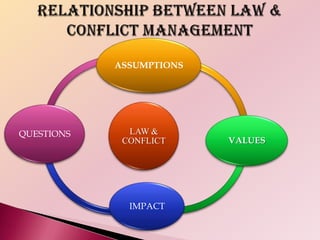
ASSUMPTIONS

QUESTIONS

LAW &
CONFLICT

IMPACT

VALUES


The virtues of accountability and love (common good)
are the soil in which the concept of law has grown.



"The Law is often thought of as being the guardian of our
liberties, and rightly so" (Leiser, 1973).



"That which challenges the law already belongs to law
and is thus liable to reflect the same desire for closure and
certitude that characterizes professionalized justice“(Tie)


The concept of law is the tree trunk on which
adjudication and facilitation theories and practices
branch out. If this is true, then the role of law is to
nurture and channel the development of how people
and groups of people manage conflict



One common factor is revealed: law and conflict
management have an enduring relationship of dealing
with human interaction.






Adjudication and facilitation are two branches from
the same tree, the trunk of which is law and the roots of
which are the values of law.
Adjudication "is thought to serve important values such
as rationality, impartiality, fairness and consistency"
(Lyons, 1984).
Facilitation, on the other hand, may appear to be
irrational at times. But this is not the case. It is simply
alternatively different in approach and style.




Although the legal system is making room for
alternative methods of dealing with disputes there is still
a wide valley between the opposing opinions of the
impact of law on conflict management.
Regarding the impact of law on conflict
management, Cloke (2001) believes that the new roles
for mediation will break the paradigm of law and return
it to its original purpose, "which was to resolve
conflict" "Mediation is justice coming full circle, a
return to the ancient tribal principles of
wisdom, compassion, honesty, self-revelation, healing
and forgiveness"








If two parties agree to facilitate their dispute instead of
using the process of adjudication, and if they come to an
agreed upon settlement, who will enforce it if there is no
legal document?
Can the legal system make more room for alternative styles
of conflict resolution?
Will lawyers and judges embrace the validity of alternative
dispute resolution with the same tepidness that nurses and
doctors had for alternative medicine years ago?
Does spirituality or religious norms play a role in the
adjudication or facilitation processes of dealing with
conflict?






It has occurred to me that in the route of researching
this unfamiliar territory of law and conflict
management, my personal beliefs about law and
conflict management have been challenged and
developed.
I was amazed at the amount of attention given to law
and conflict management in the scriptures.
"Love does no harm to its neighbor. Therefore love is
the fulfillment of the law" (The Bible, Romans 13:10)
The ideal management of conflict occurs when we seek
to love others the way that we would love ourselves.
conflict resolution

conflict resolution

  • 1.
    CONFLICT RESOLUTION by, M.Sc(N), Mrs.Kalpanasudheer Asst professor Deptof Community Health Nursing, Narayana Nursing Institutions,NELLORE,A.P
  • 2.
    The concept oflaw is as ancient as mankind From domestic interaction to group structures rules of law have impacted how individuals deal with the conflict. Law is pervasive and permanent in all human conflict From its inception, law has been at work shaping and reshaping the social order(Jenkins,1980)
  • 3.
    To establish -rulesand procedures that constrain the power of all parties, hold all parties accountable for their actions, and prohibit the accumulation of autocratic or oligarchic power.  To provide-a variety of means for the nonviolent resolution of disputes between private individuals, between groups, or between these actors and the government" (Crocker, 1996). 
  • 4.
  • 6.
  • 7.
     The virtues ofaccountability and love (common good) are the soil in which the concept of law has grown.  "The Law is often thought of as being the guardian of our liberties, and rightly so" (Leiser, 1973).  "That which challenges the law already belongs to law and is thus liable to reflect the same desire for closure and certitude that characterizes professionalized justice“(Tie)
  • 8.
     The concept oflaw is the tree trunk on which adjudication and facilitation theories and practices branch out. If this is true, then the role of law is to nurture and channel the development of how people and groups of people manage conflict  One common factor is revealed: law and conflict management have an enduring relationship of dealing with human interaction.
  • 10.
       Adjudication and facilitationare two branches from the same tree, the trunk of which is law and the roots of which are the values of law. Adjudication "is thought to serve important values such as rationality, impartiality, fairness and consistency" (Lyons, 1984). Facilitation, on the other hand, may appear to be irrational at times. But this is not the case. It is simply alternatively different in approach and style.
  • 11.
      Although the legalsystem is making room for alternative methods of dealing with disputes there is still a wide valley between the opposing opinions of the impact of law on conflict management. Regarding the impact of law on conflict management, Cloke (2001) believes that the new roles for mediation will break the paradigm of law and return it to its original purpose, "which was to resolve conflict" "Mediation is justice coming full circle, a return to the ancient tribal principles of wisdom, compassion, honesty, self-revelation, healing and forgiveness"
  • 12.
        If two partiesagree to facilitate their dispute instead of using the process of adjudication, and if they come to an agreed upon settlement, who will enforce it if there is no legal document? Can the legal system make more room for alternative styles of conflict resolution? Will lawyers and judges embrace the validity of alternative dispute resolution with the same tepidness that nurses and doctors had for alternative medicine years ago? Does spirituality or religious norms play a role in the adjudication or facilitation processes of dealing with conflict?
  • 13.
       It has occurredto me that in the route of researching this unfamiliar territory of law and conflict management, my personal beliefs about law and conflict management have been challenged and developed. I was amazed at the amount of attention given to law and conflict management in the scriptures. "Love does no harm to its neighbor. Therefore love is the fulfillment of the law" (The Bible, Romans 13:10) The ideal management of conflict occurs when we seek to love others the way that we would love ourselves.