HUMAN RESOURCE
MANAGEMENT AND STAFFING
MEANING
The term ‘personnel’ means the body of employees, officers or servants who fill the various
positions in organization. It is a collective name given to employees who man the various posts
in an organization.
INTRODUCTION
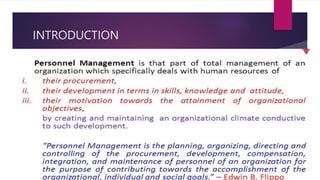
Personnel Management can be defined as obtaining, using and maintaining a
satisfied workforce. It is a significant part of management concerned with
employees at work and with their relationship within the organization.
According to Flippo, “Personnel management is the planning, organizing,
compensation, integration and maintenance of people for the purpose of
contributing to organizational, individual and societal goals.”
 According to Brech, “Personnel
Management is that part which is primarily
concerned with human resource of
organization.”
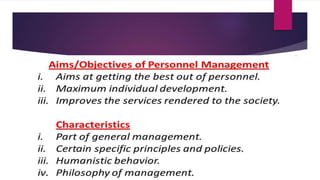
CHARACTERISTICS
 Concern With People
 It Is A Process
 Satisfaction To The Employees
 Needed Everywhere
 Acquisition, Development and Compensation
 Cordial and congenial Relation
 Cooperation and coordination
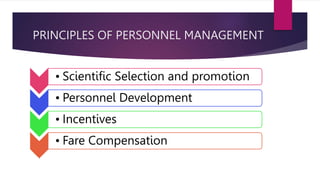
PRINCIPLES OF PERSONNEL MANAGEMENT
• Scientific Selection and promotion
• Personnel Development
• Incentives
• Fare Compensation
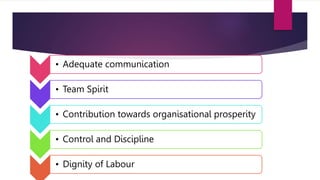
• Adequate communication
• Team Spirit
• Contribution towards organisational prosperity
• Control and Discipline
• Dignity of Labour
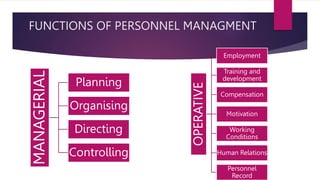
FUNCTIONS OF PERSONNEL MANAGMENT
MANAGERIAL
Planning
Organising
Directing
Controlling
OPERATIVE
Employment
Training and
development
Compensation
Motivation
Working
Conditions
Human Relations
Personnel
Record
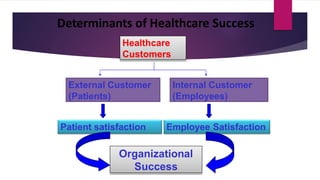
Determinants of Healthcare Success
Healthcare
Customers
Internal Customer
(Employees)
External Customer
(Patients)
Organizational
Success
Patient satisfaction Employee Satisfaction
DEFINITION
“Human resource management is the effective
use of human resources in
order to enhance organizational
performance.”
It is an art and science which controls workers,
employees; and also known as man management,
personnel management, industrial relationship or
industrial management. .
VARIOUS FEATURES OF HRM INCLUDE:
•It is pervasive in nature as it is present in all
enterprises.
• Its focus is on results rather than on rules.
• It tries to help employees develop their potential fully.
• It encourages employees to give their best to the
organization.
•It is all about people at work, both as individuals and
groups.
• It tries to put people on assigned jobs in order to
produce good results.
• It helps an organization meet its goals in the future by
providing for competent and well-motivated
employees.
• It tries to build and maintain cordial relations
between people working at various levels in the
organization.
• It is a multidisciplinary activity, utilizing knowledge
and inputs drawn from psychology, economics, etc.
Human Resource Management: Objectives
• help the organization reach its goals.
• ensure effective utilization and maximum
development of HRM
•ensure respect for human beings and identify and
satisfy the needs of individuals.
•achieve and maintain high morale among
employees.
• provide the organization with well-trained and well-
motivated employees.
• increase to the fullest the employee's job
satisfaction and self-actualization.
• develop and maintain a quality of worklife.
• develop overall personality of each employee in its
multidimensional aspect.
• enhance employee's capabilities to perform the
present job.
• inculcate the sense of team spirit, team work and
inter-team collaboration.
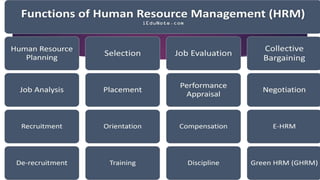
Human Resource Management: Functions
In order to achieve the above objectives, Human
Resource Management undertakes the following
activities:
1.Human resource or manpower planning.
2. Recruitment, selection and placement of personnel.
3. Training and development of employees.
4. Appraisal of performance of employees.
5. Taking corrective steps such as transfer from
one job to another.
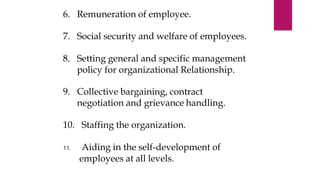
6. Remuneration of employee.
7. Social security and welfare of employees.
8. Setting general and specific management
policy for organizational Relationship.
9. Collective bargaining, contract
negotiation and grievance handling.
10. Staffing the organization.
11. Aiding in the self-development of
employees at all levels.
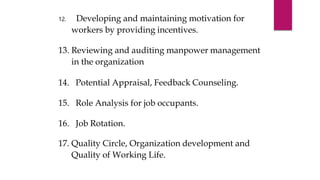
12. Developing and maintaining motivation for
workers by providing incentives.
13. Reviewing and auditing manpower management
in the organization
14. Potential Appraisal, Feedback Counseling.
15. Role Analysis for job occupants.
16. Job Rotation.
17. Quality Circle, Organization development and
Quality of Working Life.
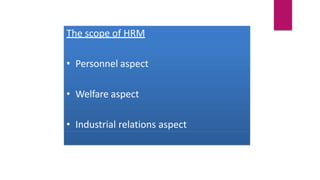
The scope of HRM
• Personnel aspect
• Welfare aspect
• Industrial relations aspect
STAFFIN
G
OBJECTIVES
At the end of the discussion, group will be able to,
• Define staffing
• Understand the Meaning of staffing
• Enlist mission of staffing
• Explain philosophy of staffing
• Describe Importance of staffing
• Safe staffing
• Describe the nature of staffing
• Identify the Feature of staffing
• Enlist the Importance of safe staffing
• Describe the System approach tostaffing
• Enlist the Components ofstaffing
• Discuss the Staffing patterns
• Enumerate Factors influencing staffing
• Discuss a research input regarding staffing.
INTRODUCTION
DEFINITION
It is a process of planning, employing and
developing human resources at different levels
of an organization for carrying out the various
managerial and other functions required.
 Staffing is the function by which mangers build an
organization through recruitment , selection and
development of individual as capable employees.
--- MC Farland
MISSION
1. Toensure maximum utilization of human resources.
2. To discover & obtain competent personnel for various
jobs.
3. To ensure the continuity & growth of the enterprise
through adequate staffing.
5.Tobe able to meet crisis/emergency situations.
6.To deliver good quality of care & attain job & patient
satisfaction
7.To improve job satisfaction & morale of the
employees through objective assessment.
SAFE STAFFING
 Safe staffing means having enough nursing staff with
the right skills and knowledge, in the right place, at
the right time.
 Without safe staffing levels in place, nursing staff are
struggling to provide patients with the safe and
effective care they would like to, and which patients
deserve.
Safe staffing
• Safe staffing means that an appropriate staff with a
suitable mix of skill levels is available at all the times to
ensure the patient care needs are met and are hazard free
working environment and working conditions are
maintained .
( International Council of Nurses)
• Safe staffing is appropriate levels of Registered nurses
(RNs) to always meet the care as per needs of the patients.
(ANA)
Nature of staffing
• Staffing is staff centered
• It is applicable for all types of organization.
• It is concerned with all the categories of personnel from top to operational
levels.
• Its basic function of management ; like management also needs the
directing , organizing coordinating the controlling functions.
• Manager in each level is engaged in performing the staffing function.
• Staffing is a continuous activity as the manager is to guide
and train the subordinates and also evaluate their
performance.
• Each manager is required to have human relation skills in
performing the staffing functions.
FEATURES OF STAFFING:
• Staffing is management of manpower or human resource.
• Staffing function is related to the employment of nursing personnel of
all types.
• It includes various type of activities to get the right type of nurses on the
right job.
• It is concerned with the filling of various type of positions or jobs in the
nursing organization with suitable nursing personnel.
• Its every nurse managers Job.
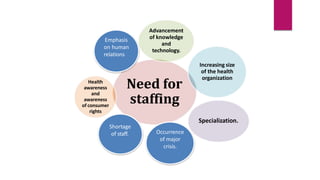
Need for
staffing
Advancement
of knowledge
and
technology.
Specialization.
Increasing size
of the health
organization
Health
awareness
and
awareness
of consumer
rights
Shortage
of staff.
Emphasis
on human
relations
Occurrence
of major
crisis.
PHILOSOPHY OF STAFFING
• Nurse administrator believes that
1. The knowledge & skill of the staff can
adequately fulfill the needs of the patient &
thereby ensure both job satisfaction &
quality care.
• Only professional trained nurses can
provide a high quality of patient care &
handle critically ill patients by providing
both technical & intrapersonal skills.
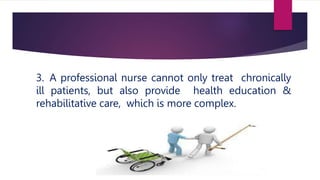
3. A professional nurse cannot only treat chronically
ill patients, but also provide health education &
rehabilitative care, which is more complex.
4. Job quantification & analysis could be done

based on patient needs & doing assignments.
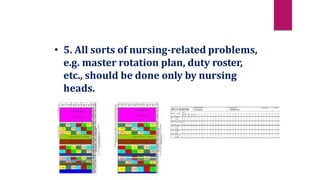
• 5. All sorts of nursing-related problems,
e.g. master rotation plan, duty roster,
etc., should be done only by nursing
heads.
6. A staffing plan should be delegated to each unit-
level head nurse so that the activities of each ward
& details of each shift are planned well.
IMPORTANCE OF STAFFING PATTERN
.
Importance of safe staffing
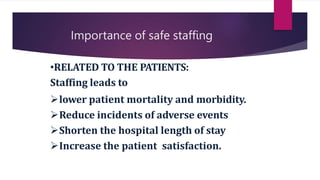
•RELATED TO THE PATIENTS:
Staffing leads to
lower patient mortality and morbidity.
Reduce incidents of adverse events
Shorten the hospital length of stay
Increase the patient satisfaction.
Importance of safe staffing
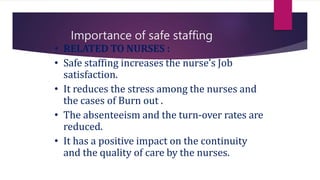
• RELATED TO NURSES :
• Safe staffing increases the nurse’s Job
satisfaction.
• It reduces the stress among the nurses and
the cases of Burn out .
• The absenteeism and the turn-over rates are
reduced.
• It has a positive impact on the continuity
and the quality of care by the nurses.
Importance of safe staffing
• COST OF CARE
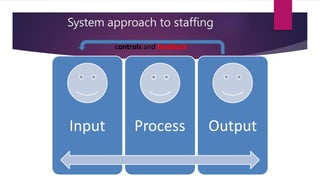
System approach to staffing
Input Process Output
Controls and feedback
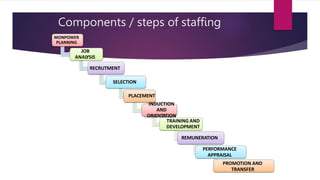
Components / steps of staffing
MONPOWER
PLANNING
JOB
ANALYSIS
RECRUTMENT
SELECTION
PLACEMENT
INDUCTION
AND
ORIENTATION
TRAINING AND
DEVELOPMENT
REMUNERATION
PERFORMANCE
APPRAISAL
PROMOTION AND
TRANSFER
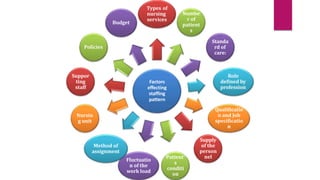
Staffing pattern
Factors
effecting
staffing
pattern
Types of
nursing
services
Numbe
r of
patient
s
Standa
rd of
care:
Role
defined by
profession
Qualificatio
n and Job
specificatio
n
Supply
of the
person
nel
Patient’
s
conditi
on
Fluctuatio
n of the
work load
Method of
assignment
Nursin
g unit
Suppor
ting
staff
Policies
Budget
 Norms are standards that guide, control, and regulate individuals and communities.
For planning nursing manpower we have to follow some norms. The nursing norms
are recommended by various committees, such as; the Nursing Man Power
Committee, the High Power Committee, Dr. Bajaj Committee, and the Staff Inspection
Committee, TNAI and INC. The norms has been recommended taking into account
the workload projected in the wards and the other areas of the hospital.
 All the above committees and the staff inspection unit recommended the norms for
optimum nurse-patient ratio. Such as 1:3 for Non Teaching Hospital and 1:5 for the
Teaching Hospital.
NORMS & ACTIVITIES
NORMS & ACTIVITIES
• Recommendations of the Staff Inspection Unit.
• Recommendations of the Patient
Classification System.
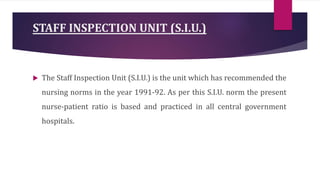
STAFF INSPECTION UNIT (S.I.U.)
 The Staff Inspection Unit (S.I.U.) is the unit which has recommended the
nursing norms in the year 1991-92. As per this S.I.U. norm the present
nurse-patient ratio is based and practiced in all central government
hospitals.
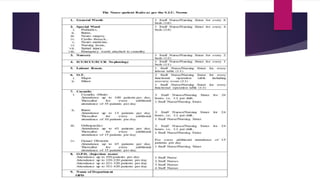
1. Out of the entitlement worked out on the basis of the norms, 30%posts may be
sanctioned as nursing sister. This would further improve the existing ratio of 1
nursing sister to 3.6.staff nurses fixed by the government in settlement with the
Delhi nurse union in may1990.
2. The assistant nursing superintendent is recommended in the ratio of 1 ANS to every
4.5nursing sisters. The ANS will perform the duty presently performed by nursing
sisters and perform duty in shift also.
1. The posts of Deputy Nursing Superintendent may continue at the level of 1 DNS per
every 7.5 ANS
2. There will be a post of Nursing Superintendent for every hospital having 250 or beds.
3. There will be a post of 1 Chief Nursing Officer for every hospital having 500 or more
beds.
4. It is recommended that 45% posts added for the area of 365 days working including
10%leave reserve (maternity leave, earned leave, and days off as nurses are entitled for
8 days off per month and 3 National Holidays per year when doing 3 shift duties).
BAJAJ COMMITTEE, 1986
 An "Expert Committee for Health Manpower Planning, Production and Management"
was constituted in 1985 under Dr. J.S. Bajaj, the then professor at AIIMS. Manpower
is one of the most vital resources for the labour intensive health services industry.
Health for all (HFA) can be achieved only by improving the utilization of these
resources.
Major recommendations are
1. Formulation of National Medical & Health Education Policy.
2. Formulate on of National Health Manpower Policy.
3. Establishment of an Educational Commission for Health
Sciences (ECHS) on the lines of UGC.
4. Establishment of Health Science Universities in various states
and union territories.
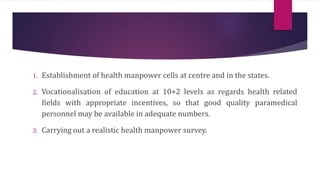
1. Establishment of health manpower cells at centre and in the states.
2. Vocationalisation of education at 10+2 levels as regards health related
fields with appropriate incentives, so that good quality paramedical
personnel may be available in adequate numbers.
3. Carrying out a realistic health manpower survey.
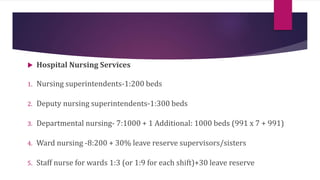
 Hospital Nursing Services
1. Nursing superintendents-1:200 beds
2. Deputy nursing superintendents-1:300 beds
3. Departmental nursing- 7:1000 + 1 Additional: 1000 beds (991 x 7 + 991)
4. Ward nursing -8:200 + 30% leave reserve supervisors/sisters
5. Staff nurse for wards 1:3 (or 1:9 for each shift)+30 leave reserve
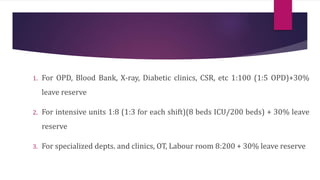
1. For OPD, Blood Bank, X-ray, Diabetic clinics, CSR, etc 1:100 (1:5 OPD)+30%
leave reserve
2. For intensive units 1:8 (1:3 for each shift)(8 beds ICU/200 beds) + 30% leave
reserve
3. For specialized depts. and clinics, OT, Labour room 8:200 + 30% leave reserve
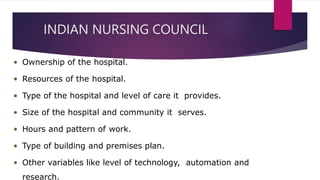
INDIAN NURSING COUNCIL
• Ownership of the hospital.
• Resources of the hospital.
• Type of the hospital and level of care it provides.
• Size of the hospital and community it serves.
• Hours and pattern of work.
• Type of building and premises plan.
• Other variables like level of technology, automation and
research.
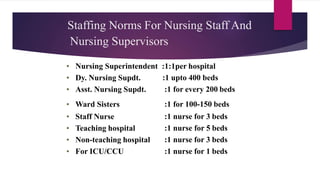
Staffing Norms For Nursing Staff And
Nursing Supervisors
• Nursing Superintendent :1:1per hospital
• Dy. Nursing Supdt.
• Asst. Nursing Supdt.
• Ward Sisters
• Staff Nurse
• Teaching hospital
• Non-teaching hospital
• For ICU/CCU
:1 upto 400 beds
:1 for every 200 beds
:1 for 100-150 beds
:1 nurse for 3 beds
:1 nurse for 5 beds
:1 nurse for 3 beds
:1 nurse for 1 beds
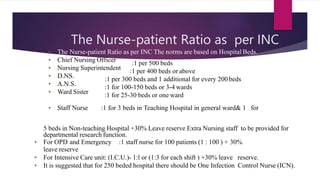
The Nurse-patient Ratio as per INC
:1 per 500 beds
:1 per 400 beds or above
:1 per 300 beds and 1 additional for every 200 beds
:1 for 100-150 beds or 3-4 wards
:1 for 25-30 beds or one ward
• The Nurse-patient Ratio as per INC The norms are based on Hospital Beds.
• Chief Nursing Officer
• Nursing Superintendent
• D.NS.
• A.N.S.
• Ward Sister
• Staff Nurse :1 for 3 beds in Teaching Hospital in general ward& 1 for
5 beds in Non-teaching Hospital +30% Leave reserve Extra Nursing staff to be provided for
departmental research function.
• For OPD and Emergency :1 staff nurse for 100 patients (1 : 100 ) + 30%
leave reserve
• For Intensive Care unit: (I.C.U.)- 1:l or (1:3 for each shift ) +30% leave reserve.
• It is suggested that for 250 beded hospital there should be One Infection Control Nurse (ICN).
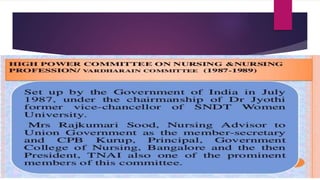
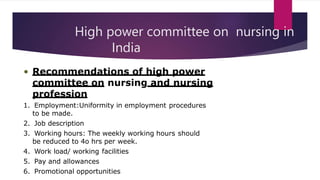
High power committee on nursing in
India
• Recommendations of high power
committee on nursing and nursing
profession
1. Employment:Uniformity in employment procedures
to be made.
2. Job description
3. Working hours: The weekly working hours should
be reduced to 4o hrs per week.
4. Work load/ working facilities
5. Pay and allowances
6. Promotional opportunities
7. Career development
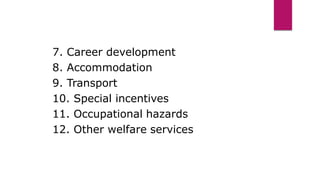
8. Accommodation
9. Transport
10. Special incentives
11. Occupational hazards
12. Other welfare services
Norms recommended for nursing
service and education hospital
setting.
•
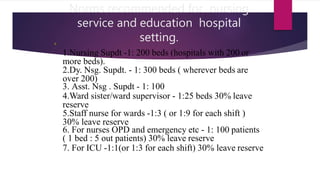
1.Nursing Supdt -1: 200 beds (hospitals with 200 or
more beds).
2.Dy. Nsg. Supdt. - 1: 300 beds ( wherever beds are
over 200)
3. Asst. Nsg . Supdt - 1: 100
4.Ward sister/ward supervisor - 1:25 beds 30% leave
reserve
5.Staff nurse for wards -1:3 ( or 1:9 for each shift )
30% leave reserve
6. For nurses OPD and emergency etc - 1: 100 patients
( 1 bed : 5 out patients) 30% leave reserve
7. For ICU -1:1(or 1:3 for each shift) 30% leave reserve
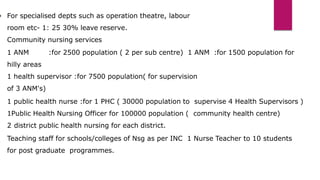
• For specialised depts such as operation theatre, labour
room etc- 1: 25 30% leave reserve.
Community nursing services
1 ANM :for 2500 population ( 2 per sub centre) 1 ANM :for 1500 population for
hilly areas
1 health supervisor :for 7500 population( for supervision
of 3 ANM's)
1 public health nurse :for 1 PHC ( 30000 population to supervise 4 Health Supervisors )
1Public Health Nursing Officer for 100000 population ( community health centre)
2 district public health nursing for each district.
Teaching staff for schools/colleges of Nsg as per INC 1 Nurse Teacher to 10 students
for post graduate programmes.
Staff estimation
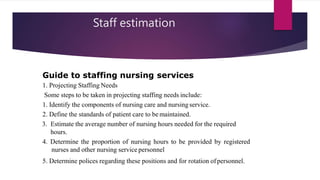
Guide to staffing nursing services
1. Projecting Staffing Needs
Some steps to be taken in projecting staffing needs include:
1. Identify the components of nursing care and nursingservice.
2. Define the standards of patient care to be maintained.
3. Estimate the average number of nursing hours needed for the required
hours.
4. Determine the proportion of nursing hours to be provided by registered
nurses and other nursing service personnel
5. Determine polices regarding these positions and for rotation ofpersonnel.
2. Computing number of nurses required on a Yearly
Basis
1. Find the total number of general nursing hours needed
in one year.
Average patient census X average nursing hours per
patient for 24 hours X days in week X weeks in year.
2. Find the number of general nursing hours needed in one
year which should be given by registered nurses and
the number which should be given by ancillary nursing
personnel.
a. Number of general nursing hours per year X percent to
be given by registered nurses.
b. Number of general nursing hours per year X percent to
be given be ancillary nursing personnel.
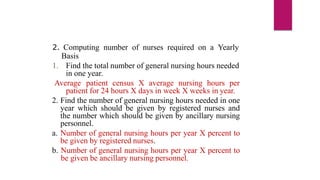
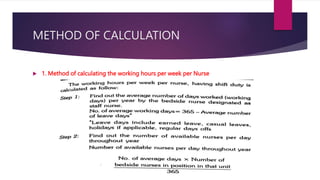
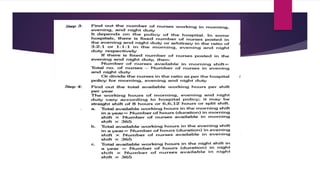
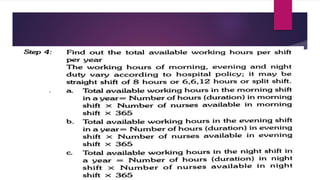
METHOD OF CALCULATION
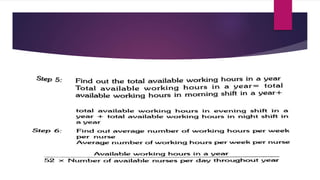
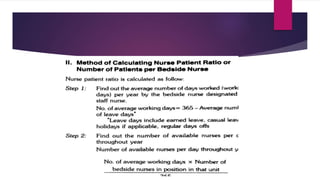
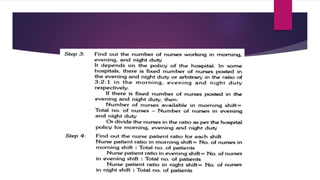
 1. Method of calculating the working hours per week per Nurse
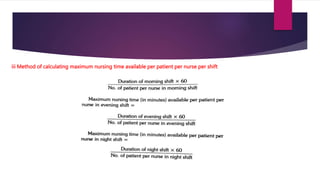
iii Method of calculating maximum nursing time available per patient per nurse per shift
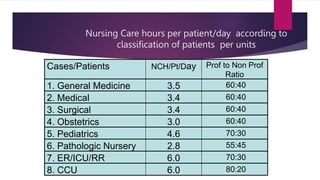
Nursing Care hours per patient/day according to
classification of patients per units
Cases/Patients NCH/Pt/Day Prof to Non Prof
Ratio
1. General Medicine 3.5 60:40
2. Medical 3.4 60:40
3. Surgical 3.4 60:40
4. Obstetrics 3.0 60:40
5. Pediatrics 4.6 70:30
6. Pathologic Nursery 2.8 55:45
7. ER/ICU/RR 6.0 70:30
8. CCU 6.0 80:20
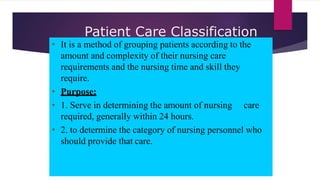
Patient Care Classification
System
• It is a method of grouping patients according to the
amount and complexity of their nursing care
requirements and the nursing time and skill they
require.
• Purpose:
• 1. Serve in determining the amount of nursing care
required, generally within 24 hours.
• 2. to determine the category of nursing personnel who
should provide that care.
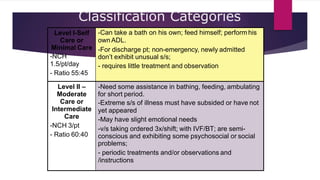
Classification Categories
Level I-Self
Care or
Minimal Care
-NCH
1.5/pt/day
- Ratio 55:45
-Can take a bath on his own; feed himself; perform his
own ADL.
-For discharge pt; non-emergency, newly admitted
don’t exhibit unusual s/s;
- requires little treatment and observation
Level II –
Moderate
Care or
Intermediate
Care
-NCH 3/pt
- Ratio 60:40
-Need some assistance in bathing, feeding, ambulating
for short period.
-Extreme s/s of illness must have subsided or have not
yet appeared
-May have slight emotional needs
-v/s taking ordered 3x/shift; with IVF/BT; are semi-
conscious and exhibiting some psychosocial or social
problems;
- periodic treatments and/or observations and
/instructions
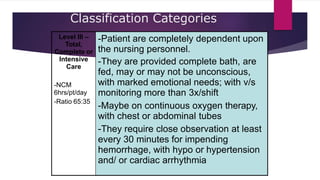
Classification Categories
Level III –
Total,
Complete or
Intensive
Care
-NCM
6hrs/pt/day
-Ratio 65:35
-Patient are completely dependent upon
the nursing personnel.
-They are provided complete bath, are
fed, may or may not be unconscious,
with marked emotional needs; with v/s
monitoring more than 3x/shift
-Maybe on continuous oxygen therapy,
with chest or abdominal tubes
-They require close observation at least
every 30 minutes for impending
hemorrhage, with hypo or hypertension
and/ or cardiac arrhythmia
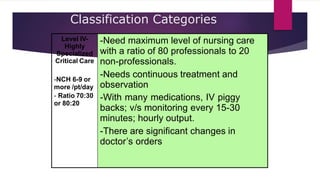
Classification Categories
Level IV-
Highly
Specialized
Critical Care
-Need maximum level of nursing care
with a ratio of 80 professionals to 20
non-professionals.
-NCH 6-9 or
more /pt/day
-Needs continuous treatment and
observation
- Ratio 70:30
or 80:20
-With many medications, IV piggy
backs; v/s monitoring every 15-30
minutes; hourly output.
-There are significant changes in
doctor’s orders
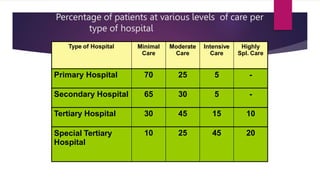
Percentage of patients at various levels of care per
type of hospital
Type of Hospital Minimal
Care
Moderate
Care
Intensive
Care
Highly
Spl. Care
Primary Hospital 70 25 5 -
Secondary Hospital 65 30 5 -
Tertiary Hospital 30 45 15 10
Special Tertiary
Hospital
10 25 45 20
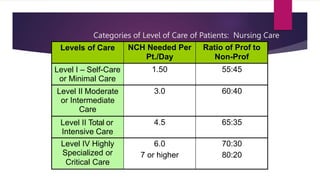
Categories of Level of Care of Patients: Nursing Care
Hours/Pt/Day & Ratio of Prof- Non Prof
Levels of Care NCH Needed Per
Pt./Day
Ratio of Prof to
Non-Prof
Level I – Self-Care
or Minimal Care
1.50 55:45
Level II Moderate
or Intermediate
Care
3.0 60:40
Level II Total or
Intensive Care
4.5 65:35
Level IV Highly 6.0 70:30
Specialized or
Critical Care
7 or higher 80:20
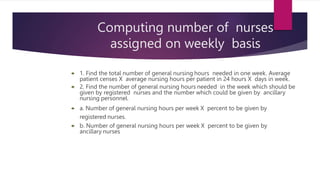
Computing number of nurses
assigned on weekly basis
 1. Find the total number of general nursing hours needed in one week. Average
patient censes X average nursing hours per patient in 24 hours X days in week.
 2. Find the number of general nursing hours needed in the week which should be
given by registered nurses and the number which could be given by ancillary
nursing personnel.
 a. Number of general nursing hours per week X percent to be given by
registered nurses.
 b. Number of general nursing hours per week X percent to be given by
ancillary nurses
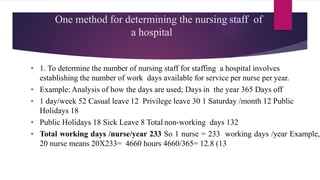
One method for determining the nursing staff of
a hospital
• 1. To determine the number of nursing staff for staffing a hospital involves
establishing the number of work days available for service per nurse per year.
• Example: Analysis of how the days are used; Days in the year 365 Days off
• 1 day/week 52 Casual leave 12 Privilege leave 30 1 Saturday /month 12 Public
Holidays 18
• Public Holidays 18 Sick Leave 8 Total non-working days 132
• Total working days /nurse/year 233 So 1 nurse = 233 working days /year Example,
20 nurse means 20X233= 4660 hours 4660/365= 12.8 (13
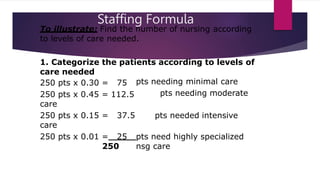
Staffing Formula
To illustrate: Find the number of nursing according
to levels of care needed.
1. Categorize the patients according to levels of
care needed
pts needing minimal care
pts needing moderate
250 pts x 0.30 = 75
250 pts x 0.45 = 112.5
care
250 pts x 0.15 = 37.5 pts needed intensive
care
250 pts x 0.01 = 25 pts need highly specialized
250 nsg care
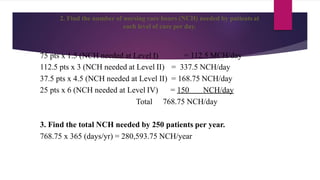
2. Find the number of nursing care hours (NCH) needed by patientsat
each level of care per day.
75 pts x 1.5 (NCH needed at Level I) = 112.5 MCH/day
= 337.5 NCH/day
112.5 pts x 3 (NCH needed at Level II)
37.5 pts x 4.5 (NCH needed at Level II) = 168.75 NCH/day
25 pts x 6 (NCH needed at Level IV)
Total
= 150 NCH/day
768.75 NCH/day
3. Find the total NCH needed by 250 patients per year.
768.75 x 365 (days/yr) = 280,593.75 NCH/year
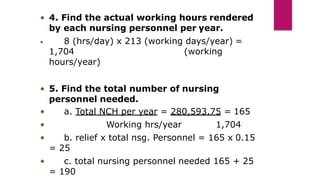
• 4. Find the actual working hours rendered
by each nursing personnel per year.
• 8 (hrs/day) x 213 (working days/year) =
1,704 (working
hours/year)
• 5. Find the total number of nursing
personnel needed.
•
• a. Total NCH per year = 280,593.75 = 165
• Working hrs/year 1,704
• b. relief x total nsg. Personnel = 165 x 0.15
= 25
c. total nursing personnel needed 165 + 25
= 190
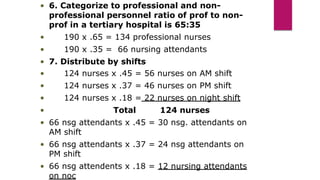
• 6. Categorize to professional and non-
professional personnel ratio of prof to non-
prof in a tertiary hospital is 65:35
• 190 x .65 = 134 professional nurses
• 190 x .35 = 66 nursing attendants
• 7. Distribute by shifts
• 124 nurses x .45 = 56 nurses on AM shift
• 124 nurses x .37 = 46 nurses on PM shift
• 124 nurses x .18 = 22 nurses on night shift
• Total 124 nurses
• 66 nsg attendants x .45 = 30 nsg. attendants on
AM shift
• 66 nsg attendants x .37 = 24 nsg attendants on
PM shift
• 66 nsg attendents x .18 = 12 nursing attendants
on noc
Staff scheduling
• Assessing a Scheduling System
• 1. Ability to cover the needs of the unit
• 2. quality to enhance the nursing personnel's
knowledge, training and experience
• 3. fairness to the staff – fair share of weekends,
holiday offs, rotation patters for the whole year
including assignment to “difficult” or “light” or
“undesirable” units or shifts
• 4. stability – the schedule must be harmonized with
their family or social activities of the nurse
staff
• 5. flexibility – ability to handle changes brought by
emergency leaves
•
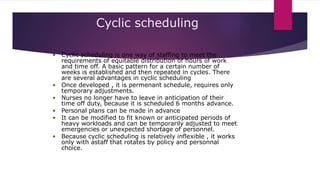
Cyclic scheduling
• Cyclic scheduling is one way of staffing to meet the
requirements of equitable distribution of hours of work
and time off. A basic pattern for a certain number of
weeks is established and then repeated in cycles. There
are several advantages in cyclic scheduling
• Once developed , it is permenant schedule, requires only
temporary adjustments.
• Nurses no longer have to leave in anticipation of their
time off duty, because it is scheduled 6 months advance.
• Personal plans can be made in advance
• It can be modified to fit known or anticipated periods of
heavy workloads and can be temporarily adjusted to meet
emergencies or unexpected shortage of personnel.
• Because cyclic scheduling is relatively inflexible , it works
only with astaff that rotates by policy and personnal
choice.
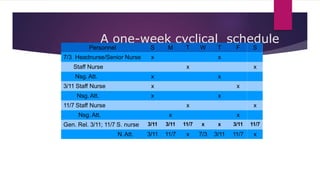
A one-week cyclical schedule
Personnel S M T W T F S
7/3 Headnurse/Senior Nurse x x
Staff Nurse x x
Nsg. Att. x x
3/11 Staff Nurse x x
Nsg. Att. x x
11/7 Staff Nurse x x
Nsg. Att. x x
Gen. Rel. 3/11; 11/7 S. nurse 3/11 3/11 11/7 x x 3/11 11/7
N.Att. 3/11 11/7 x 7/3 3/11 11/7 x
Self scheduling
• Self scheduling is an cativity that
may make a staff happier , more
cohesive, and more committed.
It should be planned on a unit
basis with a written policy as a
guideline. Planning may use
either a self directed work team
or quality circle technique
approach. personnel are
scheduled to work
Flex time
• Nurses often want flexible scheduling to
better to accommodate their personal
lives. Such scheduling options have,
infact become an essential component of
the job satisfaction.it resulted in
improved attitudes and increased
productivity as employees have gained
more more control over their work
environment.
Modified work week:
• This using 10 and 12 hour shifts and other methods
are common place. A nurse administrator should be
sure work schedules are fulfilling the staffing
philosophy and policies, particularly with regard to
efficiency. Also, such schedules should not be
imposed on the nursing staff but should show a
mutual benefits to employer, employees and the
client served.
• One modification of the worksheet is four 10 hour
shifts per week in organized time increments. One
problem with this model is time overlaps of 6 hours
per 24 –hour day. The overlap can be used for
patient –centered conference, nursing care
assessment and planning and staff development. It
can be done by hour or by a block of 3-4 hours
The weekend alternatives:
• another variation of flexible
scheduling is the weekend
alternative. Nurses work two 12
hour shifts and are paid for 40
hours plus benefits. They can
use the weekdays for continued
education or other personal
needs. The weekend scheduled
has several variations. Nurses
working Monday through Friday
Other modified approaches
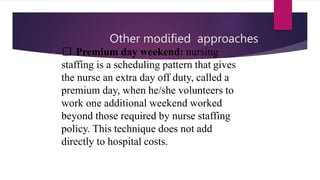
• Premium day weekend: nursing
staffing is a scheduling pattern that gives
the nurse an extra day off duty, called a
premium day, when he/she volunteers to
work one additional weekend worked
beyond those required by nurse staffing
policy. This technique does not add
directly to hospital costs.
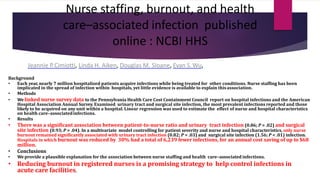
Nurse staffing, burnout, and health
care–associated infection published
online : NCBI HHS
Jeannie P.Cimiotti, Linda H. Aiken, Douglas M. Sloane, Evan S.Wu,
Background
• Each year, nearly 7 million hospitalized patients acquire infections while being treated for other conditions. Nurse staffing has been
implicated in the spread of infection within hospitals, yet little evidence is available to explain thisassociation.
• Methods
• We linked nurse survey data to the Pennsylvania Health Care Cost Containment Council report on hospital infections and the American
Hospital Association Annual Survey. Examined urinary tract and surgical site infection, the most prevalent infections reported and those
likely to be acquired on any unit within a hospital. Linear regression was used to estimate the effect of nurse and hospital characteristics
on health care–associatedinfections.
• Results
• There was a significant association between patient-to-nurse ratio and urinary tract infection (0.86; P = .02) and surgical
site infection (0.93; P = .04). In a multivariate model controlling for patient severity and nurse and hospital characteristics, only nurse
burnout remained significantly associated with urinary tract infection (0.82; P = .03) and surgical site infection (1.56; P < .01) infection.
Hospitals in which burnout was reduced by 30% had a total of 6,239 fewer infections, for an annual cost saving of up to $68
million.
• Conclusions
• We provide a plausible explanation for the association between nurse staffing and health care–associated infections.
• Reducing burnout in registered nurses is a promising strategy to help control infections in
acute care facilities.
2. Nurse staffing and patient outcomes
 The authors from the University of Lowa, investigated nurse staffing and patient outcomes in 42
inpatient nursing care units in a large university hospital. Acute care unit level data were collected
from hospital records to examine the relationships among total hours of nursing care, RN skill mix,
and adverse patient outcomes, which included medication errors, patient falls, pressure ulcers,
patient complaints, infections and death. They found that the proportion of hours of RN care was
inversely related to the unit rates of medication errors, pressure ulcers, patient complaints, infections
and deaths. An unexpected finding was that as the RN proportion increased, the rates of adverse
outcomes decreased, up to the level of 87.5%, after which adverse outcomes rates also began to
increase. Our explanation may be that better reporting resulted when more RNs were working.
Summary
ANY QUESTION
CONCLUSIO
N
• Staffing is one of the most important
activities of the administration it decides
who, when, how ,where will do what type of
work for the organization. the staffing
decides how efficiently the organization will
be able to achieve the desired outcomes
REFRENCE
• 1. I Clement. Management of nursing services and education.1st
ed. Elsevier; New Delhi,2011:Pp-47-53,143-47
• Vasavanthappa BT.Nursing Management and administration. 6th
ed. Jaypee brothers medical publishers;New Delhi, 2010.Pp-78-
84, 145.
• Hospital Nurse Staffing and Quality of Care | AHRQ Archive
available from:
https://archive.ahrq.gov/research/findings/factsheets../nursesta
ffing/nursestaff.html
• Jeannie P
. Cimiotti, Linda H. Aiken, Douglas M. Sloane, Evan S. Wu.
Nurse staffing, burnout, and health care–associated infection.Am J
Infect Control. 2012 Aug; 40(6): 486–
490.doi: 10.1016/j.ajic.2012.02.029 available from:
https://www.ncbi.nlm.nih.gov/pmc/articles/PMC3509207/.
• Vati J. Principles and practice of the nursinf management and
administration. 1st ed . jaypee brothers medical publishers ;New
Delhi, 2013Pp-218-27.
• Lucita M. Nursing: practice and public health administration . 2nd
ed . Elsevier ; New Delhi, 2013 Pp-57-63
THANKYOU
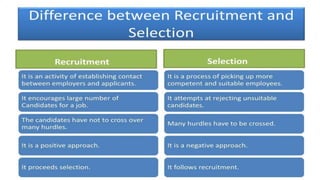
Recruitment
 Recruitment is the process of finding and attracting capable
applicants for employment. The process begins when new
recruits are sought and ends when their applicants are
submitted.
William B Werther &K.Devis
 Recruitment is the process of searching prospective employees and stimulating
them to apply for the jobs in the organization.
Edwin B Flippo
Recruitment has been defined as the process of seeking out and attracting
individuals from the labour market who are capable and interested in filling the
employment vacancies.
Taylor & Bergman
PURPOSE AND IMPORTANCE OF
RECRUITMENT
 Attract and encourage candidate to apply for the post in the organization.
 Determine present and future requirements of the organization.
 Create a pool of candidate at the low cost.
 Begin identifying and preparing potential applicants who will be
appropriate candidates.
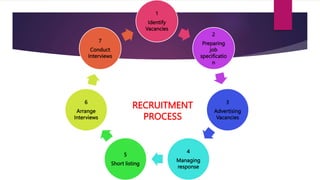
RECRUITMENT
PROCESS
1
Identify
Vacancies
2
Preparing
job
specificatio
n
3
Advertising
Vacancies
4
Managing
response
5
Short listing
6
Arrange
Interviews
7
Conduct
Interviews
1. Identify vacancies
 It begins with the human resource department receiving requisitions for recruitment
from different departments in the organization. It includes posts to be filled, number of
vacancies, duties to be performed and qualification with experience.
Preparing job and person specification
 Job specification is helpful to think of job under broad heading; main
characteristics of the training, background of the job, main
responsibilities and job boundaries, experience of job holder,
resources and constraints affecting the job. It has to be decided what
types of candidates are to be invited and what would be their
characteristics.
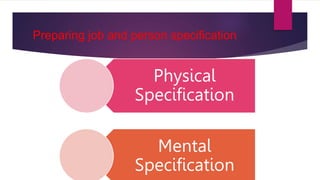
Preparing job and person specification
Physical
Specification
Mental
Specification
Advertising vacancies
 This is the method by which the candidates will be located. It
is either through internal sources or external sources and
also decided the method of advertising for the post.
 Managing response: This step is to the way adopted to receive the applications and scrutinize
each application as per the recruitment policy by the scrutiny committee.
 Short listing and identifying the prospective candidates: After the scrutiny the eligible
candidates are shortlisted and a list is prepared.
 Arranging the interview with the shortlisted employees: Interview dates are finalized.
Criteria for the merit list are prepared by the committee is formulated.
 Conducting the interview and decision making: Interview is conducted on the scheduled
date by the selection committee.
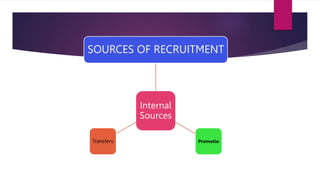
SOURCES OF RECRUITMENT
INTERNAL SOURCES
EXTERNAL SOURCES
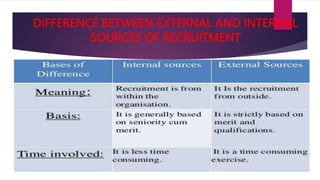
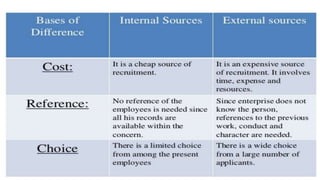
DIFFERENCE BETWEEN EXTERNAL AND INTERNAL
SOURCES OF RECRUITMENT
Internal
Sources
SOURCES OF RECRUITMENT
Promotio
Transfers
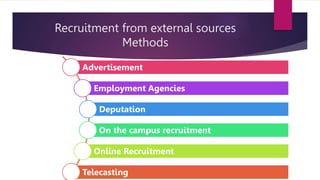
Recruitment from external sources
Methods
Advertisement
Employment Agencies
Deputation
On the campus recruitment
Online Recruitment
Telecasting
RECRUITMENT POLICY
The policy provides a framework for recruitment and contains aspect such as :
 Organizational objectives
 Identification of recruitment needs
 Preferred sources of treatment{internal /external}
 Criterion of selection and preferences
 The cost of recruitment and financial implementation of the same
SELECTION
 Selection is the process of choosing from a group of applicants those
individuals best suited for a particular position. Selection is an integral
part of staffing, wherein one person is chosen in preference to other for
the announced job position. It involves a series of steps by which
candidates are screened for choosing the most suitable person for vacant
posts in the organization.
Definition
 Selection is the process of differentiating between applicants
in order to identify those with a greater likelihood of success
in the job.
 It is a process of choosing the fit candidates or rejecting the
unfit candidates or combination of both.
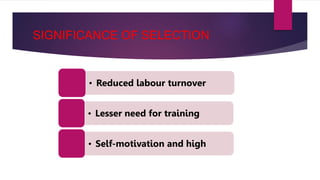
SIGNIFICANCE OF SELECTION
• Reduced labour turnover
• Lesser need for training
• Self-motivation and high
 More and better production – leading to profit maximization
 Good human relations
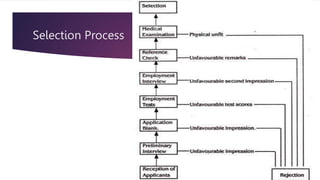
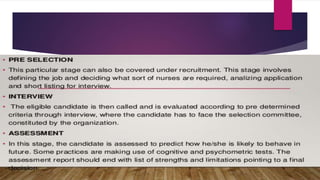
Selection Process
SCREENING OF APPLICATION FORMS
 Check all section
 Check all the essential personal requirement.
 Look for gap in dates
 Look for any patterns
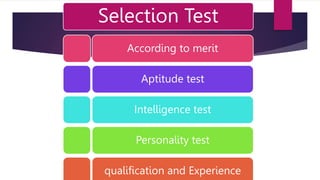
Selection Test
According to merit
Aptitude test
Intelligence test
Personality test
qualification and Experience
 Interview
 Reference Checks
 Physical / medical Examination
 Approval by the appropriate authority
 Orientation and Placement
PERSONNEL POLICIES
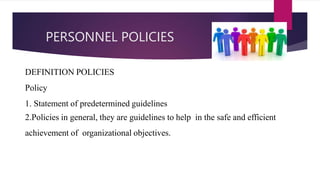
DEFINITION POLICIES
Policy
1. Statement of predetermined guidelines
2.Policies in general, they are guidelines to help in the safe and efficient
achievement of organizational objectives.
PERSONNEL POLICY
1. A set of rules that define the manner in which an organization deals with a human
resources or personnel-related matter. A personnel policy should reflect good
practice, be written down, be communicated across the organization, and should
adapt to changing circumstances.
2. Personnel policy is an integrated function which encompasses many aspects of the
personnel management.
IMPORTANCE
1) To the employee it represents a guarantee of fair and equitable treatment.
•The establishment of good personnel policies helps to give the employee a sense of security
and individual worth.
•It gives employee pride and loyalty to the organization for which he/she works.
•Policies that are planned in advance are likely to meet the needs of the organization
better.
2) To the supervisor it is a safeguard in that it relieves her of the responsibility of making
a personal decision which may conflict with decisions given by other supervisors.
•Established personnel policies serve as guides to action so that a great deal of time is saved
by administrational personnel in handling individual cases.
•A well understood clearly written policy saves the time of an employee as well as the
employer.
OBJECTIVES
1)To employ those persons best fitted by education, skill and experience to perform prescribed work.
2) Guarantee fairness in the maintenance of the discipline
3) Upgrade and promote existing staff wherever possible.
4) Take all practical steps to avoid excessive hours of
work.
5) Ensure the greatest practicable degree of permanent and
continuous employment.
6) Maintain standards of remuneration
7)Provide and maintain high level of physical working conditions.
8)Maintain effective methods of regular consultation between administration and
employees.
9)Provide suitable means for the orientation, on the job training and evaluation of
employees.
10)Encourage social and recreational facilities for employees.
11)Develop appropriate schemes for employees welfare.
TYPES OF POLICIES
According to source
Originated Appealed Imposed
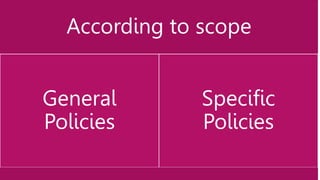
According to scope
General
Policies
Specific
Policies
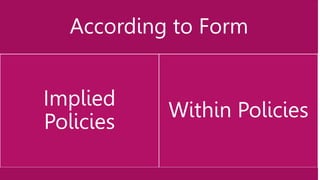
According to Form
Implied
Policies
Within Policies
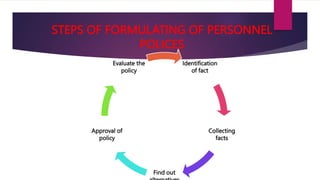
STEPS OF FORMULATING OF PERSONNEL
POLICES
Identification
of fact
Collecting
facts
Find out
Approval of
policy
Evaluate the
policy
POLICIES RELATED TO NURSING
SERVICE
•Employment- recruitment rules, qualification
•Job description
•Working hours
•Work load, working facilities
•Policies for breakage and losses
•Special allowances- special duty/ hard duty
allowance, medical allowance.
•Promotional opportunities
•Career development
•Accommodation
•Transport
•Special incentives
STAFFING POLICIES
•Vacations
•Holidays
•Sick Leave
•Weekend Off
•Rotation To Different Shifts
•Overtime
•Part Time Personnel
•Exchanging Hours
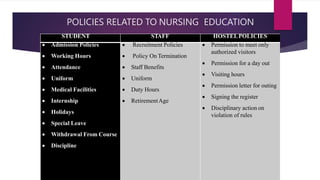
POLICIES RELATED TO NURSING EDUCATION
STUDENT STAFF HOSTELPOLICIES
 Admission Policies
 Working Hours
 Attendance
 Uniform
 Medical Facilities
 Internship
 Holidays
 Special Leave
 Withdrawal From Course
 Discipline
 Recruitment Policies
 Policy On Termination
 Staff Benefits
 Uniform
 Duty Hours
 RetirementAge
 Permission to meet only
authorized visitors
 Permission for a day out
 Visiting hours
 Permission letter for outing
 Signing the register
 Disciplinary action on
violation of rules
CHARACTERISTICS OF PERSONNEL
POLICIES
TERMINATION
• Employee termination is the process by which an organization
ends an individual’s employment against his or her.
CAUSE TERMINATION
•Poor job performance
•Lack of fit with organization
•Inability to perform job responsibilities
•Conflict with managers and other employees
•Misconduct
•Many instances of employment separation
•For poor performance, including lack of punctuality,
absenteeism, or failure to desired results
For resisting change
For negativism
For insubordination
For not conforming to company values
For questionable character or ethical lapses
For criminal acts
BEHAVIOR –RELATED TO
TERMINATION
•Absenteeism and tardiness
•Unsatisfactory performance
•Lack of qualifications or ability
•Challenged job requirements
•Gross misconduct, which might involves drug abuse, stealing
•Breaches of company or public policy
TERMINATION PROCESS
The “tree be rule” is your best guide to the termination process
when it comes time to tell the employee.
1. Be honest
2. Be compassionate
3. Be quick
STAFF DEVELOPMENT PROGRAMME
IN-SERVICE AND CONTINUING EDUCATION
DEFINITION:
Staff development refers to all training and education
provided by an employee to improve the occupational
and personal knowledge, skills and attitude of vested
employees.
GOAL:
• To assist each employee to improve performance in
his or her present position and to acquire personal
and professional abilities that maximizes the
possibility of career advancement.
NEED FOR STAFF DEVELOPMENT
•To meet social change and scientific advancement. It causes
rapid changes in nursing knowledge and skills.
•To provide the opportunity for nurses to continually acquire
and implement the knowledge, skills and attitudes, ideas and
values essential to maintain high quality nursingcare.
•To meet job related learning needs of the nurse – (e.g.
continuing education, in-service education, extramuraleducation
and post basic education).
•Fill the gaps between theory and knowledge.
•To achieve personal or professional developmente.g.
promotion.
•To prepare for future tasks or trends.
PRINCIPLES INVOLVED STAFF
DEVELOPMENT
•Activities must base of needs and interest of employees
and organization.
•Learning is combination of theory and experience.
•Learning is internal, personal and emotional process.
•Learning involves changes in behavior.
•Learner should be encouraged to contribute in learning
process.
•Problem solving approach is well suited because;
effective learning takes place when there is
need/problem.
•Positive reward is effective.
•Teaching – learning should be based on educational
psychology.
•Learning can be maximized by providing favorable
condition.
•Learning is active process i.e., teacher and learner
should be active in learning.
•Teaching must satisfy learning needs of an
individual.
•Use variety of sources for learning as adult learners
have wide range of previous
Staff development model for goal achievement of
the health care agency, the nurse and the nursing
profession
•Education
•Experience
•Socio-economics
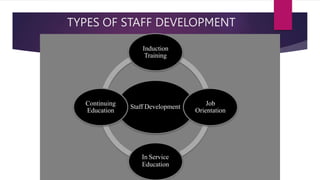
TYPES OF STAFF DEVELOPMENT
Staff Development
Induction
Training
Job
Orientation
In Service
Education
Continuing
Education
FACTORS INFLUENCING STAFF DEVELOPMENT
PROGRAMME
•Administrative philosophy, policies and practices of
health care agency
•Policies, practices and standards of nursing and other
health professionals
•Human and material resources within the health care
agency and community
•Physical facilities within a health care agency and
community
•Financial resources within a health care agency and
community
FUNCTIONS OF STAFF
DEVELOPMENT PERSONNEL
• Determination of the administrative structure of
the staff development programme.
• Determination and establishment of
organizational methods, policies and
procedures for a staff development programme.
• Determination and establishment of lines of
communication for the utilization of facilities
and resources personnel for the staff
development programme.
•Determination of organizational and individual staff
development needs and priority.
•Development of measurable short and long term objectives
for staff development programmes.
•Promotion, development, implementation and evaluation of
programmes to meet these objectives.
•Planning, co-ordination and utilization of community
resources to assist in meeting these objectives.
•Provision of a consultative service and a resource for
information relative to staff development.
PROGRAMMES FOR STAFF
DEVELOPMENT
•Orientation Programme
•Skill Training Programme
•Leadership and management development
•Continuing education
OTHER ACTIVITIES OF STAFF
DEVELOPMENT
•Make rounds with the physicians
•Attend medical round in a teaching Centre
•Visit another hospital to observe their method of
patient care
•Attend professional meetings, conferences, etc. and
present papers
•Read articles of special interest and report them to
staff
BENEFITS OF STAFF
DEVELOPMENT
For the employees:
•Leads to improved professional practice
•Aids in updating knowledge and skills at all levels
of organization
•Keep the nurses abreast of the latest trends and
developments in techniques
•Equips the nurses with knowledge of current
research and developments
•Helps the nurses to learn new and to maintain old
competencies
For the organizations/employer:
•Keeps the nursing staff enthusiastic in their learning
•Develop interest and job satisfaction amongst the staff
•Develops the sense of responsibilities for being
competent and knowledgeable
•Creates an appropriate environment and sound
decisions as well as using effective problem solving
techniques
•Helps the nurse to adjust to change
•Aids in developing leadership skills, motivation and better
attitudes
•Aids in encouraging and achieving self development and self
confidence
•Makes the organization a better place to worker
ROLE OF ADMINISTRATOR IN S.D.P
•In most of the hospitals have a staff development
coordinator who is responsible for continuing and in-
service education programmes. A staff nurse is selected
as a preceptor to assist the new nurse in the unit based
on their skill and competence. The role of the preceptor
are:
•As an orienteer
•As a teacher
•As a resource person
•As a counselor
•As a role model and evaluator
IN-SERVICE EDUCAION
DEFINITION:
In service education is defined as a continued programme of education
provided by the employing authority, with the purpose of developing the
competences of personnel in their functions appropriate to the position
they hold, or to which they will be appointed in the service.
AIM OF IN-SERVICE EDUCATION
In-service education aims at developing the abilityfor
efficient working and the capacity for continuous
learning, so that one may adapt to changes with
judgment and produce profitable services which
become an important tool for the health care of the
society and nation.
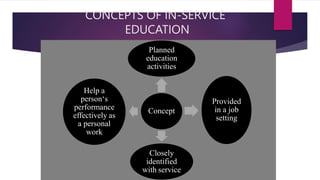
CONCEPTS OF IN-SERVICE
EDUCATION
Concept
Planned
education
activities
Provided
in a job
setting
Closely
identified
with service
Help a
person‘s
performance
effectively as
a personal
work
CHARACTERISTICS
•It should be given in job setting
•Every programme should be planned and ongoing
•It should be closely related and identified with
service components
•It should help the employees‘ learning and improve
her/his knowledge, skills and attitude.
FACTORS INFLUENCING IN-SERVICE
EDUCATION:
1. Cost of healthcare
2. Manpower
3. Changes in nursing practices
4. Standards of nursing practice
5.Organization of nursing departmental planned
approaches is regular.
APPROACHES TO IN-SERVICE
EDUCATION
The pattern of in-service education desired to be:
•Centralized Approach
•Decentralized Approach
•Co-ordinated Approach
CONTINUING
EDUCATION
• Continuing education is any extension of
opportunities for reading, study and training
to any person and adult following their
completion of or withdrawal from full time
school and /or college programmes.
NEED FOR CONTINUING
EDUCATION:
•Respond effectively to the challenge of current
social changes.
•To improve the health care, economic and
educational opportunities.
•To improve the new health patterns of health care.
•Due to increasing trend towards specialization.
•Due to legislation and its impact on the education
of health personnel.
PHILOSOPHY OF CONTINUING
EDUCATION
• It has been believed that the system of higher
education which provides the basic preparation
or the members of a profession must also
provide opportunities for practitioners to keep
abreast of advances in their field.
THE PLANNING FORMULA FOR
CONTINUING EDUCATION
1. What is to be done?
2. Why is it necessary?
3. How is it to be done?
4. Where is it to be done?
5. When is it to be done?
6. Who should do the job?
STEPS IN THE PLANNING
PROCESS
1.Establishing goals compatible with the purpose or mission of
the organization.
2. Deciding upon specific objectives consistent with these goals.
3.Determining the course of action required to meet the specific
objectives.
4. Assessing the available resources for establishing the
programme.
5. Establishing a workable budget, appropriate for the
programme.
6. Evaluating the results at stated intervals.
7. Reassessing he goals and updating the plan periodically.
ROLE OF ADMINISTRATOR/MANAGER
IN STAFF DEVELOPMENT
ROLES: He/ she:
•Applies adult learning principles when helping employees
learn new skills or information
•Uses teaching techniques that empower staff
•Sensitive to the learning deficits of the staff and creatively
minimize these difficulties
•Prepare employees readily regarding knowledge and skill
deficits.
•Actively seeks out teaching opportunities
•Frequently assess learning needs of the unit
FUNCTIONS OF ADMINISTRATOR/MANAGER IN
STAFF DEVELOPMENT
FUNCTIONS:
•Works with reduction department to delineate shared
individual responsibility
•Ensures that all staff are competent for roles assigned
•Ensure that there are adequate resources for staff
development
•Assumes responsibly for quality and fiscal control of
staff development.
•Provides input in formulating staff development policies
EVALUATION OF STAFF DEVELOPMENT
PROGRAM
• DEFINITION
Evaluation is the process of finding out how the
development or training process has affected the
individual, team and the organization. or Evaluationis
a value judgment on an observation, performance test
or indeed any data whether directly measured or
inferred
TYPES OF
EVALUATION
• Formative evaluation
• Summative evaluation
LEVELS OF EVALUATION
An Evaluation Framework The four stages of evaluation are
intended to measure:
(1) Reaction
(2) Learning
(3) Behavior and actions
(4) Results.
BIBLIOGRAPH
Y
1.Vati . J, Principles and practice of nursing
management and administration for BSc and MSc
Nursing, jaypee publication 2013.
2.Kumar . M, A comprehensive text book on
nursing management ,EMMESS Medical
Publishers,1st edition 2013.

staffing

  • 1.
  • 2.
    MEANING The term ‘personnel’means the body of employees, officers or servants who fill the various positions in organization. It is a collective name given to employees who man the various posts in an organization.
  • 3.
  • 4.
    Personnel Management canbe defined as obtaining, using and maintaining a satisfied workforce. It is a significant part of management concerned with employees at work and with their relationship within the organization. According to Flippo, “Personnel management is the planning, organizing, compensation, integration and maintenance of people for the purpose of contributing to organizational, individual and societal goals.”
  • 5.
     According toBrech, “Personnel Management is that part which is primarily concerned with human resource of organization.”
  • 7.
    CHARACTERISTICS  Concern WithPeople  It Is A Process  Satisfaction To The Employees  Needed Everywhere  Acquisition, Development and Compensation  Cordial and congenial Relation  Cooperation and coordination
  • 8.
    PRINCIPLES OF PERSONNELMANAGEMENT • Scientific Selection and promotion • Personnel Development • Incentives • Fare Compensation
  • 9.
    • Adequate communication •Team Spirit • Contribution towards organisational prosperity • Control and Discipline • Dignity of Labour
  • 10.
    FUNCTIONS OF PERSONNELMANAGMENT MANAGERIAL Planning Organising Directing Controlling OPERATIVE Employment Training and development Compensation Motivation Working Conditions Human Relations Personnel Record
  • 11.
    Determinants of HealthcareSuccess Healthcare Customers Internal Customer (Employees) External Customer (Patients) Organizational Success Patient satisfaction Employee Satisfaction
  • 12.
    DEFINITION “Human resource managementis the effective use of human resources in order to enhance organizational performance.” It is an art and science which controls workers, employees; and also known as man management, personnel management, industrial relationship or industrial management. .
  • 14.
    VARIOUS FEATURES OFHRM INCLUDE: •It is pervasive in nature as it is present in all enterprises. • Its focus is on results rather than on rules. • It tries to help employees develop their potential fully. • It encourages employees to give their best to the organization. •It is all about people at work, both as individuals and groups.
  • 15.
    • It triesto put people on assigned jobs in order to produce good results. • It helps an organization meet its goals in the future by providing for competent and well-motivated employees. • It tries to build and maintain cordial relations between people working at various levels in the organization. • It is a multidisciplinary activity, utilizing knowledge and inputs drawn from psychology, economics, etc.
  • 16.
    Human Resource Management:Objectives • help the organization reach its goals. • ensure effective utilization and maximum development of HRM •ensure respect for human beings and identify and satisfy the needs of individuals. •achieve and maintain high morale among employees. • provide the organization with well-trained and well- motivated employees.
  • 17.
    • increase tothe fullest the employee's job satisfaction and self-actualization. • develop and maintain a quality of worklife. • develop overall personality of each employee in its multidimensional aspect. • enhance employee's capabilities to perform the present job. • inculcate the sense of team spirit, team work and inter-team collaboration.
  • 18.
    Human Resource Management:Functions In order to achieve the above objectives, Human Resource Management undertakes the following activities: 1.Human resource or manpower planning. 2. Recruitment, selection and placement of personnel. 3. Training and development of employees. 4. Appraisal of performance of employees. 5. Taking corrective steps such as transfer from one job to another.
  • 19.
    6. Remuneration ofemployee. 7. Social security and welfare of employees. 8. Setting general and specific management policy for organizational Relationship. 9. Collective bargaining, contract negotiation and grievance handling. 10. Staffing the organization. 11. Aiding in the self-development of employees at all levels.
  • 20.
    12. Developing andmaintaining motivation for workers by providing incentives. 13. Reviewing and auditing manpower management in the organization 14. Potential Appraisal, Feedback Counseling. 15. Role Analysis for job occupants. 16. Job Rotation. 17. Quality Circle, Organization development and Quality of Working Life.
  • 22.
    The scope ofHRM • Personnel aspect • Welfare aspect • Industrial relations aspect
  • 23.
  • 24.
    OBJECTIVES At the endof the discussion, group will be able to, • Define staffing • Understand the Meaning of staffing • Enlist mission of staffing • Explain philosophy of staffing • Describe Importance of staffing • Safe staffing
  • 25.
    • Describe thenature of staffing • Identify the Feature of staffing • Enlist the Importance of safe staffing • Describe the System approach tostaffing • Enlist the Components ofstaffing • Discuss the Staffing patterns • Enumerate Factors influencing staffing • Discuss a research input regarding staffing.
  • 26.
  • 27.
    DEFINITION It is aprocess of planning, employing and developing human resources at different levels of an organization for carrying out the various managerial and other functions required.
  • 28.
     Staffing isthe function by which mangers build an organization through recruitment , selection and development of individual as capable employees. --- MC Farland
  • 29.
    MISSION 1. Toensure maximumutilization of human resources. 2. To discover & obtain competent personnel for various jobs. 3. To ensure the continuity & growth of the enterprise through adequate staffing.
  • 30.
    5.Tobe able tomeet crisis/emergency situations. 6.To deliver good quality of care & attain job & patient satisfaction 7.To improve job satisfaction & morale of the employees through objective assessment.
  • 31.
    SAFE STAFFING  Safestaffing means having enough nursing staff with the right skills and knowledge, in the right place, at the right time.  Without safe staffing levels in place, nursing staff are struggling to provide patients with the safe and effective care they would like to, and which patients deserve.
  • 32.
    Safe staffing • Safestaffing means that an appropriate staff with a suitable mix of skill levels is available at all the times to ensure the patient care needs are met and are hazard free working environment and working conditions are maintained . ( International Council of Nurses) • Safe staffing is appropriate levels of Registered nurses (RNs) to always meet the care as per needs of the patients. (ANA)
  • 33.
    Nature of staffing •Staffing is staff centered • It is applicable for all types of organization. • It is concerned with all the categories of personnel from top to operational levels. • Its basic function of management ; like management also needs the directing , organizing coordinating the controlling functions. • Manager in each level is engaged in performing the staffing function.
  • 34.
    • Staffing isa continuous activity as the manager is to guide and train the subordinates and also evaluate their performance. • Each manager is required to have human relation skills in performing the staffing functions.
  • 35.
    FEATURES OF STAFFING: •Staffing is management of manpower or human resource. • Staffing function is related to the employment of nursing personnel of all types. • It includes various type of activities to get the right type of nurses on the right job. • It is concerned with the filling of various type of positions or jobs in the nursing organization with suitable nursing personnel. • Its every nurse managers Job.
  • 36.
    Need for staffing Advancement of knowledge and technology. Specialization. Increasingsize of the health organization Health awareness and awareness of consumer rights Shortage of staff. Emphasis on human relations Occurrence of major crisis.
  • 37.
    PHILOSOPHY OF STAFFING •Nurse administrator believes that 1. The knowledge & skill of the staff can adequately fulfill the needs of the patient & thereby ensure both job satisfaction & quality care.
  • 38.
    • Only professionaltrained nurses can provide a high quality of patient care & handle critically ill patients by providing both technical & intrapersonal skills.
  • 39.
    3. A professionalnurse cannot only treat chronically ill patients, but also provide health education & rehabilitative care, which is more complex.
  • 40.
    4. Job quantification& analysis could be done based on patient needs & doing assignments.
  • 41.
    • 5. Allsorts of nursing-related problems, e.g. master rotation plan, duty roster, etc., should be done only by nursing heads.
  • 42.
    6. A staffingplan should be delegated to each unit- level head nurse so that the activities of each ward & details of each shift are planned well.
  • 43.
  • 45.
    Importance of safestaffing •RELATED TO THE PATIENTS: Staffing leads to lower patient mortality and morbidity. Reduce incidents of adverse events Shorten the hospital length of stay Increase the patient satisfaction.
  • 46.
    Importance of safestaffing • RELATED TO NURSES : • Safe staffing increases the nurse’s Job satisfaction. • It reduces the stress among the nurses and the cases of Burn out . • The absenteeism and the turn-over rates are reduced. • It has a positive impact on the continuity and the quality of care by the nurses.
  • 47.
    Importance of safestaffing • COST OF CARE
  • 48.
    System approach tostaffing Input Process Output Controls and feedback
  • 49.
    Components / stepsof staffing MONPOWER PLANNING JOB ANALYSIS RECRUTMENT SELECTION PLACEMENT INDUCTION AND ORIENTATION TRAINING AND DEVELOPMENT REMUNERATION PERFORMANCE APPRAISAL PROMOTION AND TRANSFER
  • 50.
  • 51.
    Factors effecting staffing pattern Types of nursing services Numbe r of patient s Standa rdof care: Role defined by profession Qualificatio n and Job specificatio n Supply of the person nel Patient’ s conditi on Fluctuatio n of the work load Method of assignment Nursin g unit Suppor ting staff Policies Budget
  • 52.
     Norms arestandards that guide, control, and regulate individuals and communities. For planning nursing manpower we have to follow some norms. The nursing norms are recommended by various committees, such as; the Nursing Man Power Committee, the High Power Committee, Dr. Bajaj Committee, and the Staff Inspection Committee, TNAI and INC. The norms has been recommended taking into account the workload projected in the wards and the other areas of the hospital.  All the above committees and the staff inspection unit recommended the norms for optimum nurse-patient ratio. Such as 1:3 for Non Teaching Hospital and 1:5 for the Teaching Hospital. NORMS & ACTIVITIES
  • 53.
    NORMS & ACTIVITIES •Recommendations of the Staff Inspection Unit. • Recommendations of the Patient Classification System.
  • 54.
    STAFF INSPECTION UNIT(S.I.U.)  The Staff Inspection Unit (S.I.U.) is the unit which has recommended the nursing norms in the year 1991-92. As per this S.I.U. norm the present nurse-patient ratio is based and practiced in all central government hospitals.
  • 57.
    1. Out ofthe entitlement worked out on the basis of the norms, 30%posts may be sanctioned as nursing sister. This would further improve the existing ratio of 1 nursing sister to 3.6.staff nurses fixed by the government in settlement with the Delhi nurse union in may1990. 2. The assistant nursing superintendent is recommended in the ratio of 1 ANS to every 4.5nursing sisters. The ANS will perform the duty presently performed by nursing sisters and perform duty in shift also.
  • 58.
    1. The postsof Deputy Nursing Superintendent may continue at the level of 1 DNS per every 7.5 ANS 2. There will be a post of Nursing Superintendent for every hospital having 250 or beds. 3. There will be a post of 1 Chief Nursing Officer for every hospital having 500 or more beds. 4. It is recommended that 45% posts added for the area of 365 days working including 10%leave reserve (maternity leave, earned leave, and days off as nurses are entitled for 8 days off per month and 3 National Holidays per year when doing 3 shift duties).
  • 59.
    BAJAJ COMMITTEE, 1986 An "Expert Committee for Health Manpower Planning, Production and Management" was constituted in 1985 under Dr. J.S. Bajaj, the then professor at AIIMS. Manpower is one of the most vital resources for the labour intensive health services industry. Health for all (HFA) can be achieved only by improving the utilization of these resources.
  • 60.
    Major recommendations are 1.Formulation of National Medical & Health Education Policy. 2. Formulate on of National Health Manpower Policy. 3. Establishment of an Educational Commission for Health Sciences (ECHS) on the lines of UGC. 4. Establishment of Health Science Universities in various states and union territories.
  • 61.
    1. Establishment ofhealth manpower cells at centre and in the states. 2. Vocationalisation of education at 10+2 levels as regards health related fields with appropriate incentives, so that good quality paramedical personnel may be available in adequate numbers. 3. Carrying out a realistic health manpower survey.
  • 62.
     Hospital NursingServices 1. Nursing superintendents-1:200 beds 2. Deputy nursing superintendents-1:300 beds 3. Departmental nursing- 7:1000 + 1 Additional: 1000 beds (991 x 7 + 991) 4. Ward nursing -8:200 + 30% leave reserve supervisors/sisters 5. Staff nurse for wards 1:3 (or 1:9 for each shift)+30 leave reserve
  • 63.
    1. For OPD,Blood Bank, X-ray, Diabetic clinics, CSR, etc 1:100 (1:5 OPD)+30% leave reserve 2. For intensive units 1:8 (1:3 for each shift)(8 beds ICU/200 beds) + 30% leave reserve 3. For specialized depts. and clinics, OT, Labour room 8:200 + 30% leave reserve
  • 64.
    INDIAN NURSING COUNCIL •Ownership of the hospital. • Resources of the hospital. • Type of the hospital and level of care it provides. • Size of the hospital and community it serves. • Hours and pattern of work. • Type of building and premises plan. • Other variables like level of technology, automation and research.
  • 65.
    Staffing Norms ForNursing Staff And Nursing Supervisors • Nursing Superintendent :1:1per hospital • Dy. Nursing Supdt. • Asst. Nursing Supdt. • Ward Sisters • Staff Nurse • Teaching hospital • Non-teaching hospital • For ICU/CCU :1 upto 400 beds :1 for every 200 beds :1 for 100-150 beds :1 nurse for 3 beds :1 nurse for 5 beds :1 nurse for 3 beds :1 nurse for 1 beds
  • 66.
    The Nurse-patient Ratioas per INC :1 per 500 beds :1 per 400 beds or above :1 per 300 beds and 1 additional for every 200 beds :1 for 100-150 beds or 3-4 wards :1 for 25-30 beds or one ward • The Nurse-patient Ratio as per INC The norms are based on Hospital Beds. • Chief Nursing Officer • Nursing Superintendent • D.NS. • A.N.S. • Ward Sister • Staff Nurse :1 for 3 beds in Teaching Hospital in general ward& 1 for 5 beds in Non-teaching Hospital +30% Leave reserve Extra Nursing staff to be provided for departmental research function. • For OPD and Emergency :1 staff nurse for 100 patients (1 : 100 ) + 30% leave reserve • For Intensive Care unit: (I.C.U.)- 1:l or (1:3 for each shift ) +30% leave reserve. • It is suggested that for 250 beded hospital there should be One Infection Control Nurse (ICN).
  • 68.
    High power committeeon nursing in India • Recommendations of high power committee on nursing and nursing profession 1. Employment:Uniformity in employment procedures to be made. 2. Job description 3. Working hours: The weekly working hours should be reduced to 4o hrs per week. 4. Work load/ working facilities 5. Pay and allowances 6. Promotional opportunities
  • 69.
    7. Career development 8.Accommodation 9. Transport 10. Special incentives 11. Occupational hazards 12. Other welfare services
  • 70.
    Norms recommended fornursing service and education hospital setting. • 1.Nursing Supdt -1: 200 beds (hospitals with 200 or more beds). 2.Dy. Nsg. Supdt. - 1: 300 beds ( wherever beds are over 200) 3. Asst. Nsg . Supdt - 1: 100 4.Ward sister/ward supervisor - 1:25 beds 30% leave reserve 5.Staff nurse for wards -1:3 ( or 1:9 for each shift ) 30% leave reserve 6. For nurses OPD and emergency etc - 1: 100 patients ( 1 bed : 5 out patients) 30% leave reserve 7. For ICU -1:1(or 1:3 for each shift) 30% leave reserve
  • 71.
    • For specialiseddepts such as operation theatre, labour room etc- 1: 25 30% leave reserve. Community nursing services 1 ANM :for 2500 population ( 2 per sub centre) 1 ANM :for 1500 population for hilly areas 1 health supervisor :for 7500 population( for supervision of 3 ANM's) 1 public health nurse :for 1 PHC ( 30000 population to supervise 4 Health Supervisors ) 1Public Health Nursing Officer for 100000 population ( community health centre) 2 district public health nursing for each district. Teaching staff for schools/colleges of Nsg as per INC 1 Nurse Teacher to 10 students for post graduate programmes.
  • 72.
    Staff estimation Guide tostaffing nursing services 1. Projecting Staffing Needs Some steps to be taken in projecting staffing needs include: 1. Identify the components of nursing care and nursingservice. 2. Define the standards of patient care to be maintained. 3. Estimate the average number of nursing hours needed for the required hours. 4. Determine the proportion of nursing hours to be provided by registered nurses and other nursing service personnel 5. Determine polices regarding these positions and for rotation ofpersonnel.
  • 73.
    2. Computing numberof nurses required on a Yearly Basis 1. Find the total number of general nursing hours needed in one year. Average patient census X average nursing hours per patient for 24 hours X days in week X weeks in year. 2. Find the number of general nursing hours needed in one year which should be given by registered nurses and the number which should be given by ancillary nursing personnel. a. Number of general nursing hours per year X percent to be given by registered nurses. b. Number of general nursing hours per year X percent to be given be ancillary nursing personnel.
  • 74.
    METHOD OF CALCULATION 1. Method of calculating the working hours per week per Nurse
  • 80.
    iii Method ofcalculating maximum nursing time available per patient per nurse per shift
  • 81.
    Nursing Care hoursper patient/day according to classification of patients per units Cases/Patients NCH/Pt/Day Prof to Non Prof Ratio 1. General Medicine 3.5 60:40 2. Medical 3.4 60:40 3. Surgical 3.4 60:40 4. Obstetrics 3.0 60:40 5. Pediatrics 4.6 70:30 6. Pathologic Nursery 2.8 55:45 7. ER/ICU/RR 6.0 70:30 8. CCU 6.0 80:20
  • 82.
    Patient Care Classification System •It is a method of grouping patients according to the amount and complexity of their nursing care requirements and the nursing time and skill they require. • Purpose: • 1. Serve in determining the amount of nursing care required, generally within 24 hours. • 2. to determine the category of nursing personnel who should provide that care.
  • 83.
    Classification Categories Level I-Self Careor Minimal Care -NCH 1.5/pt/day - Ratio 55:45 -Can take a bath on his own; feed himself; perform his own ADL. -For discharge pt; non-emergency, newly admitted don’t exhibit unusual s/s; - requires little treatment and observation Level II – Moderate Care or Intermediate Care -NCH 3/pt - Ratio 60:40 -Need some assistance in bathing, feeding, ambulating for short period. -Extreme s/s of illness must have subsided or have not yet appeared -May have slight emotional needs -v/s taking ordered 3x/shift; with IVF/BT; are semi- conscious and exhibiting some psychosocial or social problems; - periodic treatments and/or observations and /instructions
  • 84.
    Classification Categories Level III– Total, Complete or Intensive Care -NCM 6hrs/pt/day -Ratio 65:35 -Patient are completely dependent upon the nursing personnel. -They are provided complete bath, are fed, may or may not be unconscious, with marked emotional needs; with v/s monitoring more than 3x/shift -Maybe on continuous oxygen therapy, with chest or abdominal tubes -They require close observation at least every 30 minutes for impending hemorrhage, with hypo or hypertension and/ or cardiac arrhythmia
  • 85.
    Classification Categories Level IV- Highly Specialized CriticalCare -Need maximum level of nursing care with a ratio of 80 professionals to 20 non-professionals. -NCH 6-9 or more /pt/day -Needs continuous treatment and observation - Ratio 70:30 or 80:20 -With many medications, IV piggy backs; v/s monitoring every 15-30 minutes; hourly output. -There are significant changes in doctor’s orders
  • 86.
    Percentage of patientsat various levels of care per type of hospital Type of Hospital Minimal Care Moderate Care Intensive Care Highly Spl. Care Primary Hospital 70 25 5 - Secondary Hospital 65 30 5 - Tertiary Hospital 30 45 15 10 Special Tertiary Hospital 10 25 45 20
  • 87.
    Categories of Levelof Care of Patients: Nursing Care Hours/Pt/Day & Ratio of Prof- Non Prof Levels of Care NCH Needed Per Pt./Day Ratio of Prof to Non-Prof Level I – Self-Care or Minimal Care 1.50 55:45 Level II Moderate or Intermediate Care 3.0 60:40 Level II Total or Intensive Care 4.5 65:35 Level IV Highly 6.0 70:30 Specialized or Critical Care 7 or higher 80:20
  • 88.
    Computing number ofnurses assigned on weekly basis  1. Find the total number of general nursing hours needed in one week. Average patient censes X average nursing hours per patient in 24 hours X days in week.  2. Find the number of general nursing hours needed in the week which should be given by registered nurses and the number which could be given by ancillary nursing personnel.  a. Number of general nursing hours per week X percent to be given by registered nurses.  b. Number of general nursing hours per week X percent to be given by ancillary nurses
  • 89.
    One method fordetermining the nursing staff of a hospital • 1. To determine the number of nursing staff for staffing a hospital involves establishing the number of work days available for service per nurse per year. • Example: Analysis of how the days are used; Days in the year 365 Days off • 1 day/week 52 Casual leave 12 Privilege leave 30 1 Saturday /month 12 Public Holidays 18 • Public Holidays 18 Sick Leave 8 Total non-working days 132 • Total working days /nurse/year 233 So 1 nurse = 233 working days /year Example, 20 nurse means 20X233= 4660 hours 4660/365= 12.8 (13
  • 90.
    Staffing Formula To illustrate:Find the number of nursing according to levels of care needed. 1. Categorize the patients according to levels of care needed pts needing minimal care pts needing moderate 250 pts x 0.30 = 75 250 pts x 0.45 = 112.5 care 250 pts x 0.15 = 37.5 pts needed intensive care 250 pts x 0.01 = 25 pts need highly specialized 250 nsg care
  • 91.
    2. Find thenumber of nursing care hours (NCH) needed by patientsat each level of care per day. 75 pts x 1.5 (NCH needed at Level I) = 112.5 MCH/day = 337.5 NCH/day 112.5 pts x 3 (NCH needed at Level II) 37.5 pts x 4.5 (NCH needed at Level II) = 168.75 NCH/day 25 pts x 6 (NCH needed at Level IV) Total = 150 NCH/day 768.75 NCH/day 3. Find the total NCH needed by 250 patients per year. 768.75 x 365 (days/yr) = 280,593.75 NCH/year
  • 92.
    • 4. Findthe actual working hours rendered by each nursing personnel per year. • 8 (hrs/day) x 213 (working days/year) = 1,704 (working hours/year) • 5. Find the total number of nursing personnel needed. • • a. Total NCH per year = 280,593.75 = 165 • Working hrs/year 1,704 • b. relief x total nsg. Personnel = 165 x 0.15 = 25 c. total nursing personnel needed 165 + 25 = 190
  • 93.
    • 6. Categorizeto professional and non- professional personnel ratio of prof to non- prof in a tertiary hospital is 65:35 • 190 x .65 = 134 professional nurses • 190 x .35 = 66 nursing attendants • 7. Distribute by shifts • 124 nurses x .45 = 56 nurses on AM shift • 124 nurses x .37 = 46 nurses on PM shift • 124 nurses x .18 = 22 nurses on night shift • Total 124 nurses • 66 nsg attendants x .45 = 30 nsg. attendants on AM shift • 66 nsg attendants x .37 = 24 nsg attendants on PM shift • 66 nsg attendents x .18 = 12 nursing attendants on noc
  • 94.
    Staff scheduling • Assessinga Scheduling System • 1. Ability to cover the needs of the unit • 2. quality to enhance the nursing personnel's knowledge, training and experience • 3. fairness to the staff – fair share of weekends, holiday offs, rotation patters for the whole year including assignment to “difficult” or “light” or “undesirable” units or shifts • 4. stability – the schedule must be harmonized with their family or social activities of the nurse staff • 5. flexibility – ability to handle changes brought by emergency leaves •
  • 95.
    Cyclic scheduling • Cyclicscheduling is one way of staffing to meet the requirements of equitable distribution of hours of work and time off. A basic pattern for a certain number of weeks is established and then repeated in cycles. There are several advantages in cyclic scheduling • Once developed , it is permenant schedule, requires only temporary adjustments. • Nurses no longer have to leave in anticipation of their time off duty, because it is scheduled 6 months advance. • Personal plans can be made in advance • It can be modified to fit known or anticipated periods of heavy workloads and can be temporarily adjusted to meet emergencies or unexpected shortage of personnel. • Because cyclic scheduling is relatively inflexible , it works only with astaff that rotates by policy and personnal choice.
  • 96.
    A one-week cyclicalschedule Personnel S M T W T F S 7/3 Headnurse/Senior Nurse x x Staff Nurse x x Nsg. Att. x x 3/11 Staff Nurse x x Nsg. Att. x x 11/7 Staff Nurse x x Nsg. Att. x x Gen. Rel. 3/11; 11/7 S. nurse 3/11 3/11 11/7 x x 3/11 11/7 N.Att. 3/11 11/7 x 7/3 3/11 11/7 x
  • 97.
    Self scheduling • Selfscheduling is an cativity that may make a staff happier , more cohesive, and more committed. It should be planned on a unit basis with a written policy as a guideline. Planning may use either a self directed work team or quality circle technique approach. personnel are scheduled to work
  • 98.
    Flex time • Nursesoften want flexible scheduling to better to accommodate their personal lives. Such scheduling options have, infact become an essential component of the job satisfaction.it resulted in improved attitudes and increased productivity as employees have gained more more control over their work environment.
  • 99.
    Modified work week: •This using 10 and 12 hour shifts and other methods are common place. A nurse administrator should be sure work schedules are fulfilling the staffing philosophy and policies, particularly with regard to efficiency. Also, such schedules should not be imposed on the nursing staff but should show a mutual benefits to employer, employees and the client served. • One modification of the worksheet is four 10 hour shifts per week in organized time increments. One problem with this model is time overlaps of 6 hours per 24 –hour day. The overlap can be used for patient –centered conference, nursing care assessment and planning and staff development. It can be done by hour or by a block of 3-4 hours
  • 100.
    The weekend alternatives: •another variation of flexible scheduling is the weekend alternative. Nurses work two 12 hour shifts and are paid for 40 hours plus benefits. They can use the weekdays for continued education or other personal needs. The weekend scheduled has several variations. Nurses working Monday through Friday
  • 101.
    Other modified approaches •Premium day weekend: nursing staffing is a scheduling pattern that gives the nurse an extra day off duty, called a premium day, when he/she volunteers to work one additional weekend worked beyond those required by nurse staffing policy. This technique does not add directly to hospital costs.
  • 102.
    Nurse staffing, burnout,and health care–associated infection published online : NCBI HHS Jeannie P.Cimiotti, Linda H. Aiken, Douglas M. Sloane, Evan S.Wu, Background • Each year, nearly 7 million hospitalized patients acquire infections while being treated for other conditions. Nurse staffing has been implicated in the spread of infection within hospitals, yet little evidence is available to explain thisassociation. • Methods • We linked nurse survey data to the Pennsylvania Health Care Cost Containment Council report on hospital infections and the American Hospital Association Annual Survey. Examined urinary tract and surgical site infection, the most prevalent infections reported and those likely to be acquired on any unit within a hospital. Linear regression was used to estimate the effect of nurse and hospital characteristics on health care–associatedinfections. • Results • There was a significant association between patient-to-nurse ratio and urinary tract infection (0.86; P = .02) and surgical site infection (0.93; P = .04). In a multivariate model controlling for patient severity and nurse and hospital characteristics, only nurse burnout remained significantly associated with urinary tract infection (0.82; P = .03) and surgical site infection (1.56; P < .01) infection. Hospitals in which burnout was reduced by 30% had a total of 6,239 fewer infections, for an annual cost saving of up to $68 million. • Conclusions • We provide a plausible explanation for the association between nurse staffing and health care–associated infections. • Reducing burnout in registered nurses is a promising strategy to help control infections in acute care facilities.
  • 103.
    2. Nurse staffingand patient outcomes  The authors from the University of Lowa, investigated nurse staffing and patient outcomes in 42 inpatient nursing care units in a large university hospital. Acute care unit level data were collected from hospital records to examine the relationships among total hours of nursing care, RN skill mix, and adverse patient outcomes, which included medication errors, patient falls, pressure ulcers, patient complaints, infections and death. They found that the proportion of hours of RN care was inversely related to the unit rates of medication errors, pressure ulcers, patient complaints, infections and deaths. An unexpected finding was that as the RN proportion increased, the rates of adverse outcomes decreased, up to the level of 87.5%, after which adverse outcomes rates also began to increase. Our explanation may be that better reporting resulted when more RNs were working.
  • 104.
  • 105.
  • 106.
    CONCLUSIO N • Staffing isone of the most important activities of the administration it decides who, when, how ,where will do what type of work for the organization. the staffing decides how efficiently the organization will be able to achieve the desired outcomes
  • 107.
    REFRENCE • 1. IClement. Management of nursing services and education.1st ed. Elsevier; New Delhi,2011:Pp-47-53,143-47 • Vasavanthappa BT.Nursing Management and administration. 6th ed. Jaypee brothers medical publishers;New Delhi, 2010.Pp-78- 84, 145. • Hospital Nurse Staffing and Quality of Care | AHRQ Archive available from: https://archive.ahrq.gov/research/findings/factsheets../nursesta ffing/nursestaff.html • Jeannie P . Cimiotti, Linda H. Aiken, Douglas M. Sloane, Evan S. Wu. Nurse staffing, burnout, and health care–associated infection.Am J Infect Control. 2012 Aug; 40(6): 486– 490.doi: 10.1016/j.ajic.2012.02.029 available from: https://www.ncbi.nlm.nih.gov/pmc/articles/PMC3509207/. • Vati J. Principles and practice of the nursinf management and administration. 1st ed . jaypee brothers medical publishers ;New Delhi, 2013Pp-218-27. • Lucita M. Nursing: practice and public health administration . 2nd ed . Elsevier ; New Delhi, 2013 Pp-57-63
  • 108.
  • 110.
    Recruitment  Recruitment isthe process of finding and attracting capable applicants for employment. The process begins when new recruits are sought and ends when their applicants are submitted. William B Werther &K.Devis
  • 111.
     Recruitment isthe process of searching prospective employees and stimulating them to apply for the jobs in the organization. Edwin B Flippo Recruitment has been defined as the process of seeking out and attracting individuals from the labour market who are capable and interested in filling the employment vacancies. Taylor & Bergman
  • 112.
    PURPOSE AND IMPORTANCEOF RECRUITMENT  Attract and encourage candidate to apply for the post in the organization.  Determine present and future requirements of the organization.  Create a pool of candidate at the low cost.  Begin identifying and preparing potential applicants who will be appropriate candidates.
  • 113.
  • 114.
    1. Identify vacancies It begins with the human resource department receiving requisitions for recruitment from different departments in the organization. It includes posts to be filled, number of vacancies, duties to be performed and qualification with experience.
  • 115.
    Preparing job andperson specification  Job specification is helpful to think of job under broad heading; main characteristics of the training, background of the job, main responsibilities and job boundaries, experience of job holder, resources and constraints affecting the job. It has to be decided what types of candidates are to be invited and what would be their characteristics.
  • 116.
    Preparing job andperson specification Physical Specification Mental Specification
  • 117.
    Advertising vacancies  Thisis the method by which the candidates will be located. It is either through internal sources or external sources and also decided the method of advertising for the post.
  • 118.
     Managing response:This step is to the way adopted to receive the applications and scrutinize each application as per the recruitment policy by the scrutiny committee.  Short listing and identifying the prospective candidates: After the scrutiny the eligible candidates are shortlisted and a list is prepared.  Arranging the interview with the shortlisted employees: Interview dates are finalized. Criteria for the merit list are prepared by the committee is formulated.  Conducting the interview and decision making: Interview is conducted on the scheduled date by the selection committee.
  • 119.
    SOURCES OF RECRUITMENT INTERNALSOURCES EXTERNAL SOURCES
  • 120.
    DIFFERENCE BETWEEN EXTERNALAND INTERNAL SOURCES OF RECRUITMENT
  • 122.
  • 123.
    Recruitment from externalsources Methods Advertisement Employment Agencies Deputation On the campus recruitment Online Recruitment Telecasting
  • 124.
    RECRUITMENT POLICY The policyprovides a framework for recruitment and contains aspect such as :  Organizational objectives  Identification of recruitment needs  Preferred sources of treatment{internal /external}  Criterion of selection and preferences  The cost of recruitment and financial implementation of the same
  • 126.
    SELECTION  Selection isthe process of choosing from a group of applicants those individuals best suited for a particular position. Selection is an integral part of staffing, wherein one person is chosen in preference to other for the announced job position. It involves a series of steps by which candidates are screened for choosing the most suitable person for vacant posts in the organization.
  • 127.
    Definition  Selection isthe process of differentiating between applicants in order to identify those with a greater likelihood of success in the job.  It is a process of choosing the fit candidates or rejecting the unfit candidates or combination of both.
  • 128.
    SIGNIFICANCE OF SELECTION •Reduced labour turnover • Lesser need for training • Self-motivation and high
  • 129.
     More andbetter production – leading to profit maximization  Good human relations
  • 130.
  • 132.
    SCREENING OF APPLICATIONFORMS  Check all section  Check all the essential personal requirement.  Look for gap in dates  Look for any patterns
  • 133.
    Selection Test According tomerit Aptitude test Intelligence test Personality test qualification and Experience
  • 134.
     Interview  ReferenceChecks  Physical / medical Examination  Approval by the appropriate authority  Orientation and Placement
  • 151.
    PERSONNEL POLICIES DEFINITION POLICIES Policy 1.Statement of predetermined guidelines 2.Policies in general, they are guidelines to help in the safe and efficient achievement of organizational objectives.
  • 152.
    PERSONNEL POLICY 1. Aset of rules that define the manner in which an organization deals with a human resources or personnel-related matter. A personnel policy should reflect good practice, be written down, be communicated across the organization, and should adapt to changing circumstances. 2. Personnel policy is an integrated function which encompasses many aspects of the personnel management.
  • 153.
    IMPORTANCE 1) To theemployee it represents a guarantee of fair and equitable treatment. •The establishment of good personnel policies helps to give the employee a sense of security and individual worth. •It gives employee pride and loyalty to the organization for which he/she works. •Policies that are planned in advance are likely to meet the needs of the organization better.
  • 154.
    2) To thesupervisor it is a safeguard in that it relieves her of the responsibility of making a personal decision which may conflict with decisions given by other supervisors. •Established personnel policies serve as guides to action so that a great deal of time is saved by administrational personnel in handling individual cases. •A well understood clearly written policy saves the time of an employee as well as the employer.
  • 155.
    OBJECTIVES 1)To employ thosepersons best fitted by education, skill and experience to perform prescribed work. 2) Guarantee fairness in the maintenance of the discipline 3) Upgrade and promote existing staff wherever possible. 4) Take all practical steps to avoid excessive hours of work. 5) Ensure the greatest practicable degree of permanent and continuous employment. 6) Maintain standards of remuneration
  • 156.
    7)Provide and maintainhigh level of physical working conditions. 8)Maintain effective methods of regular consultation between administration and employees. 9)Provide suitable means for the orientation, on the job training and evaluation of employees. 10)Encourage social and recreational facilities for employees. 11)Develop appropriate schemes for employees welfare.
  • 157.
    TYPES OF POLICIES Accordingto source Originated Appealed Imposed
  • 158.
  • 159.
  • 160.
    STEPS OF FORMULATINGOF PERSONNEL POLICES Identification of fact Collecting facts Find out Approval of policy Evaluate the policy
  • 161.
    POLICIES RELATED TONURSING SERVICE •Employment- recruitment rules, qualification •Job description •Working hours •Work load, working facilities •Policies for breakage and losses •Special allowances- special duty/ hard duty allowance, medical allowance. •Promotional opportunities •Career development •Accommodation •Transport •Special incentives
  • 162.
    STAFFING POLICIES •Vacations •Holidays •Sick Leave •WeekendOff •Rotation To Different Shifts •Overtime •Part Time Personnel •Exchanging Hours
  • 163.
    POLICIES RELATED TONURSING EDUCATION STUDENT STAFF HOSTELPOLICIES  Admission Policies  Working Hours  Attendance  Uniform  Medical Facilities  Internship  Holidays  Special Leave  Withdrawal From Course  Discipline  Recruitment Policies  Policy On Termination  Staff Benefits  Uniform  Duty Hours  RetirementAge  Permission to meet only authorized visitors  Permission for a day out  Visiting hours  Permission letter for outing  Signing the register  Disciplinary action on violation of rules
  • 164.
  • 165.
    TERMINATION • Employee terminationis the process by which an organization ends an individual’s employment against his or her.
  • 166.
    CAUSE TERMINATION •Poor jobperformance •Lack of fit with organization •Inability to perform job responsibilities •Conflict with managers and other employees •Misconduct •Many instances of employment separation •For poor performance, including lack of punctuality, absenteeism, or failure to desired results
  • 167.
    For resisting change Fornegativism For insubordination For not conforming to company values For questionable character or ethical lapses For criminal acts
  • 168.
    BEHAVIOR –RELATED TO TERMINATION •Absenteeismand tardiness •Unsatisfactory performance •Lack of qualifications or ability •Challenged job requirements •Gross misconduct, which might involves drug abuse, stealing •Breaches of company or public policy
  • 169.
    TERMINATION PROCESS The “treebe rule” is your best guide to the termination process when it comes time to tell the employee. 1. Be honest 2. Be compassionate 3. Be quick
  • 170.
    STAFF DEVELOPMENT PROGRAMME IN-SERVICEAND CONTINUING EDUCATION DEFINITION: Staff development refers to all training and education provided by an employee to improve the occupational and personal knowledge, skills and attitude of vested employees. GOAL: • To assist each employee to improve performance in his or her present position and to acquire personal and professional abilities that maximizes the possibility of career advancement.
  • 171.
    NEED FOR STAFFDEVELOPMENT •To meet social change and scientific advancement. It causes rapid changes in nursing knowledge and skills. •To provide the opportunity for nurses to continually acquire and implement the knowledge, skills and attitudes, ideas and values essential to maintain high quality nursingcare. •To meet job related learning needs of the nurse – (e.g. continuing education, in-service education, extramuraleducation and post basic education). •Fill the gaps between theory and knowledge. •To achieve personal or professional developmente.g. promotion. •To prepare for future tasks or trends.
  • 172.
    PRINCIPLES INVOLVED STAFF DEVELOPMENT •Activitiesmust base of needs and interest of employees and organization. •Learning is combination of theory and experience. •Learning is internal, personal and emotional process. •Learning involves changes in behavior. •Learner should be encouraged to contribute in learning process. •Problem solving approach is well suited because; effective learning takes place when there is need/problem.
  • 173.
    •Positive reward iseffective. •Teaching – learning should be based on educational psychology. •Learning can be maximized by providing favorable condition. •Learning is active process i.e., teacher and learner should be active in learning. •Teaching must satisfy learning needs of an individual. •Use variety of sources for learning as adult learners have wide range of previous
  • 174.
    Staff development modelfor goal achievement of the health care agency, the nurse and the nursing profession •Education •Experience •Socio-economics
  • 175.
    TYPES OF STAFFDEVELOPMENT Staff Development Induction Training Job Orientation In Service Education Continuing Education
  • 176.
    FACTORS INFLUENCING STAFFDEVELOPMENT PROGRAMME •Administrative philosophy, policies and practices of health care agency •Policies, practices and standards of nursing and other health professionals •Human and material resources within the health care agency and community •Physical facilities within a health care agency and community •Financial resources within a health care agency and community
  • 177.
    FUNCTIONS OF STAFF DEVELOPMENTPERSONNEL • Determination of the administrative structure of the staff development programme. • Determination and establishment of organizational methods, policies and procedures for a staff development programme. • Determination and establishment of lines of communication for the utilization of facilities and resources personnel for the staff development programme.
  • 178.
    •Determination of organizationaland individual staff development needs and priority. •Development of measurable short and long term objectives for staff development programmes. •Promotion, development, implementation and evaluation of programmes to meet these objectives. •Planning, co-ordination and utilization of community resources to assist in meeting these objectives. •Provision of a consultative service and a resource for information relative to staff development.
  • 179.
    PROGRAMMES FOR STAFF DEVELOPMENT •OrientationProgramme •Skill Training Programme •Leadership and management development •Continuing education
  • 180.
    OTHER ACTIVITIES OFSTAFF DEVELOPMENT •Make rounds with the physicians •Attend medical round in a teaching Centre •Visit another hospital to observe their method of patient care •Attend professional meetings, conferences, etc. and present papers •Read articles of special interest and report them to staff
  • 181.
    BENEFITS OF STAFF DEVELOPMENT Forthe employees: •Leads to improved professional practice •Aids in updating knowledge and skills at all levels of organization •Keep the nurses abreast of the latest trends and developments in techniques •Equips the nurses with knowledge of current research and developments •Helps the nurses to learn new and to maintain old competencies
  • 182.
    For the organizations/employer: •Keepsthe nursing staff enthusiastic in their learning •Develop interest and job satisfaction amongst the staff •Develops the sense of responsibilities for being competent and knowledgeable •Creates an appropriate environment and sound decisions as well as using effective problem solving techniques
  • 183.
    •Helps the nurseto adjust to change •Aids in developing leadership skills, motivation and better attitudes •Aids in encouraging and achieving self development and self confidence •Makes the organization a better place to worker
  • 184.
    ROLE OF ADMINISTRATORIN S.D.P •In most of the hospitals have a staff development coordinator who is responsible for continuing and in- service education programmes. A staff nurse is selected as a preceptor to assist the new nurse in the unit based on their skill and competence. The role of the preceptor are: •As an orienteer •As a teacher •As a resource person •As a counselor •As a role model and evaluator
  • 185.
    IN-SERVICE EDUCAION DEFINITION: In serviceeducation is defined as a continued programme of education provided by the employing authority, with the purpose of developing the competences of personnel in their functions appropriate to the position they hold, or to which they will be appointed in the service.
  • 186.
    AIM OF IN-SERVICEEDUCATION In-service education aims at developing the abilityfor efficient working and the capacity for continuous learning, so that one may adapt to changes with judgment and produce profitable services which become an important tool for the health care of the society and nation.
  • 187.
    CONCEPTS OF IN-SERVICE EDUCATION Concept Planned education activities Provided ina job setting Closely identified with service Help a person‘s performance effectively as a personal work
  • 188.
    CHARACTERISTICS •It should begiven in job setting •Every programme should be planned and ongoing •It should be closely related and identified with service components •It should help the employees‘ learning and improve her/his knowledge, skills and attitude.
  • 189.
    FACTORS INFLUENCING IN-SERVICE EDUCATION: 1.Cost of healthcare 2. Manpower 3. Changes in nursing practices 4. Standards of nursing practice 5.Organization of nursing departmental planned approaches is regular.
  • 190.
    APPROACHES TO IN-SERVICE EDUCATION Thepattern of in-service education desired to be: •Centralized Approach •Decentralized Approach •Co-ordinated Approach
  • 191.
    CONTINUING EDUCATION • Continuing educationis any extension of opportunities for reading, study and training to any person and adult following their completion of or withdrawal from full time school and /or college programmes.
  • 192.
    NEED FOR CONTINUING EDUCATION: •Respondeffectively to the challenge of current social changes. •To improve the health care, economic and educational opportunities. •To improve the new health patterns of health care. •Due to increasing trend towards specialization. •Due to legislation and its impact on the education of health personnel.
  • 193.
    PHILOSOPHY OF CONTINUING EDUCATION •It has been believed that the system of higher education which provides the basic preparation or the members of a profession must also provide opportunities for practitioners to keep abreast of advances in their field.
  • 194.
    THE PLANNING FORMULAFOR CONTINUING EDUCATION 1. What is to be done? 2. Why is it necessary? 3. How is it to be done? 4. Where is it to be done? 5. When is it to be done? 6. Who should do the job?
  • 195.
    STEPS IN THEPLANNING PROCESS 1.Establishing goals compatible with the purpose or mission of the organization. 2. Deciding upon specific objectives consistent with these goals. 3.Determining the course of action required to meet the specific objectives. 4. Assessing the available resources for establishing the programme. 5. Establishing a workable budget, appropriate for the programme. 6. Evaluating the results at stated intervals. 7. Reassessing he goals and updating the plan periodically.
  • 196.
    ROLE OF ADMINISTRATOR/MANAGER INSTAFF DEVELOPMENT ROLES: He/ she: •Applies adult learning principles when helping employees learn new skills or information •Uses teaching techniques that empower staff •Sensitive to the learning deficits of the staff and creatively minimize these difficulties •Prepare employees readily regarding knowledge and skill deficits. •Actively seeks out teaching opportunities •Frequently assess learning needs of the unit
  • 197.
    FUNCTIONS OF ADMINISTRATOR/MANAGERIN STAFF DEVELOPMENT FUNCTIONS: •Works with reduction department to delineate shared individual responsibility •Ensures that all staff are competent for roles assigned •Ensure that there are adequate resources for staff development •Assumes responsibly for quality and fiscal control of staff development. •Provides input in formulating staff development policies
  • 198.
    EVALUATION OF STAFFDEVELOPMENT PROGRAM • DEFINITION Evaluation is the process of finding out how the development or training process has affected the individual, team and the organization. or Evaluationis a value judgment on an observation, performance test or indeed any data whether directly measured or inferred
  • 199.
    TYPES OF EVALUATION • Formativeevaluation • Summative evaluation
  • 200.
    LEVELS OF EVALUATION AnEvaluation Framework The four stages of evaluation are intended to measure: (1) Reaction (2) Learning (3) Behavior and actions (4) Results.
  • 201.
    BIBLIOGRAPH Y 1.Vati . J,Principles and practice of nursing management and administration for BSc and MSc Nursing, jaypee publication 2013. 2.Kumar . M, A comprehensive text book on nursing management ,EMMESS Medical Publishers,1st edition 2013.

Editor's Notes

  • #8 Human Resource Management is the process of recruiting, selecting, inducting employees, providing orientation, imparting training and development, ...