HUMAN RESOURCE
MANAGEMENT-
STAFFING
INTRODUCTION
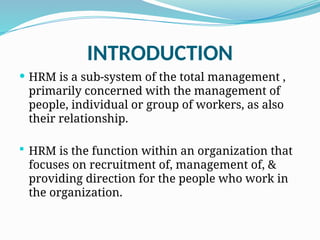
 HRM is a sub-system of the total management ,
primarily concerned with the management of
people, individual or group of workers, as also
their relationship.
 HRM is the function within an organization that
focuses on recruitment of, management of, &
providing direction for the people who work in
the organization.
Human resource management can be defined
as
“ Employing people, developing their resource,
utilizing maintaining and compensating their
services in tune with the job and
organizational requirements”.
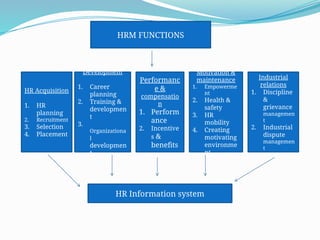
HRM FUNCTIONS
HR Acquisition
1. HR
planning
2. Recruitment
3. Selection
4. Placement
HR
Development
1. Career
planning
2. Training &
developmen
t
3.
Organizationa
l
developmen
t
Industrial
relations
1. Discipline
&
grievance
managemen
t
2. Industrial
dispute
managemen
t
Performanc
e &
compensatio
n
1. Perform
ance
2. Incentive
s &
benefits
Motivation &
maintenance
1. Empowerme
nt
2. Health &
safety
3. HR
mobility
4. Creating
motivating
environme
nt
HR Information system
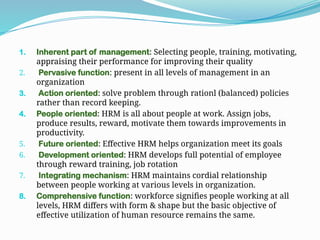
1. Inherent part of management: Selecting people, training, motivating,
appraising their performance for improving their quality
2. Pervasive function: present in all levels of management in an
organization
3. Action oriented: solve problem through rationl (balanced) policies
rather than record keeping.
4. People oriented: HRM is all about people at work. Assign jobs,
produce results, reward, motivate them towards improvements in
productivity.
5. Future oriented: Effective HRM helps organization meet its goals
6. Development oriented: HRM develops full potential of employee
through reward training, job rotation
7. Integrating mechanism: HRM maintains cordial relationship
between people working at various levels in organization.
8. Comprehensive function: workforce signifies people working at all
levels, HRM differs with form & shape but the basic objective of
effective utilization of human resource remains the same.
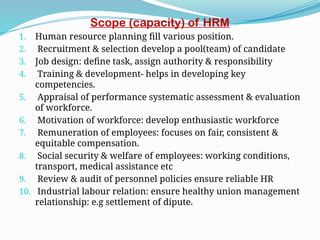
Scope (capacity) of HRM
1. Human resource planning fill various position.
2. Recruitment & selection develop a pool(team) of candidate
3. Job design: define task, assign authority & responsibility
4. Training & development- helps in developing key
competencies.
5. Appraisal of performance systematic assessment & evaluation
of workforce.
6. Motivation of workforce: develop enthusiastic workforce
7. Remuneration of employees: focuses on fair, consistent &
equitable compensation.
8. Social security & welfare of employees: working conditions,
transport, medical assistance etc
9. Review & audit of personnel policies ensure reliable HR
10. Industrial labour relation: ensure healthy union management
relationship: e.g settlement of dipute.
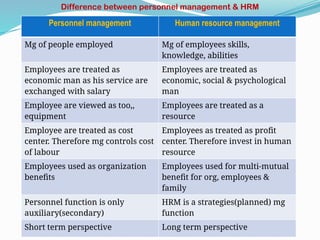
Difference between personnel management & HRM
Personnel management Human resource management
Mg of people employed Mg of employees skills,
knowledge, abilities
Employees are treated as
economic man as his service are
exchanged with salary
Employees are treated as
economic, social & psychological
man
Employee are viewed as too,,
equipment
Employees are treated as a
resource
Employee are treated as cost
center. Therefore mg controls cost
of labour
Employees as treated as profit
center. Therefore invest in human
resource
Employees used as organization
benefits
Employees used for multi-mutual
benefit for org, employees &
family
Personnel function is only
auxiliary(secondary)
HRM is a strategies(planned) mg
function
Short term perspective Long term perspective
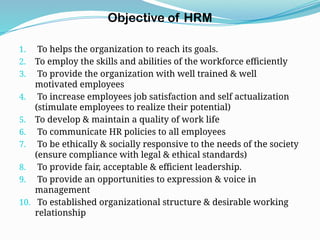
Objective of HRM
1. To helps the organization to reach its goals.
2. To employ the skills and abilities of the workforce efficiently
3. To provide the organization with well trained & well
motivated employees
4. To increase employees job satisfaction and self actualization
(stimulate employees to realize their potential)
5. To develop & maintain a quality of work life
6. To communicate HR policies to all employees
7. To be ethically & socially responsive to the needs of the society
(ensure compliance with legal & ethical standards)
8. To provide fair, acceptable & efficient leadership.
9. To provide an opportunities to expression & voice in
management
10. To established organizational structure & desirable working
relationship
STAFFING
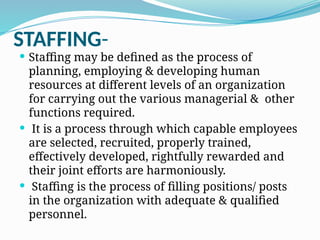
STAFFING-
 Staffing may be defined as the process of
planning, employing & developing human
resources at different levels of an organization
for carrying out the various managerial & other
functions required.
 It is a process through which capable employees
are selected, recruited, properly trained,
effectively developed, rightfully rewarded and
their joint efforts are harmoniously.
 Staffing is the process of filling positions/ posts
in the organization with adequate & qualified
personnel.
PHILOSOPHY-
 The knowledge & skill of the staff can adequately fulfill the needs of the
patient & thereby ensure both job satisfaction & quality care.
 Only professionally trained nurses can provide a high quality of patient
care & handle critically ill patients by providing both technical &
interpersonal skills.
 A professional nurse can not only treat chronically ill patients, but also
provide health education & rehabilitative care which is more complex.
 By determining patient needs & doing assignments, job qualification &
analysis can be done.
 All sorts of nursing-related plans, e.g. master rotation plan, duty
roster ,etc. should be done only by nursing heads.
 A staffing plan should be delegated to each unit-level head nurse so that
the activities of each ward & details of each shift are planned well.
Importance of staffing
 Filling the organizational positions
 Making possible discovery of able staff for chalenges
 Guaranteeing utmost productivity
 Developing personnel for shouldering greater
responsibilities
 Meeting upcoming requirements of talented people
 Satisfying job owing to correct placement
 Utilizing of human resources most favorably
 Supplying information concerning transfer,
promotion, recruitment, death, demotions
 Retaining professionalism among personnel.
Kinds of Staffing
1. Short term staffing: It centers on the urgent
needs of the company.
2. Long term staffing: It engages taking a
practical approach to company’s staffing
needs-covers at least one year
3. Succession planning: It allows to completely
understand the duties and responsibilities of
staff so you can train them to be ready for
promotion if management change takes place.
4. Strategic staffing: It involves a combination
of short-term , long term & succession.
Factors affecting staffing
A. External factors affecting staffing
1. Nature of rivalry for human resources
 India has supply of unskilled workers then highly qualified
people.
 Companies start to change their staffing policy & prefer less
talented people.
2. Legal factors
 Child labour is prohibited.
 Provision are there relating to reservations for physically
handicapped people.
 Legal provision affects the staffing policy of an organization.
3. Socio-cultural factors:
 Employment of women for job involving physical
exertion is usually avoided
 Women are not offered jobs involving continuous
travelling
4. External influences
 Employers have to face pressures from political
parties or politicians as new recruitment.
 Concept of employment to ‘ Sons of the soil’ is getting
popular in all countries.
 External influences affect the staffing policy of
business unit.
2. Internal Factors Affecting staffing
 Organizational image
 Past practices
 Size of the organization
 Organizational business plan
NORMS-
 Norm is a standard, model, or pattern. These are
standards that guide, control & regulate
individuals & communities.
 For estimating the requirement of nursing
manpower, various committees, nursing
councils, association have been recommended
staffing norms for hospitals, community both
rural & urban; nursing institutions in India.
Norms….
1.STAFF INSPECTION UNIT(SIU)
2. BAJAJ COMMITTEE
3.HIGH POWER COMMITTEE
4.INDIAN NURSING COUNCIL
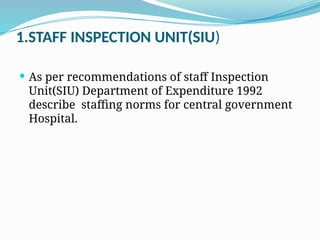
1.STAFF INSPECTION UNIT(SIU)
 As per recommendations of staff Inspection
Unit(SIU) Department of Expenditure 1992
describe staffing norms for central government
Hospital.
Cont…
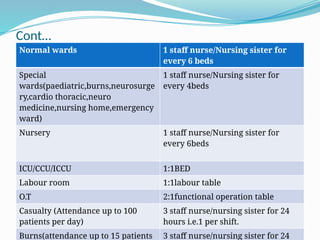
Normal wards 1 staff nurse/Nursing sister for
every 6 beds
Special
wards(paediatric,burns,neurosurge
ry,cardio thoracic,neuro
medicine,nursing home,emergency
ward)
1 staff nurse/Nursing sister for
every 4beds
Nursery 1 staff nurse/Nursing sister for
every 6beds
ICU/CCU/ICCU 1:1BED
Labour room 1:1labour table
O.T 2:1functional operation table
Casualty (Attendance up to 100
patients per day)
3 staff nurse/nursing sister for 24
hours i.e.1 per shift.
Burns(attendance up to 15 patients 3 staff nurse/nursing sister for 24
Cont…
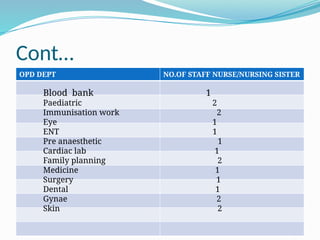
OPD DEPT NO.OF STAFF NURSE/NURSING SISTER
Blood bank 1
Paediatric 2
Immunisation work 2
Eye 1
ENT 1
Pre anaesthetic 1
Cardiac lab 1
Family planning 2
Medicine 1
Surgery 1
Dental 1
Gynae 2
Skin 2
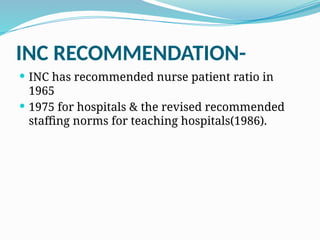
INC RECOMMENDATION-
 INC has recommended nurse patient ratio in
1965
 1975 for hospitals & the revised recommended
staffing norms for teaching hospitals(1986).
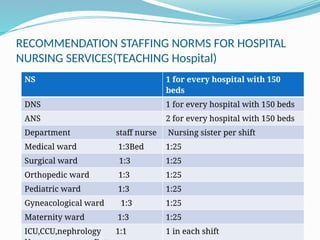
RECOMMENDATION STAFFING NORMS FOR HOSPITAL
NURSING SERVICES(TEACHING Hospital)
NS 1 for every hospital with 150
beds
DNS 1 for every hospital with 150 beds
ANS 2 for every hospital with 150 beds
Department staff nurse Nursing sister per shift
Medical ward 1:3Bed 1:25
Surgical ward 1:3 1:25
Orthopedic ward 1:3 1:25
Pediatric ward 1:3 1:25
Gyneacological ward 1:3 1:25
Maternity ward 1:3 1:25
ICU,CCU,nephrology 1:1 1 in each shift
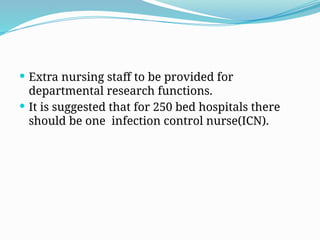
 Extra nursing staff to be provided for
departmental research functions.
 It is suggested that for 250 bed hospitals there
should be one infection control nurse(ICN).
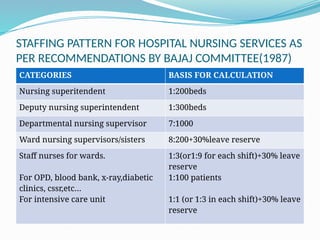
STAFFING PATTERN FOR HOSPITAL NURSING SERVICES AS
PER RECOMMENDATIONS BY BAJAJ COMMITTEE(1987)
CATEGORIES BASIS FOR CALCULATION
Nursing superitendent 1:200beds
Deputy nursing superintendent 1:300beds
Departmental nursing supervisor 7:1000
Ward nursing supervisors/sisters 8:200+30%leave reserve
Staff nurses for wards.
For OPD, blood bank, x-ray,diabetic
clinics, cssr,etc…
For intensive care unit
1:3(or1:9 for each shift)+30% leave
reserve
1:100 patients
1:1 (or 1:3 in each shift)+30% leave
reserve
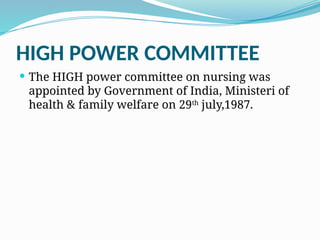
HIGH POWER COMMITTEE
 The HIGH power committee on nursing was
appointed by Government of India, Ministeri of
health & family welfare on 29th
july,1987.
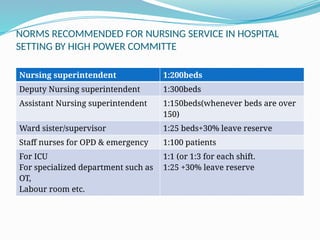
NORMS RECOMMENDED FOR NURSING SERVICE IN HOSPITAL
SETTING BY HIGH POWER COMMITTE
Nursing superintendent 1:200beds
Deputy Nursing superintendent 1:300beds
Assistant Nursing superintendent 1:150beds(whenever beds are over
150)
Ward sister/supervisor 1:25 beds+30% leave reserve
Staff nurses for OPD & emergency 1:100 patients
For ICU
For specialized department such as
OT,
Labour room etc.
1:1 (or 1:3 for each shift.
1:25 +30% leave reserve
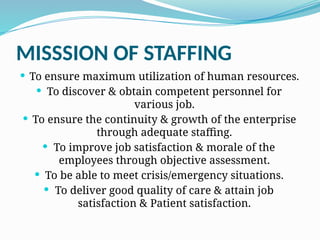
MISSSION OF STAFFING
 To ensure maximum utilization of human resources.
 To discover & obtain competent personnel for
various job.
 To ensure the continuity & growth of the enterprise
through adequate staffing.
 To improve job satisfaction & morale of the
employees through objective assessment.
 To be able to meet crisis/emergency situations.
 To deliver good quality of care & attain job
satisfaction & Patient satisfaction.
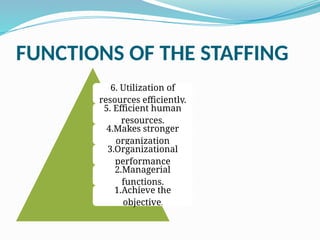
FUNCTIONS OF THE STAFFING
6. Utilization of
resources efficiently.
5. Efficient human
resources.
4.Makes stronger
organization
3.Organizational
performance
2.Managerial
functions.
1.Achieve the
objective.
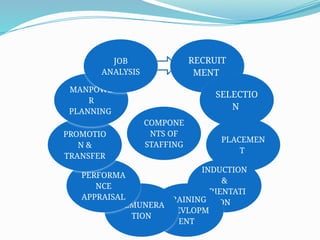
COMPONE
NTS OF
STAFFING
RECRUIT
MENT
SELECTIO
N
PLACEMEN
T
INDUCTION
&
ORIENTATI
ON
TRAINING
&DEVLOPM
ENT
REMUNERA
TION
PERFORMA
NCE
APPRAISAL
PROMOTIO
N &
TRANSFER
MANPOWE
R
PLANNING
JOB
ANALYSIS
Conclusion:
Staffing is the most vital asset with an
organization, without which it cannot move
ahead in the competitive world. It can be
equated with HR management as both have
same sort of objectives . Staffing is an open
system approach. It is carried out within the
enterprise but is also linked to external
environment.

1 STAFFING.pptx powerful content for msc

  • 1.
  • 2.
    INTRODUCTION  HRM isa sub-system of the total management , primarily concerned with the management of people, individual or group of workers, as also their relationship.  HRM is the function within an organization that focuses on recruitment of, management of, & providing direction for the people who work in the organization.
  • 3.
    Human resource managementcan be defined as “ Employing people, developing their resource, utilizing maintaining and compensating their services in tune with the job and organizational requirements”.
  • 4.
    HRM FUNCTIONS HR Acquisition 1.HR planning 2. Recruitment 3. Selection 4. Placement HR Development 1. Career planning 2. Training & developmen t 3. Organizationa l developmen t Industrial relations 1. Discipline & grievance managemen t 2. Industrial dispute managemen t Performanc e & compensatio n 1. Perform ance 2. Incentive s & benefits Motivation & maintenance 1. Empowerme nt 2. Health & safety 3. HR mobility 4. Creating motivating environme nt HR Information system
  • 5.
    1. Inherent partof management: Selecting people, training, motivating, appraising their performance for improving their quality 2. Pervasive function: present in all levels of management in an organization 3. Action oriented: solve problem through rationl (balanced) policies rather than record keeping. 4. People oriented: HRM is all about people at work. Assign jobs, produce results, reward, motivate them towards improvements in productivity. 5. Future oriented: Effective HRM helps organization meet its goals 6. Development oriented: HRM develops full potential of employee through reward training, job rotation 7. Integrating mechanism: HRM maintains cordial relationship between people working at various levels in organization. 8. Comprehensive function: workforce signifies people working at all levels, HRM differs with form & shape but the basic objective of effective utilization of human resource remains the same.
  • 6.
    Scope (capacity) ofHRM 1. Human resource planning fill various position. 2. Recruitment & selection develop a pool(team) of candidate 3. Job design: define task, assign authority & responsibility 4. Training & development- helps in developing key competencies. 5. Appraisal of performance systematic assessment & evaluation of workforce. 6. Motivation of workforce: develop enthusiastic workforce 7. Remuneration of employees: focuses on fair, consistent & equitable compensation. 8. Social security & welfare of employees: working conditions, transport, medical assistance etc 9. Review & audit of personnel policies ensure reliable HR 10. Industrial labour relation: ensure healthy union management relationship: e.g settlement of dipute.
  • 7.
    Difference between personnelmanagement & HRM Personnel management Human resource management Mg of people employed Mg of employees skills, knowledge, abilities Employees are treated as economic man as his service are exchanged with salary Employees are treated as economic, social & psychological man Employee are viewed as too,, equipment Employees are treated as a resource Employee are treated as cost center. Therefore mg controls cost of labour Employees as treated as profit center. Therefore invest in human resource Employees used as organization benefits Employees used for multi-mutual benefit for org, employees & family Personnel function is only auxiliary(secondary) HRM is a strategies(planned) mg function Short term perspective Long term perspective
  • 8.
    Objective of HRM 1.To helps the organization to reach its goals. 2. To employ the skills and abilities of the workforce efficiently 3. To provide the organization with well trained & well motivated employees 4. To increase employees job satisfaction and self actualization (stimulate employees to realize their potential) 5. To develop & maintain a quality of work life 6. To communicate HR policies to all employees 7. To be ethically & socially responsive to the needs of the society (ensure compliance with legal & ethical standards) 8. To provide fair, acceptable & efficient leadership. 9. To provide an opportunities to expression & voice in management 10. To established organizational structure & desirable working relationship
  • 9.
  • 10.
    STAFFING-  Staffing maybe defined as the process of planning, employing & developing human resources at different levels of an organization for carrying out the various managerial & other functions required.  It is a process through which capable employees are selected, recruited, properly trained, effectively developed, rightfully rewarded and their joint efforts are harmoniously.  Staffing is the process of filling positions/ posts in the organization with adequate & qualified personnel.
  • 11.
    PHILOSOPHY-  The knowledge& skill of the staff can adequately fulfill the needs of the patient & thereby ensure both job satisfaction & quality care.  Only professionally trained nurses can provide a high quality of patient care & handle critically ill patients by providing both technical & interpersonal skills.  A professional nurse can not only treat chronically ill patients, but also provide health education & rehabilitative care which is more complex.  By determining patient needs & doing assignments, job qualification & analysis can be done.  All sorts of nursing-related plans, e.g. master rotation plan, duty roster ,etc. should be done only by nursing heads.  A staffing plan should be delegated to each unit-level head nurse so that the activities of each ward & details of each shift are planned well.
  • 12.
    Importance of staffing Filling the organizational positions  Making possible discovery of able staff for chalenges  Guaranteeing utmost productivity  Developing personnel for shouldering greater responsibilities  Meeting upcoming requirements of talented people  Satisfying job owing to correct placement  Utilizing of human resources most favorably  Supplying information concerning transfer, promotion, recruitment, death, demotions  Retaining professionalism among personnel.
  • 13.
    Kinds of Staffing 1.Short term staffing: It centers on the urgent needs of the company. 2. Long term staffing: It engages taking a practical approach to company’s staffing needs-covers at least one year 3. Succession planning: It allows to completely understand the duties and responsibilities of staff so you can train them to be ready for promotion if management change takes place. 4. Strategic staffing: It involves a combination of short-term , long term & succession.
  • 14.
    Factors affecting staffing A.External factors affecting staffing 1. Nature of rivalry for human resources  India has supply of unskilled workers then highly qualified people.  Companies start to change their staffing policy & prefer less talented people. 2. Legal factors  Child labour is prohibited.  Provision are there relating to reservations for physically handicapped people.  Legal provision affects the staffing policy of an organization.
  • 15.
    3. Socio-cultural factors: Employment of women for job involving physical exertion is usually avoided  Women are not offered jobs involving continuous travelling 4. External influences  Employers have to face pressures from political parties or politicians as new recruitment.  Concept of employment to ‘ Sons of the soil’ is getting popular in all countries.  External influences affect the staffing policy of business unit.
  • 16.
    2. Internal FactorsAffecting staffing  Organizational image  Past practices  Size of the organization  Organizational business plan
  • 17.
    NORMS-  Norm isa standard, model, or pattern. These are standards that guide, control & regulate individuals & communities.  For estimating the requirement of nursing manpower, various committees, nursing councils, association have been recommended staffing norms for hospitals, community both rural & urban; nursing institutions in India.
  • 18.
    Norms…. 1.STAFF INSPECTION UNIT(SIU) 2.BAJAJ COMMITTEE 3.HIGH POWER COMMITTEE 4.INDIAN NURSING COUNCIL
  • 19.
    1.STAFF INSPECTION UNIT(SIU) As per recommendations of staff Inspection Unit(SIU) Department of Expenditure 1992 describe staffing norms for central government Hospital.
  • 20.
    Cont… Normal wards 1staff nurse/Nursing sister for every 6 beds Special wards(paediatric,burns,neurosurge ry,cardio thoracic,neuro medicine,nursing home,emergency ward) 1 staff nurse/Nursing sister for every 4beds Nursery 1 staff nurse/Nursing sister for every 6beds ICU/CCU/ICCU 1:1BED Labour room 1:1labour table O.T 2:1functional operation table Casualty (Attendance up to 100 patients per day) 3 staff nurse/nursing sister for 24 hours i.e.1 per shift. Burns(attendance up to 15 patients 3 staff nurse/nursing sister for 24
  • 21.
    Cont… OPD DEPT NO.OFSTAFF NURSE/NURSING SISTER Blood bank 1 Paediatric 2 Immunisation work 2 Eye 1 ENT 1 Pre anaesthetic 1 Cardiac lab 1 Family planning 2 Medicine 1 Surgery 1 Dental 1 Gynae 2 Skin 2
  • 22.
    INC RECOMMENDATION-  INChas recommended nurse patient ratio in 1965  1975 for hospitals & the revised recommended staffing norms for teaching hospitals(1986).
  • 23.
    RECOMMENDATION STAFFING NORMSFOR HOSPITAL NURSING SERVICES(TEACHING Hospital) NS 1 for every hospital with 150 beds DNS 1 for every hospital with 150 beds ANS 2 for every hospital with 150 beds Department staff nurse Nursing sister per shift Medical ward 1:3Bed 1:25 Surgical ward 1:3 1:25 Orthopedic ward 1:3 1:25 Pediatric ward 1:3 1:25 Gyneacological ward 1:3 1:25 Maternity ward 1:3 1:25 ICU,CCU,nephrology 1:1 1 in each shift
  • 24.
     Extra nursingstaff to be provided for departmental research functions.  It is suggested that for 250 bed hospitals there should be one infection control nurse(ICN).
  • 25.
    STAFFING PATTERN FORHOSPITAL NURSING SERVICES AS PER RECOMMENDATIONS BY BAJAJ COMMITTEE(1987) CATEGORIES BASIS FOR CALCULATION Nursing superitendent 1:200beds Deputy nursing superintendent 1:300beds Departmental nursing supervisor 7:1000 Ward nursing supervisors/sisters 8:200+30%leave reserve Staff nurses for wards. For OPD, blood bank, x-ray,diabetic clinics, cssr,etc… For intensive care unit 1:3(or1:9 for each shift)+30% leave reserve 1:100 patients 1:1 (or 1:3 in each shift)+30% leave reserve
  • 26.
    HIGH POWER COMMITTEE The HIGH power committee on nursing was appointed by Government of India, Ministeri of health & family welfare on 29th july,1987.
  • 27.
    NORMS RECOMMENDED FORNURSING SERVICE IN HOSPITAL SETTING BY HIGH POWER COMMITTE Nursing superintendent 1:200beds Deputy Nursing superintendent 1:300beds Assistant Nursing superintendent 1:150beds(whenever beds are over 150) Ward sister/supervisor 1:25 beds+30% leave reserve Staff nurses for OPD & emergency 1:100 patients For ICU For specialized department such as OT, Labour room etc. 1:1 (or 1:3 for each shift. 1:25 +30% leave reserve
  • 28.
    MISSSION OF STAFFING To ensure maximum utilization of human resources.  To discover & obtain competent personnel for various job.  To ensure the continuity & growth of the enterprise through adequate staffing.  To improve job satisfaction & morale of the employees through objective assessment.  To be able to meet crisis/emergency situations.  To deliver good quality of care & attain job satisfaction & Patient satisfaction.
  • 29.
    FUNCTIONS OF THESTAFFING 6. Utilization of resources efficiently. 5. Efficient human resources. 4.Makes stronger organization 3.Organizational performance 2.Managerial functions. 1.Achieve the objective.
  • 30.
  • 31.
    Conclusion: Staffing is themost vital asset with an organization, without which it cannot move ahead in the competitive world. It can be equated with HR management as both have same sort of objectives . Staffing is an open system approach. It is carried out within the enterprise but is also linked to external environment.

Editor's Notes

  • #11 Vati – 318, basavanthappa - 188