
Chapter 9
 Stability
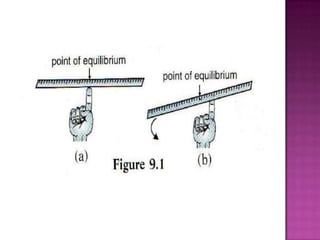
 An    object is said to be in equilibrium when it
    is stationary or at a rest.

   All object have a point of equilibrium.

 An   object can be balanced at its point of
    equilibrium.
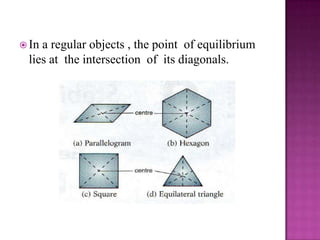
 Ina regular objects , the point of equilibrium
 lies at the intersection of its diagonals.
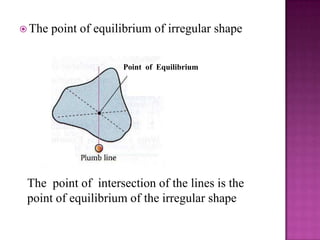
 The   point of equilibrium of irregular shape

                      Point of Equilibrium


 The point of intersection of the lines is the
 point of equilibrium of the irregular shape
 The centre of gravity of an object is the point at which
  the earth’s gravity acts on that object.
 The weight of an objects is due to the gravitational
  force acting on it.
 The gravitational force acts on all parts of the
  object, but the weight can be considered to concentrate
  at one point. This point is called the centre of gravity of
  the object.
 The point of equilibrium of an object is also the
  centre of gravity.
 The centre of gravity and the point of equilibrium
  are also defined as the point at which the whole
  weight of an object appears to act.
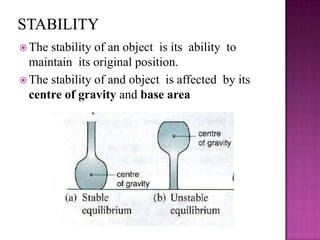
 The stability of an object is its ability to
  maintain its original position.
 The stability of and object is affected by its
  centre of gravity and base area
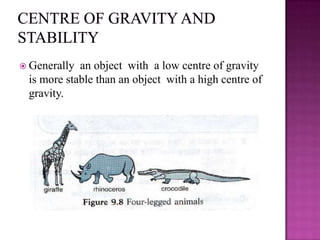
 Generally an object with a low centre of gravity
 is more stable than an object with a high centre of
 gravity.
   A racing car is designed to have a low center of gravity.

   Heavy vehicles such as lorries and buses have heavy
    engines. These engines are placed at the bottom to lower their
    centre of gravity. This makes them more stable.

   Passengers in a canoe are advised to sit when the canoe is
    paddled. This lowers the centre of gravity of the canoe and
    provides greater stability.

   A motorcyclist bends his body forward to lower his centre of
    gravity so that he becomes more stable while riding his
    motorcyles.

   The lower of the glass is made thicker and heavier . This lowers
    its center of gravity and makes it more stable.

   The passengers of a double-decker bus are not allowed to stand
    on the upper deck. This is to lower the centre of gravity of the
    bus and thus give it greater stability.
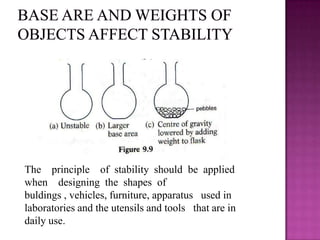
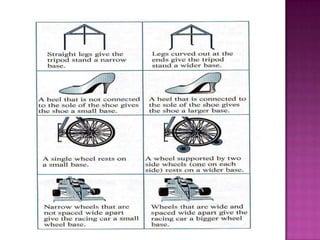
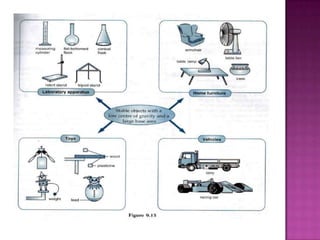
The principle of stability should be applied
when designing the shapes of
buldings , vehicles, furniture, apparatus used in
laboratories and the utensils and tools that are in
daily use.
The stability of a person’s body depends on the position of the
centre of gravity
The giraffe stands with its legs spread wide apart
to increase its base area and to lower its centre of
gravity. This makes it more stable.
Chapter 9 stability
Chapter 9 stability
Chapter 9 stability

Chapter 9 stability

  • 1.
  • 2.
     An object is said to be in equilibrium when it is stationary or at a rest.  All object have a point of equilibrium.  An object can be balanced at its point of equilibrium.
  • 4.
     Ina regularobjects , the point of equilibrium lies at the intersection of its diagonals.
  • 5.
     The point of equilibrium of irregular shape Point of Equilibrium The point of intersection of the lines is the point of equilibrium of the irregular shape
  • 6.
     The centreof gravity of an object is the point at which the earth’s gravity acts on that object.  The weight of an objects is due to the gravitational force acting on it.  The gravitational force acts on all parts of the object, but the weight can be considered to concentrate at one point. This point is called the centre of gravity of the object.  The point of equilibrium of an object is also the centre of gravity.  The centre of gravity and the point of equilibrium are also defined as the point at which the whole weight of an object appears to act.
  • 8.
     The stabilityof an object is its ability to maintain its original position.  The stability of and object is affected by its centre of gravity and base area
  • 9.
     Generally anobject with a low centre of gravity is more stable than an object with a high centre of gravity.
  • 10.
    A racing car is designed to have a low center of gravity.  Heavy vehicles such as lorries and buses have heavy engines. These engines are placed at the bottom to lower their centre of gravity. This makes them more stable.  Passengers in a canoe are advised to sit when the canoe is paddled. This lowers the centre of gravity of the canoe and provides greater stability.  A motorcyclist bends his body forward to lower his centre of gravity so that he becomes more stable while riding his motorcyles.  The lower of the glass is made thicker and heavier . This lowers its center of gravity and makes it more stable.  The passengers of a double-decker bus are not allowed to stand on the upper deck. This is to lower the centre of gravity of the bus and thus give it greater stability.
  • 11.
    The principle ofstability should be applied when designing the shapes of buldings , vehicles, furniture, apparatus used in laboratories and the utensils and tools that are in daily use.
  • 12.
    The stability ofa person’s body depends on the position of the centre of gravity
  • 13.
    The giraffe standswith its legs spread wide apart to increase its base area and to lower its centre of gravity. This makes it more stable.