 Railway electrification system supplies electric
power to railway trains and trams without an
on-board prime mover or local fuel supply.
Electrification has many advantages but
requires significant capital expenditure.
Selection of an electrification system is based
on economics of energy supply, maintenance
and capital cost compared to the revenue
obtained for freight and passenger traffic.
Different systems are used for urban and
intercity areas; some electric locomotives can
switch to different supply voltages to allow4/1/2015 1S.T.
Main elements of Electrification:-
 Pantograph.
 Overhead lines.
 Traction Substation.
4/1/2015 2S.T.
 Pantograph is a mechanical linkage connected in a
manner based on parallelograms so that the movement
of one pen, in tracing an image, produces identical
movements in a second pen. If a line drawing is traced
by the first point, an identical, enlarged, or miniaturized
copy will be drawn by a pen fixed to the other. Using
the same principle, different kinds of pantographs are
used for other forms of duplication in areas such as
sculpture, minting, engraving and milling.
4/1/2015 3S.T.
 The device which maintains electrical contact with the
contact wire and transfers power from the wire to the
traction unit, used in electric locomotives and trams, is
called a "pantograph".
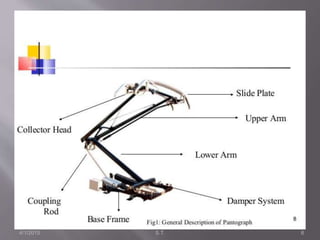
 A pantograph is a system of articulated arms fixed to
the roof of locomotives,it unfolds and extends along a
vertical axis.The Horizontal end-piece of the
pantograph is called the head.This head is fitted with
Carbon strips.Their number and type depend on the
nature and intensity of the current to be transmitted
e.g.DC or AC.These carbon strips slide along the
catenary contact wires,thus capturing the electricity
required to power the train’s traction motors.
4/1/2015 4S.T.
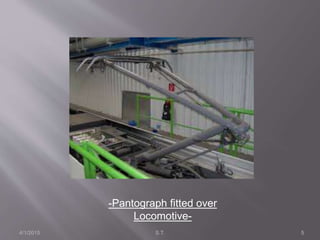
-Pantograph fitted over
Locomotive-
4/1/2015 5S.T.
4/1/2015 6S.T.
 An overhead line or overhead wire is used to transmit
electrical energy to trams, trolleybuses or trains. It is
known variously as:
1. Overhead contact system (OCS)
2. Overhead line equipment (OLE or OHLE)
3. Overhead equipment (OHE)
4. Overhead wiring (OHW) or overhead lines (OHL)
5. Catenary.
6. Trolley wire.
4/1/2015 7S.T.
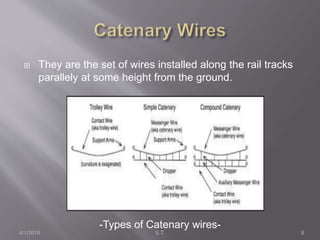
 They are the set of wires installed along the rail tracks
parallely at some height from the ground.
-Types of Catenary wires-
4/1/2015 8S.T.
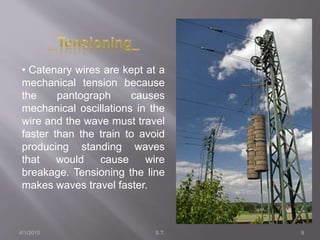
• Catenary wires are kept at a
mechanical tension because
the pantograph causes
mechanical oscillations in the
wire and the wave must travel
faster than the train to avoid
producing standing waves
that would cause wire
breakage. Tensioning the line
makes waves travel faster.
4/1/2015 9S.T.
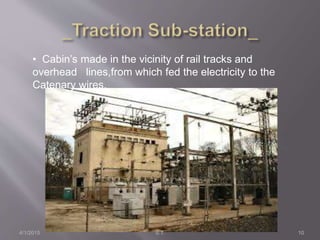
• Cabin’s made in the vicinity of rail tracks and
overhead lines,from which fed the electricity to the
Catenary wires.
4/1/2015 10S.T.
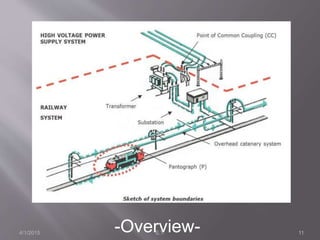
-Overview-4/1/2015 11S.T.
Reference:-
•www.wikipedia.org
•www.Indianrailways.gov.in
•www.youtube.com/HowDoesItWork
4/1/2015 12S.T.
4/1/2015 13S.T.

St pantograph

  • 1.
     Railway electrificationsystem supplies electric power to railway trains and trams without an on-board prime mover or local fuel supply. Electrification has many advantages but requires significant capital expenditure. Selection of an electrification system is based on economics of energy supply, maintenance and capital cost compared to the revenue obtained for freight and passenger traffic. Different systems are used for urban and intercity areas; some electric locomotives can switch to different supply voltages to allow4/1/2015 1S.T.
  • 2.
    Main elements ofElectrification:-  Pantograph.  Overhead lines.  Traction Substation. 4/1/2015 2S.T.
  • 3.
     Pantograph isa mechanical linkage connected in a manner based on parallelograms so that the movement of one pen, in tracing an image, produces identical movements in a second pen. If a line drawing is traced by the first point, an identical, enlarged, or miniaturized copy will be drawn by a pen fixed to the other. Using the same principle, different kinds of pantographs are used for other forms of duplication in areas such as sculpture, minting, engraving and milling. 4/1/2015 3S.T.
  • 4.
     The devicewhich maintains electrical contact with the contact wire and transfers power from the wire to the traction unit, used in electric locomotives and trams, is called a "pantograph".  A pantograph is a system of articulated arms fixed to the roof of locomotives,it unfolds and extends along a vertical axis.The Horizontal end-piece of the pantograph is called the head.This head is fitted with Carbon strips.Their number and type depend on the nature and intensity of the current to be transmitted e.g.DC or AC.These carbon strips slide along the catenary contact wires,thus capturing the electricity required to power the train’s traction motors. 4/1/2015 4S.T.
  • 5.
  • 6.
  • 7.
     An overheadline or overhead wire is used to transmit electrical energy to trams, trolleybuses or trains. It is known variously as: 1. Overhead contact system (OCS) 2. Overhead line equipment (OLE or OHLE) 3. Overhead equipment (OHE) 4. Overhead wiring (OHW) or overhead lines (OHL) 5. Catenary. 6. Trolley wire. 4/1/2015 7S.T.
  • 8.
     They arethe set of wires installed along the rail tracks parallely at some height from the ground. -Types of Catenary wires- 4/1/2015 8S.T.
  • 9.
    • Catenary wiresare kept at a mechanical tension because the pantograph causes mechanical oscillations in the wire and the wave must travel faster than the train to avoid producing standing waves that would cause wire breakage. Tensioning the line makes waves travel faster. 4/1/2015 9S.T.
  • 10.
    • Cabin’s madein the vicinity of rail tracks and overhead lines,from which fed the electricity to the Catenary wires. 4/1/2015 10S.T.
  • 11.
  • 12.
  • 13.