Presentation
On
LHB Coach & Train Lighting
PRESENTED TO:-
 Dr. Mohd. Ahmed
 Dr. Archana Sharma
Department of Electrical Engineering
PRESENTED BY:-
 ASIF JAMAL(2007350200021)
 HARSH KUMAR GOND(2007350200031)
4th Year
Electrical Engineering
Railway Workshop
Gorakhpur
 Contents…
 Introduction
 Coaches
 Types of Coaches
 Features of Coaches
 How its benefits the Railway
 Train Lighting
 Cost Comparison
 Conclusion
 Introduction…
 Indian railways is 4th largest railway network
having route length of 68,043 kms.
 Over 12,000 trains carries over 30 million
passengers and 2.8 millions tones of freight
daily.
 Word’s largest enterprise with 1.5 million
employees.
1) United States
2) China
3) Russia
4) India
 COACHES…
A passenger car (known as coach or carriage in the
UK, and also known as a bogie in India) is a piece
of railway rolling stock that is designed to carry
passengers.
The term passenger car can also be associated
with a sleeping car, baggage, dining, railway post
office and prisoner transport cars.
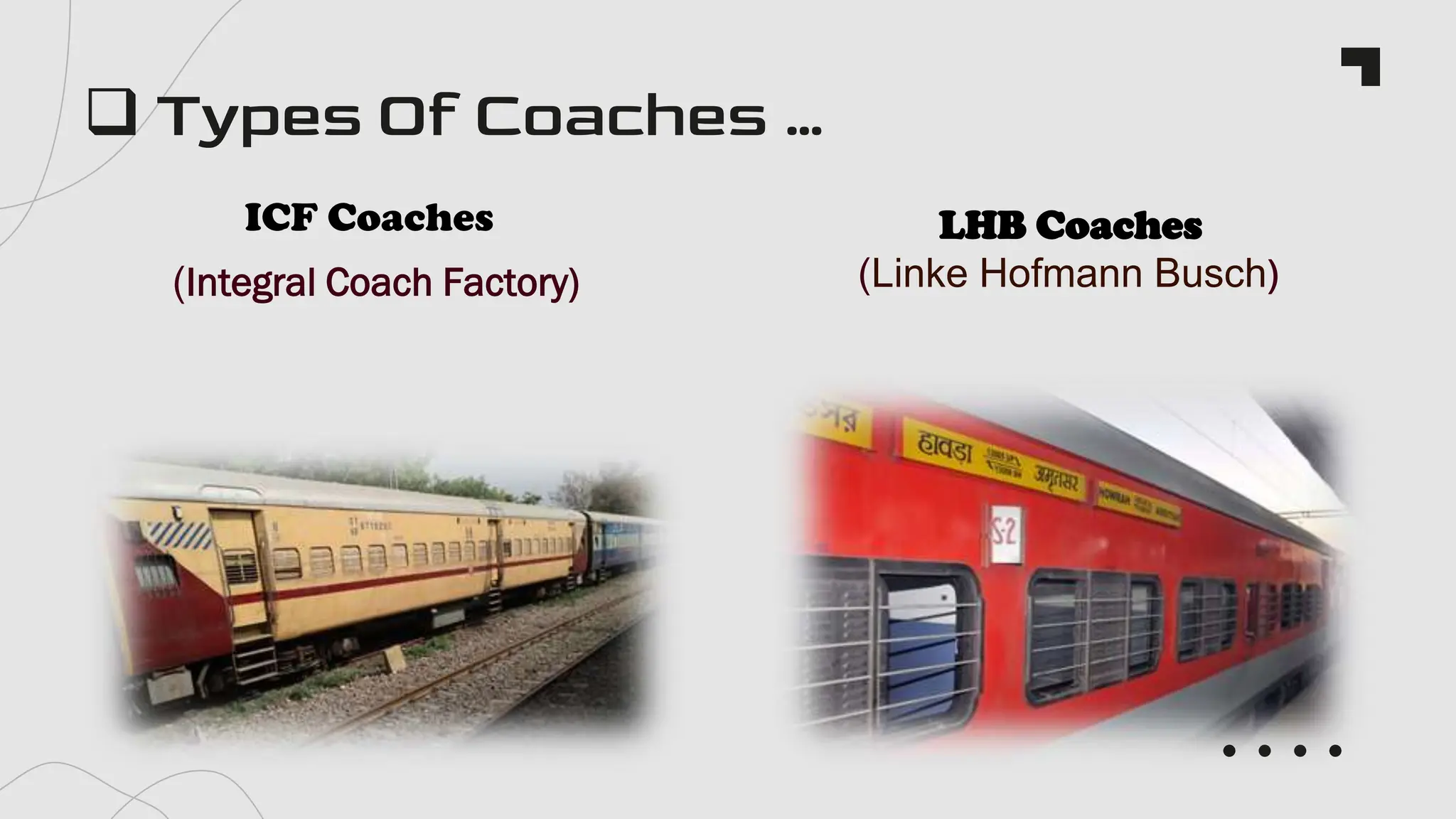
 Types Of Coaches …
ICF Coaches
(Integral Coach Factory)
LHB Coaches
(Linke Hofmann Busch)
 ICF Coaches…
Built at
Integral Coach Factory (ICF) is a manufacturer of rail
coaches located in Perambur, Chennai, Tamil Nadu,
India. It was established in 1955.
Modern Coach Factory at Raebareli
Rail Coach Factory at Kapurthala
Marathwada Rail Coach Factory at Latur
Rail Coach Naveenikaran Karkhana at Sonipat.
 ICF coach costs between ₹ 80 Lakh to ₹1.5 Crore.
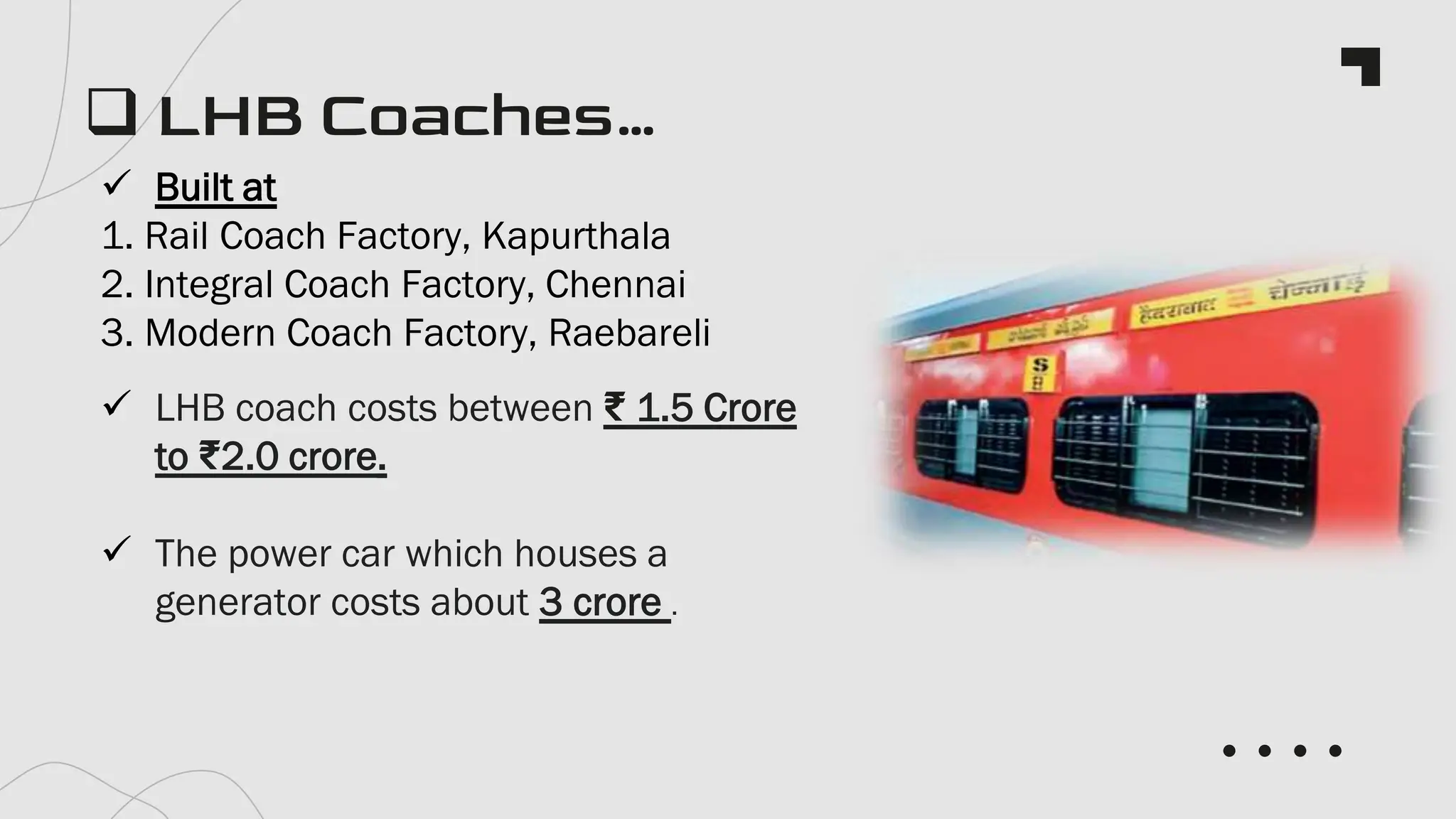
 LHB Coaches…
 LHB coach costs between ₹ 1.5 Crore
to ₹2.0 crore.
 The power car which houses a
generator costs about 3 crore .
 Built at
1. Rail Coach Factory, Kapurthala
2. Integral Coach Factory, Chennai
3. Modern Coach Factory, Raebareli
 Features of LHB Coach…
 No. Of Passengers - 78 (Chair car)
- 56 (Ex. Chair car)
 Corrosion Free Coach
Use of superior materials with longer life.
 Longer Coach
LHB coaches are approximately 2-meters longer than the conventional ICF type coaches.
This means “more travel space” “increased seating capacity”, “wider bays and doorways”
etc.
Speed Potential LHB Coach ICF Coach
Test speed 180 kmph 160 kmph
Service Speed 160 kmph 140 kmph
Oil Leakage
Problem
No Very high
 Features of LHB Coach…
 No major changes required for 200 kmph
 Speed
 Features of LHB Coach…
 Light Weight Coach
Weight of LHB coach is approximately “10%” lesser than the conventional coach.
 Higher passenger comfort
 Auto Closing Sliding Doors
 Wider Windows
 Superior Shell and furnishing Design
 Improved Air Conditioning System
 Use of Fire Retardant Materials
 How It Benefits Railways…
Lesser maintenance:
 Superior braking with Wheel slide protection (WSP) system based on
microprocessor if the variation of speed of wheel of a Coach is more than 10
kmph. Brakes of the particular coach are released automatically by
microprocessor unit till it is again reset. It protects the brake binding of the
Coach.
 Bogie with less moving parts.
 Items of wear & tear shall not require replacement/renewal before 10 Lakh km.
 Use of stainless steel and less bogie moving parts shall reduce maintenance
requirements.
 Entrance doors flush with side wall allowing automatic car washing.
Power Supply in Train
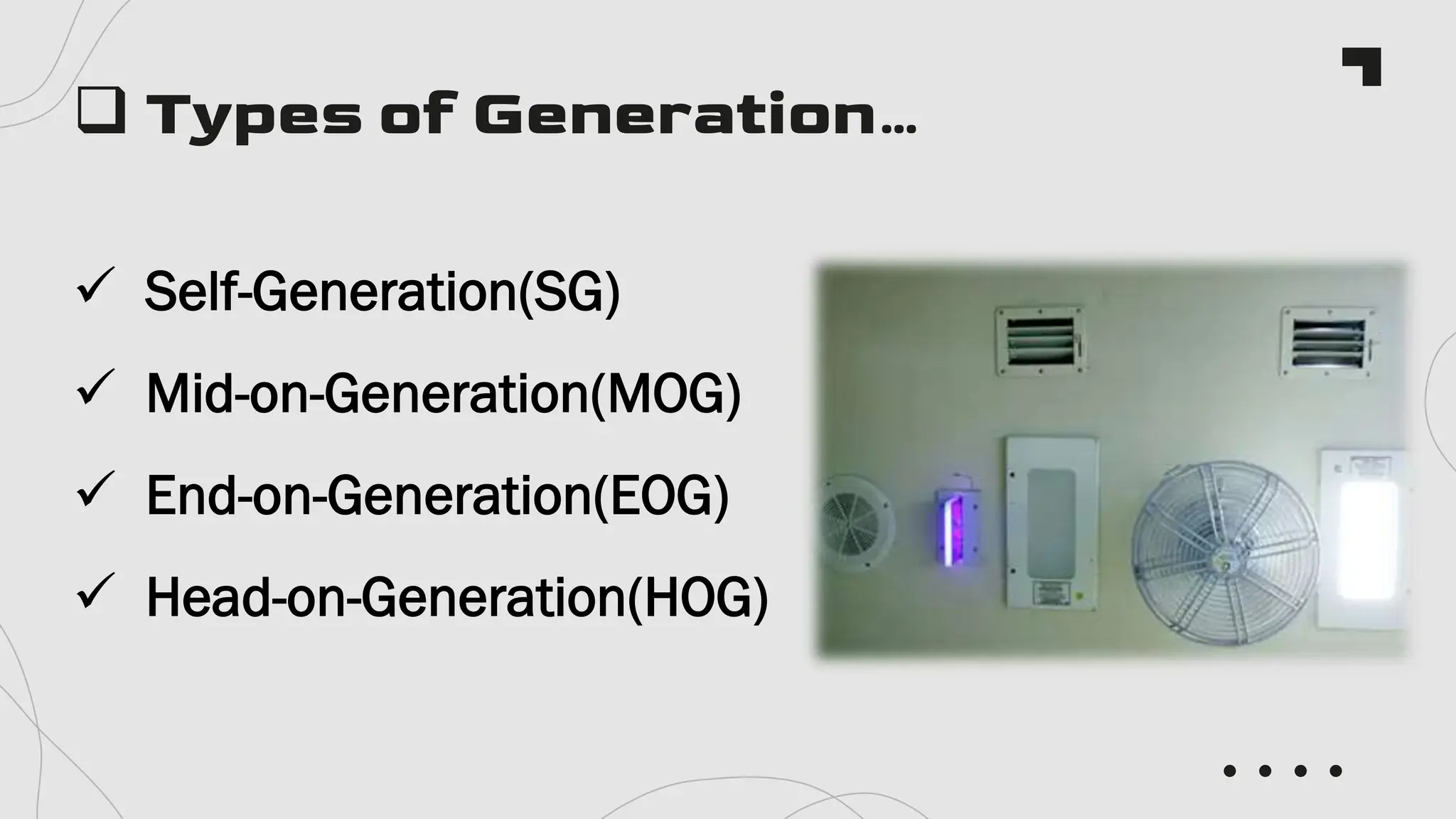
 Self-Generation(SG)
 Mid-on-Generation(MOG)
 End-on-Generation(EOG)
 Head-on-Generation(HOG)
 Types of Generation…
Self Generation System(SG)
 2×25 kW alternators for AC coach.
1×4.5 kW for non-AC coach.
110V DC Battery.
 The voltage of the alternator which varies with the speed of the train is
regulated with the help of RRU and converted to 110 V DC and is used
for charging the battery.
 2x25 kVA, 110 V dc/415 V inverters for AC load.
 110 V DC Supply for lights and fans.
 Axle driven system working on 24V DC/ 110 V DC
Self Generation(SG)
4.5 kW Non AC Coach Alternator 25 kWAC Coach Alternator
Self Generation(SG)
RRU - Rectifier Cum Regulator Unit
Disadvantages
 The electrical load of the coach is restricted by the limitation of the capacity of
generation i.e. 2*25 kW per coach at present.
 The power is not generated during standing or slow movement of the train,
therefore bulky batteries are provided.
 There is no standby source for alternator and batteries, so system became poor
reliability.
 The system requires the extensive maintenance of alternator, batteries, belts,
tensioning device etc. •
 The system has the very poor efficiency of 57%for power it receives from the
locomotive
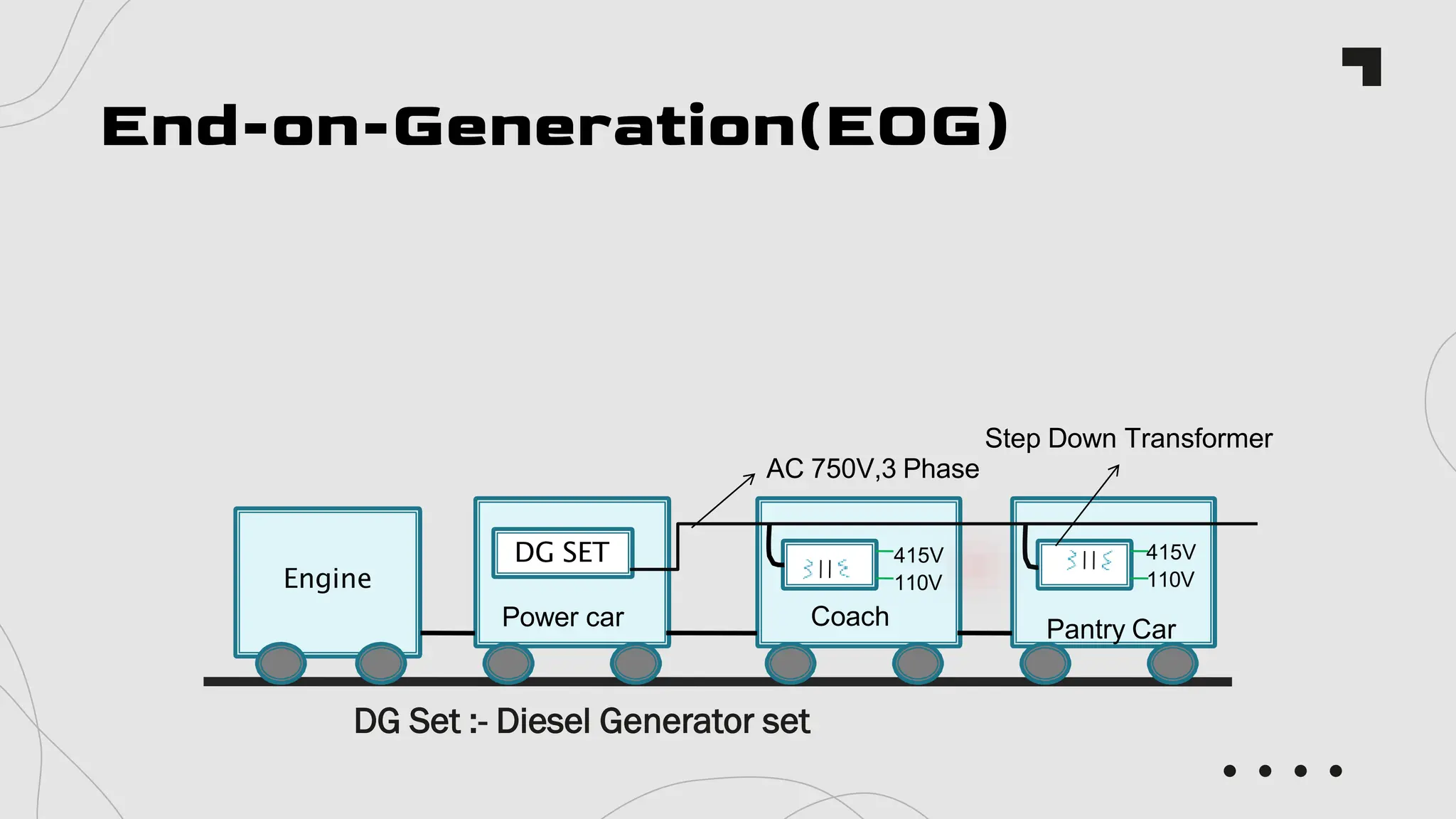
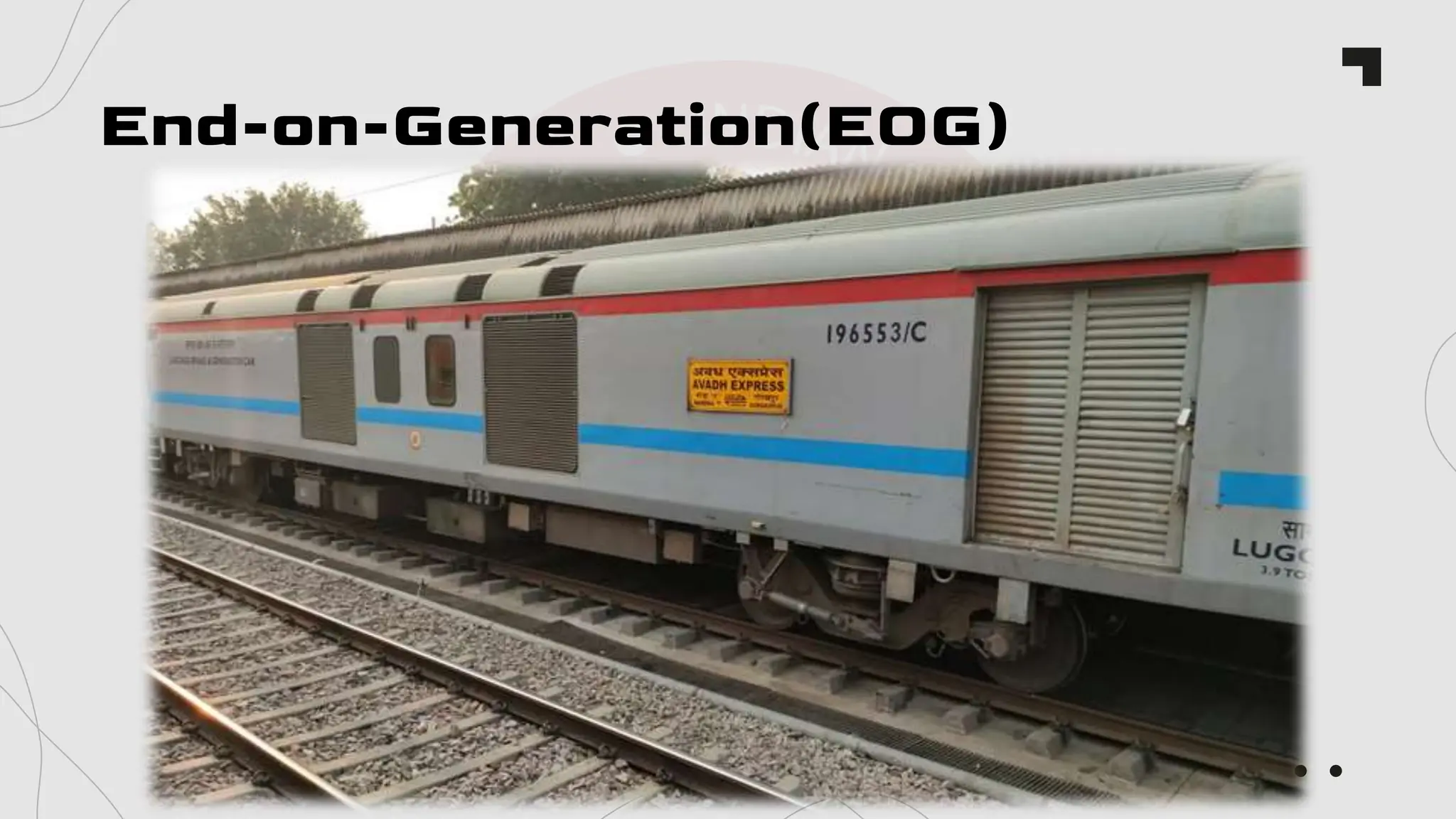
End-on-Generation(EOG)
DG Set :- Diesel Generator set
Engine
Power car
DG SET
Coach
415V
110V
415V
110V
Pantry Car
Step Down Transformer
AC 750V,3 Phase
 EOG system is followed for fully air conditioned & Premium special
trains.
Example- Rajdhani ,Shatabdi, Duranto, Garib Rath.
 Two power cars each equipped with 2×750 kVA DG sets.
DG set power supply :-
i) 415V for AC coaches
ii) 110V for Non-AC
End-on-Generation(EOG)
Disadvantages:
 The cost of energy is high due to fuel cost.
 Even with 750V, 3 phase, there is still an effect of voltage drop at the farthest
end of the train.
 Noise and smoke pollution are generated from power cars.
End-on-Generation(EOG)
Mid-on-Generation(MOG)
MOG with 415V, 3 phase generation, and 110V AC utilization. The 110 V AC
supplied to the coaches through couplers
The power car coach had two DA set of 30 KVA each out of which one was
used as standby.
These trains had one power car in the middle of the train, which fed power
supply to the coaches at either side of power car.
The MOG system was used in slow-moving passenger trains.
Example EMU(Electric Multiple Unit) & DMU(Diesel Multiple Unit).
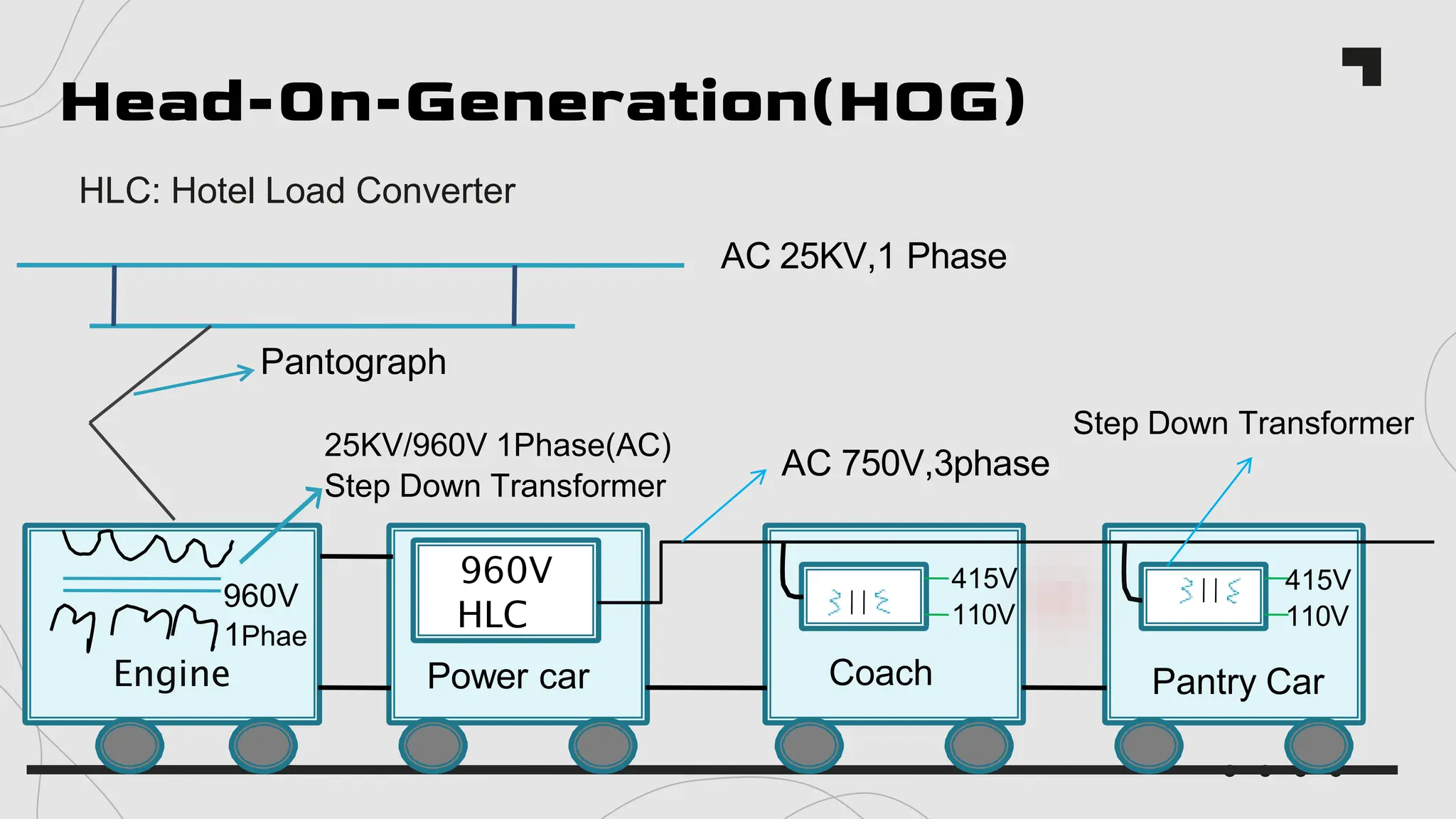
Head-0n-Generation(HOG)
Power car
960V
HLC
Coach
415V
110V
415V
110V
Pantry Car
Step Down Transformer
AC 750V,3phase
960V
1Phae
Engine
Pantograph
AC 25KV,1 Phase
HLC: Hotel Load Converter
25KV/960V 1Phase(AC)
Step Down Transformer
Head-0n-Generation(HOG)
 Power is supplied from the train
locomotive at the head of the train.
 The single phase 25 kV transformer.
 The electric locomotive is provided with
hotel load converter.
 The Hotel Load Converter is converted
to three phase AC At 750V using
2x500 KVA inverter.
 This is the most efficient system as
the cost of power is about 25% less
as compared to EOG.
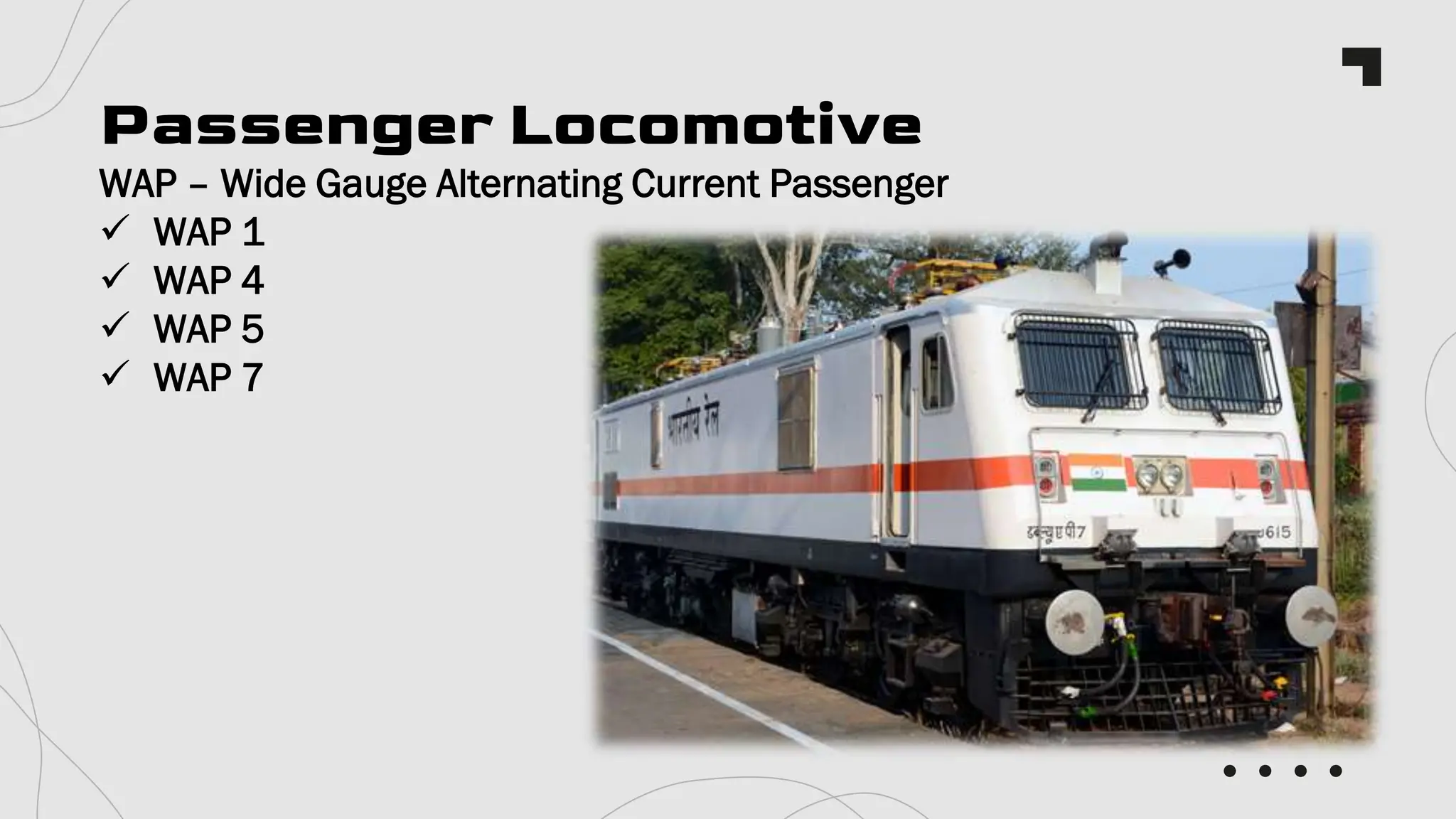
Passenger Locomotive
WAP – Wide Gauge Alternating Current Passenger
 WAP 1
 WAP 4
 WAP 5
 WAP 7
Cost Comparison
 Average cost of electricity Per Unit = Rs 7 Per Unit
 Cost of energy for HOG = Rs 7 to 8 Per Unit
 Cost of energy for SG = Rs 10 to 12 Per Unit
 Cost of Energy for EOG = Rs 25 to 26 Per Unit
ThankYou!

LHB Coache & Train Lighting.pptx

  • 1.
    Presentation On LHB Coach &Train Lighting PRESENTED TO:-  Dr. Mohd. Ahmed  Dr. Archana Sharma Department of Electrical Engineering PRESENTED BY:-  ASIF JAMAL(2007350200021)  HARSH KUMAR GOND(2007350200031) 4th Year Electrical Engineering
  • 2.
  • 3.
     Contents…  Introduction Coaches  Types of Coaches  Features of Coaches  How its benefits the Railway  Train Lighting  Cost Comparison  Conclusion
  • 4.
     Introduction…  Indianrailways is 4th largest railway network having route length of 68,043 kms.  Over 12,000 trains carries over 30 million passengers and 2.8 millions tones of freight daily.  Word’s largest enterprise with 1.5 million employees. 1) United States 2) China 3) Russia 4) India
  • 5.
     COACHES… A passengercar (known as coach or carriage in the UK, and also known as a bogie in India) is a piece of railway rolling stock that is designed to carry passengers. The term passenger car can also be associated with a sleeping car, baggage, dining, railway post office and prisoner transport cars.
  • 6.
     Types OfCoaches … ICF Coaches (Integral Coach Factory) LHB Coaches (Linke Hofmann Busch)
  • 7.
     ICF Coaches… Builtat Integral Coach Factory (ICF) is a manufacturer of rail coaches located in Perambur, Chennai, Tamil Nadu, India. It was established in 1955. Modern Coach Factory at Raebareli Rail Coach Factory at Kapurthala Marathwada Rail Coach Factory at Latur Rail Coach Naveenikaran Karkhana at Sonipat.  ICF coach costs between ₹ 80 Lakh to ₹1.5 Crore.
  • 8.
     LHB Coaches… LHB coach costs between ₹ 1.5 Crore to ₹2.0 crore.  The power car which houses a generator costs about 3 crore .  Built at 1. Rail Coach Factory, Kapurthala 2. Integral Coach Factory, Chennai 3. Modern Coach Factory, Raebareli
  • 9.
     Features ofLHB Coach…  No. Of Passengers - 78 (Chair car) - 56 (Ex. Chair car)  Corrosion Free Coach Use of superior materials with longer life.  Longer Coach LHB coaches are approximately 2-meters longer than the conventional ICF type coaches. This means “more travel space” “increased seating capacity”, “wider bays and doorways” etc.
  • 10.
    Speed Potential LHBCoach ICF Coach Test speed 180 kmph 160 kmph Service Speed 160 kmph 140 kmph Oil Leakage Problem No Very high  Features of LHB Coach…  No major changes required for 200 kmph  Speed
  • 11.
     Features ofLHB Coach…  Light Weight Coach Weight of LHB coach is approximately “10%” lesser than the conventional coach.  Higher passenger comfort  Auto Closing Sliding Doors  Wider Windows  Superior Shell and furnishing Design  Improved Air Conditioning System  Use of Fire Retardant Materials
  • 12.
     How ItBenefits Railways… Lesser maintenance:  Superior braking with Wheel slide protection (WSP) system based on microprocessor if the variation of speed of wheel of a Coach is more than 10 kmph. Brakes of the particular coach are released automatically by microprocessor unit till it is again reset. It protects the brake binding of the Coach.  Bogie with less moving parts.  Items of wear & tear shall not require replacement/renewal before 10 Lakh km.  Use of stainless steel and less bogie moving parts shall reduce maintenance requirements.  Entrance doors flush with side wall allowing automatic car washing.
  • 13.
  • 14.
     Self-Generation(SG)  Mid-on-Generation(MOG) End-on-Generation(EOG)  Head-on-Generation(HOG)  Types of Generation…
  • 15.
    Self Generation System(SG) 2×25 kW alternators for AC coach. 1×4.5 kW for non-AC coach. 110V DC Battery.  The voltage of the alternator which varies with the speed of the train is regulated with the help of RRU and converted to 110 V DC and is used for charging the battery.  2x25 kVA, 110 V dc/415 V inverters for AC load.  110 V DC Supply for lights and fans.  Axle driven system working on 24V DC/ 110 V DC
  • 16.
    Self Generation(SG) 4.5 kWNon AC Coach Alternator 25 kWAC Coach Alternator
  • 17.
    Self Generation(SG) RRU -Rectifier Cum Regulator Unit
  • 18.
    Disadvantages  The electricalload of the coach is restricted by the limitation of the capacity of generation i.e. 2*25 kW per coach at present.  The power is not generated during standing or slow movement of the train, therefore bulky batteries are provided.  There is no standby source for alternator and batteries, so system became poor reliability.  The system requires the extensive maintenance of alternator, batteries, belts, tensioning device etc. •  The system has the very poor efficiency of 57%for power it receives from the locomotive
  • 19.
    End-on-Generation(EOG) DG Set :-Diesel Generator set Engine Power car DG SET Coach 415V 110V 415V 110V Pantry Car Step Down Transformer AC 750V,3 Phase
  • 20.
     EOG systemis followed for fully air conditioned & Premium special trains. Example- Rajdhani ,Shatabdi, Duranto, Garib Rath.  Two power cars each equipped with 2×750 kVA DG sets. DG set power supply :- i) 415V for AC coaches ii) 110V for Non-AC End-on-Generation(EOG) Disadvantages:  The cost of energy is high due to fuel cost.  Even with 750V, 3 phase, there is still an effect of voltage drop at the farthest end of the train.  Noise and smoke pollution are generated from power cars.
  • 21.
  • 22.
    Mid-on-Generation(MOG) MOG with 415V,3 phase generation, and 110V AC utilization. The 110 V AC supplied to the coaches through couplers The power car coach had two DA set of 30 KVA each out of which one was used as standby. These trains had one power car in the middle of the train, which fed power supply to the coaches at either side of power car. The MOG system was used in slow-moving passenger trains. Example EMU(Electric Multiple Unit) & DMU(Diesel Multiple Unit).
  • 23.
    Head-0n-Generation(HOG) Power car 960V HLC Coach 415V 110V 415V 110V Pantry Car StepDown Transformer AC 750V,3phase 960V 1Phae Engine Pantograph AC 25KV,1 Phase HLC: Hotel Load Converter 25KV/960V 1Phase(AC) Step Down Transformer
  • 24.
    Head-0n-Generation(HOG)  Power issupplied from the train locomotive at the head of the train.  The single phase 25 kV transformer.  The electric locomotive is provided with hotel load converter.  The Hotel Load Converter is converted to three phase AC At 750V using 2x500 KVA inverter.  This is the most efficient system as the cost of power is about 25% less as compared to EOG.
  • 25.
    Passenger Locomotive WAP –Wide Gauge Alternating Current Passenger  WAP 1  WAP 4  WAP 5  WAP 7
  • 26.
    Cost Comparison  Averagecost of electricity Per Unit = Rs 7 Per Unit  Cost of energy for HOG = Rs 7 to 8 Per Unit  Cost of energy for SG = Rs 10 to 12 Per Unit  Cost of Energy for EOG = Rs 25 to 26 Per Unit
  • 27.