SUMMER TRAINING REPORT
ELECTRIC LOCO SHED-KANPUR
Submitted By- SHIVESHRANJAN
Department of Mechanical Engineering
Hindustan College of Science and Technology
Duration – 24/6/19 to 24/7/19
TABLE OF CONTENT
1. ACKNOWLEDGMENT
2.Loco Shed Introduction
3.Loco Shed Kanpur Established
4.Syntax Used
5.DifferentEquipment in an Electrical Locomotive
6.LOCOS AND THERE MAINTAINCE
7.Introduction Air compressor
8.Classificationof air compressor
9.Case Study: Air Compressorin Locomotives
10. Conclusion
ACKNOWLEDGMENT
We are thankful to the workshop "LOCO SHED KANPUR"
for providing necessary facility to carry out our training
successfully. It is our duty to record our sincere thanks
and gratitude towards the institute staff, who helped us
in bringing this project to its present form. The valuable
guidance and interest taken by them has been a
motivator and source of inspiration for us to carry out
the necessary proceedings for the project to be
completed successfully.
"ELECTRIC LOCOMOTIVE SHED KANPUR"
WHAT IS LOCO SHED?
Loco is the engine of the locomotives.
Loco Shed is the place where the maintenance
of the
Locos have to be done.
There are two types of loco sheds i.e.
1) Electric Loco Shed
2) Diesel Loco Shed
1) Electric Loco Shed, Erode is one of the premiere engine
sheds located in Erode in the Indian state of Tamil Nadu. It is
located along the Jolarpettai-Shoranur line, about 1 km to the east
of Erode Junction, under the administrative control of Salem
railway division of Southern Railway Zone.
2) Diesel Loco Shed Diesel Loco Shed, Erode is an engine
shed located on Erode–Chennimalai road in Erode, Tamil
Nadu, India. Being closely located to Erode Junction railway
station, the shed falls under Salem railway division of Southern
Railway zone
OPERATION OF LOCOMOTIVE
The 25KV AC supply is drawn from overhead catenaries
wires. The supply from overhead wires are drawn
through a pantograph inside the loco transformer. This
transformer is an autotransformer from which regulated
voltage is taken to a rectifier block for conversion from
AC to DC .It may be worth mentioning that the final
tractive effort is through DC traction motor hence AC is
required to be converted to DC. The DC current from
rectifier block is then filtered to pure DC and then fed to
traction motor. There are 6 traction motors which works
parallel to provide the attractive effort for hauling the
train. All the operations are controlled through control
circuit which works at 110 volt DC. Various power
equipment’s during operation gets heated up and hence
to cool the same, it is done by various blowers. The
electric locomotive basically works at 25 KV, 50Hz supply.
LOCO SHED KANPUR Established
The Electric Loco Shed, Kanpur was established
in 1965 with the Electrification of Mughal Sarai-
Kanpur section.
The shed has started functioning with a
meager holding of 11 imported WAM-1 type
locomotives for Passenger services
Present holding of the shed is 204 locomotives
(48-WAP4, 153-WAG7 & 3-WAM4).
Electric Loco Shed, Kanpur is known for its
glorious history in past & has been year marked
as front liner for other sheds too. Presently,
204 locomotives of shed are being innovatively
maintained by administrative officers,
supervisor and staff.
SYNTAX USED
WAP-4
W = Broad Gauge
A = AC Traction Motor
P = Passengers
4 = For 4000 Horsepower
Different Equipmentin an Electrical
Locomotive
1) Pantograph 20) Earth Fault Relay
2) Asynchronous Motor 21) Grid
3) Axle Brush 22) Wheel Spin Relay (WSR)
4) Ground Relay 23) Tap Changer
5) GTO Thyristor 24) IGBT
6) Balancing Speed 25) Inverter
7) Battery 26) Jerk Limit
8) Bucholz Relay 27) Dynamic Braking
9) Camshaft 28) Master Controller Motor
10) Cannon Box 29) Notching Relay
11) Chopper Control 30) No-Volt Relay
12) Circuit Breaker 31) Overload Relay
13) Contactor 32) Rectifier
14) Contactor 33) RelayRésistance Control SEPEX
15) Cooling Fans 35) Synchronous Motor
16) Creep Control 34) Shoe gear
17) DC Link 35) Synchronous Motor
18) Transformer
19) Wheel Spin
Figure Different Equipment in an Electrical Locomotive
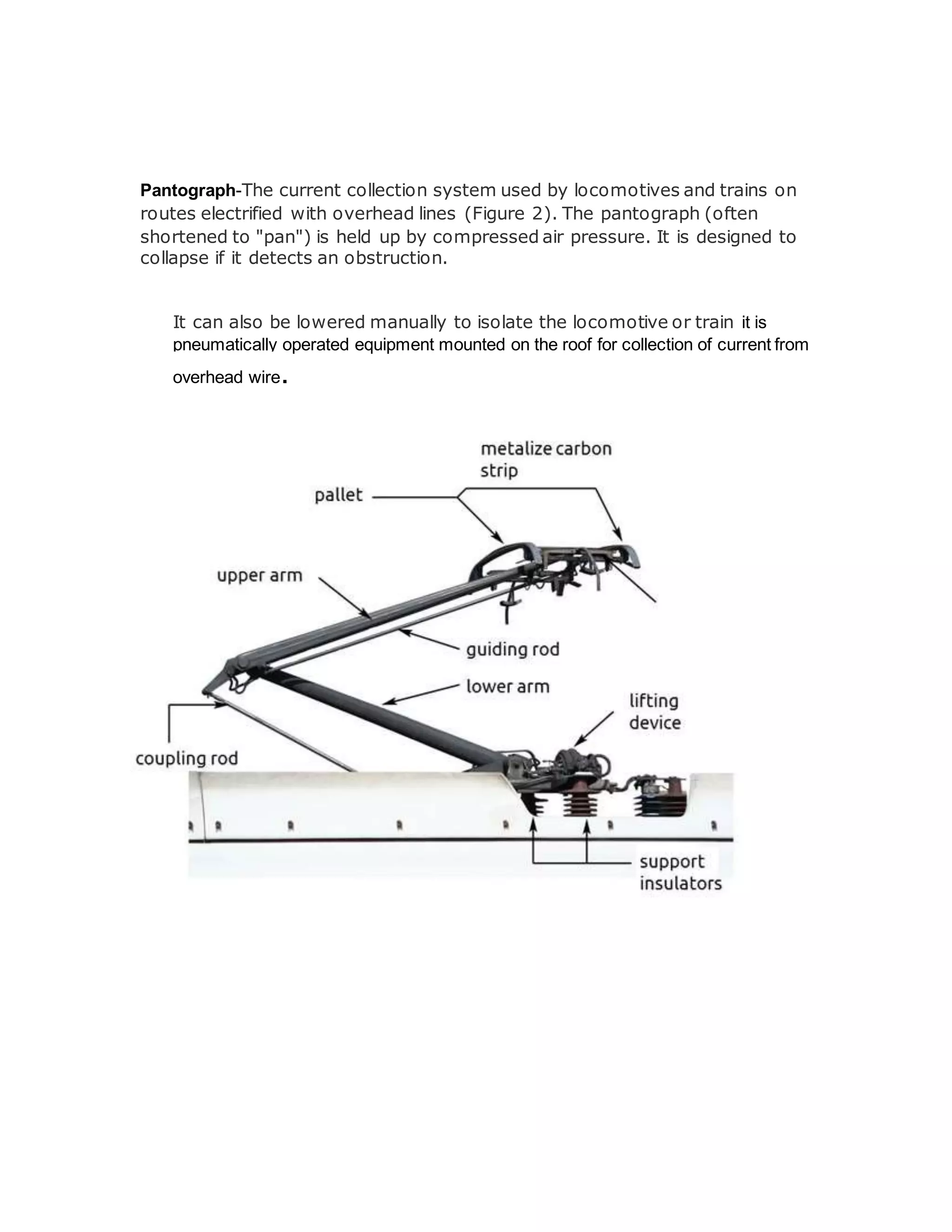
Pantograph-The current collection system used by locomotives and trains on
routes electrified with overhead lines (Figure 2). The pantograph (often
shortened to "pan") is held up by compressed air pressure. It is designed to
collapse if it detects an obstruction.
It can also be lowered manually to isolate the locomotive or train it is
pneumatically operated equipment mounted on the roof for collection of current from
overhead wire.
2)Asynchronous Motor:- Modern traction motor type using three phase AC
electrical supply and now the favored design for modern train traction
systems. It can be used on DC and AC electrified railways with suitable
control electronics and on diesel-electric locomotives.
Axle Brush
The means by which the power supply circuit is completed with the substation
once power has been drawn on the locomotive. Current collected from the
overhead line or third rail is returned via the axle brush and one of the running
rails.
Balancing Speed
The economical service speed at which the tractive effort of the train equals
the train resistance and no further acceleration takes place.
Battery
All trains are provided with a battery to provide start up current and for
supplying essential circuits, such as emergency lighting, when the line supply
fails. The battery is usually connected across the DC control supply circuit.
Bucholz Relay
A device inserted in the oil cooling circuits of electric locomotive transformers
to detect low oil pressure. If low oil pressure is detected, the relay trips out
the power system. Often a source of spurious circuit breaker trips if not
carefully calibrated.
Camshaft
Most DC electric traction power circuits use a camshaft to open or close the
contactors controlling the resistances of the traction motor power circuit. The
camshaft is driven by an electric motor or pneumatic cylinder. The cams on
the shaft are arranged to ensure that the contactors open and close in the
correct sequence. It is controlled by commands from the driver's cab and
regulated by the fall of current in the motor circuit as each section of
resistance is cut out in steps. The sound of this camshaft stepping can be
heard under many older (pre electronics) trains as they accelerate. See
also Notching Relay.
Cannon Box
Sleeve used to mount a traction motor on an axle in electric power bogies and
sometimes including an axle brush.
Chopper Control
A development in electric traction control which eliminates the need for power
resistors by causing the voltage to the traction motors to be switched on and
off (chopped) very rapidly during acceleration. It is accomplished by the use
of thyristors and will give up to 20% improvement in efficiency over
conventional resistance control.
Circuit Breaker
An electric train is almost always provided with some sort of circuit breaker to
isolate the power supply when there is a fault, or for maintenance. On AC
systems they are usually on the roof near the pantograph. There are two types
- the air blast circuit breaker and the vacuum circuit breaker or VCB. The air
or vacuum part is used to extinguish the arc which occurs as the two tips of
the circuit breaker are opened. The VCB is popular in the UK and the air blast
circuit breaker is more often seen on the continent of Europe.
Contactor
Similar to a relay in that it is a remotely operated switch used to control a
higher power local circuit. The difference is that contactors normally latch or
lock closed and have to be opened by a separate action. A lighting contactor
will have two, low voltage operating coils, one to "set" the contactor closed to
switch on the lights; the other to "trip" off the lights.
Converter
Generic term for any solid state electronic system for converting alternating
current to direct current or vice versa. Where an AC supply has to be converted
to DC it is called a rectifier and where DC is converted to AC it is called an
inverter. The word originated in the US but is now common elsewhere.
Cooling Fans
To keep the thyristors and other electronic power systems cool, the interior of
a modern locomotive is equipped with an air management system,
electronically controlled to keep all systems operating at the correct
temperature. The fans are powered by an auxiliary inverter producing 3-phase
AC at about 400 volts.
Creep Control
A form of electronically monitored acceleration control used very effectively
on some modern drive systems which permits a certain degree of wheel slip
to develop under maximum power application. A locomotive can develop
maximum slow speed tractive effort if its wheels are turning between 5% and
15% faster than actually required by the train speed.
DC Link
Used on modern electronic power systems between the single phase rectifier
and the 3-phase inverter. It is easier to convert the single phase AC from the
overhead line to the 3-phase required for the motors by rectifying it to DC and
then inverting the DC to 3-phase AC.
Dynamic Braking
A train braking system using the traction motors of the power vehicle(s) to
act as generators which provide the braking effort. The power generated
during braking is dissipated either as heat through on-board resistors
(rheostatic braking) or by return to the traction supply line (regenerative
braking). Most regenerative systems include on board resistors to allow
rheostatic braking if the traction supply system is not receptive.
Earth Fault Relay
The earth fault relay is basically a protection device used selectively for earth
fault protection. These can be used for both primary and backup protection in an
electrical system. These are used everywhere from Transformers, MCCBS, ACBs,
motors etc.
Grid Train or locomotive mounted expanded steel resistor used to absorb
excess electrical energy during motor or braking power control. Often seen
on the roofs of diesel electric locomotives where they are used to dissipate
heat during dynamic braking.
Ground Relay
An electrical relay provided in diesel and electric traction systems to protect
the equipment against damage from earths and so-called "grounds". The
result of such a relay operating is usually a shut-down of the electrical drive.
Also sometimes called an Earth Fault Relay.
GTO Thermistor
Gate Turn Off thyristor, a thyristor which does not require a commutation
(reverse flow circuit) circuit to switch it off. See Thyristor (below)
IGBT
Most recent power electronics development. It is replacing the GTO thyristor
as it is smaller and requires less current to operate the switching
sequences. See Transistor upon which the technology is based.
Inverter
Electronic power device mounted on trains to provide alternating current from
direct current. Popular nowadays for DC railways to allow three phase drive
or for auxiliary supplies which need an AC supply. See also converter with
which it is often confused.
Jerk Limit
A means by which starting is smoothed by adjusting the rate of acceleration
of a train by limiting the initial acceleration rate upon starting. It could be
described as limiting the initial rate of change of acceleration. Also used in
dynamic braking.
Line Breaker
Electro-mechanical switch in a traction motor power circuit used to activate or
disable the circuit. It is normally closed to start the train and remains closed
all the time power is required. It is opened by a command from the driving
controller, no-volts detected, overload detected and (were required) wheel
spin or slide detected. It is linked to the overload and no-volt control circuits
so that it actually functions as a protective circuit breaker.
Master Controller
Driver's power control device located in the cab. The driver moves the handle
of the master controller to apply or reduce power to the locomotive or train.
Modern systems often have controllers that incorporate braking.
Motor Blowers
Traction motors on electric locomotives get very hot and, to keep their
temperature at a reasonable level for long periods of hard work, they are
usually fitted with electric fans called motor blowers. On a modern
locomotive, they are powered by an auxiliary 3-phase AC supply of around
400 volts supplied by an auxiliary inverter.
Notching Relay
A DC motor power circuit relay which detects the rise and fall of current in the
circuit and inhibits the operation of the resistance contactors during the
acceleration sequence of automatically controlled motors. The relay operates
a contactor stepping circuit so that, during acceleration of the motor,
No-Volt Relay
A power circuit relay which detected if power was lost for any reason and
made sure that the control sequence was returned to the starting point before
power could be re-applied.
Overload Relay
A power circuit relay which detected excessive current in the circuit and
switched off the power to avoid damage to the motors. See Motor
Protection above.
LOCOS AND THERE MAINTAINCE
3-Phase Loco
Coaching Locos - WAP5/WAP7 locos
Introduction Air Compressor
 An air compressor is a mechanical device that increases the pressureof air
by reducing volume.
 The compressor fitted on AC electric locomotives supplies compressed air
for operation of air brakes, VCB, SMGR(in conventional loco), horns, wipers
and other pneumatically controlled equipment.
 Itis a reciprocating, three cylinders, two stages, and air-cooled compressor
driven by an induction motor.
 Air is compressible, the compressor reduces thevolume of air and induces
pressurein the air
 An air compressor converts electricalenergy into kinetic energy in the form
of the air
Air compressor
 An air compressor is a device that converts power (using an electric
motor, dieselor gasoline engine, etc.) into potential energy stored in
pressurized air (i.e., compressedair). By one of several methods,an
air compressorforces more and more air into a storage tank,
increasing the pressure. Whentank pressure reaches its engineered
upper limit, the air compressorshuts off.The compressed air, then, is
held in the tank until called into use.[1]
The energy contained in the
compressed air can be used for a variety of applications, utilizing the
kinetic energy of the air as it is released and the tank depressurizes.
When tank pressure reaches its lower limit, the air compressorturns
on again and re-pressurizes the tank.
 The air compressor is required to provide a constant supply
of compressed air for the locomotive and train brakes. In
the US, it is standard practice to drive the compressor off
the diesel engine drive shaft.
 In the UK, the compressor is usually electrically driven and
can therefore be mounted anywhere.
 The Class 60 compressor is under the frame, whereas the
Class 37 has the compressors in the nose.
 It deals with the study of behavior & application of compressed
air
 A basic pneumatic system consist of a source of compressed air,
control valves, pipelines & pipe fittings and pneumatic accessories
like filter, regulator and lubricator
Air compressor
Classification of air compressor
Compressors can be classified according to the pressure
delivered:
1. Low-pressure air compressors (LPACs), which have a
discharge pressure of 150 psi or less
2. Medium-pressure compressors which have a discharge
pressure of 151 psi to 1,000 psi
3. High-pressure air compressors (HPACs), which have a
discharge pressure above 1,000 psi
They can also be classified according to the design and principle
of operation:
1. Single-stage reciprocating compressor
2. Two-stage reciprocating compressor
3. Compound compressor
4. Rotary-screw compressor
5. Rotary vane pump
6. Scroll compressor
7. Turbo compressor
8. Centrifugal compressor
There are various methods of air compression, divided into two
category
1) Positive displacement
2) Dynamic displacement
Positive displacement: - Positive-displacement compressors
work by forcing air in a chamber whose volume is decreased to
compress the air. Once the maximum pressure is reached, a port
or valve opens and air is discharged into the outlet system from
the compression chamber. Common types of positive
displacement compressors are
Piston-type: air compressors use this principle by pumping air into
an air chamber through the use of the constant motion of pistons.
They use one-way valves to guide air into and out of a chamber
whose base consists of a moving piston. When the piston is on its
down stroke, it draws air into the chamber. When it’s up stroke,
the charge of air is forced out and into a storage tank. Piston
compressors generally fall into two basic categories, single-stage
and two-stage. Single stage compressors usually fall into the
fractional through 5 horsepower range. Two-stage compressors
normally fall into the 5 through 30 horsepower range. Two-stage
compressors provide greater efficiency than their single-stage
counterparts. For this reason, these compressors are the most
common units within the small business community. The
capacities for both single-stage and two-stage compressors is
generally provided in horsepower (HP), Standard Cubic feet per
Minute (SCFM)* and Pounds per Square Inch (PSI). *To a lesser
extent, some compressors are rated in Actual Cubic Feet per
Minute (ACFM). Still others are rated in Cubic Feet per
Minute (CFM). Using CFM to rate a compressor is incorrect
because it represents a flow rate that is independent of a
pressure reference. I.e. 20 CFM at 60 PSI.
 Rotary screw compressors: use positive-displacement
compression by matching two helical screws that, when turned,
guide air into a chamber, whose volume is decreased as the
screws turn.
 Vane compressors: use a slotted rotor with varied blade
placement to guide air into a chamber and compress the
volume. This type of compressor delivers a fixed volume of air
at high pressures.
3) Dynamic displacement: - Dynamic displacement air
compressors include centrifugal compressors and axial
compressors. In these types, a rotating component
imparts its kinetic energy to the air which is eventually
converted into pressure energy. These use centrifugal
force generated by a spinning impeller to accelerate
and then decelerate captured air, which pressurizes it.
Rather than physically reducing the volume of a
captured pocket of air, dynamic displacement
compressors instead speed up the air to high velocity,
and then restrict the air flow so that the reduction in
velocity causes pressure to increase. They are oil-free
by nature, and some are oil-less.
Dynamic compressors include axial and centrifugal
types.
1) Axial Compressors: - Axial compressors use a series of turbine
blades, similar in appearance to a jet engine, to force air into a
smaller and smaller area. These compressors are not
commonly used in industry.
2) Centrifugal compressor: -Centrifugal compressors,
sometimes called radial compressors, are a sub-class of dynamic
axisymmetric work-absorbing turbomachinery.[1]
They achieve a pressure rise by adding kinetic energy/velocity to
a continuous flow of fluid through the rotor or impeller. This kinetic
energy is then converted to an increase in potential energy/static
pressure by slowing the flow through a diffuser. The pressure rise
in the impeller is in most cases almost equal to the rise in the
diffuser. In the case where flow passes through a straight pipe to
enter a centrifugal compressor the flow is straight, uniform and
has no vorticity, ie swirling motion, so the swirl angle α1 = 0° as
illustrated. As the flow passes through the centrifugal impeller, the
impeller forces the flow to spin faster as it gets further from the
rotational axis. According to a form of Euler's fluid dynamics
equation, known as the pump and turbine equation, the energy
input to the fluid is proportional to the flow's local spinning velocity
multiplied by the local impeller tangential velocity.
In many cases, the flow leaving the centrifugal impeller is
travelling near the speed of sound. It then flows through a
stationary compressor causing it to decelerate. The stationary
compressor is ducting with increasing flow-area where energy
transformation takes place. If the flow has to be turned in a
rearward direction to enter the next part of the machine, eg
another impeller or a combustor, flow losses can be reduced by
directing the flow with stationary turning vanes or individual
turning pipes (pipe diffusers). As described in Bernoulli's principle,
the reduction in velocity causes the pressure to rise.
Centrifugal compressors are also similar to centrifugal fans of the
style shown in neighboring figure as they both increase the flows
energy through increasing radius.[1]
In contrast to centrifugal fans,
compressors operate at higher speeds to generate greater
pressure rises. In many cases the engineering methods used to
design a centrifugal fan are the same as those to design a
centrifugal compressor, so they can look very similar.
This relationship is less true in comparison to the squirrel-cage
fan shown in the accompanying figure.
For purposes of generalization and definition, it can be said that
centrifugal compressors often have density increases greater than
5 percent. Also, they often experience relative fluid velocities
above Mach number 0.3. When the working fluid is air or nitrogen.
In contrast, fans or blowers are often considered to have density
increases of less than five percent and peak relative fluid
velocities below Mach 0.3.
Case Study: Air Compressor in Locomotives
Problem
A locomotive air compressor was identified with a sudden jump in iron
in the oil sample by the Techonomic oil analysis team. The trending was
shown as a sudden increase in iron to 110 ppm that exceeded the high
end alarm level.
Locomotive Compressor- Iron in Oil Results
Solution
Based on oil analysis results and failure analysis recommendations
provided by Techonomic the client was advised to undertake an internal
compressor inspection. This request was followed by a second sample
five weeks later which showed a further jump in iron to 394 ppm and the
client again was urgently advised to carry out a best practice inspection
on the compressor.
Nearly a month later a third compressor oil sample was taken that
demonstrated an increase in the iron to 1414 ppm, a quadruple increase
over the previous sample. Based on the oil analysis results Techonomic
once again advised the client that an urgent inspection of the compressor
needed to be completed.
Outcome
The compressor was inspected and a metal in the sump was discovered
and as a result the compressor was changed.
Ongoing oil samples by Techonomic will provide information from the
beginning of the life cycle of the replacement compressor.
Advantages of Oil Analysis identifying Air Compressor Wear –
 Can able to service/Replace the Compressor under OEM warranty
 Avoid catastrophic compressor failure.
 Early detection of air compressor wear through oil analysis is vital in
preventing engine failures.
Conclusion
Ongoing oil analysis provides a mechanism for predictive maintenance
which will provide early warning of potential problems and prevent
costly engine failure. This incident also emphasizes the importance of a
timely response to requests for post oil analysis inspections for fuel or
metal wear changes within an engine or compressor.
It only takes the saving of one or two engine/Compressor failures to
underwrite the cost of the oil analysis programme.

SUMMER TRAINNING REPORT ELECTRIC LOCOSHED KANPUR

  • 1.
    SUMMER TRAINING REPORT ELECTRICLOCO SHED-KANPUR Submitted By- SHIVESHRANJAN Department of Mechanical Engineering Hindustan College of Science and Technology Duration – 24/6/19 to 24/7/19
  • 2.
    TABLE OF CONTENT 1.ACKNOWLEDGMENT 2.Loco Shed Introduction 3.Loco Shed Kanpur Established 4.Syntax Used 5.DifferentEquipment in an Electrical Locomotive 6.LOCOS AND THERE MAINTAINCE 7.Introduction Air compressor 8.Classificationof air compressor 9.Case Study: Air Compressorin Locomotives 10. Conclusion
  • 3.
    ACKNOWLEDGMENT We are thankfulto the workshop "LOCO SHED KANPUR" for providing necessary facility to carry out our training successfully. It is our duty to record our sincere thanks and gratitude towards the institute staff, who helped us in bringing this project to its present form. The valuable guidance and interest taken by them has been a motivator and source of inspiration for us to carry out the necessary proceedings for the project to be completed successfully. "ELECTRIC LOCOMOTIVE SHED KANPUR"
  • 4.
    WHAT IS LOCOSHED? Loco is the engine of the locomotives. Loco Shed is the place where the maintenance of the Locos have to be done. There are two types of loco sheds i.e. 1) Electric Loco Shed 2) Diesel Loco Shed 1) Electric Loco Shed, Erode is one of the premiere engine sheds located in Erode in the Indian state of Tamil Nadu. It is located along the Jolarpettai-Shoranur line, about 1 km to the east of Erode Junction, under the administrative control of Salem railway division of Southern Railway Zone. 2) Diesel Loco Shed Diesel Loco Shed, Erode is an engine shed located on Erode–Chennimalai road in Erode, Tamil Nadu, India. Being closely located to Erode Junction railway
  • 5.
    station, the shedfalls under Salem railway division of Southern Railway zone OPERATION OF LOCOMOTIVE The 25KV AC supply is drawn from overhead catenaries wires. The supply from overhead wires are drawn through a pantograph inside the loco transformer. This transformer is an autotransformer from which regulated voltage is taken to a rectifier block for conversion from AC to DC .It may be worth mentioning that the final tractive effort is through DC traction motor hence AC is required to be converted to DC. The DC current from rectifier block is then filtered to pure DC and then fed to traction motor. There are 6 traction motors which works parallel to provide the attractive effort for hauling the train. All the operations are controlled through control circuit which works at 110 volt DC. Various power equipment’s during operation gets heated up and hence to cool the same, it is done by various blowers. The electric locomotive basically works at 25 KV, 50Hz supply.
  • 6.
    LOCO SHED KANPUREstablished The Electric Loco Shed, Kanpur was established in 1965 with the Electrification of Mughal Sarai- Kanpur section. The shed has started functioning with a meager holding of 11 imported WAM-1 type locomotives for Passenger services Present holding of the shed is 204 locomotives (48-WAP4, 153-WAG7 & 3-WAM4). Electric Loco Shed, Kanpur is known for its glorious history in past & has been year marked as front liner for other sheds too. Presently, 204 locomotives of shed are being innovatively maintained by administrative officers, supervisor and staff.
  • 7.
    SYNTAX USED WAP-4 W =Broad Gauge A = AC Traction Motor P = Passengers 4 = For 4000 Horsepower
  • 10.
    Different Equipmentin anElectrical Locomotive 1) Pantograph 20) Earth Fault Relay 2) Asynchronous Motor 21) Grid 3) Axle Brush 22) Wheel Spin Relay (WSR) 4) Ground Relay 23) Tap Changer 5) GTO Thyristor 24) IGBT 6) Balancing Speed 25) Inverter 7) Battery 26) Jerk Limit 8) Bucholz Relay 27) Dynamic Braking 9) Camshaft 28) Master Controller Motor 10) Cannon Box 29) Notching Relay 11) Chopper Control 30) No-Volt Relay 12) Circuit Breaker 31) Overload Relay 13) Contactor 32) Rectifier 14) Contactor 33) RelayRésistance Control SEPEX 15) Cooling Fans 35) Synchronous Motor 16) Creep Control 34) Shoe gear 17) DC Link 35) Synchronous Motor
  • 11.
    18) Transformer 19) WheelSpin Figure Different Equipment in an Electrical Locomotive
  • 12.
    Pantograph-The current collectionsystem used by locomotives and trains on routes electrified with overhead lines (Figure 2). The pantograph (often shortened to "pan") is held up by compressed air pressure. It is designed to collapse if it detects an obstruction. It can also be lowered manually to isolate the locomotive or train it is pneumatically operated equipment mounted on the roof for collection of current from overhead wire.
  • 13.
    2)Asynchronous Motor:- Moderntraction motor type using three phase AC electrical supply and now the favored design for modern train traction systems. It can be used on DC and AC electrified railways with suitable control electronics and on diesel-electric locomotives. Axle Brush The means by which the power supply circuit is completed with the substation once power has been drawn on the locomotive. Current collected from the overhead line or third rail is returned via the axle brush and one of the running rails. Balancing Speed
  • 14.
    The economical servicespeed at which the tractive effort of the train equals the train resistance and no further acceleration takes place. Battery All trains are provided with a battery to provide start up current and for supplying essential circuits, such as emergency lighting, when the line supply fails. The battery is usually connected across the DC control supply circuit. Bucholz Relay A device inserted in the oil cooling circuits of electric locomotive transformers to detect low oil pressure. If low oil pressure is detected, the relay trips out the power system. Often a source of spurious circuit breaker trips if not carefully calibrated. Camshaft Most DC electric traction power circuits use a camshaft to open or close the contactors controlling the resistances of the traction motor power circuit. The camshaft is driven by an electric motor or pneumatic cylinder. The cams on the shaft are arranged to ensure that the contactors open and close in the correct sequence. It is controlled by commands from the driver's cab and regulated by the fall of current in the motor circuit as each section of resistance is cut out in steps. The sound of this camshaft stepping can be heard under many older (pre electronics) trains as they accelerate. See also Notching Relay. Cannon Box Sleeve used to mount a traction motor on an axle in electric power bogies and sometimes including an axle brush. Chopper Control A development in electric traction control which eliminates the need for power resistors by causing the voltage to the traction motors to be switched on and
  • 15.
    off (chopped) veryrapidly during acceleration. It is accomplished by the use of thyristors and will give up to 20% improvement in efficiency over conventional resistance control. Circuit Breaker An electric train is almost always provided with some sort of circuit breaker to isolate the power supply when there is a fault, or for maintenance. On AC systems they are usually on the roof near the pantograph. There are two types - the air blast circuit breaker and the vacuum circuit breaker or VCB. The air or vacuum part is used to extinguish the arc which occurs as the two tips of the circuit breaker are opened. The VCB is popular in the UK and the air blast circuit breaker is more often seen on the continent of Europe. Contactor Similar to a relay in that it is a remotely operated switch used to control a higher power local circuit. The difference is that contactors normally latch or lock closed and have to be opened by a separate action. A lighting contactor will have two, low voltage operating coils, one to "set" the contactor closed to switch on the lights; the other to "trip" off the lights. Converter Generic term for any solid state electronic system for converting alternating current to direct current or vice versa. Where an AC supply has to be converted to DC it is called a rectifier and where DC is converted to AC it is called an inverter. The word originated in the US but is now common elsewhere. Cooling Fans To keep the thyristors and other electronic power systems cool, the interior of a modern locomotive is equipped with an air management system, electronically controlled to keep all systems operating at the correct temperature. The fans are powered by an auxiliary inverter producing 3-phase AC at about 400 volts.
  • 16.
    Creep Control A formof electronically monitored acceleration control used very effectively on some modern drive systems which permits a certain degree of wheel slip to develop under maximum power application. A locomotive can develop maximum slow speed tractive effort if its wheels are turning between 5% and 15% faster than actually required by the train speed. DC Link Used on modern electronic power systems between the single phase rectifier and the 3-phase inverter. It is easier to convert the single phase AC from the overhead line to the 3-phase required for the motors by rectifying it to DC and then inverting the DC to 3-phase AC. Dynamic Braking A train braking system using the traction motors of the power vehicle(s) to act as generators which provide the braking effort. The power generated during braking is dissipated either as heat through on-board resistors (rheostatic braking) or by return to the traction supply line (regenerative braking). Most regenerative systems include on board resistors to allow rheostatic braking if the traction supply system is not receptive. Earth Fault Relay The earth fault relay is basically a protection device used selectively for earth fault protection. These can be used for both primary and backup protection in an electrical system. These are used everywhere from Transformers, MCCBS, ACBs, motors etc. Grid Train or locomotive mounted expanded steel resistor used to absorb excess electrical energy during motor or braking power control. Often seen on the roofs of diesel electric locomotives where they are used to dissipate heat during dynamic braking.
  • 17.
    Ground Relay An electricalrelay provided in diesel and electric traction systems to protect the equipment against damage from earths and so-called "grounds". The result of such a relay operating is usually a shut-down of the electrical drive. Also sometimes called an Earth Fault Relay. GTO Thermistor Gate Turn Off thyristor, a thyristor which does not require a commutation (reverse flow circuit) circuit to switch it off. See Thyristor (below) IGBT Most recent power electronics development. It is replacing the GTO thyristor as it is smaller and requires less current to operate the switching sequences. See Transistor upon which the technology is based. Inverter Electronic power device mounted on trains to provide alternating current from direct current. Popular nowadays for DC railways to allow three phase drive or for auxiliary supplies which need an AC supply. See also converter with which it is often confused. Jerk Limit A means by which starting is smoothed by adjusting the rate of acceleration of a train by limiting the initial acceleration rate upon starting. It could be described as limiting the initial rate of change of acceleration. Also used in dynamic braking. Line Breaker Electro-mechanical switch in a traction motor power circuit used to activate or disable the circuit. It is normally closed to start the train and remains closed all the time power is required. It is opened by a command from the driving controller, no-volts detected, overload detected and (were required) wheel
  • 18.
    spin or slidedetected. It is linked to the overload and no-volt control circuits so that it actually functions as a protective circuit breaker. Master Controller Driver's power control device located in the cab. The driver moves the handle of the master controller to apply or reduce power to the locomotive or train. Modern systems often have controllers that incorporate braking. Motor Blowers Traction motors on electric locomotives get very hot and, to keep their temperature at a reasonable level for long periods of hard work, they are usually fitted with electric fans called motor blowers. On a modern locomotive, they are powered by an auxiliary 3-phase AC supply of around 400 volts supplied by an auxiliary inverter. Notching Relay A DC motor power circuit relay which detects the rise and fall of current in the circuit and inhibits the operation of the resistance contactors during the acceleration sequence of automatically controlled motors. The relay operates a contactor stepping circuit so that, during acceleration of the motor, No-Volt Relay A power circuit relay which detected if power was lost for any reason and made sure that the control sequence was returned to the starting point before power could be re-applied. Overload Relay A power circuit relay which detected excessive current in the circuit and switched off the power to avoid damage to the motors. See Motor Protection above.
  • 19.
    LOCOS AND THEREMAINTAINCE 3-Phase Loco Coaching Locos - WAP5/WAP7 locos
  • 21.
    Introduction Air Compressor An air compressor is a mechanical device that increases the pressureof air by reducing volume.  The compressor fitted on AC electric locomotives supplies compressed air for operation of air brakes, VCB, SMGR(in conventional loco), horns, wipers and other pneumatically controlled equipment.  Itis a reciprocating, three cylinders, two stages, and air-cooled compressor driven by an induction motor.  Air is compressible, the compressor reduces thevolume of air and induces pressurein the air  An air compressor converts electricalenergy into kinetic energy in the form of the air
  • 22.
    Air compressor  Anair compressor is a device that converts power (using an electric motor, dieselor gasoline engine, etc.) into potential energy stored in pressurized air (i.e., compressedair). By one of several methods,an air compressorforces more and more air into a storage tank, increasing the pressure. Whentank pressure reaches its engineered upper limit, the air compressorshuts off.The compressed air, then, is held in the tank until called into use.[1] The energy contained in the compressed air can be used for a variety of applications, utilizing the kinetic energy of the air as it is released and the tank depressurizes. When tank pressure reaches its lower limit, the air compressorturns on again and re-pressurizes the tank.  The air compressor is required to provide a constant supply of compressed air for the locomotive and train brakes. In the US, it is standard practice to drive the compressor off the diesel engine drive shaft.  In the UK, the compressor is usually electrically driven and can therefore be mounted anywhere.  The Class 60 compressor is under the frame, whereas the Class 37 has the compressors in the nose.  It deals with the study of behavior & application of compressed air  A basic pneumatic system consist of a source of compressed air, control valves, pipelines & pipe fittings and pneumatic accessories like filter, regulator and lubricator
  • 23.
    Air compressor Classification ofair compressor Compressors can be classified according to the pressure delivered: 1. Low-pressure air compressors (LPACs), which have a discharge pressure of 150 psi or less 2. Medium-pressure compressors which have a discharge pressure of 151 psi to 1,000 psi 3. High-pressure air compressors (HPACs), which have a discharge pressure above 1,000 psi
  • 24.
    They can alsobe classified according to the design and principle of operation: 1. Single-stage reciprocating compressor 2. Two-stage reciprocating compressor 3. Compound compressor 4. Rotary-screw compressor 5. Rotary vane pump 6. Scroll compressor 7. Turbo compressor 8. Centrifugal compressor There are various methods of air compression, divided into two category 1) Positive displacement 2) Dynamic displacement Positive displacement: - Positive-displacement compressors work by forcing air in a chamber whose volume is decreased to compress the air. Once the maximum pressure is reached, a port or valve opens and air is discharged into the outlet system from the compression chamber. Common types of positive displacement compressors are Piston-type: air compressors use this principle by pumping air into an air chamber through the use of the constant motion of pistons. They use one-way valves to guide air into and out of a chamber whose base consists of a moving piston. When the piston is on its down stroke, it draws air into the chamber. When it’s up stroke, the charge of air is forced out and into a storage tank. Piston compressors generally fall into two basic categories, single-stage and two-stage. Single stage compressors usually fall into the
  • 25.
    fractional through 5horsepower range. Two-stage compressors normally fall into the 5 through 30 horsepower range. Two-stage compressors provide greater efficiency than their single-stage counterparts. For this reason, these compressors are the most common units within the small business community. The capacities for both single-stage and two-stage compressors is generally provided in horsepower (HP), Standard Cubic feet per Minute (SCFM)* and Pounds per Square Inch (PSI). *To a lesser extent, some compressors are rated in Actual Cubic Feet per Minute (ACFM). Still others are rated in Cubic Feet per Minute (CFM). Using CFM to rate a compressor is incorrect because it represents a flow rate that is independent of a pressure reference. I.e. 20 CFM at 60 PSI.  Rotary screw compressors: use positive-displacement compression by matching two helical screws that, when turned, guide air into a chamber, whose volume is decreased as the screws turn.  Vane compressors: use a slotted rotor with varied blade placement to guide air into a chamber and compress the volume. This type of compressor delivers a fixed volume of air at high pressures.
  • 26.
    3) Dynamic displacement:- Dynamic displacement air compressors include centrifugal compressors and axial compressors. In these types, a rotating component imparts its kinetic energy to the air which is eventually converted into pressure energy. These use centrifugal force generated by a spinning impeller to accelerate and then decelerate captured air, which pressurizes it. Rather than physically reducing the volume of a captured pocket of air, dynamic displacement compressors instead speed up the air to high velocity, and then restrict the air flow so that the reduction in velocity causes pressure to increase. They are oil-free by nature, and some are oil-less. Dynamic compressors include axial and centrifugal types. 1) Axial Compressors: - Axial compressors use a series of turbine blades, similar in appearance to a jet engine, to force air into a smaller and smaller area. These compressors are not commonly used in industry.
  • 27.
    2) Centrifugal compressor:-Centrifugal compressors, sometimes called radial compressors, are a sub-class of dynamic axisymmetric work-absorbing turbomachinery.[1] They achieve a pressure rise by adding kinetic energy/velocity to a continuous flow of fluid through the rotor or impeller. This kinetic energy is then converted to an increase in potential energy/static pressure by slowing the flow through a diffuser. The pressure rise in the impeller is in most cases almost equal to the rise in the diffuser. In the case where flow passes through a straight pipe to enter a centrifugal compressor the flow is straight, uniform and has no vorticity, ie swirling motion, so the swirl angle α1 = 0° as illustrated. As the flow passes through the centrifugal impeller, the impeller forces the flow to spin faster as it gets further from the rotational axis. According to a form of Euler's fluid dynamics equation, known as the pump and turbine equation, the energy input to the fluid is proportional to the flow's local spinning velocity multiplied by the local impeller tangential velocity. In many cases, the flow leaving the centrifugal impeller is travelling near the speed of sound. It then flows through a stationary compressor causing it to decelerate. The stationary compressor is ducting with increasing flow-area where energy transformation takes place. If the flow has to be turned in a rearward direction to enter the next part of the machine, eg another impeller or a combustor, flow losses can be reduced by directing the flow with stationary turning vanes or individual turning pipes (pipe diffusers). As described in Bernoulli's principle,
  • 28.
    the reduction invelocity causes the pressure to rise. Centrifugal compressors are also similar to centrifugal fans of the style shown in neighboring figure as they both increase the flows energy through increasing radius.[1] In contrast to centrifugal fans, compressors operate at higher speeds to generate greater pressure rises. In many cases the engineering methods used to design a centrifugal fan are the same as those to design a centrifugal compressor, so they can look very similar. This relationship is less true in comparison to the squirrel-cage fan shown in the accompanying figure. For purposes of generalization and definition, it can be said that centrifugal compressors often have density increases greater than
  • 29.
    5 percent. Also,they often experience relative fluid velocities above Mach number 0.3. When the working fluid is air or nitrogen. In contrast, fans or blowers are often considered to have density increases of less than five percent and peak relative fluid velocities below Mach 0.3. Case Study: Air Compressor in Locomotives Problem A locomotive air compressor was identified with a sudden jump in iron in the oil sample by the Techonomic oil analysis team. The trending was shown as a sudden increase in iron to 110 ppm that exceeded the high end alarm level. Locomotive Compressor- Iron in Oil Results Solution Based on oil analysis results and failure analysis recommendations provided by Techonomic the client was advised to undertake an internal compressor inspection. This request was followed by a second sample five weeks later which showed a further jump in iron to 394 ppm and the client again was urgently advised to carry out a best practice inspection on the compressor. Nearly a month later a third compressor oil sample was taken that demonstrated an increase in the iron to 1414 ppm, a quadruple increase over the previous sample. Based on the oil analysis results Techonomic once again advised the client that an urgent inspection of the compressor needed to be completed. Outcome The compressor was inspected and a metal in the sump was discovered and as a result the compressor was changed. Ongoing oil samples by Techonomic will provide information from the beginning of the life cycle of the replacement compressor.
  • 30.
    Advantages of OilAnalysis identifying Air Compressor Wear –  Can able to service/Replace the Compressor under OEM warranty  Avoid catastrophic compressor failure.  Early detection of air compressor wear through oil analysis is vital in preventing engine failures. Conclusion Ongoing oil analysis provides a mechanism for predictive maintenance which will provide early warning of potential problems and prevent costly engine failure. This incident also emphasizes the importance of a timely response to requests for post oil analysis inspections for fuel or metal wear changes within an engine or compressor. It only takes the saving of one or two engine/Compressor failures to underwrite the cost of the oil analysis programme.