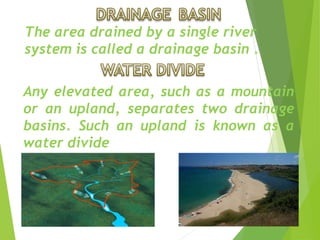
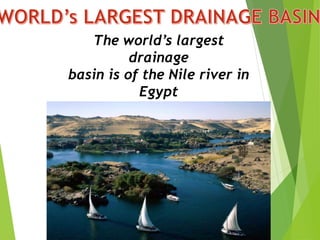
The area drained by a single river
system is called a drainage basin .
Any elevated area, such as a mountain
or an upland, separates two drainage
basins. Such an upland is known as a
water divide
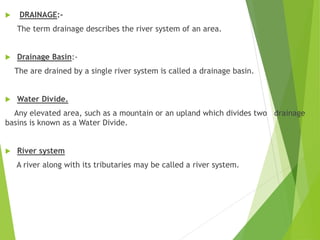
The world’s largest
drainage
basin is of the Nile river in
Egypt
 DRAINAGE:-
The term drainage describes the river system of an area.
 Drainage Basin:-
The are drained by a single river system is called a drainage basin.
 Water Divide.
Any elevated area, such as a mountain or an upland which divides two drainage
basins is known as a Water Divide.
 River system
A river along with its tributaries may be called a river system.
The streams within a drainage basin form certain patterns,
depending on the slope of land, underlying rock structure
as well as the climatic conditions of the area . These are
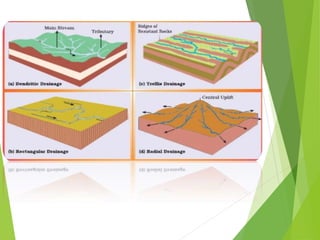
dendritic, trellis, rectangular, andradial patterns. The
dendritic pattern develops where the river channel follows
the slope of the terrain. The stream with its tributaries
resembles the branches of a tree, thus the name dendritic.
A river joined by its tributaries, at approximately right
angles, develops a trellis pattern. A trellis drainage pattern
develops where hard and soft rocks exist parallel to each
other. A rectangular drainage pattern develops on a strongly
jointed rocky terrain. The radial pattern develops when
streams flow in different directions from a central peak or
dome like structure. A combination of several patterns may
be found in the same drainage basin.
Drainage Patterns
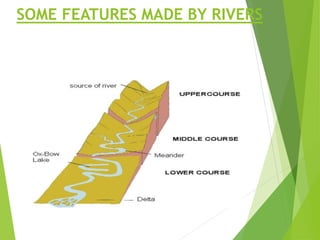
SOME FEATURES MADE BY RIVERS
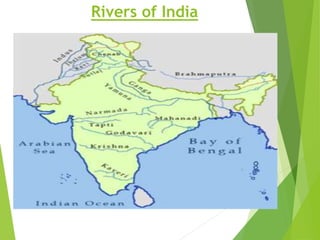
Rivers of India
TYPES OF RIVERS
 The drainage systems of India are mainly controlled by
the broad relief features of the subcontinents.
Accordingly, the Indian rivers are divided into two parts.
1. The Himalayan Rivers
2. The Peninsular rivers
 Rippling along rough surfaces and the beautiful
meadows, the numerous rivers that dot Indian
mainland are central to our history as well as to Indian
mythology. The main rivers of the Himalayas group are
the Indus, the Ganga and the Brahmaputra. These
rivers are both snow-fed and rain-fed and therefore
they are flow through so many year. Himalayan rivers
discharge about 70% of their inflow into the sea. This
includes about 5% from central Indian rivers. They
join the Ganga and drain into the Bay of Bengal
Himalayan Rivers
 Major Himalayan Rivers are
1. The Indus.
2. The Ganga.
3. The Brahmaputra.
The Himalayan rivers are long and are joined
by many large and important tributaries.
river along with its tributaries may be called
a river system
PENINSULAR RIVER
 The main water divide in Peninsular India is formed by
the Western Ghats, which runs from north to south close
to the western coast .Most of the major rivers of the
Peninsula such as the Mahanadi, the Godavari, the
Krishna and the Kaveri flow eastwards and drain into
the Bay of Bengal. These rivers make deltas at their
mouths. There are numerous small streams flowing west
of the Western Ghats .The Narmada and the Tapi are
the only long rivers, which flow west and make esturies
.The drainage basins of the peninsular rivers are
comparitevely small in size.
PENINSULAR RIVERS
THE MAJOR PENINSULAR RIVERS ARE:-
1. THE NARMADA.
2. THE TAPI.
3. THE GODAVARI.
4. THE MAHANADI.
5. THE KRISHNA.
6. THE KAVERI.
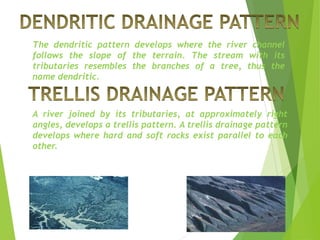
The dendritic pattern develops where the river channel
follows the slope of the terrain. The stream with its
tributaries resembles the branches of a tree, thus the
name dendritic.
A river joined by its tributaries, at approximately right
angles, develops a trellis pattern. A trellis drainage pattern
develops where hard and soft rocks exist parallel to each
other.
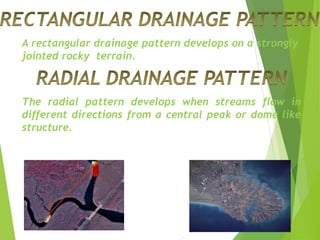
A rectangular drainage pattern develops on a strongly
jointed rocky terrain.
The radial pattern develops when streams flow in
different directions from a central peak or dome like
structure.
 Made by Abhinandan saini
 Class - 9th A
Abhi

Drainge

  • 3.
    The area drainedby a single river system is called a drainage basin . Any elevated area, such as a mountain or an upland, separates two drainage basins. Such an upland is known as a water divide
  • 4.
    The world’s largest drainage basinis of the Nile river in Egypt
  • 5.
     DRAINAGE:- The termdrainage describes the river system of an area.  Drainage Basin:- The are drained by a single river system is called a drainage basin.  Water Divide. Any elevated area, such as a mountain or an upland which divides two drainage basins is known as a Water Divide.  River system A river along with its tributaries may be called a river system.
  • 6.
    The streams withina drainage basin form certain patterns, depending on the slope of land, underlying rock structure as well as the climatic conditions of the area . These are dendritic, trellis, rectangular, andradial patterns. The dendritic pattern develops where the river channel follows the slope of the terrain. The stream with its tributaries resembles the branches of a tree, thus the name dendritic. A river joined by its tributaries, at approximately right angles, develops a trellis pattern. A trellis drainage pattern develops where hard and soft rocks exist parallel to each other. A rectangular drainage pattern develops on a strongly jointed rocky terrain. The radial pattern develops when streams flow in different directions from a central peak or dome like structure. A combination of several patterns may be found in the same drainage basin. Drainage Patterns
  • 8.
  • 9.
  • 10.
    TYPES OF RIVERS The drainage systems of India are mainly controlled by the broad relief features of the subcontinents. Accordingly, the Indian rivers are divided into two parts. 1. The Himalayan Rivers 2. The Peninsular rivers
  • 11.
     Rippling alongrough surfaces and the beautiful meadows, the numerous rivers that dot Indian mainland are central to our history as well as to Indian mythology. The main rivers of the Himalayas group are the Indus, the Ganga and the Brahmaputra. These rivers are both snow-fed and rain-fed and therefore they are flow through so many year. Himalayan rivers discharge about 70% of their inflow into the sea. This includes about 5% from central Indian rivers. They join the Ganga and drain into the Bay of Bengal
  • 12.
    Himalayan Rivers  MajorHimalayan Rivers are 1. The Indus. 2. The Ganga. 3. The Brahmaputra. The Himalayan rivers are long and are joined by many large and important tributaries. river along with its tributaries may be called a river system
  • 13.
    PENINSULAR RIVER  Themain water divide in Peninsular India is formed by the Western Ghats, which runs from north to south close to the western coast .Most of the major rivers of the Peninsula such as the Mahanadi, the Godavari, the Krishna and the Kaveri flow eastwards and drain into the Bay of Bengal. These rivers make deltas at their mouths. There are numerous small streams flowing west of the Western Ghats .The Narmada and the Tapi are the only long rivers, which flow west and make esturies .The drainage basins of the peninsular rivers are comparitevely small in size.
  • 14.
    PENINSULAR RIVERS THE MAJORPENINSULAR RIVERS ARE:- 1. THE NARMADA. 2. THE TAPI. 3. THE GODAVARI. 4. THE MAHANADI. 5. THE KRISHNA. 6. THE KAVERI.
  • 16.
    The dendritic patterndevelops where the river channel follows the slope of the terrain. The stream with its tributaries resembles the branches of a tree, thus the name dendritic. A river joined by its tributaries, at approximately right angles, develops a trellis pattern. A trellis drainage pattern develops where hard and soft rocks exist parallel to each other.
  • 17.
    A rectangular drainagepattern develops on a strongly jointed rocky terrain. The radial pattern develops when streams flow in different directions from a central peak or dome like structure.
  • 18.
     Made byAbhinandan saini  Class - 9th A Abhi

Editor's Notes