drainage
Farhan Alam
IX – B
14
S.st.
 Drainage
The term drainage describes the river system of an area.
 Drainage Basin:-
The are drained by a single river system is called a drainage
basin.
 Water Divide.
Any elevated area, such as a mountain or an upland which
divides two drainage basins is known as a Water Divide.
 River system
A river along with its tributaries may be called a river system.
The streams within a drainage basin form certain patterns,
depending on the slope of land, underlying rock structure
as well as the climatic conditions of the area . These are
dendritic, trellis, rectangular, andradial patterns. The
dendritic pattern develops where the river channel follows
the slope of the terrain. The stream with its tributaries
resembles the branches of a tree, thus the name dendritic.
A river joined by its tributaries, at approximately right
angles, develops a trellis pattern. A trellis drainage pattern
develops where hard and soft rocks exist parallel to each
other. A rectangular drainage pattern develops on a
strongly jointed rocky terrain. The radial pattern develops
when streams flow in different directions from a central
peak or dome like structure. A combination of several
patterns may be found in the same drainage basin.
Drainage Patterns
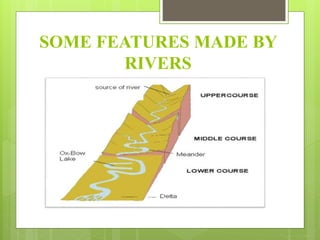
SOME FEATURES MADE BY
RIVERS
Rivers of India
Types of rivers
The drainage systems of India are
mainly controlled by the broad relief
features of the subcontinents.
Accordingly, the Indian rivers are
divided into two parts.
Himalyan Rivers
Peninsular Rivers
Rippling along rough surfaces and the beautiful
meadows, the numerous rivers that dot Indian
mainland are central to our history as well as to
Indian mythology. The main rivers of the Himalayas
group are the Indus, the Ganga and the Brahmaputra.
These rivers are both snow-fed and rain-fed and
therefore they are flow through so many year.
Himalayan rivers discharge about 70% of their
inflow into the sea. This includes about 5% from
central Indian rivers. They join the Ganga and drain
into the Bay of Bengal.
Major Himalayan Rivers
The Himalayan rivers are long, and are
joined by many large and important
tributaries. A river along with its tributaries
may be called a river system.
The Indus
The Ganga
The Brahmaputra
THE RIVER INDUS
 River Indus rises in Tibet, near Lake
Mansarowar.
 It flows west and enters India in the
Ladakh district of Jammu and
Kashmir through a picturesque gorge.
 Several tributaries like the Zaskar, the
Shyok, and the Huzana join it here.
 It flows through Baltistan-the Gilgit
and emerges from the mountain of
Attok.
 Famous five rivers of Punjab-the
Satluj, the Beas, the Ravi, the Chenab
and the Jhelum-meet the Indus a little
above Mithankot in Pakistan.
THE RIVERINDUS
 After this the Indus River flows southwards and
ultimately meets the Arabian Sea.
 The total length of the river is about 2900 km. This length
ranks it one amongst the longest river of the world.
 Nearly 33.3% the Indus basin is located in India-in the
states of Jammu and Kashmir, Himachal Pradesh and the
Punjab and the 67% is in Pakistan.
 According to the provisions of the Indus Water Treaty
(1960) India can only use 20% of the total water carried
by this river system.
 This water is used for irrigation in the Punjab, Haryana
and the western parts of Rajasthan
THE RIVER GANGA
 The Ganges has many names associated
with its many roles in Sanskrit
mythology. Bhagiratha himself is the
source of the name Bhagirathi (of
Bhagiratha), which is its initial stream,
but is also another name for the Hooghly.
At one point, Bhagiratha went too close
to the sage Jahnu's meditation site, and
the disturbed hermit immediately gulped
up all the waters. Eventually, after more
persuasion from Bhagiratha, the sage
yielded the waters, but Ganges retained
the name "Jahnavi“. Water from the
Ganga has the recursive property that any
water mixed with even the minutest
quantity of Ganga water becomes Ganga
water, and inherits its healing and other
holy properties. Also, despite its many
impurities, Ganga water does not rot or
stink if stored for several days.
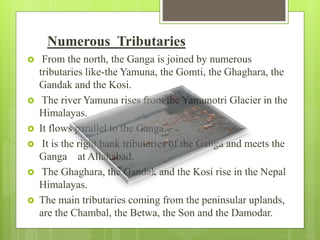
Numerous Tributaries
 From the north, the Ganga is joined by numerous
tributaries like-the Yamuna, the Gomti, the Ghaghara, the
Gandak and the Kosi.
 The river Yamuna rises from the Yamunotri Glacier in the
Himalayas.
 It flows parallel to the Ganga.
 It is the right bank tributaries of the Ganga and meets the
Ganga at Allahabad.
 The Ghaghara, the Gandak and the Kosi rise in the Nepal
Himalayas.
 The main tributaries coming from the peninsular uplands,
are the Chambal, the Betwa, the Son and the Damodar.
THE BRAHMAPUTRA RIVER
 Brahmaputra rises in Tibet, east of
Mansarowar Lake very close to the
sources of the Indus and the Satluj.
 In Tibet, it is known by the name,
Tsang Po.
 It is slightly longer than the Indus, and
most of its course lies in Tibet.
 It flows eastwards parallel to the
Himalayas to its south.
 When it reaches mountain peak of
Namcha Barwa (7757 m), it takes a 'U'
twin and makes a 5500 m deep gorge.
 Then it enters India in Arunachal
Pradesh through a gorge. Here it is
called the Dihang and it is joined by the
Dibang, the Lohit, the Kenula and
numerous other tributaries to form the
Brahmaputra in Assam.
THE RIVER BRAHMAPUTRA
 In Tibet Tsang Po river carries a smaller volume of water and
less silt as it is a comparatively dry and hard rocked area.
 In India it passes through a region, which receives a huge
amount of rainfall. The result is that the river carries a large
volume of water and considerable amount of silt.
 The Brahmaputra has a braided channel in its entire length in
Assam, with numerous riverine islands.
 Every year during the rainy season, Brahmaputra River
floods its banks and causes widespread devastation in Assam
and Bangladesh.
 The river also shifts its channels during rainy season every
year.
PENINSULAR RIVER
 The main water divide in Peninsular India is formed
by the Western Ghats, which runs from north to south
close to the western coast .Most of the major rivers
of the Peninsula such as the Mahanadi, the Godavari,
the Krishna and the Kaveri flow eastwards and drain
into the Bay of Bengal. These rivers make deltas at
their mouths. There are numerous small streams
flowing west of the Western Ghats .The Narmada and
the Tapi are the only long rivers, which flow west
and make esturies .The drainage basins of the
peninsular rivers are comparitevely small in size.
PENINSULAR RIVERS
The Narmada
The Tapi
The Godavari
The Mahanadi
The Krishna
The Kaveri
THE RIVER NARMADA
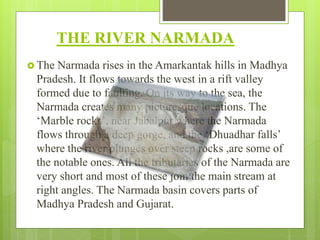
 The Narmada rises in the Amarkantak hills in Madhya
Pradesh. It flows towards the west in a rift valley
formed due to faulting. On its way to the sea, the
Narmada creates many picturesque locations. The
‘Marble rocks’, near Jabalpur where the Narmada
flows through a deep gorge, and the ‘Dhuadhar falls’
where the river plunges over steep rocks ,are some of
the notable ones. All the tributaries of the Narmada are
very short and most of these join the main stream at
right angles. The Narmada basin covers parts of
Madhya Pradesh and Gujarat.
THE RIVER TAPI
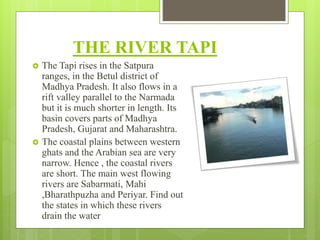
 The Tapi rises in the Satpura
ranges, in the Betul district of
Madhya Pradesh. It also flows in a
rift valley parallel to the Narmada
but it is much shorter in length. Its
basin covers parts of Madhya
Pradesh, Gujarat and Maharashtra.
 The coastal plains between western
ghats and the Arabian sea are very
narrow. Hence , the coastal rivers
are short. The main west flowing
rivers are Sabarmati, Mahi
,Bharathpuzha and Periyar. Find out
the states in which these rivers
drain the water
THE RIVER GODAVARI
 The Godavari is the largest Peninsular river .It rises from
the slopes of the Western Ghats in the Nasik district of
Maharashtra. Its length is about 1500 km .It drains into the
Bay of Bengal. Its drainage basin is also the largest among
the peninsular rivers. The basin covers parts of
Maharashtra (about 50per cent of the basin area lies in
Maharashtra),Madhya Pradesh, Orissa and Andhra
Pradesh. The Godavari is joined by a number of tributaries
such as the Purna, the Wardha,the Pranhita, the Manjra,
the Wainganga and the Penganga.The last three tributaries
are very large. Because of its length and the area it covers,
it is also known as the‘Dakshin Ganga’.
THE MAHANADI RIVER
The Mahanadi rises in the
highlands of Chhattisgarh. It
flows through Orissa to reach
the Bay of Bengal. The length
of the river is about 860 km.
Its drainage basin is shared
by Maharashtra,
Chhattisgarh, Jharkhand, and
Orissa.
THE KRISHNA RIVER
Rising from a spring near Mahabaleshwar, the
Krishna flows for about 1400 km and reaches the
Bay of Bengal. The Tungabhadra, the Koyana, the
Ghatprabha, the Musi and the Bhima are some of
its tributaries. Its drainage basin is shared by
Maharashtra, Karnataka and Andhra Pradesh.
THE KAVERI RIVER
 The Kaveri rises in the
Brahmagri range of the Western
Ghats and it reaches the Bay of
Bengal in south of Cuddalore, in
Tamil Nadu. Total length of the
river is about 760 km. Its main
tributaries are Amravati,
Bhavani, Hemavati and Kabini.
Its basin drains parts of
Karnataka, Kerala and Tamil
Nadu.
Drainage

Drainage

  • 1.
  • 2.
     Drainage The termdrainage describes the river system of an area.  Drainage Basin:- The are drained by a single river system is called a drainage basin.  Water Divide. Any elevated area, such as a mountain or an upland which divides two drainage basins is known as a Water Divide.  River system A river along with its tributaries may be called a river system.
  • 3.
    The streams withina drainage basin form certain patterns, depending on the slope of land, underlying rock structure as well as the climatic conditions of the area . These are dendritic, trellis, rectangular, andradial patterns. The dendritic pattern develops where the river channel follows the slope of the terrain. The stream with its tributaries resembles the branches of a tree, thus the name dendritic. A river joined by its tributaries, at approximately right angles, develops a trellis pattern. A trellis drainage pattern develops where hard and soft rocks exist parallel to each other. A rectangular drainage pattern develops on a strongly jointed rocky terrain. The radial pattern develops when streams flow in different directions from a central peak or dome like structure. A combination of several patterns may be found in the same drainage basin. Drainage Patterns
  • 4.
  • 5.
  • 6.
    Types of rivers Thedrainage systems of India are mainly controlled by the broad relief features of the subcontinents. Accordingly, the Indian rivers are divided into two parts. Himalyan Rivers Peninsular Rivers
  • 7.
    Rippling along roughsurfaces and the beautiful meadows, the numerous rivers that dot Indian mainland are central to our history as well as to Indian mythology. The main rivers of the Himalayas group are the Indus, the Ganga and the Brahmaputra. These rivers are both snow-fed and rain-fed and therefore they are flow through so many year. Himalayan rivers discharge about 70% of their inflow into the sea. This includes about 5% from central Indian rivers. They join the Ganga and drain into the Bay of Bengal.
  • 8.
    Major Himalayan Rivers TheHimalayan rivers are long, and are joined by many large and important tributaries. A river along with its tributaries may be called a river system. The Indus The Ganga The Brahmaputra
  • 9.
    THE RIVER INDUS River Indus rises in Tibet, near Lake Mansarowar.  It flows west and enters India in the Ladakh district of Jammu and Kashmir through a picturesque gorge.  Several tributaries like the Zaskar, the Shyok, and the Huzana join it here.  It flows through Baltistan-the Gilgit and emerges from the mountain of Attok.  Famous five rivers of Punjab-the Satluj, the Beas, the Ravi, the Chenab and the Jhelum-meet the Indus a little above Mithankot in Pakistan.
  • 10.
    THE RIVERINDUS  Afterthis the Indus River flows southwards and ultimately meets the Arabian Sea.  The total length of the river is about 2900 km. This length ranks it one amongst the longest river of the world.  Nearly 33.3% the Indus basin is located in India-in the states of Jammu and Kashmir, Himachal Pradesh and the Punjab and the 67% is in Pakistan.  According to the provisions of the Indus Water Treaty (1960) India can only use 20% of the total water carried by this river system.  This water is used for irrigation in the Punjab, Haryana and the western parts of Rajasthan
  • 11.
    THE RIVER GANGA The Ganges has many names associated with its many roles in Sanskrit mythology. Bhagiratha himself is the source of the name Bhagirathi (of Bhagiratha), which is its initial stream, but is also another name for the Hooghly. At one point, Bhagiratha went too close to the sage Jahnu's meditation site, and the disturbed hermit immediately gulped up all the waters. Eventually, after more persuasion from Bhagiratha, the sage yielded the waters, but Ganges retained the name "Jahnavi“. Water from the Ganga has the recursive property that any water mixed with even the minutest quantity of Ganga water becomes Ganga water, and inherits its healing and other holy properties. Also, despite its many impurities, Ganga water does not rot or stink if stored for several days.
  • 12.
    Numerous Tributaries  Fromthe north, the Ganga is joined by numerous tributaries like-the Yamuna, the Gomti, the Ghaghara, the Gandak and the Kosi.  The river Yamuna rises from the Yamunotri Glacier in the Himalayas.  It flows parallel to the Ganga.  It is the right bank tributaries of the Ganga and meets the Ganga at Allahabad.  The Ghaghara, the Gandak and the Kosi rise in the Nepal Himalayas.  The main tributaries coming from the peninsular uplands, are the Chambal, the Betwa, the Son and the Damodar.
  • 13.
    THE BRAHMAPUTRA RIVER Brahmaputra rises in Tibet, east of Mansarowar Lake very close to the sources of the Indus and the Satluj.  In Tibet, it is known by the name, Tsang Po.  It is slightly longer than the Indus, and most of its course lies in Tibet.  It flows eastwards parallel to the Himalayas to its south.  When it reaches mountain peak of Namcha Barwa (7757 m), it takes a 'U' twin and makes a 5500 m deep gorge.  Then it enters India in Arunachal Pradesh through a gorge. Here it is called the Dihang and it is joined by the Dibang, the Lohit, the Kenula and numerous other tributaries to form the Brahmaputra in Assam.
  • 14.
    THE RIVER BRAHMAPUTRA In Tibet Tsang Po river carries a smaller volume of water and less silt as it is a comparatively dry and hard rocked area.  In India it passes through a region, which receives a huge amount of rainfall. The result is that the river carries a large volume of water and considerable amount of silt.  The Brahmaputra has a braided channel in its entire length in Assam, with numerous riverine islands.  Every year during the rainy season, Brahmaputra River floods its banks and causes widespread devastation in Assam and Bangladesh.  The river also shifts its channels during rainy season every year.
  • 15.
    PENINSULAR RIVER  Themain water divide in Peninsular India is formed by the Western Ghats, which runs from north to south close to the western coast .Most of the major rivers of the Peninsula such as the Mahanadi, the Godavari, the Krishna and the Kaveri flow eastwards and drain into the Bay of Bengal. These rivers make deltas at their mouths. There are numerous small streams flowing west of the Western Ghats .The Narmada and the Tapi are the only long rivers, which flow west and make esturies .The drainage basins of the peninsular rivers are comparitevely small in size.
  • 16.
    PENINSULAR RIVERS The Narmada TheTapi The Godavari The Mahanadi The Krishna The Kaveri
  • 17.
    THE RIVER NARMADA The Narmada rises in the Amarkantak hills in Madhya Pradesh. It flows towards the west in a rift valley formed due to faulting. On its way to the sea, the Narmada creates many picturesque locations. The ‘Marble rocks’, near Jabalpur where the Narmada flows through a deep gorge, and the ‘Dhuadhar falls’ where the river plunges over steep rocks ,are some of the notable ones. All the tributaries of the Narmada are very short and most of these join the main stream at right angles. The Narmada basin covers parts of Madhya Pradesh and Gujarat.
  • 18.
    THE RIVER TAPI The Tapi rises in the Satpura ranges, in the Betul district of Madhya Pradesh. It also flows in a rift valley parallel to the Narmada but it is much shorter in length. Its basin covers parts of Madhya Pradesh, Gujarat and Maharashtra.  The coastal plains between western ghats and the Arabian sea are very narrow. Hence , the coastal rivers are short. The main west flowing rivers are Sabarmati, Mahi ,Bharathpuzha and Periyar. Find out the states in which these rivers drain the water
  • 19.
    THE RIVER GODAVARI The Godavari is the largest Peninsular river .It rises from the slopes of the Western Ghats in the Nasik district of Maharashtra. Its length is about 1500 km .It drains into the Bay of Bengal. Its drainage basin is also the largest among the peninsular rivers. The basin covers parts of Maharashtra (about 50per cent of the basin area lies in Maharashtra),Madhya Pradesh, Orissa and Andhra Pradesh. The Godavari is joined by a number of tributaries such as the Purna, the Wardha,the Pranhita, the Manjra, the Wainganga and the Penganga.The last three tributaries are very large. Because of its length and the area it covers, it is also known as the‘Dakshin Ganga’.
  • 20.
    THE MAHANADI RIVER TheMahanadi rises in the highlands of Chhattisgarh. It flows through Orissa to reach the Bay of Bengal. The length of the river is about 860 km. Its drainage basin is shared by Maharashtra, Chhattisgarh, Jharkhand, and Orissa.
  • 21.
    THE KRISHNA RIVER Risingfrom a spring near Mahabaleshwar, the Krishna flows for about 1400 km and reaches the Bay of Bengal. The Tungabhadra, the Koyana, the Ghatprabha, the Musi and the Bhima are some of its tributaries. Its drainage basin is shared by Maharashtra, Karnataka and Andhra Pradesh.
  • 22.
    THE KAVERI RIVER The Kaveri rises in the Brahmagri range of the Western Ghats and it reaches the Bay of Bengal in south of Cuddalore, in Tamil Nadu. Total length of the river is about 760 km. Its main tributaries are Amravati, Bhavani, Hemavati and Kabini. Its basin drains parts of Karnataka, Kerala and Tamil Nadu.