STUDY SESSION
MARKET SEGMENTATION
Agenda
• Introduction
• Segmentation
• Targeting
• Positioning
• Summary
INTRODUCTION
MARKET SEGMENTATION
Definition
• Segmentation is essentially the identification of subsets of
buyers within a market that share similar needs and
demonstrate similar buyer behavior. The world is made up
of billions of buyers with their own sets of needs and
behavior.
• Segmentation aims to match groups of purchasers with
the same set of needs and buyer behavior. Such a group
is known as a 'segment'. Think of your market as an
orange, with a series of connected but distinctive
segments, each with their own profile.
Segmentation evaluation
• Of course you can segment by all sorts of variables. The
diagram above depicts how segmentation information is
often represented as a pie chart diagram - the segments
are often named and/ or numbered in some way.
• Segmentation is a form of critical evaluation rather than a
prescribed process or system, and hence no two markets
are defined and segmented in the same way. However
there are a number of underpinning criteria that assist us
with segmentation:
• Is the segment viable? Can we make a profit from it?
• Is the segment accessible? How easy is it for us to get
into the segment?
• Is the segment measurable? Can we obtain realistic data
to consider its potential?
Segmentation ways
• The are many ways that a segment can be considered.
For example, the auto market could be segmented by:
driver age, engine size, model type, cost, and so on.
However the more general bases include:
• by geography - such as where in the world was the
product bought.
• by psychographics - such as lifestyle or beliefs.
• by socio-cultural factors - such as class.
• by demography - such as age, sex, and so on.
Segmentation evaluation
• A company will evaluate each segment based upon
potential business success. Opportunities will depend
upon factors such as: the potential growth of the segment
the state of competitive rivalry within the segment how
much profit the segment will deliver how big the segment
is how the segment fits with the current direction of the
company and its vision.
TARGETING
MARKET SEGMENTATION
Targeting
• After the market has been separated into its segments,
the marketer will select a segment or series of segments
and 'target' it/them. Resources and effort will be targeted
at the segment.
Three Strategies:
• Single segment with a single product
• Multiple segment with a single product
• Multi-segment approach
Targeting Strategy 1
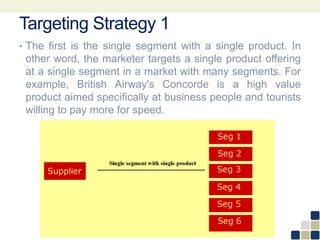
• The first is the single segment with a single product. In
other word, the marketer targets a single product offering
at a single segment in a market with many segments. For
example, British Airway's Concorde is a high value
product aimed specifically at business people and tourists
willing to pay more for speed.
Pros and Cons
PROS include:
• It allows a firm to specialize
• can focus all energies on satisfying one group's needs
• A firm with limited resources can compete with larger
organizations.
CONS include:
• Puts all eggs in one basket.
• Small shift in the population or consumer tastes can
greatly effect the firm.
• May have trouble expanding into new markets (especially
up-market).
Targeting Strategy 2
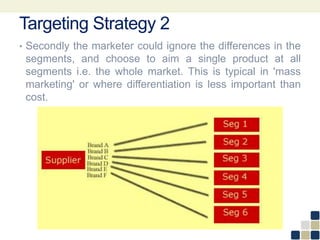
• Secondly the marketer could ignore the differences in the
segments, and choose to aim a single product at all
segments i.e. the whole market. This is typical in 'mass
marketing' or where differentiation is less important than
cost.
Pros and Cons
PROS include:
• Shift excess production capacity.
• Can achieve same market coverage as with mass marketing.
• Price differentials among different brands can be maintained
Contact Lens!!
• Consumers in each segment may be willing to pay a premium
for the tailor-made product.
• Less risk, not relying on one market.
CONS include:
• Demands a greater number of production processes.
• Costs and resources and increased marketing costs through
selling through different channels and promoting more brands,
using different packaging etc.
• Must be careful to maintain the product distinctiveness in each
consumer group and guard its overall image (Contact lenses)
Targeting Strategy 3
• Finally there is a multi-segment approach. Here a
marketer will target a variety of different segments with a
series of differentiated products. This is typical in the
motor industry. Here there are a variety of products such
as diesel, four-wheel-drive, sports saloons, and so on.
Target market strategy
• Developing a target market strategy has three phases:
• Analyzing consumer demand
• Targeting the market(s)
• Undifferentiated
• Concentrated
• Multi segmented
• Developing the marketing strategy
POSITIONING
MARKET SEGMENTATION
Positioning
• Positioning is undoubtedly one of the simplest and most
useful tools to marketers. After segmenting a market and
then targeting a consumer, you would proceed to position
a product within that market.
Positioning
• Positioning is all about 'perception'. As perception differs
from person to person, so do the results of the positioning
map e.g what you perceive as quality, value for money,
etc, is different to my perception. However, there will be
similarities.
• Products or services are 'mapped' together on a
'positioning map'. This allows them to be compared and
contrasted in relation to each other. This is the main
strength of this tool. Marketers decide upon a competitive
position which enables them to distinguish their own
products from the offerings of their competition (hence the
term positioning strategy).
Positioning map
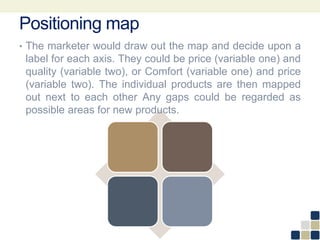
• The marketer would draw out the map and decide upon a
label for each axis. They could be price (variable one) and
quality (variable two), or Comfort (variable one) and price
(variable two). The individual products are then mapped
out next to each other Any gaps could be regarded as
possible areas for new products.
Framework for successful positioning
• The term 'positioning' refers to the consumer's perception
of a product or service in relation to its competitors. You
need to ask yourself, what is the position of the product in
the mind of the consumer?
• A six-step question framework for successful positioning:
1. What position do you currently own?
2. What position do you want to own?
3. Whom you have to defeat to own the position you want.
4. Do you have the resources to do it?
5. Can you persist until you get there?
6. Are your tactics supporting the positioning objective you
set?
SUMMARY
MARKET SEGMENTATION
Summary
• A marketing term referring to the aggregating of
prospective buyers into groups (segments) that have
common needs and will respond similarly to a marketing
action. Market segmentation enables companies to target
different categories of consumers who perceive the full
value of certain products and services differently from one
another. Generally three criteria can be used to identify
different market segments:
1) Homogeneity (common needs within segment)
2) Distinction (unique from other groups)
3) Reaction (similar response to market)

Ss segmentation

  • 1.
  • 2.
    Agenda • Introduction • Segmentation •Targeting • Positioning • Summary
  • 3.
  • 4.
    Definition • Segmentation isessentially the identification of subsets of buyers within a market that share similar needs and demonstrate similar buyer behavior. The world is made up of billions of buyers with their own sets of needs and behavior. • Segmentation aims to match groups of purchasers with the same set of needs and buyer behavior. Such a group is known as a 'segment'. Think of your market as an orange, with a series of connected but distinctive segments, each with their own profile.
  • 5.
    Segmentation evaluation • Ofcourse you can segment by all sorts of variables. The diagram above depicts how segmentation information is often represented as a pie chart diagram - the segments are often named and/ or numbered in some way. • Segmentation is a form of critical evaluation rather than a prescribed process or system, and hence no two markets are defined and segmented in the same way. However there are a number of underpinning criteria that assist us with segmentation: • Is the segment viable? Can we make a profit from it? • Is the segment accessible? How easy is it for us to get into the segment? • Is the segment measurable? Can we obtain realistic data to consider its potential?
  • 6.
    Segmentation ways • Theare many ways that a segment can be considered. For example, the auto market could be segmented by: driver age, engine size, model type, cost, and so on. However the more general bases include: • by geography - such as where in the world was the product bought. • by psychographics - such as lifestyle or beliefs. • by socio-cultural factors - such as class. • by demography - such as age, sex, and so on.
  • 7.
    Segmentation evaluation • Acompany will evaluate each segment based upon potential business success. Opportunities will depend upon factors such as: the potential growth of the segment the state of competitive rivalry within the segment how much profit the segment will deliver how big the segment is how the segment fits with the current direction of the company and its vision.
  • 8.
  • 9.
    Targeting • After themarket has been separated into its segments, the marketer will select a segment or series of segments and 'target' it/them. Resources and effort will be targeted at the segment. Three Strategies: • Single segment with a single product • Multiple segment with a single product • Multi-segment approach
  • 10.
    Targeting Strategy 1 •The first is the single segment with a single product. In other word, the marketer targets a single product offering at a single segment in a market with many segments. For example, British Airway's Concorde is a high value product aimed specifically at business people and tourists willing to pay more for speed.
  • 11.
    Pros and Cons PROSinclude: • It allows a firm to specialize • can focus all energies on satisfying one group's needs • A firm with limited resources can compete with larger organizations. CONS include: • Puts all eggs in one basket. • Small shift in the population or consumer tastes can greatly effect the firm. • May have trouble expanding into new markets (especially up-market).
  • 12.
    Targeting Strategy 2 •Secondly the marketer could ignore the differences in the segments, and choose to aim a single product at all segments i.e. the whole market. This is typical in 'mass marketing' or where differentiation is less important than cost.
  • 13.
    Pros and Cons PROSinclude: • Shift excess production capacity. • Can achieve same market coverage as with mass marketing. • Price differentials among different brands can be maintained Contact Lens!! • Consumers in each segment may be willing to pay a premium for the tailor-made product. • Less risk, not relying on one market. CONS include: • Demands a greater number of production processes. • Costs and resources and increased marketing costs through selling through different channels and promoting more brands, using different packaging etc. • Must be careful to maintain the product distinctiveness in each consumer group and guard its overall image (Contact lenses)
  • 14.
    Targeting Strategy 3 •Finally there is a multi-segment approach. Here a marketer will target a variety of different segments with a series of differentiated products. This is typical in the motor industry. Here there are a variety of products such as diesel, four-wheel-drive, sports saloons, and so on.
  • 15.
    Target market strategy •Developing a target market strategy has three phases: • Analyzing consumer demand • Targeting the market(s) • Undifferentiated • Concentrated • Multi segmented • Developing the marketing strategy
  • 16.
  • 17.
    Positioning • Positioning isundoubtedly one of the simplest and most useful tools to marketers. After segmenting a market and then targeting a consumer, you would proceed to position a product within that market.
  • 18.
    Positioning • Positioning isall about 'perception'. As perception differs from person to person, so do the results of the positioning map e.g what you perceive as quality, value for money, etc, is different to my perception. However, there will be similarities. • Products or services are 'mapped' together on a 'positioning map'. This allows them to be compared and contrasted in relation to each other. This is the main strength of this tool. Marketers decide upon a competitive position which enables them to distinguish their own products from the offerings of their competition (hence the term positioning strategy).
  • 19.
    Positioning map • Themarketer would draw out the map and decide upon a label for each axis. They could be price (variable one) and quality (variable two), or Comfort (variable one) and price (variable two). The individual products are then mapped out next to each other Any gaps could be regarded as possible areas for new products.
  • 20.
    Framework for successfulpositioning • The term 'positioning' refers to the consumer's perception of a product or service in relation to its competitors. You need to ask yourself, what is the position of the product in the mind of the consumer? • A six-step question framework for successful positioning: 1. What position do you currently own? 2. What position do you want to own? 3. Whom you have to defeat to own the position you want. 4. Do you have the resources to do it? 5. Can you persist until you get there? 6. Are your tactics supporting the positioning objective you set?
  • 21.
  • 22.
    Summary • A marketingterm referring to the aggregating of prospective buyers into groups (segments) that have common needs and will respond similarly to a marketing action. Market segmentation enables companies to target different categories of consumers who perceive the full value of certain products and services differently from one another. Generally three criteria can be used to identify different market segments: 1) Homogeneity (common needs within segment) 2) Distinction (unique from other groups) 3) Reaction (similar response to market)