STUDY SESSION
MARKETING ENVIRONMENT
Agenda
• Introduction
• Micro level
• Macro level
• 5 force model
• Summary
INTRODUCTION
MARKETING ENVIRONMENT
Marketing Environment
• The marketing environment surrounds and impacts upon
the organization. There are three key elements to the
marketing environment which are the internal environment,
the microenvironment and the macroenvironment.
• Why are they important? Well marketers build both internal
and external relationships. Marketers aim to deliver value to
satisfied customers, so we need to assess and evaluate our
internal business/corporate environment and our external
environment which is subdivided into micro and macro.
Marketing Environment
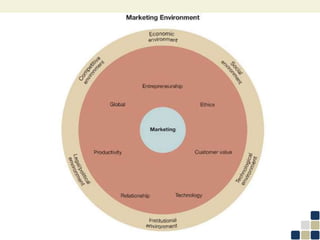
• All the actors and forces influencing the company’s ability to
transact business effectively with it’s target market.
• Includes:
• Micro environment - forces close to the company that
affect its ability to serve its customers.
• Macro environment - larger societal forces that affect the
whole microenvironment.
MICRO ENVIRONMENT
MARKETING ENVIRONMENT
Micro environment
• The Micro environment has already been touched upon by
other lessons on marketing teacher. For example, the lessons
on internal marketing and also on the functions within an
organization give a good starting point to look at our internal
environment. A useful tool for quickly auditing your internal
environment is known as the Five Ms which are Men, Money,
Machinery, Materials and Markets. Here is a really quick
example using British Airways. Looking internally at men,
British Airways employees pilots, engineers, cabin crew,
marketing managers, etc.
• Money is invested in the business by shareholders and banks
for example. Machinery would include its aircraft but also
access to air bridges and buses to ferry passengers from the
terminal to the aircraft. Materials for a service business like
British Airways would be aircraft fuel called kerosene (although
if we were making aircraft materials would include aluminium,
wiring, glass, fabric, and so on). Finally markets which we know
can be both internal and external. Some might include a sixth
M, which is minutes, since time is a valuable internal resource.
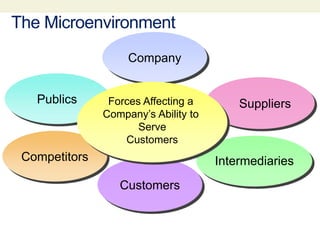
The Microenvironment
Company
Customers
Publics Suppliers
Competitors Intermediaries
Forces Affecting a
Company’s Ability to
Serve
Customers
The Company’s Microenvironment
• Company’s Internal Environment - functional areas such as
top management, finance, and manufacturing, etc.
Suppliers
• provide the resources needed to produce goods and
services.
Marketing Intermediaries
• help the company to promote, sell, and distribute its goods
to final buyers.
Customers
• five types of markets that purchase a company’s
goods and services.
Competitors
• those who serve a target market with similar products
and services.
Publics
• any group that perceives itself having an interest in a
company’s ability to achieve its objectives.
The Company’s Microenvironment
MACRO ENVIRONMENT
MARKETING ENVIRONMENT
Introduction
• The macro marketing environment takes into account all
factors that can influence an organization, but are outside
of their control.
• There are six major macro marketing environment forces
to deal with (PESTLE): political, economic, socio-cultural,
technological, legal and environmental.
6 Macro environment forces
• The political environment includes all laws, government
agencies and lobbying groups that influence or restrict
individuals or organisations.
• The economic environment consists of all factors-such as
salary levels, credit trends and pricing patterns that affect
consumer spending habits and purchasing power.
• The socio-cultural environment includes institutions and
other forces that affect the basic values, behaviours, and
preferences of the society-all of which have an effect on
consumer marketing decisions.
6 Macro environment forces
• The technological environment consists of those forces
that affect the technology with which can create new
products, new markets and new marketing opportunities.
• The legal environment also affects an organisation – even
though a company cannot directly influence any laws –
lobbying or becoming part of a trade organisation is widely
accepted in helping to ‘shape’ particular legal decisions.
• Marketing environments are continuously changing and
businesses operating in such turbulent environments need
to be flexible. Globalisation and lower barriers to entry now
mean that there is an even greater threat of substitute
products and new entrants to market.
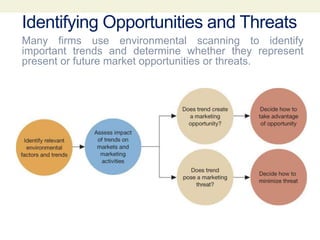
Identifying Opportunities and Threats
Many firms use environmental scanning to identify
important trends and determine whether they represent
present or future market opportunities or threats.
The Demographic Environment
The demographic environment refers to the size,
distribution, and growth rate of groups of people with
different characteristics.
The demographic characteristics of interest to marketers
relate in some way to purchasing behavior, because people
from different countries, cultures, age groups, or household
arrangements often exhibit different purchasing behaviors.
A global perspective requires that marketers be familiar
with important demographic trends around the world as
well as within the United States.
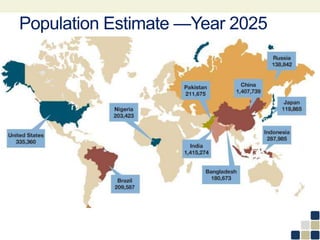
Population Estimate —Year 2025
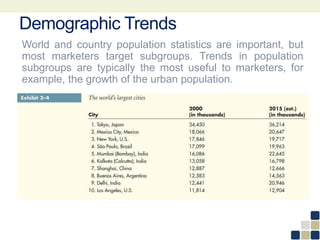
Demographic Trends
World and country population statistics are important, but
most marketers target subgroups. Trends in population
subgroups are typically the most useful to marketers, for
example, the growth of the urban population.
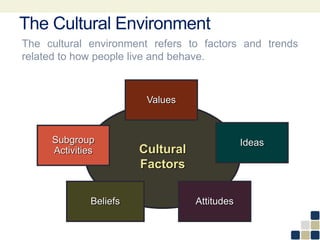
Cultural
Factors
Values
Ideas
Attitudes
Subgroup
Activities
Beliefs
The Cultural Environment
The cultural environment refers to factors and trends
related to how people live and behave.
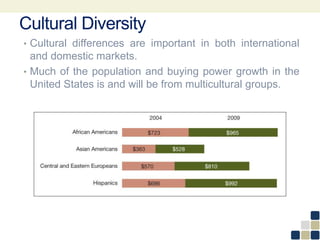
Cultural Diversity
• Cultural differences are important in both international
and domestic markets.
• Much of the population and buying power growth in the
United States is and will be from multicultural groups.
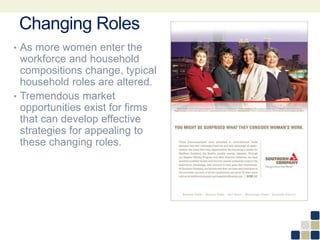
Changing Roles
• As more women enter the
workforce and household
compositions change, typical
household roles are altered.
• Tremendous market
opportunities exist for firms
that can develop effective
strategies for appealing to
these changing roles.
Emphasis on Health & Fitness
The pursuit of a more healthful lifestyle includes:
• eating more nutritious foods
• exercising regularly
• participating in various sports activities
• focusing on wellness.
This translates into potential market opportunities for firms
that provide products and services geared toward
improving health and fitness.
The Desire for Convenience
Increased desire for convenience created by:
• Changes in household composition
• Increases in the number of working women
• General shortage of time
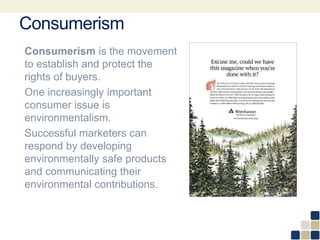
Consumerism
Consumerism is the movement
to establish and protect the
rights of buyers.
One increasingly important
consumer issue is
environmentalism.
Successful marketers can
respond by developing
environmentally safe products
and communicating their
environmental contributions.
The Economic Environment
The economic environment includes factors and trends
related to income levels and the production of goods and
services.
Economic trends in different parts of the world can affect
marketing activities in other parts of the world.
The gross domestic product (GDP) represents the total
size of a country’s economy measured in the amount of
goods and services produced.
The Political/Legal Environment
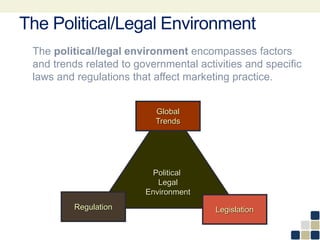
The political/legal environment encompasses factors
and trends related to governmental activities and specific
laws and regulations that affect marketing practice.
Political
Legal
Environment
Global
Trends
LegislationRegulation
Global Political Trends
In today’s world economy, international political events
greatly affect marketing activities. For example the
impact of the war on terrorism on the travel and security
industries.
A second important political trend is movement toward
free trade and away from protectionism. Studies show
that countries with the freest trade have the highest GDP
growth.
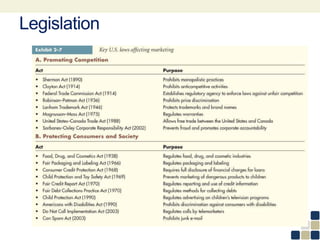
Legislation
Regulations and RegulatoryAgencies
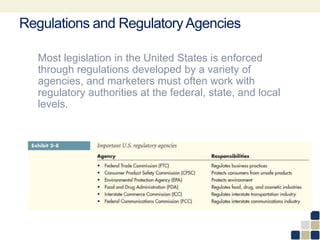
Most legislation in the United States is enforced
through regulations developed by a variety of
agencies, and marketers must often work with
regulatory authorities at the federal, state, and local
levels.
The Technological Environment
The technological environment includes
factors and trends related to innovations that
affect the development of new products or the
marketing process.
These technological trends can provide
opportunities for new product development,
affect how marketing activities are performed,
or both.
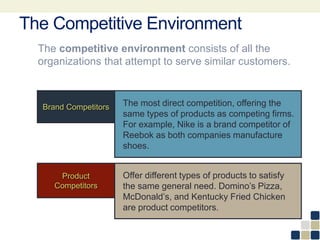
The Competitive Environment
The competitive environment consists of all the
organizations that attempt to serve similar customers.
Product
Competitors
Offer different types of products to satisfy
the same general need. Domino’s Pizza,
McDonald’s, and Kentucky Fried Chicken
are product competitors.
Brand Competitors The most direct competition, offering the
same types of products as competing firms.
For example, Nike is a brand competitor of
Reebok as both companies manufacture
shoes.
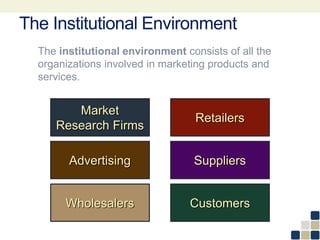
The Institutional Environment
The institutional environment consists of all the
organizations involved in marketing products and
services.
Market
Research Firms
Advertising
Wholesalers
Retailers
Suppliers
Customers
5 FORCE MODEL
MARKETING ENVIRONMENT
Five Forces Model
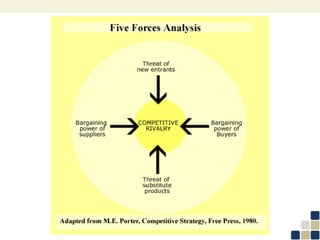
• Five Forces Analysis helps the marketer to contrast a
competitive environment. It has similarities with other tools
for environmental audit, such as PEST analysis, but tends
to focus on the single, stand alone, business or SBU
(Strategic Business Unit) rather than a single product or
range of products. For example, Dell would analyse the
market for Business Computers i.e. one of its SBUs.
•
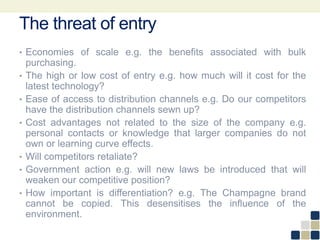
The threat of entry
• Economies of scale e.g. the benefits associated with bulk
purchasing.
• The high or low cost of entry e.g. how much will it cost for the
latest technology?
• Ease of access to distribution channels e.g. Do our competitors
have the distribution channels sewn up?
• Cost advantages not related to the size of the company e.g.
personal contacts or knowledge that larger companies do not
own or learning curve effects.
• Will competitors retaliate?
• Government action e.g. will new laws be introduced that will
weaken our competitive position?
• How important is differentiation? e.g. The Champagne brand
cannot be copied. This desensitises the influence of the
environment.
The power of suppliers
• The power of suppliers tends to be a reversal of the power
of buyers.
• Where the switching costs are high e.g. Switching from one
software supplier to another.
• Power is high where the brand is powerful e.g. Cadillac,
Pizza Hut, Microsoft.
• There is a possibility of the supplier integrating forward e.g.
Brewers buying bars.
• Customers are fragmented (not in clusters) so that they
have little bargaining power e.g. Gas/Petrol stations in
remote places.
The threat of substitutes
• Where there is product-for-product substitution e.g. email
for fax Where there is substitution of need e.g. better
toothpaste reduces the need for dentists.
• Where there is generic substitution (competing for the
currency in your pocket) e.g. Video suppliers compete with
travel companies.
• We could always do without e.g. cigarettes.
Customer
• This is most likely to be high where entry is likely; there is
the threat of substitute products, and suppliers and buyers
in the market attempt to control. This is why it is always
seen in the center of the diagram.
• The power of buyers is the impact that customers have on
a producing industry. In general, when buyer power is
strong, the relationship to the producing industry is near to
what an economist terms a monopsony - a market in which
there are many suppliers and one buyer. Under such
market conditions, the buyer sets the price. In reality few
pure monopsonies exist, but frequently there is some
asymmetry between a producing industry and buyers. The
following tables outline some factors that determine buyer
power.
Competitive Rivalry
• This is most likely to be high where entry is likely; there is
the threat of substitute products, and suppliers and buyers
in the market attempt to control. This is why it is always
seen in the center of the diagram.
SUMMARY
MARKETING ENVIRONMENT
Summary
• The market environment is a marketing term and refers to
factors and forces that affect a firm’s ability to build and
maintain successful relationships with customers.
• Two levels of the environment are:
• Micro (internal) environment - small forces within the
company that affect its ability to serve its customers.
• Macro (external) environment - larger societal forces that
affect the microenvironment.

Ss marketing environment

  • 1.
  • 2.
    Agenda • Introduction • Microlevel • Macro level • 5 force model • Summary
  • 3.
  • 4.
    Marketing Environment • Themarketing environment surrounds and impacts upon the organization. There are three key elements to the marketing environment which are the internal environment, the microenvironment and the macroenvironment. • Why are they important? Well marketers build both internal and external relationships. Marketers aim to deliver value to satisfied customers, so we need to assess and evaluate our internal business/corporate environment and our external environment which is subdivided into micro and macro.
  • 5.
    Marketing Environment • Allthe actors and forces influencing the company’s ability to transact business effectively with it’s target market. • Includes: • Micro environment - forces close to the company that affect its ability to serve its customers. • Macro environment - larger societal forces that affect the whole microenvironment.
  • 6.
  • 7.
    Micro environment • TheMicro environment has already been touched upon by other lessons on marketing teacher. For example, the lessons on internal marketing and also on the functions within an organization give a good starting point to look at our internal environment. A useful tool for quickly auditing your internal environment is known as the Five Ms which are Men, Money, Machinery, Materials and Markets. Here is a really quick example using British Airways. Looking internally at men, British Airways employees pilots, engineers, cabin crew, marketing managers, etc. • Money is invested in the business by shareholders and banks for example. Machinery would include its aircraft but also access to air bridges and buses to ferry passengers from the terminal to the aircraft. Materials for a service business like British Airways would be aircraft fuel called kerosene (although if we were making aircraft materials would include aluminium, wiring, glass, fabric, and so on). Finally markets which we know can be both internal and external. Some might include a sixth M, which is minutes, since time is a valuable internal resource.
  • 8.
    The Microenvironment Company Customers Publics Suppliers CompetitorsIntermediaries Forces Affecting a Company’s Ability to Serve Customers
  • 9.
    The Company’s Microenvironment •Company’s Internal Environment - functional areas such as top management, finance, and manufacturing, etc. Suppliers • provide the resources needed to produce goods and services. Marketing Intermediaries • help the company to promote, sell, and distribute its goods to final buyers.
  • 10.
    Customers • five typesof markets that purchase a company’s goods and services. Competitors • those who serve a target market with similar products and services. Publics • any group that perceives itself having an interest in a company’s ability to achieve its objectives. The Company’s Microenvironment
  • 11.
  • 12.
    Introduction • The macromarketing environment takes into account all factors that can influence an organization, but are outside of their control. • There are six major macro marketing environment forces to deal with (PESTLE): political, economic, socio-cultural, technological, legal and environmental.
  • 14.
    6 Macro environmentforces • The political environment includes all laws, government agencies and lobbying groups that influence or restrict individuals or organisations. • The economic environment consists of all factors-such as salary levels, credit trends and pricing patterns that affect consumer spending habits and purchasing power. • The socio-cultural environment includes institutions and other forces that affect the basic values, behaviours, and preferences of the society-all of which have an effect on consumer marketing decisions.
  • 15.
    6 Macro environmentforces • The technological environment consists of those forces that affect the technology with which can create new products, new markets and new marketing opportunities. • The legal environment also affects an organisation – even though a company cannot directly influence any laws – lobbying or becoming part of a trade organisation is widely accepted in helping to ‘shape’ particular legal decisions. • Marketing environments are continuously changing and businesses operating in such turbulent environments need to be flexible. Globalisation and lower barriers to entry now mean that there is an even greater threat of substitute products and new entrants to market.
  • 16.
    Identifying Opportunities andThreats Many firms use environmental scanning to identify important trends and determine whether they represent present or future market opportunities or threats.
  • 17.
    The Demographic Environment Thedemographic environment refers to the size, distribution, and growth rate of groups of people with different characteristics. The demographic characteristics of interest to marketers relate in some way to purchasing behavior, because people from different countries, cultures, age groups, or household arrangements often exhibit different purchasing behaviors. A global perspective requires that marketers be familiar with important demographic trends around the world as well as within the United States.
  • 18.
  • 19.
    Demographic Trends World andcountry population statistics are important, but most marketers target subgroups. Trends in population subgroups are typically the most useful to marketers, for example, the growth of the urban population.
  • 20.
    Cultural Factors Values Ideas Attitudes Subgroup Activities Beliefs The Cultural Environment Thecultural environment refers to factors and trends related to how people live and behave.
  • 21.
    Cultural Diversity • Culturaldifferences are important in both international and domestic markets. • Much of the population and buying power growth in the United States is and will be from multicultural groups.
  • 22.
    Changing Roles • Asmore women enter the workforce and household compositions change, typical household roles are altered. • Tremendous market opportunities exist for firms that can develop effective strategies for appealing to these changing roles.
  • 23.
    Emphasis on Health& Fitness The pursuit of a more healthful lifestyle includes: • eating more nutritious foods • exercising regularly • participating in various sports activities • focusing on wellness. This translates into potential market opportunities for firms that provide products and services geared toward improving health and fitness.
  • 24.
    The Desire forConvenience Increased desire for convenience created by: • Changes in household composition • Increases in the number of working women • General shortage of time
  • 25.
    Consumerism Consumerism is themovement to establish and protect the rights of buyers. One increasingly important consumer issue is environmentalism. Successful marketers can respond by developing environmentally safe products and communicating their environmental contributions.
  • 26.
    The Economic Environment Theeconomic environment includes factors and trends related to income levels and the production of goods and services. Economic trends in different parts of the world can affect marketing activities in other parts of the world. The gross domestic product (GDP) represents the total size of a country’s economy measured in the amount of goods and services produced.
  • 27.
    The Political/Legal Environment Thepolitical/legal environment encompasses factors and trends related to governmental activities and specific laws and regulations that affect marketing practice. Political Legal Environment Global Trends LegislationRegulation
  • 28.
    Global Political Trends Intoday’s world economy, international political events greatly affect marketing activities. For example the impact of the war on terrorism on the travel and security industries. A second important political trend is movement toward free trade and away from protectionism. Studies show that countries with the freest trade have the highest GDP growth.
  • 29.
  • 30.
    Regulations and RegulatoryAgencies Mostlegislation in the United States is enforced through regulations developed by a variety of agencies, and marketers must often work with regulatory authorities at the federal, state, and local levels.
  • 31.
    The Technological Environment Thetechnological environment includes factors and trends related to innovations that affect the development of new products or the marketing process. These technological trends can provide opportunities for new product development, affect how marketing activities are performed, or both.
  • 32.
    The Competitive Environment Thecompetitive environment consists of all the organizations that attempt to serve similar customers. Product Competitors Offer different types of products to satisfy the same general need. Domino’s Pizza, McDonald’s, and Kentucky Fried Chicken are product competitors. Brand Competitors The most direct competition, offering the same types of products as competing firms. For example, Nike is a brand competitor of Reebok as both companies manufacture shoes.
  • 33.
    The Institutional Environment Theinstitutional environment consists of all the organizations involved in marketing products and services. Market Research Firms Advertising Wholesalers Retailers Suppliers Customers
  • 34.
  • 35.
    Five Forces Model •Five Forces Analysis helps the marketer to contrast a competitive environment. It has similarities with other tools for environmental audit, such as PEST analysis, but tends to focus on the single, stand alone, business or SBU (Strategic Business Unit) rather than a single product or range of products. For example, Dell would analyse the market for Business Computers i.e. one of its SBUs. •
  • 37.
    The threat ofentry • Economies of scale e.g. the benefits associated with bulk purchasing. • The high or low cost of entry e.g. how much will it cost for the latest technology? • Ease of access to distribution channels e.g. Do our competitors have the distribution channels sewn up? • Cost advantages not related to the size of the company e.g. personal contacts or knowledge that larger companies do not own or learning curve effects. • Will competitors retaliate? • Government action e.g. will new laws be introduced that will weaken our competitive position? • How important is differentiation? e.g. The Champagne brand cannot be copied. This desensitises the influence of the environment.
  • 38.
    The power ofsuppliers • The power of suppliers tends to be a reversal of the power of buyers. • Where the switching costs are high e.g. Switching from one software supplier to another. • Power is high where the brand is powerful e.g. Cadillac, Pizza Hut, Microsoft. • There is a possibility of the supplier integrating forward e.g. Brewers buying bars. • Customers are fragmented (not in clusters) so that they have little bargaining power e.g. Gas/Petrol stations in remote places.
  • 39.
    The threat ofsubstitutes • Where there is product-for-product substitution e.g. email for fax Where there is substitution of need e.g. better toothpaste reduces the need for dentists. • Where there is generic substitution (competing for the currency in your pocket) e.g. Video suppliers compete with travel companies. • We could always do without e.g. cigarettes.
  • 40.
    Customer • This ismost likely to be high where entry is likely; there is the threat of substitute products, and suppliers and buyers in the market attempt to control. This is why it is always seen in the center of the diagram. • The power of buyers is the impact that customers have on a producing industry. In general, when buyer power is strong, the relationship to the producing industry is near to what an economist terms a monopsony - a market in which there are many suppliers and one buyer. Under such market conditions, the buyer sets the price. In reality few pure monopsonies exist, but frequently there is some asymmetry between a producing industry and buyers. The following tables outline some factors that determine buyer power.
  • 41.
    Competitive Rivalry • Thisis most likely to be high where entry is likely; there is the threat of substitute products, and suppliers and buyers in the market attempt to control. This is why it is always seen in the center of the diagram.
  • 42.
  • 43.
    Summary • The marketenvironment is a marketing term and refers to factors and forces that affect a firm’s ability to build and maintain successful relationships with customers. • Two levels of the environment are: • Micro (internal) environment - small forces within the company that affect its ability to serve its customers. • Macro (external) environment - larger societal forces that affect the microenvironment.