STUDY SESSION
MARKETING MIX
Agenda
• Introduction
• Product
• Price
• Promotion
• Place
• 7 Ps
• Summary
INTRODUCTION
MARKETING MIX
Introduction
• Marketing Mix is a combination of marketing tools that a
company uses to satisfy their target customers and
achieving organizational goals. McCarthy classified all
these marketing tools under four broad categories:
• Product
• Price
• Place
• Promotion
• These four elements are the basic components of a
marketing plan and are collectively called 4 P’s of
marketing. 4 P’s pertain more to physical products than
services.
• The important thing to note is that all these four P’s
(variable) are controllable, subject to internal and external
constraints of marketing environment. Marketers, using
different blends of these variables, can target different
group of customers having different needs. So, a
customer may call marketing mix “the offering”.
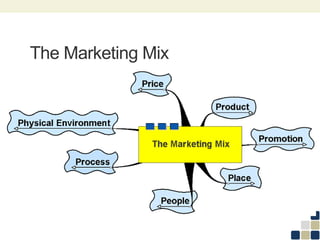
The Marketing Mix
The Marketing Mix
• The tools available to a business to gain the
reaction it is seeking from its target market in
relation to its marketing objectives
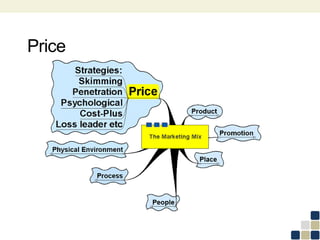
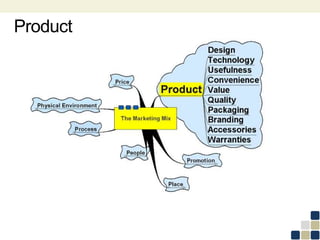
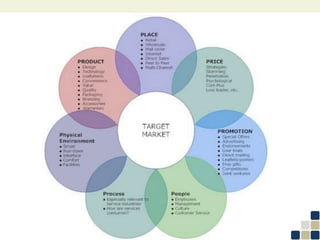
• 7Ps – Price, Product, Promotion, Place, People,
Process, Physical Environment
• Traditional 4Ps extended to encompass growth of
service industry
PRICE
MARKETING MIX
Price
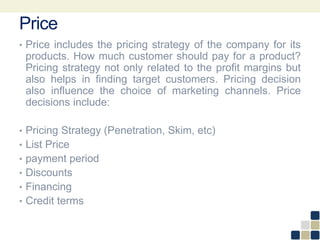
• Price includes the pricing strategy of the company for its
products. How much customer should pay for a product?
Pricing strategy not only related to the profit margins but
also helps in finding target customers. Pricing decision
also influence the choice of marketing channels. Price
decisions include:
• Pricing Strategy (Penetration, Skim, etc)
• List Price
• payment period
• Discounts
• Financing
• Credit terms
Price
Price
• Pricing Strategy
• Importance of:
• knowing the market
elasticity
• keeping an eye
on rivals
Image copyright: www.freeimages.co.uk
Questions on Price
• Where do buyers look for your product or service?
• If they look in a store, what kind? A specialist boutique or in
a supermarket, or both? Or online? Or direct, via a
catalogue?
• How can you access the right distribution channels?
• Do you need to use a sales force? Or attend trade fairs? Or
make online submissions? Or send samples to catalogue
companies?
• What do you competitors do, and how can you learn from
that and/or differentiate?
PRODUCT
MARKETING MIX
Product
• Product is the actual offering by the company to its targeted
customers which also includes value added stuff. Product may be
tangible (goods) or intangible (services).
• While formulating the marketing strategy, product decisions include:
• What to offer?
• Brand name
• Packaging
• Quality
• Appearance
• Functionality
• Accessories
• Installation
• After sale services
• Warranty
Product
Product
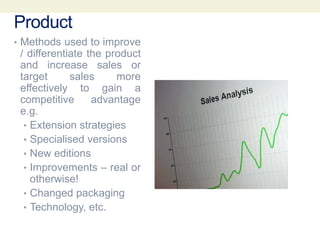
• Methods used to improve
/ differentiate the product
and increase sales or
target sales more
effectively to gain a
competitive advantage
e.g.
• Extension strategies
• Specialised versions
• New editions
• Improvements – real or
otherwise!
• Changed packaging
• Technology, etc.
Questions on Product
• What does the customer want from the product/service?
What needs does it satisfy?
• What features does it have to meet these needs?
• Are there any features you've missed out?
• Are you including costly features that the customer won't
actually use?
• How and where will the customer use it?
• What does it look like? How will customers experience it?
• What size(s), color(s), and so on, should it be?
• What is it to be called?
• How is it branded?
• How is it differentiated versus your competitors?
• What is the most it can cost to provide, and still be sold
sufficiently profitably?
PROMOTION
MARKETING MIX
Promotion
• Promotion includes all communication and selling
activities to pursuade future prospects to buy the product.
Promotion decisions include:
• Advertising
• Media Types
• Message
• Budgets
• Sales promotion
• Personal selling
• Public relations
• Direct marketing
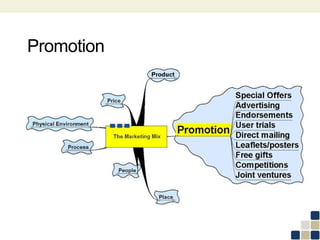
Promotion
Promotion
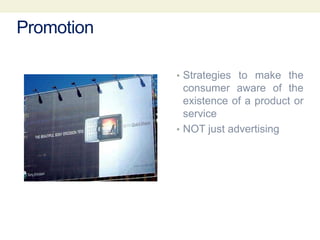
• Strategies to make the
consumer aware of the
existence of a product or
service
• NOT just advertising
Questions on Promotion
• Where and when can you get across your marketing
messages to your target market?
• Will you reach your audience by advertising in the press, or
on TV, or radio, or on billboards? By using direct marketing
mailshot? Through PR? On the Internet?
• When is the best time to promote? Is there seasonality in
the market? Are there any wider environmental issues that
suggest or dictate the timing of your market launch, or the
timing of subsequent promotions?
• How do your competitors do their promotions? And how
does that influence your choice of promotional activity?
PLACE
MARKETING MIX
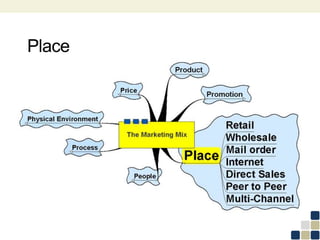
Place
• It not only includes the place where the product is placed, all
those activities performed by the company to ensure the
availability of the product tot he targeted customers. Availability
of the product at the right place, at the right time and in the
right quantity is crucial in placement decisions.
• Placement decisions include:
• Placement
• Distribution channels
• Logistics
• Inventory
• Order processing
• Market coverage
• selection of channel members
Place
Place
• The means by which products and services get from
producer to consumer and where they can be accessed
by the consumer.
• The more places to buy the product and the easier it is
made to buy it, the better for the business (and the
consumer?)
Questions on Place
• Where do buyers look for your product or service?
• If they look in a store, what kind? A specialist boutique or in
a supermarket, or both? Or online? Or direct, via a
catalogue?
• How can you access the right distribution channels?
• Do you need to use a sales force? Or attend trade fairs? Or
make online submissions? Or send samples to catalogue
companies?
• What do you competitors do, and how can you learn from
that and/or differentiate?
7P
MARKETING MIX
Limitations of 4Ps
• Marketing mix (4 P’s) was more useful in early 19′s when
production concept ws in and physical products were in
larger proportion. Today, with latest marketing concepts,
marketing environment has become more intergrated. So,
in order to extend the usefulness of marketing mix, some
authors introduced a fifth P and then seven P’s (People,
Packaging, Process). But the foundation of Marketing Mix
still stands on the basic 4P’s.
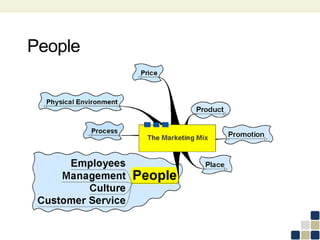
People
People
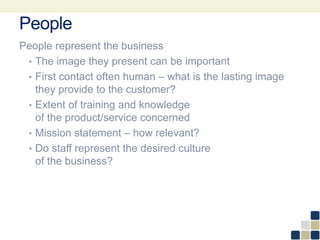
People represent the business
• The image they present can be important
• First contact often human – what is the lasting image
they provide to the customer?
• Extent of training and knowledge
of the product/service concerned
• Mission statement – how relevant?
• Do staff represent the desired culture
of the business?
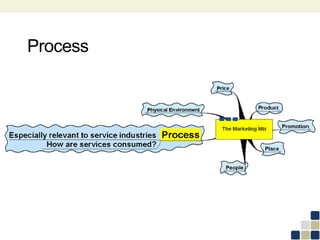
Process
Process
• How do people consume services?
• What processes do they have to go through to acquire
the services?
• Where do they find the availability of the service?
• Contact
• Reminders
• Registration
• Subscription
• Form filling
• Degree of technology
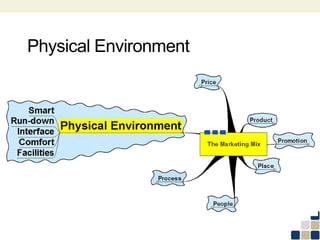
Physical Environment
• The ambience, mood or physical presentation of the
environment
• Smart/shabby?
• Trendy/retro/modern/old fashioned?
• Light/dark/bright/subdued?
• Romantic/chic/loud?
• Clean/dirty/unkempt/neat?
• Music?
• Smell?
SUMMARY
MARKETING MIX
Using the Marketing Mix
• The marketing mix model can be used to help you decide how
to take a new offer to market. It can also be used to test your
existing marketing strategy. Whether you are considering a
new or existing offer, follow the steps below help you define
and improve your marketing mix.
1. Start by identifying the product or service that you want to
analyze.
2. Now go through and answer the 4Ps questions – as defined
in detail above.
3. Try asking "why" and "what if" questions too, to challenge
your offer. For example, ask why your target audience needs
a particular feature. What if you drop your price by 5%? What
if you offer more colors? Why sell through wholesalers rather
than direct channels? What if you improve PR rather than
rely on TV advertising?
Using the Marketing Mix
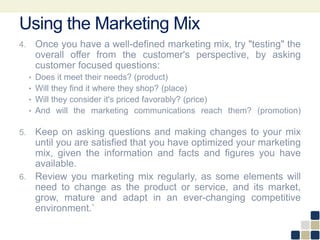
4. Once you have a well-defined marketing mix, try "testing" the
overall offer from the customer's perspective, by asking
customer focused questions:
• Does it meet their needs? (product)
• Will they find it where they shop? (place)
• Will they consider it's priced favorably? (price)
• And will the marketing communications reach them? (promotion)
5. Keep on asking questions and making changes to your mix
until you are satisfied that you have optimized your marketing
mix, given the information and facts and figures you have
available.
6. Review you marketing mix regularly, as some elements will
need to change as the product or service, and its market,
grow, mature and adapt in an ever-changing competitive
environment.`
The Marketing Mix
• Blend of the mix depends upon:
• Marketing objectives
• Type of product
• Target market
• Market structure
• Rivals’ behaviour
• Global issues – culture/religion, etc.
• Marketing position
• Product portfolio
• Product lifecycle
• Boston Matrix
Summary The Marketing Mix
• The tools available to a business to gain the reaction it is
seeking from its target market in relation to its marketing
objectives.
• Modern 7Ps:
• Price
• Product
• Promotion
• Place
• People
• Process
• Physical Environment

Ss marketing mix

  • 1.
  • 2.
    Agenda • Introduction • Product •Price • Promotion • Place • 7 Ps • Summary
  • 3.
  • 4.
    Introduction • Marketing Mixis a combination of marketing tools that a company uses to satisfy their target customers and achieving organizational goals. McCarthy classified all these marketing tools under four broad categories: • Product • Price • Place • Promotion
  • 5.
    • These fourelements are the basic components of a marketing plan and are collectively called 4 P’s of marketing. 4 P’s pertain more to physical products than services. • The important thing to note is that all these four P’s (variable) are controllable, subject to internal and external constraints of marketing environment. Marketers, using different blends of these variables, can target different group of customers having different needs. So, a customer may call marketing mix “the offering”.
  • 6.
  • 7.
    The Marketing Mix •The tools available to a business to gain the reaction it is seeking from its target market in relation to its marketing objectives • 7Ps – Price, Product, Promotion, Place, People, Process, Physical Environment • Traditional 4Ps extended to encompass growth of service industry
  • 8.
  • 9.
    Price • Price includesthe pricing strategy of the company for its products. How much customer should pay for a product? Pricing strategy not only related to the profit margins but also helps in finding target customers. Pricing decision also influence the choice of marketing channels. Price decisions include: • Pricing Strategy (Penetration, Skim, etc) • List Price • payment period • Discounts • Financing • Credit terms
  • 10.
  • 11.
    Price • Pricing Strategy •Importance of: • knowing the market elasticity • keeping an eye on rivals Image copyright: www.freeimages.co.uk
  • 12.
    Questions on Price •Where do buyers look for your product or service? • If they look in a store, what kind? A specialist boutique or in a supermarket, or both? Or online? Or direct, via a catalogue? • How can you access the right distribution channels? • Do you need to use a sales force? Or attend trade fairs? Or make online submissions? Or send samples to catalogue companies? • What do you competitors do, and how can you learn from that and/or differentiate?
  • 13.
  • 14.
    Product • Product isthe actual offering by the company to its targeted customers which also includes value added stuff. Product may be tangible (goods) or intangible (services). • While formulating the marketing strategy, product decisions include: • What to offer? • Brand name • Packaging • Quality • Appearance • Functionality • Accessories • Installation • After sale services • Warranty
  • 15.
  • 16.
    Product • Methods usedto improve / differentiate the product and increase sales or target sales more effectively to gain a competitive advantage e.g. • Extension strategies • Specialised versions • New editions • Improvements – real or otherwise! • Changed packaging • Technology, etc.
  • 17.
    Questions on Product •What does the customer want from the product/service? What needs does it satisfy? • What features does it have to meet these needs? • Are there any features you've missed out? • Are you including costly features that the customer won't actually use? • How and where will the customer use it? • What does it look like? How will customers experience it? • What size(s), color(s), and so on, should it be? • What is it to be called? • How is it branded? • How is it differentiated versus your competitors? • What is the most it can cost to provide, and still be sold sufficiently profitably?
  • 18.
  • 19.
    Promotion • Promotion includesall communication and selling activities to pursuade future prospects to buy the product. Promotion decisions include: • Advertising • Media Types • Message • Budgets • Sales promotion • Personal selling • Public relations • Direct marketing
  • 20.
  • 21.
    Promotion • Strategies tomake the consumer aware of the existence of a product or service • NOT just advertising
  • 22.
    Questions on Promotion •Where and when can you get across your marketing messages to your target market? • Will you reach your audience by advertising in the press, or on TV, or radio, or on billboards? By using direct marketing mailshot? Through PR? On the Internet? • When is the best time to promote? Is there seasonality in the market? Are there any wider environmental issues that suggest or dictate the timing of your market launch, or the timing of subsequent promotions? • How do your competitors do their promotions? And how does that influence your choice of promotional activity?
  • 23.
  • 24.
    Place • It notonly includes the place where the product is placed, all those activities performed by the company to ensure the availability of the product tot he targeted customers. Availability of the product at the right place, at the right time and in the right quantity is crucial in placement decisions. • Placement decisions include: • Placement • Distribution channels • Logistics • Inventory • Order processing • Market coverage • selection of channel members
  • 25.
  • 26.
    Place • The meansby which products and services get from producer to consumer and where they can be accessed by the consumer. • The more places to buy the product and the easier it is made to buy it, the better for the business (and the consumer?)
  • 27.
    Questions on Place •Where do buyers look for your product or service? • If they look in a store, what kind? A specialist boutique or in a supermarket, or both? Or online? Or direct, via a catalogue? • How can you access the right distribution channels? • Do you need to use a sales force? Or attend trade fairs? Or make online submissions? Or send samples to catalogue companies? • What do you competitors do, and how can you learn from that and/or differentiate?
  • 28.
  • 29.
    Limitations of 4Ps •Marketing mix (4 P’s) was more useful in early 19′s when production concept ws in and physical products were in larger proportion. Today, with latest marketing concepts, marketing environment has become more intergrated. So, in order to extend the usefulness of marketing mix, some authors introduced a fifth P and then seven P’s (People, Packaging, Process). But the foundation of Marketing Mix still stands on the basic 4P’s.
  • 30.
  • 31.
    People People represent thebusiness • The image they present can be important • First contact often human – what is the lasting image they provide to the customer? • Extent of training and knowledge of the product/service concerned • Mission statement – how relevant? • Do staff represent the desired culture of the business?
  • 32.
  • 33.
    Process • How dopeople consume services? • What processes do they have to go through to acquire the services? • Where do they find the availability of the service? • Contact • Reminders • Registration • Subscription • Form filling • Degree of technology
  • 34.
  • 35.
    Physical Environment • Theambience, mood or physical presentation of the environment • Smart/shabby? • Trendy/retro/modern/old fashioned? • Light/dark/bright/subdued? • Romantic/chic/loud? • Clean/dirty/unkempt/neat? • Music? • Smell?
  • 36.
  • 37.
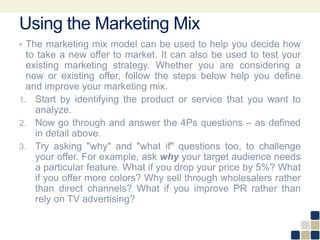
    Using the MarketingMix • The marketing mix model can be used to help you decide how to take a new offer to market. It can also be used to test your existing marketing strategy. Whether you are considering a new or existing offer, follow the steps below help you define and improve your marketing mix. 1. Start by identifying the product or service that you want to analyze. 2. Now go through and answer the 4Ps questions – as defined in detail above. 3. Try asking "why" and "what if" questions too, to challenge your offer. For example, ask why your target audience needs a particular feature. What if you drop your price by 5%? What if you offer more colors? Why sell through wholesalers rather than direct channels? What if you improve PR rather than rely on TV advertising?
  • 38.
    Using the MarketingMix 4. Once you have a well-defined marketing mix, try "testing" the overall offer from the customer's perspective, by asking customer focused questions: • Does it meet their needs? (product) • Will they find it where they shop? (place) • Will they consider it's priced favorably? (price) • And will the marketing communications reach them? (promotion) 5. Keep on asking questions and making changes to your mix until you are satisfied that you have optimized your marketing mix, given the information and facts and figures you have available. 6. Review you marketing mix regularly, as some elements will need to change as the product or service, and its market, grow, mature and adapt in an ever-changing competitive environment.`
  • 39.
    The Marketing Mix •Blend of the mix depends upon: • Marketing objectives • Type of product • Target market • Market structure • Rivals’ behaviour • Global issues – culture/religion, etc. • Marketing position • Product portfolio • Product lifecycle • Boston Matrix
  • 41.
    Summary The MarketingMix • The tools available to a business to gain the reaction it is seeking from its target market in relation to its marketing objectives. • Modern 7Ps: • Price • Product • Promotion • Place • People • Process • Physical Environment