การดูแลผู้ป่วยทางการดูแลผู้ป่วยทาง
ศัลยกรรมศัลยกรรม
Napong Kitpanit , General surgeonNapong Kitpanit , General surgeon
Bhumibol Adulyadej HospitalBhumibol Adulyadej Hospital
ContentsContents
 Initial assessment and managementInitial assessment and management
in trauma patientsin trauma patients
 ICD placementICD placement
 Acut abdomenAcut abdomen
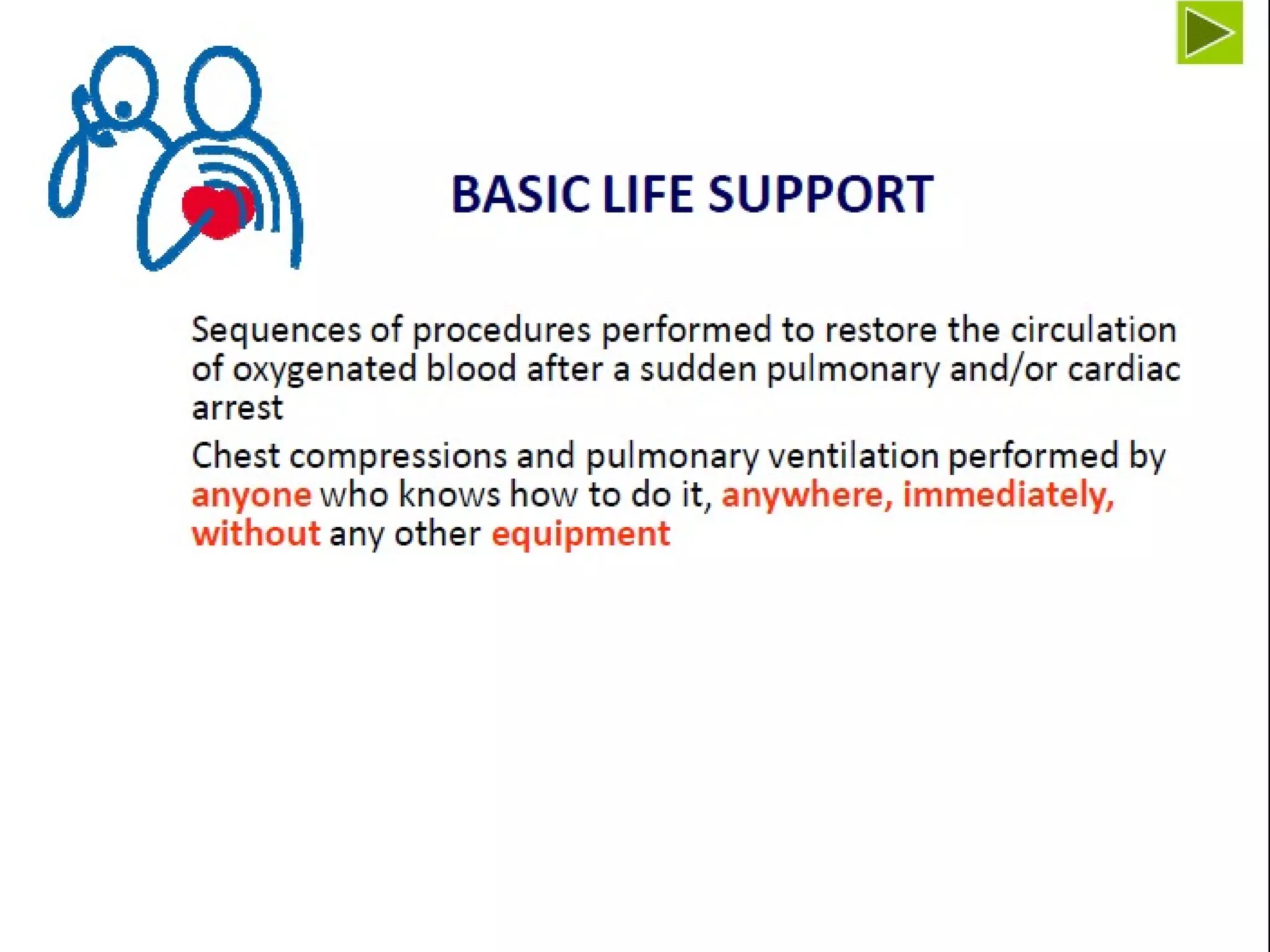
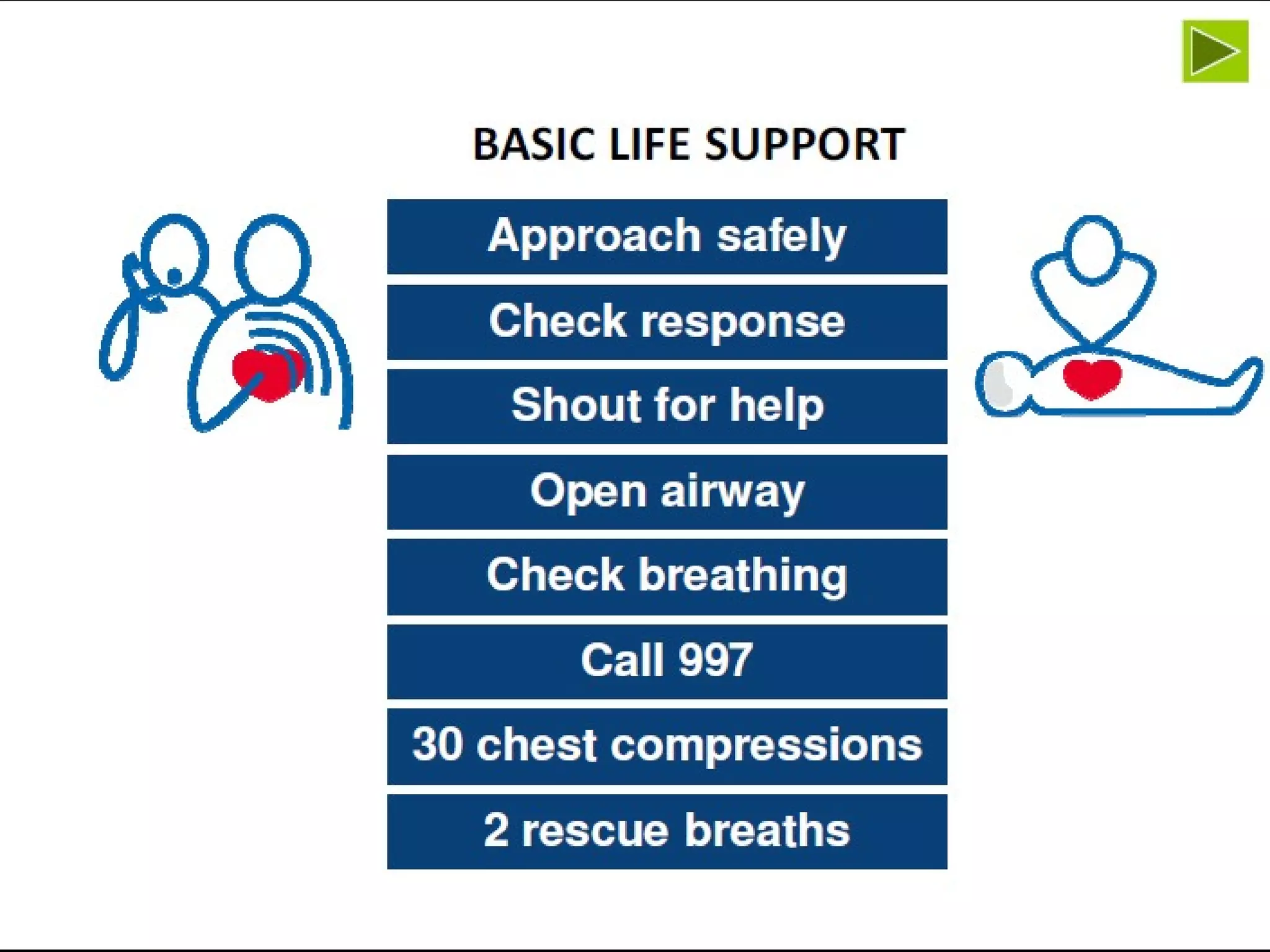
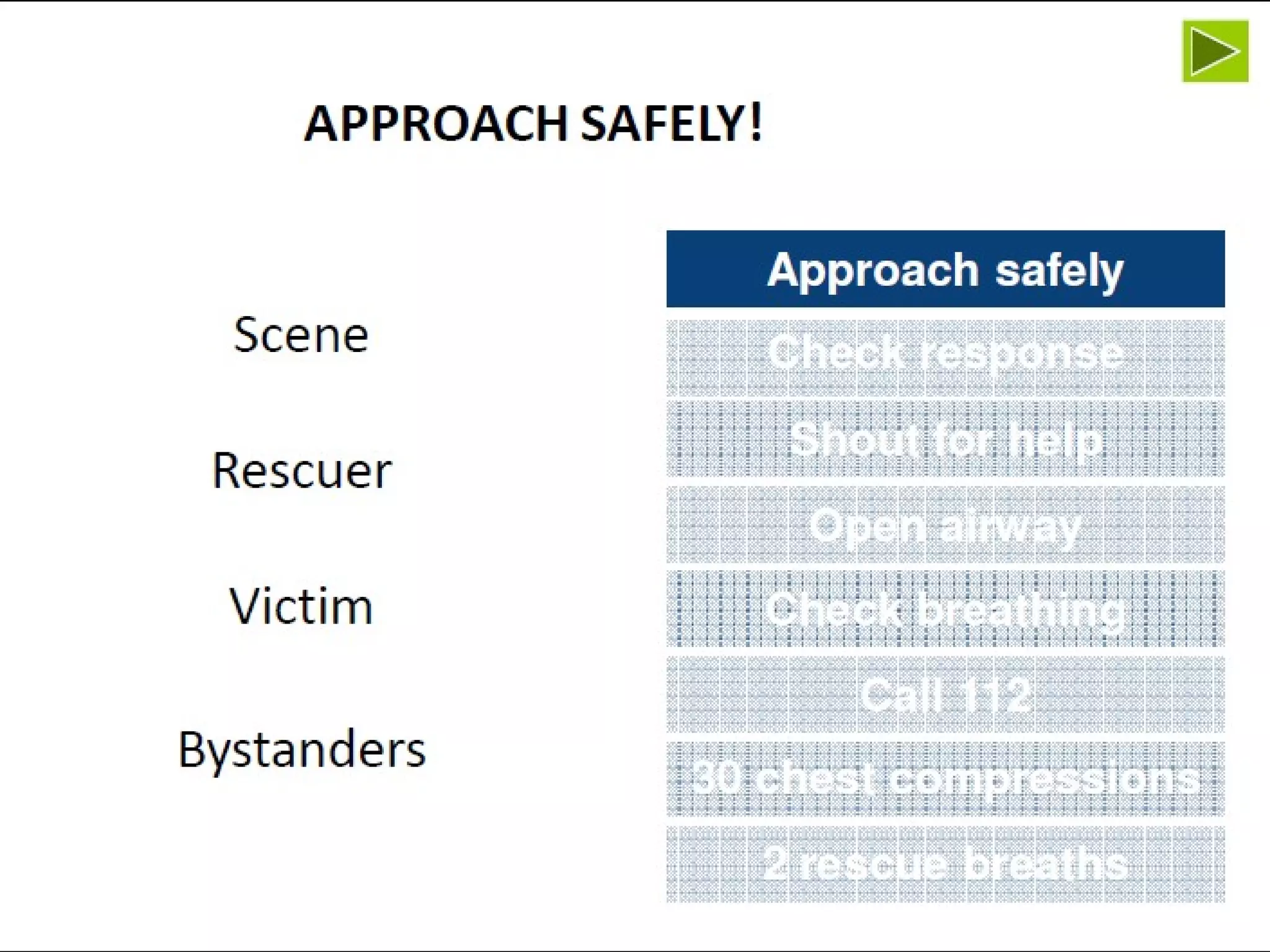
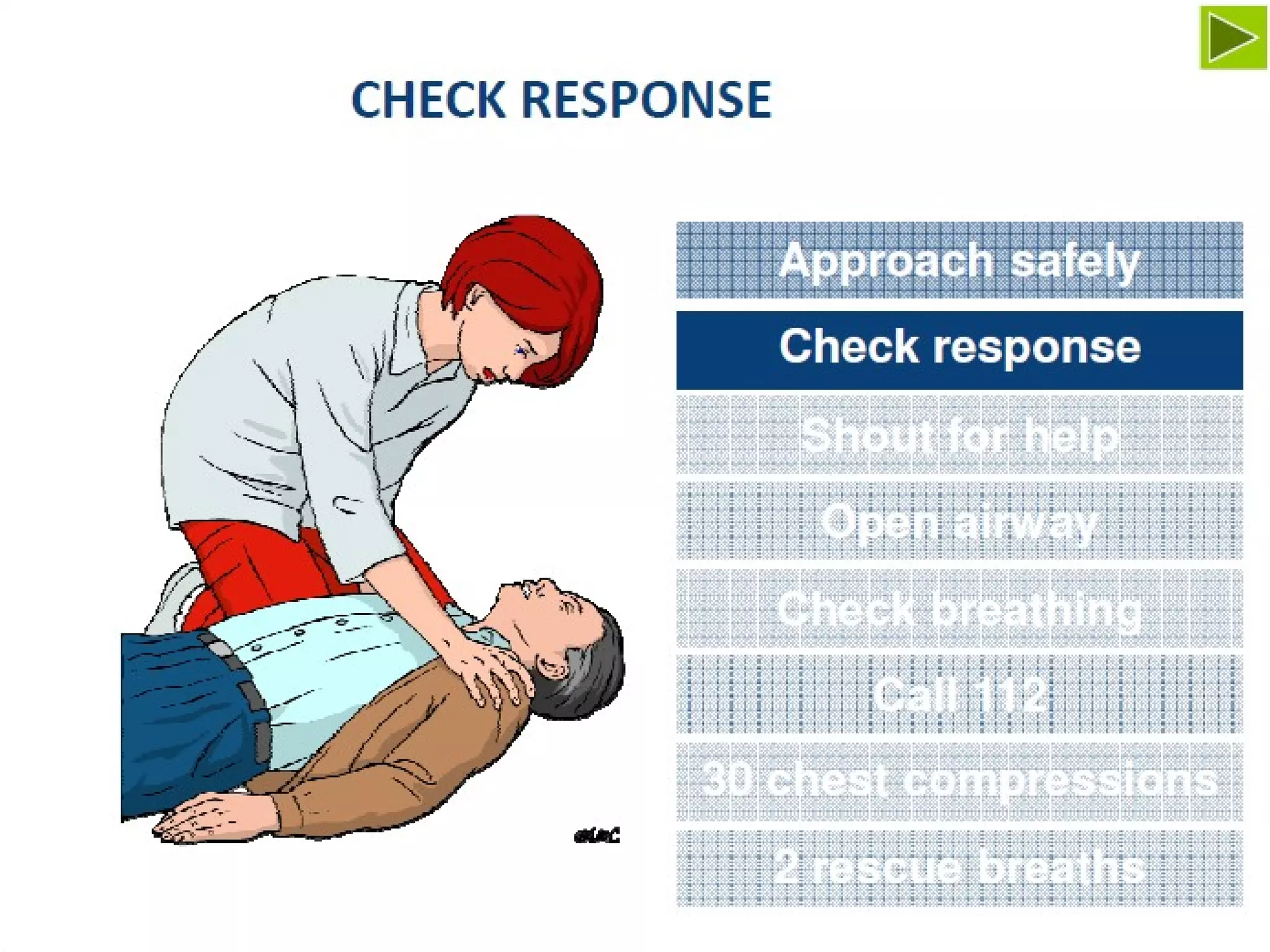
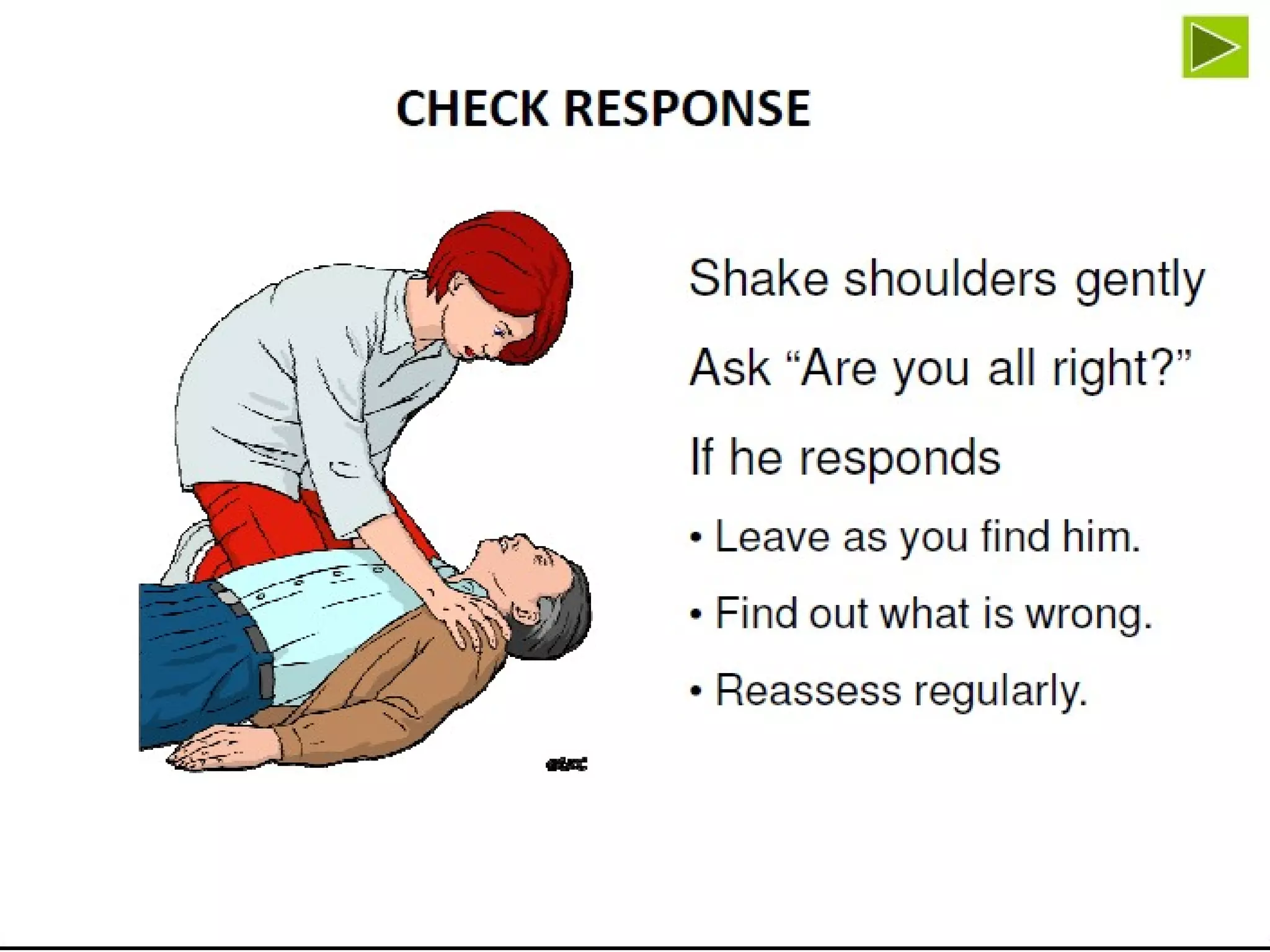
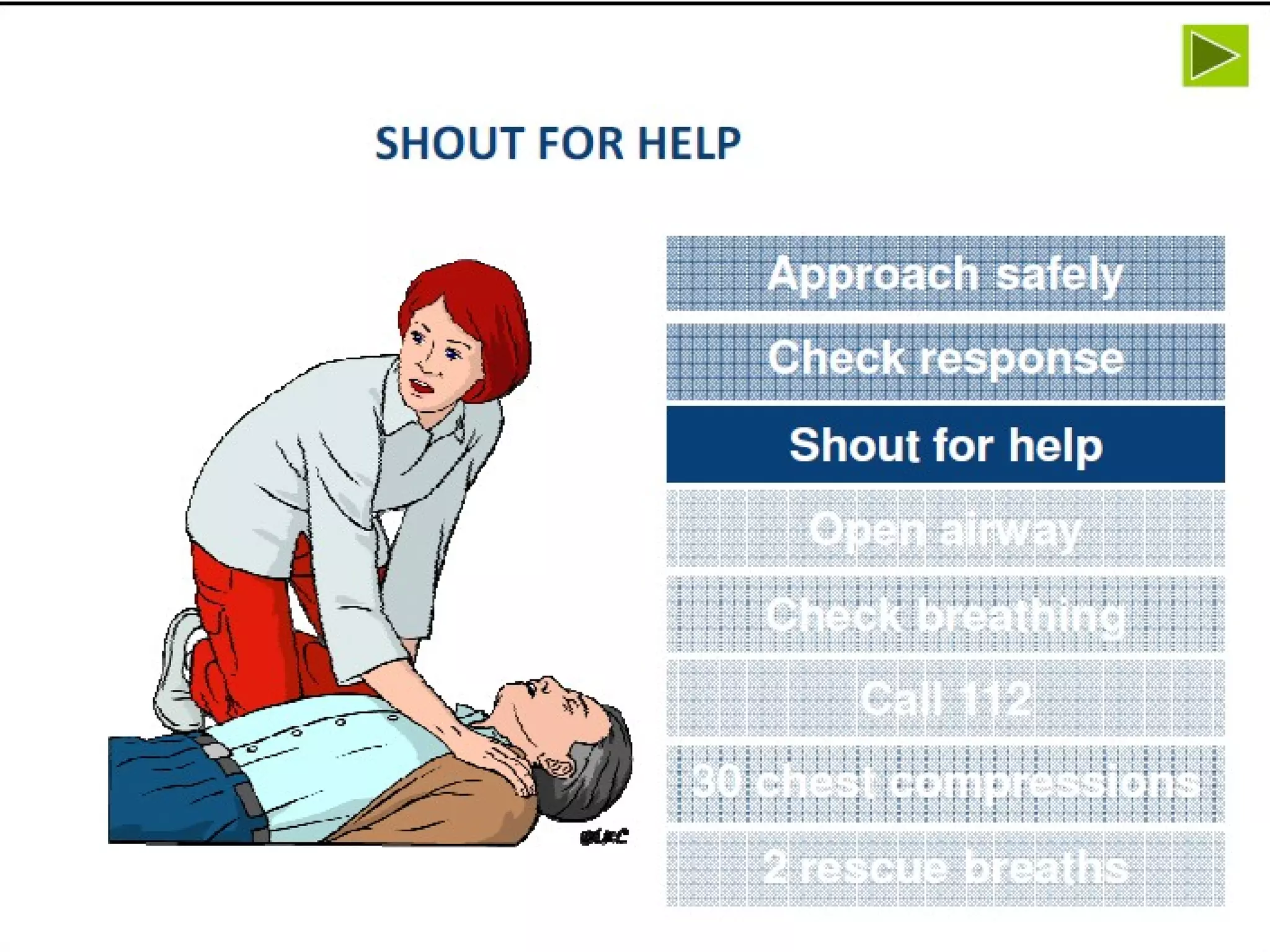
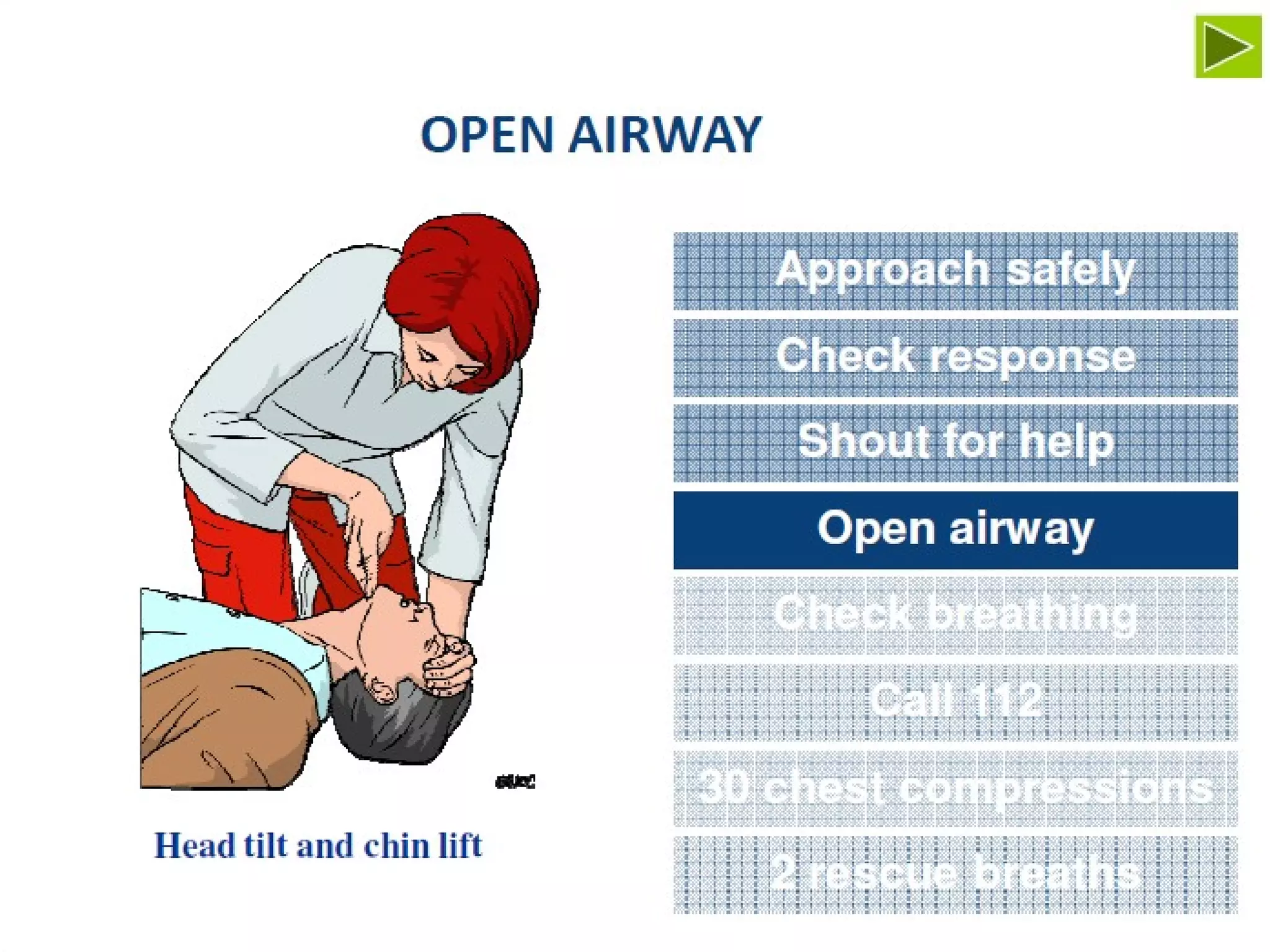
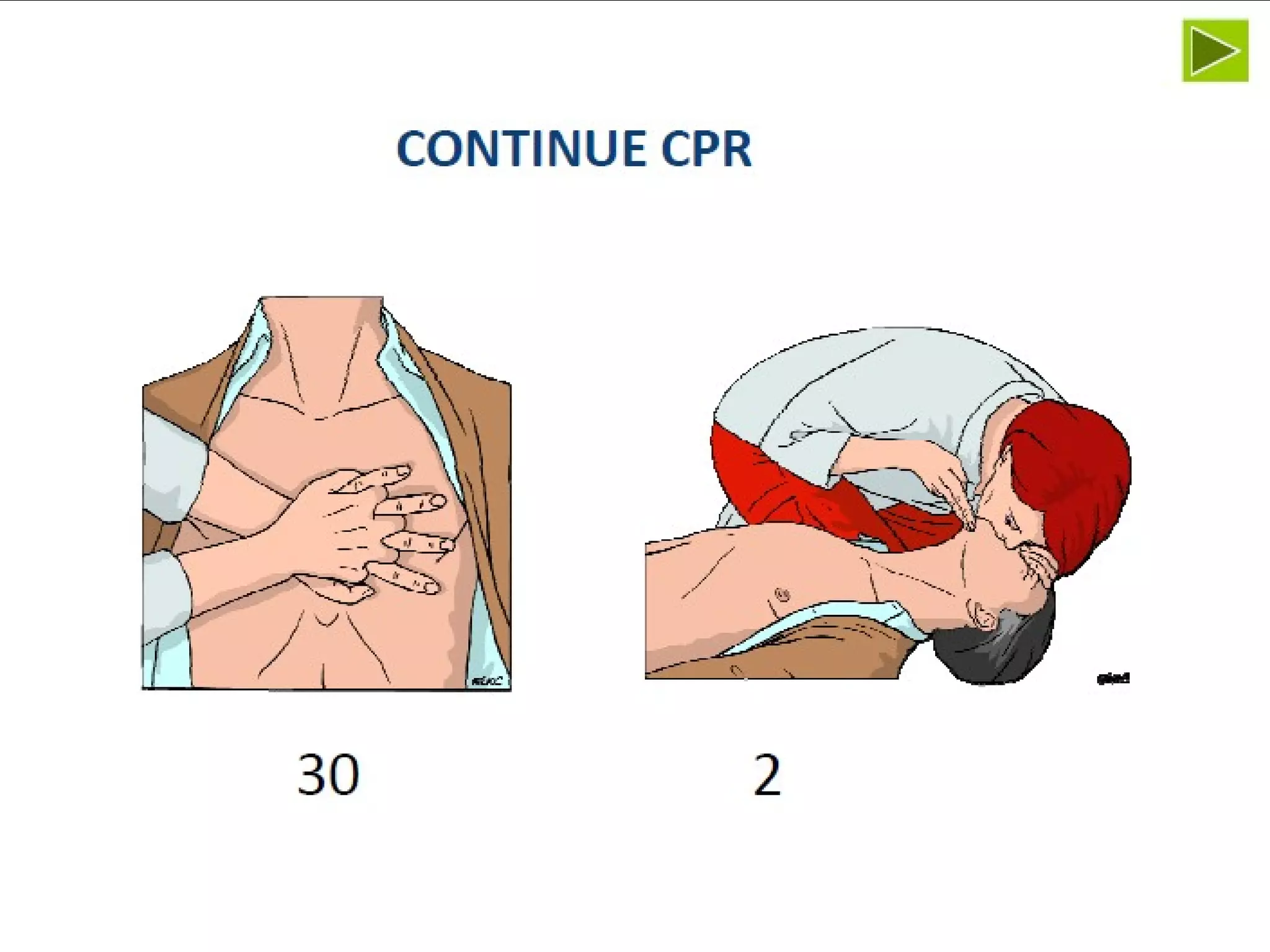
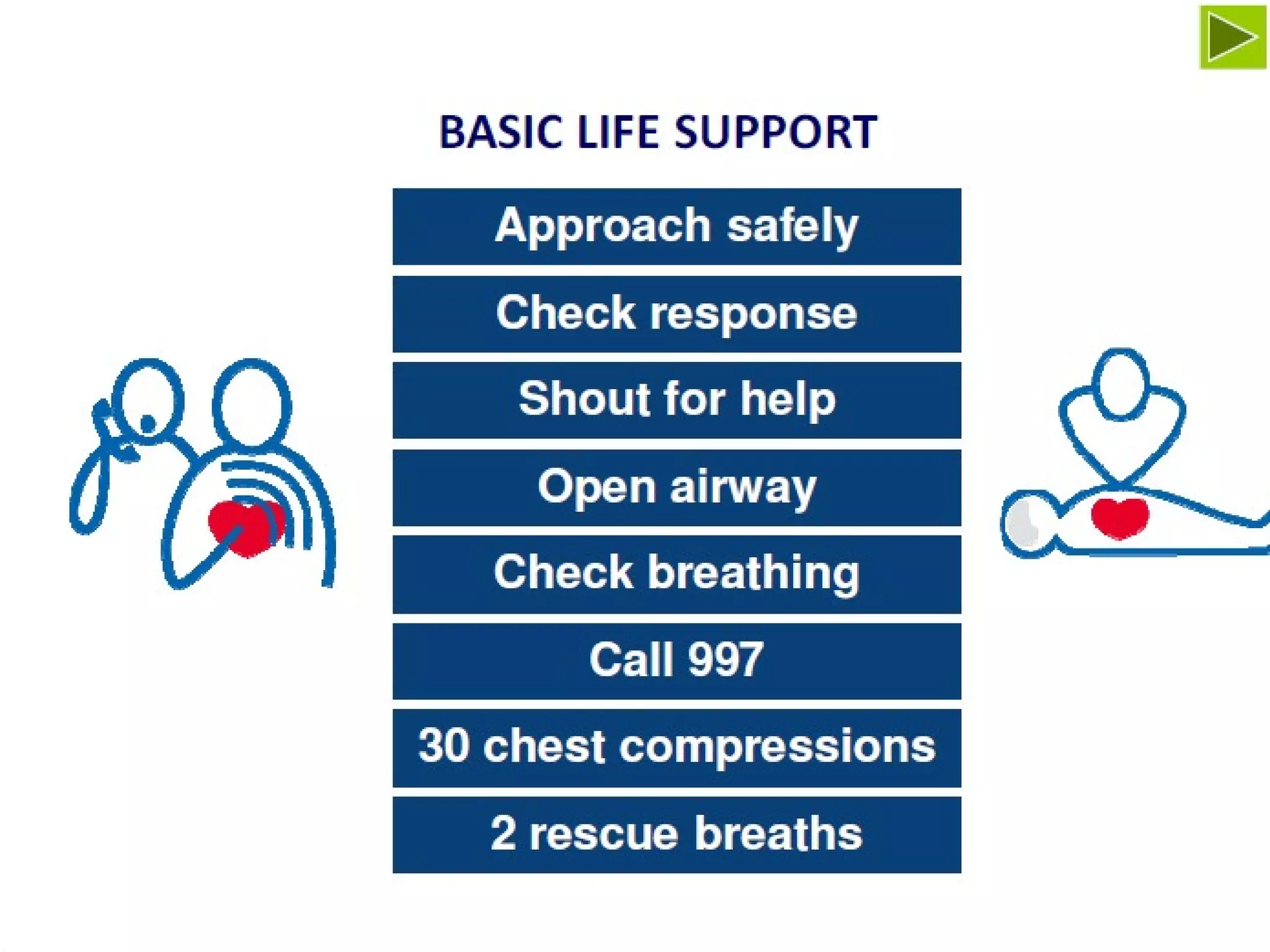
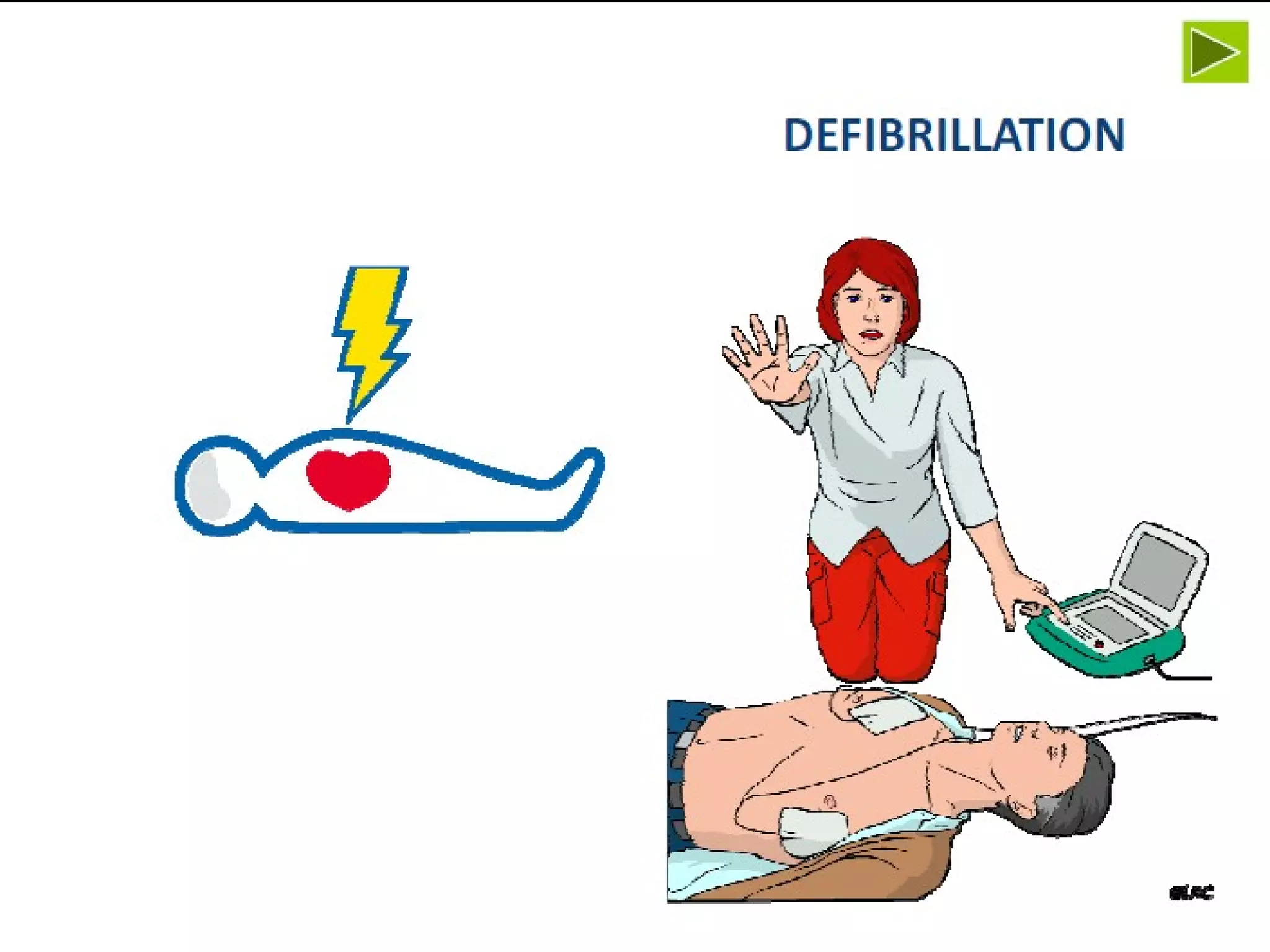
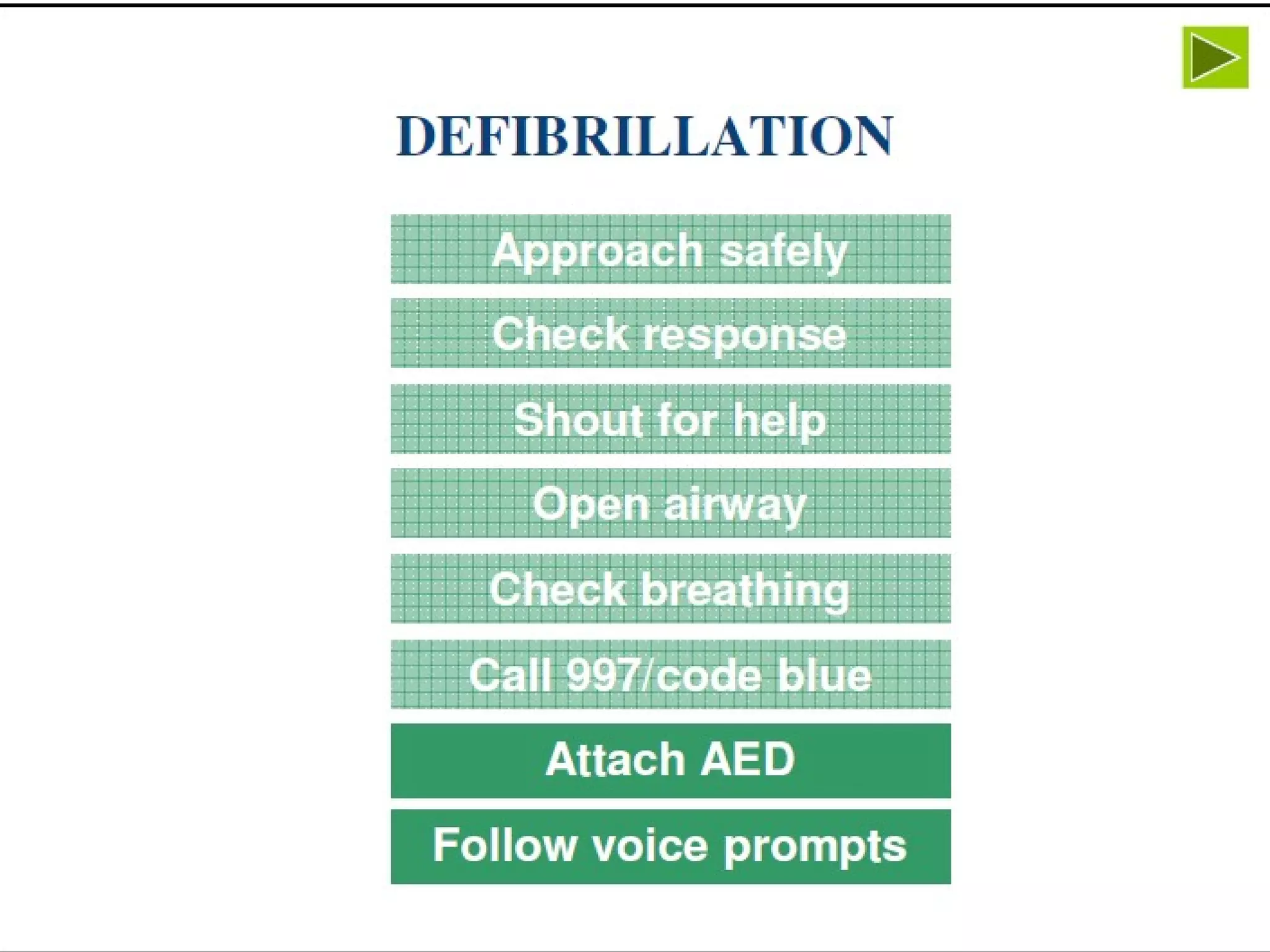
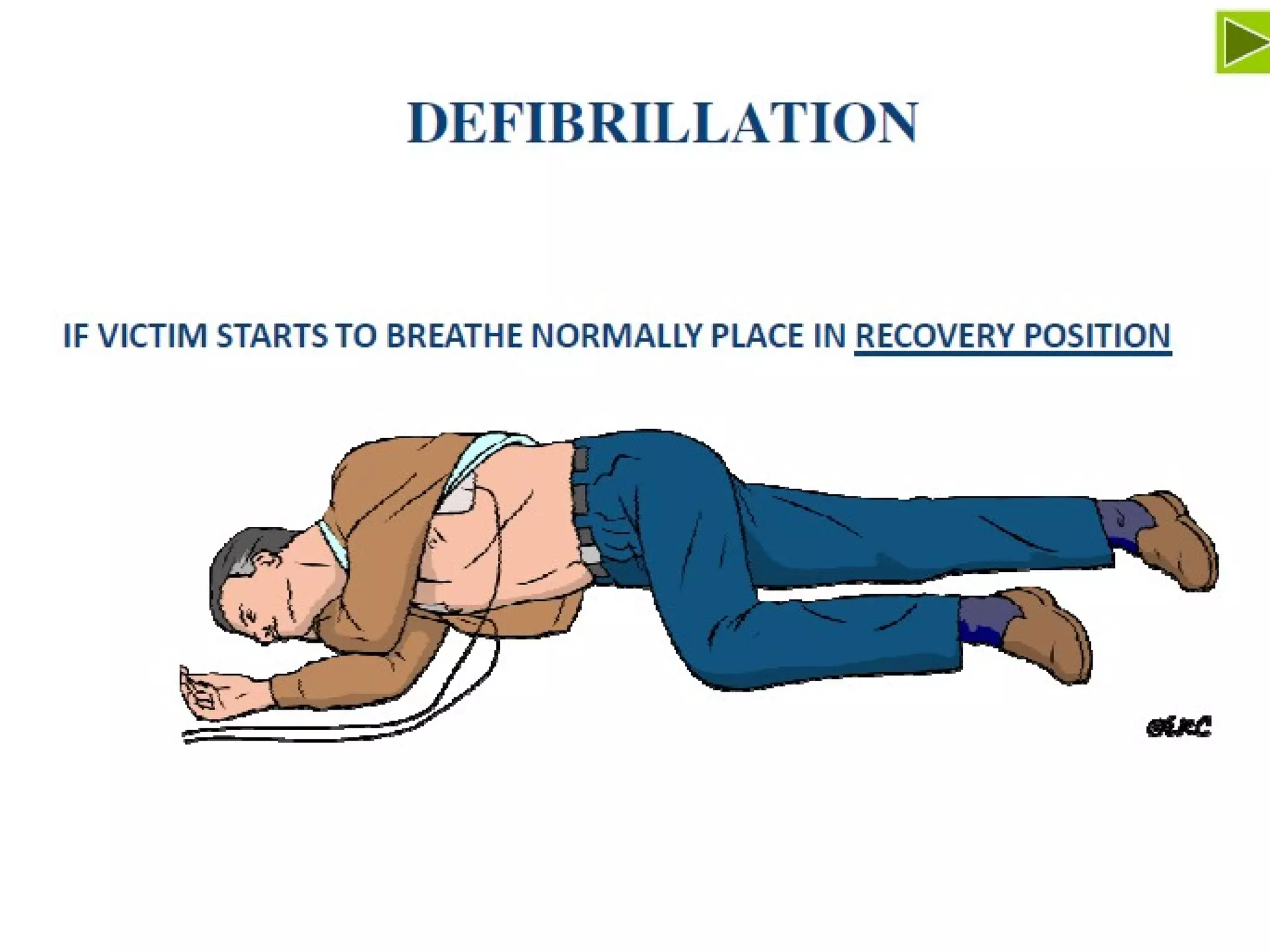
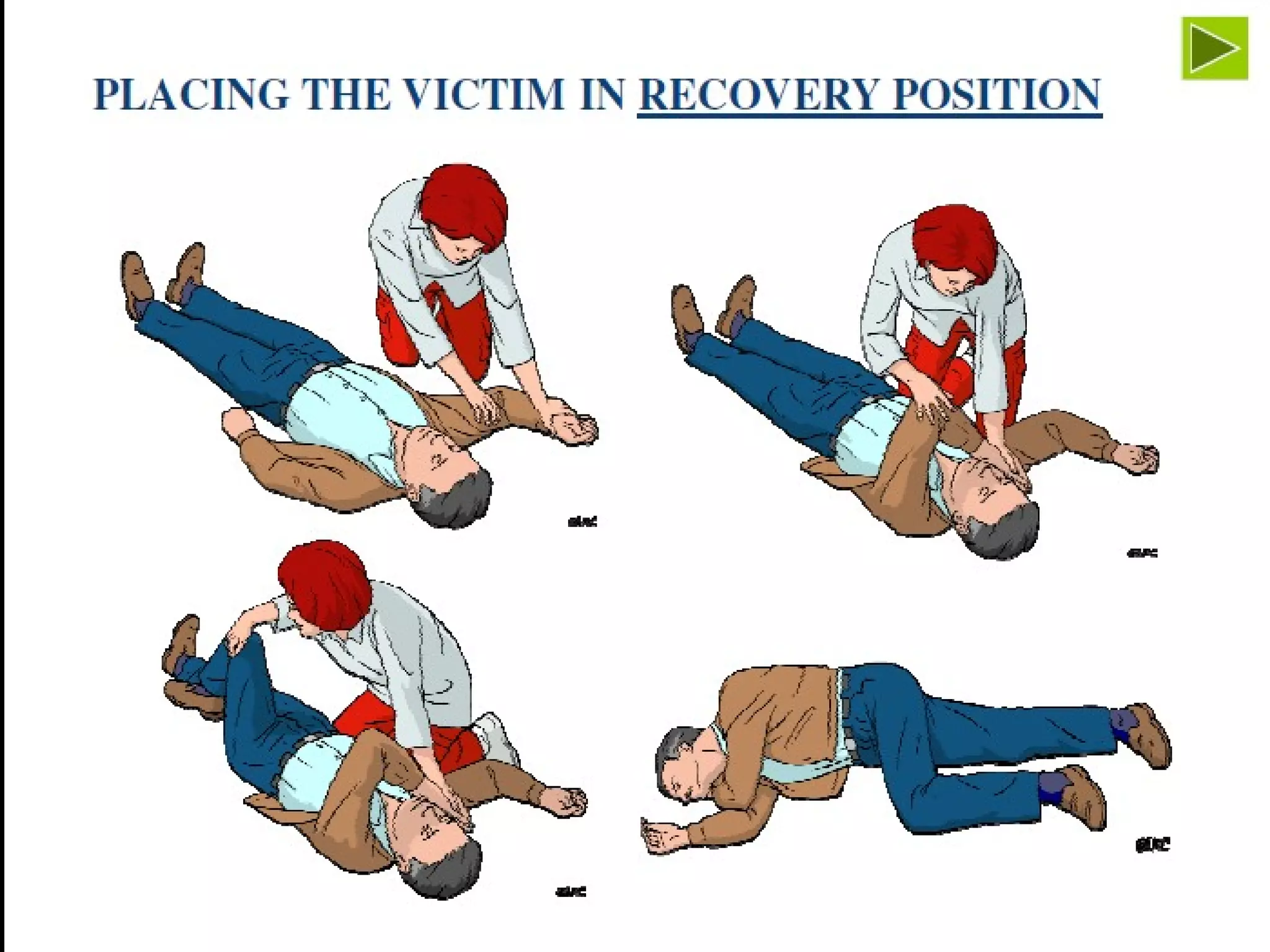
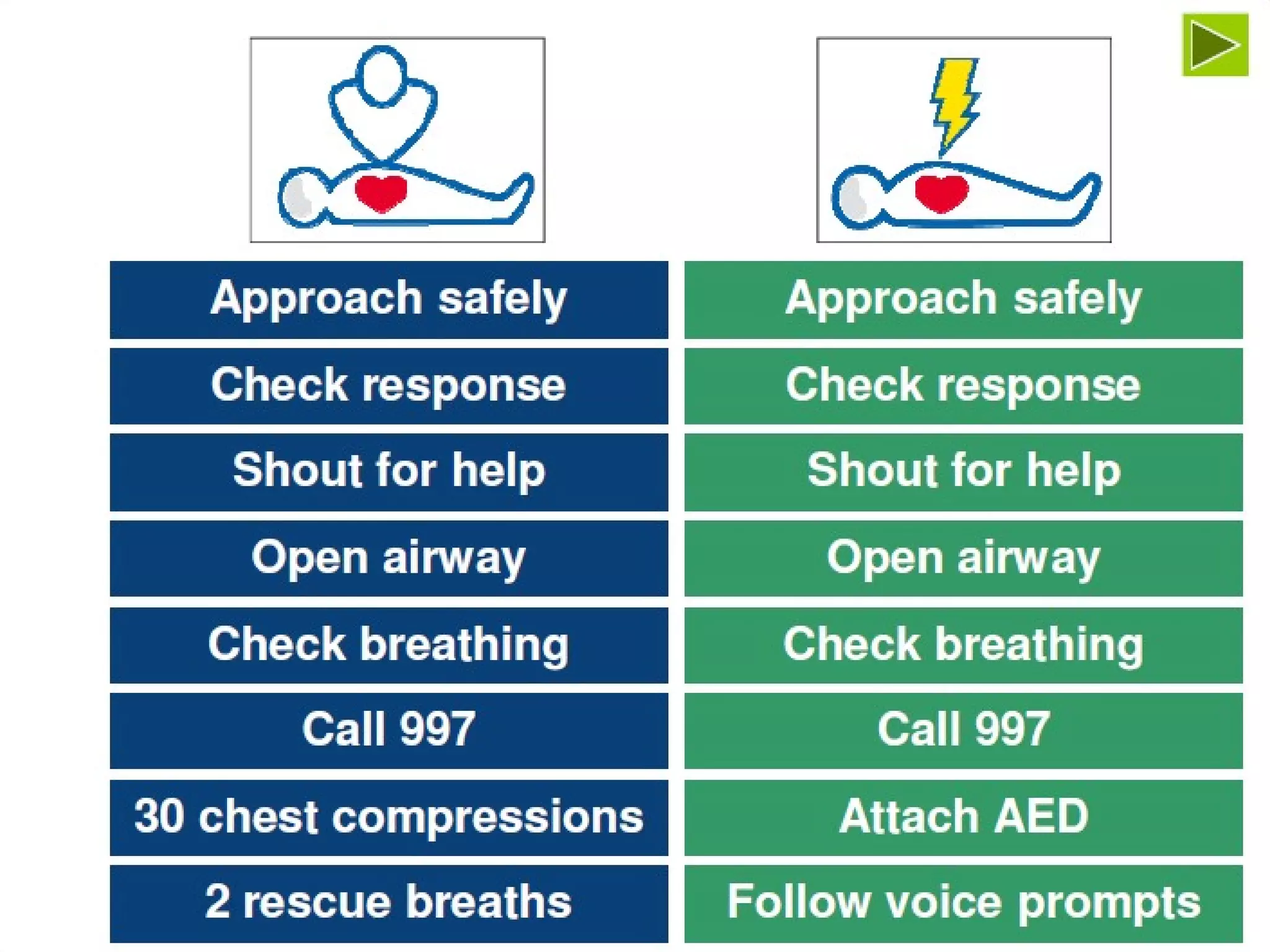
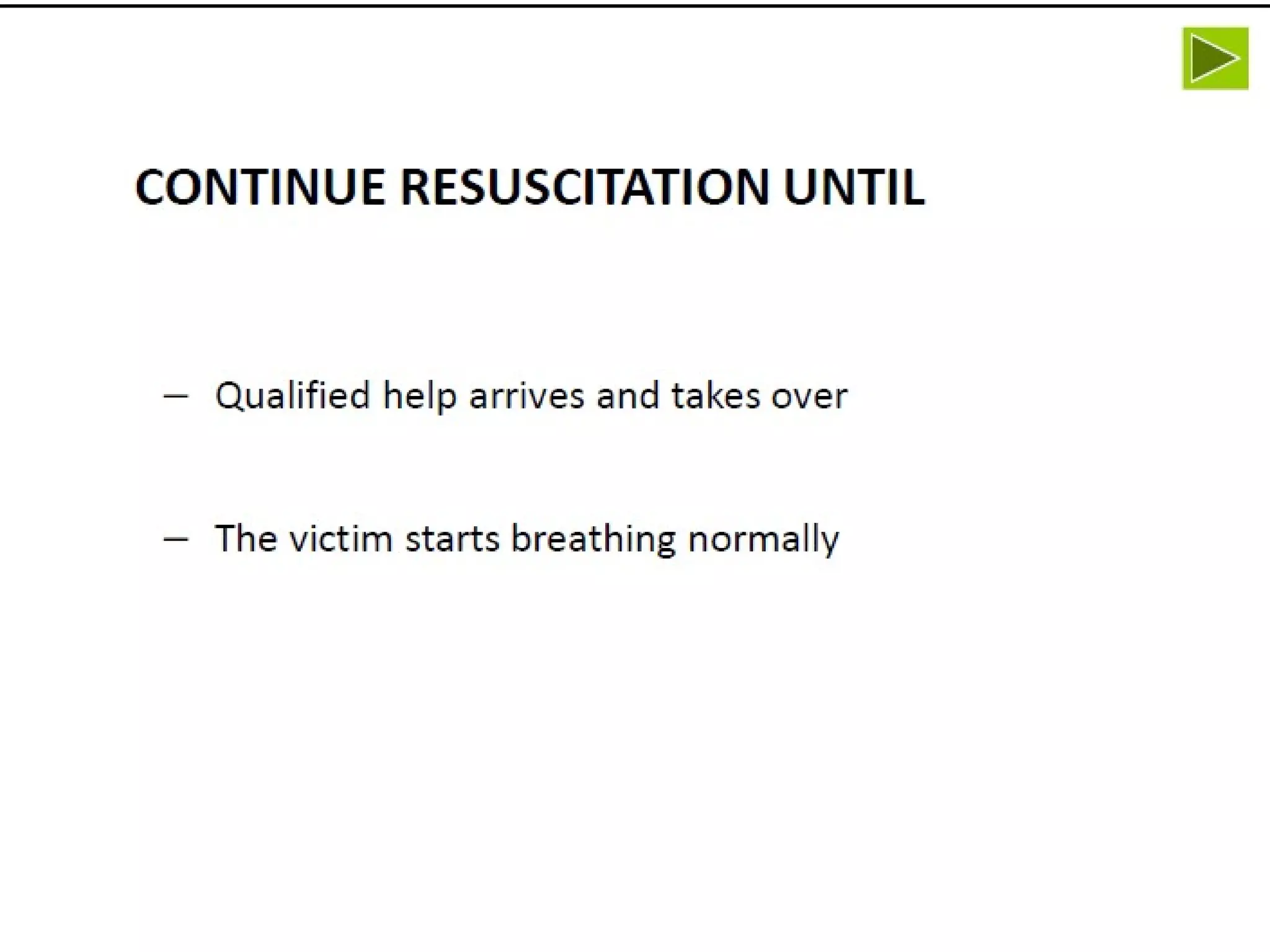
 Basic life support ( BLS )Basic life support ( BLS )
INITIAL ASSESSMENTINITIAL ASSESSMENT
ANDAND
MANAGEMENT OF TRAUMA PATIENTSMANAGEMENT OF TRAUMA PATIENTS
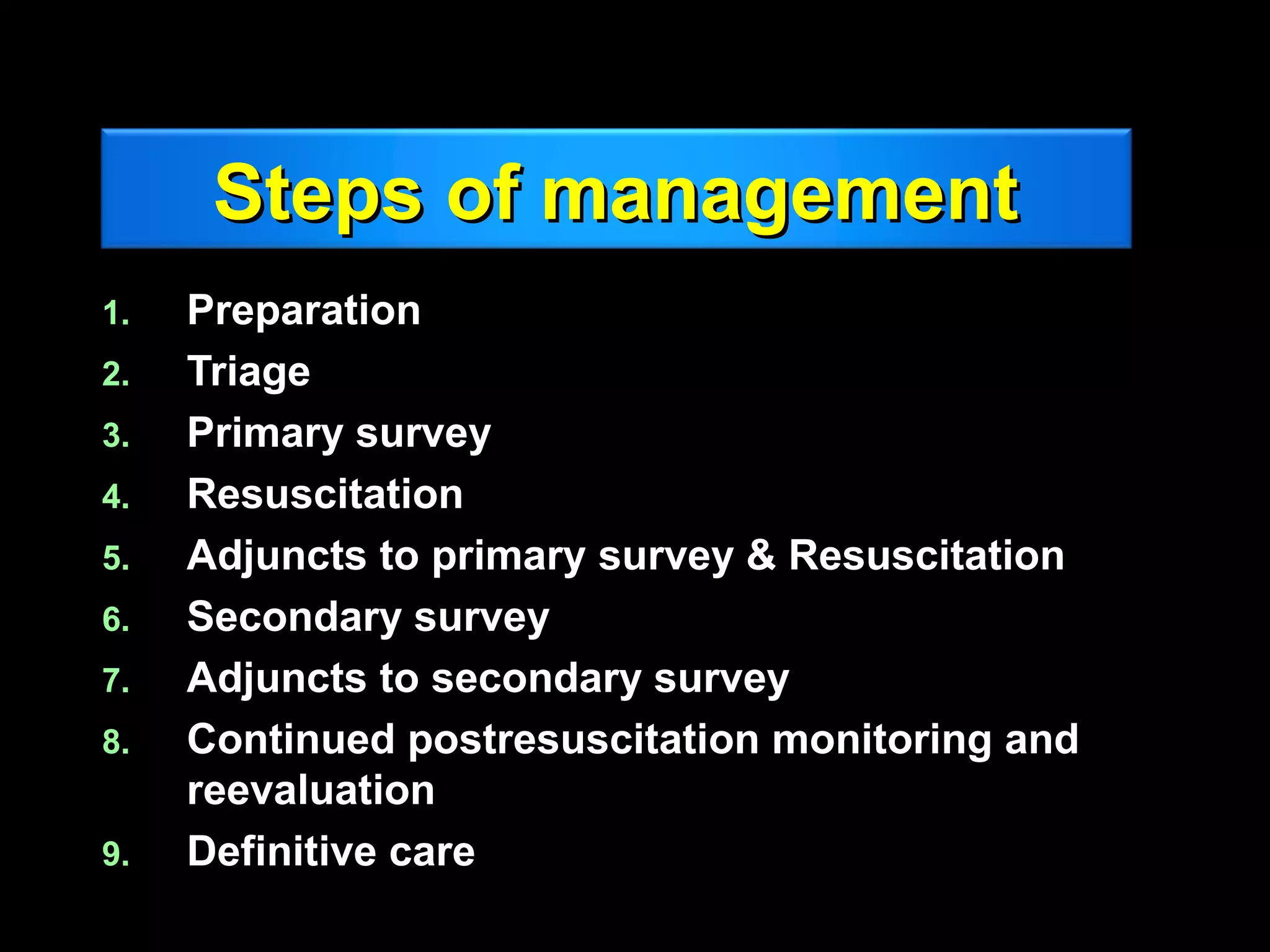
Steps of managementSteps of management
1.1. PreparationPreparation
2.2. TriageTriage
3.3. Primary surveyPrimary survey
4.4. ResuscitationResuscitation
5.5. Adjuncts to primaryAdjuncts to primary survey & Resuscitationsurvey & Resuscitation
6.6. Secondary surveySecondary survey
7.7. Adjuncts to secondary surveyAdjuncts to secondary survey
8.8. Continued postresuscitation monitoring andContinued postresuscitation monitoring and
reevaluationreevaluation
9.9. Definitive careDefinitive care
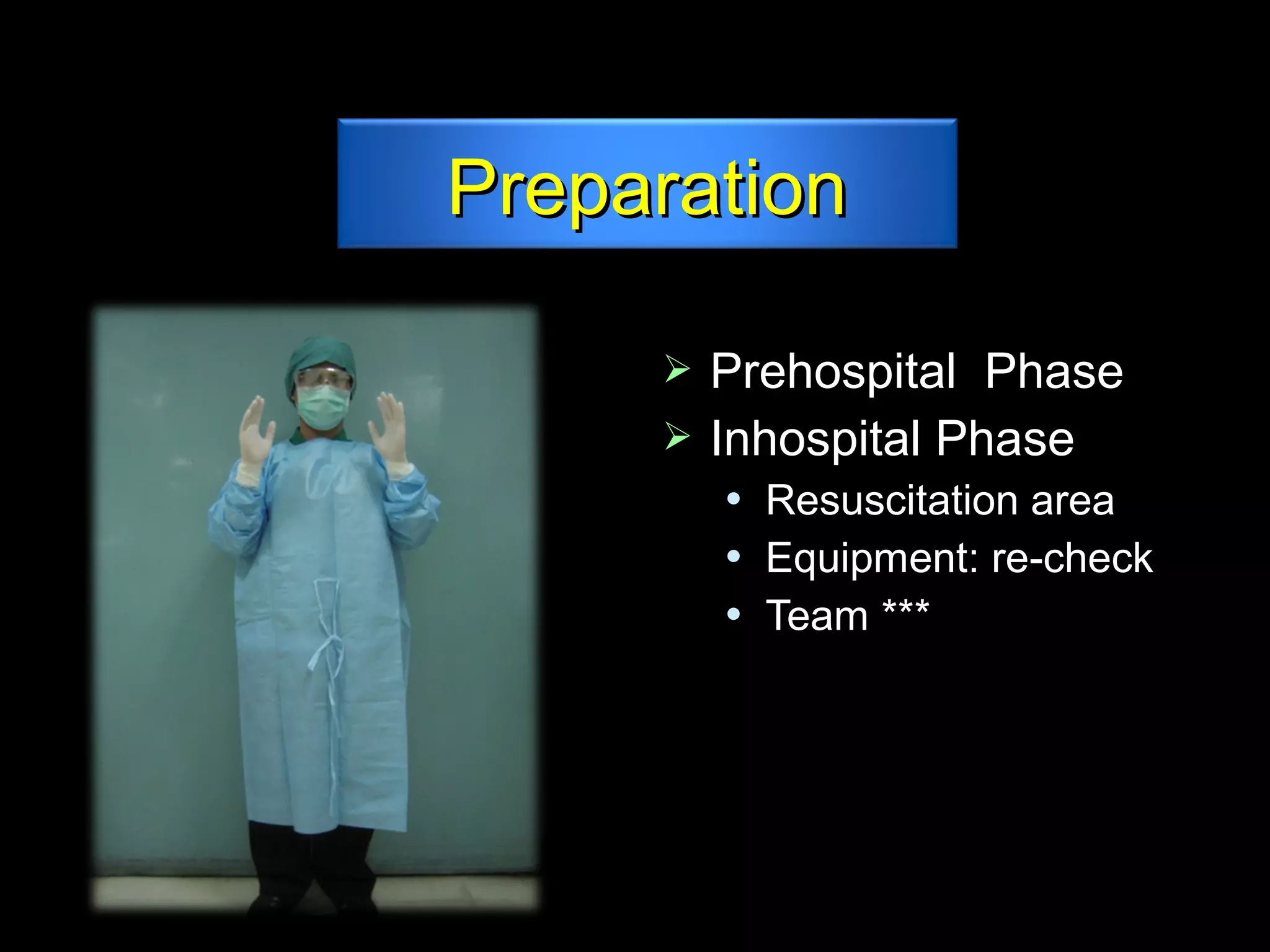
PreparationPreparation
 Prehospital PhasePrehospital Phase
 Inhospital PhaseInhospital Phase
 Resuscitation areaResuscitation area
 Equipment: re-checkEquipment: re-check
 Team ***Team ***
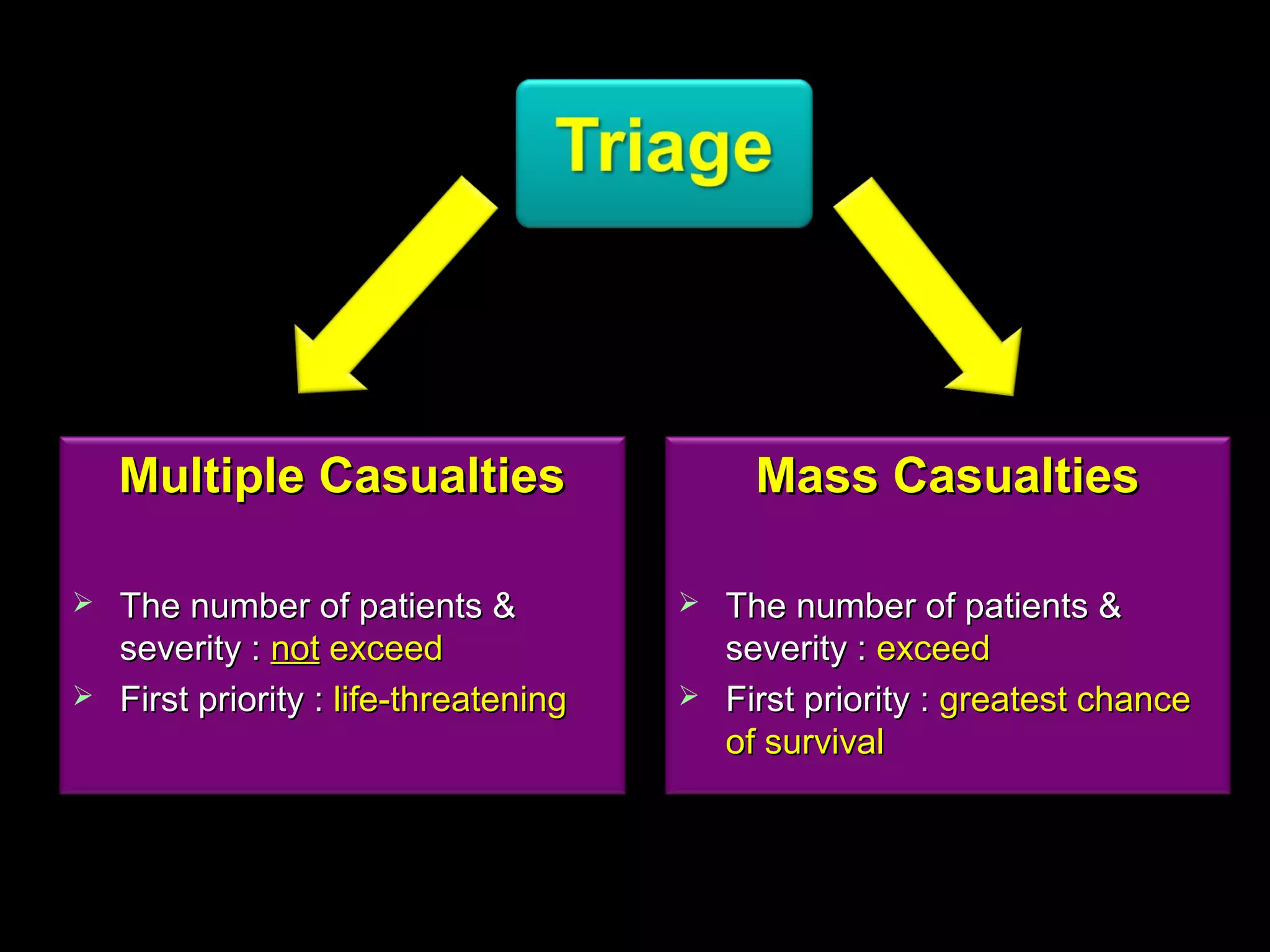
Multiple CasualtiesMultiple Casualties
 The number of patients &The number of patients &
severity :severity : notnot exceedexceed
 First priority :First priority : life-threateninglife-threatening
Mass CasualtiesMass Casualties
 The number of patients &The number of patients &
severity :severity : exceedexceed
 First priority :First priority : greatest chancegreatest chance
of survivalof survival
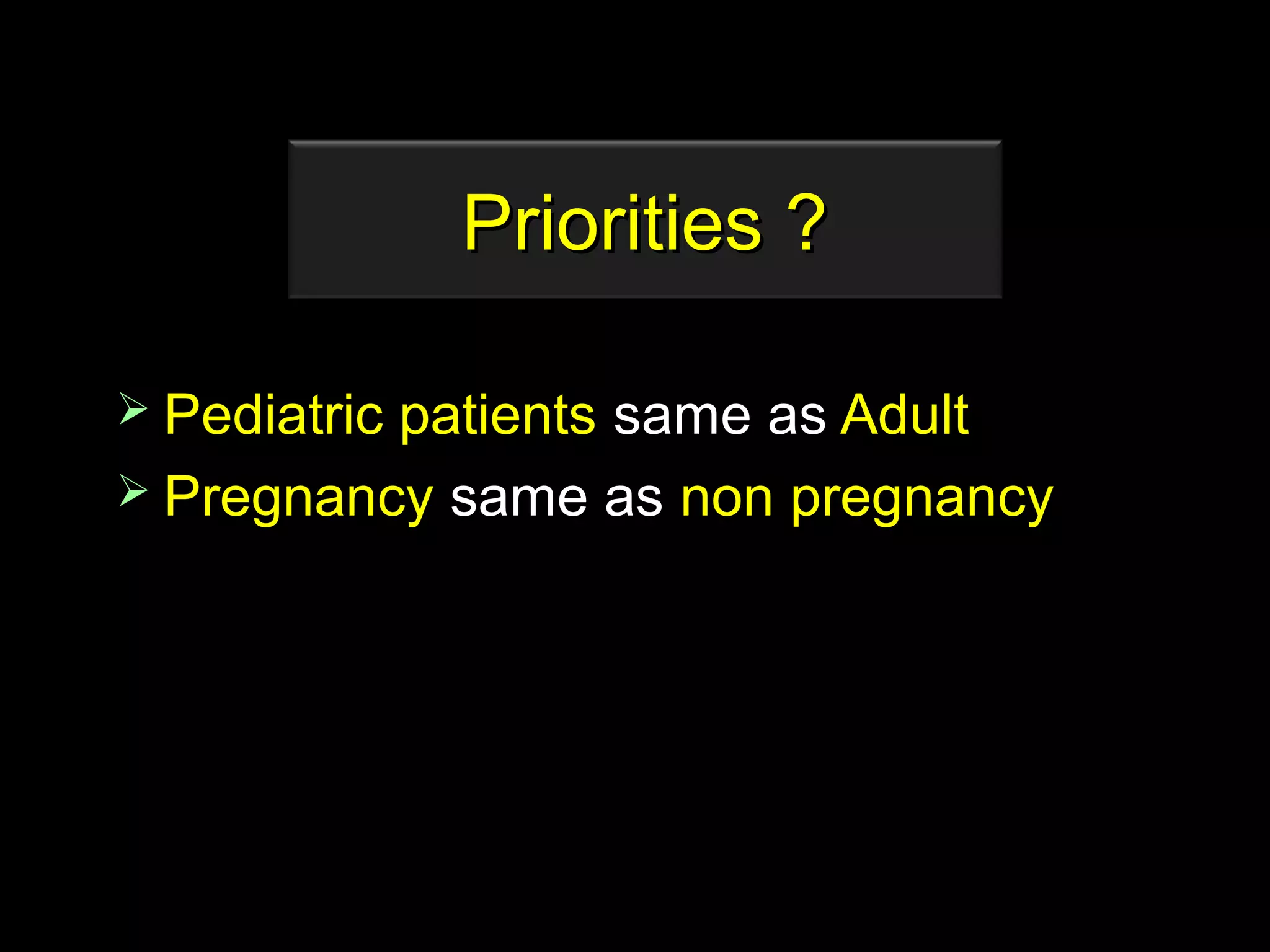
Priorities ?Priorities ?
 Pediatric patientsPediatric patients same assame as AdultAdult
 PregnancyPregnancy same assame as non pregnancynon pregnancy
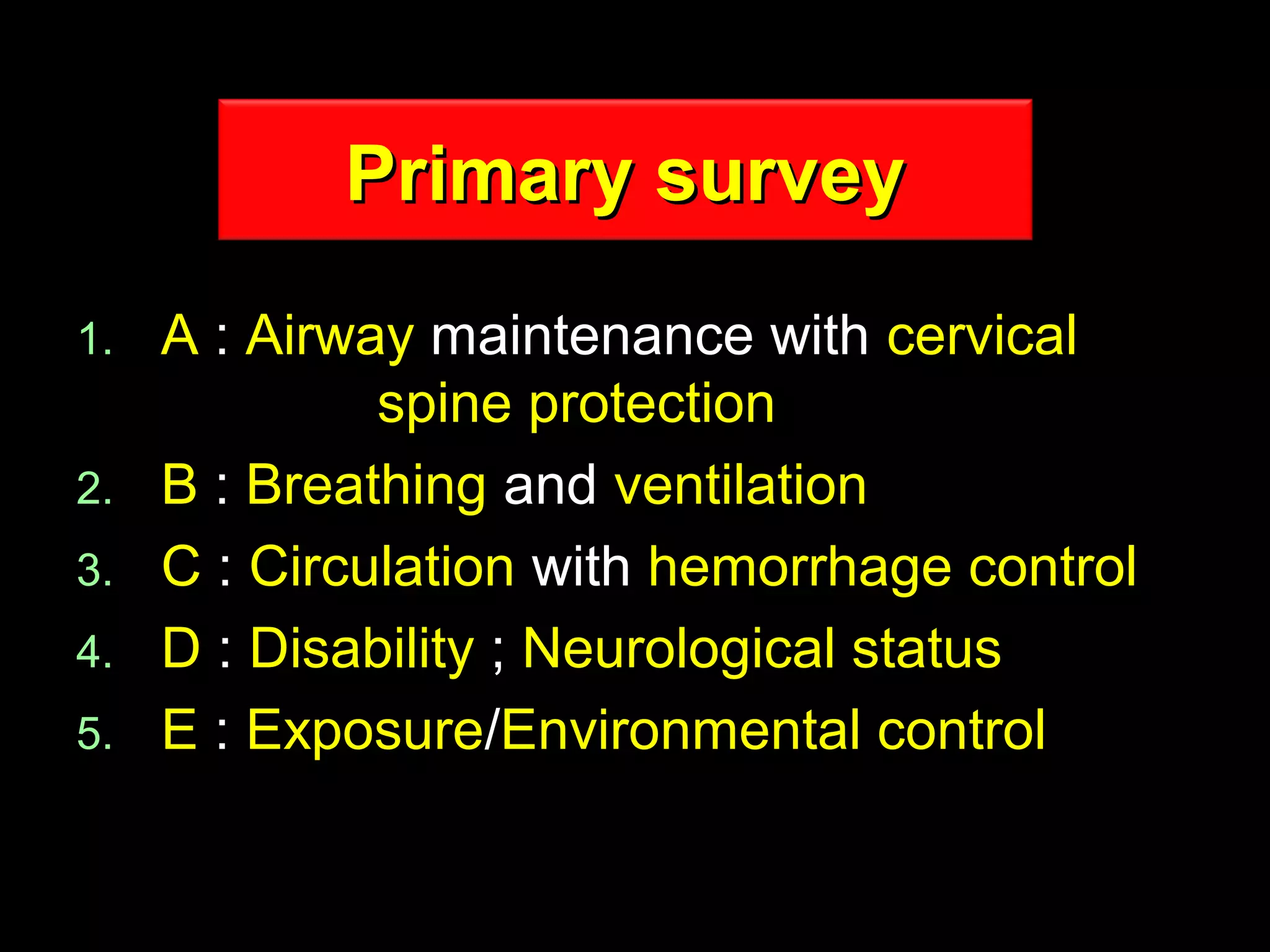
Primary surveyPrimary survey
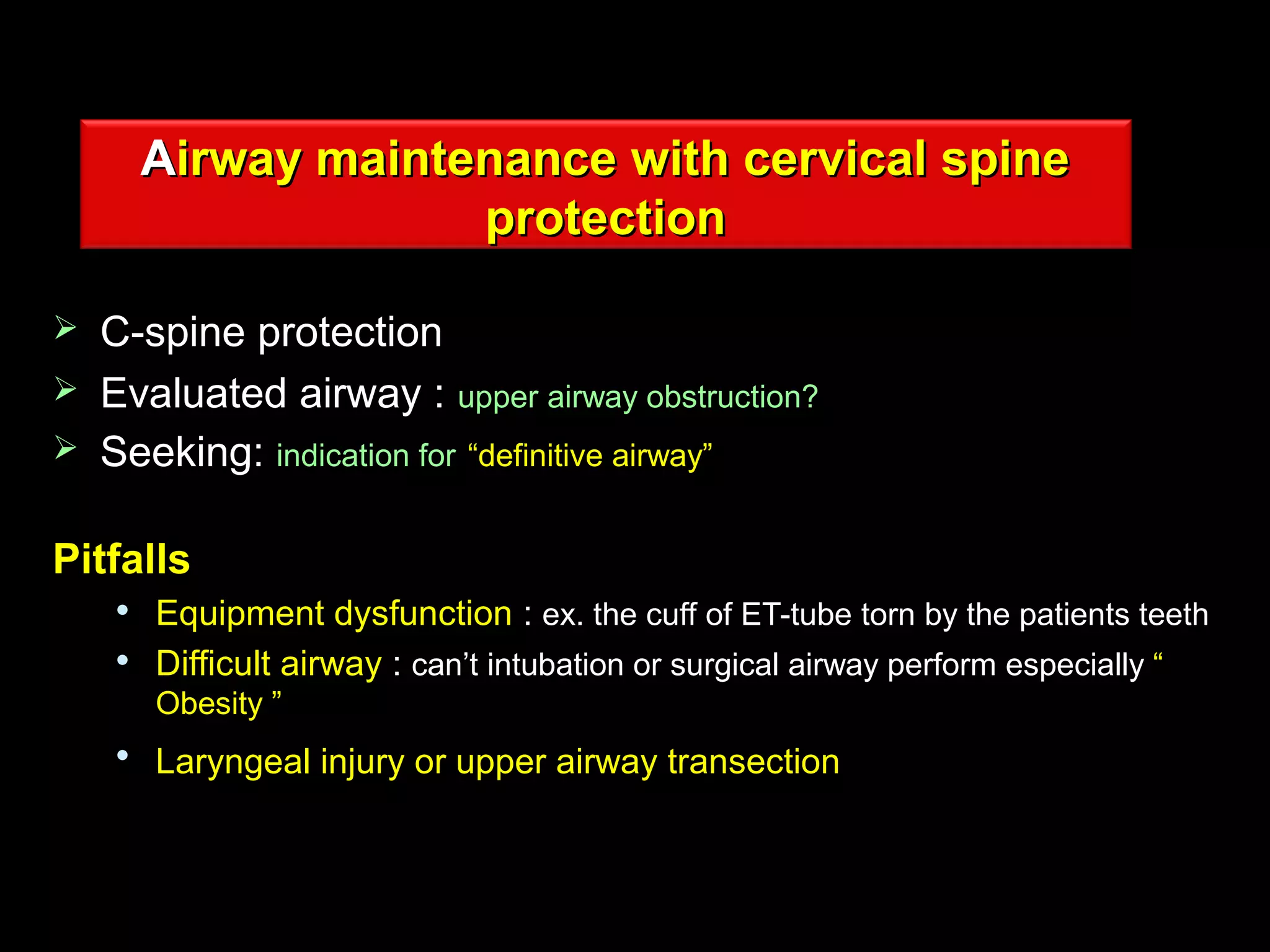
1.1. AA :: AirwayAirway maintenance withmaintenance with cervicalcervical
spine protectionspine protection
2.2. BB :: BreathingBreathing andand ventilationventilation
3.3. CC :: CirculationCirculation withwith hemorrhage controlhemorrhage control
4.4. DD :: DisabilityDisability ;; Neurological statusNeurological status
5.5. EE :: ExposureExposure//Environmental controlEnvironmental control
AAirway maintenance with cervical spineirway maintenance with cervical spine
protectionprotection
 C-spine protectionC-spine protection
 Evaluated airway :Evaluated airway : upper airway obstruction?upper airway obstruction?
 Seeking:Seeking: indication forindication for “definitive airway”“definitive airway”
PitfallsPitfalls

Equipment dysfunctionEquipment dysfunction :: ex. the cuff of ET-tube torn by the patients teethex. the cuff of ET-tube torn by the patients teeth

Difficult airwayDifficult airway :: can’t intubation or surgical airway performcan’t intubation or surgical airway perform especiallyespecially ““
Obesity ”Obesity ”

Laryngeal injury or upper airway transectionLaryngeal injury or upper airway transection
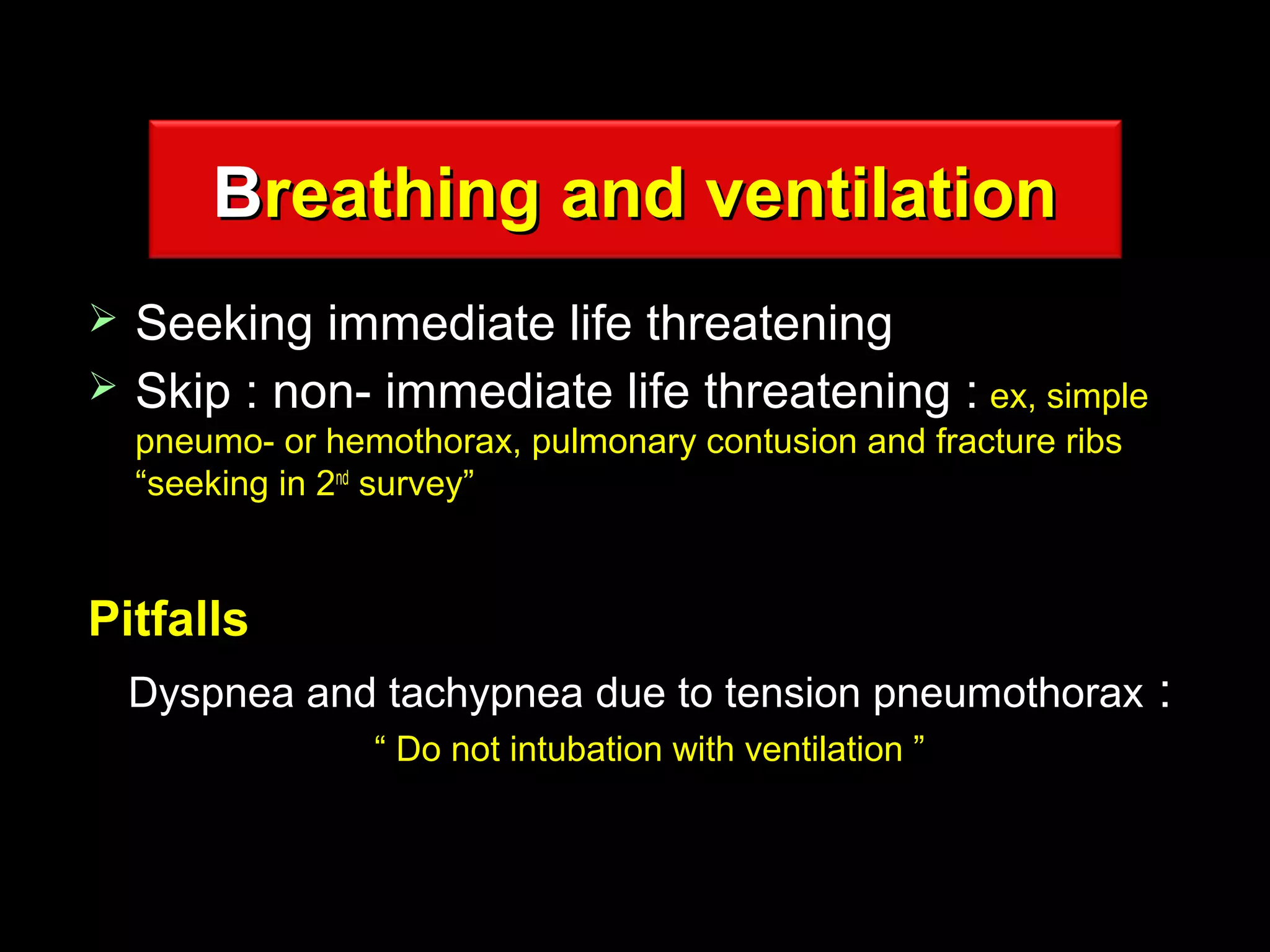
BBreathing and ventilationreathing and ventilation
 Seeking immediate life threateningSeeking immediate life threatening
 Skip : non- immediate life threatening :Skip : non- immediate life threatening : ex, simpleex, simple
pneumo- or hemothorax, pulmonary contusion and fracture ribspneumo- or hemothorax, pulmonary contusion and fracture ribs
“seeking in 2“seeking in 2ndnd
survey”survey”
PitfallsPitfalls
Dyspnea and tachypnea due to tension pneumothoraxDyspnea and tachypnea due to tension pneumothorax ::
““ Do not intubation with ventilation ”Do not intubation with ventilation ”
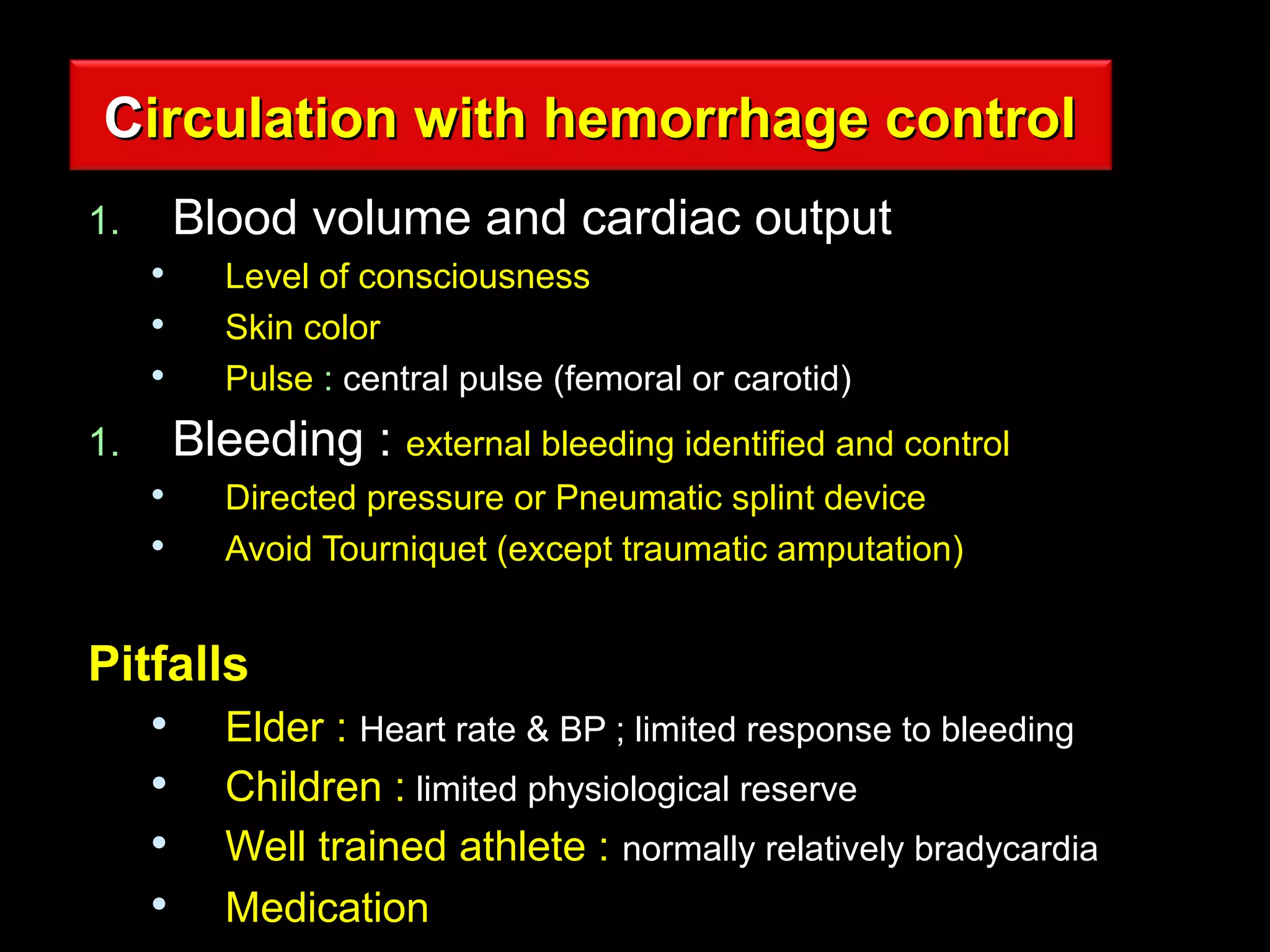
CCirculation with hemorrhage controlirculation with hemorrhage control
1.1. Blood volume and cardiac outputBlood volume and cardiac output

Level of consciousnessLevel of consciousness

Skin colorSkin color

PulsePulse :: central pulse (femoral or carotid)central pulse (femoral or carotid)
1.1. BleedingBleeding :: external bleeding identified and controlexternal bleeding identified and control

Directed pressure or Pneumatic splint deviceDirected pressure or Pneumatic splint device

Avoid Tourniquet (except traumatic amputation)Avoid Tourniquet (except traumatic amputation)
PitfallsPitfalls

ElderElder :: Heart rate & BP ; limited response to bleedingHeart rate & BP ; limited response to bleeding

Children :Children : limited physiological reservelimited physiological reserve

Well trained athlete :Well trained athlete : normally relatively bradycardianormally relatively bradycardia

MedicationMedication
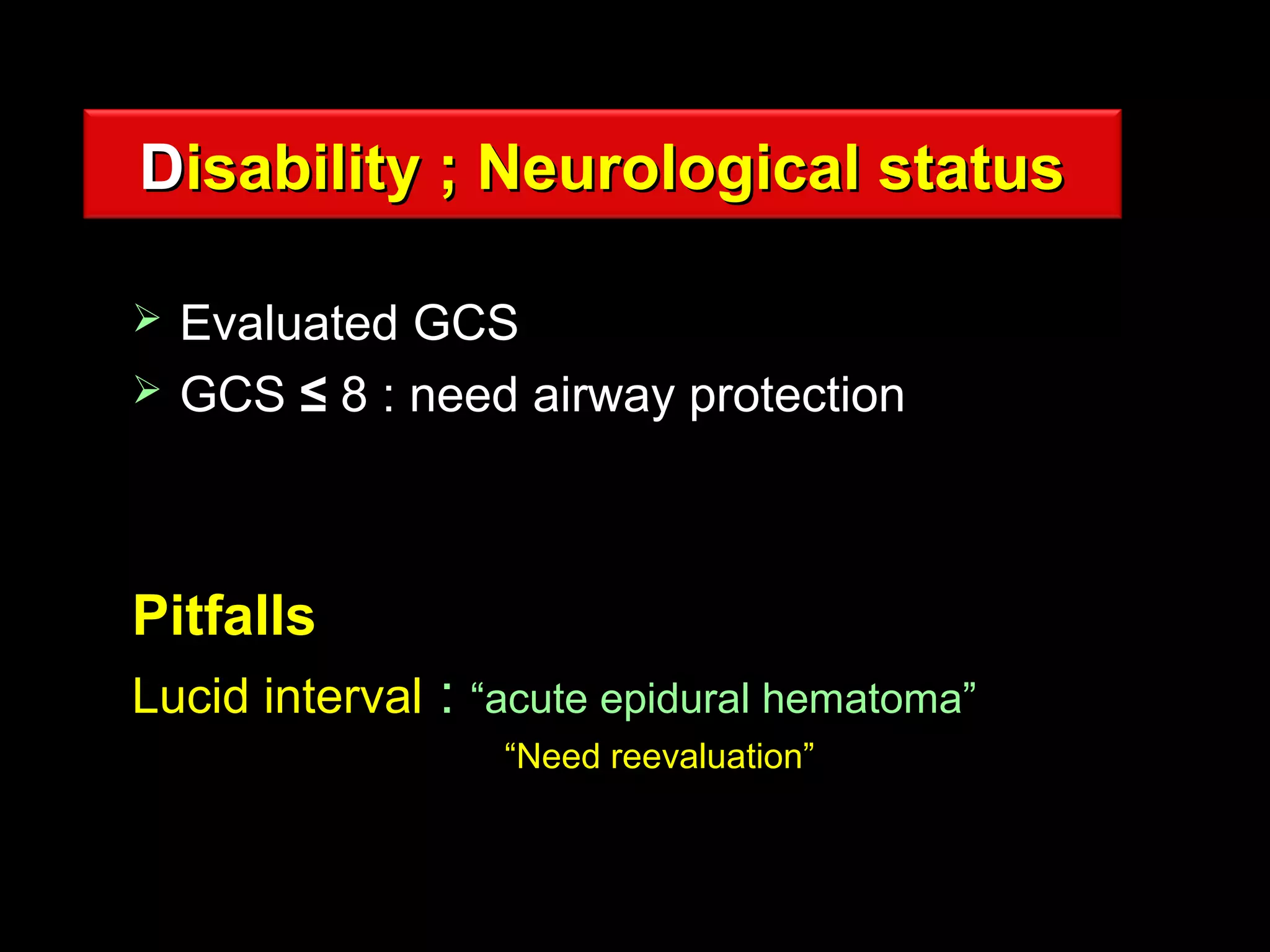
DDisability ; Neurological statusisability ; Neurological status
 Evaluated GCSEvaluated GCS
 GCSGCS ≤≤ 8 : need airway protection8 : need airway protection
PitfallsPitfalls
Lucid intervalLucid interval :: “acute epidural hematoma”“acute epidural hematoma”
““Need reevaluation”Need reevaluation”
Aims of Primary surveyAims of Primary survey
““Early Detection of Immediate LifeEarly Detection of Immediate Life
Threatening conditions”Threatening conditions”
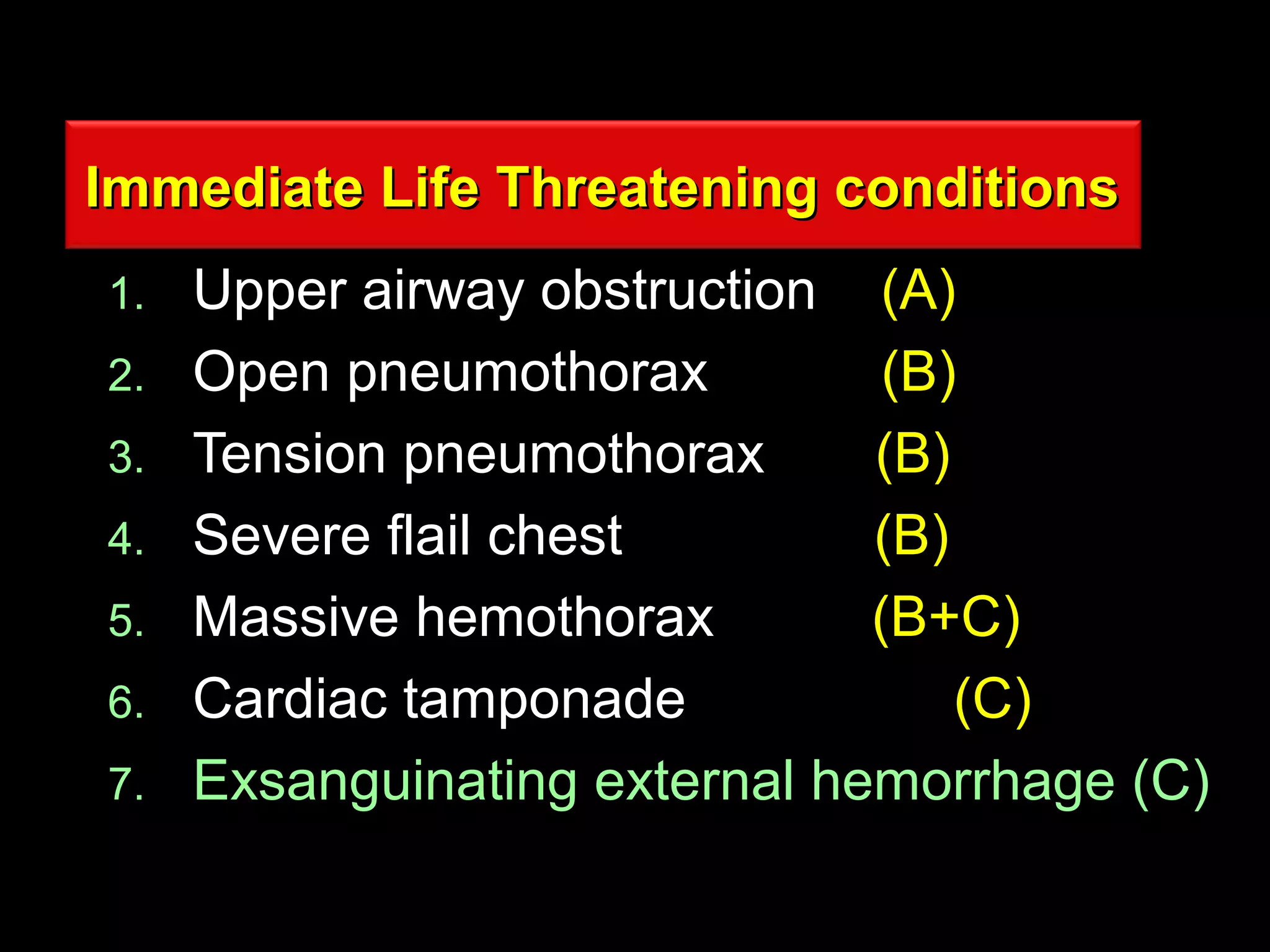
Immediate Life Threatening conditionsImmediate Life Threatening conditions
1.1. Upper airway obstructionUpper airway obstruction (A)(A)
2.2. Open pneumothoraxOpen pneumothorax (B)(B)
3.3. Tension pneumothoraxTension pneumothorax (B)(B)
4.4. Severe flail chestSevere flail chest (B)(B)
5.5. Massive hemothoraxMassive hemothorax (B+C)(B+C)
6.6. Cardiac tamponadeCardiac tamponade (C)(C)
7.7. Exsanguinating external hemorrhage (C)Exsanguinating external hemorrhage (C)
ResuscitationResuscitation
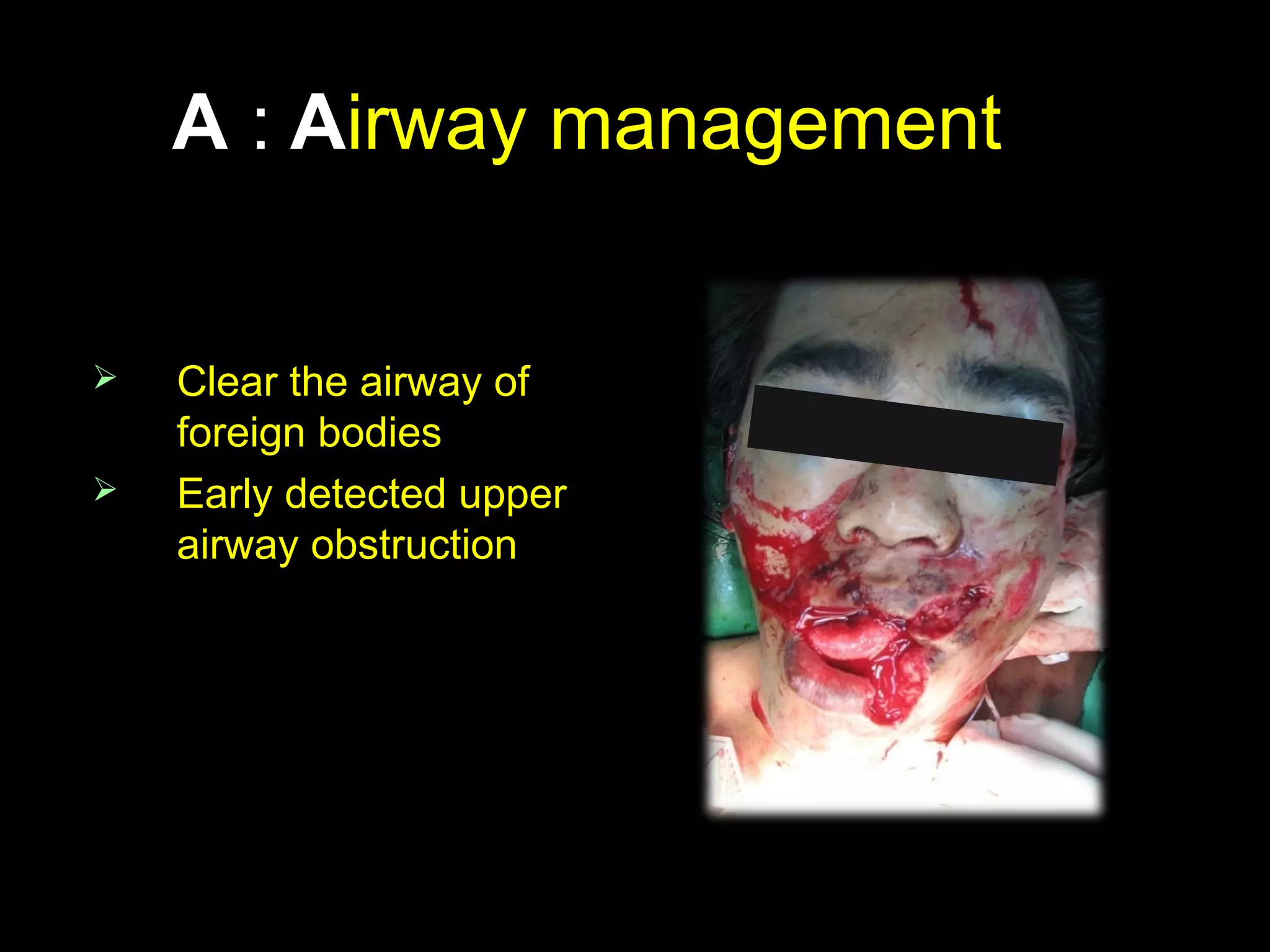
AA :: AAirwayirway managementmanagement
 Clear the airway ofClear the airway of
foreign bodiesforeign bodies
 Early detected upperEarly detected upper
airway obstructionairway obstruction
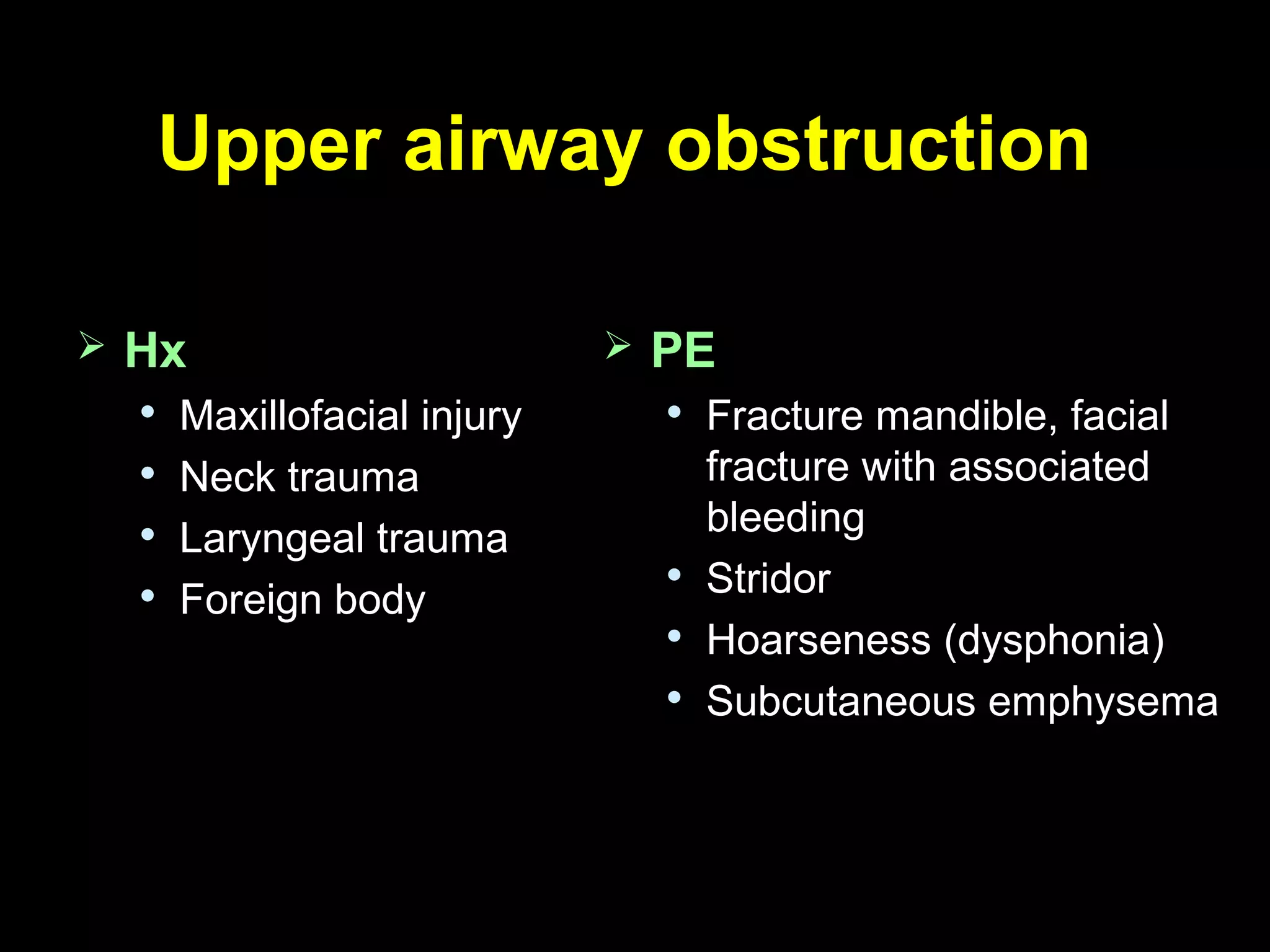
Upper airway obstructionUpper airway obstruction
 HxHx

Maxillofacial injuryMaxillofacial injury

Neck traumaNeck trauma

Laryngeal traumaLaryngeal trauma

Foreign bodyForeign body
 PEPE

Fracture mandible, facialFracture mandible, facial
fracture with associatedfracture with associated
bleedingbleeding

StridorStridor

Hoarseness (dysphonia)Hoarseness (dysphonia)

Subcutaneous emphysemaSubcutaneous emphysema
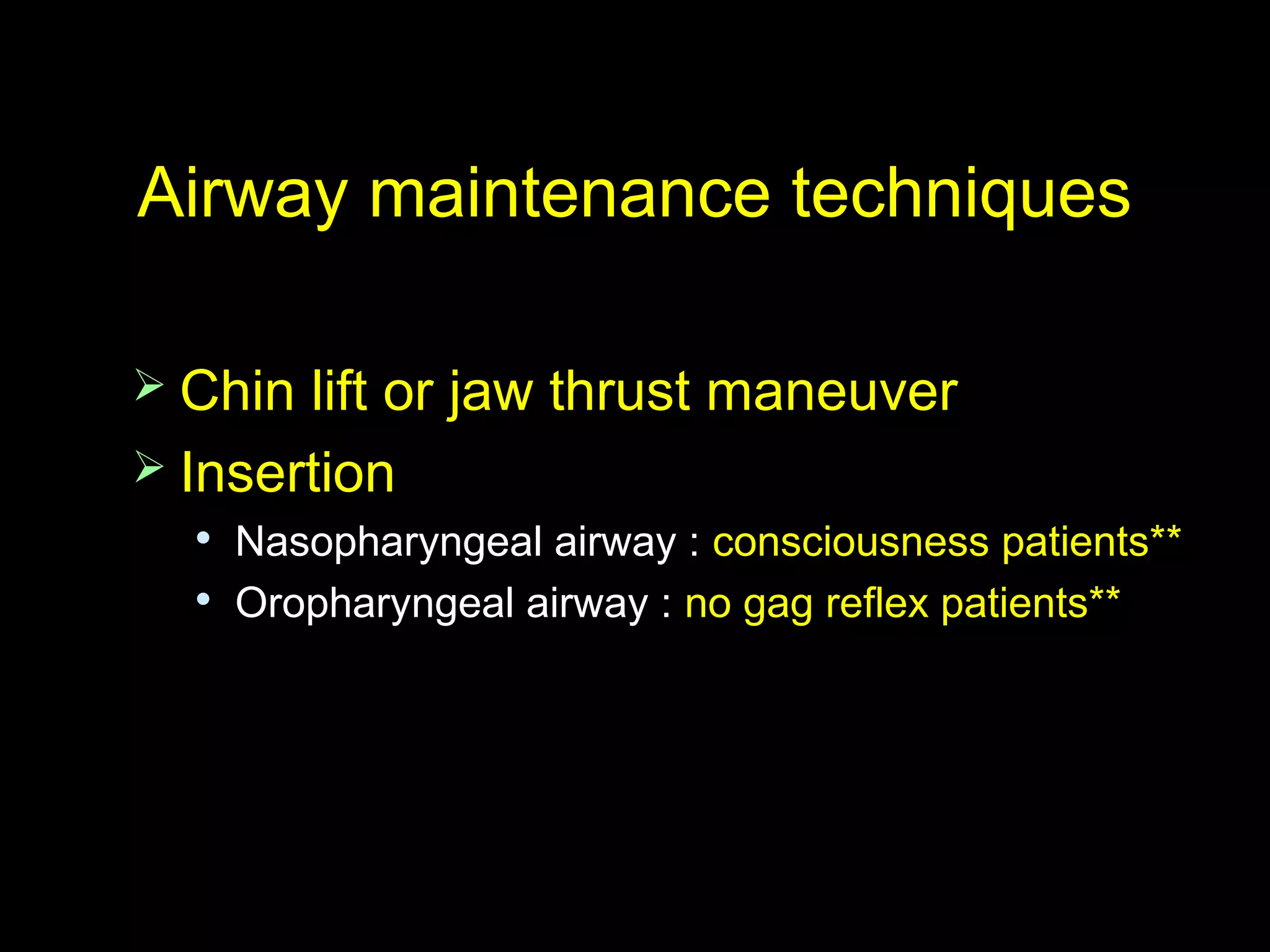
Airway maintenance techniquesAirway maintenance techniques
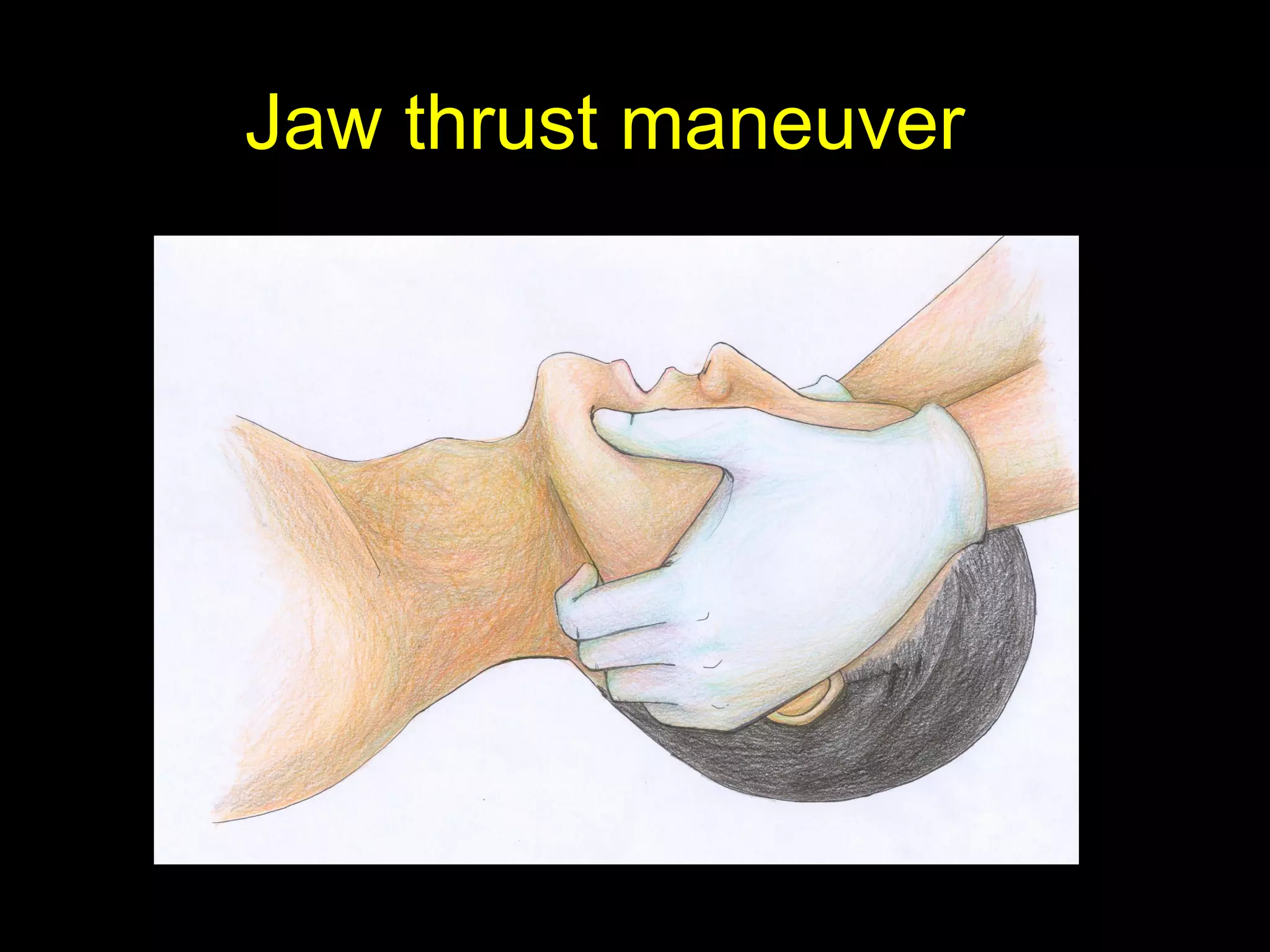
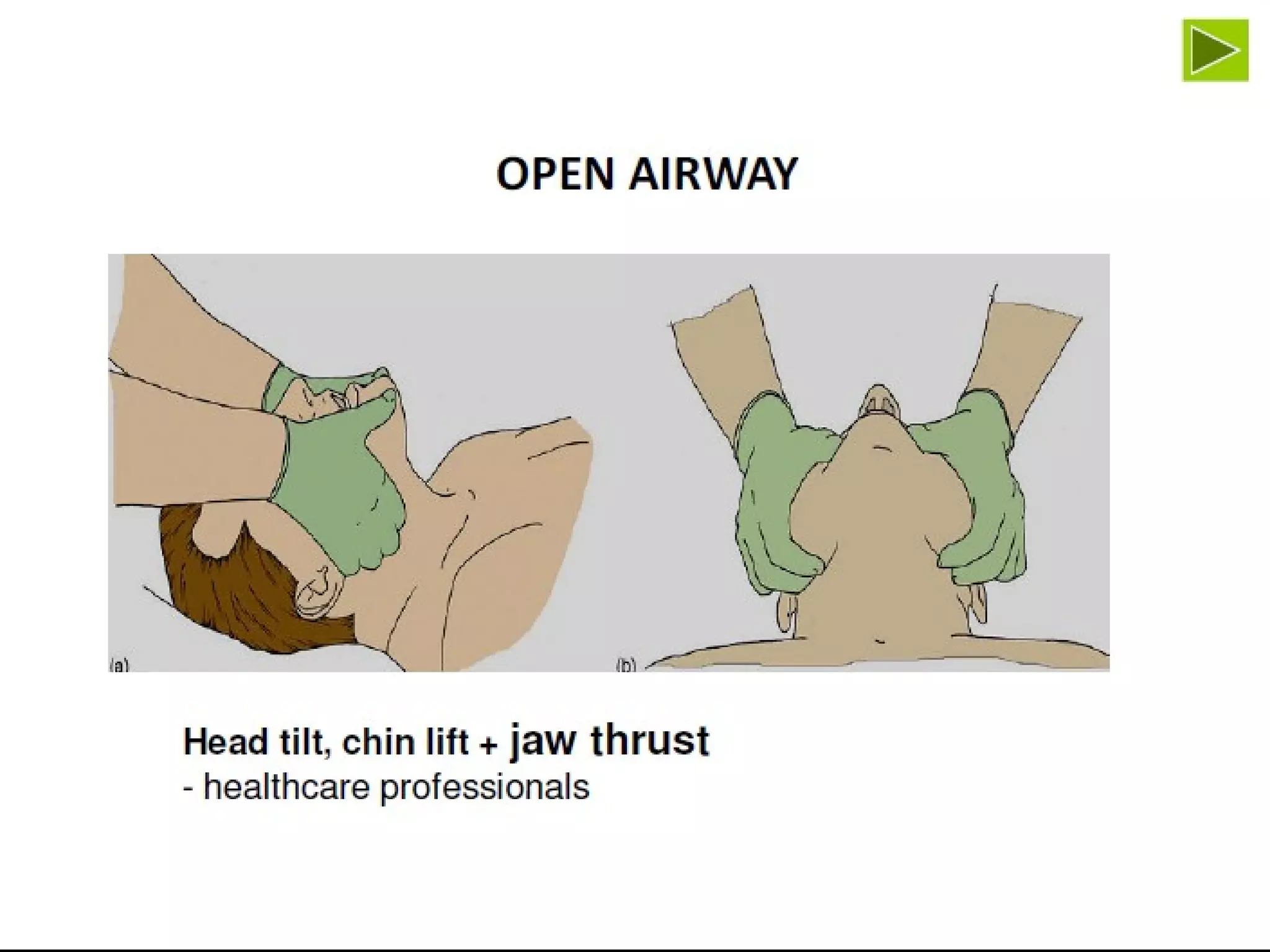
 Chin lift or jaw thrust maneuverChin lift or jaw thrust maneuver
 InsertionInsertion

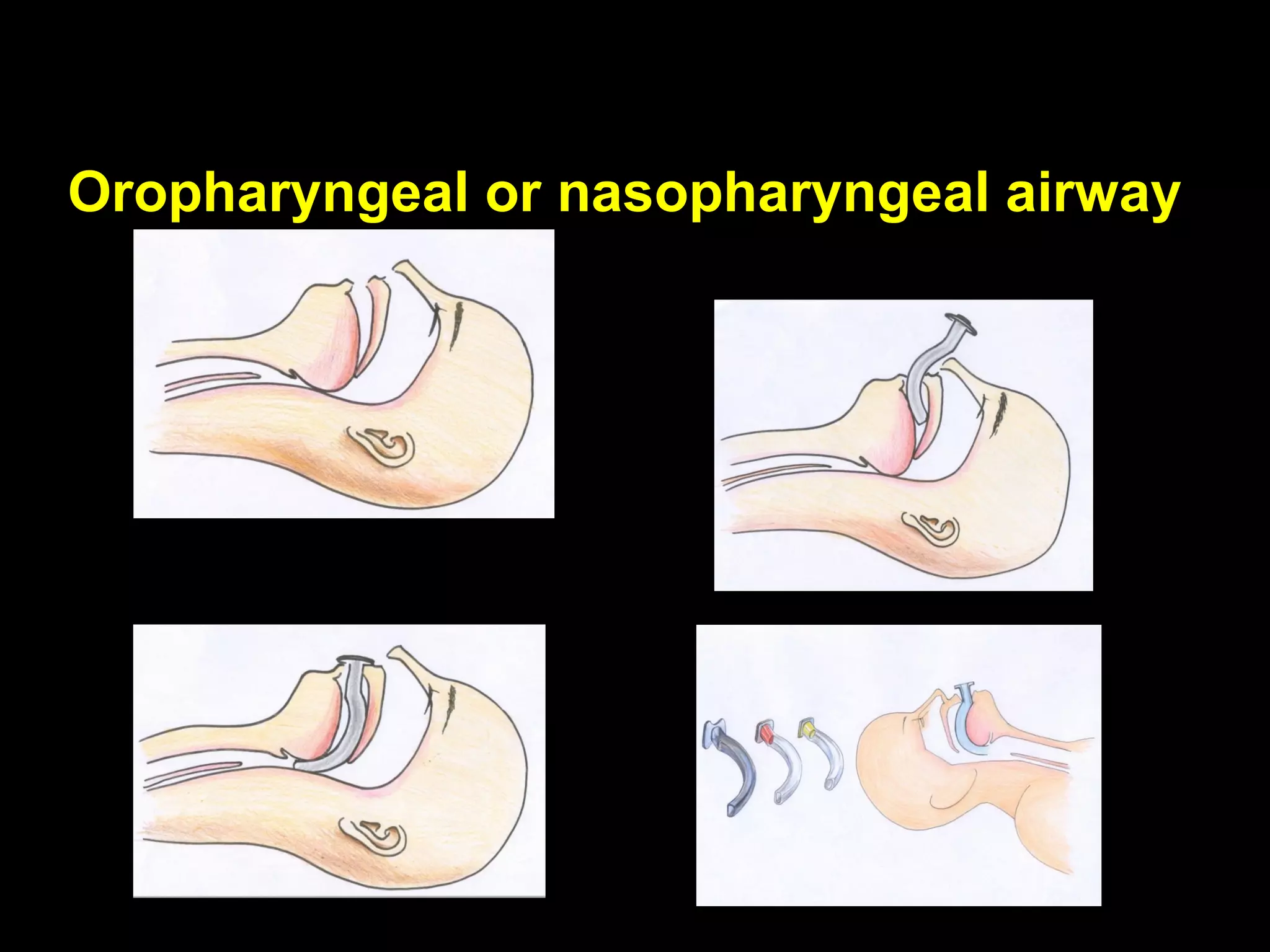
Nasopharyngeal airway :Nasopharyngeal airway : consciousness patients**consciousness patients**

Oropharyngeal airway :Oropharyngeal airway : no gag reflex patients**no gag reflex patients**
Jaw thrust maneuverJaw thrust maneuver
Oropharyngeal or nasopharyngeal airwayOropharyngeal or nasopharyngeal airway
Establish aEstablish a definitivedefinitive airwayairway
 Endotracheal intubationEndotracheal intubation
 Jet insufflation of the airwayJet insufflation of the airway
 Surgical cricothyroidotomySurgical cricothyroidotomy
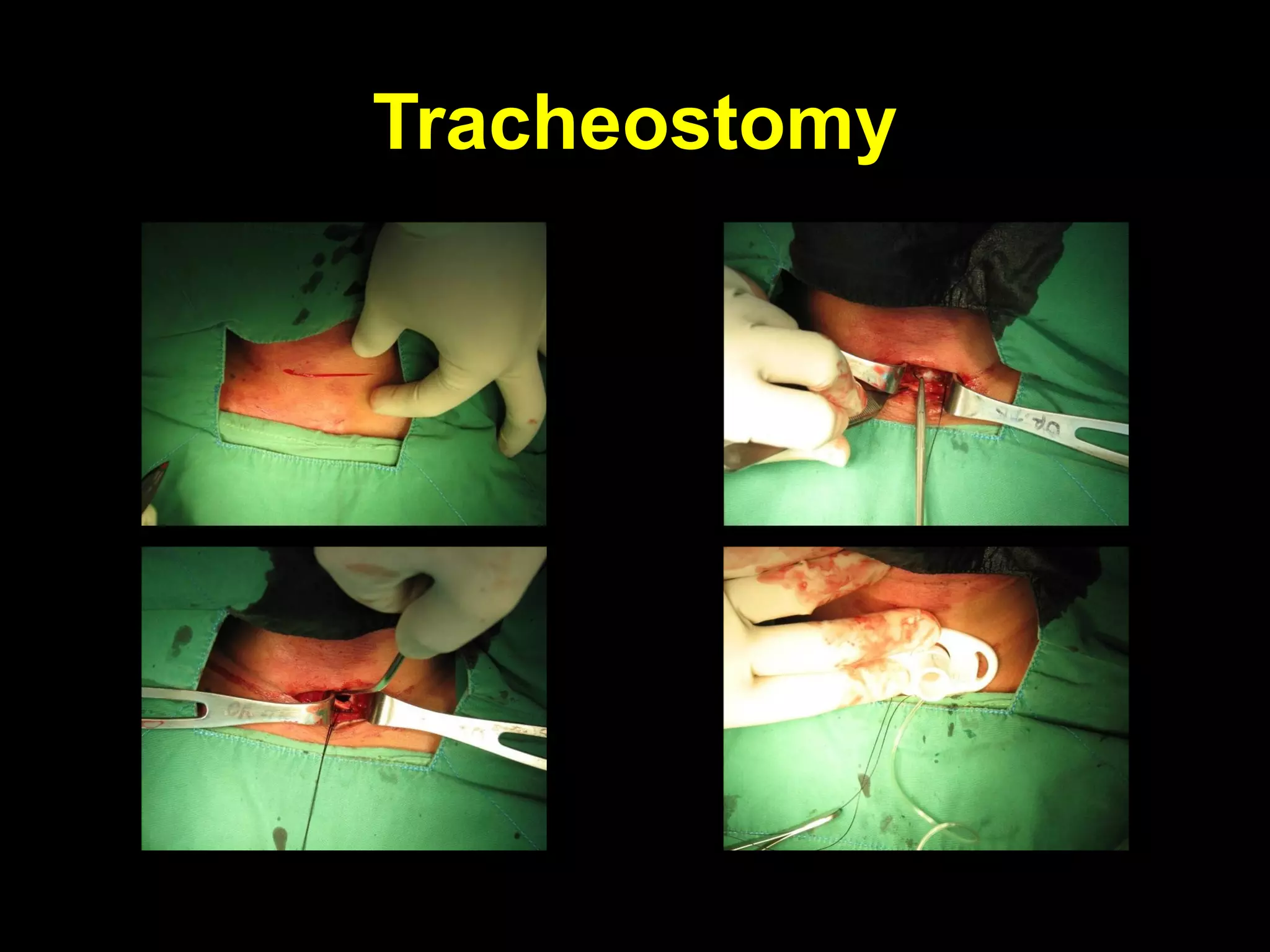
 TracheostomyTracheostomy
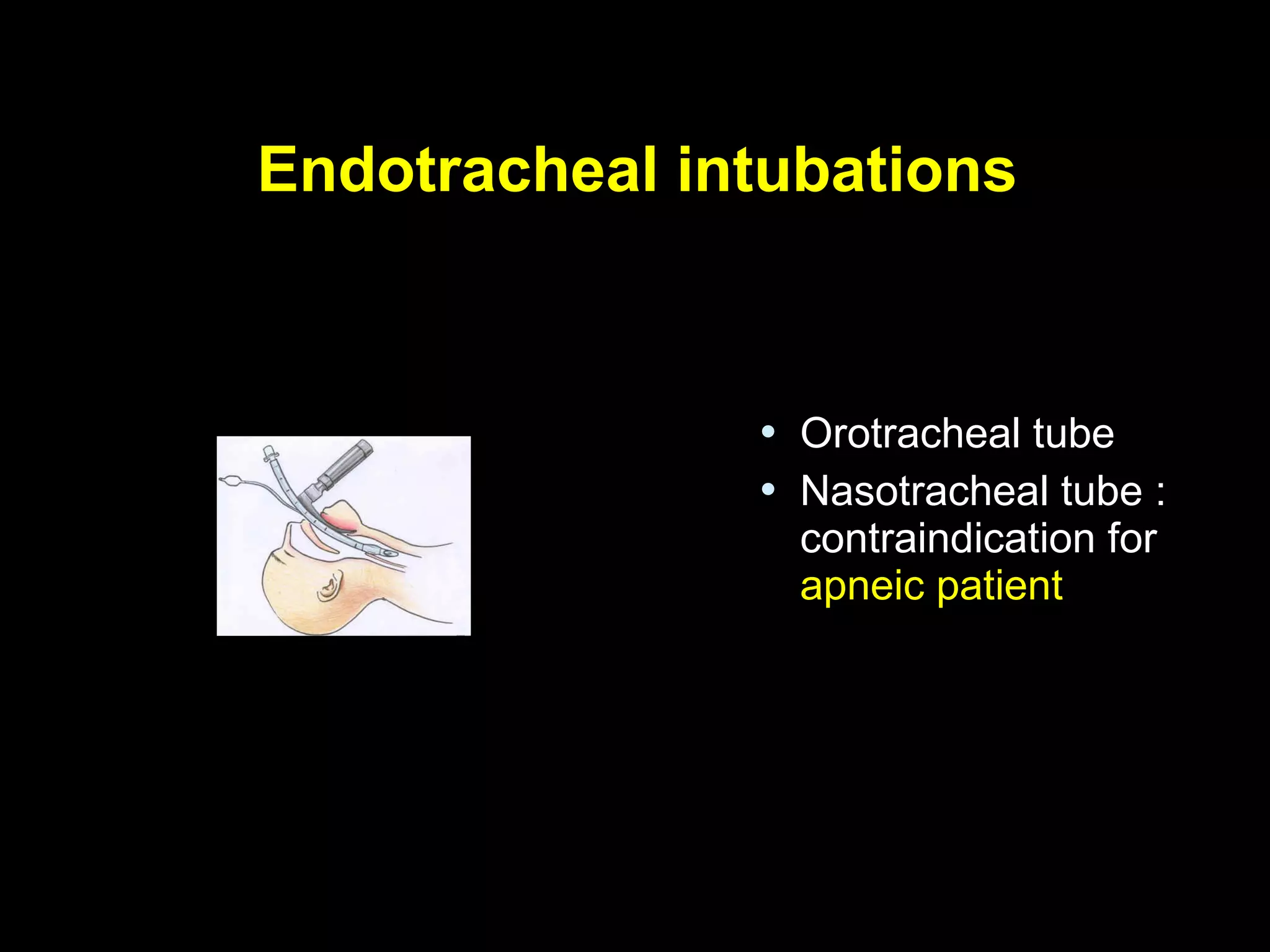
Endotracheal intubationsEndotracheal intubations
 Orotracheal tubeOrotracheal tube
 Nasotracheal tube :Nasotracheal tube :
contraindication forcontraindication for
apneic patientapneic patient
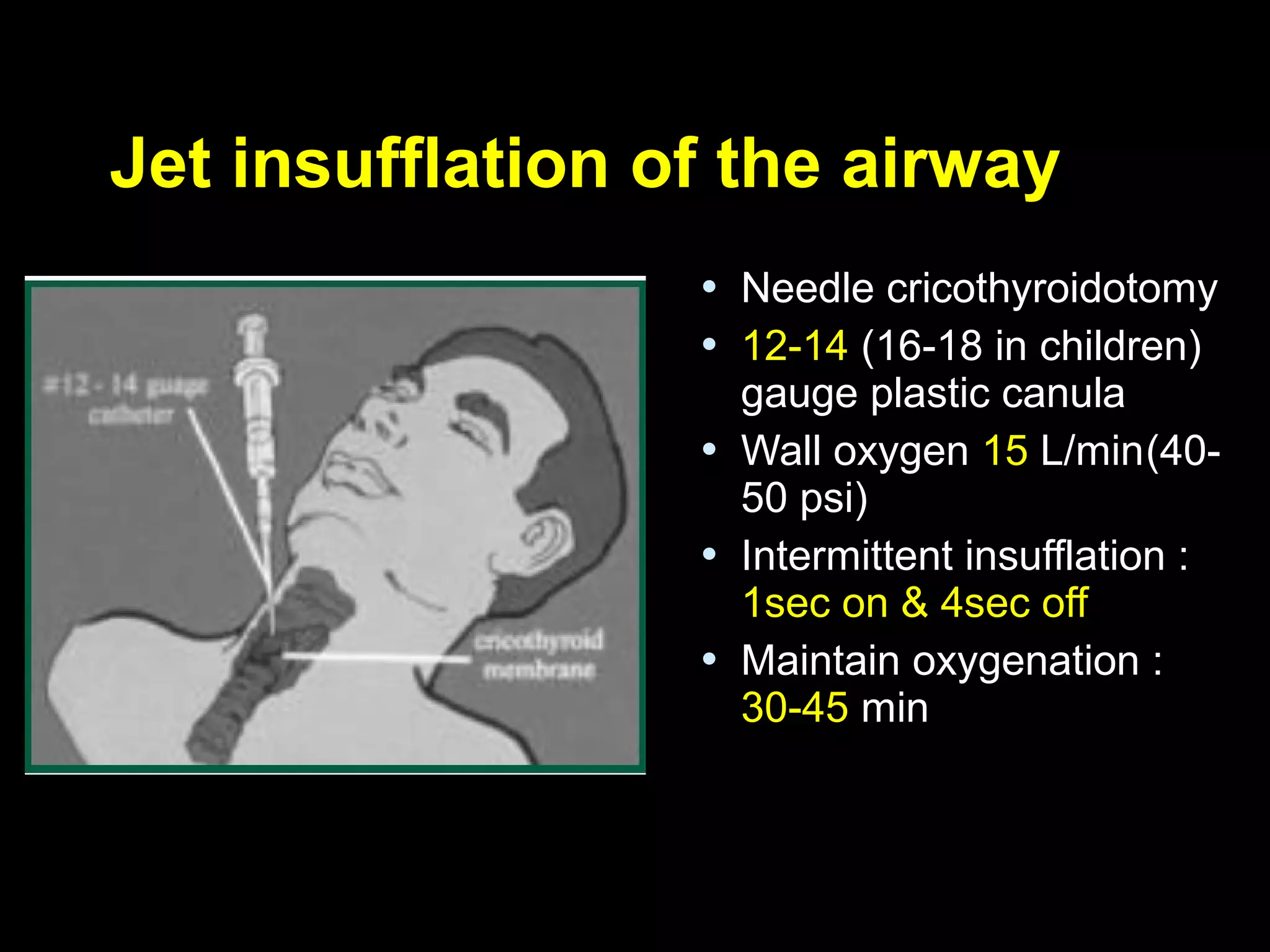
Jet insufflation of the airwayJet insufflation of the airway
 Needle cricothyroidotomyNeedle cricothyroidotomy
 12-1412-14 (16-18 in children)(16-18 in children)
gauge plastic canulagauge plastic canula
 Wall oxygenWall oxygen 1515 L/minL/min(40-(40-
50 psi)50 psi)
 Intermittent insufflation :Intermittent insufflation :
1sec on & 4sec off1sec on & 4sec off
 Maintain oxygenation :Maintain oxygenation :
30-4530-45 minmin
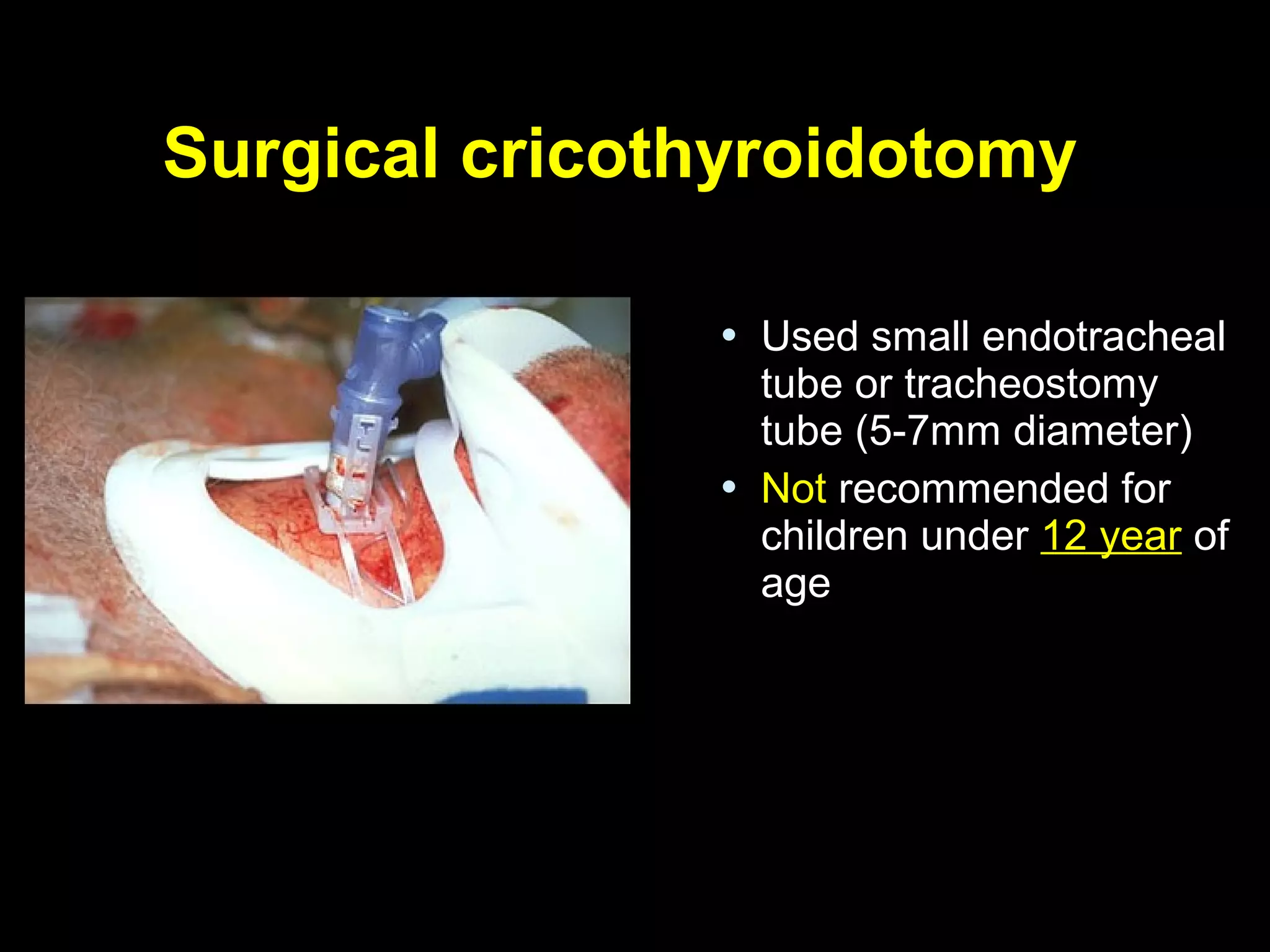
Surgical cricothyroidotomySurgical cricothyroidotomy
 Used small endotrachealUsed small endotracheal
tube or tracheostomytube or tracheostomy
tube (5-7mm diameter)tube (5-7mm diameter)
 NotNot recommended forrecommended for
children underchildren under 12 year12 year ofof
ageage
TracheostomyTracheostomy
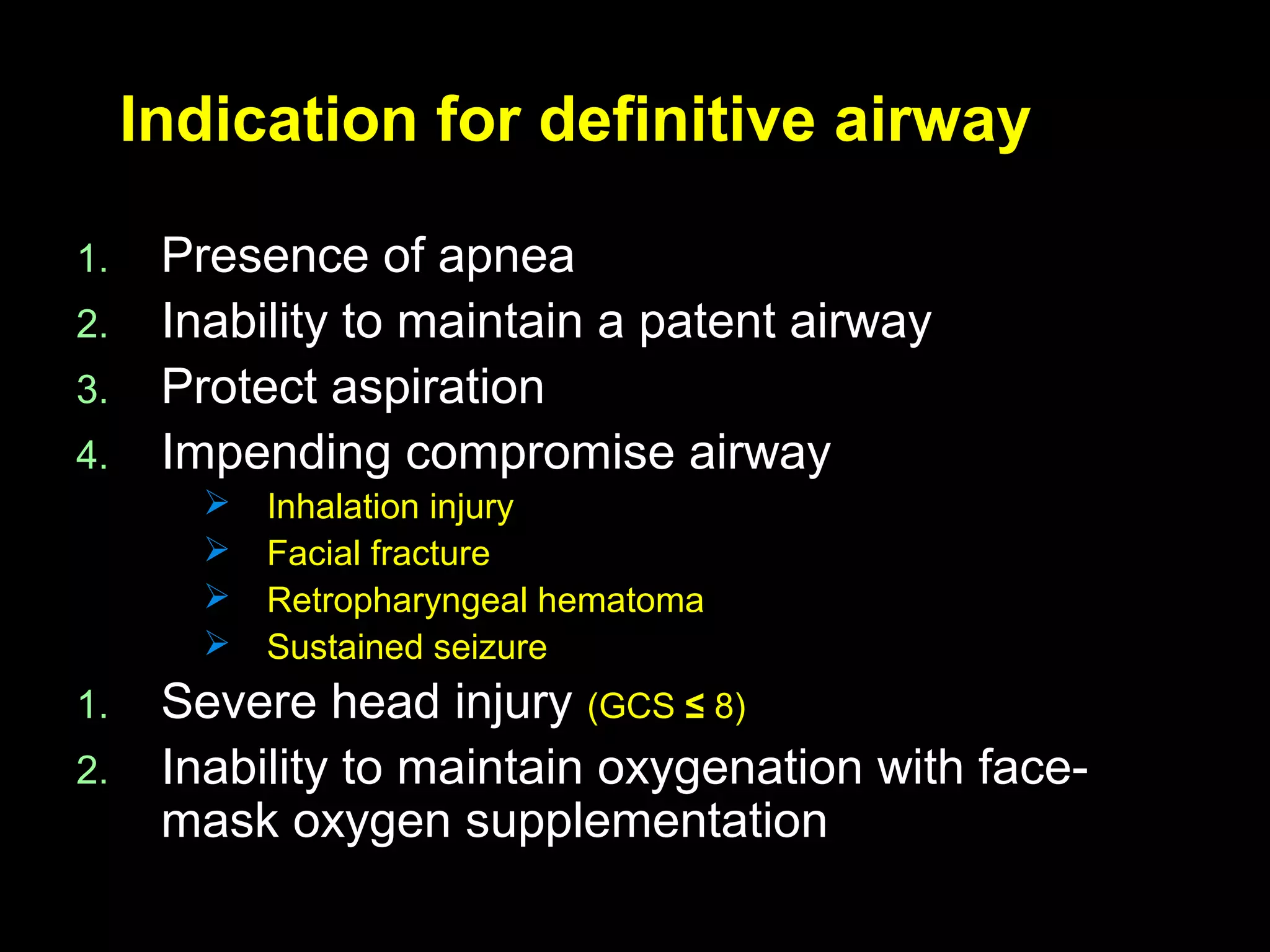
Indication for definitive airwayIndication for definitive airway
1.1. Presence of apneaPresence of apnea
2.2. Inability to maintain a patent airwayInability to maintain a patent airway
3.3. Protect aspirationProtect aspiration
4.4. Impending compromise airwayImpending compromise airway
 Inhalation injuryInhalation injury
 Facial fractureFacial fracture
 Retropharyngeal hematomaRetropharyngeal hematoma
 Sustained seizureSustained seizure
1.1. Severe head injurySevere head injury (GCS(GCS ≤≤ 8)8)
2.2. Inability to maintain oxygenation with face-Inability to maintain oxygenation with face-
mask oxygen supplementationmask oxygen supplementation
BB :: BBreathing/Ventilation/Oxygenationreathing/Ventilation/Oxygenation
• Seeking immediate life threateningSeeking immediate life threatening
• Open pneumothoraxOpen pneumothorax
• Tension pneumothoraxTension pneumothorax
• Severe flail chestSevere flail chest
• Ventilation supportiveVentilation supportive
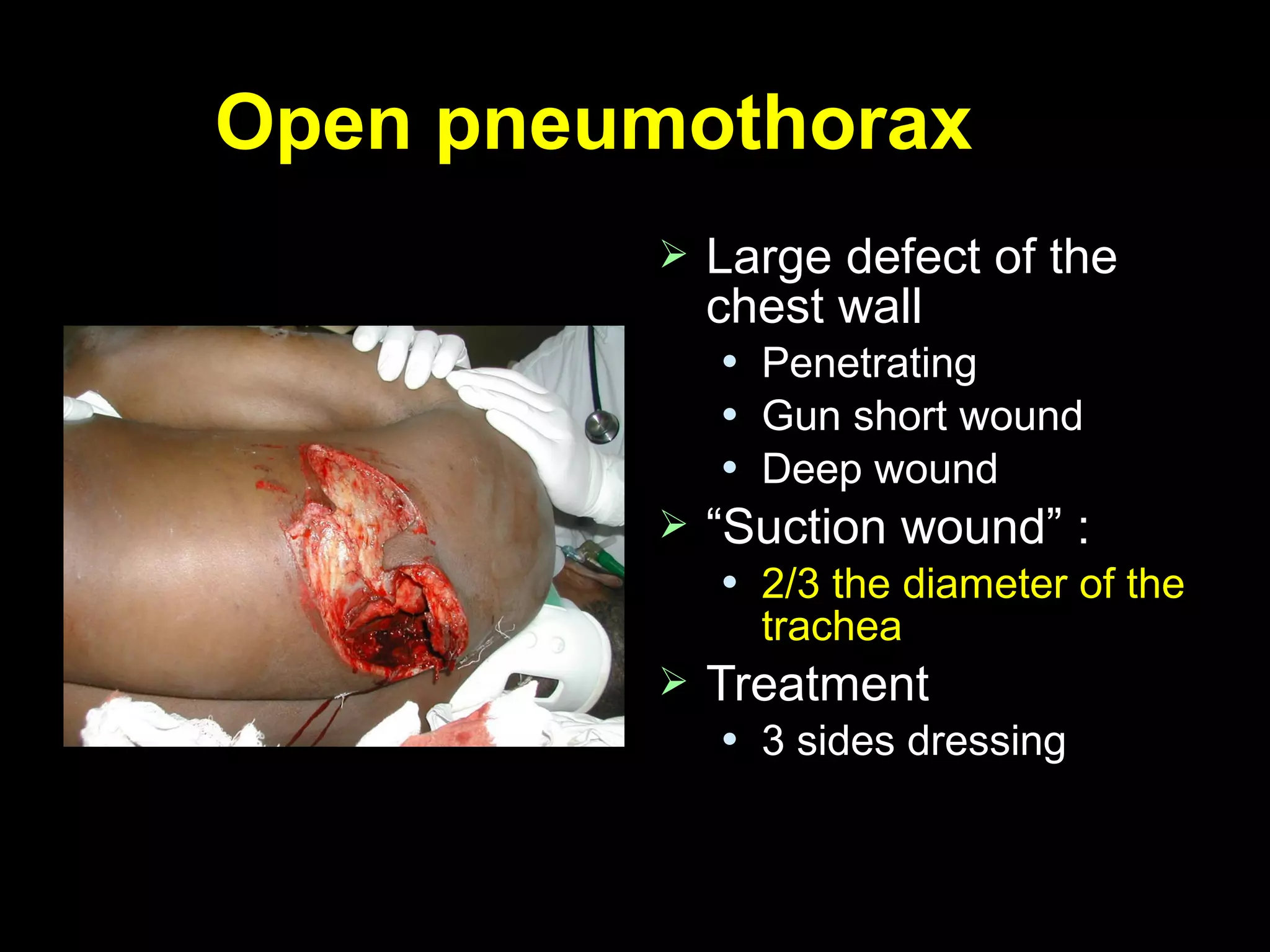
Open pneumothoraxOpen pneumothorax
 Large defect of theLarge defect of the
chest wallchest wall
 PenetratingPenetrating
 Gun short woundGun short wound
 Deep woundDeep wound
 ““Suction wound”Suction wound” ::
 2/3 the diameter of the2/3 the diameter of the
tracheatrachea
 TreatmentTreatment
 3 sides dressing3 sides dressing
Tension pneumothoraxTension pneumothorax
 Hx. chest injuryHx. chest injury
 Physical signs:Physical signs: chest pain, air hunger, reparatorychest pain, air hunger, reparatory
distress, trachycardiadistress, trachycardia
 Classic signsClassic signs

Neck vein distensionNeck vein distension

HypotensionHypotension

Tracheal deviationTracheal deviation

Unilateral absent breath soundUnilateral absent breath sound

Hyperresonant percussion with absent breath soundHyperresonant percussion with absent breath sound
 Differentiation from cardiac tamponadeDifferentiation from cardiac tamponade
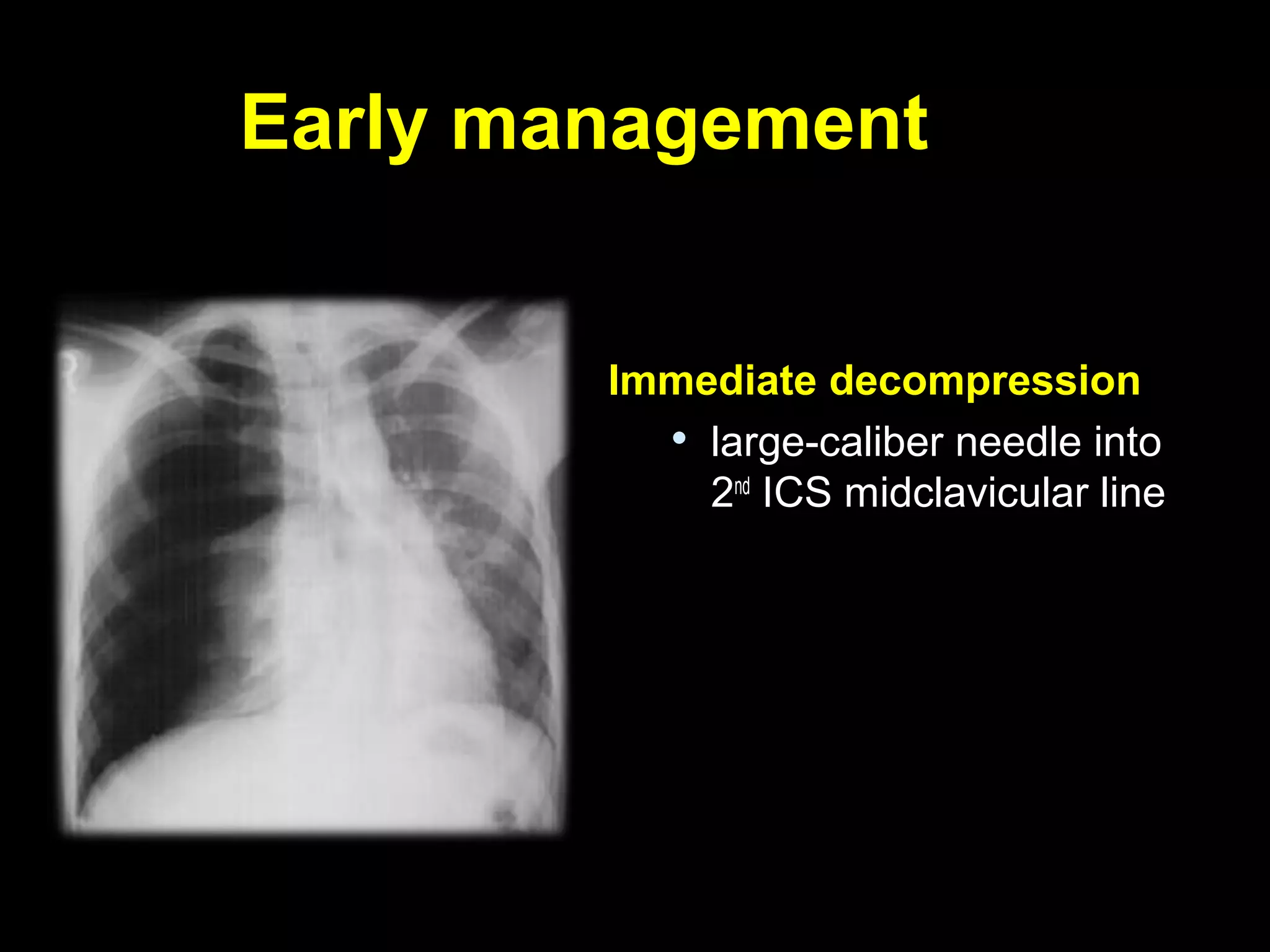
Early managementEarly management
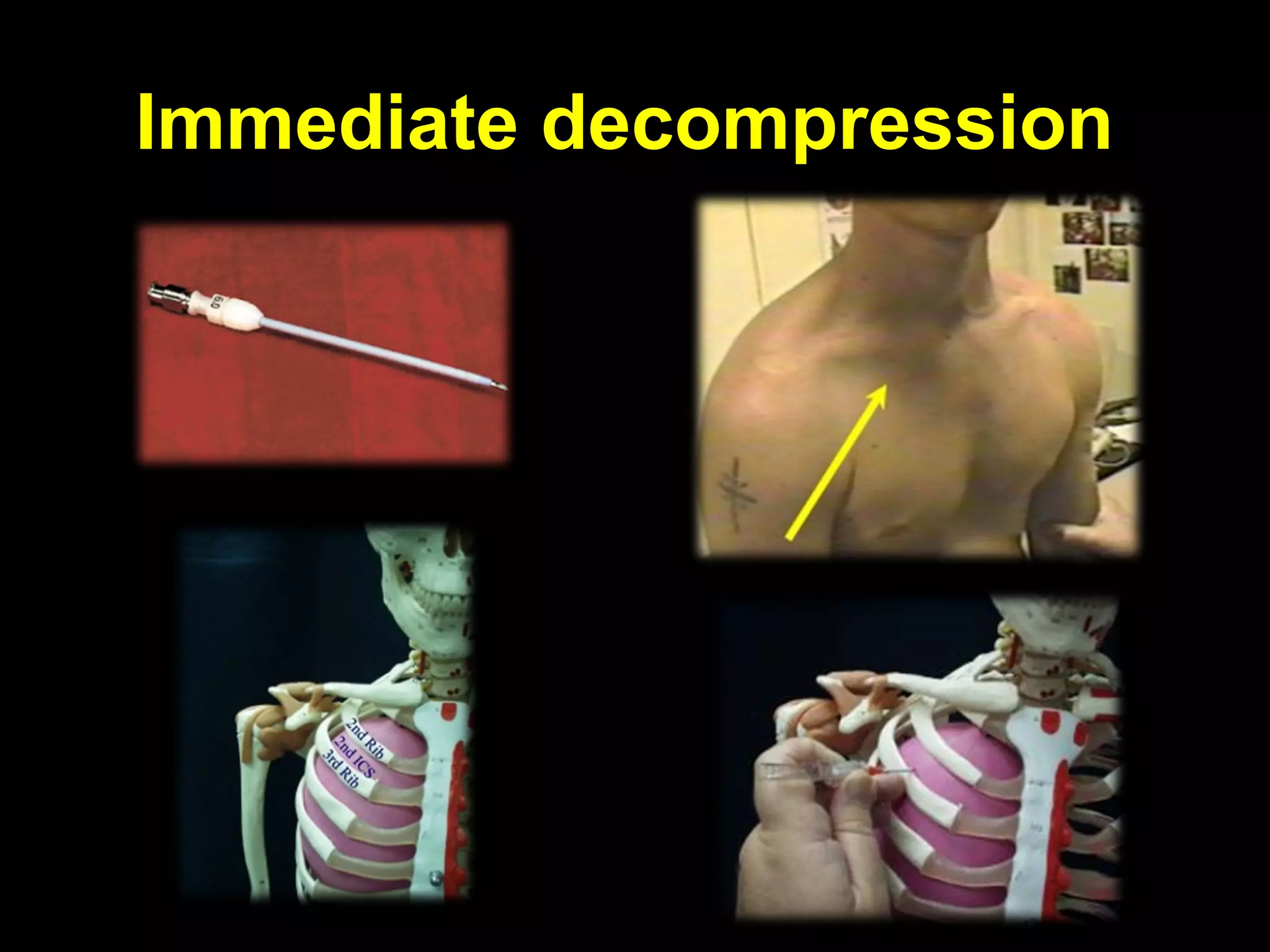
Immediate decompressionImmediate decompression

large-caliber needle intolarge-caliber needle into
22ndnd
ICS midclavicular lineICS midclavicular line
Immediate decompressionImmediate decompression
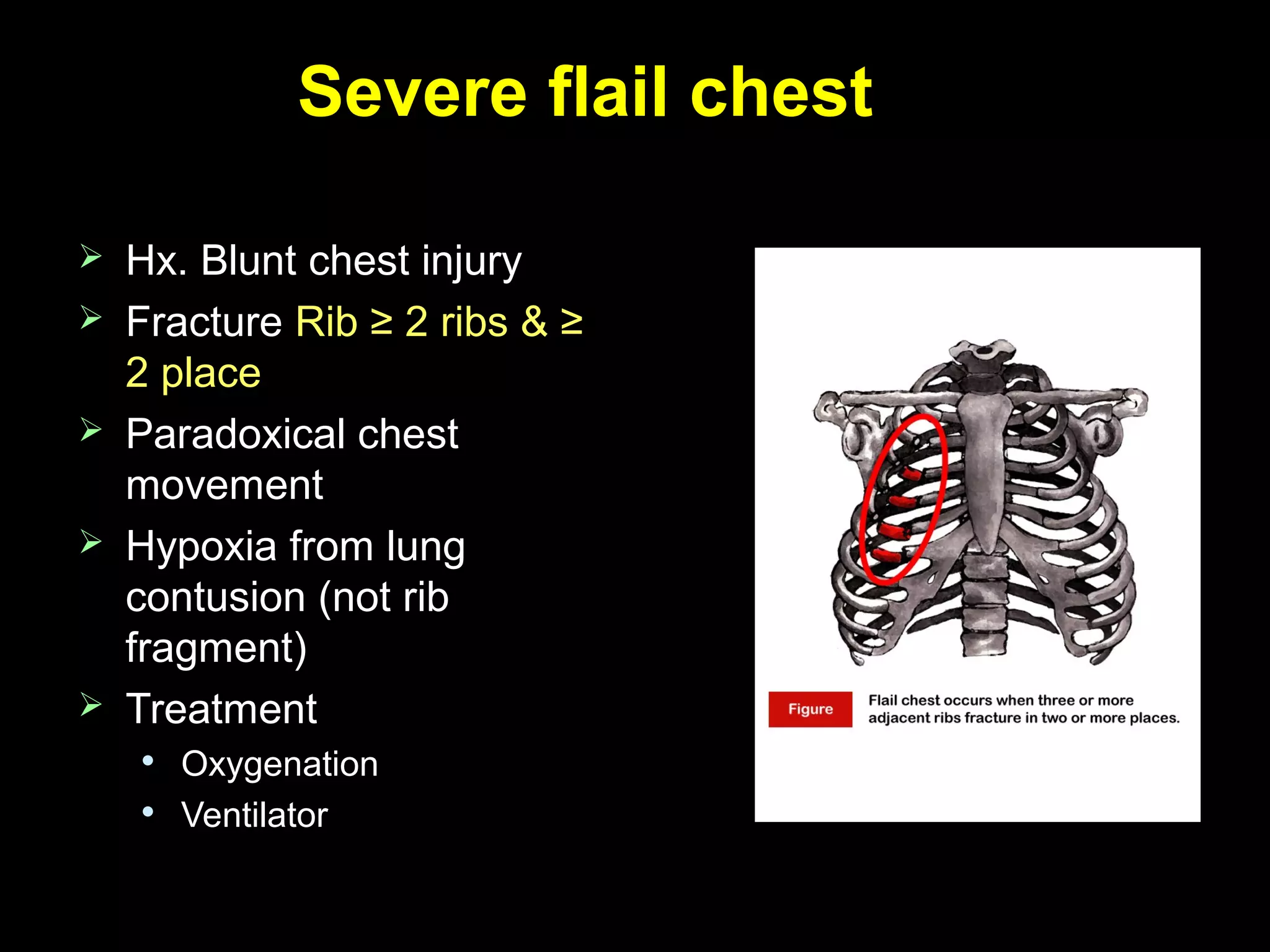
Severe flail chestSevere flail chest
 Hx. Blunt chest injuryHx. Blunt chest injury
 FractureFracture Rib ≥ 2 ribs & ≥Rib ≥ 2 ribs & ≥
2 place2 place
 Paradoxical chestParadoxical chest
movementmovement
 Hypoxia from lungHypoxia from lung
contusion (not ribcontusion (not rib
fragment)fragment)
 TreatmentTreatment

OxygenationOxygenation

VentilatorVentilator
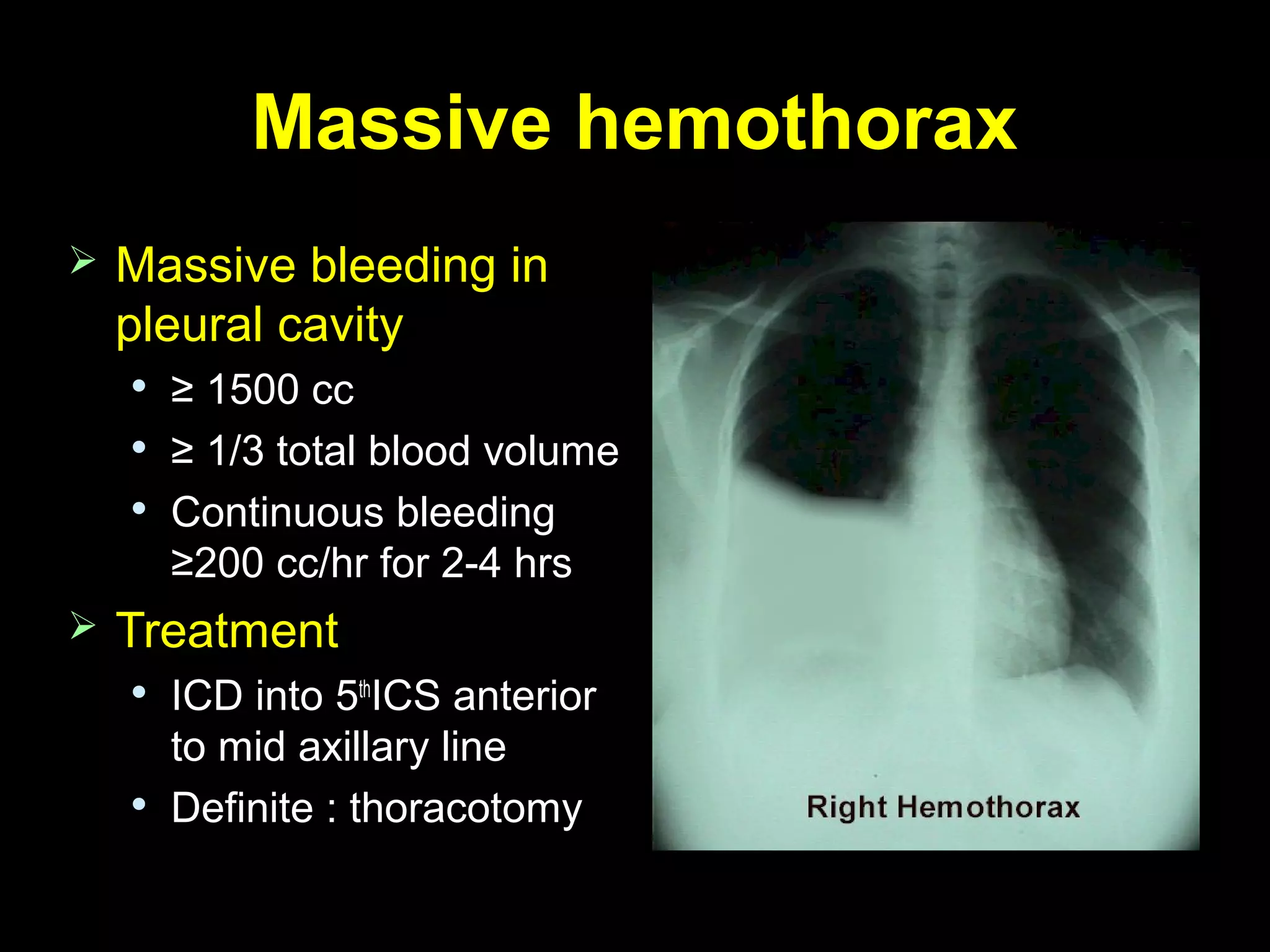
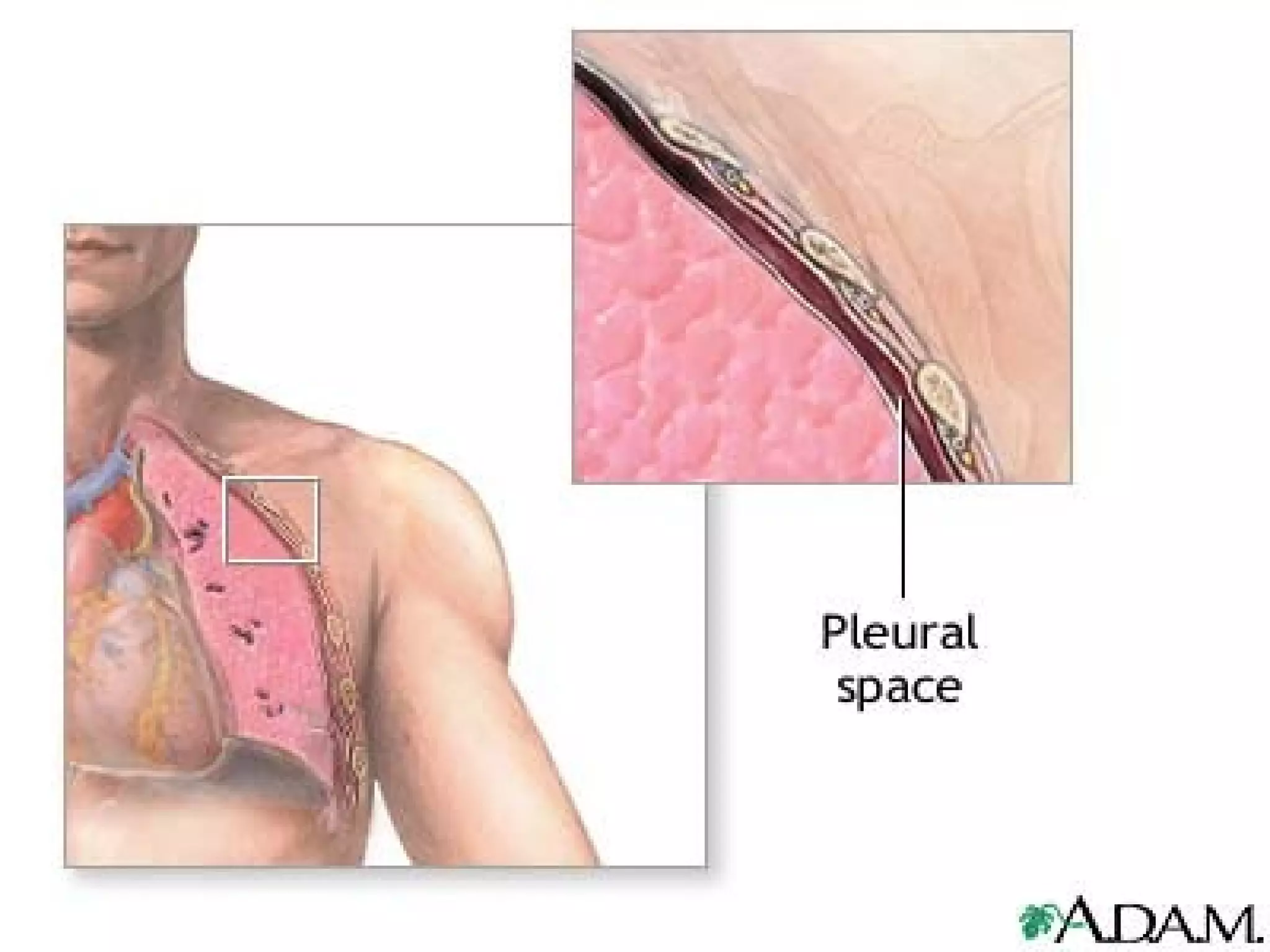
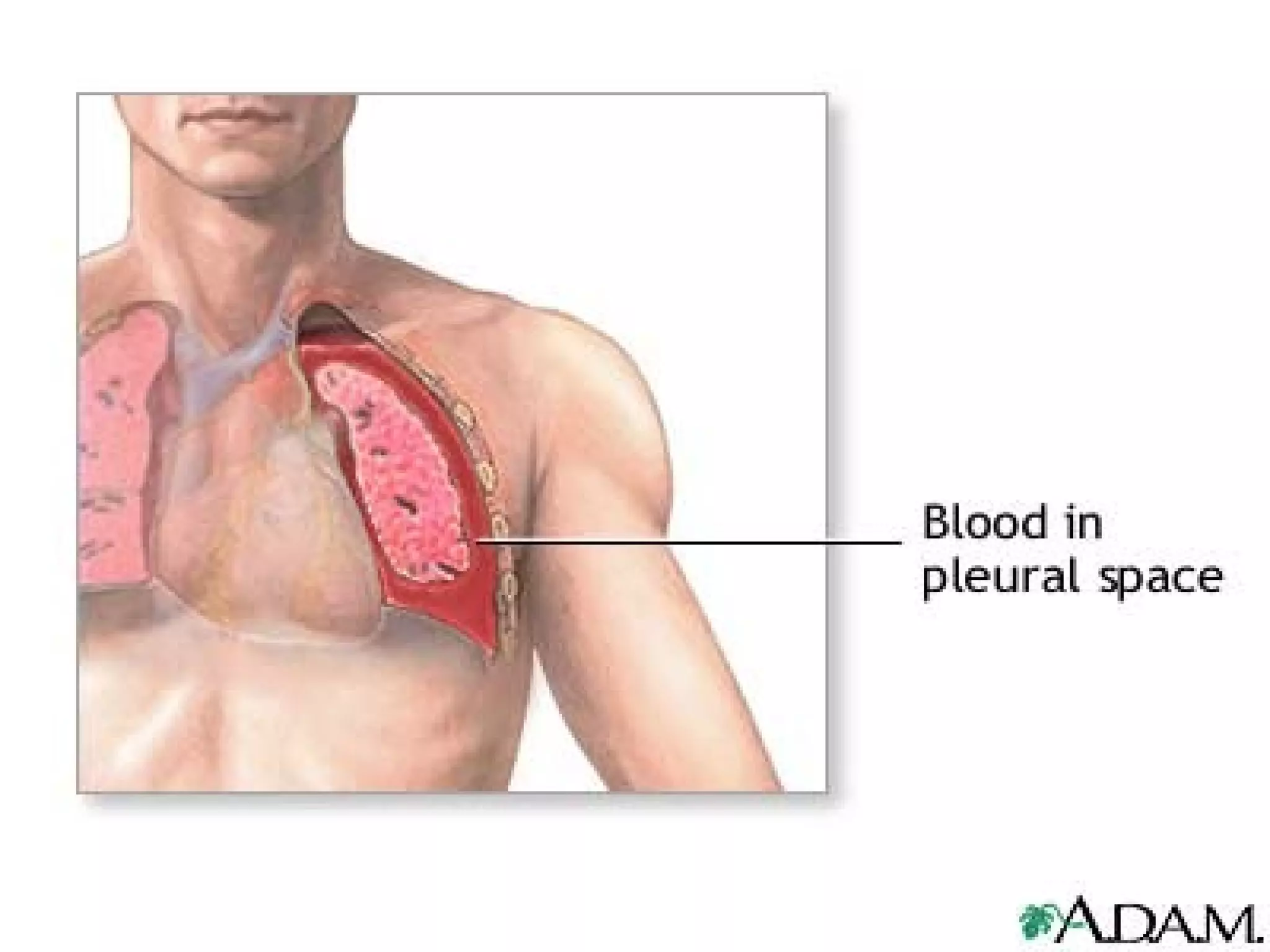
Massive hemothoraxMassive hemothorax
 Massive bleeding inMassive bleeding in
pleural cavitypleural cavity

≥≥ 1500 cc1500 cc

≥≥ 1/3 total blood volume1/3 total blood volume

Continuous bleedingContinuous bleeding
≥200 cc/hr for 2-4 hrs≥200 cc/hr for 2-4 hrs
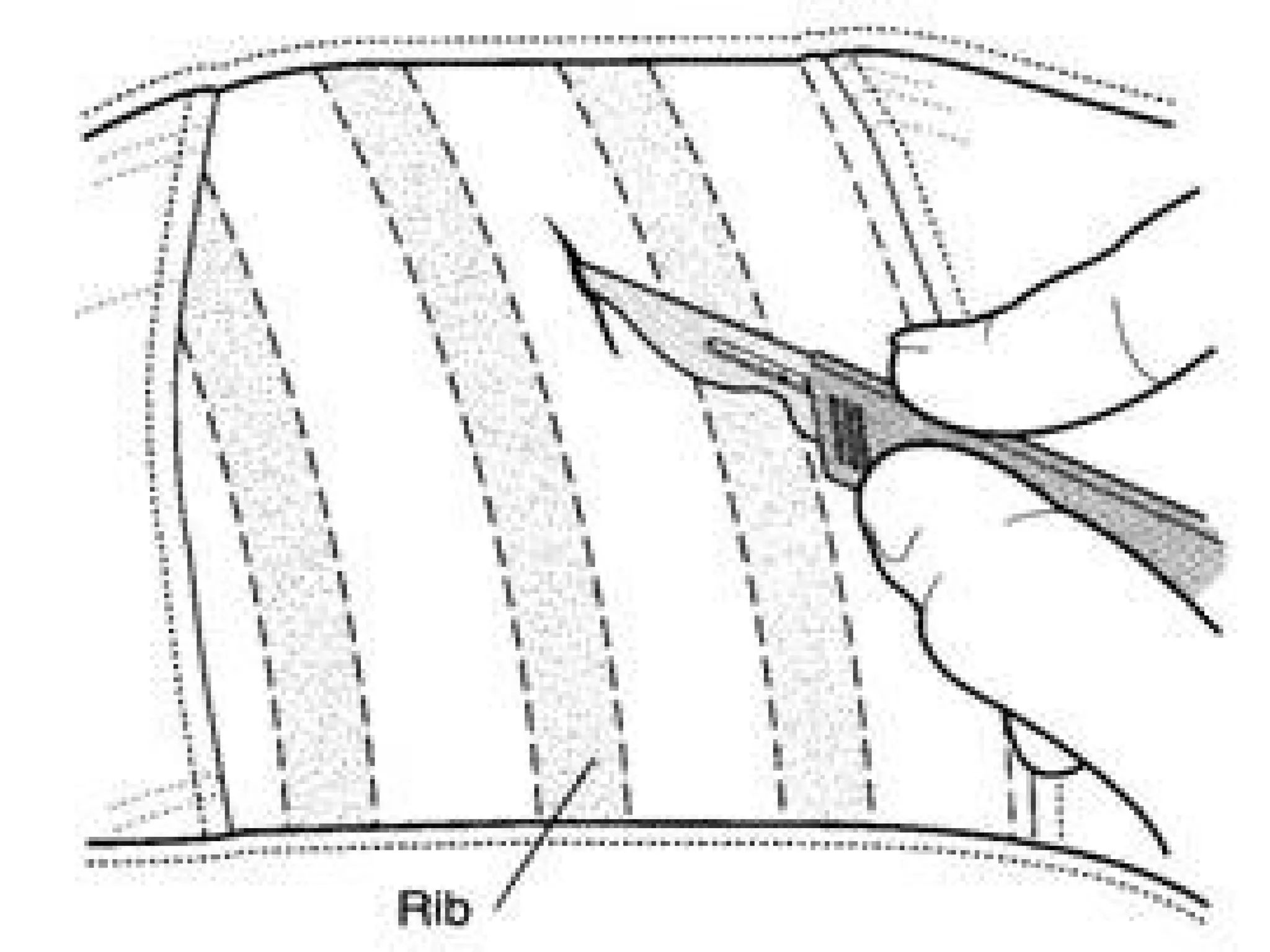
 TreatmentTreatment

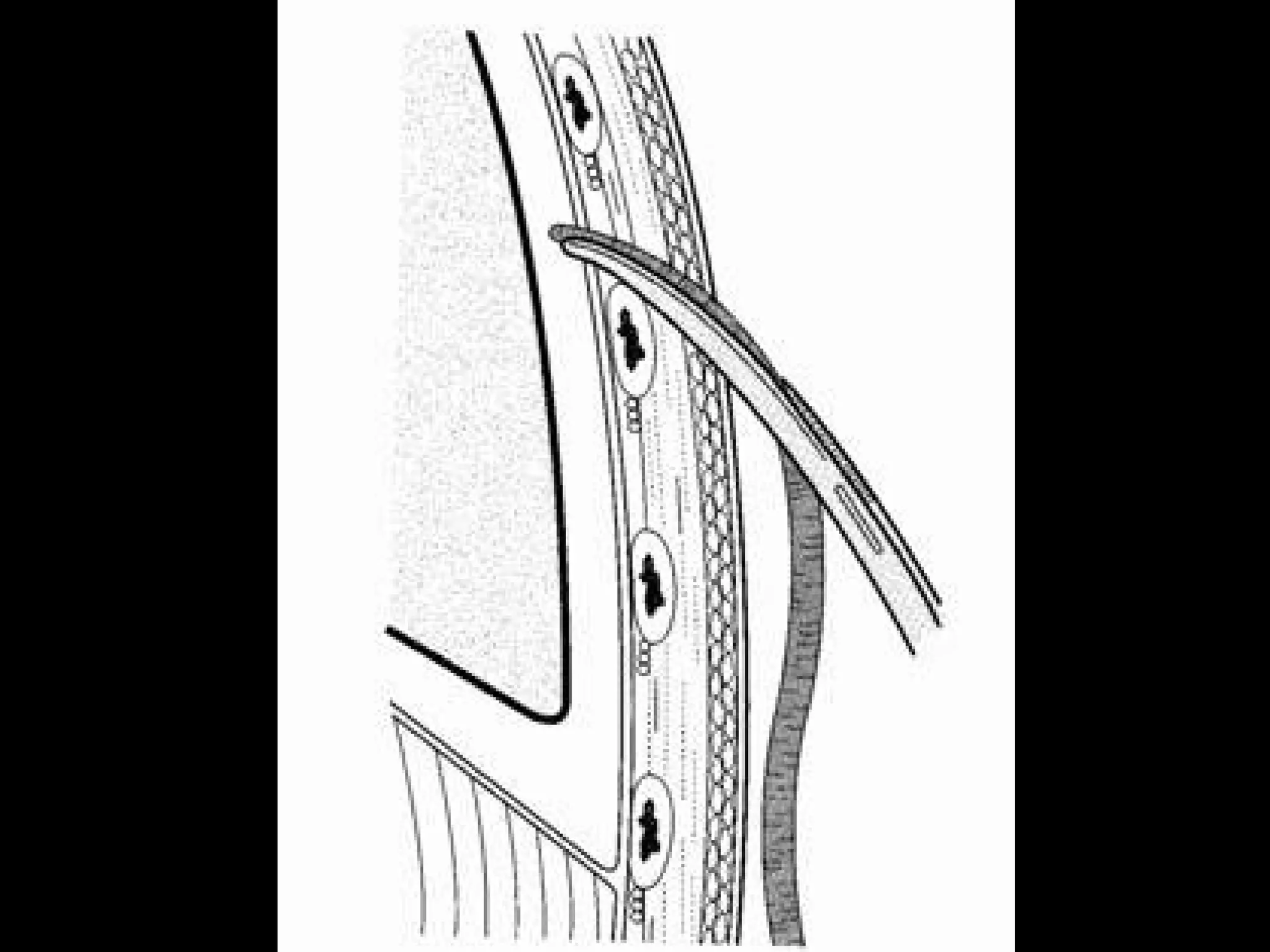
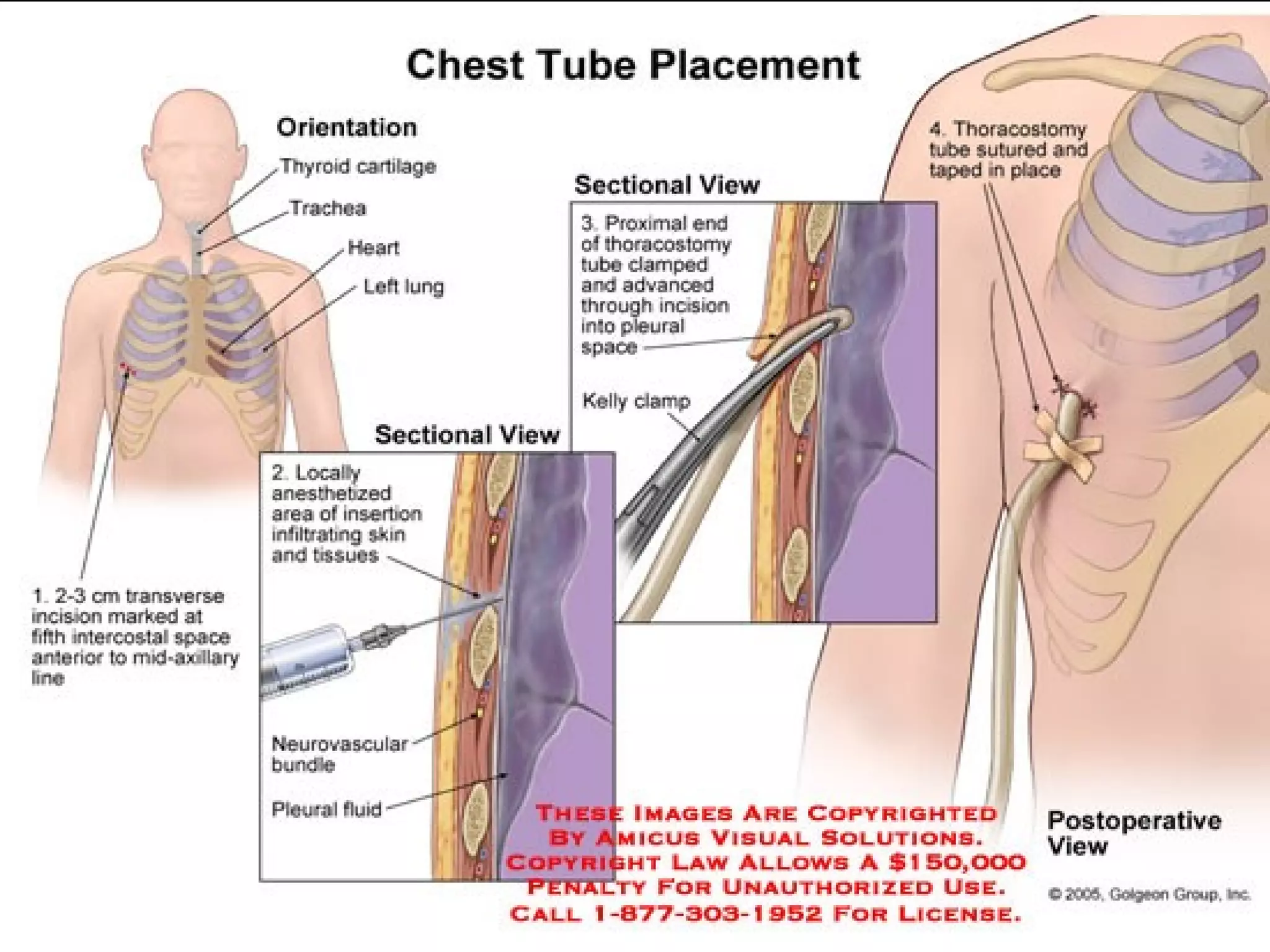
ICD into 5ICD into 5thth
ICS anteriorICS anterior
to mid axillary lineto mid axillary line

Definite : thoracotomyDefinite : thoracotomy
CC :: CCirculationirculation
 Detected and early management cardiacDetected and early management cardiac
temponadetemponade
 Control bleedingControl bleeding
 Volume resuscitationVolume resuscitation
 Protected hypothermiaProtected hypothermia
Cardiac tamponadeCardiac tamponade
 Blunt or penetrating chestBlunt or penetrating chest
 Beck’s triadBeck’s triad

Neck vein distensionNeck vein distension

HypotensionHypotension

Muffled heart soundMuffled heart sound
 Pulsus paradoxusPulsus paradoxus
 May Dx: FASTMay Dx: FAST
 TreatmentTreatment

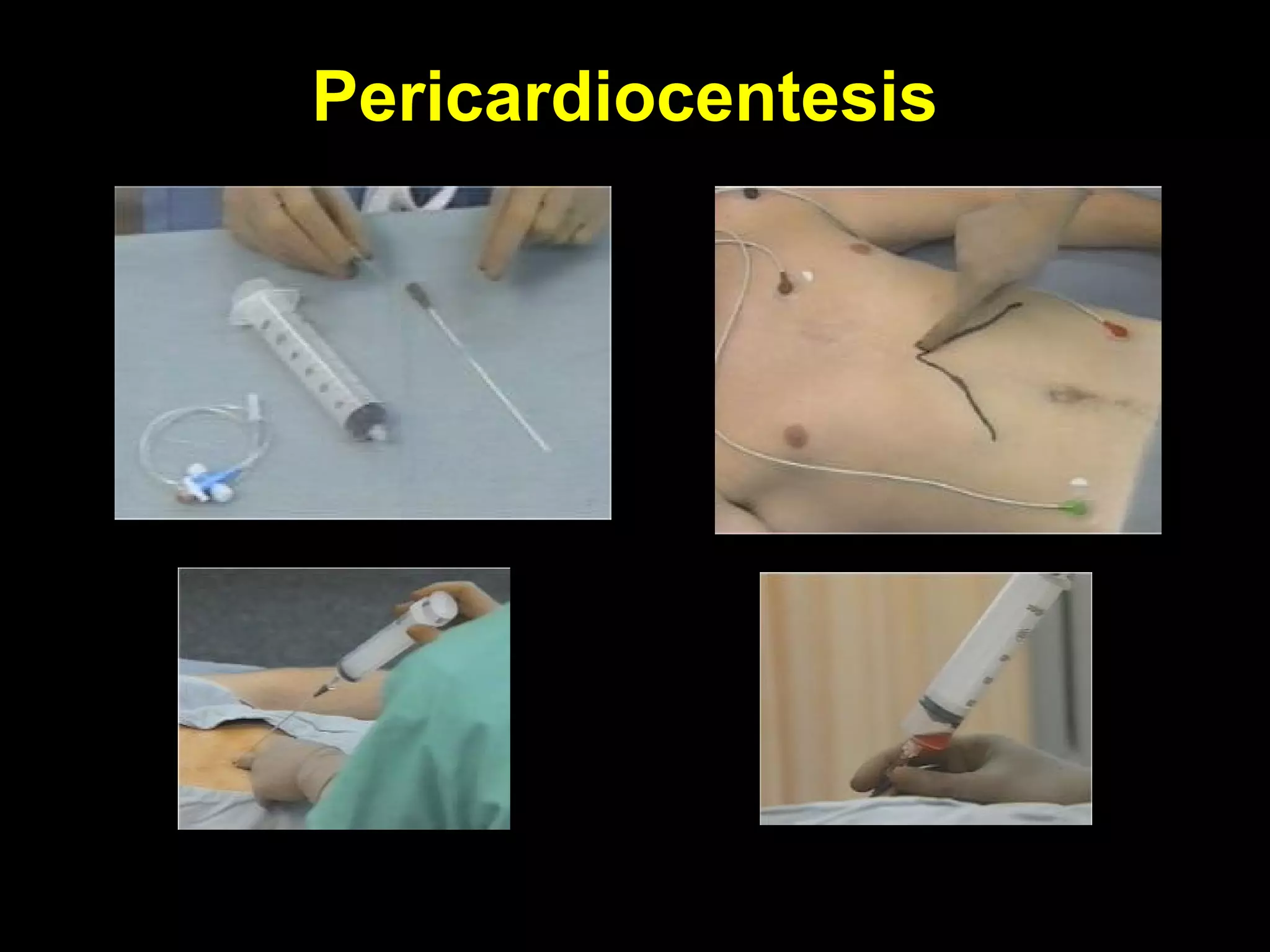
PericardiocentesisPericardiocentesis

Subxyphoid pericardial windowSubxyphoid pericardial window

PericardiotomyPericardiotomy
PericardiocentesisPericardiocentesis
Control bleedingControl bleeding
 Direct pressureDirect pressure
 Operative interventionOperative intervention
 Evaluated blood lossEvaluated blood loss
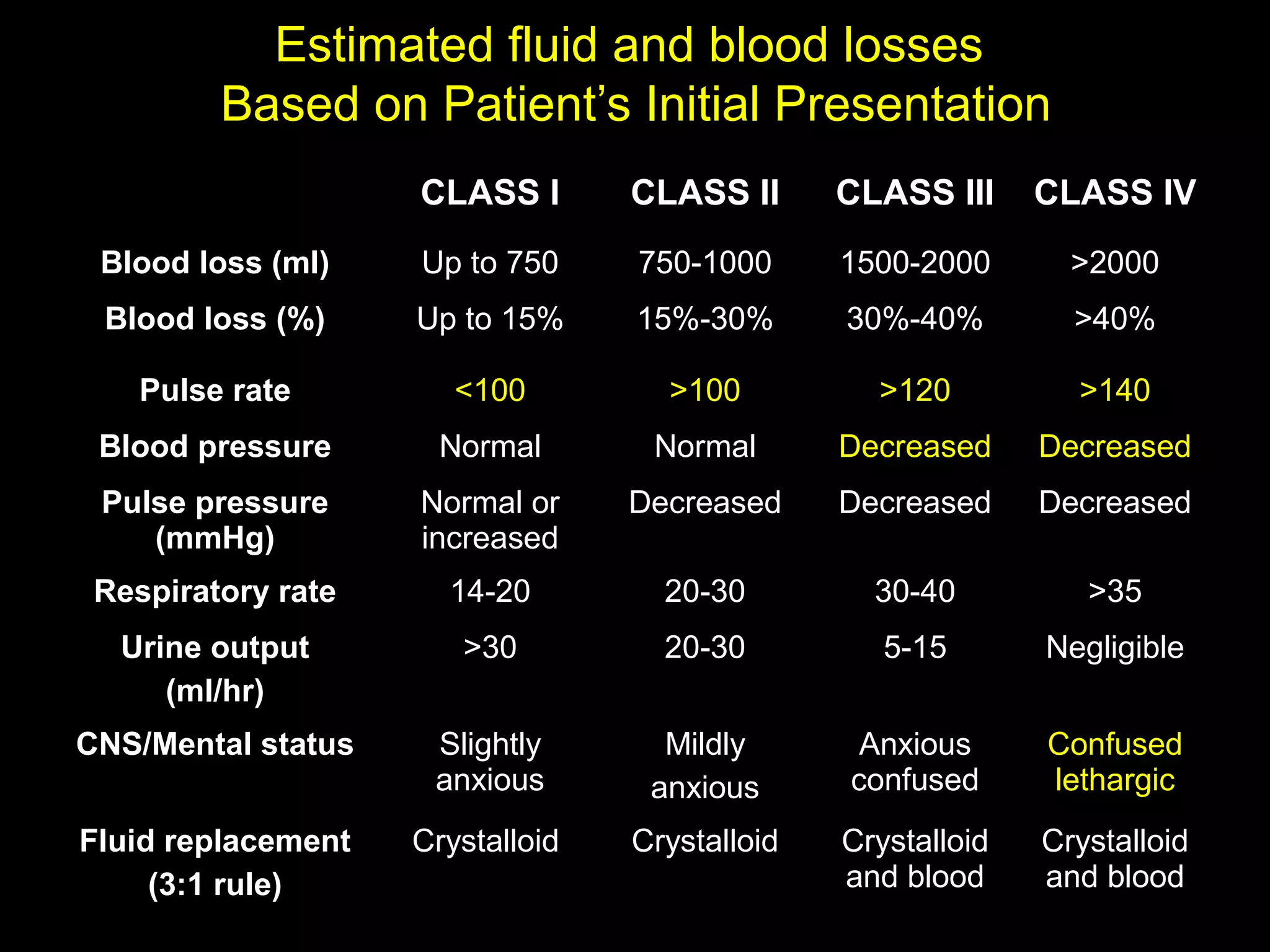
Estimated fluid and blood lossesEstimated fluid and blood losses
Based on Patient’s Initial PresentationBased on Patient’s Initial Presentation
CLASS ICLASS I CLASS IICLASS II CLASS IIICLASS III CLASS IVCLASS IV
Blood loss (ml)Blood loss (ml) Up to 750Up to 750 750-1000750-1000 1500-20001500-2000 >2000>2000
Blood loss (%)Blood loss (%) Up to 15%Up to 15% 15%-30%15%-30% 30%-40%30%-40% >40%>40%
Pulse ratePulse rate <100<100 >100>100 >120>120 >140>140
Blood pressureBlood pressure NormalNormal NormalNormal DecreasedDecreased DecreasedDecreased
Pulse pressurePulse pressure
(mmHg)(mmHg)
Normal orNormal or
increasedincreased
DecreasedDecreased DecreasedDecreased DecreasedDecreased
Respiratory rateRespiratory rate 14-2014-20 20-3020-30 30-4030-40 >35>35
Urine outputUrine output
(ml/hr)(ml/hr)
>30>30 20-3020-30 5-155-15 NegligibleNegligible
CNS/Mental statusCNS/Mental status SlightlySlightly
anxiousanxious
MildlyMildly
anxiousanxious
AnxiousAnxious
confusedconfused
ConfusedConfused
lethargiclethargic
Fluid replacementFluid replacement
(3:1 rule)(3:1 rule)
CrystalloidCrystalloid CrystalloidCrystalloid CrystalloidCrystalloid
and bloodand blood
CrystalloidCrystalloid
and bloodand blood
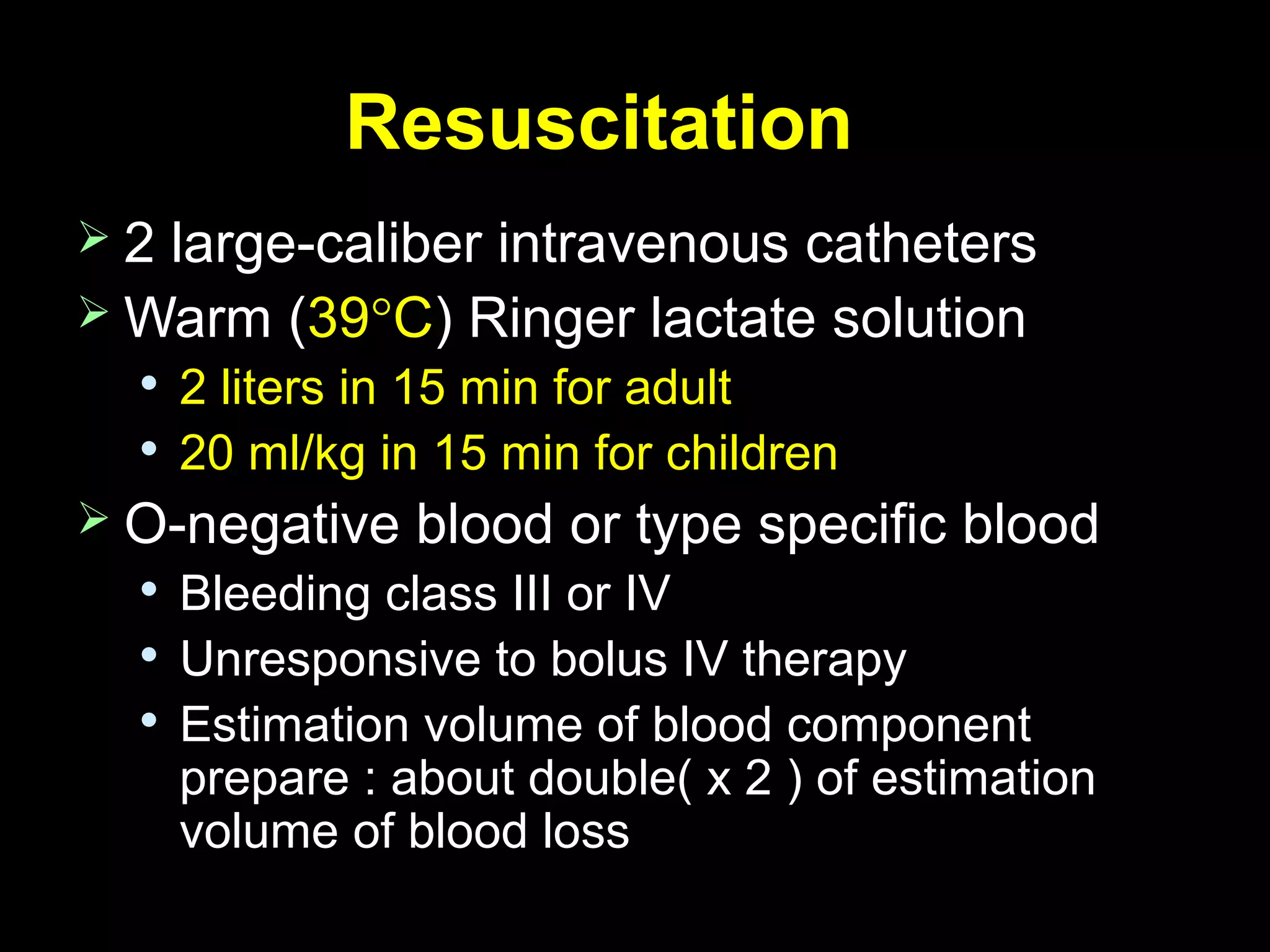
ResuscitationResuscitation
 2 large-caliber intravenous catheters2 large-caliber intravenous catheters
 Warm (Warm (3939°°CC) Ringer lactate solution) Ringer lactate solution

2 liters in 15 min for adult2 liters in 15 min for adult

20 ml/kg in 15 min for children20 ml/kg in 15 min for children
 O-negative blood or type specific bloodO-negative blood or type specific blood

Bleeding class III or IVBleeding class III or IV

Unresponsive to bolus IV therapyUnresponsive to bolus IV therapy

Estimation volume of blood componentEstimation volume of blood component
prepare : about double( x 2 ) of estimationprepare : about double( x 2 ) of estimation
volumevolume of blood lossof blood loss
““Aggressive and continued volumeAggressive and continued volume
resuscitation is not a substitute for manualresuscitation is not a substitute for manual
or operative control of hemorrhage”or operative control of hemorrhage”
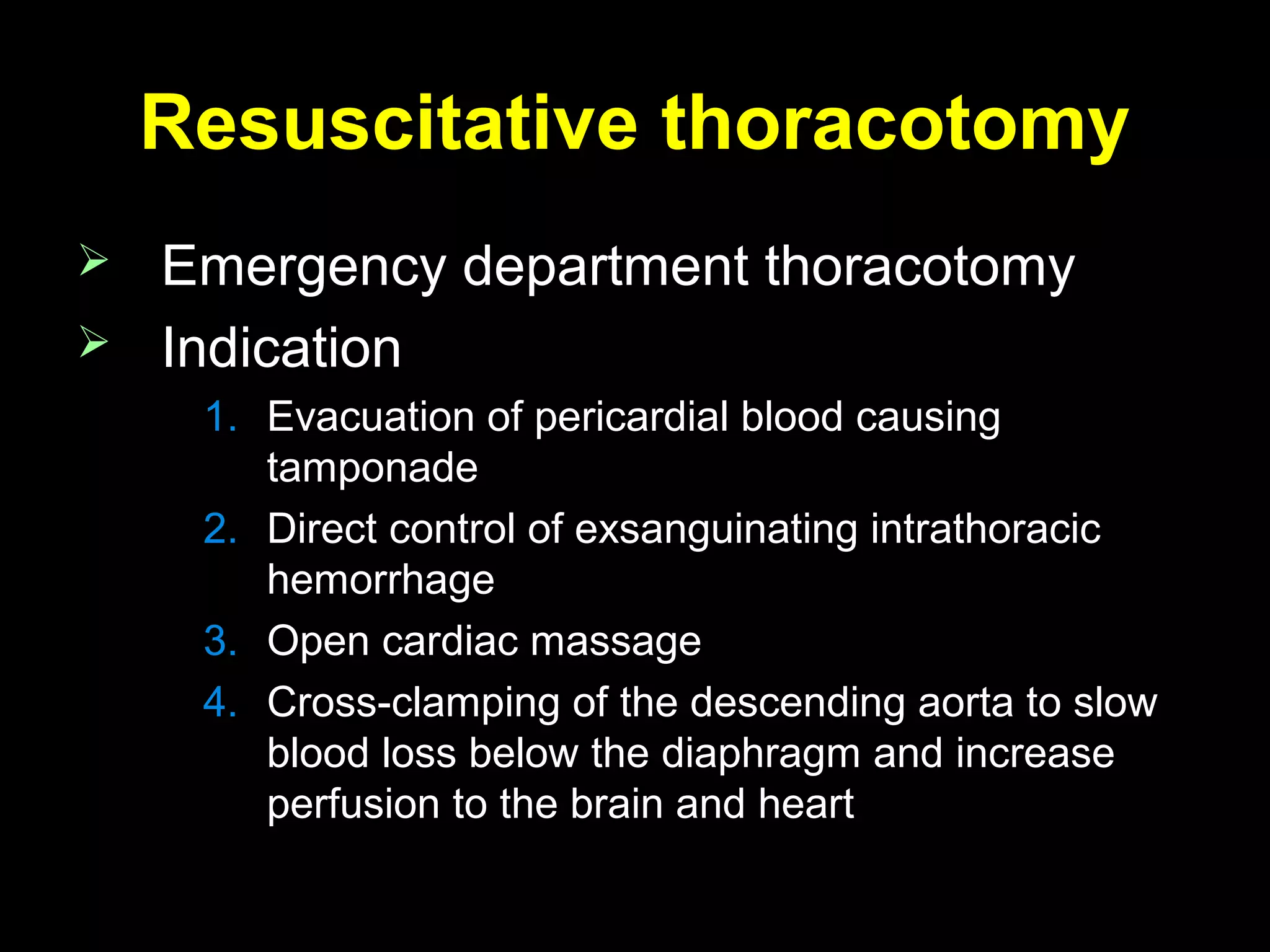
Resuscitative thoracotomyResuscitative thoracotomy
 Emergency department thoracotomyEmergency department thoracotomy
 IndicationIndication
1.1. Evacuation of pericardial blood causingEvacuation of pericardial blood causing
tamponadetamponade
2.2. Direct control of exsanguinating intrathoracicDirect control of exsanguinating intrathoracic
hemorrhagehemorrhage
3.3. Open cardiac massageOpen cardiac massage
4.4. Cross-clamping of the descending aorta to slowCross-clamping of the descending aorta to slow
blood loss below the diaphragm and increaseblood loss below the diaphragm and increase
perfusion to the brain and heartperfusion to the brain and heart
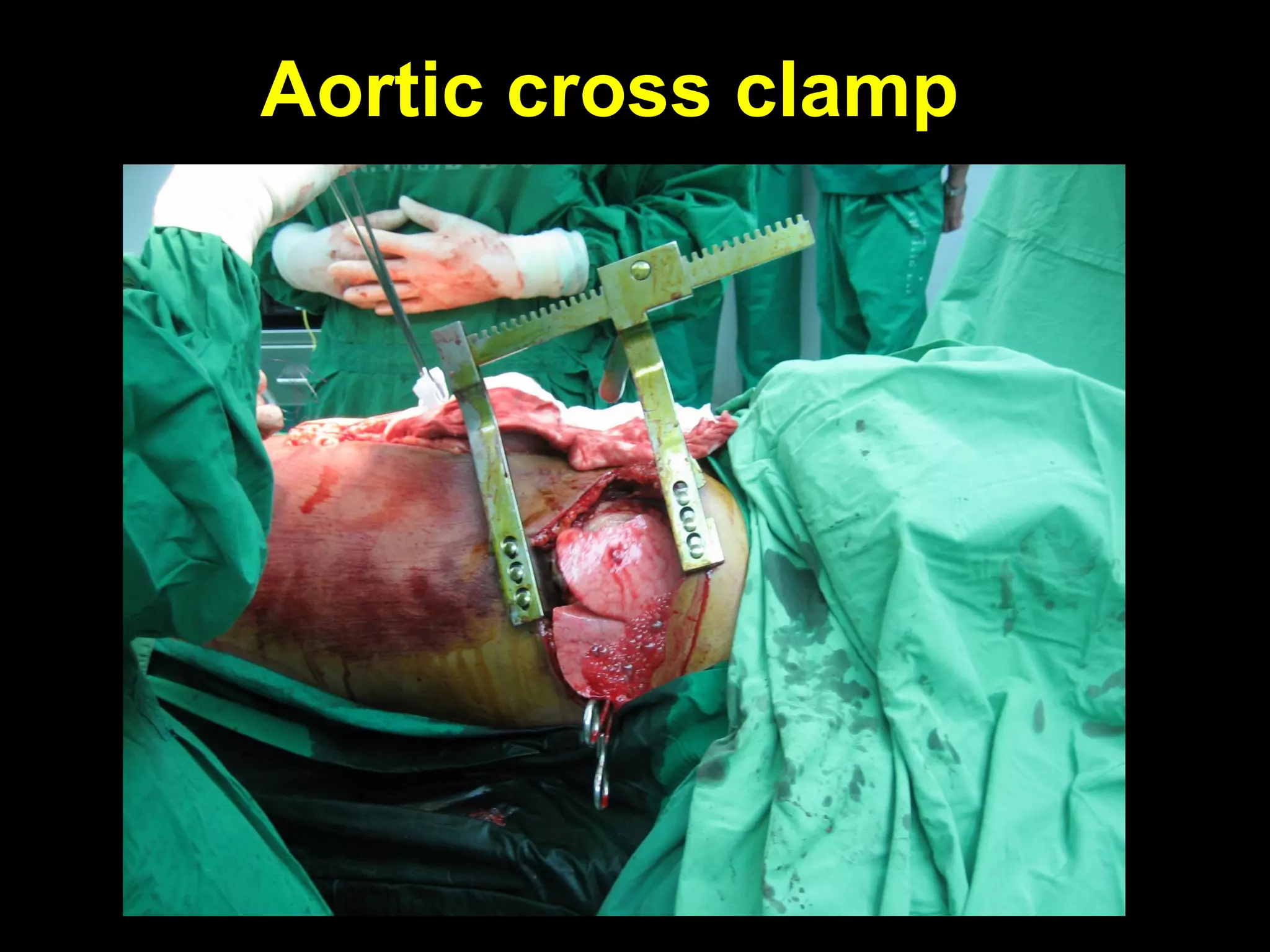
Aortic cross clampAortic cross clamp
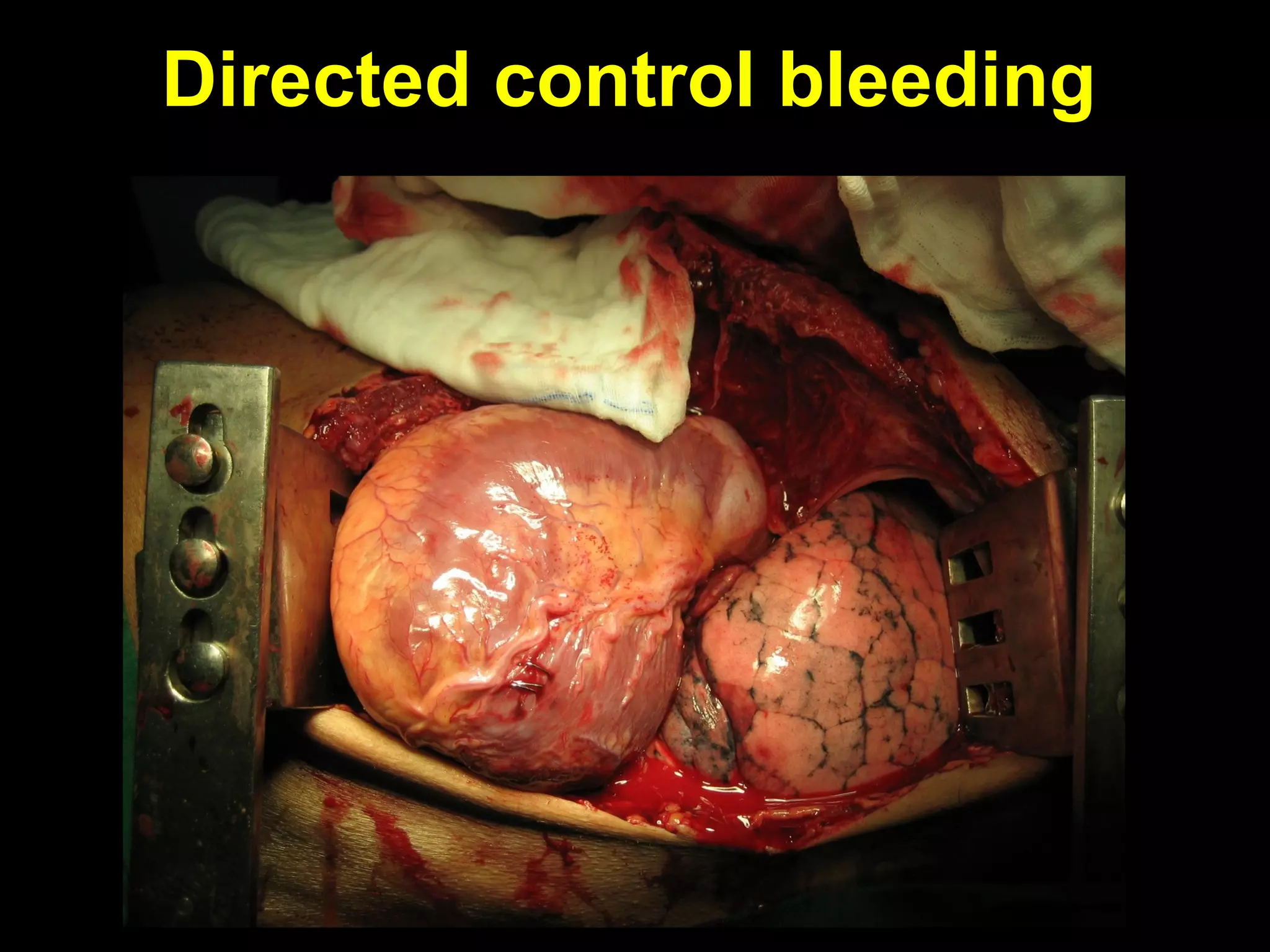
Directed control bleedingDirected control bleeding
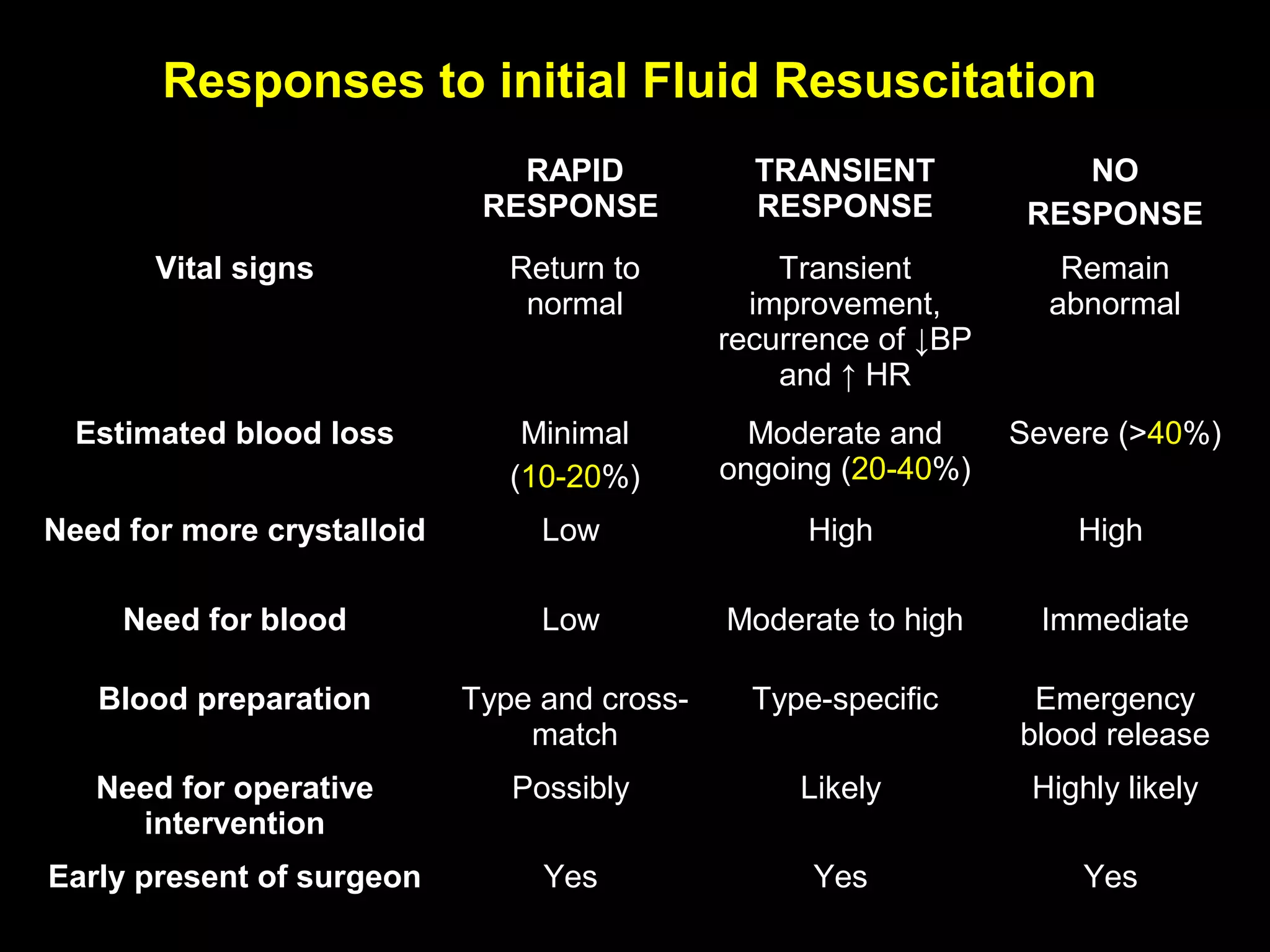
Responses to initial Fluid ResuscitationResponses to initial Fluid Resuscitation
RAPIDRAPID
RESPONSERESPONSE
TRANSIENTTRANSIENT
RESPONSERESPONSE
NONO
RESPONSERESPONSE
Vital signsVital signs Return toReturn to
normalnormal
TransientTransient
improvement,improvement,
recurrence ofrecurrence of ↓↓BPBP
andand ↑↑ HRHR
RemainRemain
abnormalabnormal
Estimated blood lossEstimated blood loss MinimalMinimal
((10-2010-20%)%)
Moderate andModerate and
ongoing (ongoing (20-4020-40%)%)
Severe (>Severe (>4040%)%)
Need for more crystalloidNeed for more crystalloid LowLow HighHigh HighHigh
Need for bloodNeed for blood LowLow Moderate to highModerate to high ImmediateImmediate
Blood preparationBlood preparation Type and cross-Type and cross-
matchmatch
Type-specificType-specific EmergencyEmergency
blood releaseblood release
Need for operativeNeed for operative
interventionintervention
PossiblyPossibly LikelyLikely Highly likelyHighly likely
Early present of surgeonEarly present of surgeon YesYes YesYes YesYes
Adjuncts to primaryAdjuncts to primary survey and resuscitationsurvey and resuscitation
1.1. MonitoringMonitoring
• EKG monitoringEKG monitoring
• Pulse oximetryPulse oximetry
• Blood pressureBlood pressure
1.1. Urinary and gastric cathetersUrinary and gastric catheters
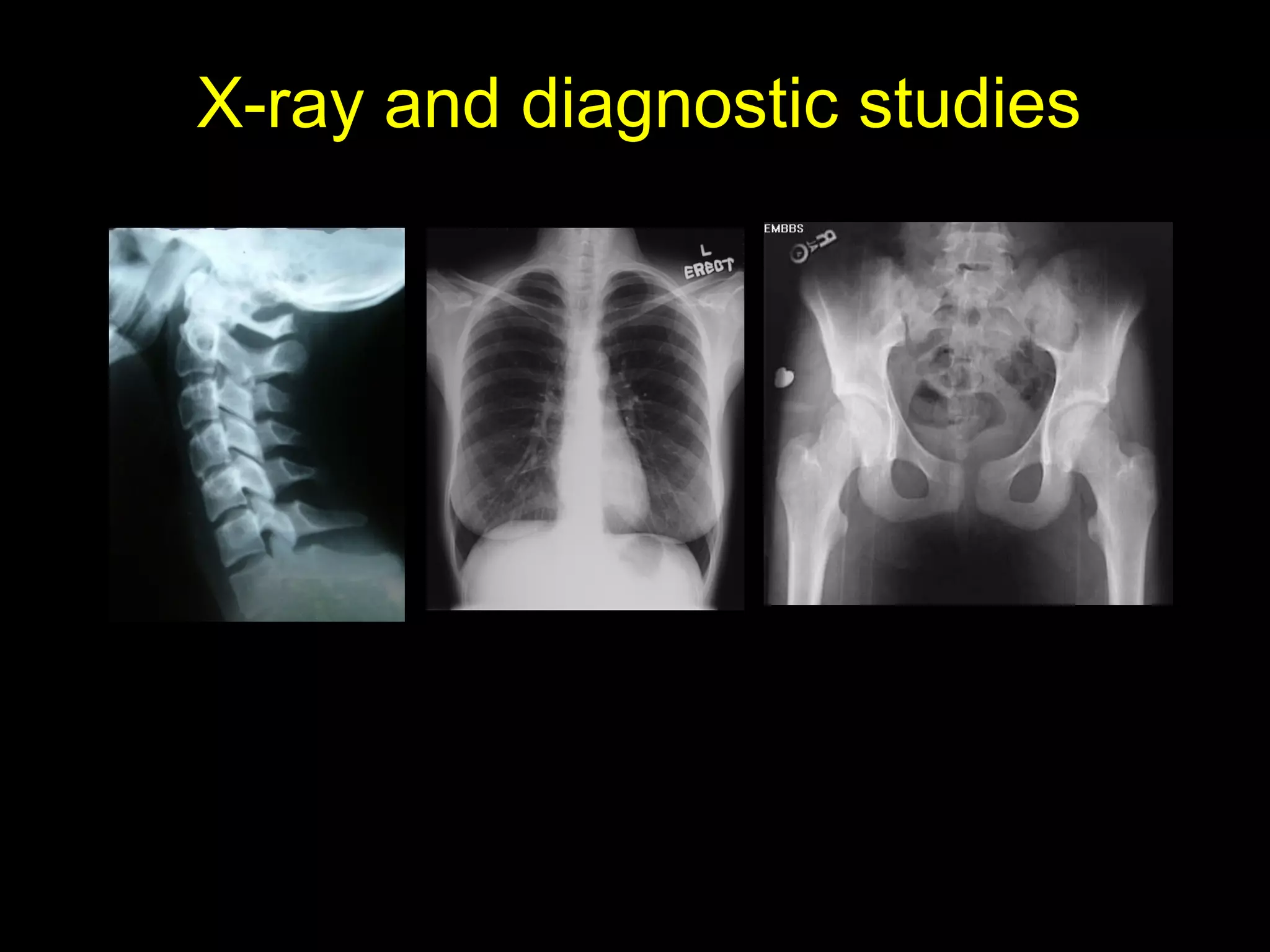
2.2. X-ray and diagnostic studies :X-ray and diagnostic studies : “should not“should not
interrupt the resuscitation process”interrupt the resuscitation process”
• ChestChest
• PelvisPelvis
• C-spineC-spine
• DPL or FASTDPL or FAST
Urinary catheterUrinary catheter
Contraindication for transurethral bladderContraindication for transurethral bladder
catheterizationcatheterization
““suspected urethral transection”suspected urethral transection”
1.1. Blood at penile meatusBlood at penile meatus
2.2. Perineal ecchymosisPerineal ecchymosis
3.3. Blood in scrotumBlood in scrotum
4.4. High-riding or nonpalpable prostateHigh-riding or nonpalpable prostate
5.5. Pelvic fracturePelvic fracture
X-ray and diagnostic studiesX-ray and diagnostic studies
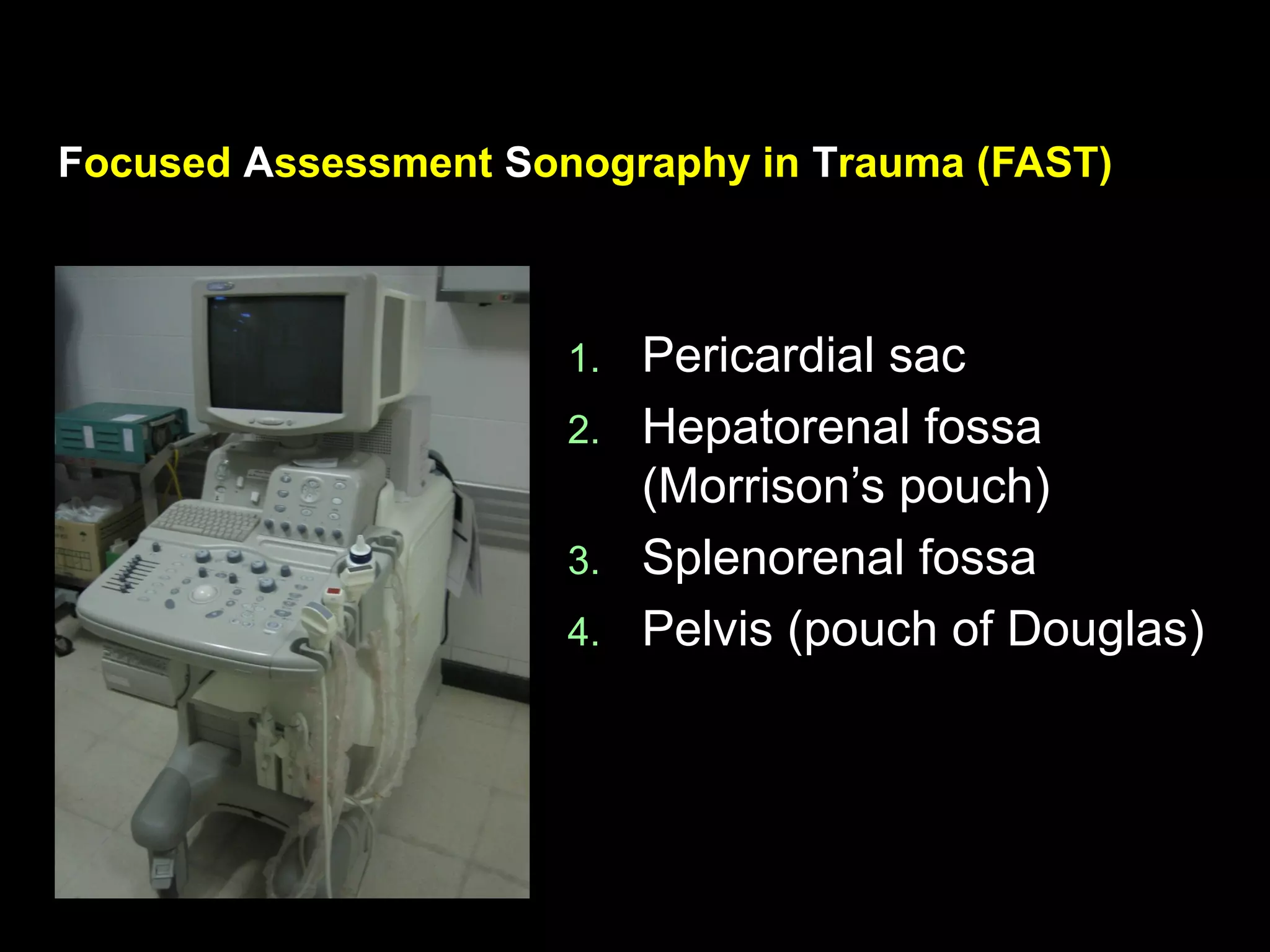
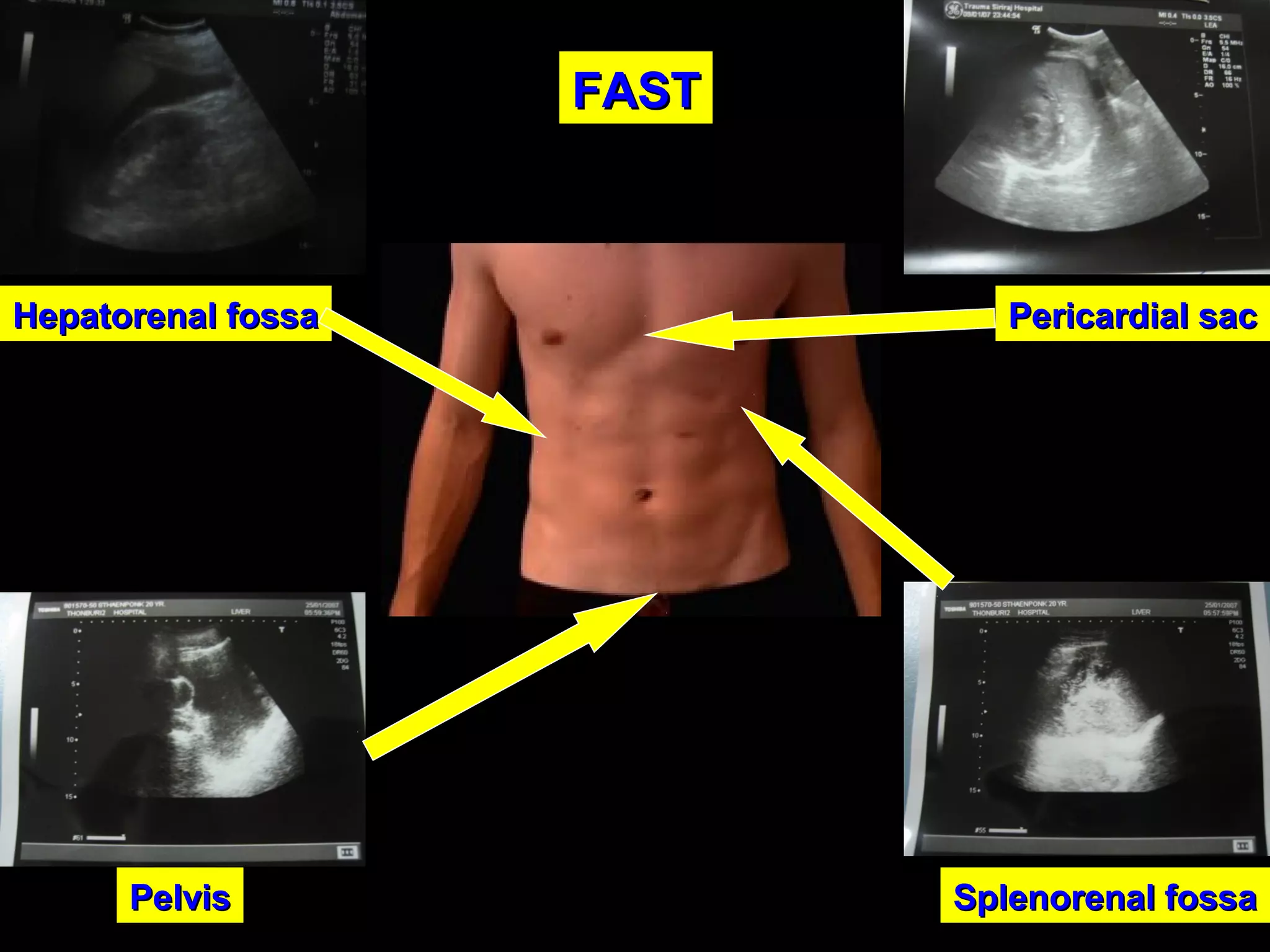
FFocusedocused AAssessmentssessment SSonography inonography in TTrauma (FAST)rauma (FAST)
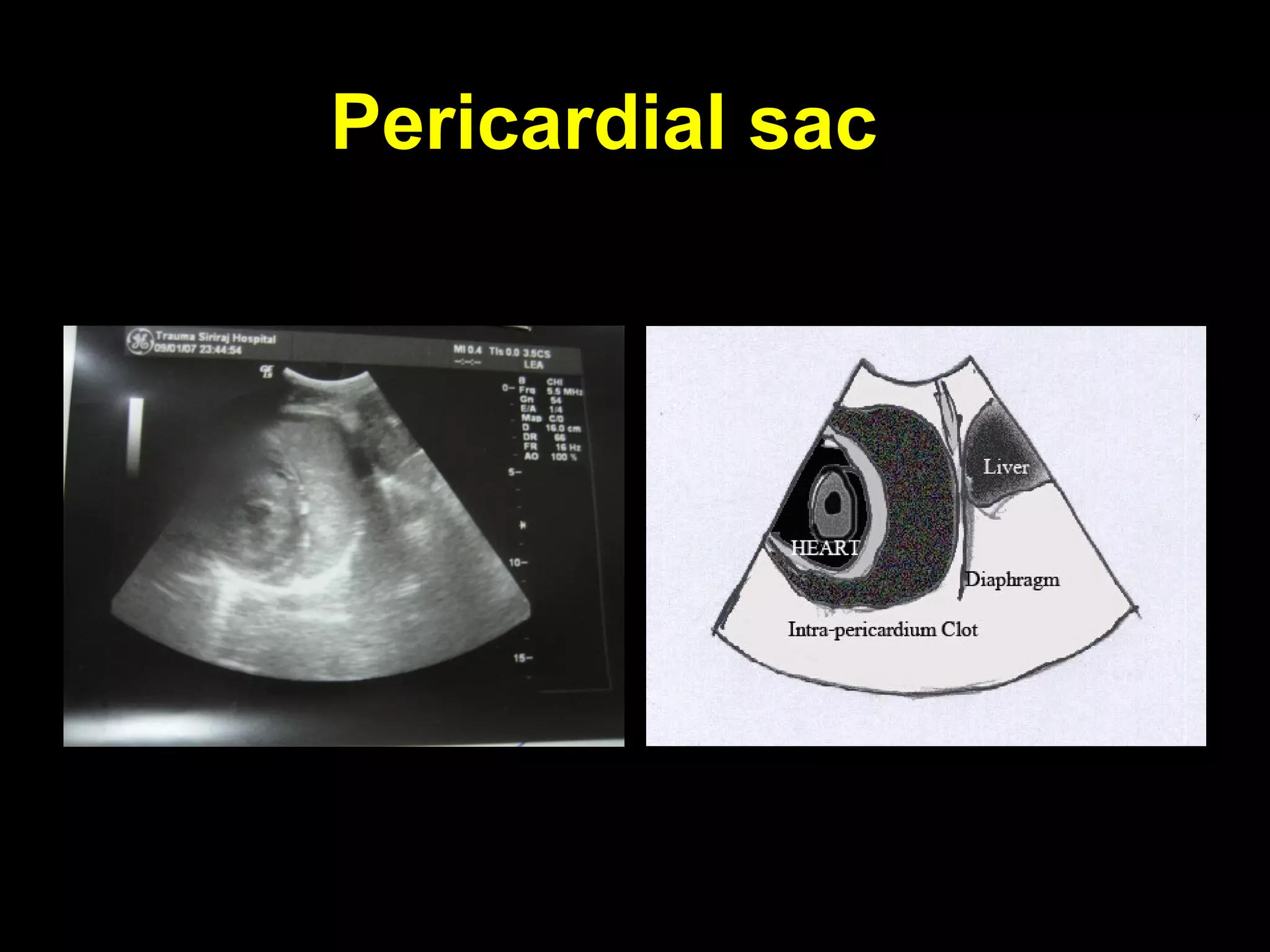
1.1. Pericardial sacPericardial sac
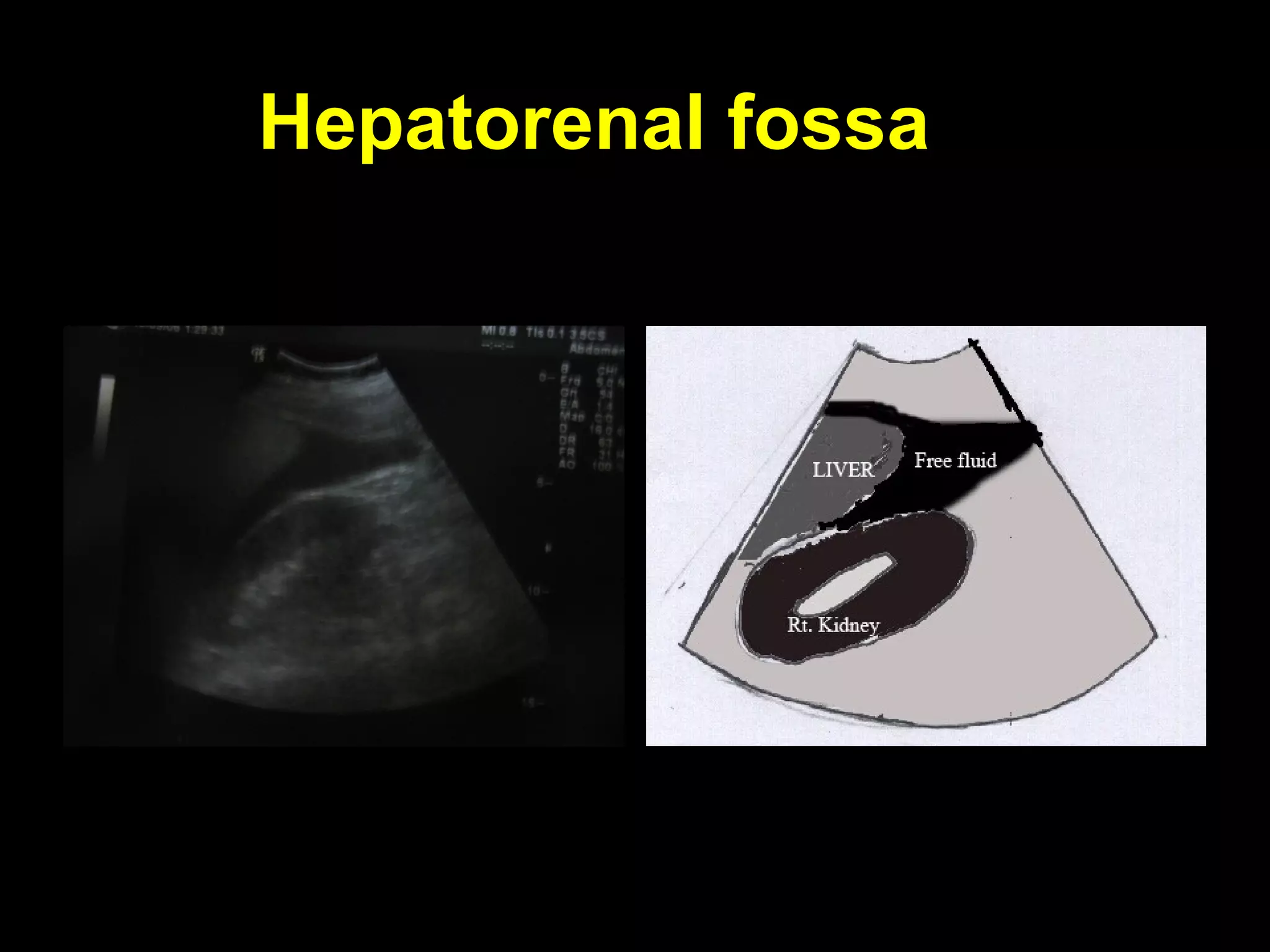
2.2. Hepatorenal fossaHepatorenal fossa
(Morrison’s pouch)(Morrison’s pouch)
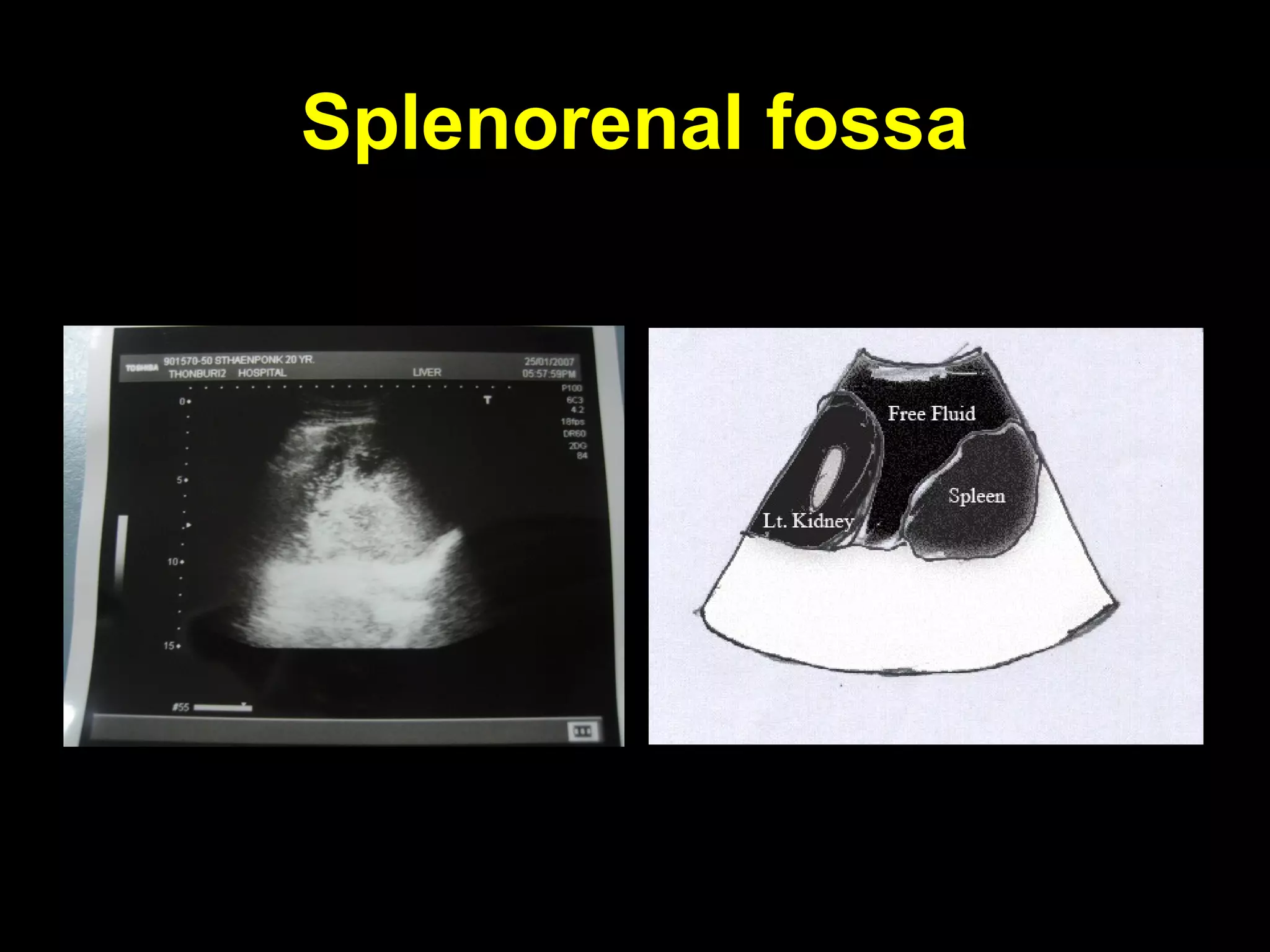
3.3. Splenorenal fossaSplenorenal fossa
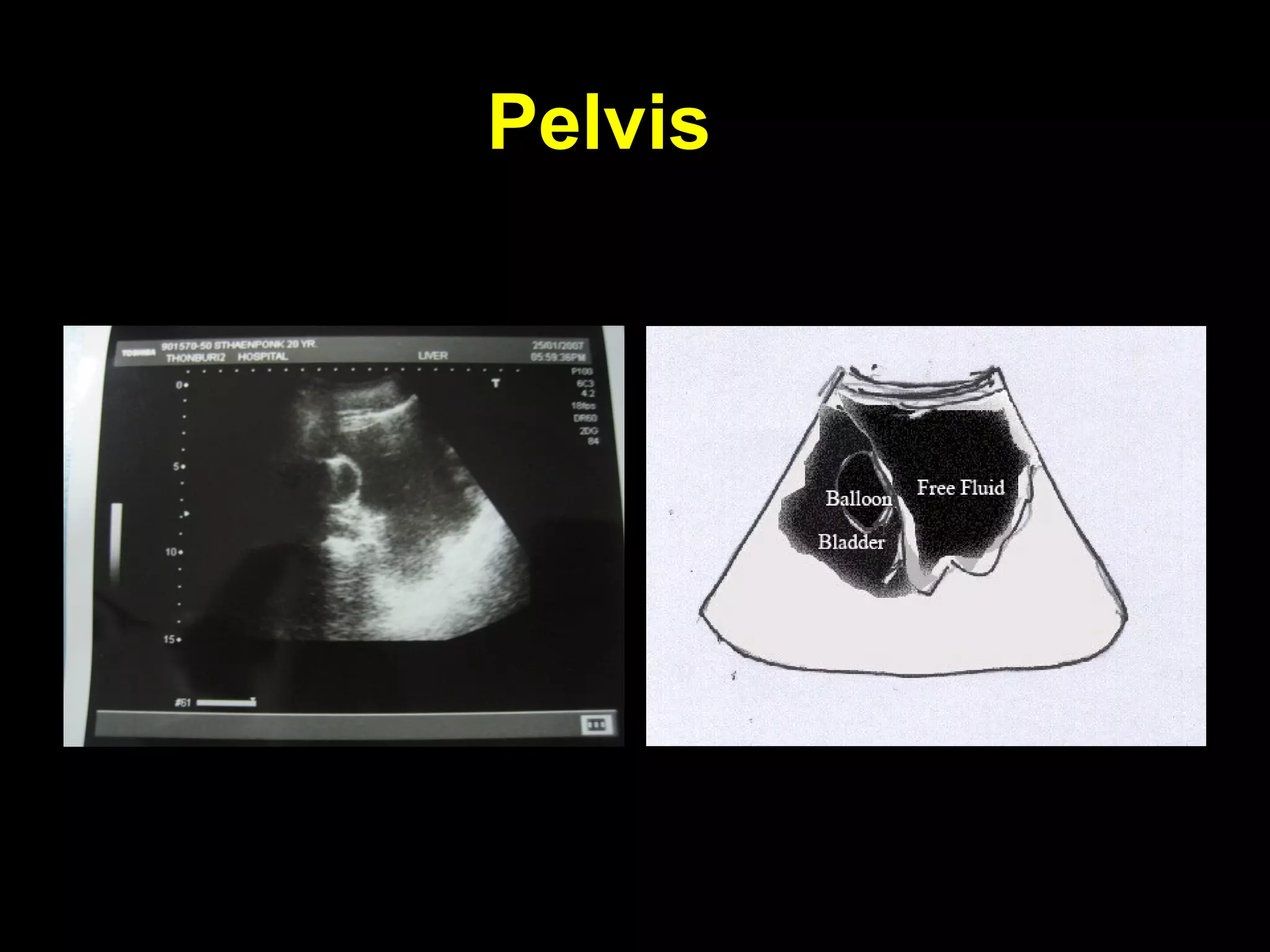
4.4. Pelvis (pouch of Douglas)Pelvis (pouch of Douglas)
Pericardial sacPericardial sacHepatorenal fossaHepatorenal fossa
Splenorenal fossaSplenorenal fossaPelvisPelvis
FASTFAST
Pericardial sacPericardial sac
Hepatorenal fossaHepatorenal fossa
Splenorenal fossaSplenorenal fossa
PelvisPelvis
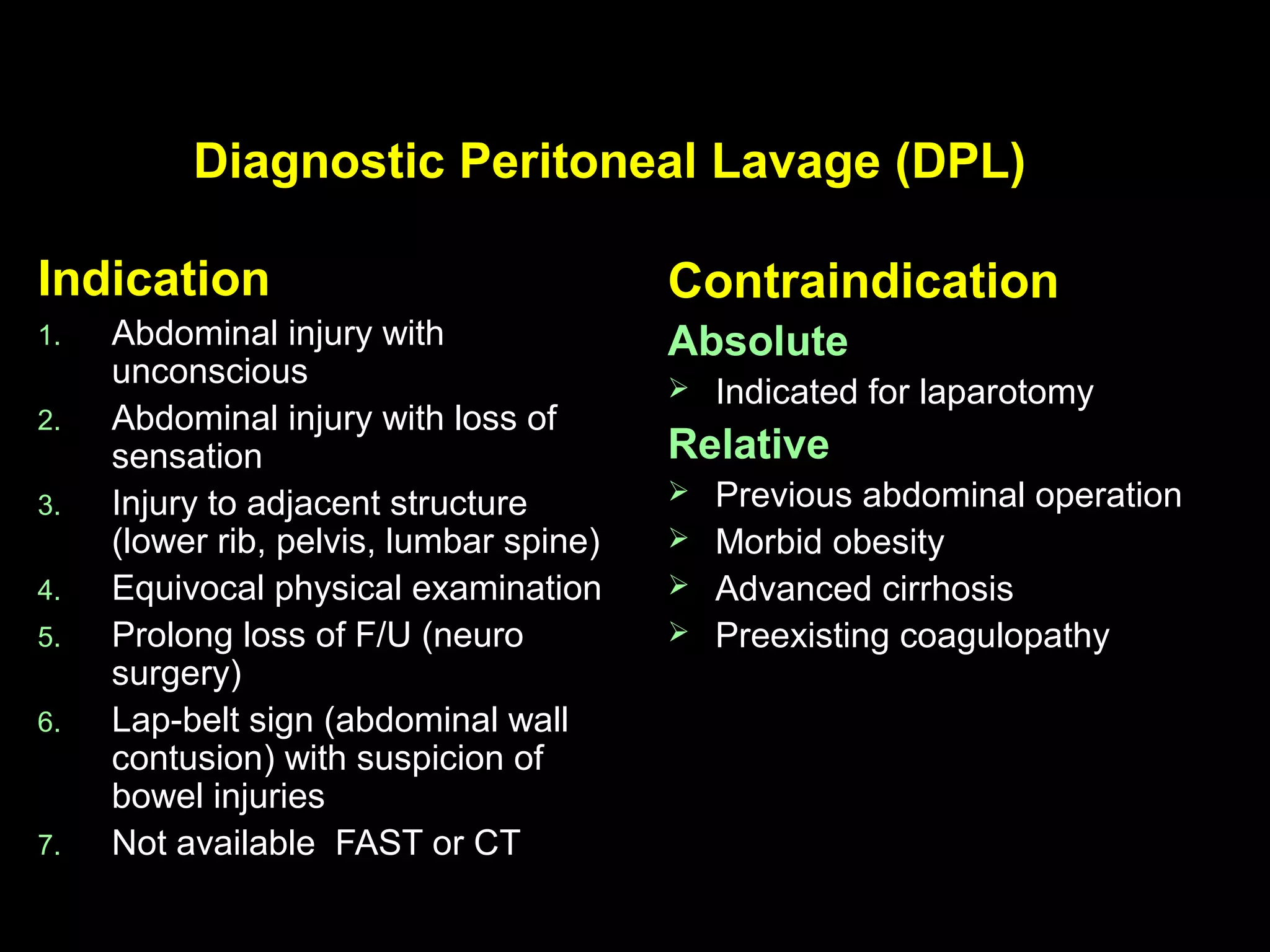
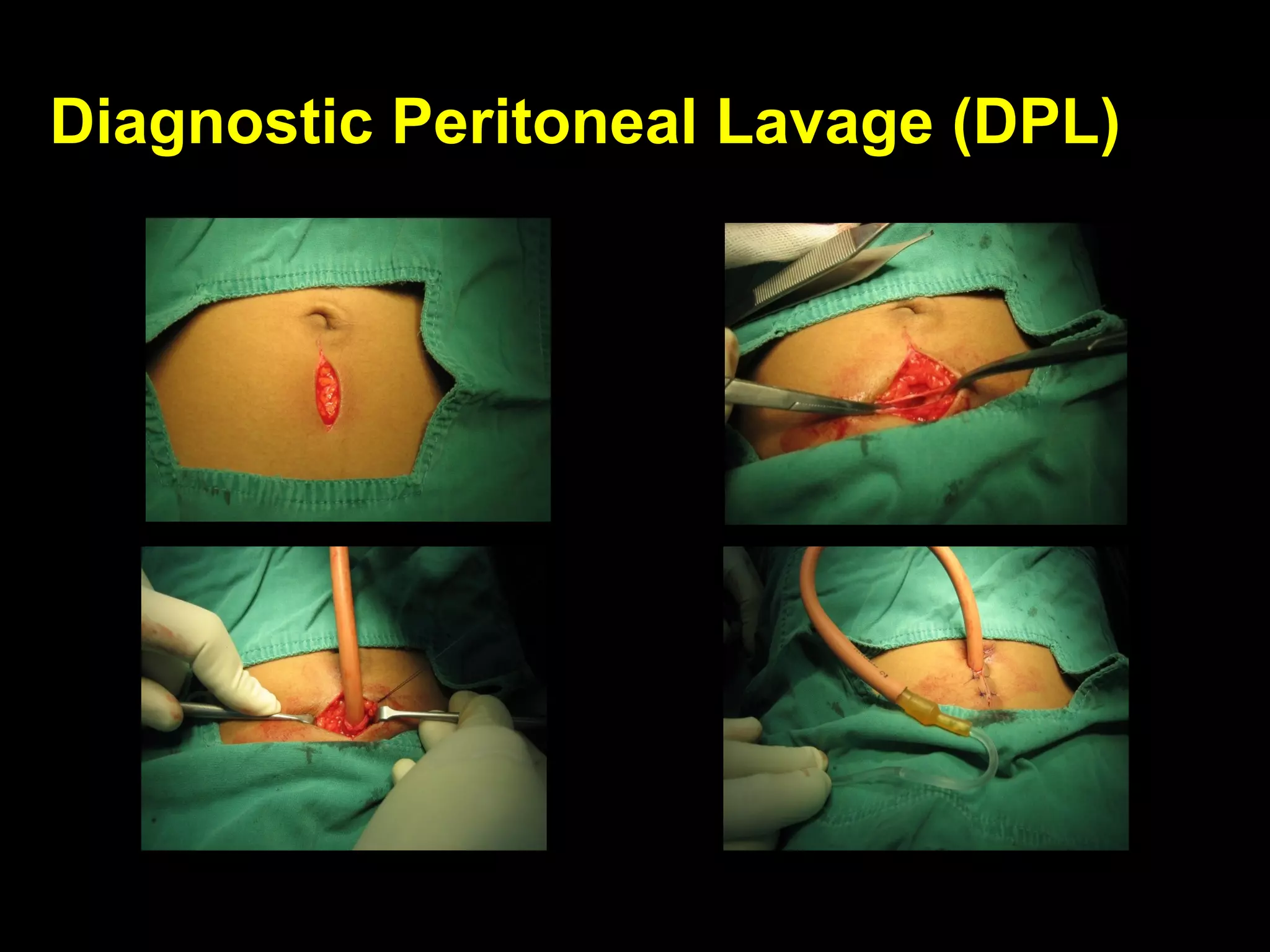
Diagnostic Peritoneal Lavage (DPL)Diagnostic Peritoneal Lavage (DPL)
IndicationIndication
1.1. Abdominal injury withAbdominal injury with
unconsciousunconscious
2.2. Abdominal injury with loss ofAbdominal injury with loss of
sensationsensation
3.3. Injury to adjacent structureInjury to adjacent structure
(lower rib, pelvis, lumbar spine)(lower rib, pelvis, lumbar spine)
4.4. Equivocal physical examinationEquivocal physical examination
5.5. Prolong loss of F/U (neuroProlong loss of F/U (neuro
surgery)surgery)
6.6. Lap-belt sign (abdominal wallLap-belt sign (abdominal wall
contusion) with suspicion ofcontusion) with suspicion of
bowel injuriesbowel injuries
7.7. Not available FAST or CTNot available FAST or CT
ContraindicationContraindication
AbsoluteAbsolute
 Indicated for laparotomyIndicated for laparotomy
RelativeRelative
 Previous abdominal operationPrevious abdominal operation
 Morbid obesityMorbid obesity
 Advanced cirrhosisAdvanced cirrhosis
 Preexisting coagulopathyPreexisting coagulopathy
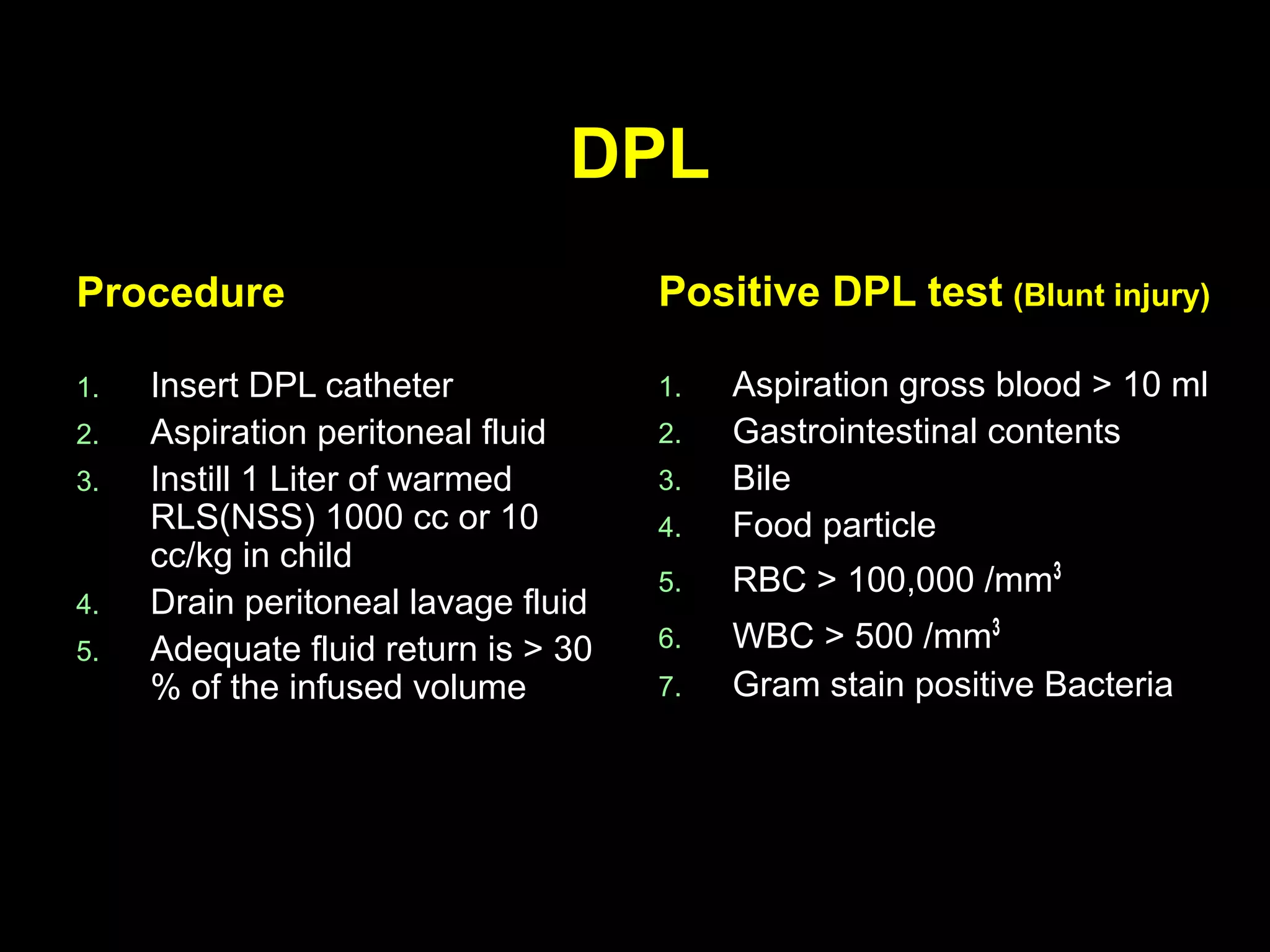
DPLDPL
ProcedureProcedure
1.1. Insert DPL catheterInsert DPL catheter
2.2. Aspiration peritoneal fluidAspiration peritoneal fluid
3.3. Instill 1 Liter of warmedInstill 1 Liter of warmed
RLS(NSS) 1000 cc or 10RLS(NSS) 1000 cc or 10
cc/kg in childcc/kg in child
4.4. Drain peritoneal lavage fluidDrain peritoneal lavage fluid
5.5. Adequate fluid return is > 30Adequate fluid return is > 30
% of the infused volume% of the infused volume
Positive DPL testPositive DPL test (Blunt injury)(Blunt injury)
1.1. Aspiration gross blood > 10 mlAspiration gross blood > 10 ml
2.2. Gastrointestinal contentsGastrointestinal contents
3.3. BileBile
4.4. Food particleFood particle
5.5. RBC > 100,000 /mmRBC > 100,000 /mm33
6.6. WBC > 500 /mmWBC > 500 /mm33
7.7. Gram stain positive BacteriaGram stain positive Bacteria
Diagnostic Peritoneal Lavage (DPL)Diagnostic Peritoneal Lavage (DPL)
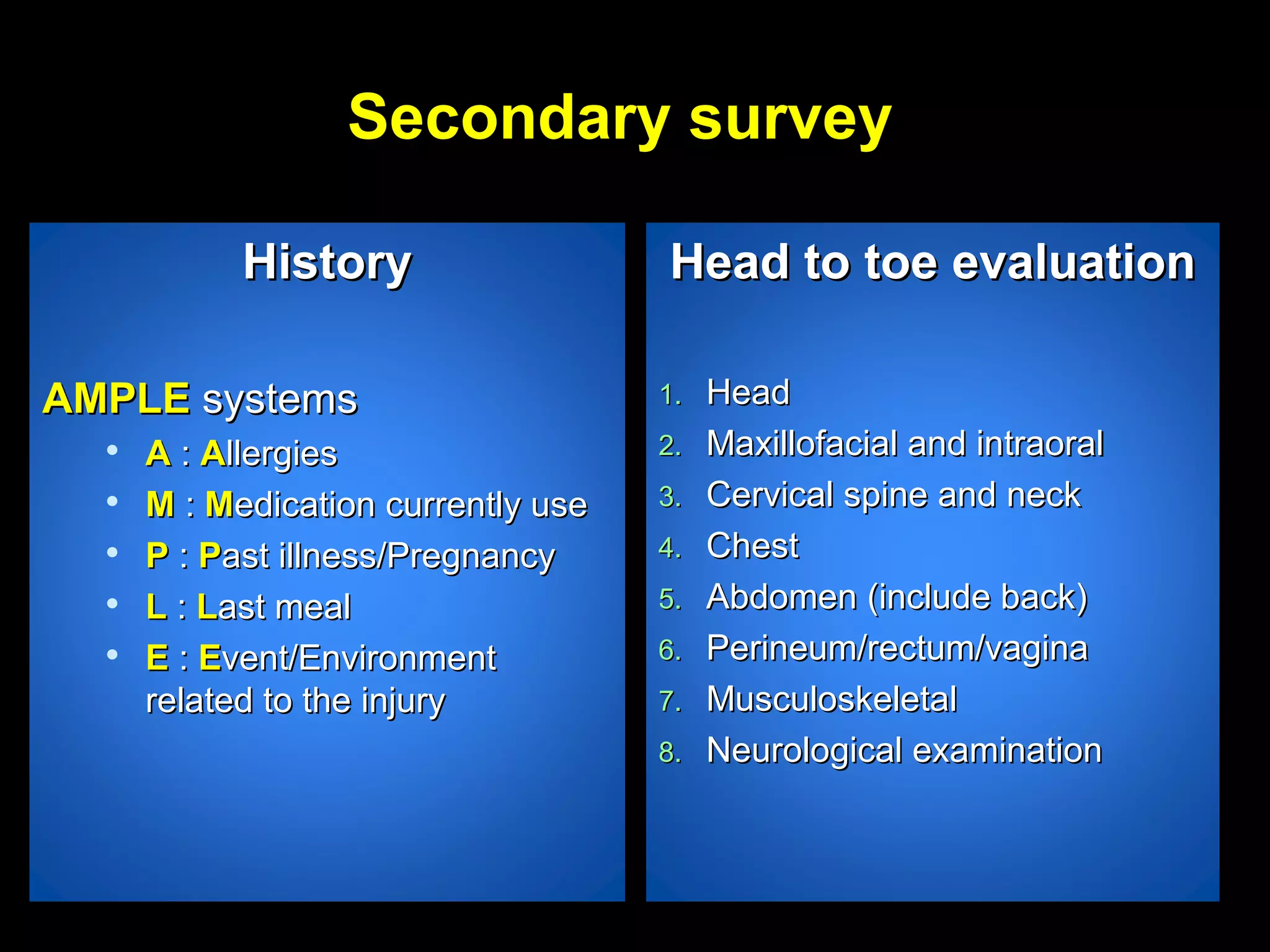
Secondary surveySecondary survey
HistoryHistory
AMPLEAMPLE systemssystems

AA :: AAllergiesllergies

MM :: MMedication currently useedication currently use

PP :: PPast illness/Pregnancyast illness/Pregnancy

LL :: LLast mealast meal

EE :: EEvent/Environmentvent/Environment
related to the injuryrelated to the injury
Head to toe evaluationHead to toe evaluation
1.1. HeadHead
2.2. Maxillofacial and intraoralMaxillofacial and intraoral
3.3. Cervical spine and neckCervical spine and neck
4.4. ChestChest
5.5. Abdomen (include back)Abdomen (include back)
6.6. Perineum/rectum/vaginaPerineum/rectum/vagina
7.7. MusculoskeletalMusculoskeletal
8.8. Neurological examinationNeurological examination
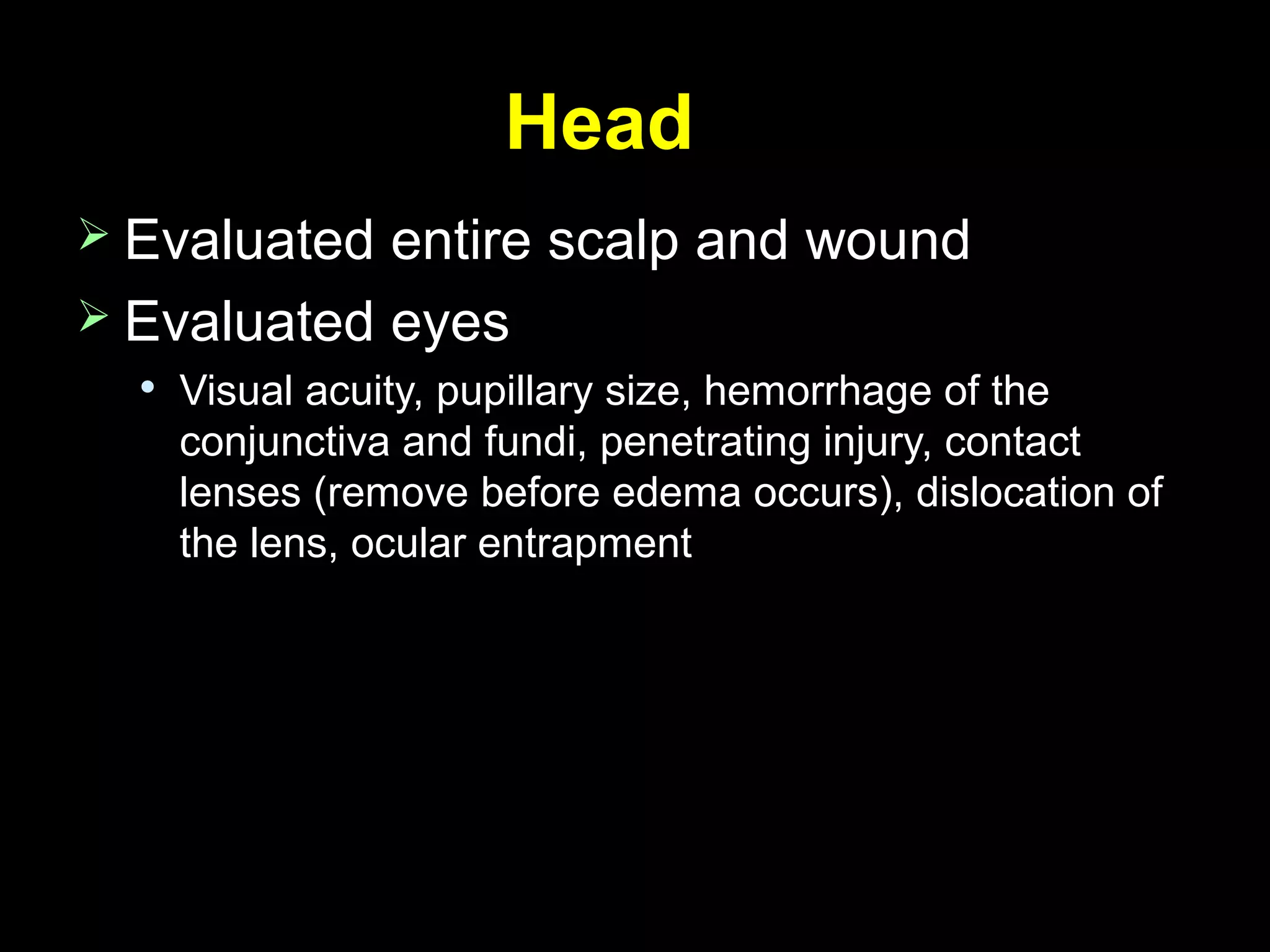
HeadHead
 Evaluated entire scalp and woundEvaluated entire scalp and wound
 Evaluated eyesEvaluated eyes

Visual acuity, pupillary size, hemorrhage of theVisual acuity, pupillary size, hemorrhage of the
conjunctiva and fundi, penetrating injury, contactconjunctiva and fundi, penetrating injury, contact
lenses (remove before edema occurs), dislocation oflenses (remove before edema occurs), dislocation of
the lens, ocular entrapmentthe lens, ocular entrapment
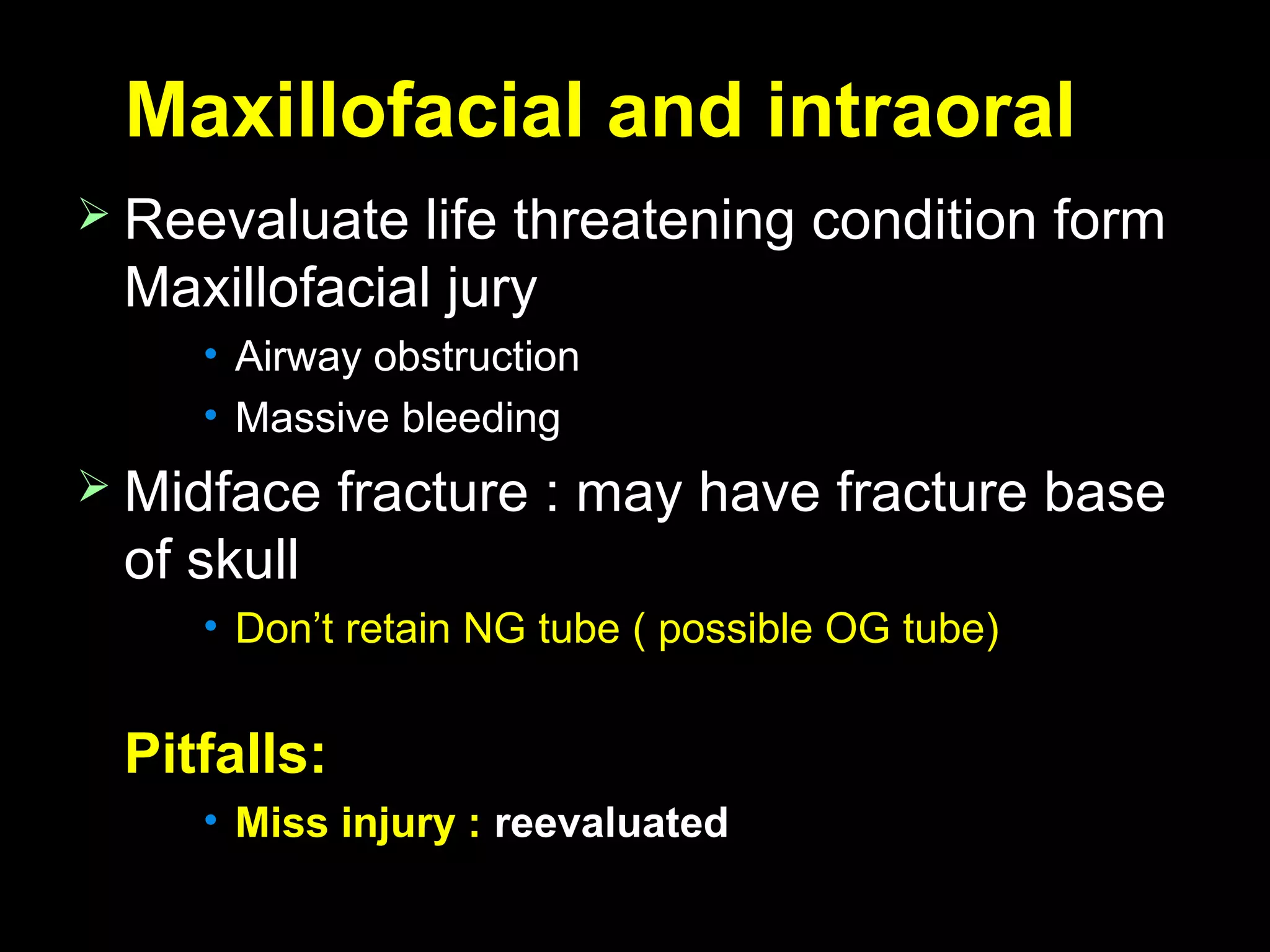
Maxillofacial and intraoralMaxillofacial and intraoral
 Reevaluate life threatening condition formReevaluate life threatening condition form
Maxillofacial juryMaxillofacial jury
• Airway obstructionAirway obstruction
• Massive bleedingMassive bleeding
 Midface fracture : may have fracture baseMidface fracture : may have fracture base
of skullof skull
• Don’t retain NG tube ( possible OG tube)Don’t retain NG tube ( possible OG tube)
Pitfalls:Pitfalls:
• Miss injury :Miss injury : reevaluatedreevaluated
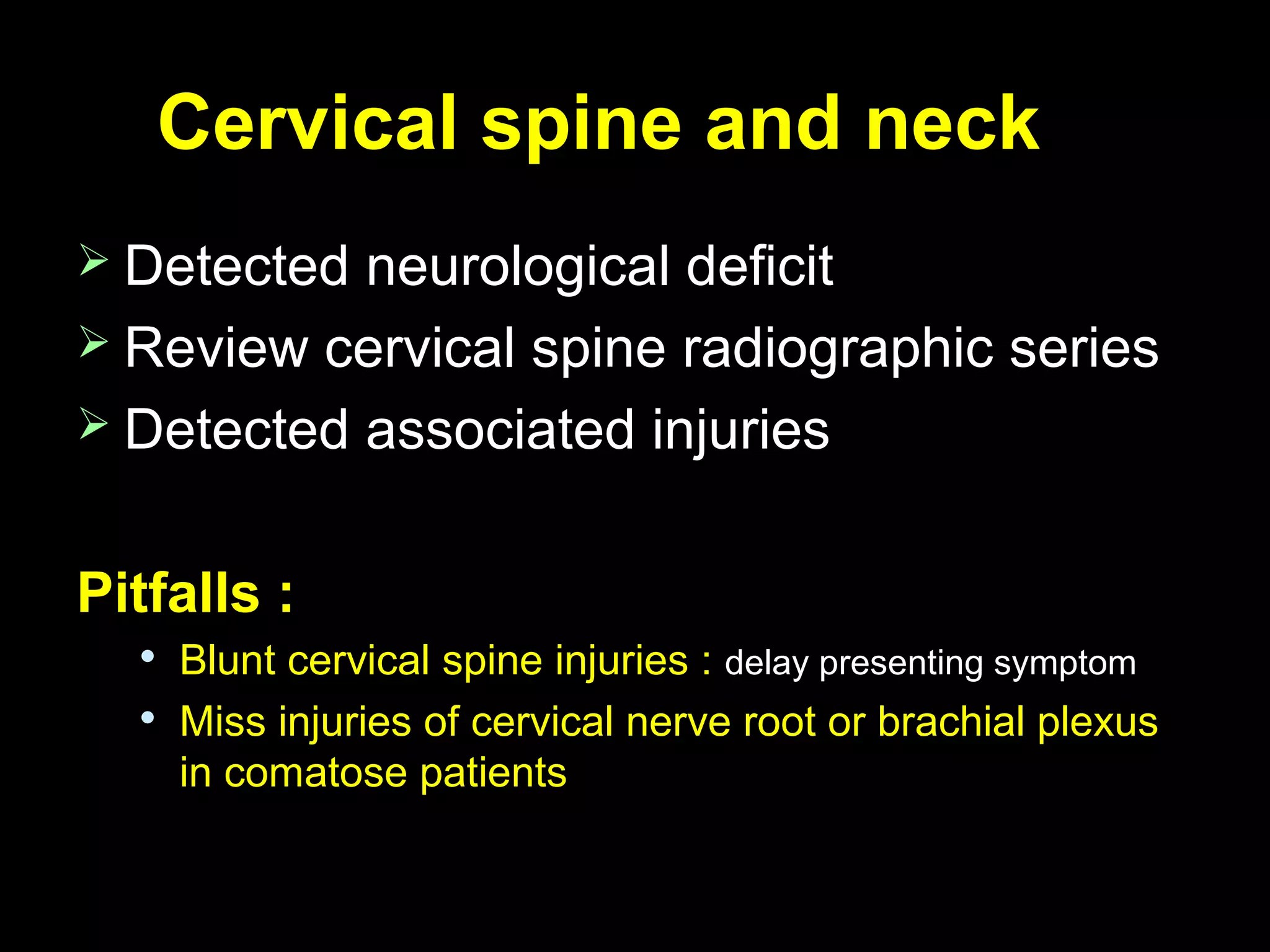
Cervical spine and neckCervical spine and neck
 Detected neurological deficitDetected neurological deficit
 Review cervical spine radiographic seriesReview cervical spine radiographic series
 Detected associated injuriesDetected associated injuries
Pitfalls :Pitfalls :

Blunt cervical spine injuries :Blunt cervical spine injuries : delay presenting symptomdelay presenting symptom

Miss injuries of cervical nerve root or brachial plexusMiss injuries of cervical nerve root or brachial plexus
in comatose patientsin comatose patients
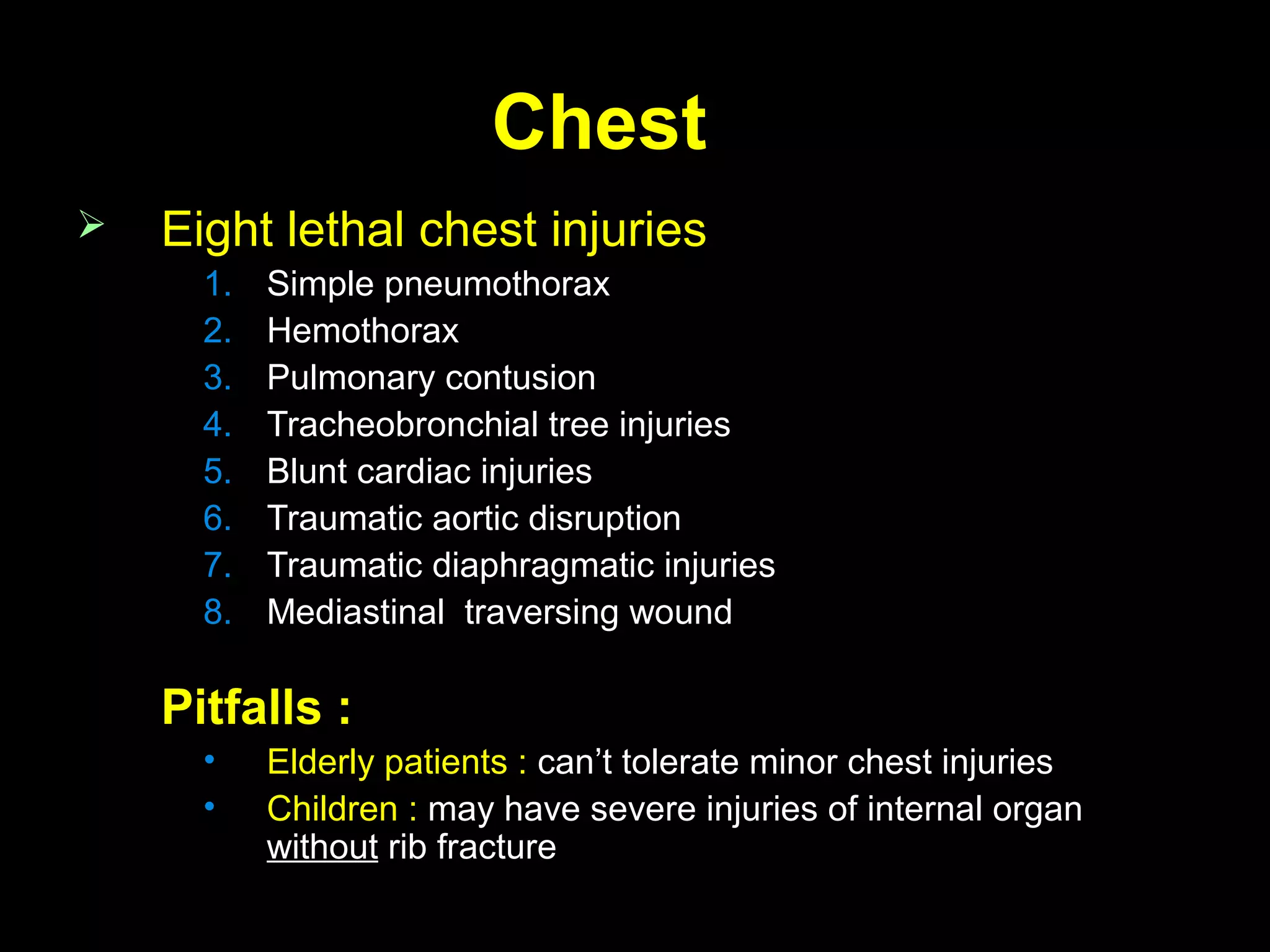
ChestChest
 Eight lethal chest injuriesEight lethal chest injuries
1.1. Simple pneumothoraxSimple pneumothorax
2.2. HemothoraxHemothorax
3.3. Pulmonary contusionPulmonary contusion
4.4. Tracheobronchial tree injuriesTracheobronchial tree injuries
5.5. Blunt cardiac injuriesBlunt cardiac injuries
6.6. Traumatic aortic disruptionTraumatic aortic disruption
7.7. Traumatic diaphragmatic injuriesTraumatic diaphragmatic injuries
8.8. Mediastinal traversing woundMediastinal traversing wound
Pitfalls :Pitfalls :
• Elderly patients :Elderly patients : can’t tolerate minor chest injuriescan’t tolerate minor chest injuries
• Children :Children : may have severe injuries of internal organmay have severe injuries of internal organ
withoutwithout rib fracturerib fracture
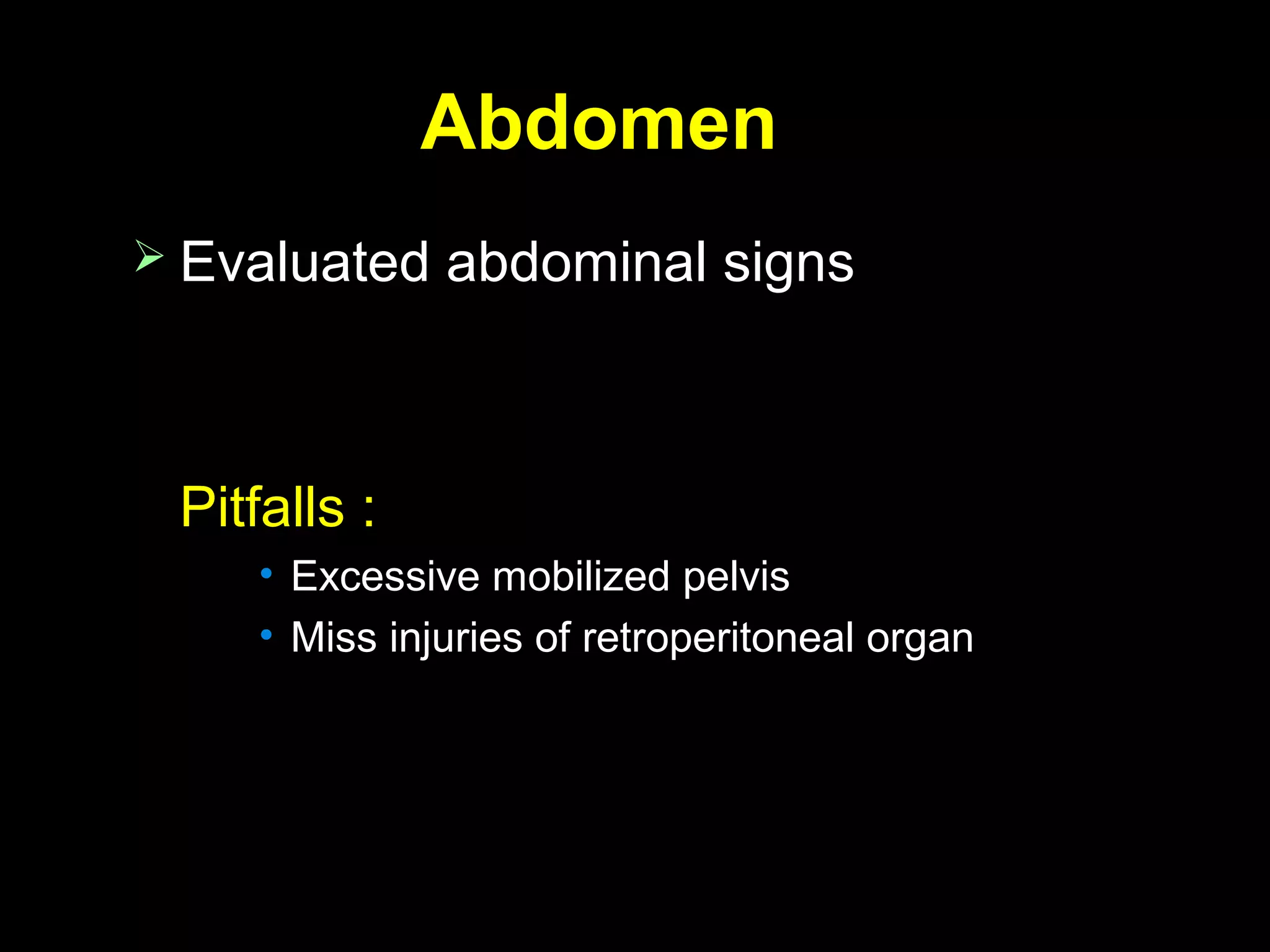
AbdomenAbdomen
 Evaluated abdominal signsEvaluated abdominal signs
Pitfalls :Pitfalls :
• Excessive mobilized pelvisExcessive mobilized pelvis
• Miss injuries of retroperitoneal organMiss injuries of retroperitoneal organ
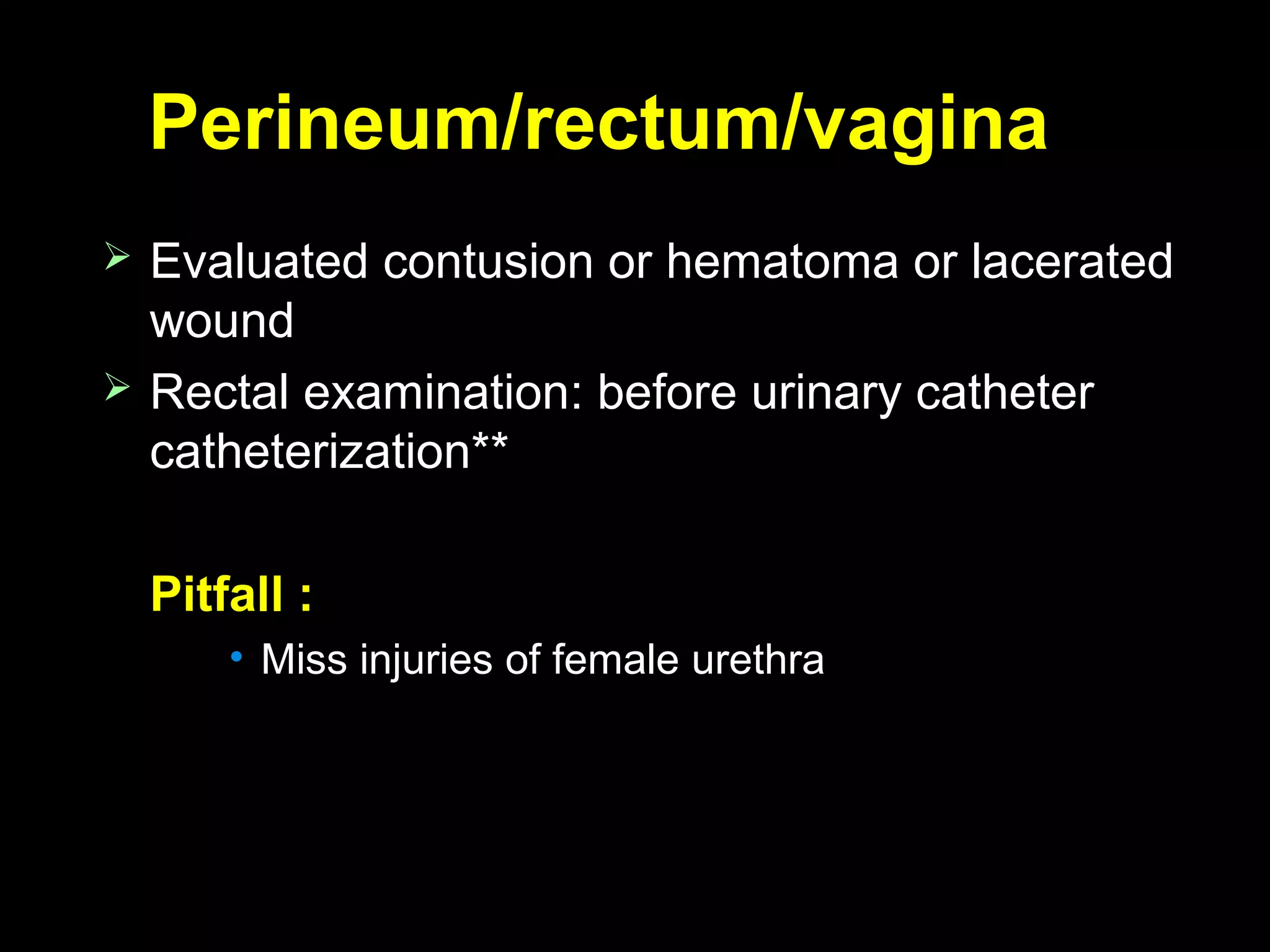
Perineum/rectum/vaginaPerineum/rectum/vagina
 Evaluated contusion or hematoma or laceratedEvaluated contusion or hematoma or lacerated
woundwound
 Rectal examination: before urinary catheterRectal examination: before urinary catheter
catheterization**catheterization**
Pitfall :Pitfall :
• Miss injuries of female urethraMiss injuries of female urethra
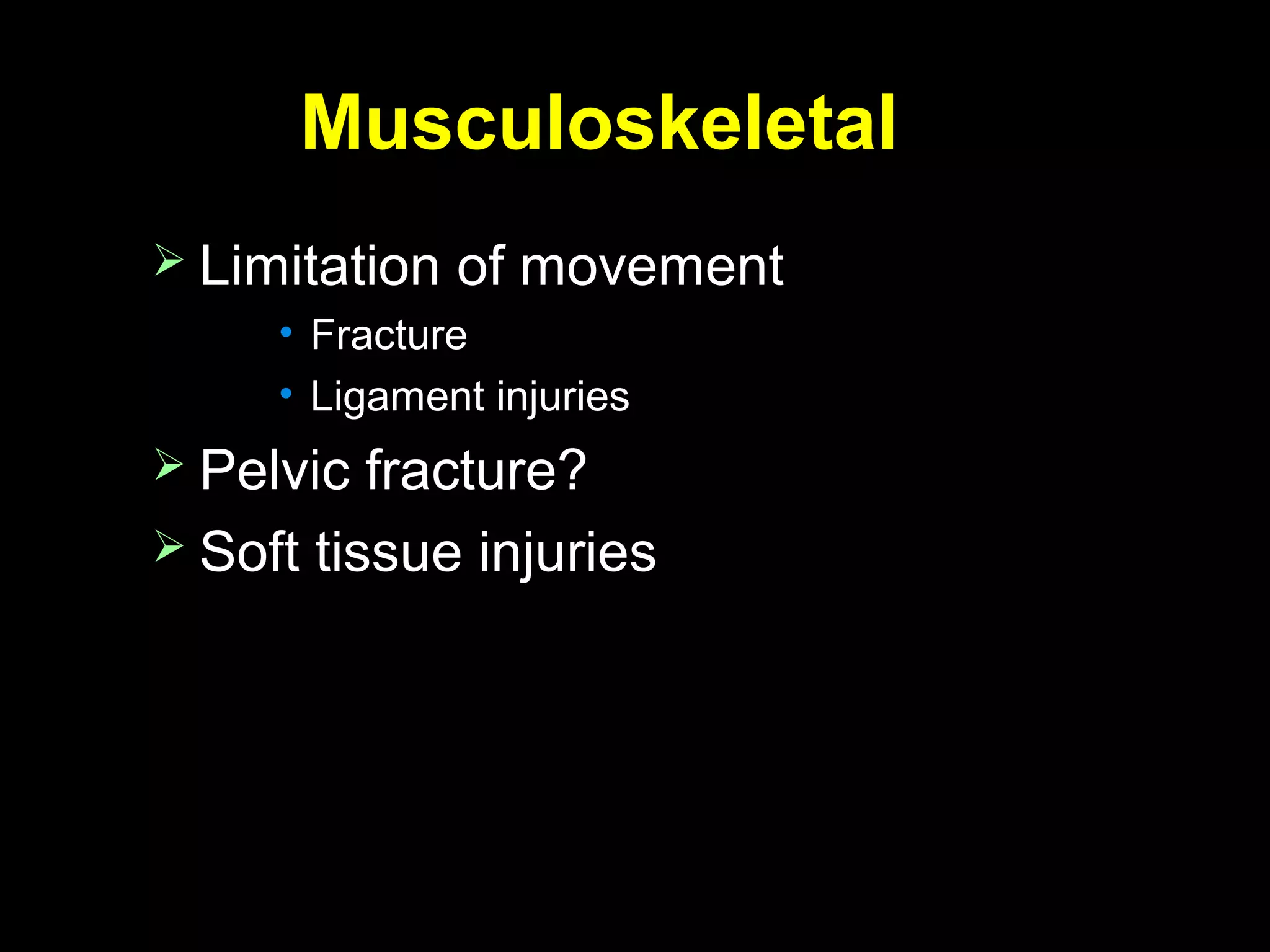
MusculoskeletalMusculoskeletal
 Limitation of movementLimitation of movement
• FractureFracture
• Ligament injuriesLigament injuries
 Pelvic fracture?Pelvic fracture?
 Soft tissue injuriesSoft tissue injuries
Neurological examinationNeurological examination
 Evaluated GCS scoreEvaluated GCS score
 Evaluated sensory and motor systemEvaluated sensory and motor system
Adjuncts to secondary surveyAdjuncts to secondary survey
 Further investigationFurther investigation
• CT scanCT scan
• Contrast x-ray studyContrast x-ray study
• Extremities x-rayExtremities x-ray
• Endoscope and U/SEndoscope and U/S
ReevaluationReevaluation
 MonitoringMonitoring
 StabilizationStabilization
Definitive careDefinitive care
 ObserveObserve
 SurgerySurgery
 InterventionIntervention
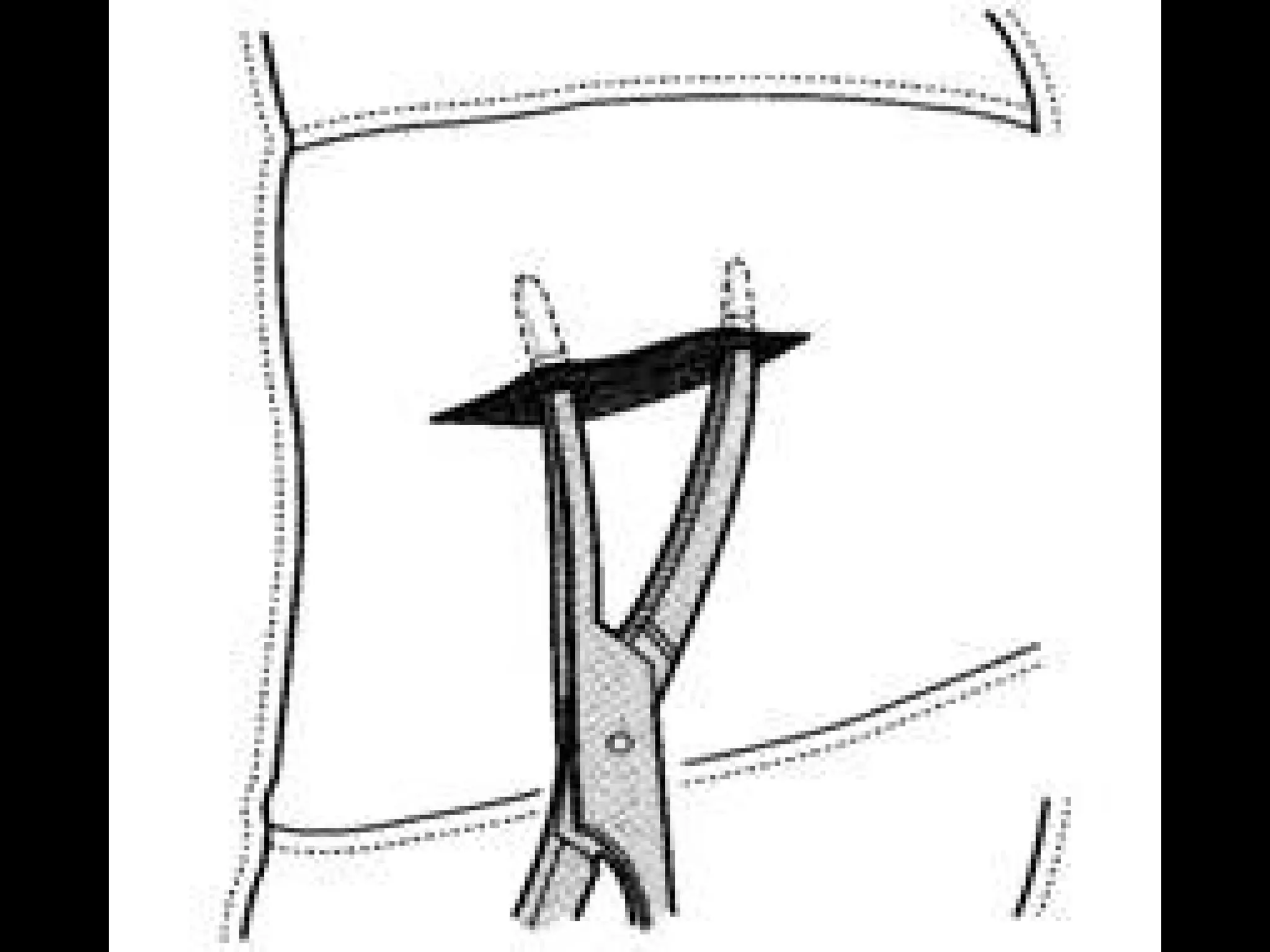
ICD placementICD placement
ขวดรองรับชนิดขวดเดียวขวดรองรับชนิดขวดเดียว
Prevent air & fluid from returnin
to the pleural space
Prevent air & fluid from returning
to the pleural space
• Most b
• Straw a
chest t
is place
fluid (w
• Just lik
drink, a
through
air can
• Most ba
• Straw a
chest tu
is place
fluid (w
• Just lik
drink, a
through
air can
Tube open to
atmosphere
vents air
Tube from patient
ขวดรองรับชนิดขวดรองรับชนิด 22 ขวดขวด
Prevent air & fluid from returni
to the pleural space
Prevent air & fluid from returnin
to the pleural space
• For dr
bottle
• The fir
the dra
• The se
the wa
• With a
draina
seal w
• For dra
bottle w
• The fir
the dra
• The se
the wa
• With a
draina
seal w
Tube from patient
Tube open to
atmosphere
vents air
Fluid
drainage
2cm
fluid
ขวดรองรับชนิดขวดรองรับชนิด 33 ขวดขวดRestore negative pressure in the
pleural space
Restore negative pressure in the
pleural space
2cm fluid water seal Collection bottleSuction control
Tube from patient
Fluid
drainage
Tube open to
atmosphere
vents air
Straw under
20 cmH2O
Tube to
vacuum
source
Acute AbdomenAcute Abdomen
อาการปวดท้องอาการปวดท้อง (Acute abdomen,(Acute abdomen,
abdominal pain)abdominal pain)
 ชนิดของการปวดท้องชนิดของการปวดท้อง

Visceral painVisceral pain มาจากการกระตุ้นอมาจากการกระตุ้นอ
วัยวะภายใน โดยทั่วไปอาการปวดวัยวะภายใน โดยทั่วไปอาการปวด
จะอยู่ในแนวกลางตัวจะอยู่ในแนวกลางตัว บอกตำาแหน่งบอกตำาแหน่ง
ไม่ได้ชัดเจนไม่ได้ชัดเจน

Somato-parietal painSomato-parietal pain การกระตุ้นการกระตุ้น
parietal peritoneumparietal peritoneum ซึ่งมักเกิดซึ่งมักเกิด
จากการมีเนื้อเยื่อบาดเจ็บหรือจากการมีเนื้อเยื่อบาดเจ็บหรือ
อักเสบในตำาแหน่งนั้นๆ มักจะอักเสบในตำาแหน่งนั้นๆ มักจะ ระบุระบุ
ตำาแหน่งที่ปวดได้ชัดเจน
การประเมินอาการปวดการประเมินอาการปวด
 ลักษณะของการปวดลักษณะของการปวด
1.1. อาการปวดเริ่มจากน้อยๆ เพิ่มขึ้นเรื่อยๆช้าๆ และอาการปวดเริ่มจากน้อยๆ เพิ่มขึ้นเรื่อยๆช้าๆ และ
ทุเลาเองช้าๆ เช่นกัน มักพบใน โรคแผลในทุเลาเองช้าๆ เช่นกัน มักพบใน โรคแผลใน
กระเพาะอาหาร หรือกระเพาะอาหาร หรือ acute gastroenteritisacute gastroenteritis
2.2. มีอาการปวดเป็นๆ หายๆ ที่ความปวดเพิ่มขึ้นอย่างมีอาการปวดเป็นๆ หายๆ ที่ความปวดเพิ่มขึ้นอย่าง
รวดเร็ว เป็นอยู่สักครู่แล้วอาการดีขึ้นเอง มักพบในรวดเร็ว เป็นอยู่สักครู่แล้วอาการดีขึ้นเอง มักพบใน
intestinal colicintestinal colic หรือหรือ biliary colicbiliary colic
3.3. อาการปวดท้องมากขึ้นเรื่อยๆ อย่างช้าๆ โดยอาการปวดท้องมากขึ้นเรื่อยๆ อย่างช้าๆ โดย
อาการไม่ดีขึ้นเลย มักพบในอาการไม่ดีขึ้นเลย มักพบใน acuteacute
cholecystitischolecystitis หรือหรือ acute appendicitisacute appendicitis
4.4. เป็นอาการปวดที่มากและเฉียบพลัน มักพบในผู้ที่มีเป็นอาการปวดที่มากและเฉียบพลัน มักพบในผู้ที่มี
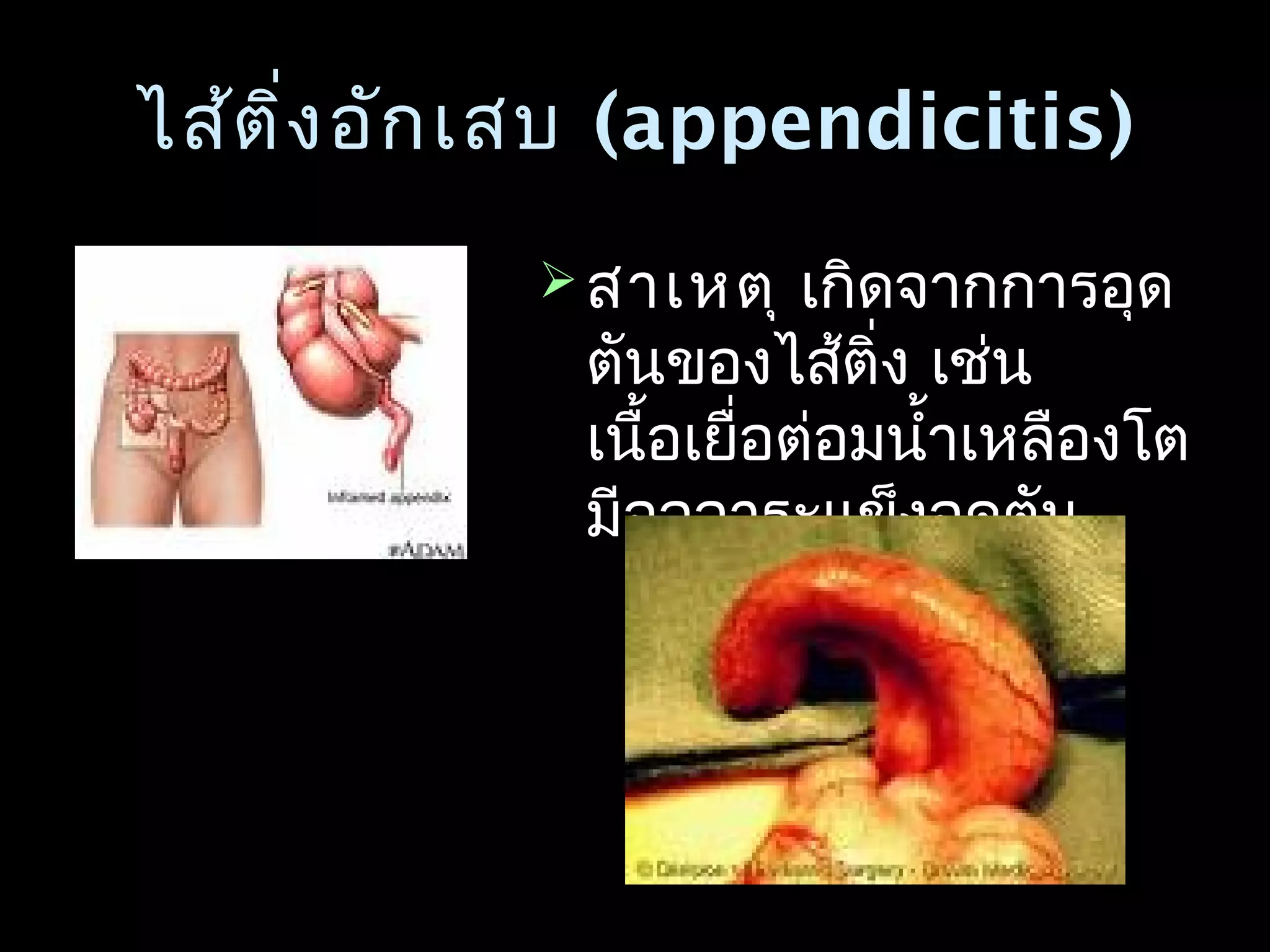
ไส้ติ่งอักเสบไส้ติ่งอักเสบ (appendicitis)(appendicitis)
 สาเหตุสาเหตุ เกิดจากการอุดเกิดจากการอุด
ตันของไส้ติ่ง เช่นตันของไส้ติ่ง เช่น
เนื้อเยื่อต่อมนำ้าเหลืองโตเนื้อเยื่อต่อมนำ้าเหลืองโต
มีอุจจาระแข็งอุดตันมีอุจจาระแข็งอุดตัน
เยื่อบุช่องท้องอักเสบเยื่อบุช่องท้องอักเสบ
(Peritonitis)(Peritonitis)
 สาเหตุสาเหตุ มักเกิดภายหลังมีการแตกทะลุของมักเกิดภายหลังมีการแตกทะลุของ
อวัยวะในช่องท้อง หรือได้รับอุบัติเหตุที่อวัยวะในช่องท้อง หรือได้รับอุบัติเหตุที่
ท้อง หรือเกิดขึ้นเองโดยไม่อาจหาสาเหตุท้อง หรือเกิดขึ้นเองโดยไม่อาจหาสาเหตุ
ที่แท้จริงที่แท้จริง
 อาการและอาการแสดงอาการและอาการแสดง มีอาการปวดมีอาการปวด
ท้องรุนแรงตลอดเวลา ขยับเขยื้อนหรือท้องรุนแรงตลอดเวลา ขยับเขยื้อนหรือ
กระเทือนจะรู้สึกเจ็บ ผู้ป่วยมักจะต้องนอนกระเทือนจะรู้สึกเจ็บ ผู้ป่วยมักจะต้องนอน
นิ่งๆ เนื่องจากปวดท้องมาก อาการปวดนิ่งๆ เนื่องจากปวดท้องมาก อาการปวด
ท้องมักจะเป็นติดต่อกันหลายชั่วโมงจนท้องมักจะเป็นติดต่อกันหลายชั่วโมงจน
การอุดตันของลำาไส้การอุดตันของลำาไส้ (Gut/(Gut/
Bowel obstruction)Bowel obstruction)
 สาเหตุสาเหตุ มักเกิดจากความผิดปกติของลำาไส้มักเกิดจากความผิดปกติของลำาไส้
เองทำาให้มีการบิดตัวเองทำาให้มีการบิดตัว (Volvulus)(Volvulus) หรือหรือ
การมีพังผืดไปรัด ซึ่งมักพบในผู้ที่มีประวัติการมีพังผืดไปรัด ซึ่งมักพบในผู้ที่มีประวัติ
ได้รับการผ่าตัดของลำาไส้ มีก้อนเนื้อได้รับการผ่าตัดของลำาไส้ มีก้อนเนื้อ
(Mass, Polyp)(Mass, Polyp) หรือมะเร็งหรือมะเร็ง ((Carcinoma)Carcinoma)
ในผู้ป่วยเด็กที่สุขวิทยาไม่ดีและมีอาการในผู้ป่วยเด็กที่สุขวิทยาไม่ดีและมีอาการ
ขาดสารอาหารอาจเกิดจากพยาธิขาดสารอาหารอาจเกิดจากพยาธิ
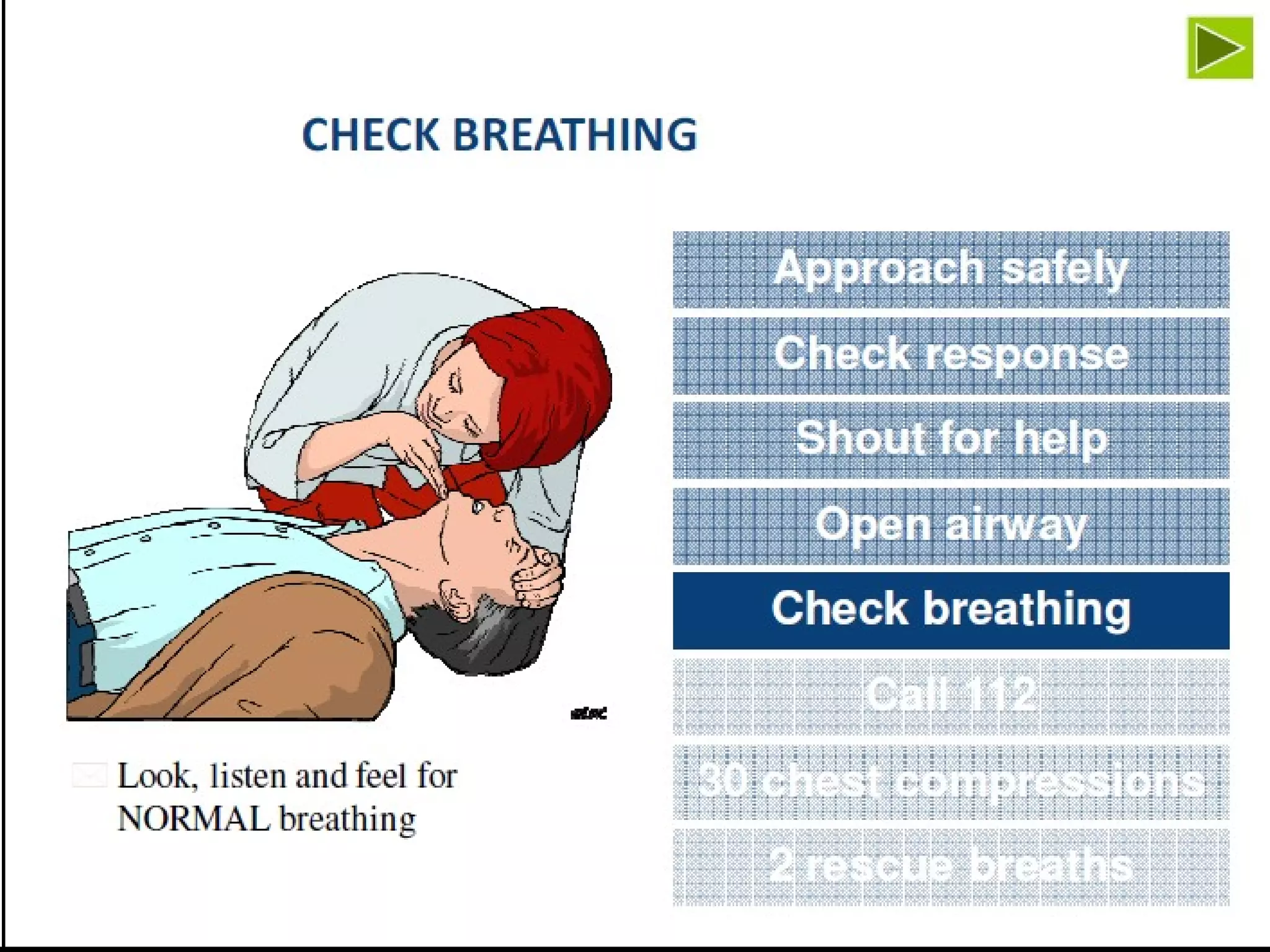
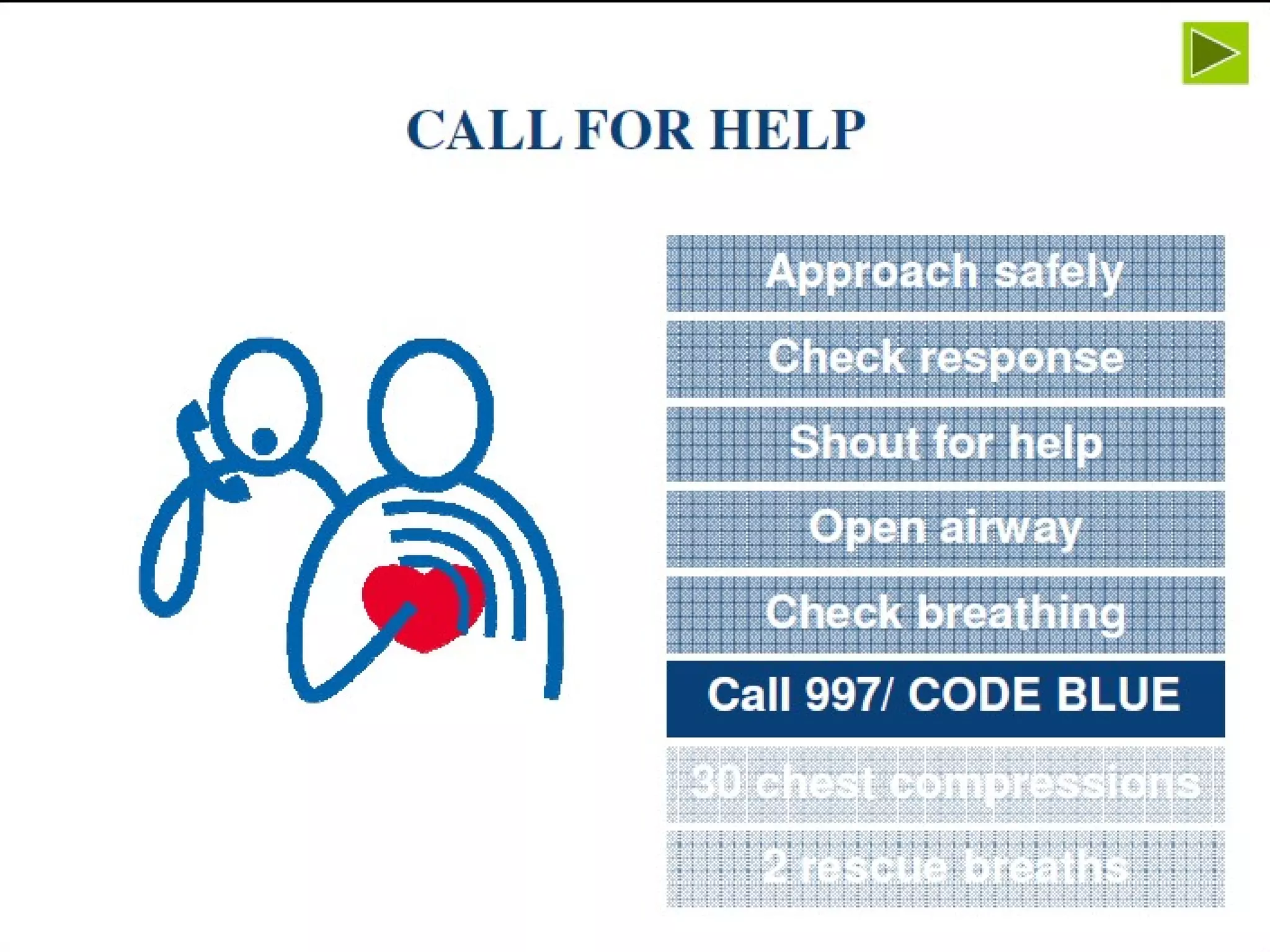
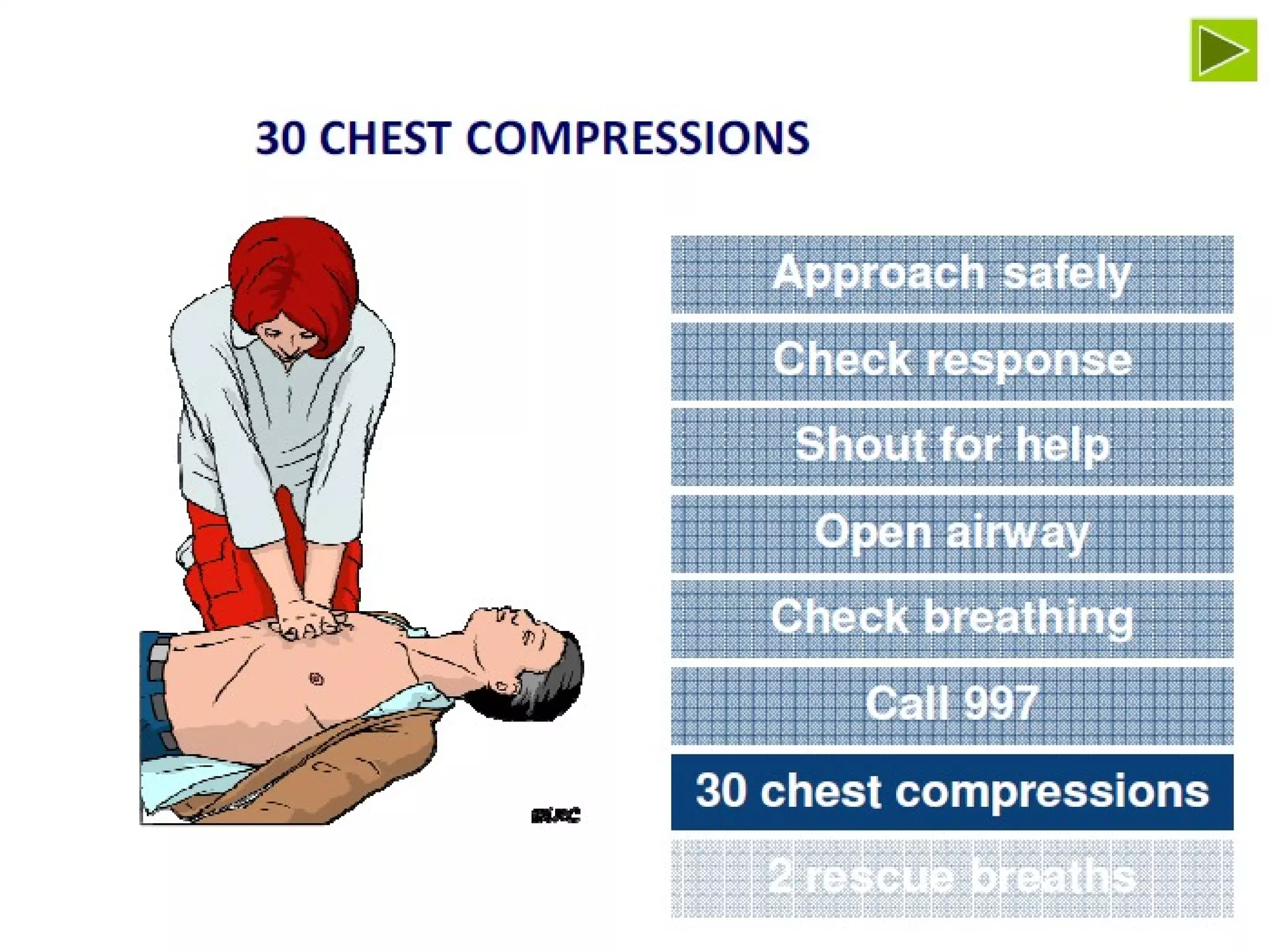
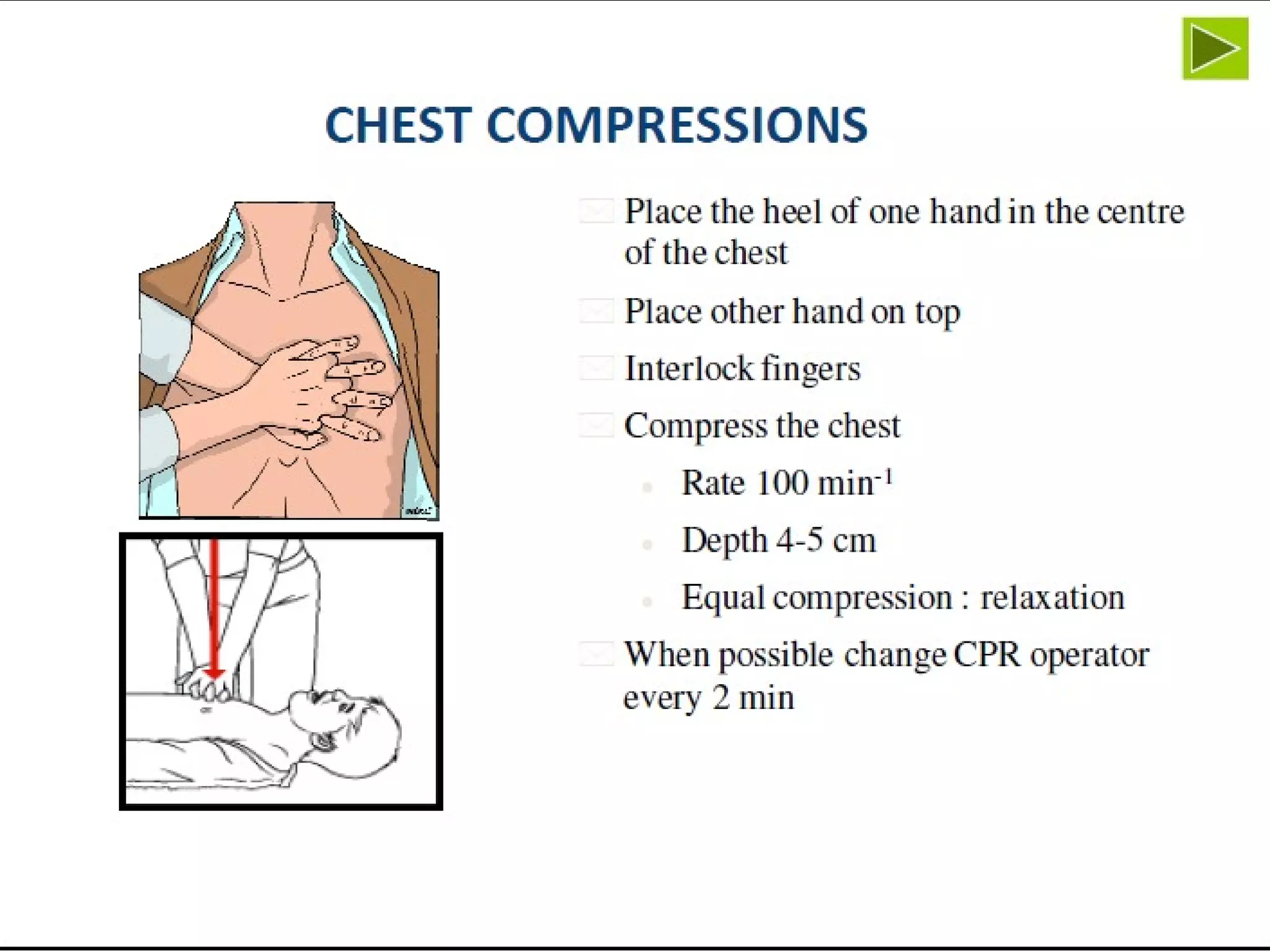
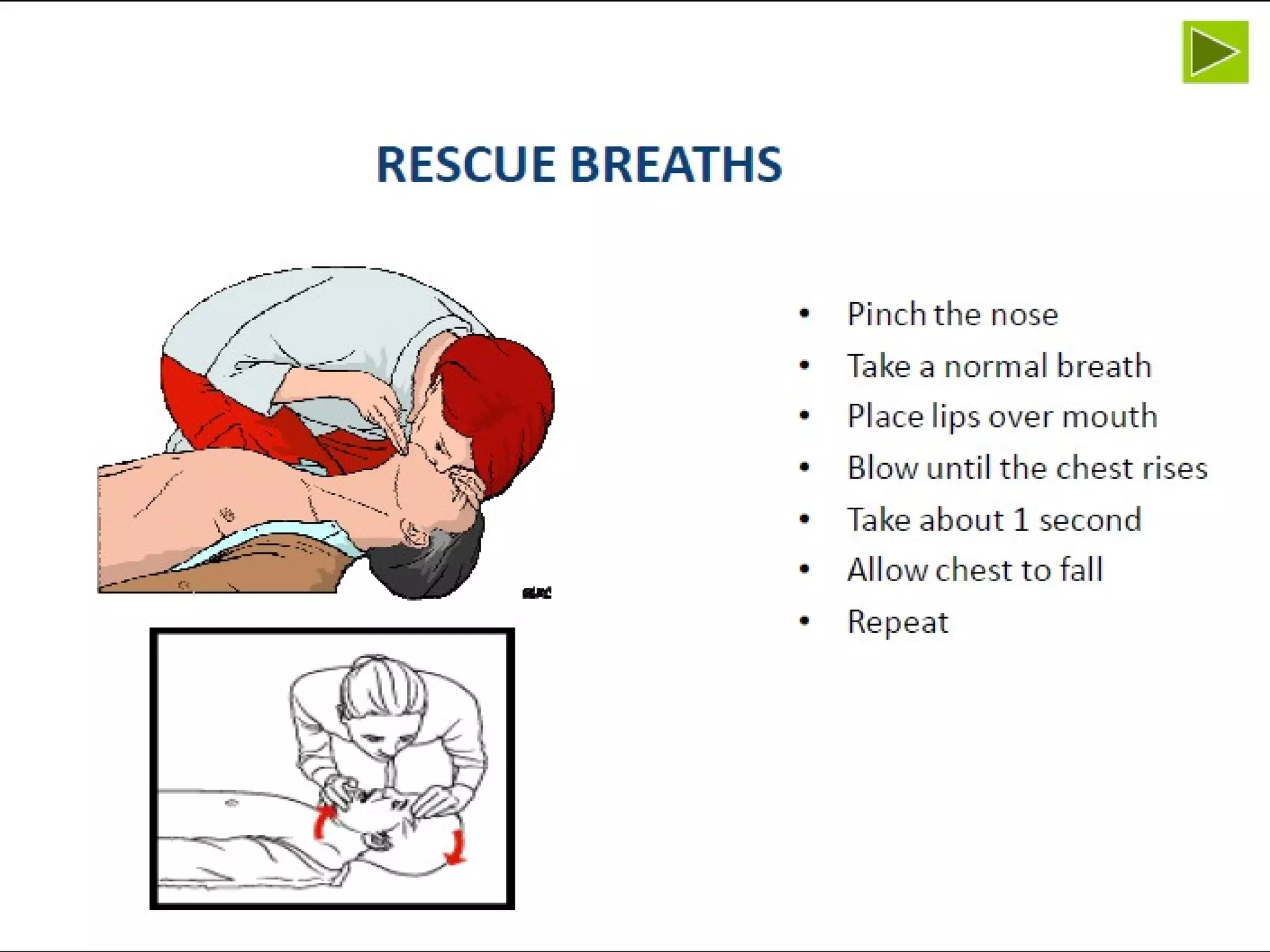
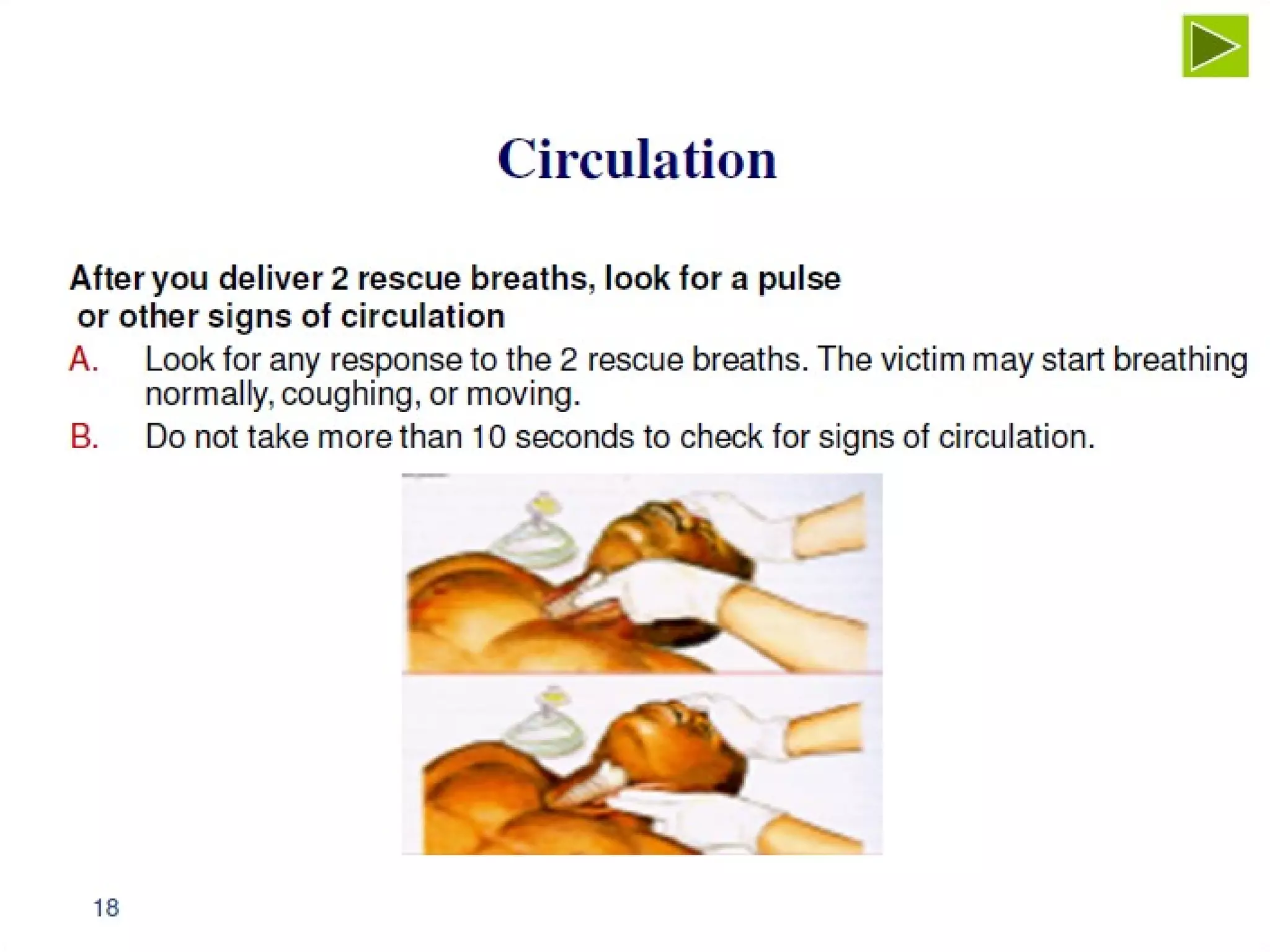
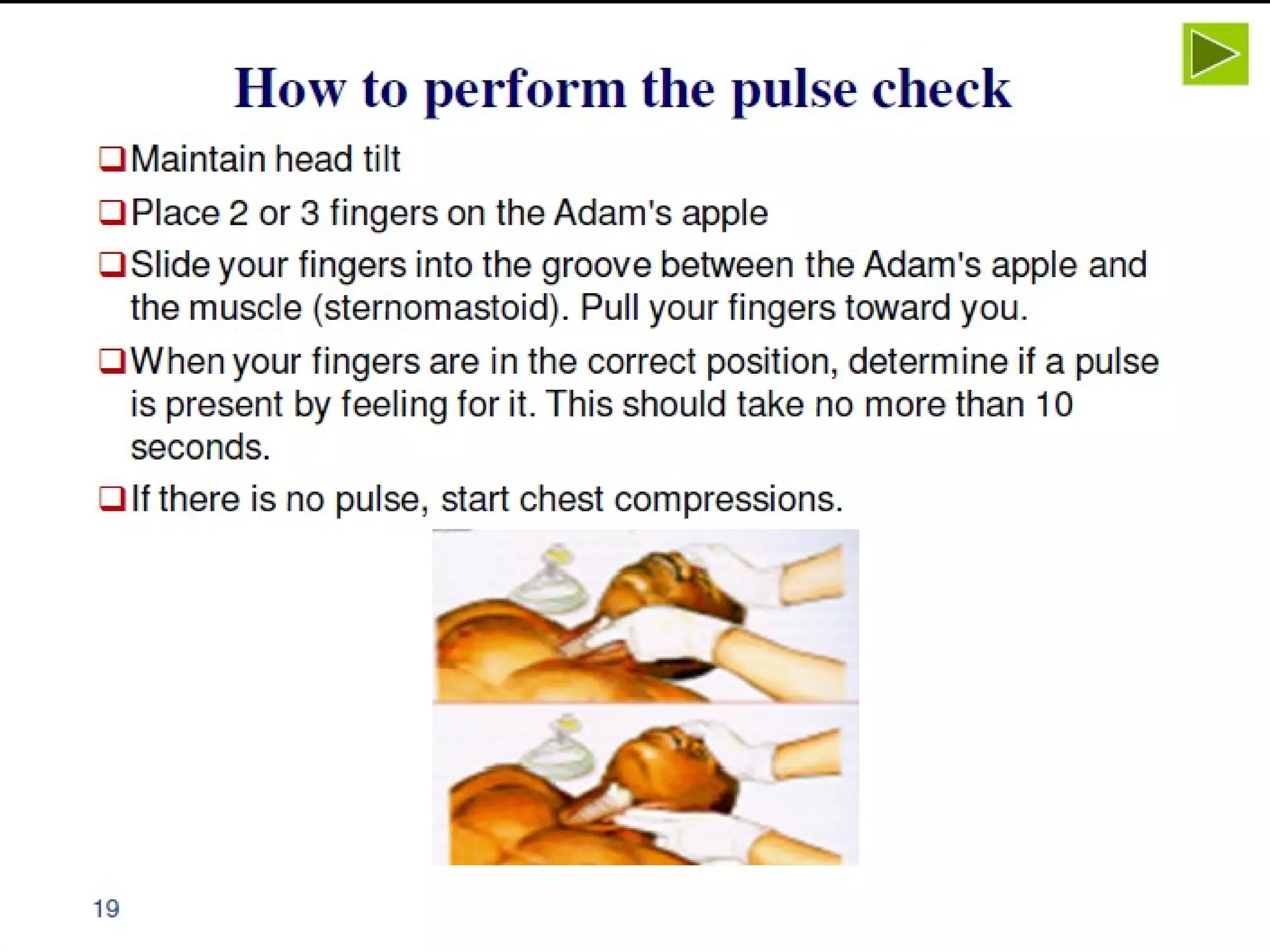
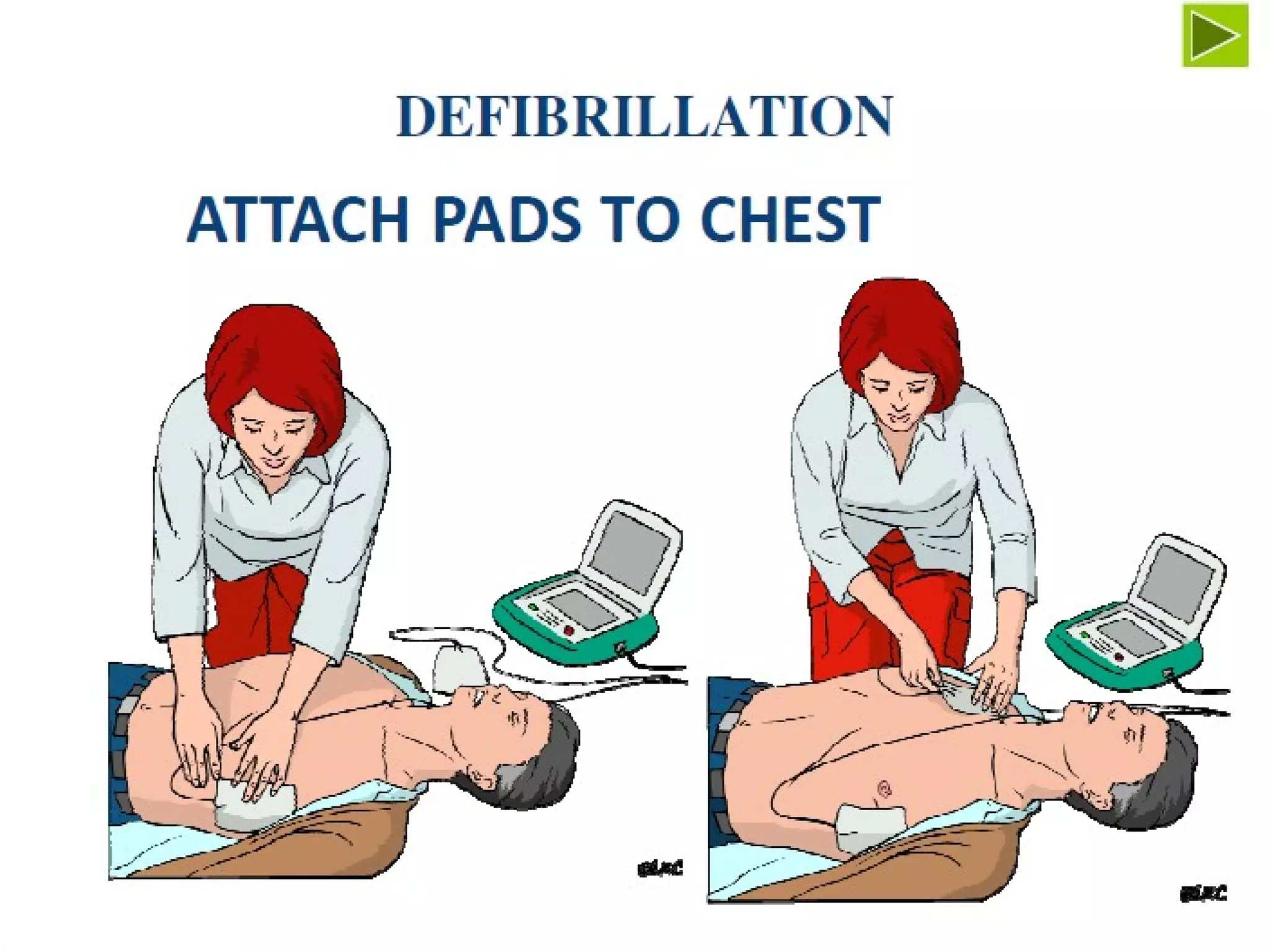
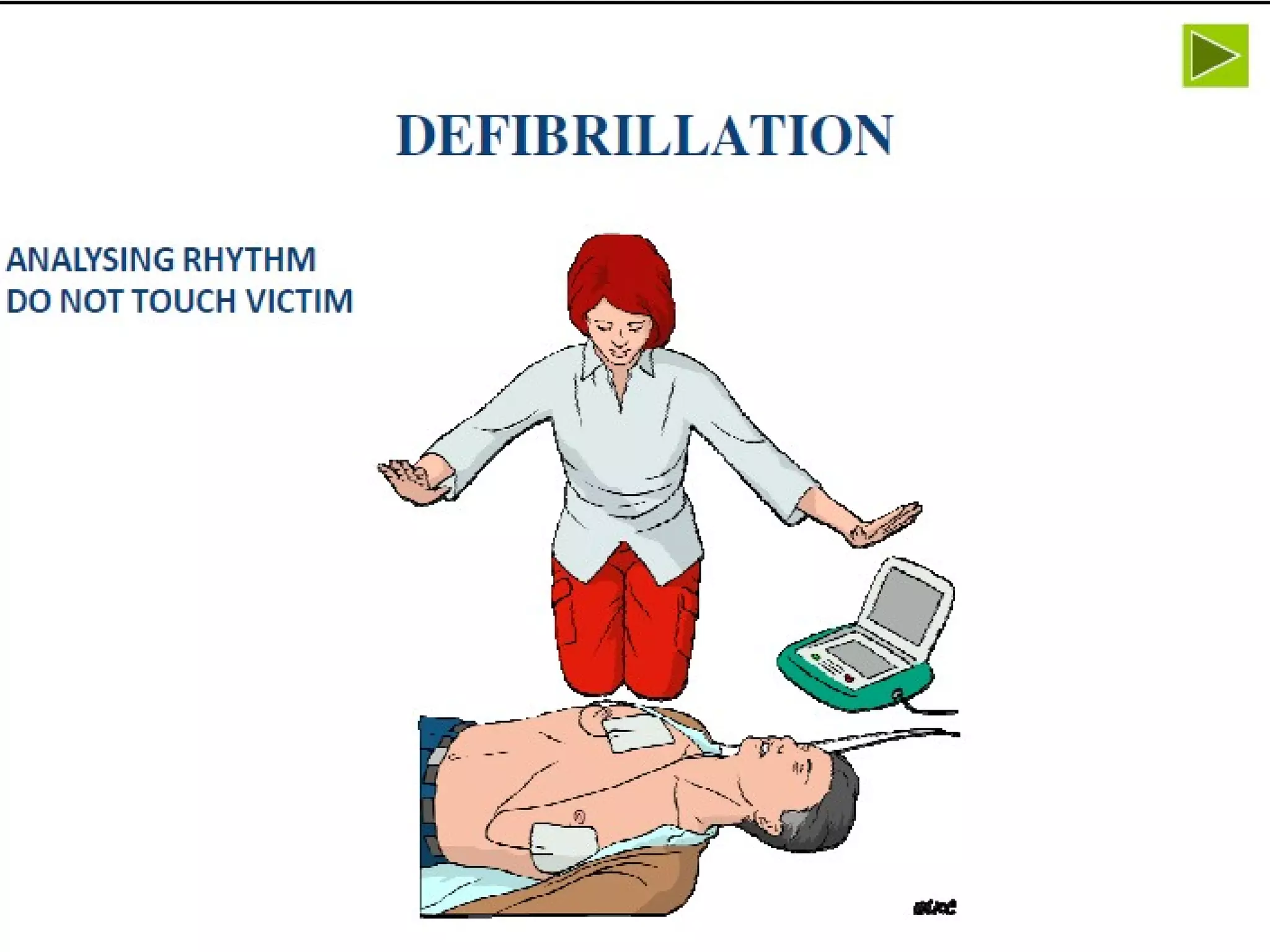
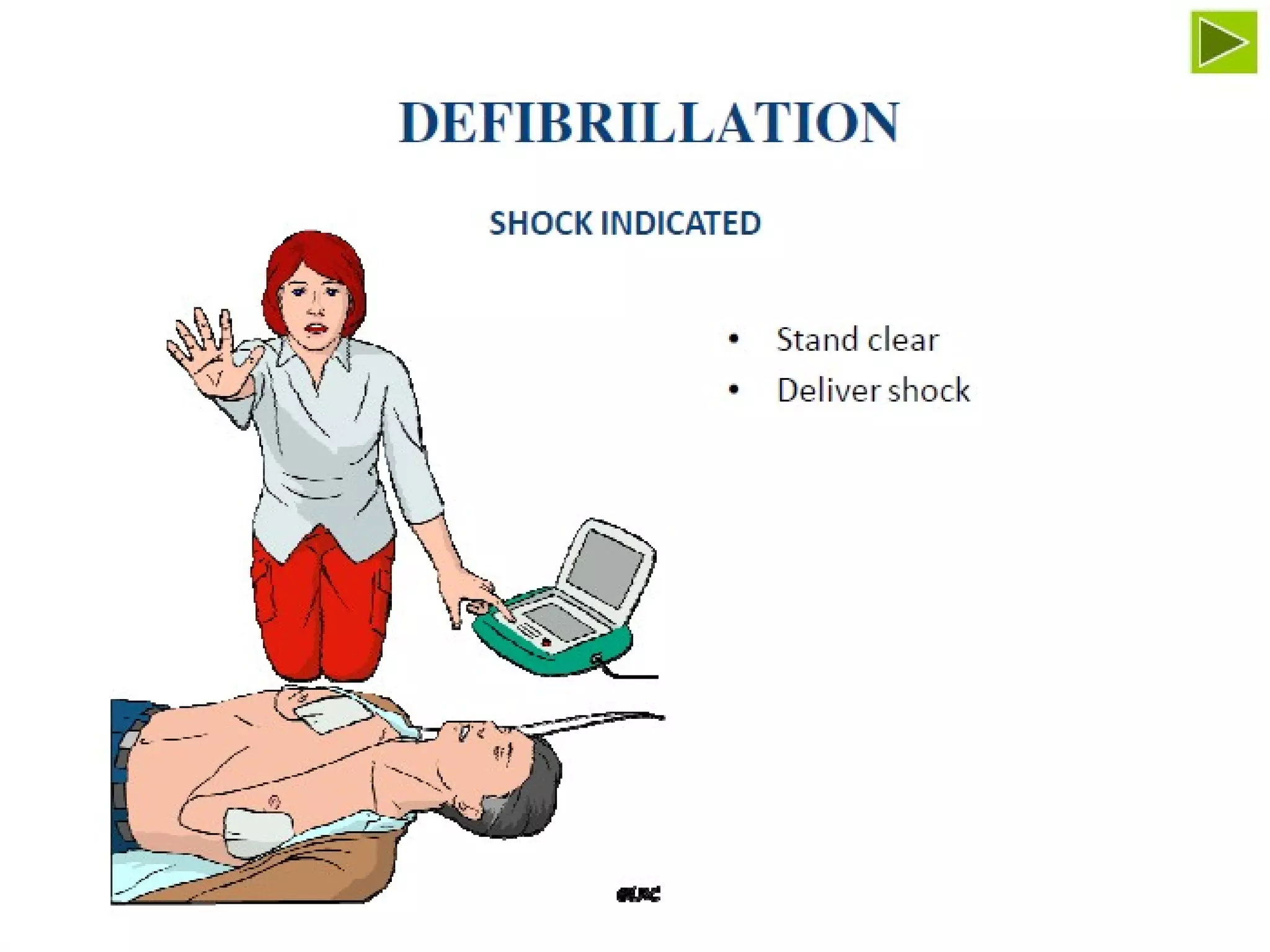
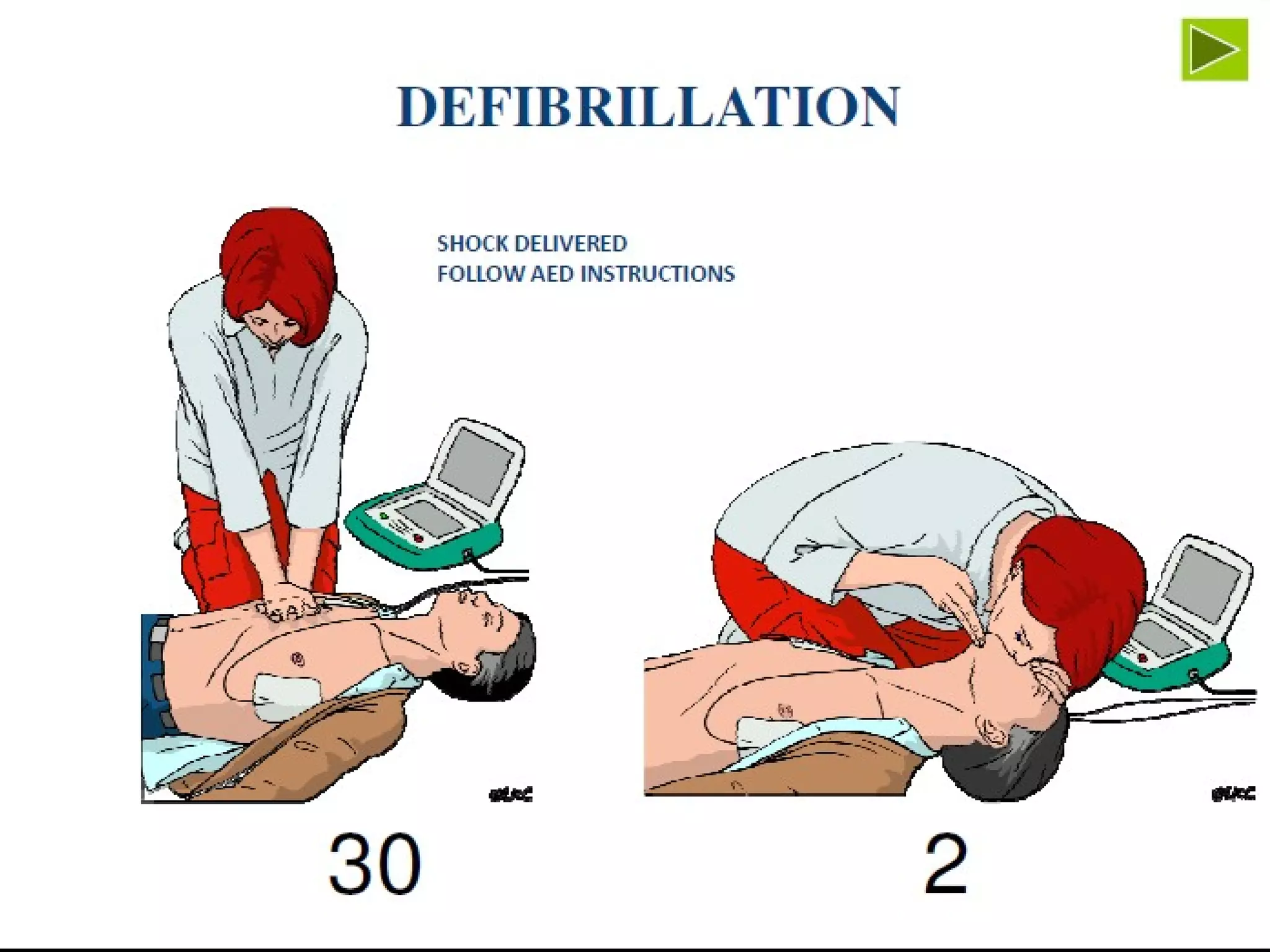
Basic Life Support ( BLS )Basic Life Support ( BLS )
Thank YouThank You

การดูแลผู้ป่วยทางศัลยกรรม

  • 1.
  • 2.
    ContentsContents  Initial assessmentand managementInitial assessment and management in trauma patientsin trauma patients  ICD placementICD placement  Acut abdomenAcut abdomen  Basic life support ( BLS )Basic life support ( BLS )
  • 3.
    INITIAL ASSESSMENTINITIAL ASSESSMENT ANDAND MANAGEMENTOF TRAUMA PATIENTSMANAGEMENT OF TRAUMA PATIENTS
  • 4.
    Steps of managementStepsof management 1.1. PreparationPreparation 2.2. TriageTriage 3.3. Primary surveyPrimary survey 4.4. ResuscitationResuscitation 5.5. Adjuncts to primaryAdjuncts to primary survey & Resuscitationsurvey & Resuscitation 6.6. Secondary surveySecondary survey 7.7. Adjuncts to secondary surveyAdjuncts to secondary survey 8.8. Continued postresuscitation monitoring andContinued postresuscitation monitoring and reevaluationreevaluation 9.9. Definitive careDefinitive care
  • 5.
    PreparationPreparation  Prehospital PhasePrehospitalPhase  Inhospital PhaseInhospital Phase  Resuscitation areaResuscitation area  Equipment: re-checkEquipment: re-check  Team ***Team ***
  • 6.
    Multiple CasualtiesMultiple Casualties The number of patients &The number of patients & severity :severity : notnot exceedexceed  First priority :First priority : life-threateninglife-threatening Mass CasualtiesMass Casualties  The number of patients &The number of patients & severity :severity : exceedexceed  First priority :First priority : greatest chancegreatest chance of survivalof survival
  • 7.
    Priorities ?Priorities ? Pediatric patientsPediatric patients same assame as AdultAdult  PregnancyPregnancy same assame as non pregnancynon pregnancy
  • 8.
    Primary surveyPrimary survey 1.1.AA :: AirwayAirway maintenance withmaintenance with cervicalcervical spine protectionspine protection 2.2. BB :: BreathingBreathing andand ventilationventilation 3.3. CC :: CirculationCirculation withwith hemorrhage controlhemorrhage control 4.4. DD :: DisabilityDisability ;; Neurological statusNeurological status 5.5. EE :: ExposureExposure//Environmental controlEnvironmental control
  • 9.
    AAirway maintenance withcervical spineirway maintenance with cervical spine protectionprotection  C-spine protectionC-spine protection  Evaluated airway :Evaluated airway : upper airway obstruction?upper airway obstruction?  Seeking:Seeking: indication forindication for “definitive airway”“definitive airway” PitfallsPitfalls  Equipment dysfunctionEquipment dysfunction :: ex. the cuff of ET-tube torn by the patients teethex. the cuff of ET-tube torn by the patients teeth  Difficult airwayDifficult airway :: can’t intubation or surgical airway performcan’t intubation or surgical airway perform especiallyespecially ““ Obesity ”Obesity ”  Laryngeal injury or upper airway transectionLaryngeal injury or upper airway transection
  • 10.
    BBreathing and ventilationreathingand ventilation  Seeking immediate life threateningSeeking immediate life threatening  Skip : non- immediate life threatening :Skip : non- immediate life threatening : ex, simpleex, simple pneumo- or hemothorax, pulmonary contusion and fracture ribspneumo- or hemothorax, pulmonary contusion and fracture ribs “seeking in 2“seeking in 2ndnd survey”survey” PitfallsPitfalls Dyspnea and tachypnea due to tension pneumothoraxDyspnea and tachypnea due to tension pneumothorax :: ““ Do not intubation with ventilation ”Do not intubation with ventilation ”
  • 11.
    CCirculation with hemorrhagecontrolirculation with hemorrhage control 1.1. Blood volume and cardiac outputBlood volume and cardiac output  Level of consciousnessLevel of consciousness  Skin colorSkin color  PulsePulse :: central pulse (femoral or carotid)central pulse (femoral or carotid) 1.1. BleedingBleeding :: external bleeding identified and controlexternal bleeding identified and control  Directed pressure or Pneumatic splint deviceDirected pressure or Pneumatic splint device  Avoid Tourniquet (except traumatic amputation)Avoid Tourniquet (except traumatic amputation) PitfallsPitfalls  ElderElder :: Heart rate & BP ; limited response to bleedingHeart rate & BP ; limited response to bleeding  Children :Children : limited physiological reservelimited physiological reserve  Well trained athlete :Well trained athlete : normally relatively bradycardianormally relatively bradycardia  MedicationMedication
  • 12.
    DDisability ; Neurologicalstatusisability ; Neurological status  Evaluated GCSEvaluated GCS  GCSGCS ≤≤ 8 : need airway protection8 : need airway protection PitfallsPitfalls Lucid intervalLucid interval :: “acute epidural hematoma”“acute epidural hematoma” ““Need reevaluation”Need reevaluation”
  • 13.
    Aims of PrimarysurveyAims of Primary survey ““Early Detection of Immediate LifeEarly Detection of Immediate Life Threatening conditions”Threatening conditions”
  • 14.
    Immediate Life ThreateningconditionsImmediate Life Threatening conditions 1.1. Upper airway obstructionUpper airway obstruction (A)(A) 2.2. Open pneumothoraxOpen pneumothorax (B)(B) 3.3. Tension pneumothoraxTension pneumothorax (B)(B) 4.4. Severe flail chestSevere flail chest (B)(B) 5.5. Massive hemothoraxMassive hemothorax (B+C)(B+C) 6.6. Cardiac tamponadeCardiac tamponade (C)(C) 7.7. Exsanguinating external hemorrhage (C)Exsanguinating external hemorrhage (C)
  • 15.
  • 16.
    AA :: AAirwayirwaymanagementmanagement  Clear the airway ofClear the airway of foreign bodiesforeign bodies  Early detected upperEarly detected upper airway obstructionairway obstruction
  • 17.
    Upper airway obstructionUpperairway obstruction  HxHx  Maxillofacial injuryMaxillofacial injury  Neck traumaNeck trauma  Laryngeal traumaLaryngeal trauma  Foreign bodyForeign body  PEPE  Fracture mandible, facialFracture mandible, facial fracture with associatedfracture with associated bleedingbleeding  StridorStridor  Hoarseness (dysphonia)Hoarseness (dysphonia)  Subcutaneous emphysemaSubcutaneous emphysema
  • 18.
    Airway maintenance techniquesAirwaymaintenance techniques  Chin lift or jaw thrust maneuverChin lift or jaw thrust maneuver  InsertionInsertion  Nasopharyngeal airway :Nasopharyngeal airway : consciousness patients**consciousness patients**  Oropharyngeal airway :Oropharyngeal airway : no gag reflex patients**no gag reflex patients**
  • 19.
    Jaw thrust maneuverJawthrust maneuver
  • 20.
    Oropharyngeal or nasopharyngealairwayOropharyngeal or nasopharyngeal airway
  • 21.
    Establish aEstablish adefinitivedefinitive airwayairway  Endotracheal intubationEndotracheal intubation  Jet insufflation of the airwayJet insufflation of the airway  Surgical cricothyroidotomySurgical cricothyroidotomy  TracheostomyTracheostomy
  • 22.
    Endotracheal intubationsEndotracheal intubations Orotracheal tubeOrotracheal tube  Nasotracheal tube :Nasotracheal tube : contraindication forcontraindication for apneic patientapneic patient
  • 23.
    Jet insufflation ofthe airwayJet insufflation of the airway  Needle cricothyroidotomyNeedle cricothyroidotomy  12-1412-14 (16-18 in children)(16-18 in children) gauge plastic canulagauge plastic canula  Wall oxygenWall oxygen 1515 L/minL/min(40-(40- 50 psi)50 psi)  Intermittent insufflation :Intermittent insufflation : 1sec on & 4sec off1sec on & 4sec off  Maintain oxygenation :Maintain oxygenation : 30-4530-45 minmin
  • 24.
    Surgical cricothyroidotomySurgical cricothyroidotomy Used small endotrachealUsed small endotracheal tube or tracheostomytube or tracheostomy tube (5-7mm diameter)tube (5-7mm diameter)  NotNot recommended forrecommended for children underchildren under 12 year12 year ofof ageage
  • 25.
  • 26.
    Indication for definitiveairwayIndication for definitive airway 1.1. Presence of apneaPresence of apnea 2.2. Inability to maintain a patent airwayInability to maintain a patent airway 3.3. Protect aspirationProtect aspiration 4.4. Impending compromise airwayImpending compromise airway  Inhalation injuryInhalation injury  Facial fractureFacial fracture  Retropharyngeal hematomaRetropharyngeal hematoma  Sustained seizureSustained seizure 1.1. Severe head injurySevere head injury (GCS(GCS ≤≤ 8)8) 2.2. Inability to maintain oxygenation with face-Inability to maintain oxygenation with face- mask oxygen supplementationmask oxygen supplementation
  • 27.
    BB :: BBreathing/Ventilation/Oxygenationreathing/Ventilation/Oxygenation •Seeking immediate life threateningSeeking immediate life threatening • Open pneumothoraxOpen pneumothorax • Tension pneumothoraxTension pneumothorax • Severe flail chestSevere flail chest • Ventilation supportiveVentilation supportive
  • 28.
    Open pneumothoraxOpen pneumothorax Large defect of theLarge defect of the chest wallchest wall  PenetratingPenetrating  Gun short woundGun short wound  Deep woundDeep wound  ““Suction wound”Suction wound” ::  2/3 the diameter of the2/3 the diameter of the tracheatrachea  TreatmentTreatment  3 sides dressing3 sides dressing
  • 29.
    Tension pneumothoraxTension pneumothorax Hx. chest injuryHx. chest injury  Physical signs:Physical signs: chest pain, air hunger, reparatorychest pain, air hunger, reparatory distress, trachycardiadistress, trachycardia  Classic signsClassic signs  Neck vein distensionNeck vein distension  HypotensionHypotension  Tracheal deviationTracheal deviation  Unilateral absent breath soundUnilateral absent breath sound  Hyperresonant percussion with absent breath soundHyperresonant percussion with absent breath sound  Differentiation from cardiac tamponadeDifferentiation from cardiac tamponade
  • 30.
    Early managementEarly management ImmediatedecompressionImmediate decompression  large-caliber needle intolarge-caliber needle into 22ndnd ICS midclavicular lineICS midclavicular line
  • 31.
  • 32.
    Severe flail chestSevereflail chest  Hx. Blunt chest injuryHx. Blunt chest injury  FractureFracture Rib ≥ 2 ribs & ≥Rib ≥ 2 ribs & ≥ 2 place2 place  Paradoxical chestParadoxical chest movementmovement  Hypoxia from lungHypoxia from lung contusion (not ribcontusion (not rib fragment)fragment)  TreatmentTreatment  OxygenationOxygenation  VentilatorVentilator
  • 33.
    Massive hemothoraxMassive hemothorax Massive bleeding inMassive bleeding in pleural cavitypleural cavity  ≥≥ 1500 cc1500 cc  ≥≥ 1/3 total blood volume1/3 total blood volume  Continuous bleedingContinuous bleeding ≥200 cc/hr for 2-4 hrs≥200 cc/hr for 2-4 hrs  TreatmentTreatment  ICD into 5ICD into 5thth ICS anteriorICS anterior to mid axillary lineto mid axillary line  Definite : thoracotomyDefinite : thoracotomy
  • 34.
    CC :: CCirculationirculation Detected and early management cardiacDetected and early management cardiac temponadetemponade  Control bleedingControl bleeding  Volume resuscitationVolume resuscitation  Protected hypothermiaProtected hypothermia
  • 35.
    Cardiac tamponadeCardiac tamponade Blunt or penetrating chestBlunt or penetrating chest  Beck’s triadBeck’s triad  Neck vein distensionNeck vein distension  HypotensionHypotension  Muffled heart soundMuffled heart sound  Pulsus paradoxusPulsus paradoxus  May Dx: FASTMay Dx: FAST  TreatmentTreatment  PericardiocentesisPericardiocentesis  Subxyphoid pericardial windowSubxyphoid pericardial window  PericardiotomyPericardiotomy
  • 36.
  • 37.
    Control bleedingControl bleeding Direct pressureDirect pressure  Operative interventionOperative intervention  Evaluated blood lossEvaluated blood loss
  • 38.
    Estimated fluid andblood lossesEstimated fluid and blood losses Based on Patient’s Initial PresentationBased on Patient’s Initial Presentation CLASS ICLASS I CLASS IICLASS II CLASS IIICLASS III CLASS IVCLASS IV Blood loss (ml)Blood loss (ml) Up to 750Up to 750 750-1000750-1000 1500-20001500-2000 >2000>2000 Blood loss (%)Blood loss (%) Up to 15%Up to 15% 15%-30%15%-30% 30%-40%30%-40% >40%>40% Pulse ratePulse rate <100<100 >100>100 >120>120 >140>140 Blood pressureBlood pressure NormalNormal NormalNormal DecreasedDecreased DecreasedDecreased Pulse pressurePulse pressure (mmHg)(mmHg) Normal orNormal or increasedincreased DecreasedDecreased DecreasedDecreased DecreasedDecreased Respiratory rateRespiratory rate 14-2014-20 20-3020-30 30-4030-40 >35>35 Urine outputUrine output (ml/hr)(ml/hr) >30>30 20-3020-30 5-155-15 NegligibleNegligible CNS/Mental statusCNS/Mental status SlightlySlightly anxiousanxious MildlyMildly anxiousanxious AnxiousAnxious confusedconfused ConfusedConfused lethargiclethargic Fluid replacementFluid replacement (3:1 rule)(3:1 rule) CrystalloidCrystalloid CrystalloidCrystalloid CrystalloidCrystalloid and bloodand blood CrystalloidCrystalloid and bloodand blood
  • 39.
    ResuscitationResuscitation  2 large-caliberintravenous catheters2 large-caliber intravenous catheters  Warm (Warm (3939°°CC) Ringer lactate solution) Ringer lactate solution  2 liters in 15 min for adult2 liters in 15 min for adult  20 ml/kg in 15 min for children20 ml/kg in 15 min for children  O-negative blood or type specific bloodO-negative blood or type specific blood  Bleeding class III or IVBleeding class III or IV  Unresponsive to bolus IV therapyUnresponsive to bolus IV therapy  Estimation volume of blood componentEstimation volume of blood component prepare : about double( x 2 ) of estimationprepare : about double( x 2 ) of estimation volumevolume of blood lossof blood loss
  • 40.
    ““Aggressive and continuedvolumeAggressive and continued volume resuscitation is not a substitute for manualresuscitation is not a substitute for manual or operative control of hemorrhage”or operative control of hemorrhage”
  • 41.
    Resuscitative thoracotomyResuscitative thoracotomy Emergency department thoracotomyEmergency department thoracotomy  IndicationIndication 1.1. Evacuation of pericardial blood causingEvacuation of pericardial blood causing tamponadetamponade 2.2. Direct control of exsanguinating intrathoracicDirect control of exsanguinating intrathoracic hemorrhagehemorrhage 3.3. Open cardiac massageOpen cardiac massage 4.4. Cross-clamping of the descending aorta to slowCross-clamping of the descending aorta to slow blood loss below the diaphragm and increaseblood loss below the diaphragm and increase perfusion to the brain and heartperfusion to the brain and heart
  • 42.
  • 43.
  • 44.
    Responses to initialFluid ResuscitationResponses to initial Fluid Resuscitation RAPIDRAPID RESPONSERESPONSE TRANSIENTTRANSIENT RESPONSERESPONSE NONO RESPONSERESPONSE Vital signsVital signs Return toReturn to normalnormal TransientTransient improvement,improvement, recurrence ofrecurrence of ↓↓BPBP andand ↑↑ HRHR RemainRemain abnormalabnormal Estimated blood lossEstimated blood loss MinimalMinimal ((10-2010-20%)%) Moderate andModerate and ongoing (ongoing (20-4020-40%)%) Severe (>Severe (>4040%)%) Need for more crystalloidNeed for more crystalloid LowLow HighHigh HighHigh Need for bloodNeed for blood LowLow Moderate to highModerate to high ImmediateImmediate Blood preparationBlood preparation Type and cross-Type and cross- matchmatch Type-specificType-specific EmergencyEmergency blood releaseblood release Need for operativeNeed for operative interventionintervention PossiblyPossibly LikelyLikely Highly likelyHighly likely Early present of surgeonEarly present of surgeon YesYes YesYes YesYes
  • 45.
    Adjuncts to primaryAdjunctsto primary survey and resuscitationsurvey and resuscitation 1.1. MonitoringMonitoring • EKG monitoringEKG monitoring • Pulse oximetryPulse oximetry • Blood pressureBlood pressure 1.1. Urinary and gastric cathetersUrinary and gastric catheters 2.2. X-ray and diagnostic studies :X-ray and diagnostic studies : “should not“should not interrupt the resuscitation process”interrupt the resuscitation process” • ChestChest • PelvisPelvis • C-spineC-spine • DPL or FASTDPL or FAST
  • 46.
    Urinary catheterUrinary catheter Contraindicationfor transurethral bladderContraindication for transurethral bladder catheterizationcatheterization ““suspected urethral transection”suspected urethral transection” 1.1. Blood at penile meatusBlood at penile meatus 2.2. Perineal ecchymosisPerineal ecchymosis 3.3. Blood in scrotumBlood in scrotum 4.4. High-riding or nonpalpable prostateHigh-riding or nonpalpable prostate 5.5. Pelvic fracturePelvic fracture
  • 47.
    X-ray and diagnosticstudiesX-ray and diagnostic studies
  • 48.
    FFocusedocused AAssessmentssessment SSonographyinonography in TTrauma (FAST)rauma (FAST) 1.1. Pericardial sacPericardial sac 2.2. Hepatorenal fossaHepatorenal fossa (Morrison’s pouch)(Morrison’s pouch) 3.3. Splenorenal fossaSplenorenal fossa 4.4. Pelvis (pouch of Douglas)Pelvis (pouch of Douglas)
  • 49.
    Pericardial sacPericardial sacHepatorenalfossaHepatorenal fossa Splenorenal fossaSplenorenal fossaPelvisPelvis FASTFAST
  • 50.
  • 51.
  • 52.
  • 53.
  • 54.
    Diagnostic Peritoneal Lavage(DPL)Diagnostic Peritoneal Lavage (DPL) IndicationIndication 1.1. Abdominal injury withAbdominal injury with unconsciousunconscious 2.2. Abdominal injury with loss ofAbdominal injury with loss of sensationsensation 3.3. Injury to adjacent structureInjury to adjacent structure (lower rib, pelvis, lumbar spine)(lower rib, pelvis, lumbar spine) 4.4. Equivocal physical examinationEquivocal physical examination 5.5. Prolong loss of F/U (neuroProlong loss of F/U (neuro surgery)surgery) 6.6. Lap-belt sign (abdominal wallLap-belt sign (abdominal wall contusion) with suspicion ofcontusion) with suspicion of bowel injuriesbowel injuries 7.7. Not available FAST or CTNot available FAST or CT ContraindicationContraindication AbsoluteAbsolute  Indicated for laparotomyIndicated for laparotomy RelativeRelative  Previous abdominal operationPrevious abdominal operation  Morbid obesityMorbid obesity  Advanced cirrhosisAdvanced cirrhosis  Preexisting coagulopathyPreexisting coagulopathy
  • 55.
    DPLDPL ProcedureProcedure 1.1. Insert DPLcatheterInsert DPL catheter 2.2. Aspiration peritoneal fluidAspiration peritoneal fluid 3.3. Instill 1 Liter of warmedInstill 1 Liter of warmed RLS(NSS) 1000 cc or 10RLS(NSS) 1000 cc or 10 cc/kg in childcc/kg in child 4.4. Drain peritoneal lavage fluidDrain peritoneal lavage fluid 5.5. Adequate fluid return is > 30Adequate fluid return is > 30 % of the infused volume% of the infused volume Positive DPL testPositive DPL test (Blunt injury)(Blunt injury) 1.1. Aspiration gross blood > 10 mlAspiration gross blood > 10 ml 2.2. Gastrointestinal contentsGastrointestinal contents 3.3. BileBile 4.4. Food particleFood particle 5.5. RBC > 100,000 /mmRBC > 100,000 /mm33 6.6. WBC > 500 /mmWBC > 500 /mm33 7.7. Gram stain positive BacteriaGram stain positive Bacteria
  • 56.
    Diagnostic Peritoneal Lavage(DPL)Diagnostic Peritoneal Lavage (DPL)
  • 57.
    Secondary surveySecondary survey HistoryHistory AMPLEAMPLEsystemssystems  AA :: AAllergiesllergies  MM :: MMedication currently useedication currently use  PP :: PPast illness/Pregnancyast illness/Pregnancy  LL :: LLast mealast meal  EE :: EEvent/Environmentvent/Environment related to the injuryrelated to the injury Head to toe evaluationHead to toe evaluation 1.1. HeadHead 2.2. Maxillofacial and intraoralMaxillofacial and intraoral 3.3. Cervical spine and neckCervical spine and neck 4.4. ChestChest 5.5. Abdomen (include back)Abdomen (include back) 6.6. Perineum/rectum/vaginaPerineum/rectum/vagina 7.7. MusculoskeletalMusculoskeletal 8.8. Neurological examinationNeurological examination
  • 58.
    HeadHead  Evaluated entirescalp and woundEvaluated entire scalp and wound  Evaluated eyesEvaluated eyes  Visual acuity, pupillary size, hemorrhage of theVisual acuity, pupillary size, hemorrhage of the conjunctiva and fundi, penetrating injury, contactconjunctiva and fundi, penetrating injury, contact lenses (remove before edema occurs), dislocation oflenses (remove before edema occurs), dislocation of the lens, ocular entrapmentthe lens, ocular entrapment
  • 59.
    Maxillofacial and intraoralMaxillofacialand intraoral  Reevaluate life threatening condition formReevaluate life threatening condition form Maxillofacial juryMaxillofacial jury • Airway obstructionAirway obstruction • Massive bleedingMassive bleeding  Midface fracture : may have fracture baseMidface fracture : may have fracture base of skullof skull • Don’t retain NG tube ( possible OG tube)Don’t retain NG tube ( possible OG tube) Pitfalls:Pitfalls: • Miss injury :Miss injury : reevaluatedreevaluated
  • 60.
    Cervical spine andneckCervical spine and neck  Detected neurological deficitDetected neurological deficit  Review cervical spine radiographic seriesReview cervical spine radiographic series  Detected associated injuriesDetected associated injuries Pitfalls :Pitfalls :  Blunt cervical spine injuries :Blunt cervical spine injuries : delay presenting symptomdelay presenting symptom  Miss injuries of cervical nerve root or brachial plexusMiss injuries of cervical nerve root or brachial plexus in comatose patientsin comatose patients
  • 61.
    ChestChest  Eight lethalchest injuriesEight lethal chest injuries 1.1. Simple pneumothoraxSimple pneumothorax 2.2. HemothoraxHemothorax 3.3. Pulmonary contusionPulmonary contusion 4.4. Tracheobronchial tree injuriesTracheobronchial tree injuries 5.5. Blunt cardiac injuriesBlunt cardiac injuries 6.6. Traumatic aortic disruptionTraumatic aortic disruption 7.7. Traumatic diaphragmatic injuriesTraumatic diaphragmatic injuries 8.8. Mediastinal traversing woundMediastinal traversing wound Pitfalls :Pitfalls : • Elderly patients :Elderly patients : can’t tolerate minor chest injuriescan’t tolerate minor chest injuries • Children :Children : may have severe injuries of internal organmay have severe injuries of internal organ withoutwithout rib fracturerib fracture
  • 62.
    AbdomenAbdomen  Evaluated abdominalsignsEvaluated abdominal signs Pitfalls :Pitfalls : • Excessive mobilized pelvisExcessive mobilized pelvis • Miss injuries of retroperitoneal organMiss injuries of retroperitoneal organ
  • 63.
    Perineum/rectum/vaginaPerineum/rectum/vagina  Evaluated contusionor hematoma or laceratedEvaluated contusion or hematoma or lacerated woundwound  Rectal examination: before urinary catheterRectal examination: before urinary catheter catheterization**catheterization** Pitfall :Pitfall : • Miss injuries of female urethraMiss injuries of female urethra
  • 64.
    MusculoskeletalMusculoskeletal  Limitation ofmovementLimitation of movement • FractureFracture • Ligament injuriesLigament injuries  Pelvic fracture?Pelvic fracture?  Soft tissue injuriesSoft tissue injuries
  • 65.
    Neurological examinationNeurological examination Evaluated GCS scoreEvaluated GCS score  Evaluated sensory and motor systemEvaluated sensory and motor system
  • 66.
    Adjuncts to secondarysurveyAdjuncts to secondary survey  Further investigationFurther investigation • CT scanCT scan • Contrast x-ray studyContrast x-ray study • Extremities x-rayExtremities x-ray • Endoscope and U/SEndoscope and U/S
  • 67.
  • 68.
    Definitive careDefinitive care ObserveObserve  SurgerySurgery  InterventionIntervention
  • 69.
  • 70.
    ขวดรองรับชนิดขวดเดียวขวดรองรับชนิดขวดเดียว Prevent air &fluid from returnin to the pleural space Prevent air & fluid from returning to the pleural space • Most b • Straw a chest t is place fluid (w • Just lik drink, a through air can • Most ba • Straw a chest tu is place fluid (w • Just lik drink, a through air can Tube open to atmosphere vents air Tube from patient
  • 71.
    ขวดรองรับชนิดขวดรองรับชนิด 22 ขวดขวด Preventair & fluid from returni to the pleural space Prevent air & fluid from returnin to the pleural space • For dr bottle • The fir the dra • The se the wa • With a draina seal w • For dra bottle w • The fir the dra • The se the wa • With a draina seal w Tube from patient Tube open to atmosphere vents air Fluid drainage 2cm fluid
  • 72.
    ขวดรองรับชนิดขวดรองรับชนิด 33 ขวดขวดRestorenegative pressure in the pleural space Restore negative pressure in the pleural space 2cm fluid water seal Collection bottleSuction control Tube from patient Fluid drainage Tube open to atmosphere vents air Straw under 20 cmH2O Tube to vacuum source
  • 79.
  • 80.
    อาการปวดท้องอาการปวดท้อง (Acute abdomen,(Acuteabdomen, abdominal pain)abdominal pain)  ชนิดของการปวดท้องชนิดของการปวดท้อง  Visceral painVisceral pain มาจากการกระตุ้นอมาจากการกระตุ้นอ วัยวะภายใน โดยทั่วไปอาการปวดวัยวะภายใน โดยทั่วไปอาการปวด จะอยู่ในแนวกลางตัวจะอยู่ในแนวกลางตัว บอกตำาแหน่งบอกตำาแหน่ง ไม่ได้ชัดเจนไม่ได้ชัดเจน  Somato-parietal painSomato-parietal pain การกระตุ้นการกระตุ้น parietal peritoneumparietal peritoneum ซึ่งมักเกิดซึ่งมักเกิด จากการมีเนื้อเยื่อบาดเจ็บหรือจากการมีเนื้อเยื่อบาดเจ็บหรือ อักเสบในตำาแหน่งนั้นๆ มักจะอักเสบในตำาแหน่งนั้นๆ มักจะ ระบุระบุ ตำาแหน่งที่ปวดได้ชัดเจน
  • 81.
    การประเมินอาการปวดการประเมินอาการปวด  ลักษณะของการปวดลักษณะของการปวด 1.1. อาการปวดเริ่มจากน้อยๆเพิ่มขึ้นเรื่อยๆช้าๆ และอาการปวดเริ่มจากน้อยๆ เพิ่มขึ้นเรื่อยๆช้าๆ และ ทุเลาเองช้าๆ เช่นกัน มักพบใน โรคแผลในทุเลาเองช้าๆ เช่นกัน มักพบใน โรคแผลใน กระเพาะอาหาร หรือกระเพาะอาหาร หรือ acute gastroenteritisacute gastroenteritis 2.2. มีอาการปวดเป็นๆ หายๆ ที่ความปวดเพิ่มขึ้นอย่างมีอาการปวดเป็นๆ หายๆ ที่ความปวดเพิ่มขึ้นอย่าง รวดเร็ว เป็นอยู่สักครู่แล้วอาการดีขึ้นเอง มักพบในรวดเร็ว เป็นอยู่สักครู่แล้วอาการดีขึ้นเอง มักพบใน intestinal colicintestinal colic หรือหรือ biliary colicbiliary colic 3.3. อาการปวดท้องมากขึ้นเรื่อยๆ อย่างช้าๆ โดยอาการปวดท้องมากขึ้นเรื่อยๆ อย่างช้าๆ โดย อาการไม่ดีขึ้นเลย มักพบในอาการไม่ดีขึ้นเลย มักพบใน acuteacute cholecystitischolecystitis หรือหรือ acute appendicitisacute appendicitis 4.4. เป็นอาการปวดที่มากและเฉียบพลัน มักพบในผู้ที่มีเป็นอาการปวดที่มากและเฉียบพลัน มักพบในผู้ที่มี
  • 82.
    ไส้ติ่งอักเสบไส้ติ่งอักเสบ (appendicitis)(appendicitis)  สาเหตุสาเหตุเกิดจากการอุดเกิดจากการอุด ตันของไส้ติ่ง เช่นตันของไส้ติ่ง เช่น เนื้อเยื่อต่อมนำ้าเหลืองโตเนื้อเยื่อต่อมนำ้าเหลืองโต มีอุจจาระแข็งอุดตันมีอุจจาระแข็งอุดตัน
  • 83.
    เยื่อบุช่องท้องอักเสบเยื่อบุช่องท้องอักเสบ (Peritonitis)(Peritonitis)  สาเหตุสาเหตุ มักเกิดภายหลังมีการแตกทะลุของมักเกิดภายหลังมีการแตกทะลุของ อวัยวะในช่องท้องหรือได้รับอุบัติเหตุที่อวัยวะในช่องท้อง หรือได้รับอุบัติเหตุที่ ท้อง หรือเกิดขึ้นเองโดยไม่อาจหาสาเหตุท้อง หรือเกิดขึ้นเองโดยไม่อาจหาสาเหตุ ที่แท้จริงที่แท้จริง  อาการและอาการแสดงอาการและอาการแสดง มีอาการปวดมีอาการปวด ท้องรุนแรงตลอดเวลา ขยับเขยื้อนหรือท้องรุนแรงตลอดเวลา ขยับเขยื้อนหรือ กระเทือนจะรู้สึกเจ็บ ผู้ป่วยมักจะต้องนอนกระเทือนจะรู้สึกเจ็บ ผู้ป่วยมักจะต้องนอน นิ่งๆ เนื่องจากปวดท้องมาก อาการปวดนิ่งๆ เนื่องจากปวดท้องมาก อาการปวด ท้องมักจะเป็นติดต่อกันหลายชั่วโมงจนท้องมักจะเป็นติดต่อกันหลายชั่วโมงจน
  • 84.
    การอุดตันของลำาไส้การอุดตันของลำาไส้ (Gut/(Gut/ Bowel obstruction)Bowelobstruction)  สาเหตุสาเหตุ มักเกิดจากความผิดปกติของลำาไส้มักเกิดจากความผิดปกติของลำาไส้ เองทำาให้มีการบิดตัวเองทำาให้มีการบิดตัว (Volvulus)(Volvulus) หรือหรือ การมีพังผืดไปรัด ซึ่งมักพบในผู้ที่มีประวัติการมีพังผืดไปรัด ซึ่งมักพบในผู้ที่มีประวัติ ได้รับการผ่าตัดของลำาไส้ มีก้อนเนื้อได้รับการผ่าตัดของลำาไส้ มีก้อนเนื้อ (Mass, Polyp)(Mass, Polyp) หรือมะเร็งหรือมะเร็ง ((Carcinoma)Carcinoma) ในผู้ป่วยเด็กที่สุขวิทยาไม่ดีและมีอาการในผู้ป่วยเด็กที่สุขวิทยาไม่ดีและมีอาการ ขาดสารอาหารอาจเกิดจากพยาธิขาดสารอาหารอาจเกิดจากพยาธิ
  • 85.
    Basic Life Support( BLS )Basic Life Support ( BLS )
  • 114.