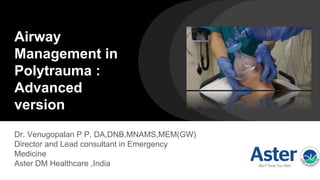
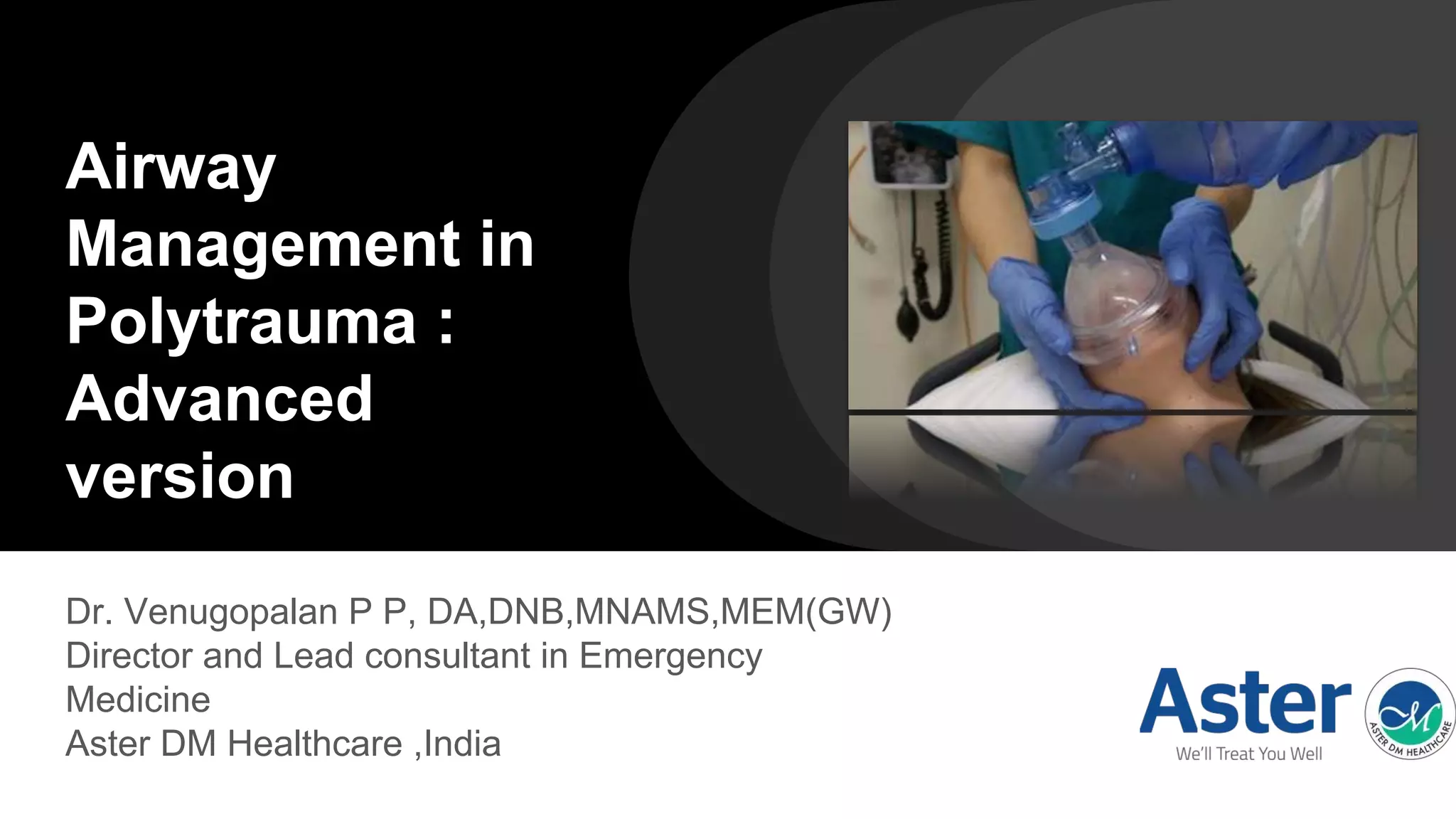
Airway
Management in
Polytrauma :
Advanced
version
Dr. Venugopalan P P, DA,DNB,MNAMS,MEM(GW)
Director and Lead consultant in Emergency
Medicine
Aster DM Healthcare ,India
Background
Prevention of hypoxemia requires a protected, unobstructed airway
and adequate ventilation, which take priority over management of all
other conditions.
This session...
1. Define definitive airway.
2. Recognize the signs and symptoms of airway
obstruction and ventilatory compromise.
3. Describe the techniques for establishing and
maintaining a patent airway.
4. Describe techniques for confirming the adequacy of
ventilation and oxygenation
5. Explore the management pearls in specifice trauma
scenarios
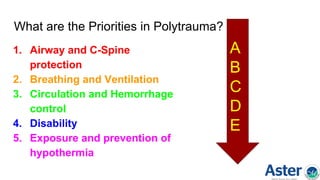
What are the Priorities in Polytrauma?
1. Airway and C-Spine
protection
2. Breathing and Ventilation
3. Circulation and Hemorrhage
control
4. Disability
5. Exposure and prevention of
hypothermia
A
B
C
D
E
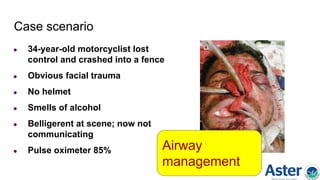
Case scenario
● 34-year-old motorcyclist lost
control and crashed into a fence
● Obvious facial trauma
● No helmet
● Smells of alcohol
● Belligerent at scene; now not
communicating
● Pulse oximeter 85% Airway
management
Airway assessment
How do I know the airway is adequate?
Airway
management
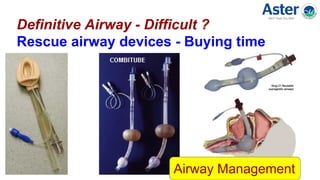
How do I know the airway is adequate?
• Patient is alert and oriented.
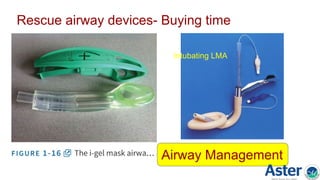
• Patient is talking normally.
• There is no evidence of injury to
the head or neck.
• You have assessed and
re-assessed for deterioration
Airway
Assessment
Signs and symptoms of airway
compromise
• High index of suspicion
• Change in voice / sore throat
• Noisy breathing (snoring and
stridor)
• Dyspnea and agitation
Airway
Assessment
Signs and symptoms of airway
compromise
• Tachypnea
• Abnormal breathing pattern
• Low oxygen saturation (late
sign)
Airway
Assessment
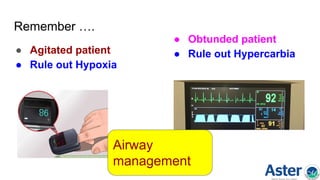
Remember ….
● Agitated patient
● Rule out Hypoxia
● Obtunded patient
● Rule out Hypercarbia
Airway
management
When to intervene in a patient with a
patent airway?
1. Airway problem - Impending airway
compromise
2. Breathing problem-Need for ventilation
3. Circulatory Problem-Intractable shock
4. Disability problem-Inability to protect the
airway, Low GCS
5. Expected course : Transfer to Radiology , Transfer to
another Institution
Airway Assessment
A
B
C
D
E
Dynamic Airway - Anticipatory Intubation
● Bullet
● Burn
● Bites
3 B’s in
Head &
Neck
Airway
management
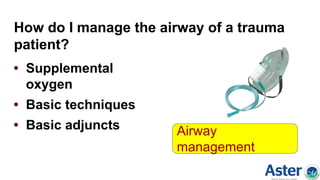
How do I manage the airway of a trauma
patient?
• Supplemental
oxygen
• Basic techniques
• Basic adjuncts Airway
management
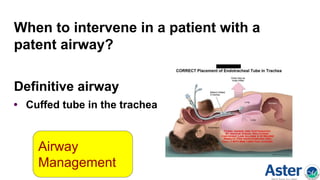
When to intervene in a patient with a
patent airway?
Definitive airway
• Cuffed tube in the trachea
Airway
Management
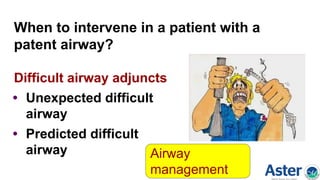
When to intervene in a patient with a
patent airway?
Difficult airway adjuncts
• Unexpected difficult
airway
• Predicted difficult
airway Airway
management
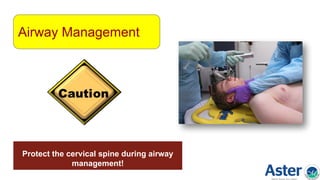
Protect the cervical spine during airway
management!
Airway Management
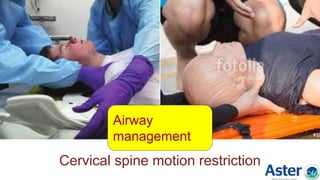
Cervical spine motion restriction
Airway
management
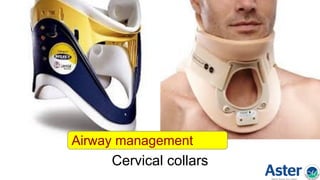
Cervical collars
Airway management
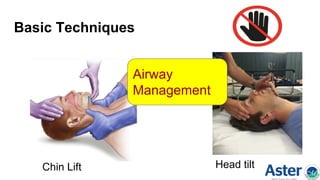
Basic Techniques
Chin Lift Head tilt
Airway
Management
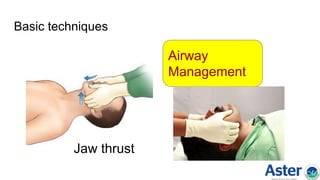
Basic techniques
Airway
Management
Jaw thrust
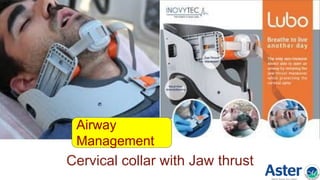
Cervical collar with Jaw thrust
Airway
Management
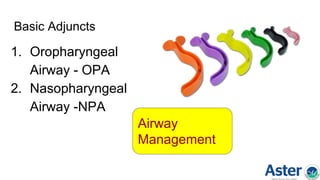
Basic Adjuncts
1. Oropharyngeal
Airway - OPA
2. Nasopharyngeal
Airway -NPA
Airway
Management
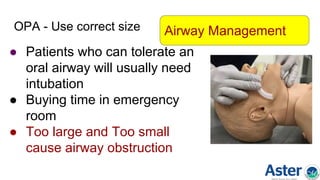
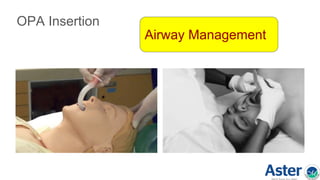
OPA - Use correct size
● Patients who can tolerate an
oral airway will usually need
intubation
● Buying time in emergency
room
● Too large and Too small
cause airway obstruction
Airway Management
OPA Insertion
Airway Management
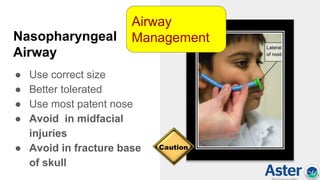
Nasopharyngeal
Airway
● Use correct size
● Better tolerated
● Use most patent nose
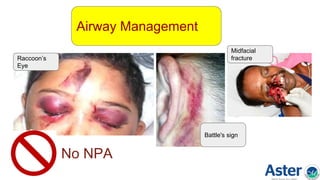
● Avoid in midfacial
injuries
● Avoid in fracture base
of skull
Airway
Management
No NPA
Airway Management
Raccoon’s
Eye
Battle's sign
Midfacial
fracture
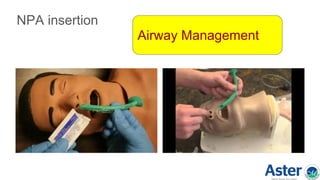
NPA insertion
Airway Management
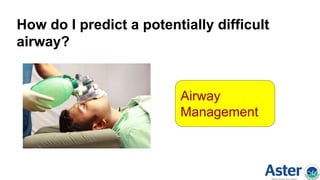
How do I predict a potentially difficult
airway?
Airway
Management
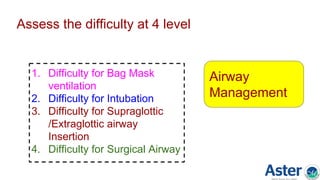
Assess the difficulty at 4 level
Airway
Management
1. Difficulty for Bag Mask
ventilation
2. Difficulty for Intubation
3. Difficulty for Supraglottic
/Extraglottic airway
Insertion
4. Difficulty for Surgical Airway
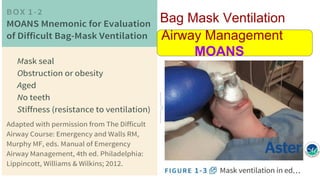
Bag Mask Ventilation
Airway Management
MOANS
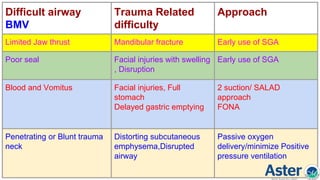
Difficult airway
BMV
Trauma Related
difficulty
Approach
Limited Jaw thrust Mandibular fracture Early use of SGA
Poor seal Facial injuries with swelling
, Disruption
Early use of SGA
Blood and Vomitus Facial injuries, Full
stomach
Delayed gastric emptying
2 suction/ SALAD
approach
FONA
Penetrating or Blunt trauma
neck
Distorting subcutaneous
emphysema,Disrupted
airway
Passive oxygen
delivery/minimize Positive
pressure ventilation
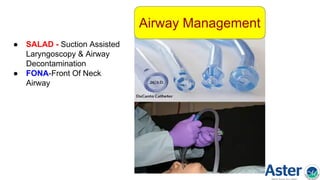
● SALAD - Suction Assisted
Laryngoscopy & Airway
Decontamination
● FONA-Front Of Neck
Airway
Airway Management
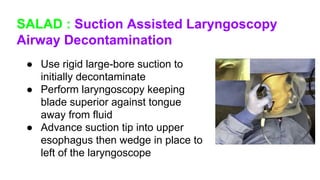
SALAD : Suction Assisted Laryngoscopy
Airway Decontamination
● Use rigid large-bore suction to
initially decontaminate
● Perform laryngoscopy keeping
blade superior against tongue
away from fluid
● Advance suction tip into upper
esophagus then wedge in place to
left of the laryngoscope
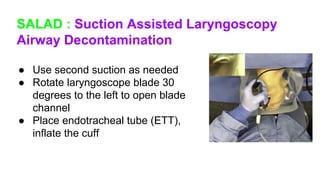
SALAD : Suction Assisted Laryngoscopy
Airway Decontamination
● Use second suction as needed
● Rotate laryngoscope blade 30
degrees to the left to open blade
channel
● Place endotracheal tube (ETT),
inflate the cuff
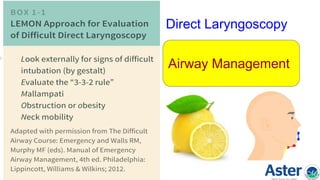
Direct Laryngoscopy
Airway Management
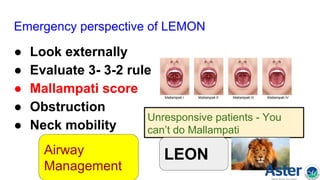
Emergency perspective of LEMON
● Look externally
● Evaluate 3- 3-2 rule
● Mallampati score
● Obstruction
● Neck mobility
Unresponsive patients - You
can’t do Mallampati
LEONAirway
Management
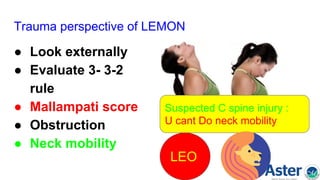
Trauma perspective of LEMON
● Look externally
● Evaluate 3- 3-2
rule
● Mallampati score
● Obstruction
● Neck mobility
Suspected C spine injury :
U cant Do neck mobility
LEO
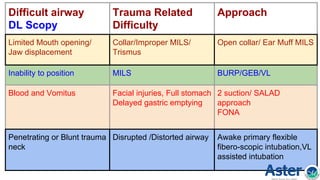
Difficult airway
DL Scopy
Trauma Related
Difficulty
Approach
Limited Mouth opening/
Jaw displacement
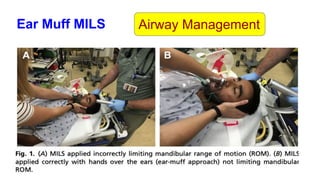
Collar/Improper MILS/
Trismus
Open collar/ Ear Muff MILS
Inability to position MILS BURP/GEB/VL
Blood and Vomitus Facial injuries, Full stomach
Delayed gastric emptying
2 suction/ SALAD
approach
FONA
Penetrating or Blunt trauma
neck
Disrupted /Distorted airway Awake primary flexible
fibero-scopic intubation,VL
assisted intubation
Ear Muff MILS Airway Management
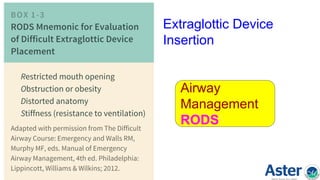
Extraglottic Device
Insertion
Airway
Management
RODS
Difficult airway Trauma Related
Difficulty
Approach
Blood and Vomitus Facial injuries, Full
stomach
Delayed gastric emptying
2 suction/ SALAD
approach
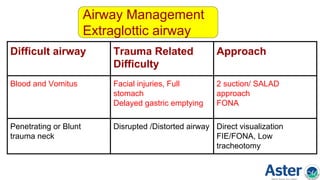
FONA
Penetrating or Blunt
trauma neck
Disrupted /Distorted airway Direct visualization
FIE/FONA, Low
tracheotomy
Airway Management
Extraglottic airway
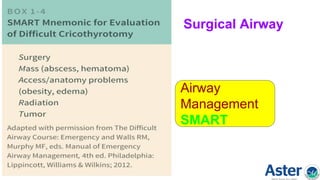
Surgical Airway
Airway
Management
SMART
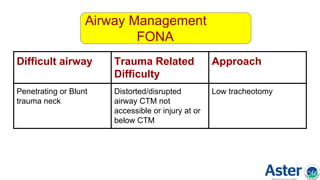
Difficult airway Trauma Related
Difficulty
Approach
Penetrating or Blunt
trauma neck
Distorted/disrupted
airway CTM not
accessible or injury at or
below CTM
Low tracheotomy
Airway Management
FONA
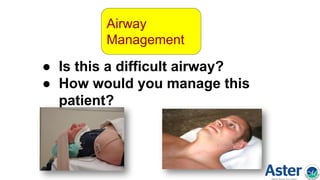
Airway
Management
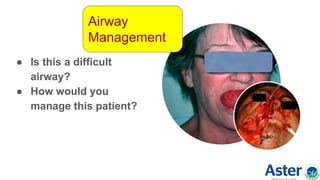
● Is this a difficult airway?
● How would you manage this
patient?
What is meant by a Definitive Airway?
A definitive airway is a tube placed in
the trachea with the cuff inflated below
the vocal cords, the tube connected to
some form of oxygen-enriched
assisted ventilation, and the airway
secured in place with tape
Airway Management
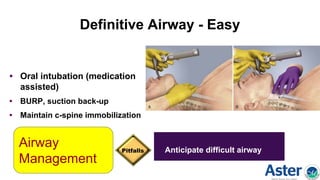
Definitive Airway - Easy
• Oral intubation (medication
assisted)
• BURP, suction back-up
• Maintain c-spine immobilization
Anticipate difficult airway
Airway
Management
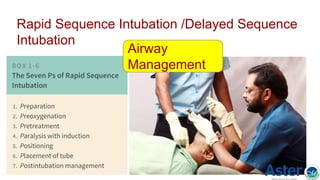
Rapid Sequence Intubation /Delayed Sequence
Intubation
Airway
Management
● Is this a difficult
airway?
● How would you
manage this patient?
Airway
Management
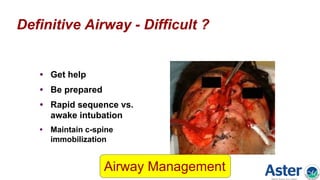
Definitive Airway - Difficult ?
• Get help
• Be prepared
• Rapid sequence vs.
awake intubation
• Maintain c-spine
immobilization
Airway Management
Definitive Airway - Difficult ?
Using Paralytic Agents
for Intubation will be
suicidal
Airway Management
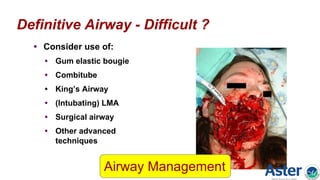
Definitive Airway - Difficult ?
• Consider use of:
• Gum elastic bougie
• Combitube
• King’s Airway
• (Intubating) LMA
• Surgical airway
• Other advanced
techniques
Airway Management
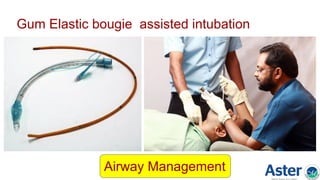
Gum Elastic bougie assisted intubation
Airway Management
Definitive Airway - Difficult ?
Rescue airway devices - Buying time
Airway Management
Rescue airway devices- Buying time
Intubating LMA
Airway Management
Definitive Airway - Difficult ?
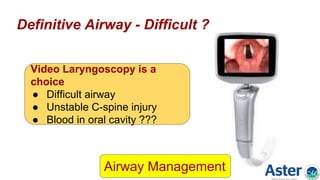
Video Laryngoscopy is a
choice
● Difficult airway
● Unstable C-spine injury
● Blood in oral cavity ???
Airway Management
Video Laryngoscopes : Types
Macintosh video laryngoscope
-standard geometry blade
● C-MAC (Mac Blade; Karl Storz, Tuttlingen,
Germany)
● McGrath Mac (Mac blade; Medtronic,
Minneapolis, MN)
● GlideScope Titanium Mac (GlideScope,
Verathon, WA),
● Venner APA (Mac blade; Venner Medical,
Singapore, Republic of Singapore).
Video Laryngoscopes: Types
Hyperangulated VL (also known
as indirect VL)
● C-MAC (D-Blade)
● McGrath Mac (X blade) standard
GlideScope
● King Vision (non channeled blade Ambu,
Ballerup, Denmark)
Data from Kovacs G, Law JA. Lights camera action: redirecting videolaryngoscopy. EMCrit. 2016. Available at:
https://emcrit.org/blogpost/redirecting-videolaryngoscopy/. Accessed February 25, 2017
Video Laryngoscopes: Types
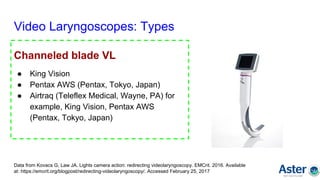
Channeled blade VL
● King Vision
● Pentax AWS (Pentax, Tokyo, Japan)
● Airtraq (Teleflex Medical, Wayne, PA) for
example, King Vision, Pentax AWS
(Pentax, Tokyo, Japan)
Data from Kovacs G, Law JA. Lights camera action: redirecting videolaryngoscopy. EMCrit. 2016. Available
at: https://emcrit.org/blogpost/redirecting-videolaryngoscopy/. Accessed February 25, 2017
Definitive Airway - Difficult ?
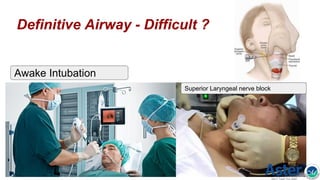
Superior Laryngeal nerve block
Awake Intubation
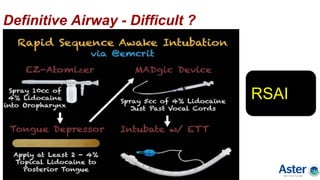
Definitive Airway - Difficult ?
RSAI
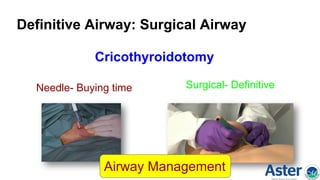
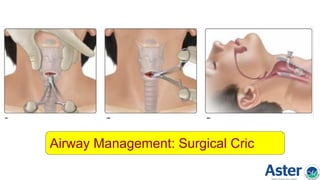
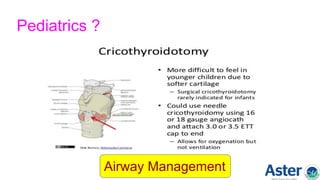
Definitive Airway: Surgical Airway
Cricothyroidotomy
Needle- Buying time Surgical- Definitive
Airway Management
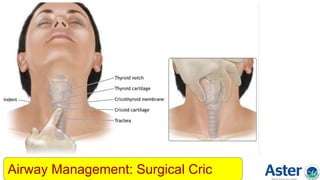
Airway Management: Surgical Cric
Pediatrics ?
Airway Management
How do I know the tube is in the
right place?
Airway Management
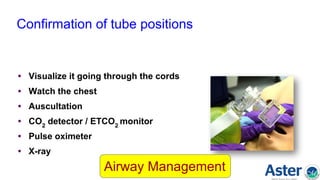
Confirmation of tube positions
• Visualize it going through the cords
• Watch the chest
• Auscultation
• CO2
detector / ETCO2
monitor
• Pulse oximeter
• X-ray
Airway Management
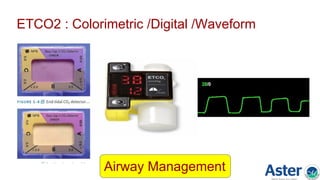
ETCO2 : Colorimetric /Digital /Waveform
Airway Management
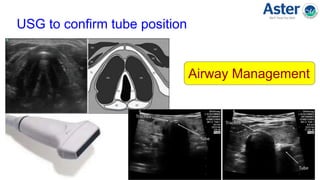
USG to confirm tube position
Airway Management
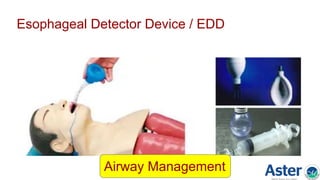
Esophageal Detector Device / EDD
Airway Management
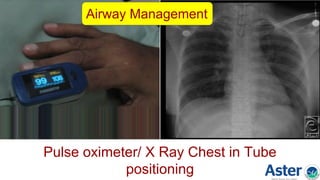
Pulse oximeter/ X Ray Chest in Tube
positioning
Airway Management
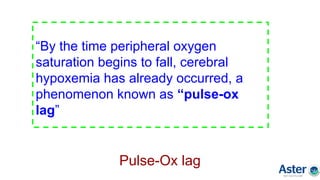
Pulse-Ox lag
“By the time peripheral oxygen
saturation begins to fall, cerebral
hypoxemia has already occurred, a
phenomenon known as “pulse-ox
lag”
Airway
Management
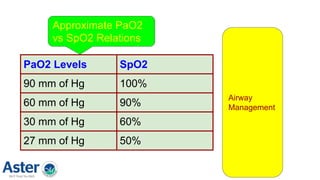
PaO2 Levels SpO2
90 mm of Hg 100%
60 mm of Hg 90%
30 mm of Hg 60%
27 mm of Hg 50%
Approximate PaO2
vs SpO2 Relations
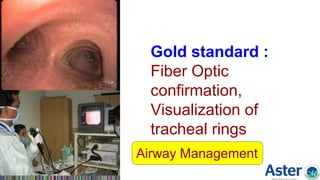
Gold standard :
Fiber Optic
confirmation,
Visualization of
tracheal rings
Airway Management
Pearls in Trauma
airway
management
Focussed
Management Pearls
1. Traumatic brain injury
2. Unstable C Spine
injuries
3. Contaminated Airway
4. Agitated trauma patient
5. Faciomaxillary injuries
6. Laryngotracheal injuries
7. Hemodynamic instability
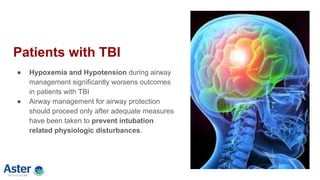
Patients with TBI
● Hypoxemia and Hypotension during airway
management significantly worsens outcomes
in patients with TBI
● Airway management for airway protection
should proceed only after adequate measures
have been taken to prevent intubation
related physiologic disturbances.
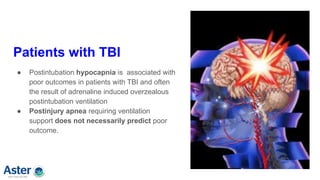
Patients with TBI
● Postintubation hypocapnia is associated with
poor outcomes in patients with TBI and often
the result of adrenaline induced overzealous
postintubation ventilation
● Postinjury apnea requiring ventilation
support does not necessarily predict poor
outcome.
❏ What are points to be taken care in airway
management in patient with Traumatic brain
injury?
● Avoid Hypoxia
● Avoid Hypotension
● Avoid airway Obstruction
● Pre Oxygenation
● Pre Treatment :
Lignocaine/Opioid/Defasciculating
agents
● Pre load : Fluid
Pre-Intubation
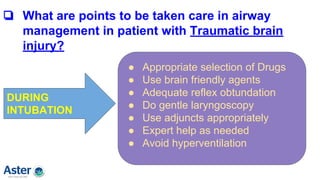
❏ What are points to be taken care in airway
management in patient with Traumatic brain
injury?
DURING
INTUBATION
● Appropriate selection of Drugs
● Use brain friendly agents
● Adequate reflex obtundation
● Do gentle laryngoscopy
● Use adjuncts appropriately
● Expert help as needed
● Avoid hyperventilation
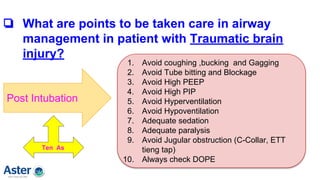
❏ What are points to be taken care in airway
management in patient with Traumatic brain
injury?
1. Avoid coughing ,bucking and Gagging
2. Avoid Tube bitting and Blockage
3. Avoid High PEEP
4. Avoid High PIP
5. Avoid Hyperventilation
6. Avoid Hypoventilation
7. Adequate sedation
8. Adequate paralysis
9. Avoid Jugular obstruction (C-Collar, ETT
tieng tap)
10. Always check DOPE
Post Intubation
Ten As
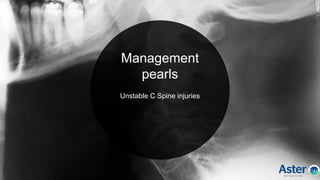
Management
pearls
Unstable C Spine injuries
Patient with Unstable C spine injuries
● Imaging should not delay airway
management and assume all trauma
patients have unstable cervical spines.
● Optimally use the intubation device he
or she is most experienced with.
● Be prepared for a poor view with direct
laryngoscopy (DL) and always have a
bougie ready for use.
Patient with Unstable C spine injuries
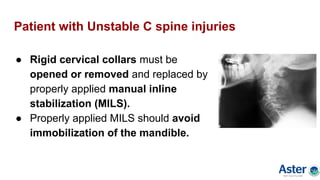
● Rigid cervical collars must be
opened or removed and replaced by
properly applied manual inline
stabilization (MILS).
● Properly applied MILS should avoid
immobilization of the mandible.
Patient with Unstable C spine injuries
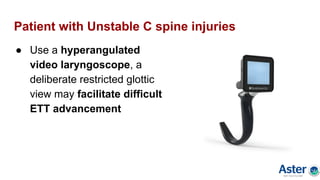
● Use a hyperangulated
video laryngoscope, a
deliberate restricted glottic
view may facilitate difficult
ETT advancement
Management
pearls
Contaminated
airway
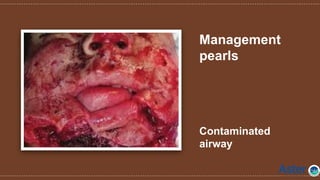
Patient with contaminated Airway
● Have at least 2 large-bore rigid suction catheters.
● Consider alternative options for hemorrhage control
(sutures, packing, epistaxis kit).
● Minimize positive-pressure ventilation (PPV) and
use a mono meter for provider feedback when mask
ventilation is indicated.
● Look for epiglottis as an important landmark for
glottis and have a bougie prepared for use with DL
Patient with contaminated Airway
● VL is considered the best option, Macintosh VL may be
the preferred device, as it may be used directly if
contamination obstructs camera
● Consider esophageal ETT diversion connected to
suction
● Suction-assisted laryngoscopy airway decontamination
(SALAD) approach
● If intubation fails and patient is desaturating, front of
neck airway (FONA) rescue oxygenation approach is
indicated
Agitated
trauma
patients
Management pearls
● Agitation may be a symptom of traumatic pathology
● Agitated patients may require facilitated cooperation to
ensure adequate preoxygenation
● Ketamine is an appropriate agent to facilitate cooperation
in agitated patients in preparation for airway management
● Always be prepared to provide definitive airway
intervention before administering sedation.
Agitated Trauma patients
Faciomaxillary
trauma
Management pearls
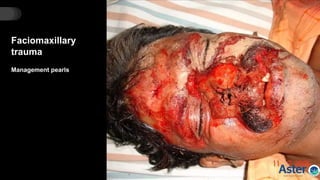
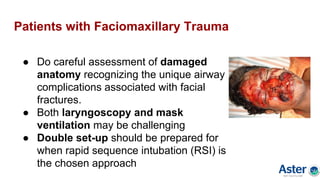
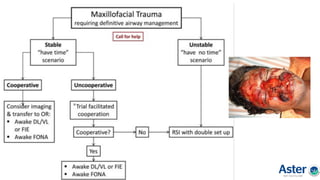
Patients with Faciomaxillary Trauma
● Do careful assessment of damaged
anatomy recognizing the unique airway
complications associated with facial
fractures.
● Both laryngoscopy and mask
ventilation may be challenging
● Double set-up should be prepared for
when rapid sequence intubation (RSI) is
the chosen approach
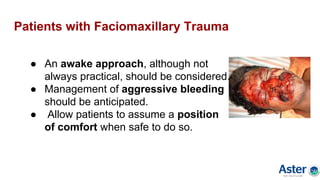
Patients with Faciomaxillary Trauma
● An awake approach, although not
always practical, should be considered.
● Management of aggressive bleeding
should be anticipated.
● Allow patients to assume a position
of comfort when safe to do so.
Management pearls
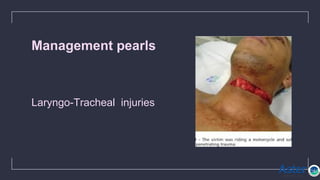
Laryngo-Tracheal injuries
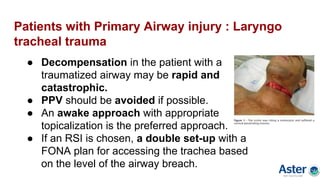
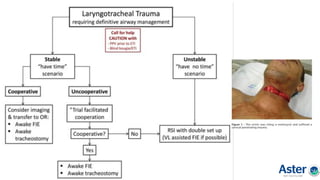
Patients with Primary Airway injury : Laryngo
tracheal trauma
● Decompensation in the patient with a
traumatized airway may be rapid and
catastrophic.
● PPV should be avoided if possible.
● An awake approach with appropriate
topicalization is the preferred approach.
● If an RSI is chosen, a double set-up with a
FONA plan for accessing the trachea based
on the level of the airway breach.
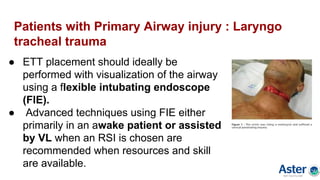
Patients with Primary Airway injury : Laryngo
tracheal trauma
● ETT placement should ideally be
performed with visualization of the airway
using a flexible intubating endoscope
(FIE).
● Advanced techniques using FIE either
primarily in an awake patient or assisted
by VL when an RSI is chosen are
recommended when resources and skill
are available.
Management pearls
Hemodynamic instability
Peri Intubation hemodynamic instability
● Resuscitation using blood products (packed red
blood cells/massive transfusion) should be done
early in the pre-intubation phase of trauma
management
● Selected scenarios consider the use of
vasopressors during the peri-intubation phase.
● Reduce the dose of all induction agents by at
least 50% and increase the dose of the
paralytic agents
Management pearls
Pre-Oxygenation
“The rule of two”
PreOxygenation : “The Rule of Two”
● Elevate the Head (ear to sternum) and the Bed
greater than 20 (reverse Trendelenburg).
● Two sources of oxygen for all critically ill patients
1. High-flow nasal prongs !15 L/min
2. NRB/bag-mask ventilation !15 L/min.
● Two approaches for obstruction: OPA with a Jaw
thrust for soft tissue obstruction
PreOxygenation : “The Rule of Two”
● Two attachments for your BVM: positive
end-expiratory pressure valve and pressure
manometer
● Two hands on all face masks: to ensure closed
system oxygenation and ventilation and perform
an aggressive jaw thrust
● Two providers: a tight mask seal and
aggressive jaw thrust giving feedback to the
provider squeezing the bag
● Avoid over ventilation and hyperventilation
Trauma-
Airway
Management
Checklists
Pre Intubation
checklist
One
Emerg Med Clin N Am 36 (2018) 61–84
https://doi.org/10.1016/j.emc.2017.08.006 emed.theclinics.com 0733-8627/18/a 2017 The Authors. Published by
Elsevier Inc. This is an open access article under the CC BY-NC-ND license
(http://creativecommons.org/licenses/by-nc-nd/4.0/).
Team Ready ?
❏ EP Aware / Experienced airway
staff present
❏ Do we need additional help?
❏ Assign roles: Lead /
MILS/BVM/Drugs/ETI
Trauma -Airway
Management
Pre Intubation
checklist
Two
Trauma -Airway
Management
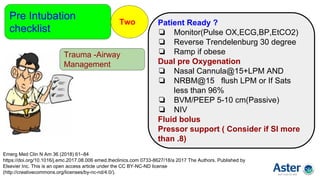
Patient Ready ?
❏ Monitor(Pulse OX,ECG,BP,EtCO2)
❏ Reverse Trendelenburg 30 degree
❏ Ramp if obese
Dual pre Oxygenation
❏ Nasal Cannula@15+LPM AND
❏ NRBM@15 flush LPM or If Sats
less than 96%
❏ BVM/PEEP 5-10 cm(Passive)
❏ NIV
Fluid bolus
Pressor support ( Consider if SI more
than .8)
Emerg Med Clin N Am 36 (2018) 61–84
https://doi.org/10.1016/j.emc.2017.08.006 emed.theclinics.com 0733-8627/18/a 2017 The Authors. Published by
Elsevier Inc. This is an open access article under the CC BY-NC-ND license
(http://creativecommons.org/licenses/by-nc-nd/4.0/).
Pre Intubation
checklist
Three
Emerg Med Clin N Am 36 (2018) 61–84
https://doi.org/10.1016/j.emc.2017.08.006 emed.theclinics.com 0733-8627/18/a 2017 The Authors. Published by
Elsevier Inc. This is an open access article under the CC BY-NC-ND license
(http://creativecommons.org/licenses/by-nc-nd/4.0/).
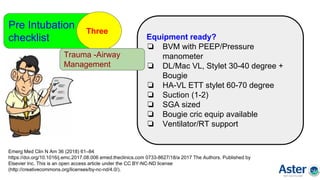
Equipment ready?
❏ BVM with PEEP/Pressure
manometer
❏ DL/Mac VL, Stylet 30-40 degree +
Bougie
❏ HA-VL ETT stylet 60-70 degree
❏ Suction (1-2)
❏ SGA sized
❏ Bougie cric equip available
❏ Ventilator/RT support
Trauma -Airway
Management
Intubation checklist One
Emerg Med Clin N Am 36 (2018) 61–84
https://doi.org/10.1016/j.emc.2017.08.006 emed.theclinics.com 0733-8627/18/a 2017 The Authors. Published by
Elsevier Inc. This is an open access article under the CC BY-NC-ND license
(http://creativecommons.org/licenses/by-nc-nd/4.0/).
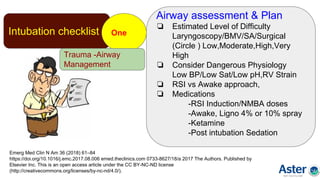
Airway assessment & Plan
❏ Estimated Level of Difficulty
Laryngoscopy/BMV/SA/Surgical
(Circle ) Low,Moderate,High,Very
High
❏ Consider Dangerous Physiology
Low BP/Low Sat/Low pH,RV Strain
❏ RSI vs Awake approach,
❏ Medications
-RSI Induction/NMBA doses
-Awake, Ligno 4% or 10% spray
-Ketamine
-Post intubation Sedation
Trauma -Airway
Management
Intubation checklist Two
Plan A-B- C- D
Emerg Med Clin N Am 36 (2018) 61–84
https://doi.org/10.1016/j.emc.2017.08.006 emed.theclinics.com 0733-8627/18/a 2017 The Authors. Published by
Elsevier Inc. This is an open access article under the CC BY-NC-ND license
(http://creativecommons.org/licenses/by-nc-nd/4.0/).
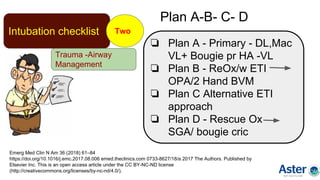
❏ Plan A - Primary - DL,Mac
VL+ Bougie pr HA -VL
❏ Plan B - ReOx/w ETI
OPA/2 Hand BVM
❏ Plan C Alternative ETI
approach
❏ Plan D - Rescue Ox
SGA/ bougie cric
Trauma -Airway
Management
Intubation checklist Three
Emerg Med Clin N Am 36 (2018) 61–84
https://doi.org/10.1016/j.emc.2017.08.006 emed.theclinics.com 0733-8627/18/a 2017 The Authors. Published by
Elsevier Inc. This is an open access article under the CC BY-NC-ND license
(http://creativecommons.org/licenses/by-nc-nd/4.0/).
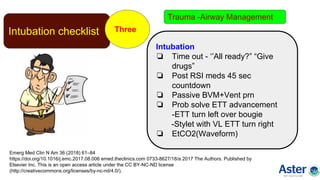
Intubation
❏ Time out - ‘’All ready?” “Give
drugs”
❏ Post RSI meds 45 sec
countdown
❏ Passive BVM+Vent prn
❏ Prob solve ETT advancement
-ETT turn left over bougie
-Stylet with VL ETT turn right
❏ EtCO2(Waveform)
Trauma -Airway Management
Post Intubation
checklist
One
Emerg Med Clin N Am 36 (2018) 61–84
https://doi.org/10.1016/j.emc.2017.08.006 emed.theclinics.com 0733-8627/18/a 2017 The Authors. Published by
Elsevier Inc. This is an open access article under the CC BY-NC-ND license
(http://creativecommons.org/licenses/by-nc-nd/4.0/).
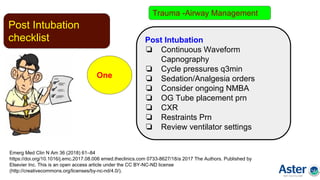
Post Intubation
❏ Continuous Waveform
Capnography
❏ Cycle pressures q3min
❏ Sedation/Analgesia orders
❏ Consider ongoing NMBA
❏ OG Tube placement prn
❏ CXR
❏ Restraints Prn
❏ Review ventilator settings
Trauma -Airway Management
Post Intubation
checklist
Two
Emerg Med Clin N Am 36 (2018) 61–84
https://doi.org/10.1016/j.emc.2017.08.006 emed.theclinics.com 0733-8627/18/a 2017 The Authors. Published by
Elsevier Inc. This is an open access article under the CC BY-NC-ND license
(http://creativecommons.org/licenses/by-nc-nd/4.0/).
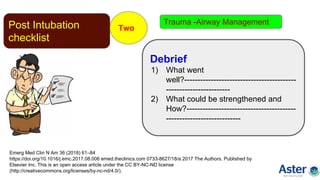
Debrief
1) What went
well?------------------------------------------
------------------------
2) What could be strengthened and
How?-----------------------------------------
----------------------------
Trauma -Airway Management
Post Intubation
checklist
Three
Emerg Med Clin N Am 36 (2018) 61–84
https://doi.org/10.1016/j.emc.2017.08.006 emed.theclinics.com 0733-8627/18/a 2017 The Authors. Published by
Elsevier Inc. This is an open access article under the CC BY-NC-ND license
(http://creativecommons.org/licenses/by-nc-nd/4.0/).
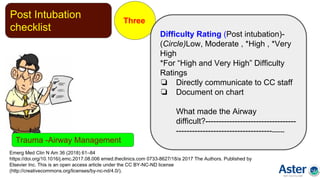
Difficulty Rating (Post intubation)-
(Circle)Low, Moderate , *High , *Very
High
*For “High and Very High” Difficulty
Ratings
❏ Directly communicate to CC staff
❏ Document on chart
What made the Airway
difficult?----------------------------------
------------------------------------------
Trauma -Airway Management
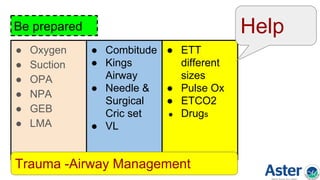
Be prepared
● Oxygen
● Suction
● OPA
● NPA
● GEB
● LMA
● Combitude
● Kings
Airway
● Needle &
Surgical
Cric set
● VL
● ETT
different
sizes
● Pulse Ox
● ETCO2
● Drugs
Help
Trauma -Airway Management
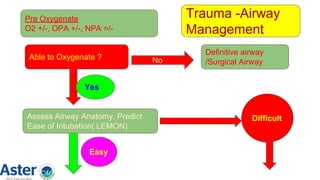
Pre Oxygenate
O2 +/-, OPA +/-, NPA =/-
Able to Oxygenate ? No
Definitive airway
/Surgical Airway
Yes
Assess Airway Anatomy, Predict
Ease of Intubation( LEMON)
Easy
Difficult
Trauma -Airway
Management
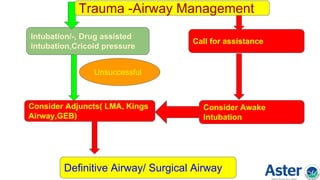
Intubation/-, Drug assisted
intubation,Cricoid pressure
Call for assistance
Unsuccessful
Consider Adjuncts( LMA, Kings
Airway,GEB)
Consider Awake
Intubation
Definitive Airway/ Surgical Airway
Trauma -Airway Management
drvenugopalpp@gmail.com, 9847054747
www.drvenu.blogspot.in

Airway management in polytrauma

  • 1.
    Airway Management in Polytrauma : Advanced version Dr.Venugopalan P P, DA,DNB,MNAMS,MEM(GW) Director and Lead consultant in Emergency Medicine Aster DM Healthcare ,India
  • 2.
    Background Prevention of hypoxemiarequires a protected, unobstructed airway and adequate ventilation, which take priority over management of all other conditions.
  • 3.
    This session... 1. Definedefinitive airway. 2. Recognize the signs and symptoms of airway obstruction and ventilatory compromise. 3. Describe the techniques for establishing and maintaining a patent airway. 4. Describe techniques for confirming the adequacy of ventilation and oxygenation 5. Explore the management pearls in specifice trauma scenarios
  • 4.
    What are thePriorities in Polytrauma? 1. Airway and C-Spine protection 2. Breathing and Ventilation 3. Circulation and Hemorrhage control 4. Disability 5. Exposure and prevention of hypothermia A B C D E
  • 5.
    Case scenario ● 34-year-oldmotorcyclist lost control and crashed into a fence ● Obvious facial trauma ● No helmet ● Smells of alcohol ● Belligerent at scene; now not communicating ● Pulse oximeter 85% Airway management
  • 6.
    Airway assessment How doI know the airway is adequate? Airway management
  • 7.
    How do Iknow the airway is adequate? • Patient is alert and oriented. • Patient is talking normally. • There is no evidence of injury to the head or neck. • You have assessed and re-assessed for deterioration Airway Assessment
  • 8.
    Signs and symptomsof airway compromise • High index of suspicion • Change in voice / sore throat • Noisy breathing (snoring and stridor) • Dyspnea and agitation Airway Assessment
  • 9.
    Signs and symptomsof airway compromise • Tachypnea • Abnormal breathing pattern • Low oxygen saturation (late sign) Airway Assessment
  • 10.
    Remember …. ● Agitatedpatient ● Rule out Hypoxia ● Obtunded patient ● Rule out Hypercarbia Airway management
  • 11.
    When to intervenein a patient with a patent airway? 1. Airway problem - Impending airway compromise 2. Breathing problem-Need for ventilation 3. Circulatory Problem-Intractable shock 4. Disability problem-Inability to protect the airway, Low GCS 5. Expected course : Transfer to Radiology , Transfer to another Institution Airway Assessment A B C D E
  • 12.
    Dynamic Airway -Anticipatory Intubation ● Bullet ● Burn ● Bites 3 B’s in Head & Neck Airway management
  • 13.
    How do Imanage the airway of a trauma patient? • Supplemental oxygen • Basic techniques • Basic adjuncts Airway management
  • 14.
    When to intervenein a patient with a patent airway? Definitive airway • Cuffed tube in the trachea Airway Management
  • 15.
    When to intervenein a patient with a patent airway? Difficult airway adjuncts • Unexpected difficult airway • Predicted difficult airway Airway management
  • 16.
    Protect the cervicalspine during airway management! Airway Management
  • 17.
    Cervical spine motionrestriction Airway management
  • 18.
  • 19.
    Basic Techniques Chin LiftHead tilt Airway Management
  • 20.
  • 21.
    Cervical collar withJaw thrust Airway Management
  • 22.
    Basic Adjuncts 1. Oropharyngeal Airway- OPA 2. Nasopharyngeal Airway -NPA Airway Management
  • 23.
    OPA - Usecorrect size ● Patients who can tolerate an oral airway will usually need intubation ● Buying time in emergency room ● Too large and Too small cause airway obstruction Airway Management
  • 24.
  • 25.
    Nasopharyngeal Airway ● Use correctsize ● Better tolerated ● Use most patent nose ● Avoid in midfacial injuries ● Avoid in fracture base of skull Airway Management
  • 26.
  • 27.
  • 28.
    How do Ipredict a potentially difficult airway? Airway Management
  • 29.
    Assess the difficultyat 4 level Airway Management 1. Difficulty for Bag Mask ventilation 2. Difficulty for Intubation 3. Difficulty for Supraglottic /Extraglottic airway Insertion 4. Difficulty for Surgical Airway
  • 30.
  • 31.
    Difficult airway BMV Trauma Related difficulty Approach LimitedJaw thrust Mandibular fracture Early use of SGA Poor seal Facial injuries with swelling , Disruption Early use of SGA Blood and Vomitus Facial injuries, Full stomach Delayed gastric emptying 2 suction/ SALAD approach FONA Penetrating or Blunt trauma neck Distorting subcutaneous emphysema,Disrupted airway Passive oxygen delivery/minimize Positive pressure ventilation
  • 32.
    ● SALAD -Suction Assisted Laryngoscopy & Airway Decontamination ● FONA-Front Of Neck Airway Airway Management
  • 33.
    SALAD : SuctionAssisted Laryngoscopy Airway Decontamination ● Use rigid large-bore suction to initially decontaminate ● Perform laryngoscopy keeping blade superior against tongue away from fluid ● Advance suction tip into upper esophagus then wedge in place to left of the laryngoscope
  • 34.
    SALAD : SuctionAssisted Laryngoscopy Airway Decontamination ● Use second suction as needed ● Rotate laryngoscope blade 30 degrees to the left to open blade channel ● Place endotracheal tube (ETT), inflate the cuff
  • 35.
  • 36.
    Emergency perspective ofLEMON ● Look externally ● Evaluate 3- 3-2 rule ● Mallampati score ● Obstruction ● Neck mobility Unresponsive patients - You can’t do Mallampati LEONAirway Management
  • 37.
    Trauma perspective ofLEMON ● Look externally ● Evaluate 3- 3-2 rule ● Mallampati score ● Obstruction ● Neck mobility Suspected C spine injury : U cant Do neck mobility LEO
  • 38.
    Difficult airway DL Scopy TraumaRelated Difficulty Approach Limited Mouth opening/ Jaw displacement Collar/Improper MILS/ Trismus Open collar/ Ear Muff MILS Inability to position MILS BURP/GEB/VL Blood and Vomitus Facial injuries, Full stomach Delayed gastric emptying 2 suction/ SALAD approach FONA Penetrating or Blunt trauma neck Disrupted /Distorted airway Awake primary flexible fibero-scopic intubation,VL assisted intubation
  • 39.
    Ear Muff MILSAirway Management
  • 40.
  • 41.
    Difficult airway TraumaRelated Difficulty Approach Blood and Vomitus Facial injuries, Full stomach Delayed gastric emptying 2 suction/ SALAD approach FONA Penetrating or Blunt trauma neck Disrupted /Distorted airway Direct visualization FIE/FONA, Low tracheotomy Airway Management Extraglottic airway
  • 42.
  • 43.
    Difficult airway TraumaRelated Difficulty Approach Penetrating or Blunt trauma neck Distorted/disrupted airway CTM not accessible or injury at or below CTM Low tracheotomy Airway Management FONA
  • 44.
    Airway Management ● Is thisa difficult airway? ● How would you manage this patient?
  • 45.
    What is meantby a Definitive Airway? A definitive airway is a tube placed in the trachea with the cuff inflated below the vocal cords, the tube connected to some form of oxygen-enriched assisted ventilation, and the airway secured in place with tape Airway Management
  • 46.
    Definitive Airway -Easy • Oral intubation (medication assisted) • BURP, suction back-up • Maintain c-spine immobilization Anticipate difficult airway Airway Management
  • 47.
    Rapid Sequence Intubation/Delayed Sequence Intubation Airway Management
  • 48.
    ● Is thisa difficult airway? ● How would you manage this patient? Airway Management
  • 49.
    Definitive Airway -Difficult ? • Get help • Be prepared • Rapid sequence vs. awake intubation • Maintain c-spine immobilization Airway Management
  • 50.
    Definitive Airway -Difficult ? Using Paralytic Agents for Intubation will be suicidal Airway Management
  • 51.
    Definitive Airway -Difficult ? • Consider use of: • Gum elastic bougie • Combitube • King’s Airway • (Intubating) LMA • Surgical airway • Other advanced techniques Airway Management
  • 52.
    Gum Elastic bougieassisted intubation Airway Management
  • 53.
    Definitive Airway -Difficult ? Rescue airway devices - Buying time Airway Management
  • 54.
    Rescue airway devices-Buying time Intubating LMA Airway Management
  • 55.
    Definitive Airway -Difficult ? Video Laryngoscopy is a choice ● Difficult airway ● Unstable C-spine injury ● Blood in oral cavity ??? Airway Management
  • 56.
    Video Laryngoscopes :Types Macintosh video laryngoscope -standard geometry blade ● C-MAC (Mac Blade; Karl Storz, Tuttlingen, Germany) ● McGrath Mac (Mac blade; Medtronic, Minneapolis, MN) ● GlideScope Titanium Mac (GlideScope, Verathon, WA), ● Venner APA (Mac blade; Venner Medical, Singapore, Republic of Singapore).
  • 57.
    Video Laryngoscopes: Types HyperangulatedVL (also known as indirect VL) ● C-MAC (D-Blade) ● McGrath Mac (X blade) standard GlideScope ● King Vision (non channeled blade Ambu, Ballerup, Denmark) Data from Kovacs G, Law JA. Lights camera action: redirecting videolaryngoscopy. EMCrit. 2016. Available at: https://emcrit.org/blogpost/redirecting-videolaryngoscopy/. Accessed February 25, 2017
  • 58.
    Video Laryngoscopes: Types Channeledblade VL ● King Vision ● Pentax AWS (Pentax, Tokyo, Japan) ● Airtraq (Teleflex Medical, Wayne, PA) for example, King Vision, Pentax AWS (Pentax, Tokyo, Japan) Data from Kovacs G, Law JA. Lights camera action: redirecting videolaryngoscopy. EMCrit. 2016. Available at: https://emcrit.org/blogpost/redirecting-videolaryngoscopy/. Accessed February 25, 2017
  • 59.
    Definitive Airway -Difficult ? Superior Laryngeal nerve block Awake Intubation
  • 60.
    Definitive Airway -Difficult ? RSAI
  • 61.
    Definitive Airway: SurgicalAirway Cricothyroidotomy Needle- Buying time Surgical- Definitive Airway Management
  • 62.
  • 63.
  • 64.
  • 65.
    How do Iknow the tube is in the right place? Airway Management
  • 66.
    Confirmation of tubepositions • Visualize it going through the cords • Watch the chest • Auscultation • CO2 detector / ETCO2 monitor • Pulse oximeter • X-ray Airway Management
  • 67.
    ETCO2 : Colorimetric/Digital /Waveform Airway Management
  • 68.
    USG to confirmtube position Airway Management
  • 69.
    Esophageal Detector Device/ EDD Airway Management
  • 70.
    Pulse oximeter/ XRay Chest in Tube positioning Airway Management
  • 71.
    Pulse-Ox lag “By thetime peripheral oxygen saturation begins to fall, cerebral hypoxemia has already occurred, a phenomenon known as “pulse-ox lag”
  • 72.
    Airway Management PaO2 Levels SpO2 90mm of Hg 100% 60 mm of Hg 90% 30 mm of Hg 60% 27 mm of Hg 50% Approximate PaO2 vs SpO2 Relations
  • 73.
    Gold standard : FiberOptic confirmation, Visualization of tracheal rings Airway Management
  • 74.
  • 75.
    Focussed Management Pearls 1. Traumaticbrain injury 2. Unstable C Spine injuries 3. Contaminated Airway 4. Agitated trauma patient 5. Faciomaxillary injuries 6. Laryngotracheal injuries 7. Hemodynamic instability
  • 76.
    Patients with TBI ●Hypoxemia and Hypotension during airway management significantly worsens outcomes in patients with TBI ● Airway management for airway protection should proceed only after adequate measures have been taken to prevent intubation related physiologic disturbances.
  • 77.
    Patients with TBI ●Postintubation hypocapnia is associated with poor outcomes in patients with TBI and often the result of adrenaline induced overzealous postintubation ventilation ● Postinjury apnea requiring ventilation support does not necessarily predict poor outcome.
  • 78.
    ❏ What arepoints to be taken care in airway management in patient with Traumatic brain injury? ● Avoid Hypoxia ● Avoid Hypotension ● Avoid airway Obstruction ● Pre Oxygenation ● Pre Treatment : Lignocaine/Opioid/Defasciculating agents ● Pre load : Fluid Pre-Intubation
  • 79.
    ❏ What arepoints to be taken care in airway management in patient with Traumatic brain injury? DURING INTUBATION ● Appropriate selection of Drugs ● Use brain friendly agents ● Adequate reflex obtundation ● Do gentle laryngoscopy ● Use adjuncts appropriately ● Expert help as needed ● Avoid hyperventilation
  • 80.
    ❏ What arepoints to be taken care in airway management in patient with Traumatic brain injury? 1. Avoid coughing ,bucking and Gagging 2. Avoid Tube bitting and Blockage 3. Avoid High PEEP 4. Avoid High PIP 5. Avoid Hyperventilation 6. Avoid Hypoventilation 7. Adequate sedation 8. Adequate paralysis 9. Avoid Jugular obstruction (C-Collar, ETT tieng tap) 10. Always check DOPE Post Intubation Ten As
  • 81.
  • 82.
    Patient with UnstableC spine injuries ● Imaging should not delay airway management and assume all trauma patients have unstable cervical spines. ● Optimally use the intubation device he or she is most experienced with. ● Be prepared for a poor view with direct laryngoscopy (DL) and always have a bougie ready for use.
  • 83.
    Patient with UnstableC spine injuries ● Rigid cervical collars must be opened or removed and replaced by properly applied manual inline stabilization (MILS). ● Properly applied MILS should avoid immobilization of the mandible.
  • 84.
    Patient with UnstableC spine injuries ● Use a hyperangulated video laryngoscope, a deliberate restricted glottic view may facilitate difficult ETT advancement
  • 85.
  • 86.
    Patient with contaminatedAirway ● Have at least 2 large-bore rigid suction catheters. ● Consider alternative options for hemorrhage control (sutures, packing, epistaxis kit). ● Minimize positive-pressure ventilation (PPV) and use a mono meter for provider feedback when mask ventilation is indicated. ● Look for epiglottis as an important landmark for glottis and have a bougie prepared for use with DL
  • 87.
    Patient with contaminatedAirway ● VL is considered the best option, Macintosh VL may be the preferred device, as it may be used directly if contamination obstructs camera ● Consider esophageal ETT diversion connected to suction ● Suction-assisted laryngoscopy airway decontamination (SALAD) approach ● If intubation fails and patient is desaturating, front of neck airway (FONA) rescue oxygenation approach is indicated
  • 88.
  • 89.
    ● Agitation maybe a symptom of traumatic pathology ● Agitated patients may require facilitated cooperation to ensure adequate preoxygenation ● Ketamine is an appropriate agent to facilitate cooperation in agitated patients in preparation for airway management ● Always be prepared to provide definitive airway intervention before administering sedation. Agitated Trauma patients
  • 90.
  • 91.
    Patients with FaciomaxillaryTrauma ● Do careful assessment of damaged anatomy recognizing the unique airway complications associated with facial fractures. ● Both laryngoscopy and mask ventilation may be challenging ● Double set-up should be prepared for when rapid sequence intubation (RSI) is the chosen approach
  • 92.
    Patients with FaciomaxillaryTrauma ● An awake approach, although not always practical, should be considered. ● Management of aggressive bleeding should be anticipated. ● Allow patients to assume a position of comfort when safe to do so.
  • 94.
  • 95.
    Patients with PrimaryAirway injury : Laryngo tracheal trauma ● Decompensation in the patient with a traumatized airway may be rapid and catastrophic. ● PPV should be avoided if possible. ● An awake approach with appropriate topicalization is the preferred approach. ● If an RSI is chosen, a double set-up with a FONA plan for accessing the trachea based on the level of the airway breach.
  • 96.
    Patients with PrimaryAirway injury : Laryngo tracheal trauma ● ETT placement should ideally be performed with visualization of the airway using a flexible intubating endoscope (FIE). ● Advanced techniques using FIE either primarily in an awake patient or assisted by VL when an RSI is chosen are recommended when resources and skill are available.
  • 98.
  • 99.
    Peri Intubation hemodynamicinstability ● Resuscitation using blood products (packed red blood cells/massive transfusion) should be done early in the pre-intubation phase of trauma management ● Selected scenarios consider the use of vasopressors during the peri-intubation phase. ● Reduce the dose of all induction agents by at least 50% and increase the dose of the paralytic agents
  • 100.
  • 101.
    PreOxygenation : “TheRule of Two” ● Elevate the Head (ear to sternum) and the Bed greater than 20 (reverse Trendelenburg). ● Two sources of oxygen for all critically ill patients 1. High-flow nasal prongs !15 L/min 2. NRB/bag-mask ventilation !15 L/min. ● Two approaches for obstruction: OPA with a Jaw thrust for soft tissue obstruction
  • 102.
    PreOxygenation : “TheRule of Two” ● Two attachments for your BVM: positive end-expiratory pressure valve and pressure manometer ● Two hands on all face masks: to ensure closed system oxygenation and ventilation and perform an aggressive jaw thrust ● Two providers: a tight mask seal and aggressive jaw thrust giving feedback to the provider squeezing the bag ● Avoid over ventilation and hyperventilation
  • 103.
  • 104.
    Pre Intubation checklist One Emerg MedClin N Am 36 (2018) 61–84 https://doi.org/10.1016/j.emc.2017.08.006 emed.theclinics.com 0733-8627/18/a 2017 The Authors. Published by Elsevier Inc. This is an open access article under the CC BY-NC-ND license (http://creativecommons.org/licenses/by-nc-nd/4.0/). Team Ready ? ❏ EP Aware / Experienced airway staff present ❏ Do we need additional help? ❏ Assign roles: Lead / MILS/BVM/Drugs/ETI Trauma -Airway Management
  • 105.
    Pre Intubation checklist Two Trauma -Airway Management PatientReady ? ❏ Monitor(Pulse OX,ECG,BP,EtCO2) ❏ Reverse Trendelenburg 30 degree ❏ Ramp if obese Dual pre Oxygenation ❏ Nasal Cannula@15+LPM AND ❏ NRBM@15 flush LPM or If Sats less than 96% ❏ BVM/PEEP 5-10 cm(Passive) ❏ NIV Fluid bolus Pressor support ( Consider if SI more than .8) Emerg Med Clin N Am 36 (2018) 61–84 https://doi.org/10.1016/j.emc.2017.08.006 emed.theclinics.com 0733-8627/18/a 2017 The Authors. Published by Elsevier Inc. This is an open access article under the CC BY-NC-ND license (http://creativecommons.org/licenses/by-nc-nd/4.0/).
  • 106.
    Pre Intubation checklist Three Emerg MedClin N Am 36 (2018) 61–84 https://doi.org/10.1016/j.emc.2017.08.006 emed.theclinics.com 0733-8627/18/a 2017 The Authors. Published by Elsevier Inc. This is an open access article under the CC BY-NC-ND license (http://creativecommons.org/licenses/by-nc-nd/4.0/). Equipment ready? ❏ BVM with PEEP/Pressure manometer ❏ DL/Mac VL, Stylet 30-40 degree + Bougie ❏ HA-VL ETT stylet 60-70 degree ❏ Suction (1-2) ❏ SGA sized ❏ Bougie cric equip available ❏ Ventilator/RT support Trauma -Airway Management
  • 107.
    Intubation checklist One EmergMed Clin N Am 36 (2018) 61–84 https://doi.org/10.1016/j.emc.2017.08.006 emed.theclinics.com 0733-8627/18/a 2017 The Authors. Published by Elsevier Inc. This is an open access article under the CC BY-NC-ND license (http://creativecommons.org/licenses/by-nc-nd/4.0/). Airway assessment & Plan ❏ Estimated Level of Difficulty Laryngoscopy/BMV/SA/Surgical (Circle ) Low,Moderate,High,Very High ❏ Consider Dangerous Physiology Low BP/Low Sat/Low pH,RV Strain ❏ RSI vs Awake approach, ❏ Medications -RSI Induction/NMBA doses -Awake, Ligno 4% or 10% spray -Ketamine -Post intubation Sedation Trauma -Airway Management
  • 108.
    Intubation checklist Two PlanA-B- C- D Emerg Med Clin N Am 36 (2018) 61–84 https://doi.org/10.1016/j.emc.2017.08.006 emed.theclinics.com 0733-8627/18/a 2017 The Authors. Published by Elsevier Inc. This is an open access article under the CC BY-NC-ND license (http://creativecommons.org/licenses/by-nc-nd/4.0/). ❏ Plan A - Primary - DL,Mac VL+ Bougie pr HA -VL ❏ Plan B - ReOx/w ETI OPA/2 Hand BVM ❏ Plan C Alternative ETI approach ❏ Plan D - Rescue Ox SGA/ bougie cric Trauma -Airway Management
  • 109.
    Intubation checklist Three EmergMed Clin N Am 36 (2018) 61–84 https://doi.org/10.1016/j.emc.2017.08.006 emed.theclinics.com 0733-8627/18/a 2017 The Authors. Published by Elsevier Inc. This is an open access article under the CC BY-NC-ND license (http://creativecommons.org/licenses/by-nc-nd/4.0/). Intubation ❏ Time out - ‘’All ready?” “Give drugs” ❏ Post RSI meds 45 sec countdown ❏ Passive BVM+Vent prn ❏ Prob solve ETT advancement -ETT turn left over bougie -Stylet with VL ETT turn right ❏ EtCO2(Waveform) Trauma -Airway Management
  • 110.
    Post Intubation checklist One Emerg MedClin N Am 36 (2018) 61–84 https://doi.org/10.1016/j.emc.2017.08.006 emed.theclinics.com 0733-8627/18/a 2017 The Authors. Published by Elsevier Inc. This is an open access article under the CC BY-NC-ND license (http://creativecommons.org/licenses/by-nc-nd/4.0/). Post Intubation ❏ Continuous Waveform Capnography ❏ Cycle pressures q3min ❏ Sedation/Analgesia orders ❏ Consider ongoing NMBA ❏ OG Tube placement prn ❏ CXR ❏ Restraints Prn ❏ Review ventilator settings Trauma -Airway Management
  • 111.
    Post Intubation checklist Two Emerg MedClin N Am 36 (2018) 61–84 https://doi.org/10.1016/j.emc.2017.08.006 emed.theclinics.com 0733-8627/18/a 2017 The Authors. Published by Elsevier Inc. This is an open access article under the CC BY-NC-ND license (http://creativecommons.org/licenses/by-nc-nd/4.0/). Debrief 1) What went well?------------------------------------------ ------------------------ 2) What could be strengthened and How?----------------------------------------- ---------------------------- Trauma -Airway Management
  • 112.
    Post Intubation checklist Three Emerg MedClin N Am 36 (2018) 61–84 https://doi.org/10.1016/j.emc.2017.08.006 emed.theclinics.com 0733-8627/18/a 2017 The Authors. Published by Elsevier Inc. This is an open access article under the CC BY-NC-ND license (http://creativecommons.org/licenses/by-nc-nd/4.0/). Difficulty Rating (Post intubation)- (Circle)Low, Moderate , *High , *Very High *For “High and Very High” Difficulty Ratings ❏ Directly communicate to CC staff ❏ Document on chart What made the Airway difficult?---------------------------------- ------------------------------------------ Trauma -Airway Management
  • 113.
  • 115.
    Be prepared ● Oxygen ●Suction ● OPA ● NPA ● GEB ● LMA ● Combitude ● Kings Airway ● Needle & Surgical Cric set ● VL ● ETT different sizes ● Pulse Ox ● ETCO2 ● Drugs Help Trauma -Airway Management
  • 116.
    Pre Oxygenate O2 +/-,OPA +/-, NPA =/- Able to Oxygenate ? No Definitive airway /Surgical Airway Yes Assess Airway Anatomy, Predict Ease of Intubation( LEMON) Easy Difficult Trauma -Airway Management
  • 117.
    Intubation/-, Drug assisted intubation,Cricoidpressure Call for assistance Unsuccessful Consider Adjuncts( LMA, Kings Airway,GEB) Consider Awake Intubation Definitive Airway/ Surgical Airway Trauma -Airway Management
  • 119.