Thinking [Better] About
the Future:
A Hands-on Approach to Applying
Foresight
Andy Hines
IABC Houston
May 12, 2011
Where I‟m Coming From
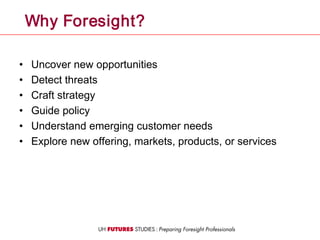
• Uncover new opportunities
• Detect threats
• Craft strategy
• Guide policy
• Understand emerging customer needs
• Explore new offering, markets, products, or services
Why Foresight?
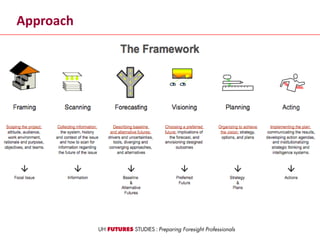
Approach
Framing
Framing: What Are We Looking For?
1.1 Know your audience
1.2 Map the innovation landscape
1.3 Set your time horizon
1.4 Polling: Degree of “stretch”
If you don’t know where you’re going, you may end up somewhere else – Yogi Berra
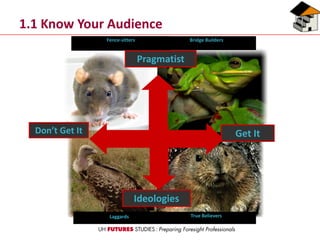
Fence-sitters Bridge Builders
Laggards
Don’t Get It Get It
Ideologies
True Believers
Pragmatist
1.1 Know Your Audience
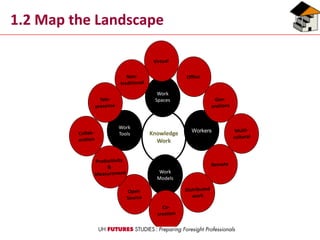
1.2 Map the Landscape
Knowledge
Work
Workers
Work
Tools
Work
Models
Work
Spaces
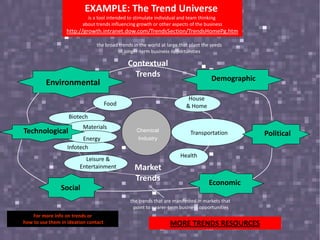
EXAMPLE: The Trend Universe
is a tool intended to stimulate individual and team thinking
about trends influencing growth or other aspects of the business
http://growth.intranet.dow.com/TrendsSection/TrendsHomePg.htm
Contextual
Trends
Social
Chemical
House
& Home
Health
Transportation
Food
Industry
Biotech
Infotech
Leisure &
Entertainment
Materials
Energy
Market
Trends Economic
Political
Demographic
Environmental
Technological
the broad trends in the world at large that plant the seeds
of longer-term business opportunities
the trends that are manifested in markets that
point to nearer-term business opportunities
MORE TRENDS RESOURCES
For more info on trends or
how to use them in ideation contact
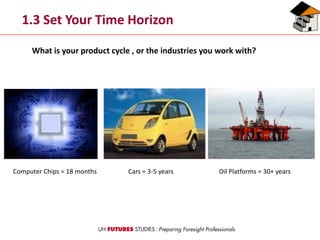
1.3 Set Your Time Horizon
Computer Chips = 18 months Cars = 3-5 years Oil Platforms = 30+ years
What is your product cycle , or the industries you work with?
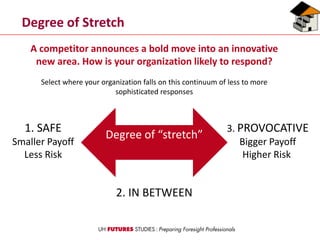
Degree of Stretch
Degree of “stretch”
1. SAFE
Smaller Payoff
Less Risk
3. PROVOCATIVE
Bigger Payoff
Higher Risk
A competitor announces a bold move into an innovative
new area. How is your organization likely to respond?
Select where your organization falls on this continuum of less to more
sophisticated responses
2. IN BETWEEN
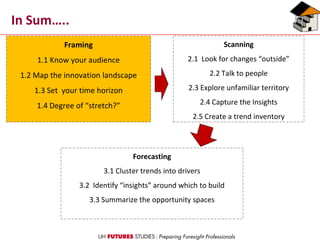
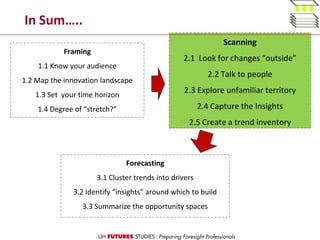
In Sum…..
Framing
1.1 Know your audience
1.2 Map the innovation landscape
1.3 Set your time horizon
1.4 Degree of “stretch?”
Scanning
2.1 Look for changes “outside”
2.2 Talk to people
2.3 Explore unfamiliar territory
2.4 Capture the Insights
2.5 Create a trend inventory
Forecasting
3.1 Cluster trends into drivers
3.2 Identify “insights” around which to build
3.3 Summarize the opportunity spaces
Scanning
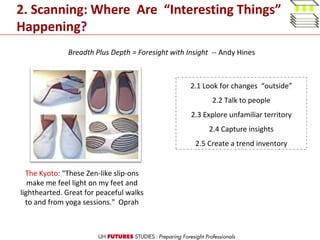
The Kyoto: "These Zen-like slip-ons
make me feel light on my feet and
lighthearted. Great for peaceful walks
to and from yoga sessions." Oprah
2. Scanning: Where Are “Interesting Things”
Happening?
2.1 Look for changes “outside”
2.2 Talk to people
2.3 Explore unfamiliar territory
2.4 Capture insights
2.5 Create a trend inventory
Breadth Plus Depth = Foresight with Insight -- Andy Hines
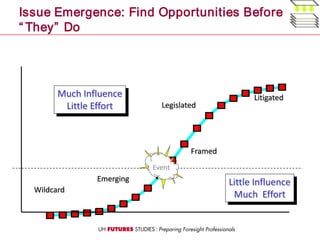
Issue Emergence: Find Opportunities Before
“ They” Do
Wildcard
Emerging
Framed
Event
Legislated
LitigatedMuch Influence
Little Effort
Little Influence
Much Effort
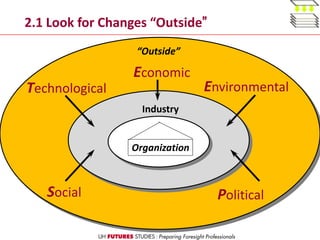
2.1 Look for Changes “Outside”
Industry
Organization
Political
EnvironmentalTechnological
Economic
Social
“Outside”
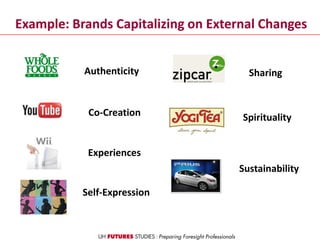
Co-Creation
Authenticity
Experiences
Self-Expression
Sharing
Spirituality
Sustainability
Example: Brands Capitalizing on External Changes
Finding Scanning Hits on the Web
• Search Engines, e.g. Google
• Syndicated Content/Feeds, RSS, Feed Demon
• Alerts, e.g., Google Alerts
• Target specific sites, e.g., Population Reference Bureau
• Bookmarking sites, e.g., Delicious, Magnolia
• Specialized software/data mining, e.g., Porter’s Technology
Opportunity Analysis
• Databases, e.g., Lexis-Nexis
• 3rd Party Services, e.g., Social Technologies
2.2 Talk to People
• If I could answer any question for you, what would it be?
• If you looked back from 10 years hence, and told the triumph in the ____,
what would it be?
• If you looked back from 10 years hence, and told the failure in the ______ ,
what would it be?
• What does the _______ need to forget?
• What are one or two critical strategic decisions regarding the __________
on the horizon?
• What are the top 2 or 3 trends driving the future of the ______?
• What are the obstacles to progress in the ________?
• What should I have asked that I didn’t? (at the end)
Source: Global Business Network, Developing & Using Scenarios, www.gbn.com
Good open-ended questions
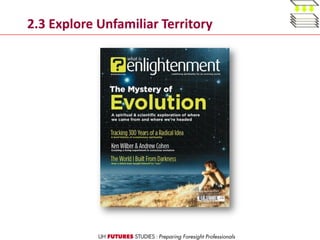
2.3 Explore Unfamiliar Territory
Where do you get your best ideas?
Where do you typically come up with your most
creative ideas….wherever that might be?
Discussion: Getting Ideas
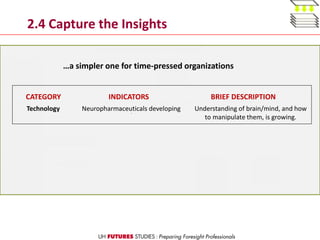
2.4 Capture the Insights
A complicated form for students….
…a simpler one for time-pressed organizations
Understanding of brain/mind, and how
to manipulate them, is growing.
Neuropharmaceuticals developingTechnology
BRIEF DESCRIPTIONINDICATORSCATEGORY
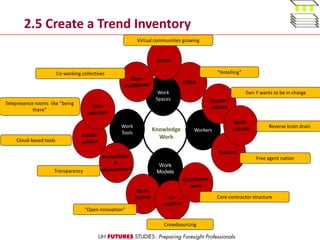
2.5 Create a Trend Inventory
Knowledge
Work
Workers
Work
Tools
Work
Models
Work
Spaces
Transparency
Telepresence rooms like “being
there”
Reverse brain drain
Gen Y wants to be in charge
Co-working collectives “Hotelling”
Core-contractor structure
Crowdsourcing
“Open innovation”
Free agent nation
Cloud-based tools
Virtual communities growing
In Sum…..
Framing
1.1 Know your audience
1.2 Map the innovation landscape
1.3 Set your time horizon
1.4 Degree of “stretch?”
Scanning
2.1 Look for changes “outside”
2.2 Talk to people
2.3 Explore unfamiliar territory
2.4 Capture the Insights
2.5 Create a trend inventory
Forecasting
3.1 Cluster trends into drivers
3.2 Identify “insights” around which to build
3.3 Summarize the opportunity spaces
Forecasting
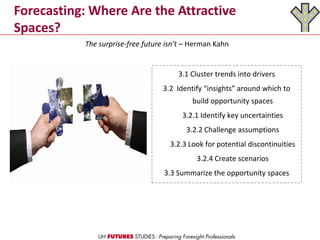
Forecasting: Where Are the Attractive
Spaces?
3.1 Cluster trends into drivers
3.2 Identify “insights” around which to
build opportunity spaces
3.2.1 Identify key uncertainties
3.2.2 Challenge assumptions
3.2.3 Look for potential discontinuities
3.2.4 Create scenarios
3.3 Summarize the opportunity spaces
The surprise-free future isn’t – Herman Kahn
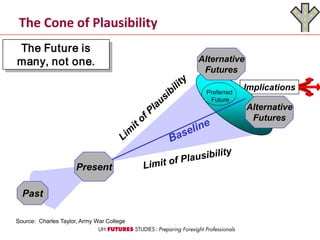
The Cone of Plausibility
The Future is
many, not one.
Implications
Past
Source: Charles Taylor, Army War College
Present
Alternative
Futures
Alternative
Futures
Preferred
Future
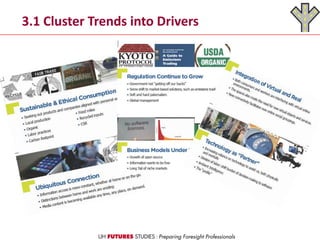
3.1 Cluster Trends into Drivers
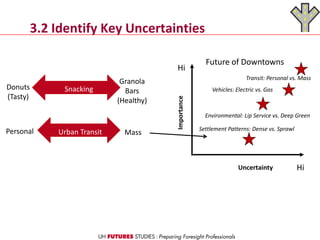
3.2 Identify Key Uncertainties
Snacking
Granola
Bars
(Healthy)
Donuts
(Tasty)
Personal MassUrban Transit
Importance
Uncertainty
Settlement Patterns: Dense vs. Sprawl
Environmental: Lip Service vs. Deep Green
Vehicles: Electric vs. Gas
Transit: Personal vs. Mass
Future of Downtowns
Hi
Hi
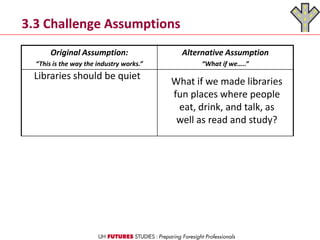
3.3 Challenge Assumptions
Original Assumption:
“This is the way the industry works.”
Alternative Assumption
“What if we…..”
Libraries should be quiet
What if we made libraries
fun places where people
eat, drink, and talk, as
well as read and study?
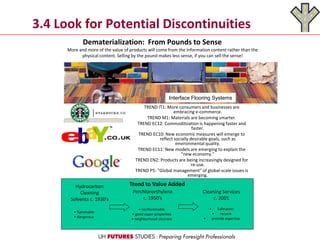
3.4 Look for Potential Discontinuities
Dematerialization: From Pounds to Sense
More and more of the value of products will come from the information content rather than the
physical content. Selling by the pound makes less sense, if you can sell the sense!
TREND IT1: More consumers and businesses are
embracing e-commerce.
TREND M1: Materials are becoming smarter.
TREND EC12: Commoditization is happening faster and
faster.
TREND EC10: New economic measures will emerge to
reflect socially desirable goals, such as
environmental quality.
TREND EC11: New models are emerging to explain the
"new economy."
TREND EN2: Products are being increasingly designed for
re-use.
TREND P5: "Global management" of global-scale issues is
emerging.
Hydrocarbon
Cleaning
Solvents c. 1930’s
Perchloroethylene
c. 1950’s
Cleaning Services
c. 2001
• flammable
• dangerous
• nonflammable
• good vapor properties
• neighborhood cleaners
• Safetainer
• recycle
• provide expertise
Trend to Value Added
Interface Flooring Systems
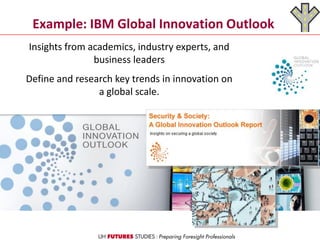
Example: IBM Global Innovation Outlook
Insights from academics, industry experts, and
business leaders
Define and research key trends in innovation on
a global scale.
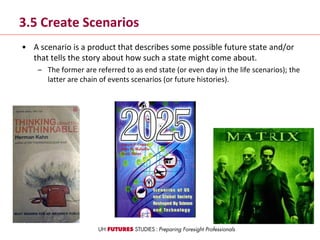
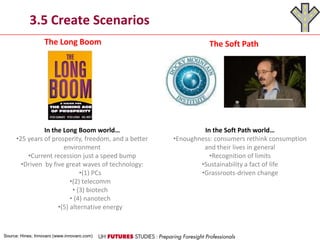
3.5 Create Scenarios
• A scenario is a product that describes some possible future state and/or
that tells the story about how such a state might come about.
– The former are referred to as end state (or even day in the life scenarios); the
latter are chain of events scenarios (or future histories).
The Long Boom The Soft Path
Source: Hines; Innovaro (www.innovaro.com)
3.5 Create Scenarios
In the Long Boom world…
•25 years of prosperity, freedom, and a better
environment
•Current recession just a speed bump
•Driven by five great waves of technology:
•(1) PCs
•(2) telecomm
• (3) biotech
• (4) nanotech
•(5) alternative energy
In the Soft Path world…
•Enoughness: consumers rethink consumption
and their lives in general
•Recognition of limits
•Sustainability a fact of life
•Grassroots-driven change
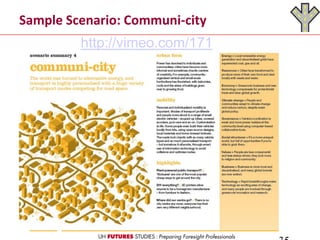
Sample Scenario: Communi-city
http://vimeo.com/171
23084
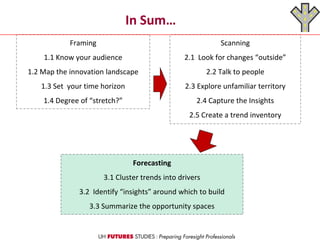
In Sum…
Framing
1.1 Know your audience
1.2 Map the innovation landscape
1.3 Set your time horizon
1.4 Degree of “stretch?”
Scanning
2.1 Look for changes “outside”
2.2 Talk to people
2.3 Explore unfamiliar territory
2.4 Capture the Insights
2.5 Create a trend inventory
Forecasting
3.1 Cluster trends into drivers
3.2 Identify “insights” around which to build
3.3 Summarize the opportunity spaces
ActingPlanningVisioning
4. Visioning, Planning ,& Acting
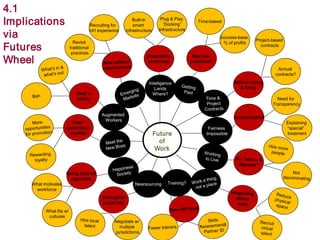
4.1 Implications via Futures Wheel
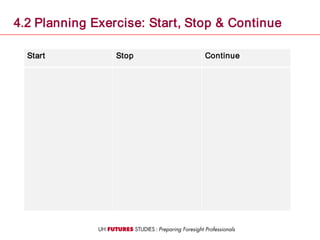
4.2 Actions via Start, Stop & Continue
4.3 Institutionalizing
If you don’t know where you’re going, you may end up somewhere else – Yogi Berra
Future
of
Work
4.1
Implications
via
Futures
Wheel
Augmented
Workers
Need a
policy
Nearsourcing
Strengthen
Local ties
Negotiate w/
multiple
jurisdictions
Training?
Going beyond
paycheck
What fits w/
cultures
What motivates
workforce
Revisit
traditional
practices
Recruiting for
int‟l experience
Inter-
generation
conflict
New pay
practices?
Success-base,
% of profits
Time-based
Rethink hiring
& firing
Annual
contracts?
Project-based
contracts
Intelligence
Lands
Where?
Integrating
smartness
Built-in
smart
infrastructure
Plug & Play
„Docking”
Infrastructure
Fairness
Impossible
Customization
Explaining
“special”
treatment
Need for
Transparency
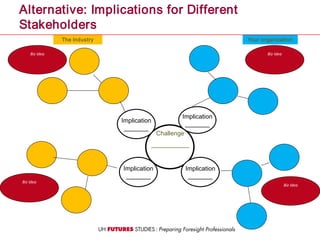
The Industry Your organization
Challenge
___________
Implication
_______
Alternative: Implications for Different
Stakeholders
Implication
_______
Biz Idea
Biz IdeaBiz Idea
Biz Idea
Implication
_______
Implication
_______
Start Stop Continue
4.2 Planning Exercise: Start, Stop & Continue
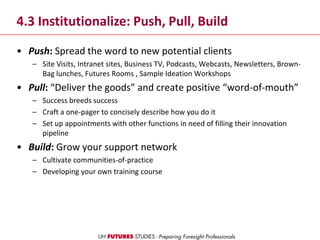
4.3 Institutionalize: Push, Pull, Build
• Push: Spread the word to new potential clients
– Site Visits, Intranet sites, Business TV, Podcasts, Webcasts, Newsletters, Brown-
Bag lunches, Futures Rooms , Sample Ideation Workshops
• Pull: “Deliver the goods” and create positive “word-of-mouth”
– Success breeds success
– Craft a one-pager to concisely describe how you do it
– Set up appointments with other functions in need of filling their innovation
pipeline
• Build: Grow your support network
– Cultivate communities-of-practice
– Developing your own training course
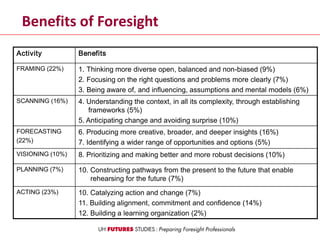
Activity Benefits
FRAMING (22%) 1. Thinking more diverse open, balanced and non-biased (9%)
2. Focusing on the right questions and problems more clearly (7%)
3. Being aware of, and influencing, assumptions and mental models (6%)
SCANNING (16%) 4. Understanding the context, in all its complexity, through establishing
frameworks (5%)
5. Anticipating change and avoiding surprise (10%)
FORECASTING
(22%)
6. Producing more creative, broader, and deeper insights (16%)
7. Identifying a wider range of opportunities and options (5%)
VISIONING (10%) 8. Prioritizing and making better and more robust decisions (10%)
PLANNING (7%) 10. Constructing pathways from the present to the future that enable
rehearsing for the future (7%)
ACTING (23%) 10. Catalyzing action and change (7%)
11. Building alignment, commitment and confidence (14%)
12. Building a learning organization (2%)
Benefits of Foresight
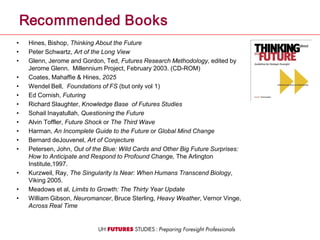
Recommended Books
• Hines, Bishop, Thinking About the Future
• Peter Schwartz, Art of the Long View
• Glenn, Jerome and Gordon, Ted, Futures Research Methodology, edited by
Jerome Glenn. Millennium Project, February 2003. (CD-ROM)
• Coates, Mahaffie & Hines, 2025
• Wendel Bell, Foundations of FS (but only vol 1)
• Ed Cornish, Futuring
• Richard Slaughter, Knowledge Base of Futures Studies
• Sohail Inayatullah, Questioning the Future
• Alvin Toffler, Future Shock or The Third Wave
• Harman, An Incomplete Guide to the Future or Global Mind Change
• Bernard deJouvenel, Art of Conjecture
• Petersen, John, Out of the Blue: Wild Cards and Other Big Future Surprises:
How to Anticipate and Respond to Profound Change, The Arlington
Institute,1997.
• Kurzweil, Ray, The Singularity Is Near: When Humans Transcend Biology,
Viking 2005.
• Meadows et al, Limits to Growth: The Thirty Year Update
• William Gibson, Neuromancer, Bruce Sterling, Heavy Weather, Vernor Vinge,
Across Real Time
Contact Info
Lecturer/Executive-in-Residence
ahines@uh.edu
832 367 5575
www.andyhinesight.com
Andy Hines
U of Houston Futures Studies

форсайт управление думая о будущем 2

  • 1.
    Thinking [Better] About theFuture: A Hands-on Approach to Applying Foresight Andy Hines IABC Houston May 12, 2011
  • 2.
  • 3.
    • Uncover newopportunities • Detect threats • Craft strategy • Guide policy • Understand emerging customer needs • Explore new offering, markets, products, or services Why Foresight?
  • 4.
  • 5.
  • 6.
    Framing: What AreWe Looking For? 1.1 Know your audience 1.2 Map the innovation landscape 1.3 Set your time horizon 1.4 Polling: Degree of “stretch” If you don’t know where you’re going, you may end up somewhere else – Yogi Berra
  • 7.
    Fence-sitters Bridge Builders Laggards Don’tGet It Get It Ideologies True Believers Pragmatist 1.1 Know Your Audience
  • 8.
    1.2 Map theLandscape Knowledge Work Workers Work Tools Work Models Work Spaces
  • 9.
    EXAMPLE: The TrendUniverse is a tool intended to stimulate individual and team thinking about trends influencing growth or other aspects of the business http://growth.intranet.dow.com/TrendsSection/TrendsHomePg.htm Contextual Trends Social Chemical House & Home Health Transportation Food Industry Biotech Infotech Leisure & Entertainment Materials Energy Market Trends Economic Political Demographic Environmental Technological the broad trends in the world at large that plant the seeds of longer-term business opportunities the trends that are manifested in markets that point to nearer-term business opportunities MORE TRENDS RESOURCES For more info on trends or how to use them in ideation contact
  • 10.
    1.3 Set YourTime Horizon Computer Chips = 18 months Cars = 3-5 years Oil Platforms = 30+ years What is your product cycle , or the industries you work with?
  • 11.
    Degree of Stretch Degreeof “stretch” 1. SAFE Smaller Payoff Less Risk 3. PROVOCATIVE Bigger Payoff Higher Risk A competitor announces a bold move into an innovative new area. How is your organization likely to respond? Select where your organization falls on this continuum of less to more sophisticated responses 2. IN BETWEEN
  • 12.
    In Sum….. Framing 1.1 Knowyour audience 1.2 Map the innovation landscape 1.3 Set your time horizon 1.4 Degree of “stretch?” Scanning 2.1 Look for changes “outside” 2.2 Talk to people 2.3 Explore unfamiliar territory 2.4 Capture the Insights 2.5 Create a trend inventory Forecasting 3.1 Cluster trends into drivers 3.2 Identify “insights” around which to build 3.3 Summarize the opportunity spaces
  • 13.
  • 14.
    The Kyoto: "TheseZen-like slip-ons make me feel light on my feet and lighthearted. Great for peaceful walks to and from yoga sessions." Oprah 2. Scanning: Where Are “Interesting Things” Happening? 2.1 Look for changes “outside” 2.2 Talk to people 2.3 Explore unfamiliar territory 2.4 Capture insights 2.5 Create a trend inventory Breadth Plus Depth = Foresight with Insight -- Andy Hines
  • 15.
    Issue Emergence: FindOpportunities Before “ They” Do Wildcard Emerging Framed Event Legislated LitigatedMuch Influence Little Effort Little Influence Much Effort
  • 16.
    2.1 Look forChanges “Outside” Industry Organization Political EnvironmentalTechnological Economic Social “Outside”
  • 17.
  • 18.
    Finding Scanning Hitson the Web • Search Engines, e.g. Google • Syndicated Content/Feeds, RSS, Feed Demon • Alerts, e.g., Google Alerts • Target specific sites, e.g., Population Reference Bureau • Bookmarking sites, e.g., Delicious, Magnolia • Specialized software/data mining, e.g., Porter’s Technology Opportunity Analysis • Databases, e.g., Lexis-Nexis • 3rd Party Services, e.g., Social Technologies
  • 19.
    2.2 Talk toPeople • If I could answer any question for you, what would it be? • If you looked back from 10 years hence, and told the triumph in the ____, what would it be? • If you looked back from 10 years hence, and told the failure in the ______ , what would it be? • What does the _______ need to forget? • What are one or two critical strategic decisions regarding the __________ on the horizon? • What are the top 2 or 3 trends driving the future of the ______? • What are the obstacles to progress in the ________? • What should I have asked that I didn’t? (at the end) Source: Global Business Network, Developing & Using Scenarios, www.gbn.com Good open-ended questions
  • 20.
  • 21.
    Where do youget your best ideas? Where do you typically come up with your most creative ideas….wherever that might be? Discussion: Getting Ideas
  • 22.
    2.4 Capture theInsights A complicated form for students…. …a simpler one for time-pressed organizations Understanding of brain/mind, and how to manipulate them, is growing. Neuropharmaceuticals developingTechnology BRIEF DESCRIPTIONINDICATORSCATEGORY
  • 23.
    2.5 Create aTrend Inventory Knowledge Work Workers Work Tools Work Models Work Spaces Transparency Telepresence rooms like “being there” Reverse brain drain Gen Y wants to be in charge Co-working collectives “Hotelling” Core-contractor structure Crowdsourcing “Open innovation” Free agent nation Cloud-based tools Virtual communities growing
  • 24.
    In Sum….. Framing 1.1 Knowyour audience 1.2 Map the innovation landscape 1.3 Set your time horizon 1.4 Degree of “stretch?” Scanning 2.1 Look for changes “outside” 2.2 Talk to people 2.3 Explore unfamiliar territory 2.4 Capture the Insights 2.5 Create a trend inventory Forecasting 3.1 Cluster trends into drivers 3.2 Identify “insights” around which to build 3.3 Summarize the opportunity spaces
  • 25.
  • 26.
    Forecasting: Where Arethe Attractive Spaces? 3.1 Cluster trends into drivers 3.2 Identify “insights” around which to build opportunity spaces 3.2.1 Identify key uncertainties 3.2.2 Challenge assumptions 3.2.3 Look for potential discontinuities 3.2.4 Create scenarios 3.3 Summarize the opportunity spaces The surprise-free future isn’t – Herman Kahn
  • 27.
    The Cone ofPlausibility The Future is many, not one. Implications Past Source: Charles Taylor, Army War College Present Alternative Futures Alternative Futures Preferred Future
  • 28.
    3.1 Cluster Trendsinto Drivers
  • 29.
    3.2 Identify KeyUncertainties Snacking Granola Bars (Healthy) Donuts (Tasty) Personal MassUrban Transit Importance Uncertainty Settlement Patterns: Dense vs. Sprawl Environmental: Lip Service vs. Deep Green Vehicles: Electric vs. Gas Transit: Personal vs. Mass Future of Downtowns Hi Hi
  • 30.
    3.3 Challenge Assumptions OriginalAssumption: “This is the way the industry works.” Alternative Assumption “What if we…..” Libraries should be quiet What if we made libraries fun places where people eat, drink, and talk, as well as read and study?
  • 31.
    3.4 Look forPotential Discontinuities Dematerialization: From Pounds to Sense More and more of the value of products will come from the information content rather than the physical content. Selling by the pound makes less sense, if you can sell the sense! TREND IT1: More consumers and businesses are embracing e-commerce. TREND M1: Materials are becoming smarter. TREND EC12: Commoditization is happening faster and faster. TREND EC10: New economic measures will emerge to reflect socially desirable goals, such as environmental quality. TREND EC11: New models are emerging to explain the "new economy." TREND EN2: Products are being increasingly designed for re-use. TREND P5: "Global management" of global-scale issues is emerging. Hydrocarbon Cleaning Solvents c. 1930’s Perchloroethylene c. 1950’s Cleaning Services c. 2001 • flammable • dangerous • nonflammable • good vapor properties • neighborhood cleaners • Safetainer • recycle • provide expertise Trend to Value Added Interface Flooring Systems
  • 32.
    Example: IBM GlobalInnovation Outlook Insights from academics, industry experts, and business leaders Define and research key trends in innovation on a global scale.
  • 33.
    3.5 Create Scenarios •A scenario is a product that describes some possible future state and/or that tells the story about how such a state might come about. – The former are referred to as end state (or even day in the life scenarios); the latter are chain of events scenarios (or future histories).
  • 34.
    The Long BoomThe Soft Path Source: Hines; Innovaro (www.innovaro.com) 3.5 Create Scenarios In the Long Boom world… •25 years of prosperity, freedom, and a better environment •Current recession just a speed bump •Driven by five great waves of technology: •(1) PCs •(2) telecomm • (3) biotech • (4) nanotech •(5) alternative energy In the Soft Path world… •Enoughness: consumers rethink consumption and their lives in general •Recognition of limits •Sustainability a fact of life •Grassroots-driven change
  • 35.
  • 36.
    In Sum… Framing 1.1 Knowyour audience 1.2 Map the innovation landscape 1.3 Set your time horizon 1.4 Degree of “stretch?” Scanning 2.1 Look for changes “outside” 2.2 Talk to people 2.3 Explore unfamiliar territory 2.4 Capture the Insights 2.5 Create a trend inventory Forecasting 3.1 Cluster trends into drivers 3.2 Identify “insights” around which to build 3.3 Summarize the opportunity spaces
  • 37.
  • 38.
    4. Visioning, Planning,& Acting 4.1 Implications via Futures Wheel 4.2 Actions via Start, Stop & Continue 4.3 Institutionalizing If you don’t know where you’re going, you may end up somewhere else – Yogi Berra
  • 39.
    Future of Work 4.1 Implications via Futures Wheel Augmented Workers Need a policy Nearsourcing Strengthen Local ties Negotiatew/ multiple jurisdictions Training? Going beyond paycheck What fits w/ cultures What motivates workforce Revisit traditional practices Recruiting for int‟l experience Inter- generation conflict New pay practices? Success-base, % of profits Time-based Rethink hiring & firing Annual contracts? Project-based contracts Intelligence Lands Where? Integrating smartness Built-in smart infrastructure Plug & Play „Docking” Infrastructure Fairness Impossible Customization Explaining “special” treatment Need for Transparency
  • 40.
    The Industry Yourorganization Challenge ___________ Implication _______ Alternative: Implications for Different Stakeholders Implication _______ Biz Idea Biz IdeaBiz Idea Biz Idea Implication _______ Implication _______
  • 41.
    Start Stop Continue 4.2Planning Exercise: Start, Stop & Continue
  • 42.
    4.3 Institutionalize: Push,Pull, Build • Push: Spread the word to new potential clients – Site Visits, Intranet sites, Business TV, Podcasts, Webcasts, Newsletters, Brown- Bag lunches, Futures Rooms , Sample Ideation Workshops • Pull: “Deliver the goods” and create positive “word-of-mouth” – Success breeds success – Craft a one-pager to concisely describe how you do it – Set up appointments with other functions in need of filling their innovation pipeline • Build: Grow your support network – Cultivate communities-of-practice – Developing your own training course
  • 43.
    Activity Benefits FRAMING (22%)1. Thinking more diverse open, balanced and non-biased (9%) 2. Focusing on the right questions and problems more clearly (7%) 3. Being aware of, and influencing, assumptions and mental models (6%) SCANNING (16%) 4. Understanding the context, in all its complexity, through establishing frameworks (5%) 5. Anticipating change and avoiding surprise (10%) FORECASTING (22%) 6. Producing more creative, broader, and deeper insights (16%) 7. Identifying a wider range of opportunities and options (5%) VISIONING (10%) 8. Prioritizing and making better and more robust decisions (10%) PLANNING (7%) 10. Constructing pathways from the present to the future that enable rehearsing for the future (7%) ACTING (23%) 10. Catalyzing action and change (7%) 11. Building alignment, commitment and confidence (14%) 12. Building a learning organization (2%) Benefits of Foresight
  • 44.
    Recommended Books • Hines,Bishop, Thinking About the Future • Peter Schwartz, Art of the Long View • Glenn, Jerome and Gordon, Ted, Futures Research Methodology, edited by Jerome Glenn. Millennium Project, February 2003. (CD-ROM) • Coates, Mahaffie & Hines, 2025 • Wendel Bell, Foundations of FS (but only vol 1) • Ed Cornish, Futuring • Richard Slaughter, Knowledge Base of Futures Studies • Sohail Inayatullah, Questioning the Future • Alvin Toffler, Future Shock or The Third Wave • Harman, An Incomplete Guide to the Future or Global Mind Change • Bernard deJouvenel, Art of Conjecture • Petersen, John, Out of the Blue: Wild Cards and Other Big Future Surprises: How to Anticipate and Respond to Profound Change, The Arlington Institute,1997. • Kurzweil, Ray, The Singularity Is Near: When Humans Transcend Biology, Viking 2005. • Meadows et al, Limits to Growth: The Thirty Year Update • William Gibson, Neuromancer, Bruce Sterling, Heavy Weather, Vernor Vinge, Across Real Time
  • 45.
    Contact Info Lecturer/Executive-in-Residence ahines@uh.edu 832 3675575 www.andyhinesight.com Andy Hines U of Houston Futures Studies